
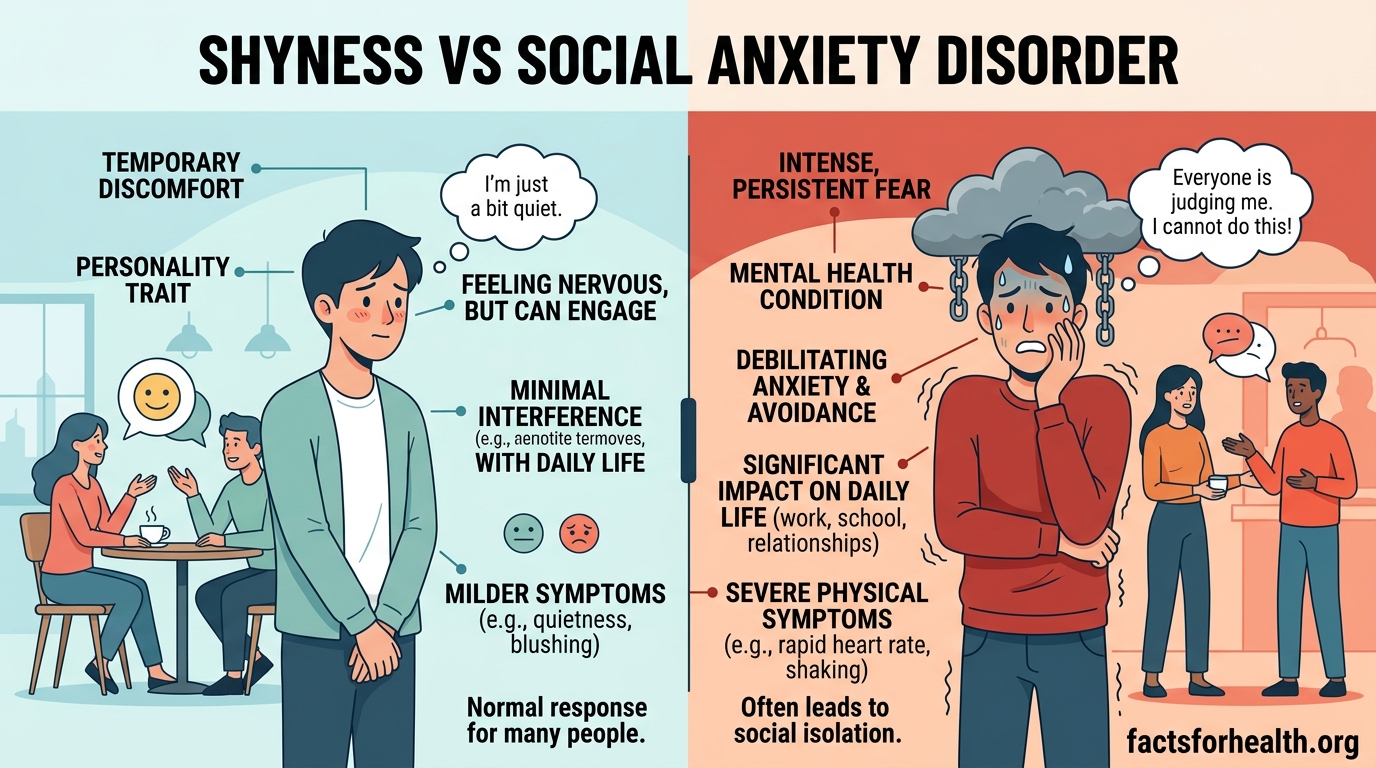
Shyness is a common personality trait involving mild discomfort in new social situations, while social anxiety disorder is a diagnosable mental health condition characterized by intense, persistent fear of being judged that interferes with daily life. That single sentence captures the difference between shyness and social anxiety disorder, but the full picture is far more nuanced. Many people spend years thinking they are “just shy” when they are actually living with a treatable condition.
If you have ever wondered whether your nervousness before a party or dread of phone calls is normal personality or something more, you are asking the right question. Understanding the difference between shyness and social anxiety disorder matters because it determines whether you need professional support or simply more practice in social settings. The distinction affects relationships, careers, mental well-being, and quality of life.
Our team has reviewed clinical definitions from the DSM-5, prevalence data from the National Institute of Mental Health (NIMH), and real experiences shared in support communities to put together this guide. We will walk through definitions, symptoms, key differences, treatment options, and actionable steps so you can understand where you or a loved one falls on this spectrum.
Table of Contents
What Is Shyness?
Shyness is a personality trait, not a disorder. It involves feeling reserved, awkward, or mildly uncomfortable in social situations, especially when meeting new people or entering unfamiliar environments. People who are shy typically warm up over time. Once they feel comfortable, their anxiety fades and they engage normally.
Research suggests that roughly 20 to 40 percent of the population identifies as shy to some degree. It is considered a normal variation of human temperament, much like introversion or being talkative. Shyness often appears in early childhood and may persist throughout life without causing significant distress or impairment.
A shy person might feel nervous at a networking event but still attend, introduce themselves, and make connections after the initial awkwardness passes. They may prefer smaller gatherings over large parties, but their preference does not prevent them from participating when they choose to. Shyness becomes a concern only when it is paired with intense fear, avoidance, or significant distress, which points toward social anxiety rather than simple shyness.
What Is Social Anxiety Disorder?
Social anxiety disorder, also called social phobia, is a recognized mental health condition listed in the DSM-5. It is characterized by a persistent, intense fear of being watched, judged, embarrassed, or humiliated in social or performance situations. Unlike shyness, this fear is disproportionate to the actual threat and typically leads to avoidance behavior.
According to the NIMH, approximately 7 percent of U.S. adults experience social anxiety disorder in any given year, making it one of the most common anxiety disorders. The Cleveland Clinic notes that it is the third most common mental health condition overall, behind only depression and alcohol dependence. It usually begins in early to mid-adolescence, with a median onset age of around 13.
To meet the diagnostic criteria for social anxiety disorder, the fear must be persistent, lasting six months or more. It must also cause significant distress or impairment in important areas of functioning, such as work, school, or relationships. A person with social anxiety may skip job interviews, avoid dating, drop classes that require presentations, or turn down promotions because the fear feels insurmountable.
The physical symptoms can be intense and feel uncontrollable. Racing heartbeat, sweating, trembling, blushing, nausea, and even full panic attacks can occur in social situations. Many people describe feeling trapped in their own body, unable to think clearly or speak naturally. After the event, they may replay every interaction over and over, convinced they said or did something embarrassing.
Shyness vs Introversion vs Social Anxiety
These three terms get confused constantly, and understanding how they differ is essential. Shyness is a personality trait rooted in mild social discomfort that fades with familiarity. Introversion is a preference for lower-stimulation environments and solitude to recharge energy. Social anxiety disorder is a clinical condition involving intense fear and avoidance.
An introvert genuinely enjoys being alone or in small groups and feels drained by large gatherings, but they do not fear social interaction. A shy person feels nervous initially but can participate once they settle in. Someone with social anxiety fears judgment so intensely that they avoid the situation altogether.
Here is a quick way to separate them. Introversion is about energy. Shyness is about temporary discomfort. Social anxiety is about fear and impairment. You can be introverted without being shy, shy without being introverted, and neither without having social anxiety. You can also have all three at once, which is why teasing them apart matters for getting the right kind of help.
Shared Symptoms Between Shyness and Social Anxiety
Shyness and social anxiety share several features, which is exactly why they are so frequently confused. Both can involve feeling self-conscious, nervous, or awkward in social situations. Both may cause physical reactions like a slightly elevated heart rate or mild sweating when meeting new people.
People with either trait may avoid being the center of attention, feel uncomfortable making eye contact, or struggle with small talk. Both can lead to overthinking social interactions afterward. The overlap is real, and a shy person experiencing a particularly stressful day might temporarily feel symptoms that resemble social anxiety.
The critical difference lies in intensity, frequency, and consequences. Shyness produces mild discomfort that a person can push through. Social anxiety produces intense fear that feels impossible to overcome. A shy person feels nervous at a party but stays. A person with social anxiety feels so overwhelmed that they cancel at the last minute, or never agree to attend in the first place.
Key Differences: Shyness vs Social Anxiety Disorder
The clearest way to understand the difference between shyness and social anxiety disorder is to look at specific dimensions side by side. The comparison below breaks down how each condition differs in practice.
Side-by-Side Comparison: Shyness vs Social Anxiety Disorder
- Intensity of fear: Shyness involves mild to moderate nervousness. Social anxiety involves intense, sometimes overwhelming fear that can trigger panic attacks.
- Duration: Shyness is often temporary, fading as a person becomes comfortable. Social anxiety is persistent, lasting six months or more by diagnostic definition.
- Avoidance behavior: Shy people may hesitate but still participate. People with social anxiety frequently avoid situations entirely, including work, school, or social events.
- Impact on functioning: Shyness rarely interferes with daily life or career progression. Social anxiety causes significant impairment in relationships, work performance, and educational achievement.
- Physical symptoms: Shyness may cause mild butterflies or slight nervousness. Social anxiety can cause severe physical reactions including racing heartbeat, sweating, trembling, nausea, and panic attacks.
- Anticipatory worry: Shy people might think briefly about an upcoming event. People with social anxiety may spend days or weeks dreading it, losing sleep and feeling physically ill.
- Post-event rumination: Shyness rarely leads to intense replaying of conversations. Social anxiety often triggers hours or days of overthinking every word and gesture.
- Self-perception: Shy people usually recognize their shyness as a personality trait. People with social anxiety often feel deeply ashamed, broken, or inadequate because of their fear.
- Response to familiarity: Shyness decreases as comfort increases. Social anxiety persists even with familiar people and environments.
- Treatment need: Shyness typically requires no treatment. Social anxiety responds well to cognitive behavioral therapy, exposure therapy, and sometimes medication.
Reddit users who have experienced both consistently highlight one distinguishing factor. They say the key difference is whether the fear is proportionate to the situation. Being nervous before a big presentation is normal. Being unable to eat at a restaurant because you fear people are watching you is something else entirely.
Can Shyness Turn Into Social Anxiety?
Yes, shyness can develop into social anxiety disorder, though it does not always do so. Research indicates that children who are behaviorally inhibited or temperamentally shy are at a higher risk of developing social anxiety later in life. However, many shy children grow into well-adjusted adults who never experience clinical anxiety.
The progression from shyness to social anxiety often involves a triggering event or prolonged stress. A humiliating experience at school, bullying, a public failure, or accumulated negative social encounters can shift mild shyness into something more severe. Over time, the brain begins to associate social situations with danger, triggering an exaggerated fear response.
People on support forums frequently describe a turning point. They recall being “just shy” as a child, then experiencing a stressful life change such as a move, family conflict, or academic pressure, after which their nervousness intensified into avoidance and panic. The transition can happen gradually over months or years, which is why it often goes unrecognized.
Noticing the shift early matters. If you find that situations you used to handle are now causing intense dread, or that avoidance is becoming your default coping strategy, those are signs that shyness may be evolving into something more serious.
Impact on Daily Life
The impact of social anxiety disorder extends far beyond feeling nervous at parties. It touches nearly every aspect of a person’s life, often in ways that remain invisible to others.
In the workplace, social anxiety can prevent someone from speaking up in meetings, networking, or pursuing leadership roles. Many capable professionals turn down promotions because the new role would require more public interaction. Job interviews become nearly impossible, leading to underemployment despite strong qualifications.
In relationships, social anxiety can make dating feel terrifying. Making new friends becomes a hurdle, and maintaining existing relationships can suffer if the person avoids gatherings or cancels plans repeatedly. Over time, isolation can set in, which increases the risk of depression.
In academic settings, students with social anxiety may avoid raising their hand, participating in group projects, or giving presentations. Some drop classes or change majors to avoid public speaking requirements. The educational and career consequences can be lifelong.
Everyday activities that others take for granted become obstacles. Making phone calls, returning items to a store, eating in public, using a public restroom, or signing a check while someone watches can all trigger intense fear. The cumulative effect is a significantly reduced quality of life.
Social Anxiety in Children and Teens
Social anxiety often begins in childhood or early adolescence, with most cases emerging between ages 8 and 15. In younger children, it may appear as excessive clinging, refusal to speak in certain settings (selective mutism), tantrums when forced into social situations, or physical complaints like stomachaches before school.
Teenagers with social anxiety may avoid eye contact, speak very softly, sit alone at lunch, or refuse to attend social events. They might struggle with class presentations, avoid joining clubs or sports, and become increasingly isolated. Parents sometimes misread these signs as normal teenage behavior or simple shyness.
Early intervention makes a significant difference. Children who receive treatment, whether through cognitive behavioral therapy adapted for their age or family-based approaches, show much better long-term outcomes. If a child’s fear is interfering with school attendance, friendships, or daily activities for more than a few months, a professional evaluation is warranted.
When to Seek Professional Help
Knowing when shyness has crossed into territory that warrants professional help can be difficult. A good rule of thumb is to ask whether the fear or avoidance is interfering with your daily life, relationships, career, or happiness.
Consider seeking help if your anxiety has persisted for six months or more, if you regularly avoid situations that matter to you, or if the physical symptoms are severe enough to feel unbearable. If you find yourself rearranging your entire life to avoid social situations, that is a clear signal.
The Mini-SPIN (Mini Social Phobia Inventory) is a brief three-question screening tool that can help indicate whether a fuller evaluation is warranted. While it is not a diagnostic tool, answering yes to feeling that avoidance or fear is interfering with your life warrants a conversation with a mental health professional.
Talking to a primary care doctor is often the easiest first step. They can provide a referral to a psychologist, psychiatrist, or licensed therapist who specializes in anxiety disorders. Online therapy platforms have also made accessing care significantly easier for people whose anxiety makes in-person visits difficult.
Treatment Options for Social Anxiety Disorder
The encouraging news is that social anxiety disorder is highly treatable. Research indicates that approximately 70 percent of people who receive appropriate treatment experience significant improvement in their symptoms.
Cognitive Behavioral Therapy (CBT) is considered the gold standard for treating social anxiety. CBT helps individuals identify and challenge the distorted thinking patterns that fuel their fear. A person might learn that their belief that “everyone is judging me” is a cognitive distortion, not reality. Through structured exercises, they gradually learn to reframe their thoughts and reduce their anxiety response.
Exposure therapy, a specific form of CBT, involves gradually facing feared social situations in a controlled and supportive manner. The therapist and client build a hierarchy of anxiety-provoking situations, starting with the least threatening and working upward. Over time, repeated exposure helps the brain learn that these situations are not actually dangerous.
Medication can also play an important role, particularly for moderate to severe cases. Selective serotonin reuptake inhibitors (SSRIs) such as sertraline and paroxetine are commonly prescribed and have been shown to reduce social anxiety symptoms. Serotonin-norepinephrine reuptake inhibitors (SNRIs) like venlafaxine are another option. Beta-blockers are sometimes used for performance-based anxiety to manage physical symptoms like rapid heartbeat and trembling.
Support groups offer a powerful complement to individual therapy. Connecting with others who understand the experience of social anxiety reduces isolation and shame. Many people find that simply knowing they are not alone provides immense relief. Both in-person and online support groups are widely available.
Treatment is rarely instantaneous. Most people see meaningful improvement within 12 to 16 weeks of starting CBT, though full recovery can take longer. The combination of therapy and medication, when appropriate, often produces the best outcomes.
Practical Coping Strategies
While professional treatment is the most effective path, several practical strategies can help manage social anxiety symptoms in daily life. These techniques are not a replacement for therapy but can provide relief in difficult moments.
- Practice grounding techniques. When anxiety spikes, focus on your senses. Name five things you can see, four you can touch, three you can hear, two you can smell, and one you can taste. This pulls your attention away from internal fear and back to the present moment.
- Use slow, deep breathing. Inhale for four counts, hold for four, exhale for four. This activates the parasympathetic nervous system and helps slow a racing heart.
- Challenge negative self-talk. When you catch yourself thinking “everyone thinks I’m awkward,” ask for evidence. Usually, there is none. Replace the thought with something more balanced.
- Start small and build. If large gatherings feel impossible, start with a one-on-one coffee with a trusted friend. Gradually expand your comfort zone rather than forcing yourself into overwhelming situations.
- Prepare for social events. Think of two or three conversation starters in advance. Having a mental script reduces the panic of not knowing what to say.
- Set realistic expectations. You do not need to be the life of the party. Simply showing up and staying for 30 minutes is progress worth celebrating.
- Limit caffeine and alcohol. Caffeine can intensify physical anxiety symptoms, and alcohol, while temporarily reducing inhibition, can worsen anxiety long-term and lead to dependence.
- Practice self-compassion. Beating yourself up after a social interaction only reinforces the anxiety. Treat yourself the way you would treat a good friend who is struggling.
How to Help Someone With Social Anxiety
If someone you care about is dealing with social anxiety, your support can make a meaningful difference. The most important thing is to listen without judgment and avoid dismissing their feelings as “just shyness.”
Do not force them into situations they find overwhelming. Instead, offer to accompany them to anxiety-provoking events and let them know they can leave at any time. Having an exit plan often makes attending feel more manageable.
Encourage them gently to seek professional help when they are ready. Offer to help research therapists or make the first phone call if that feels too daunting. Avoid saying things like “just get over it” or “you’re being ridiculous.” Those responses increase shame and make it harder for the person to open up.
Celebrate small victories. Attending a social event for 20 minutes, making a phone call, or speaking up in a meeting are significant achievements for someone with social anxiety. Acknowledging those steps reinforces progress.
FAQs
How to know if it’s shyness or social anxiety?
Shyness involves mild, temporary nervousness that fades as you become comfortable, while social anxiety involves intense, persistent fear that leads to avoidance and interferes with daily life. If your fear lasts six months or more, causes significant distress, and makes you avoid important situations like work, school, or social events, it is more likely social anxiety disorder than shyness.
Is social anxiety more than just shyness?
Yes. Social anxiety disorder is a diagnosable mental health condition recognized in the DSM-5, while shyness is a personality trait. Social anxiety involves disproportionate fear of judgment, physical symptoms like panic attacks and sweating, and avoidance behavior that impairs daily functioning. Shyness does not typically cause these levels of distress or impairment.
Where does social anxiety come from?
Social anxiety disorder develops from a combination of factors including genetics, brain chemistry, temperament, and life experiences. Traumatic social experiences, bullying, overprotective parenting, and prolonged stress can all contribute. Children with behavioral inhibition are at higher risk. It is not caused by personal weakness or lack of social skills.
How can one overcome shyness?
Shyness can be reduced through gradual social exposure, practicing conversation skills, challenging negative self-talk, and building self-confidence. Joining clubs or groups centered around shared interests, setting small social goals, and celebrating incremental progress all help. Unlike social anxiety, shyness typically does not require professional treatment, though therapy can help if it causes distress.
Can shyness turn into social anxiety disorder?
Yes, shyness can develop into social anxiety disorder, particularly when combined with stressful life events, bullying, trauma, or prolonged social pressure. Children who are temperamentally shy are at higher risk. However, most shy people do not develop social anxiety. The transition often happens gradually, making it important to notice when normal nervousness intensifies into persistent fear and avoidance.
Is being shy a mental disorder?
No, shyness is not a mental disorder. It is a normal personality trait shared by 20 to 40 percent of the population. It becomes a concern only when it is accompanied by intense, persistent fear, avoidance behavior, and significant impairment in daily functioning, which would suggest social anxiety disorder rather than ordinary shyness.
What is the best treatment for social anxiety disorder?
Cognitive behavioral therapy (CBT) is considered the most effective treatment for social anxiety disorder, with approximately 70 percent of treated individuals showing significant improvement. Exposure therapy, a form of CBT, is particularly effective. Medications such as SSRIs and SNRIs can also help, especially for moderate to severe cases. The combination of therapy and medication often produces the best outcomes.
How long does it take to overcome social anxiety?
Most people see meaningful improvement within 12 to 16 weeks of starting cognitive behavioral therapy. Full recovery can take several months to a year depending on severity, consistency of treatment, and individual factors. Social anxiety is highly treatable, and with appropriate professional support, the vast majority of people experience significant reduction in symptoms.
Conclusion
Understanding the difference between shyness and social anxiety disorder is the first step toward getting the right kind of support. Shyness is a normal personality trait that involves mild social discomfort and typically does not require treatment. Social anxiety disorder is a recognized mental health condition involving intense, persistent fear of judgment that significantly impairs daily life.
If you recognized yourself in the descriptions of social anxiety, know that you are not alone and that effective treatment exists. Cognitive behavioral therapy has a 70 percent success rate, and millions of people have learned to manage their symptoms and reclaim their social lives. Reaching out to a mental health professional is the most important step you can take, and it is easier than ever with online therapy options.
If you are supporting someone who may be struggling, your patience and understanding matter more than you know. Encourage them gently, celebrate their progress, and avoid minimizing their experience. With the right support, social anxiety disorder is a condition that can be effectively managed and overcome.
The information in this guide is based on clinical definitions from the DSM-5, prevalence data from NIMH and the Cleveland Clinic, and real experiences shared in support communities. We hope it helps you or someone you care about take the next step toward confidence and connection.