
Every winter, millions of people watch their mood, energy, and motivation quietly slip away as the days grow shorter. If you have found yourself wondering whether a small box of artificial light could genuinely make a difference, you are in the right place. The question “do light therapy lamps actually work for winter depression” is one of the most searched mental health queries during fall and winter, and for good reason.
Our team dug into peer-reviewed research, clinical guidelines from Mayo Clinic and Cleveland Clinic, a 2026 PMC meta-analysis, and dozens of real user discussions from communities like r/SeasonalAffective and r/HubermanLab. What we found is encouraging. Light therapy is not a cure-all, but the evidence base is strong, the mechanism is well understood, and roughly 60 percent of users experience significant symptom improvement within the first week of consistent use.
In this guide, we explain exactly how light therapy works, what the clinical evidence says, how to use a lamp correctly, what to watch out for, and how it compares to other treatments. We will also clear up a few stubborn myths, including the common confusion between light therapy and vitamin D.
Table of Contents
Quick Answer: Do Light Therapy Lamps Actually Work for Winter Depression?
Yes, light therapy lamps do work for winter depression caused by seasonal affective disorder (SAD). Clinical studies show that approximately 60 percent of people who use a 10,000-lux light box for 20 to 30 minutes each morning experience a significant reduction in SAD symptoms, with many seeing improvement within two to four days. Light therapy is considered a first-line, drug-free treatment for seasonal depression and is regarded by researchers at Harvard Health as at least as effective as antidepressant medication for this specific condition.
However, it does not work for everyone. Roughly 40 percent of users see little to no benefit, and results depend heavily on using the right intensity (10,000 lux), the right timing (early morning), and consistent daily use throughout the dark season. Light therapy is also not a permanent cure. Symptoms typically return the following year unless treatment is resumed.
What Is Seasonal Affective Disorder (SAD)?
Seasonal affective disorder, often abbreviated as SAD, is a type of depression that follows a predictable seasonal pattern. For most people, symptoms begin in late fall or early winter and lift naturally during spring. A smaller subset experiences summer-pattern SAD, but winter depression is by far the more common form.
The core symptoms of winter-pattern SAD go beyond simply feeling a bit down. People frequently experience persistent low mood, low energy that borders on exhaustion, oversleeping or difficulty waking, intense carbohydrate cravings, weight gain, social withdrawal, and difficulty concentrating. These symptoms can last for four to five months out of the year, which is why effective treatment matters so much.
SAD is surprisingly common. It is estimated to affect roughly 5 percent of adults in the United States, with another 10 to 20 percent experiencing a milder form often called the “winter blues.” Prevalence increases dramatically the farther you live from the equator. In northern latitudes like Alaska or Scandinavia, rates climb significantly higher. Women are diagnosed with SAD about four times more often than men, and it most commonly begins between the ages of 18 and 30.
The underlying cause is tied to reduced exposure to natural sunlight during winter months. Shorter days and weaker sunlight disrupt the body’s internal biological clock, alter brain chemistry, and throw off the hormones that regulate sleep and mood. This is precisely the gap that light therapy aims to fill.
How Light Therapy Works: The Science Explained
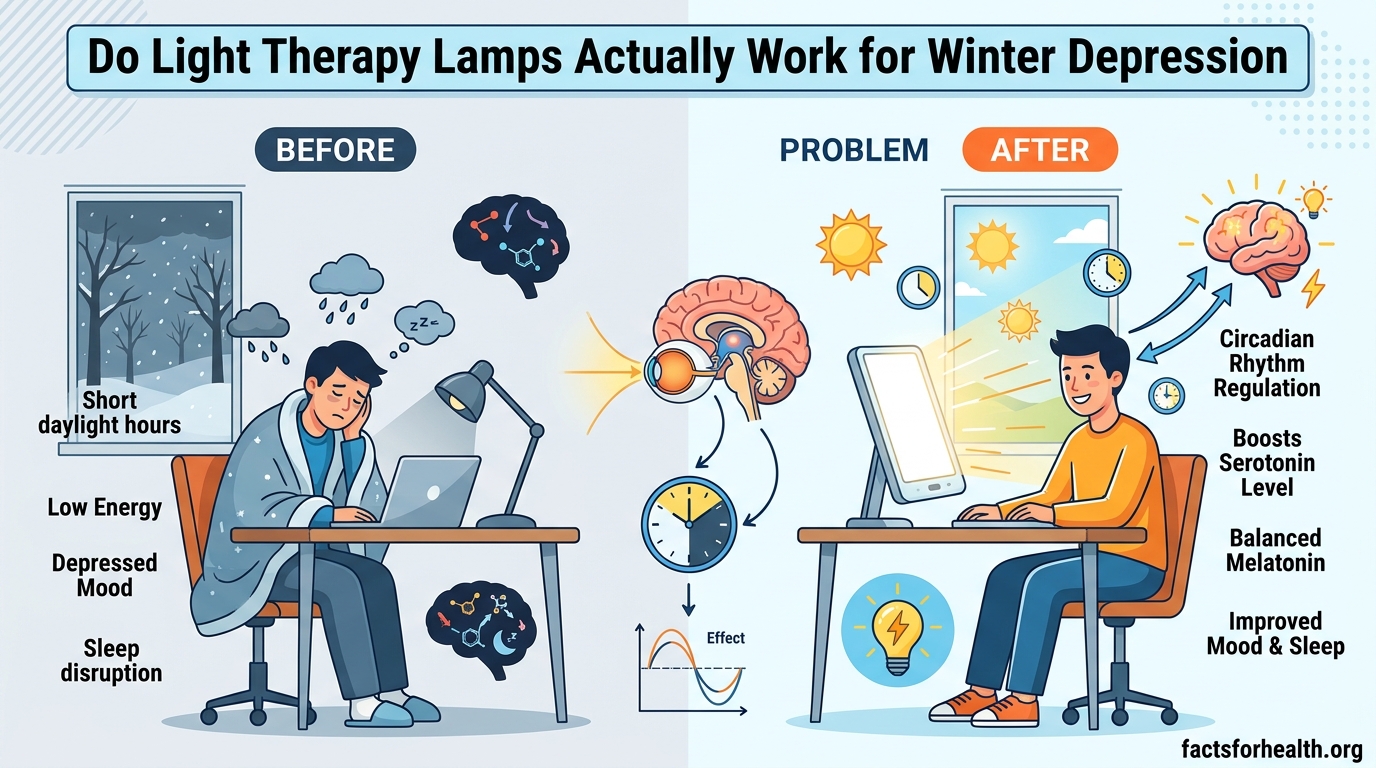
Light therapy works by delivering intense, bright artificial light to the retina of the eye, which then signals a chain of biological reactions deep in the brain. The mechanism is not mysterious. It is well-documented neuroscience that connects what your eyes perceive to how your brain regulates mood, energy, and sleep.
Here is the step-by-step process of what happens when you sit in front of a properly calibrated light box:
Step 1: Light hits specialized cells in your retina. Your eyes contain intrinsically photosensitive retinal ganglion cells, a specific type of photoreceptor that does not contribute to vision but instead communicates directly with the brain’s internal clock. These cells are especially sensitive to blue wavelengths of light.
Step 2: The signal travels to the hypothalamus. These retinal cells send a direct signal along the optic nerve to the suprachiasmatic nucleus, a tiny region in the hypothalamus that acts as the body’s master clock. This is the same region that controls your circadian rhythm, the roughly 24-hour cycle that governs sleep, wakefulness, hormone release, and body temperature.
Step 3: Melatonin production is suppressed. In darkness, the pineal gland produces melatonin, the hormone that makes you feel sleepy. In winter, reduced morning light means melatonin levels stay elevated longer, which is why people with SAD often feel groggy and struggle to wake up. Bright light therapy signals the brain to shut off melatonin production earlier in the morning, helping you feel alert.
Step 4: Serotonin pathways are activated. Bright light exposure also influences serotonin, a neurotransmitter closely linked to mood regulation. Research suggests that light therapy boosts serotonin availability in the brain, which helps explain the mood improvements users report. People with SAD tend to have lower serotonin activity during winter, and light therapy appears to partially correct this imbalance.
Step 5: The circadian rhythm resets. By delivering a strong light signal at a consistent time each morning, you effectively tell your brain when “day” begins. This helps re-anchor a circadian rhythm that has drifted out of phase during the darker months. A well-aligned internal clock improves sleep quality, daytime energy, and emotional stability.
Light Color Matters: White vs. Blue vs. Red vs. Green
One question that comes up constantly in forums like r/HubermanLab is whether the color of light matters. A 2026 meta-analysis published in PubMed Central (PMC) compared the effectiveness of different visible light wavelengths for seasonal mood symptoms. The findings were clear: white light therapy was the most effective across the board for alleviating seasonal depression.
Blue-enriched light has been heavily marketed in recent years, and it does have biological plausibility since retinal cells are most sensitive to blue wavelengths. However, the 2026 PMC evidence did not find blue light superior to standard white light in clinical outcomes. Green light showed modest effects, and red light was largely ineffective for mood symptoms.
The practical takeaway is straightforward. A standard white light box delivering 10,000 lux remains the gold standard. You do not need to overpay for blue-only devices, and you should be cautious about excessive blue light exposure if you have any concerns about eye health.
The Vitamin D Misconception
Here is one of the most common misunderstandings we found in forum discussions. Many people assume that light therapy lamps produce vitamin D the way natural sunlight does. They do not.
Vitamin D synthesis requires ultraviolet B (UVB) radiation to penetrate the skin. Legitimate light therapy lamps are specifically designed to filter out UV radiation entirely, because UV exposure carries real risks including skin damage and eye injury. This means your light box provides zero vitamin D benefit.
What the lamp does instead is stimulate your brain through visible light to regulate melatonin and serotonin. If you are concerned about low vitamin D levels during winter, and many people in northern climates are legitimately deficient, you should talk to your doctor about a blood test and supplementation. Light therapy and vitamin D are two separate interventions that address different aspects of winter health.
The Clinical Evidence: How Effective Is Light Therapy?
The clinical evidence supporting light therapy for seasonal affective disorder is robust and has been building for more than three decades. Multiple randomized controlled trials, meta-analyses, and clinical guidelines from major medical institutions converge on the same conclusion: bright light therapy is an effective treatment for winter depression.
The most widely cited statistic comes from clinical research showing that approximately 60 percent of people using light therapy for seasonal depression experience significant improvement in their symptoms. Ohio State University’s Wexner Medical Center and other institutions have reinforced this figure. A separate body of research suggests remission rates, meaning full resolution of symptoms, can reach around 41 percent with consistent use.
For comparison, these response rates are similar to what is seen with first-line antidepressant medications. Harvard Health noted in their clinical review that “light therapy is at least as effective as antidepressant medications for treating seasonal affective disorder.” This is a significant statement from a major medical institution and helps explain why light therapy is widely recommended as a first-line treatment for SAD.
That said, the research also acknowledges real limitations. Light therapy does not work for roughly 40 percent of users, and the reasons for non-response are not fully understood. Some people may need to combine light therapy with medication, psychotherapy, or lifestyle changes for full benefit. Adherence is also a factor. The treatment only works if you actually use it every day, and forum users consistently report that remembering to sit in front of the lamp is the single biggest barrier to success.
The 2026 PMC meta-analysis on visible light effectiveness added an important new layer to the evidence. By systematically comparing different light wavelengths, researchers confirmed that white light remains the most effective option and reaffirmed the 10,000-lux standard. This study also highlighted the need for individualized dosing, as some users respond well to shorter sessions while others require the full 30 minutes.
Research on light therapy for non-seasonal depression is also growing. Several studies have found response rates of around 41 percent for non-seasonal major depressive disorder when light therapy is used either alone or as an add-on to medication. While light therapy is not yet a standard treatment for non-seasonal depression, the early evidence is promising enough that researchers are calling for larger trials.
Light Therapy vs. Antidepressants
Many people facing winter depression weigh light therapy against antidepressant medication. Both are legitimate, evidence-based options, and they work through entirely different mechanisms.
Light therapy offers several practical advantages. It is drug-free, which means no risk of systemic side effects like weight changes, sexual dysfunction, or gastrointestinal issues that some antidepressants can cause. It works quickly, often within days rather than the four to six weeks typically needed for antidepressants to reach full effect. And it is a one-time purchase rather than an ongoing prescription cost.
Antidepressants, on the other hand, have a longer track record for severe depression and may be more appropriate for people whose symptoms are intense enough to significantly impair daily functioning. SSRIs and other antidepressants also provide a steady, all-day effect that does not depend on remembering a morning routine.
In practice, the two treatments are not mutually exclusive. Many clinicians recommend combining light therapy with medication or cognitive behavioral therapy for patients who do not respond fully to one approach alone. If you are currently taking antidepressants, do not stop or adjust your medication to try light therapy without discussing it with your prescribing doctor.
How to Use a Light Therapy Lamp (Step by Step)
Using a light therapy lamp correctly is essential. The wrong intensity, timing, or distance can dramatically reduce effectiveness or cause discomfort. Based on clinical guidelines and real-world user experience, here is the recommended protocol.
Step 1: Choose a 10,000-lux light box. The 10,000-lux standard is not arbitrary. It was established through decades of clinical research as the intensity that produces reliable therapeutic effects. Lower intensities like 2,500 or 5,000 lux can work but require much longer sessions, sometimes up to two hours, which most people will not maintain consistently.
Step 2: Use it first thing in the morning. Timing matters as much as intensity. Morning exposure, ideally within an hour of waking up, produces the strongest effect on circadian rhythm realignment. Using a light box too late in the day can actually worsen sleep problems by suppressing melatonin at the wrong time. The goal is to signal to your brain that daytime has begun.
Step 3: Position it correctly. Place the light box about 16 to 24 inches from your face, slightly off to the side or angled toward you. You do not need to stare directly into the light. The therapeutic effect comes from light reaching your peripheral vision and the retinal cells that project to your brain clock. You can read, eat breakfast, work on a laptop, or scroll your phone while the light is on.
Step 4: Start with 20 to 30 minutes daily. Most clinical protocols recommend beginning with a 30-minute session each morning. Some people find they can reduce to 15 or 20 minutes once symptoms improve. If you experience side effects like headaches or eye strain early on, start with just 10 to 15 minutes and gradually increase over several days.
Step 5: Be consistent every day. This is the step where most people fail. Light therapy requires daily use throughout the winter season to maintain its effect. Missing a day here and there will not erase your progress, but forum users consistently report that skipping several days causes symptoms to creep back. Build it into your morning routine the way you would brushing your teeth.
Step 6: Continue through the entire dark season. Most clinicians recommend starting light therapy in early fall, before symptoms become severe, and continuing until spring when natural daylight increases. Starting early can actually prevent symptoms from developing rather than just treating them after the fact.
Timeline: When Will You See Results?
This is one of the most common questions we encountered in forum research, and most medical sources are frustratingly vague about it. The good news is that light therapy works faster than most depression treatments.
Cleveland Clinic reports that many people notice mood improvement within two to four days of starting consistent morning light therapy at 10,000 lux. Some users in r/SeasonalAffective describe feeling a noticeable shift in energy and alertness after just one or two sessions. For others, the improvement is more gradual and builds over one to two weeks.
Full symptom remission, when it occurs, typically takes one to two weeks of daily use. If you have been using a light box consistently for two full weeks with no change in symptoms at all, it is worth reviewing your setup. Check that the intensity is genuinely 10,000 lux, that the distance is correct, that you are using it early enough in the morning, and that you are not skipping days. If everything checks out and you still see no benefit after three to four weeks, you may be among the roughly 40 percent of non-responders, and it is worth discussing other options with your doctor.
Safety and Side Effects
Light therapy is generally considered safe when used as directed, but it is not completely free of side effects. Understanding the potential downsides helps you use it responsibly and recognize when something is wrong.
The most commonly reported side effects are mild and tend to diminish as your body adjusts. These include eye strain or eye discomfort, mild headaches, nausea or feeling slightly jittery, and difficulty falling asleep if the light is used too late in the day. Most of these can be resolved by reducing session length, moving slightly farther from the light, or shifting your session earlier in the morning.
More serious concerns, though rare, deserve attention. Some users report visual disturbances or afterimages. If you have pre-existing eye conditions like glaucoma, cataracts, or macular degeneration, the bright light could potentially aggravate them. Mayo Clinic specifically recommends consulting an eye specialist before starting light therapy if you have any history of eye disease.
People with conditions that make their skin particularly sensitive to light, such as lupus, should also exercise caution. Even though legitimate light therapy lamps filter out UV radiation, the intense visible light can still cause reactions in some individuals. When in doubt, talk to your dermatologist or rheumatologist first.
People taking certain medications, including some antibiotics, anti-inflammatories, and herbal supplements like St. John’s wort, may experience increased light sensitivity. This is known as photosensitivity and can make the light uncomfortable or cause skin reactions. Check your medication list with a pharmacist if you are unsure.
Who Should Avoid Light Therapy
The single most important contraindication is bipolar disorder. Bright light therapy can trigger manic or hypomanic episodes in people with bipolar disorder, just as antidepressant medications can. If you have bipolar disorder or any history of mania, you should not use light therapy without the supervision of a psychiatrist. Cleveland Clinic notes that if light therapy is used in bipolar patients, a mood stabilizing medication should be in place first.
Other groups who should consult a doctor before starting include anyone with retinal disease, people taking photosensitizing medications, individuals with a history of skin cancer, and pregnant or breastfeeding women. None of these are absolute contraindications, but they warrant professional guidance.
If you have any doubt whatsoever about whether light therapy is appropriate for your situation, the safest step is to have a brief conversation with your primary care provider or a mental health professional before purchasing a device.
What to Look for in a Light Therapy Lamp
If you have decided to try light therapy, choosing the right device matters. The FDA does not strictly regulate light therapy lamps, which means quality and claims vary widely across the market. Here are the key factors to evaluate.
Light intensity of 10,000 lux. This is non-negotiable. The clinical standard is 10,000 lux measured at a comfortable sitting distance, typically around 14 to 24 inches. Some cheaper lamps claim high lux numbers but only achieve them when measured inches from the surface, which is impractical. Look for the lux specification measured at the recommended usage distance.
UV filtration. A legitimate therapy lamp should filter out ultraviolet light entirely. UV exposure provides no therapeutic benefit for SAD and carries real risks of skin and eye damage. Reputable manufacturers will clearly state that their device is UV-free.
Adequate light surface area. The therapeutic effect depends on enough light reaching your retina. A larger light surface gives you more flexibility in positioning and ensures consistent exposure even if you shift around during your session. Very small or narrow devices may not deliver enough total light to be effective.
White light over colored light. As the 2026 research confirms, standard white light remains the most effective. Blue-light-only devices are not superior despite the marketing, and you avoid the additional concern about prolonged blue light exposure and eye health.
Practical considerations. Look at size, weight, and portability if you plan to travel with the device. Some users in forums mention that a timer function is helpful for staying on track. Adjustable brightness can be useful for gradually increasing intensity during your first week. Consider where you will place the lamp and whether the cord length and angle adjustability work for your space.
One format worth knowing about is light therapy glasses. These are wearable devices that deliver bright light through the visual field while allowing you to move around freely. No major medical institution has published clinical guidelines on them yet, but Reddit users who struggled with the consistency of sitting at a light box report that glasses solved the adherence problem. If sitting still for 30 minutes every morning is a barrier for you, glasses may be worth exploring as an alternative format.
Regarding cost, light therapy boxes typically range from around $40 for basic models to $300 for clinical-grade devices. Most people find a solid mid-range option in the $60 to $150 range. Insurance generally does not cover light therapy devices since they are not FDA-approved medical devices in the formal regulatory sense, though some flexible spending accounts may allow the purchase. Check with your specific plan.
FAQs
Do seasonal depression lamps actually work?
Yes, clinical research consistently shows that 10,000-lux light therapy lamps are an effective treatment for seasonal affective disorder. Approximately 60 percent of users experience significant symptom improvement, often within the first week of daily morning use.
Are there lamps that help with winter depression?
Yes. Light therapy lamps, also called SAD lamps or light boxes, are specifically designed to deliver 10,000 lux of bright white light that mimics outdoor sunlight. This intensity and brightness is what separates them from regular household lamps, which typically produce only 100 to 300 lux.
Does light therapy work in the winter?
Yes, winter is exactly when light therapy is most effective. The treatment was specifically developed to address the reduced daylight exposure that triggers seasonal affective disorder during fall and winter months. Most users start in early fall and continue daily until spring.
Do you get vitamin D from light therapy lamps?
No. Legitimate light therapy lamps filter out all UV radiation, which means they cannot trigger vitamin D synthesis in the skin. Light therapy works through visible light stimulating brain chemistry, not through UV exposure. If you are concerned about vitamin D deficiency, talk to your doctor about supplementation.
How long does light therapy take to work for seasonal depression?
Many people notice improvement within two to four days of starting consistent morning light therapy at 10,000 lux. Full symptom remission typically takes one to two weeks of daily use. If you see no change after three to four weeks, review your setup or consult your doctor.
What color light is best for seasonal depression?
White light is the most effective for seasonal depression according to a 2026 PMC meta-analysis. Blue-enriched light has biological plausibility but has not shown superior clinical results to standard white light. Green light showed modest effects, and red light was largely ineffective.
Conclusion
So, do light therapy lamps actually work for winter depression? The evidence says yes for the majority of people who use them correctly. With a 10,000-lux white light box, 20 to 30 minutes each morning, and consistent daily use from fall through spring, roughly 60 percent of users experience meaningful symptom relief. It is fast-acting, drug-free, and backed by decades of clinical research. It is not a cure, and it does not work for everyone, but for those who respond, the difference can be life-changing. If you suspect seasonal affective disorder is dragging down your winters, light therapy is one of the most accessible, evidence-based first steps you can take.