
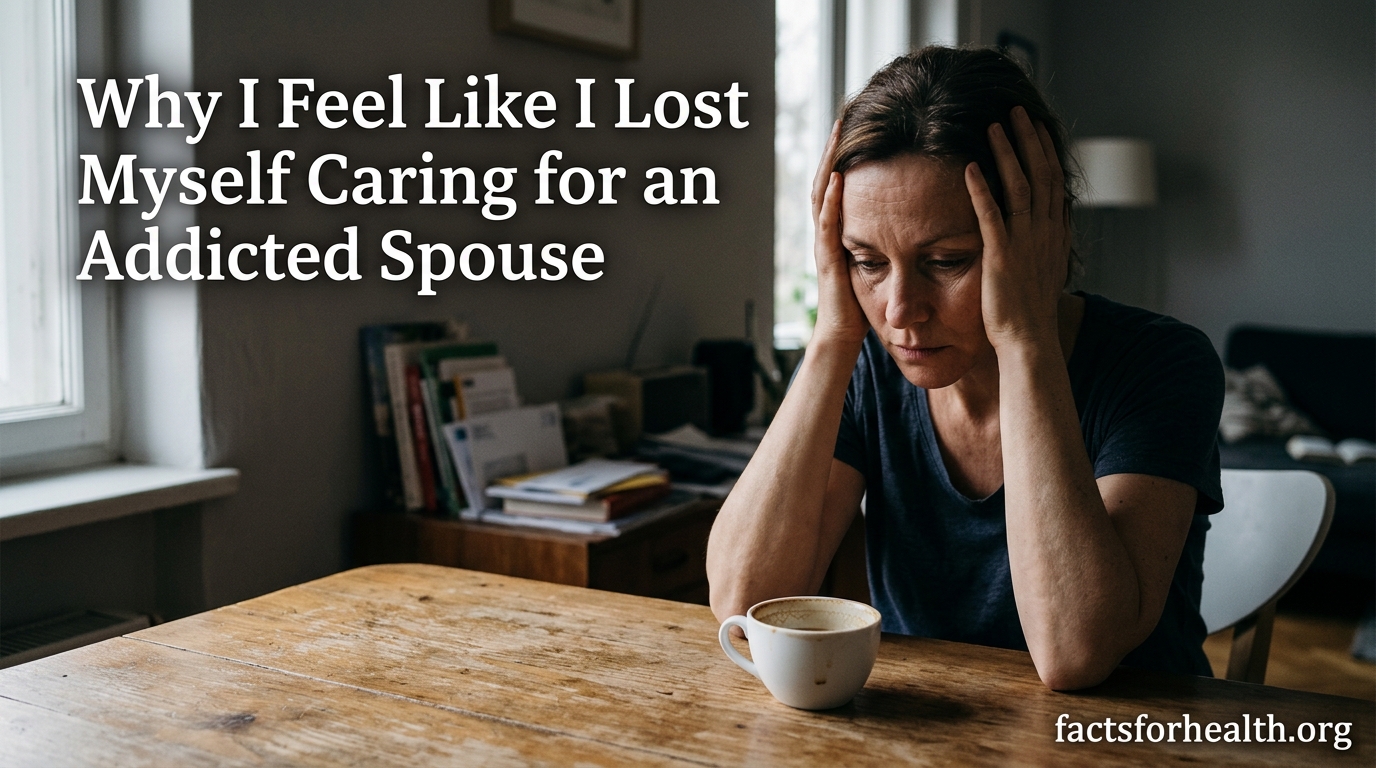
If you typed the words “why I feel like I lost myself caring for an addicted spouse” into a search bar, you already know something has shifted inside you. You may not recognize the person staring back in the mirror anymore. The hobbies, friendships, and dreams that once defined you feel distant, like they belonged to someone else.
You are not broken for feeling this way. You are experiencing something thousands of spouses of people with substance use disorder go through. The slow erosion of self happens gradually, often so quietly that you do not notice until you are deep inside it. By the time you realize you have lost yourself, the path back feels impossible to find.
In this article, I want to walk beside you through what is actually happening when caring for an addicted spouse consumes your identity. We will look at the emotional stages of caregiver burnout, the grief of losing who you used to be, and concrete steps to set boundaries without guilt. You will also find a self-assessment checklist, real talk about when leaving might be the right call, and a roadmap for rebuilding your sense of self. You deserve to feel like yourself again.
Table of Contents
Why Caring for an Addicted Spouse Leads to Identity Loss
Identity loss does not happen because you are weak or lacking willpower. It happens because addiction rewires not just the person using substances, but the entire relationship around them. When your spouse is in active addiction, their brain prioritizes the substance above everything else, including you. That leaves you scrambling to hold together what feels like a life coming apart at the seams.
The first mechanism is hyperfocus on their crisis. Addiction is a chronic brain disease that hijacks the dopamine reward system, driving compulsive drug-seeking behavior. When your spouse is caught in that cycle, your nervous system stays on high alert. You monitor their mood, scan for signs of relapse, and brace for the next emergency. Over time, your entire mental bandwidth gets consumed by their wellbeing, leaving nothing for your own.
The second mechanism is boundary erosion. You start making small compromises, telling yourself they are temporary. Maybe you cover for them with family, take over their responsibilities, or drain your savings to keep things afloat. Each compromise feels necessary in the moment, but together they slowly erase the line between their problems and your life.
The third mechanism is codependency. Codependency is a pattern where your sense of purpose and self-worth becomes tied to managing another person’s behavior, particularly their recovery or substance use. You may find that you only feel okay when they are okay, and you spiral when they spiral. Your emotional state becomes a mirror of theirs, and somewhere in that reflection, your own identity fades.
The Emotional Stages of Caregiver Burnout
Caregiver burnout is not a single event. It unfolds in stages, and understanding where you are can help you name what is happening and take action. Most spouses of people with addiction move through four emotional phases, though not always in a neat line.
Stage one is hyper-vigilance. In the early days, you pour everything into fixing the problem. You research treatment options, hide or pour out alcohol, check their phone, and lose sleep worrying. Adrenaline carries you forward. Friends may even comment on how strong you are being, which reinforces the pattern.
Stage two is resentment. Months or years in, exhaustion replaces adrenaline. You feel angry that nothing you do seems to matter. You resent being the one who holds everything together while your spouse seems unbothered. The guilt about feeling resentful can be crushing, especially when you still love them deeply.
Stage three is numbness and disconnection. This is where the lost-self feeling crystallizes. You stop feeling much of anything. Activities you used to love feel pointless. You go through the motions of daily life but feel like a ghost inhabiting your own body. This emotional flatline is a protective response from a nervous system that has been overwhelmed for too long.
Stage four is identity erosion. You no longer know what you want, what you enjoy, or who you are outside of the caregiving role. If someone asked you to describe yourself without mentioning your spouse, you might draw a blank. This is the core of why you feel like you lost yourself, and it is a direct consequence of sustained caregiver stress.
Signs You Have Lost Yourself Caring for Your Addicted Spouse
Sometimes naming the problem is the first step toward solving it. I want to offer you a checklist drawn from what spouses in Al-Anon, therapy groups, and online support communities describe. See how many of these resonate with where you are right now.
You have stopped doing activities or hobbies that once brought you joy. Your calendar revolves entirely around your spouse’s moods, schedules, and recovery status. You cannot remember the last time you made a decision based on what you wanted rather than what would keep the peace.
You feel responsible for your spouse’s sobriety or relapse. Your friendships have withered because you are embarrassed or exhausted. You lie to family members about what is happening at home. Your physical health has declined because you are not sleeping, eating well, or exercising.
You feel like a shadow of your former self, and when you try to picture the person you were before the addiction took over your marriage, that version of you feels unreachable. If four or more of these signs feel true for you, what you are experiencing is real and it has a name. It is caregiver burnout with identity loss, and it is treatable.
It helps to understand the line between supporting and enabling. Supporting means encouraging your spouse’s recovery while maintaining your own boundaries and wellbeing. Enabling means shielding your spouse from the natural consequences of their addiction in ways that ultimately prolong it. Paying their debts, lying for them, or rescuing them from every crisis is enabling. Listening without fixing, encouraging treatment, and protecting your own finances is supporting.
The Grief of Losing Who You Used to Be
Few people talk about the grief that comes with losing yourself to caregiving. But grief is exactly the right word. You are mourning a version of yourself that existed before addiction took center stage in your marriage, and that grief deserves recognition.
You may be grieving the person your spouse used to be. The partner who made you laugh, showed up for you, and shared your vision for the future. Addiction can swallow a person whole, as one spouse described it, and watching that happen is a form of loss that does not get acknowledged enough. Society tends to focus on the person with the addiction, leaving caregivers to grieve silently.
You may also be grieving the relationship you thought you would have. The plans you made together, the trust you built, the future you envisioned. When addiction becomes the third person in your marriage, those dreams do not just get paused. They get reshaped or dismantled, and processing that loss is part of finding your footing again.
And you are grieving yourself. The confident, carefree, or settled version of you who had room in their life for joy, spontaneity, and rest. That grief is valid. Naming it, rather than pushing it down, is the beginning of healing. You cannot rebuild something you have not allowed yourself to mourn.
Setting Boundaries Without Guilt
Boundaries are not punishments for your spouse. They are protections for you. Setting them is one of the most powerful things you can do, both for your own recovery and, paradoxically, for your spouse’s. A boundary says this is what I will do to protect myself, not this is what you must do.
Step one is identifying your limits. Get specific about what you can and cannot tolerate. Maybe you will no longer lie to family members about why your spouse missed an event. Maybe you will not allow substances in your home. Maybe you will keep separate finances to protect your stability. Write your limits down so they feel real and concrete.
Step two is communicating clearly. Use simple, direct language without justifying or over-explaining. A statement like, I am no longer going to cover for you when you miss work, is enough. You do not need a debate. Your spouse may react with anger, guilt-tripping, or promises to change. That reaction belongs to them, not to you.
Step three is following through. A boundary without follow-through is just a wish. If you say you will leave the room when your spouse is using, leave the room. If you say you will not bail them out of financial trouble, do not bail them out. Consistency is what makes boundaries real, and inconsistency is what teaches people your words do not mean anything.
Step four is releasing the guilt. You will feel guilty, especially at first. That guilt is not proof you are doing something wrong. It is a learned response from years of putting yourself last. Remind yourself that protecting your wellbeing is not selfish. It is what allows you to be a whole person, and a whole person is better equipped to make clear decisions about their marriage than someone running on empty.
Coping Strategies and Self-Care for Caregivers
Self-care when you are married to an addict is not bubble baths and face masks. It is survival-level maintenance of your mental, physical, and emotional health. Here are five strategies that spouses in recovery communities consistently point to as life-changing.
One, find a support group. Al-Anon and Nar-Anon are free, widely available, and built specifically for people who love someone with an addiction. Hearing others describe your exact experience can dissolve the isolation that fuels burnout. You do not have to speak if you do not want to. Just listening is enough at first.
Two, get a therapist who understands addiction. A general counselor may not grasp the nuances of codependency, enabling, and trauma bonding. Look for someone who specializes in family addiction or partners of substance users. Individual therapy gives you a private space to process your feelings without worrying about your spouse’s reaction.
Three, rebuild one connection at a time. Isolation is one of the first things addiction takes from you. Reach out to one friend you have lost touch with. Send a text, suggest coffee, and let the relationship rebuild slowly. You do not have to explain everything. You just have to let people back in.
Four, reclaim small pieces of your identity. Pick one thing you used to love and do it this week. A class, a walk, a book, a creative project. It does not have to be productive. It just has to be yours. These small acts of self-reclamation add up over time.
Five, use the 3-3-3 rule when you are spiraling. When anxiety or panic hits, name three things you can see, three sounds you can hear, and move three parts of your body. This grounding technique interrupts the stress cycle and brings you back to the present moment. It is simple, free, and surprisingly effective for caregivers whose nervous systems are stuck in fight-or-flight.
If you are in crisis or feeling hopeless, please reach out. The SAMHSA National Helpline at 1-800-662-4357 is free, confidential, and available 24 hours a day for both people with addiction and their family members. You do not have to navigate this alone.
Rebuilding Your Identity After Caregiving
Whether your spouse gets sober, you decide to leave, or you are somewhere in between, rebuilding your identity is your work to do. It is the most important project of your life right now, and it is entirely within your control even when everything else feels uncertain.
Start by asking yourself who you were before the addiction took over your household. What did you care about? What made you feel alive? Write it down without filtering. Some of those things may no longer fit, and that is okay. The point is to begin reconnecting with your own inner compass rather than orienting every decision around your spouse.
Rebuild your friendships deliberately. Addiction thrives in isolation, and so does caregiver burnout. The people who drifted away did not stop caring about you. They likely backed off because they did not know how to help. Reach out and let them know you are ready to reconnect. You may be surprised by how quickly people show up when you open the door.
Create new routines that belong only to you. A morning walk, a weekly class, a standing phone call with a friend. These anchors remind your brain that your life has structure and meaning outside of caregiving. Over time, these small routines become the scaffolding of a rebuilt identity.
Give yourself permission to want things again. Wanting things for yourself, not just survival or peace, is a sign that you are coming back to life. It will feel uncomfortable at first. Lean into it anyway.
When to Consider Leaving an Addicted Spouse
This is the question that brings thousands of people to support forums every month. There is no universal answer, because every situation is different. But there are signals that can help you think clearly about whether staying is still the right choice for you.
If there is physical, emotional, or verbal abuse, your safety comes first. Addiction does not excuse violence, and no amount of love for your spouse should require you to endure abuse. If you are afraid in your own home, that is a signal to act on, not to wait out.
If your spouse has repeatedly refused treatment after multiple opportunities, if your mental or physical health is deteriorating, if your children are being affected, or if your financial stability has been destroyed, these are all serious indicators. None of them automatically mean you must leave. But they do mean it is time to stop making decisions on autopilot and start evaluating your situation with clear eyes.
Ask yourself these questions. Am I staying out of love, or out of fear and guilt? Would I want my child or best friend to stay in this situation? What would I tell a friend who described my life to me? Have I given my spouse real opportunities to change, and what have they done with them? Your honest answers will tell you more than any article can.
Leaving is not failure. Staying is not weakness. Both choices require courage, and both can be the right one depending on your circumstances. What matters is that the decision is yours, made with support and clarity rather than from a place of depleted exhaustion.
FAQs
At what point do you give up on an addict?
There is no single point that applies to everyone, but most addiction counselors suggest reconsidering the relationship when there is abuse, repeated refusal of treatment, severe financial or emotional harm, or when your own mental and physical health is collapsing. Giving up is a misleading phrase. What you are actually doing is deciding that you cannot sacrifice yourself indefinitely for someone who is not ready to change. That is a healthy boundary, not a failure.
How to cope with an addict spouse?
Coping starts with recognizing that you cannot control your spouse’s addiction. Effective strategies include joining a support group like Al-Anon or Nar-Anon, working with a therapist who specializes in family addiction, setting clear boundaries, maintaining your own friendships and interests, and using grounding techniques like the 3-3-3 rule when anxiety spikes. Prioritizing your own wellbeing is not selfish. It is the foundation that allows you to make clear decisions about your marriage.
Should you stay in a relationship with an addict?
Whether to stay depends on whether your spouse acknowledges the problem, is willing to seek treatment, and treats you with respect through the process. If your spouse is actively working toward recovery and the relationship is not abusive, staying can be a valid choice. If there is abuse, repeated broken promises, or your own health is breaking down, leaving may be the healthier option. There is no universally right answer. The right answer is the one you arrive at with support, clarity, and honest self-reflection.
What is the 3 3 3 rule for addiction?
The 3-3-3 rule is a grounding technique used to interrupt anxiety and panic. You name three things you can see, identify three sounds you can hear, and move three parts of your body. It pulls your nervous system out of fight-or-flight mode and back into the present moment. It is especially helpful for spouses of addicts whose stress response has been chronically activated by living in crisis mode.
How to recover from being married to an addict?
Recovery involves rebuilding your identity outside the caregiving role. Start by reconnecting with activities and people you lost touch with, working with a therapist on codependency and trauma patterns, joining a support group, creating personal routines that belong only to you, and giving yourself permission to grieve who you were before addiction entered your life. Recovery is gradual. Small consistent steps matter more than dramatic changes.
You Are Still in There
Feeling like you lost yourself caring for an addicted spouse is one of the most isolating experiences a person can have. But it is not a permanent state. The version of you that existed before addiction took over your household has not disappeared. She is buried under layers of survival, exhaustion, and self-sacrifice, and she can be uncovered one small choice at a time.
Recovery from identity loss looks like setting one boundary, reaching out to one friend, attending one Al-Anon meeting, and doing one thing this week that is purely for you. It is not dramatic. It is not a personality transplant. It is the slow, steady work of coming home to yourself.
If you take one thing from this article, let it be this. You matter independently of your spouse’s addiction. Your wellbeing has value even if they never get sober. And the person you are searching for when you say you lost yourself is still in there, waiting for you to make room for her again.