
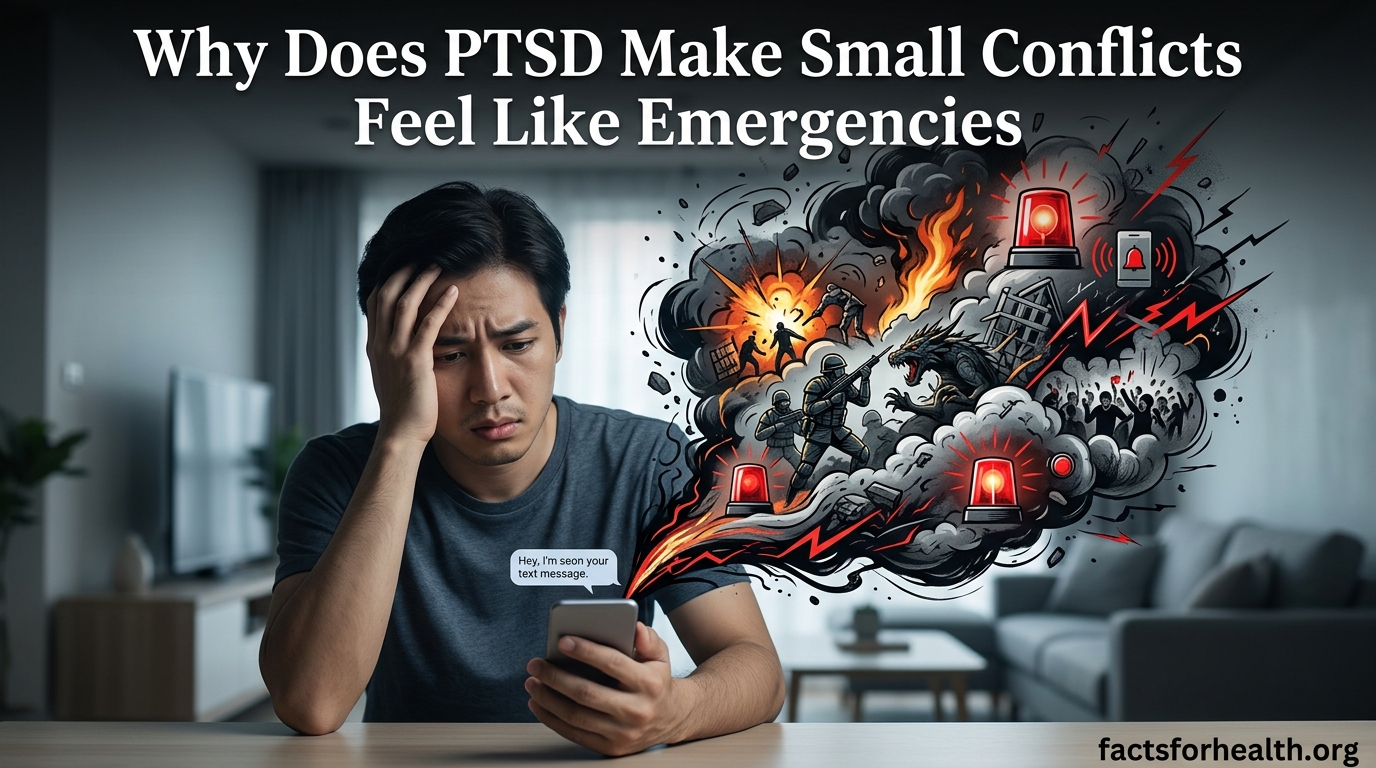
If you have ever felt your heart race, your chest tighten, or your mind go blank during what should be a minor disagreement, you are not alone. Many people with PTSD experience exactly this. A simple comment from a coworker, a slight change in a partner’s tone, or a small scheduling mixup can suddenly feel like a five-alarm fire in your body.
This is one of the most confusing and exhausting aspects of living with trauma. You know, on some level, that the situation is not life-threatening. But your body does not get the memo. Your nervous system reacts as though you are in physical danger, even when the “threat” is just someone asking why you forgot to take out the trash.
In this article, we will explore why does PTSD make small conflicts feel like emergencies. We will look at what happens in your brain, why your body overreacts, and what you can do to manage these intense responses. Understanding the mechanism behind your reactions is the first step toward feeling more in control.
Table of Contents
What Happens in the Brain During PTSD Activation
To understand why small conflicts trigger emergency responses, we need to look at the part of your brain called the amygdala. The amygdala is your built-in threat detector. Its job is to scan your environment for danger and, when it finds any, trigger your body’s survival systems before you even have time to think.
In a person without PTSD, the amygdala and the prefrontal cortex (the logical, decision-making part of the brain) work together. The amygdala sends an alert, and the prefrontal cortex evaluates whether the threat is real. If your boss frowns at you, your amygdala might fire a brief warning, but your prefrontal cortex quickly says, “It is just a frown. We are fine.”
In someone with PTSD, this system is altered. The amygdala becomes overactive, firing danger signals at full intensity. Meanwhile, the prefrontal cortex becomes less effective at putting on the brakes. The result is what neuroscientists sometimes call an “amygdala hijack,” where the emotional, survival-focused part of your brain takes over before your rational mind can intervene.
This is not a character flaw. It is not weakness. It is a neurobiological response. Your brain learned, through trauma, that the world is dangerous. It is now doing exactly what it was designed to do: protecting you. The problem is that it is overcorrecting, treating a disagreement about dishes the same way it would treat a threat to your life.
Why Does PTSD Make Small Conflicts Feel Like Emergencies
Conflict, even minor conflict, contains several ingredients that the traumatized brain reads as danger. Tone of voice changes. Someone’s face may look angry or dismissive. There is uncertainty about what will happen next. For a nervous system already stuck in survival mode, these cues can feel indistinguishable from the original traumatic situation.
Think about what happens during a small argument. Your partner raises their voice slightly. Your coworker sends a terse email. A friend gives you a look you cannot quite read. In a regulated nervous system, these moments register as mild stress. In a trauma-activated nervous system, the same cues get sorted into the “threat” category and routed through the same emergency pathways that were used during the actual trauma.
This is why people on trauma support forums describe feeling like they are having panic attacks over nothing. One person shared that a friend disagreed about something driving-related, and even though it was not really an argument, the tone alone triggered a full-body response. Another described freezing in place and then walking away mid-conversation because the discomfort became unbearable. These reactions are real, they are physiological, and they make complete sense when you understand how trauma rewires threat perception.
There is also an element of emotional flooding. When a trauma response activates, your body gets hit with a surge of stress hormones, including cortisol and adrenaline. Your heart pounds, your breathing changes, your muscles tense. These physical sensations are the same ones you would experience in actual danger. So your brain interprets the intensity of your body’s response as proof that the threat is real. The bigger the physical reaction, the more your brain confirms that yes, this must be an emergency.
This creates a feedback loop. The conflict triggers the body, the body confirms the danger, and the perceived danger intensifies the body’s response. Breaking that loop requires understanding what is happening and having tools to intervene, which we will cover later in this article.
The Four Trauma Responses to Conflict
When your nervous system detects a threat, it activates one of four survival responses. These are deeply wired into human biology, and they happen automatically, before conscious thought. Understanding which response tends to be your default can help you recognize what is happening in real time.
1. Fight
The fight response turns conflict into confrontation. If this is your default, you may find yourself reacting to minor disagreements with intense anger, raised voice, or an urge to defend yourself aggressively. The anger feels urgent and overwhelming, as though you must win the argument or something terrible will happen. Afterward, you may feel deep shame about how you reacted.
Fight responses are often misunderstood. People may label you as aggressive or difficult. But this response is actually your nervous system trying to protect you by eliminating the perceived threat through force. The anger is a shield, not a character trait.
2. Flight
The flight response drives you to escape the situation. You might physically leave the room, end the conversation abruptly, or emotionally withdraw even while standing in place. Some people describe an overwhelming urge to get away, as though staying in the conversation is physically painful.
One forum user shared that their PTSD makes it nearly impossible to deal with any kind of conflict, causing them to freeze and then walk away mid-conversation. This is the flight response in action. Your nervous system has decided the safest option is to remove yourself entirely.
3. Freeze
The freeze response locks you in place. Your mind goes blank, your body feels heavy or numb, and you lose the ability to respond. People experiencing freeze often describe feeling stuck, unable to find words, or watching the conflict happen from a distance, as though they are floating outside their body.
Freeze can be particularly frustrating because it looks, from the outside, like you do not care or are not trying. In reality, your nervous system has decided that neither fighting nor fleeing is possible, so it shuts down to minimize damage. This is the same response that animals use when they play dead.
4. Fawn
The fawn response drives you to appease the other person and end the conflict as quickly as possible. You might agree to things you do not actually want, apologize even when you are not at fault, or suppress your own needs to keep the peace. Fawning is especially common in people whose trauma involved relationships where disagreeing was dangerous.
Fawning can be hard to recognize as a trauma response because it looks like being accommodating or easygoing. But if you consistently abandon your own boundaries the moment someone seems upset, that is your nervous system trying to keep you safe by making the threat go away through compliance.
Hypervigilance and the Window of Tolerance
Two concepts help explain why everyday conflicts feel so overwhelming: hypervigilance and the window of tolerance.
Hypervigilance is a state of constant alertness. Your nervous system is always scanning for signs of danger, even in safe situations. This means you might notice a slight change in someone’s tone, a micro-expression on their face, or a shift in the atmosphere of a room that other people miss entirely. These detections trigger your threat response before you can rationally evaluate them.
The window of tolerance, a concept developed by Dr. Dan Siegel, describes the zone where you can function, think clearly, and handle stress effectively. Everyone has a window of tolerance, but trauma narrows it dramatically. For someone without trauma, a disagreement might be uncomfortable but still within their window. For someone with PTSD, the same disagreement may immediately push them above their window into hyperarousal, or below it into hypoarousal, where they shut down.
When you are outside your window of tolerance, your thinking brain goes offline. You cannot reason your way through the conflict because your survival brain has taken over. This is why telling yourself to “just calm down” rarely works in the moment. Your prefrontal cortex is not fully online. You need strategies that work with your body, not against it.
How Trauma Responses Impact Daily Life and Relationships
The effects of trauma-based conflict responses ripple through every area of life. At work, you might avoid speaking up in meetings, dread performance reviews, or interpret neutral feedback as a personal attack. The constant stress of navigating workplace interactions can lead to burnout, job changes, or career stagnation.
In romantic relationships, these responses can create painful cycles. If you react to small disagreements with intense emotion, shutdown, or appeasement, your partner may feel confused, shut out, or unable to bring up concerns. Over time, this erodes trust and intimacy on both sides. The person with PTSD often feels ashamed of their reactions, while the partner may feel like they are walking on eggshells.
Family dynamics are equally affected. You might avoid family gatherings, limit contact with certain relatives, or find that old family conflicts trigger responses rooted in childhood experiences. People with complex trauma (C-PTSD) often find that family settings are particularly activating because they may involve the same people or dynamics that caused the original trauma.
Socially, you might withdraw from friendships, decline invitations, or struggle to maintain connections because casual social interactions feel unpredictable and therefore dangerous. The exhaustion of constantly managing your nervous system can make even enjoyable socializing feel like too much effort.
None of this means something is wrong with you as a person. These are predictable consequences of a nervous system that learned to prioritize survival over connection. With the right tools and support, these patterns can change.
Grounding Techniques to Calm Your Nervous System
Grounding techniques work by bringing your attention back to the present moment and signaling to your nervous system that you are safe. Because trauma responses pull you into survival mode, you need tools that engage your body directly, not just your thoughts. Here are several techniques that people with PTSD find helpful for managing conflict-triggered responses.
The 5-4-3-2-1 Technique
Name five things you can see, four things you can physically feel, three things you can hear, two things you can smell, and one thing you can taste. This exercise forces your brain to process sensory information from your current environment, which interrupts the threat-detection loop. It works best if you practice it before you are in crisis, so it becomes familiar.
Temperature Shifts
Splashing cold water on your face, holding an ice cube, or pressing a cold can against your neck activates the mammalian dive reflex, which slows your heart rate and calms your nervous system. This is one of the fastest ways to interrupt a panic response during conflict. Many people keep ice packs or cold water nearby for exactly this purpose.
Box Breathing
Inhale for four counts, hold for four counts, exhale for four counts, hold for four counts. Repeat for at least one minute. This breathing pattern directly influences your vagus nerve, which controls your body’s relaxation response. It is subtle enough to do during a conversation without anyone noticing.
Orienting
Slowly look around the room, naming objects out loud or in your head. Let your eyes rest on each item for a moment before moving to the next. This sounds simple, but it directly counters the tunnel vision that accompanies a threat response. It reminds your nervous system that you are in a specific, real place, not trapped in a trauma memory.
Physical Grounding
Press your feet firmly into the floor. Feel the weight of your body in the chair. Squeeze something textured, like a piece of fabric or a stress ball. These sensations give your nervous system concrete, present-moment input that competes with the alarm signals coming from your amygdala.
The key with all grounding techniques is repetition and practice. They work best when you have used them during calmer moments, so your body recognizes them as safety cues when you are activated. Start with one technique and practice it daily, even when you feel fine.
Self-Compassion and Healing
If you take one thing from this article, let it be this: your reactions to conflict are not a personal failure. They are the response of a nervous system that learned to survive. Shame about these reactions only adds fuel to the fire, because shame itself is activating to your nervous system.
Self-compassion is not just a nice idea. It is a practical tool. When you can acknowledge that your response makes sense given what you have been through, you reduce the secondary wave of distress that comes from judging yourself for reacting. You are then in a better position to use grounding techniques, communicate your needs, or step away and return when you are regulated.
Professional support can make a significant difference. Trauma-focused therapies, including EMDR, Somatic Experiencing, and trauma-focused cognitive behavioral therapy, are designed to help your nervous system process and integrate traumatic memories so they stop driving your current reactions. If you have access to a therapist who specializes in trauma, it is worth exploring these options.
Healing does not mean never having a trauma response again. It means having more tools, more awareness, and a wider window of tolerance so that small conflicts can stay small. Recovery is real, and people do heal from C-PTSD and PTSD, even when it feels impossible.
FAQs
What is C-PTSD vs PTSD?
PTSD typically results from a single traumatic event, such as an accident or assault. C-PTSD (Complex PTSD) results from repeated or prolonged trauma, often in childhood or in situations where escape was not possible, such as ongoing abuse or neglect. C-PTSD includes the core symptoms of PTSD plus additional difficulties with emotional regulation, self-worth, and relationships.
How does complex PTSD affect daily life?
C-PTSD affects daily life through chronic emotional dysregulation, difficulty trusting others, heightened sensitivity to conflict, problems with self-esteem, and a narrowed window of tolerance for stress. Everyday situations like workplace feedback, social interactions, or minor disagreements can trigger intense physical and emotional responses. Many people also experience difficulty concentrating, sleep problems, and a persistent sense of unsafety.
Will I ever heal from C-PTSD?
Yes, healing from C-PTSD is possible. With trauma-focused therapy, grounding practices, and consistent self-regulation work, many people experience significant improvement in their symptoms and quality of life. Healing is not linear and takes time, but the nervous system is capable of change at any age through a process called neuroplasticity. Many people reach a point where small conflicts no longer trigger emergency responses.
Is C-PTSD serious?
Yes, C-PTSD is a serious mental health condition. It can profoundly affect relationships, work, daily functioning, and physical health. However, it is also highly treatable. Recognizing it as serious does not mean it is hopeless. It means that professional support, self-education, and consistent coping strategies are important components of recovery.
Conclusion
Understanding why does PTSD make small conflicts feel like emergencies is the first step toward change. Your amygdala is doing its job, just too enthusiastically. Your nervous system learned to prioritize survival, and it has not yet learned that everyday disagreements are not life-threatening.
With grounding techniques, self-compassion, and professional support, your window of tolerance can widen. Small conflicts can begin to feel like what they actually are: small. The path is not quick or easy, but it is real, and you do not have to walk it alone.
If you are struggling with trauma responses that interfere with your daily life, reach out to a mental health professional who specializes in trauma. You deserve support, and healing is possible.