
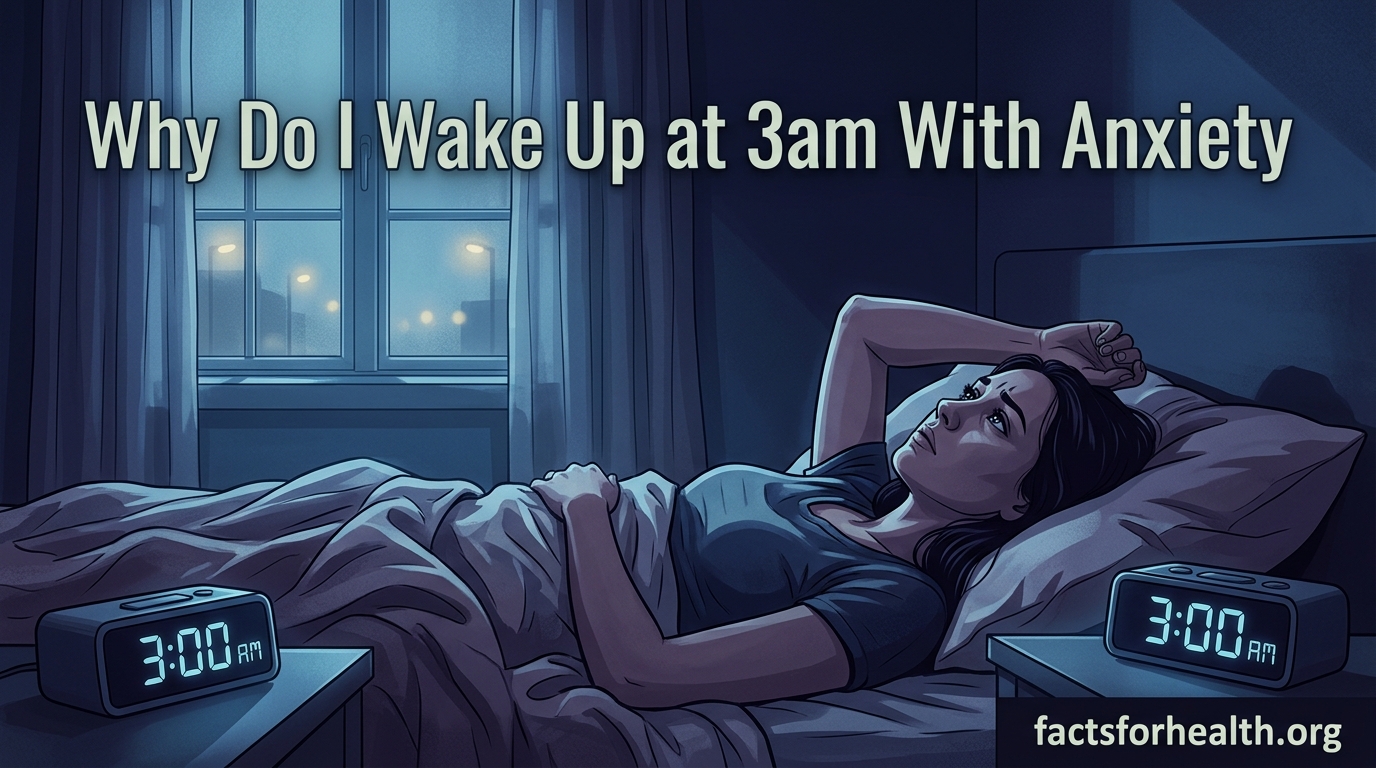
You know the feeling. Your eyes snap open. The clock reads 3:00 AM, and before you can even orient yourself, your mind floods with worry. Your heart beats faster. Thoughts spiral about work deadlines, relationship tensions, that awkward thing you said five years ago, and whether you will ever fall back asleep.
If this sounds familiar, you are far from alone. Thousands of people search for answers to this exact experience every month. Our team dug into the research, sleep science, and forum discussions from real people who live through this nightly pattern. The goal was to understand not just what is happening, but why it happens and what actually helps.
Here is the short version: waking up at 3am with anxiety and racing thoughts is usually caused by your body’s natural cortisol surge combining with lighter REM sleep stages, while your brain has fewer distractions to keep anxious thoughts at bay. Stress, poor sleep habits, and environmental factors all amplify the effect. The good news is that understanding the mechanism gives you real tools to break the cycle.
Let us walk through exactly what your brain and body are doing at 3 AM, why anxiety feels so much worse in the dark, and the specific strategies that can help you calm your mind and get back to sleep.
Table of Contents
Why Do I Wake Up at 3am With Anxiety and Racing Thoughts?
Waking up at 3am with anxiety is caused by a combination of biological and psychological factors working together. Three primary drivers explain most cases.
First, your sleep architecture naturally shifts you into lighter sleep stages during the second half of the night. Around 3 AM, you are likely transitioning between REM cycles or moving from deep sleep into lighter stages. This makes you more easily aroused and more aware of your thoughts.
Second, your body begins producing cortisol several hours before dawn as part of its natural circadian rhythm. Cortisol is often called the stress hormone, but it is also the hormone that prepares your body to wake up. If you are already carrying stress during the day, this natural cortisol rise can feel like a jolt of anxiety rather than a gentle awakening signal.
Third, the quiet and darkness of night remove all the external distractions that normally keep anxious thoughts in check. During the day, work, conversations, and activities compete for your attention. At 3 AM, your worries have the stage all to themselves.
One Reddit user in the r/Anxiety community described it perfectly: it feels like your brain decides to hold a committee meeting about everything that has ever gone wrong, right when you need rest the most. That experience is remarkably common, and it has a clear biological basis.
Your Sleep Cycle: Why 3am Is a Vulnerable Time
To understand why 3 AM specifically tends to trigger nighttime anxiety, you need to understand how your sleep cycle works throughout the night.
Sleep happens in roughly 90-minute cycles. Each cycle moves you through different stages: light sleep (N1 and N2), deep sleep (N3, also called slow-wave sleep), and REM sleep where most dreaming occurs. Over the course of a night, your deep sleep decreases and your REM sleep increases. This means the second half of your night contains longer REM periods and lighter sleep overall.
If you go to bed around 10 or 11 PM, the 3 AM hour falls right in the middle of this transition. You are sleeping more lightly, spending more time in REM, and cycling between stages more frequently. All of this makes you more likely to wake up briefly.
Normal, healthy sleep includes several of these brief awakenings per night. Most people fall right back asleep without ever remembering them. But when you are stressed or anxious, even a normal brief awakening can become a full wake-up. Your brain, instead of sliding back into sleep, grabs onto a worry and runs with it.
REM sleep deserves special attention here. During REM, your brain processes emotions and consolidates memories. This means the thoughts and feelings you carry to bed are actively being worked through during REM. When you wake from REM sleep, those processing thoughts are close to the surface and can feel vivid and urgent.
Key Sleep Cycle Facts
Deep sleep dominates the first third of the night, providing physical restoration. REM sleep dominates the last third, handling emotional and cognitive processing. Brief awakenings between cycles are completely normal. The problem is not waking up; it is the anxious thoughts that keep you from falling back asleep.
The Cortisol Connection: Your Body’s Alarm System
Cortisol is a hormone produced by your adrenal glands, and it follows a predictable daily rhythm. Cortisol levels are lowest around midnight, then begin rising in the hours before dawn to help you wake up and face the day. This is called the cortisol awakening response.
For most people, this gradual rise starts around 2 or 3 AM and reaches its peak within the first 30 to 45 minutes after waking. If your stress levels are elevated during the day from work pressures, relationship conflicts, financial worries, or health concerns, your cortisol baseline is already higher than it should be. When the natural pre-dawn rise begins, it stacks on top of that elevated baseline.
This is why the 3 AM wake-up can feel so physical. You might notice a racing heart, shallow breathing, sweating, a pit in your stomach, or a sense of dread. These are not random symptoms. They are your body responding to a cortisol spike as if there were an actual threat nearby.
People who have never experienced this often assume it is purely psychological. It is not. The physical sensation of a cortisol surge is real and measurable. Your sympathetic nervous system is activating, dumping adrenaline alongside cortisol, preparing your body for fight or flight. At 3 AM, there is nothing to fight and nowhere to flee, so that energy channels directly into racing thoughts and anxiety.
Forum discussions on r/sleep and r/Anxiety are full of people describing this exact experience. They wake with their heart pounding, chest tight, mind immediately racing. Many report the anxiety hits before they are even fully conscious, as if their body sounded the alarm before their brain could catch up.
What a 3am Cortisol Spike Feels Like
Common physical sensations include a rapid heartbeat, feeling warm or flushed, muscle tension, nausea or stomach discomfort, and a sudden sense of alertness that feels inappropriate for the time of night. Mentally, it often brings a flood of worst-case-scenario thinking, a sense of urgency or dread, and difficulty thinking calmly or rationally.
Why Your Mind Gets Louder at Night
The biological factors explain why your body wakes up. But why does your mind immediately go to the worst possible thoughts? The answer involves how your brain handles worry when external distractions disappear.
During the day, your prefrontal cortex is actively engaged. This is the part of your brain responsible for executive function, rational thinking, and emotional regulation. It helps you evaluate whether a worry is worth your attention and suppress thoughts that are not helpful. But the prefrontal cortex gets tired. Research shows that cognitive control diminishes with fatigue, meaning your ability to dismiss anxious thoughts weakens as the day wears on and during the night.
At 3 AM, without the demands of the day, there is nothing competing for your attention. The email you need to send, the difficult conversation you need to have, the bill that is overdue, the health symptom you have been ignoring. During the day, you can push these aside by focusing on tasks. At night, there is nothing to push them aside for.
One researcher described 3 AM thinking as barbed-wire thinking. The thoughts are sharp, repetitive, and hard to let go of. They tend to be self-critical and future-focused, dwelling on shortcomings and feared outcomes. This is not a character flaw or a sign of weakness. It is a predictable result of a fatigued brain encountering unstructured time with fewer cognitive resources to manage worry.
Sleep deprivation also impairs emotional regulation. Even a single night of poor sleep reduces your ability to manage anxiety the next day. So when you wake at 3 AM, you are both cognitively depleted from the day and emotionally vulnerable from interrupted sleep. It is a perfect storm for anxious, racing thoughts.
The Anxious Sleep Cycle: A Self-Feeding Loop
Here is where many articles stop short. They explain why 3 AM anxiety happens but miss the most important piece: why it keeps happening night after night. The answer is a feedback loop between anxiety and sleep disruption.
The cycle works like this. You go to bed carrying daytime stress. Your elevated cortisol causes you to wake around 3 AM. Your racing thoughts prevent you from falling back asleep. The sleep you lose makes your anxiety worse the next day. Worse anxiety means higher cortisol the following night. You wake at 3 AM again.
After a few nights of this pattern, a new problem emerges: anticipatory anxiety about sleep itself. You start dreading bedtime because you know what is coming. You lie down already anxious about waking at 3 AM. This anxiety makes it harder to fall asleep in the first place, which means you are even more sleep-deprived, which makes the 3 AM wake-up even worse.
This is why simply trying to relax rarely works. The cycle is self-reinforcing. Breaking it requires interrupting the loop at one or more points: reducing daytime stress to lower your cortisol baseline, changing how you respond when you wake at 3 AM, and removing the anticipatory anxiety about sleep.
Many people in sleep forums describe this exact progression. It starts as an occasional bad night, then becomes a pattern, then becomes an expectation. The shift from occasional disruption to chronic cycle can happen in as little as one to two weeks. Recognizing the pattern is the first step toward breaking it.
Why This Loop Is So Hard to Break Alone
The anxious sleep cycle is self-reinforcing because each element feeds the others. Sleep loss worsens anxiety, anxiety worsens sleep, and the fear of not sleeping creates a third layer of anxiety. Willpower alone usually is not enough because the cycle operates on an unconscious, physiological level. This is why structured approaches, whether cognitive behavioral therapy for insomnia (CBT-I) or systematic lifestyle changes, tend to work better than ad hoc relaxation attempts.
What Makes It Worse: Triggers and Contributing Factors
Several factors can make 3 AM anxiety wake-ups more frequent and more intense. Understanding your personal triggers is essential for breaking the pattern.
Alcohol Before Bed
Alcohol is a major contributor to nighttime awakenings. It helps you fall asleep faster by depressing your central nervous system, but as it metabolizes during the night, it causes a rebound effect. This rebound disrupts your sleep architecture, increases heart rate, and triggers awakenings in the second half of the night, often around 3 AM. If you have been drinking, your cortisol and adrenaline may also be higher as your body processes the alcohol.
Caffeine Late in the Day
Caffeine has a half-life of about five to six hours. That afternoon coffee at 3 PM still has half its caffeine in your system at 9 PM and a quarter of it at 3 AM. Caffeine blocks adenosine, the brain chemical that builds sleep pressure throughout the day. Even if you fall asleep fine, residual caffeine can lighten your sleep stages and make you more prone to awakenings.
Blood Sugar Drops
If you eat dinner early and go to bed on a relatively empty stomach, your blood sugar may drop during the night. A significant drop triggers a stress response, including cortisol and adrenaline release, to mobilize stored glucose. This is the same fight-or-flight response that wakes you up anxious at 3 AM. Eating a small, balanced snack with protein and complex carbohydrates before bed can help stabilize blood sugar.
Screen Time and Blue Light
Using phones, tablets, or computers before bed suppresses melatonin production through blue light exposure. Melatonin is the hormone that signals to your brain that it is time to sleep. When melatonin is delayed or reduced, your sleep quality suffers. Additionally, the content you consume on screens, whether stressful news, work emails, or social media, can directly elevate your stress and anxiety levels right before bed.
Sleep Disorders
Conditions like sleep apnea, restless legs syndrome, and chronic insomnia can cause frequent nighttime awakenings. Sleep apnea, in particular, causes micro-awakenings throughout the night as your breathing repeatedly stops and restarts. If you suspect a sleep disorder, it is worth discussing with a healthcare provider, as these conditions require specific treatment beyond stress management alone.
Bedroom Environment
A bedroom that is too warm, too bright, or too noisy disrupts sleep quality. The ideal sleeping temperature is cool, around 60 to 67 degrees Fahrenheit. Even small amounts of light from electronics or street lamps can interfere with melatonin. Noise, whether from traffic, neighbors, or a snoring partner, can trigger brief awakenings that your anxious mind then amplifies.
Irregular Sleep Schedule
Going to bed and waking up at different times each day confuses your circadian rhythm. Your body does not know when to expect sleep, so it does not prepare for it properly. An irregular schedule can throw off your cortisol rhythm, making the pre-dawn rise feel more abrupt and anxiety-inducing.
How to Calm Racing Thoughts When You Wake Up at 3am
When you wake up anxious at 3 AM, the goal is not to force yourself back to sleep. That approach usually backfires because the effort creates more anxiety. Instead, focus on calming your nervous system so that sleep can return naturally.
Step 1: Do Not Check the Clock
Turn your clock around or put your phone out of reach. Knowing the exact time creates pressure and feeds the anxiety cycle. You start calculating how many hours of sleep you have left, which makes you more anxious, which keeps you awake longer. Remove the clock from your awareness entirely.
Step 2: Accept the Wake-Up Without Fighting It
Resisting the fact that you are awake creates tension. Instead of thinking, I need to get back to sleep right now, try reframing: I am awake for now, and that is okay. My body will sleep when it is ready. This acceptance reduces the secondary anxiety about being awake, which is often more disruptive than the original wake-up.
Step 3: Try the 4-7-8 Breathing Technique
This simple breathing exercise activates your parasympathetic nervous system, which counteracts the fight-or-flight response. Inhale through your nose for four counts. Hold your breath for seven counts. Exhale slowly through your mouth for eight counts. Repeat four times. The extended exhale signals to your body that you are safe, which helps lower heart rate and reduce cortisol effects.
Step 4: Do a Brain Dump on Paper
If specific thoughts are racing through your mind, get them out of your head and onto paper. Keep a notebook by your bed. Write down every worry, to-do item, or anxious thought without judging it. You are not solving anything at 3 AM. You are simply telling your brain that the thought has been recorded and does not need to be held onto.
Step 5: Get Up If You Cannot Sleep After 20 Minutes
If you have been lying awake for more than 20 minutes, leave the bedroom. Go to a dimly lit room and do something calm and low-stimulation. Read a physical book, do some light stretching, or listen to quiet music. Return to bed only when you feel genuinely sleepy. This prevents your brain from associating your bed with being awake and anxious, which strengthens the sleep cycle.
Step 6: Try Grounding Techniques
If your thoughts are spiraling, ground yourself in your body. The 5-4-3-2-1 technique works well: identify five things you can see, four things you can feel, three things you can hear, two things you can smell, and one thing you can taste. This pulls your attention out of the anxious thought loop and into the present moment.
Step 7: Avoid Screens Entirely
Do not check your phone, watch TV, or scroll social media. The blue light suppresses melatonin, the content can trigger more anxiety, and the engagement keeps your brain active when you want it calming down. The exception would be a guided meditation or sleep story app with a dark screen, but even these should be used with the screen face-down after you start the audio.
Breaking the Cycle: Preventing the 3am Anxiety Wake-Up
Managing the moment is important, but preventing the wake-ups in the first place is even more powerful. These strategies address the root causes of 3 AM anxiety.
Build a Consistent Wind-Down Routine
Your brain needs a signal that it is time to shift from active mode to rest mode. Create a 30 to 60 minute pre-sleep routine that you follow every night. This could include dimming lights, avoiding screens, taking a warm shower, reading, doing gentle stretches, or practicing relaxation exercises. Consistency matters more than the specific activities. Over time, the routine itself becomes a cue that triggers your relaxation response.
Manage Daytime Stress Actively
Nighttime anxiety is often a reflection of unresolved daytime stress. If you spend your entire day in high gear without processing what happened, your brain will try to process it at 3 AM. Build in stress-processing time during the day. This could be journaling in the evening, talking through concerns with a trusted person, exercising, or practicing mindfulness. The goal is to give your worries attention while you have the cognitive resources to manage them.
Watch Your Caffeine and Alcohol Intake
Stop consuming caffeine by early afternoon, ideally before 2 PM. Be aware of hidden caffeine sources like chocolate, certain teas, and some medications. Limit alcohol, especially within three hours of bedtime. If you drink, do so moderately and earlier in the evening, and always hydrate.
Optimize Your Sleep Environment
Keep your bedroom cool, dark, and quiet. Use blackout curtains if street light enters your room. Consider a white noise machine or fan if noise is an issue. Keep the temperature between 60 and 67 degrees Fahrenheit. Remove visible clocks and electronics that emit light. Your bedroom should be a calm, predictable space that your brain associates exclusively with sleep.
Keep a Consistent Sleep Schedule
Go to bed and wake up at the same time every day, including weekends. This stabilizes your circadian rhythm so your body knows when to expect sleep and when to expect wakefulness. Consistency helps regulate your cortisol rhythm, making the pre-dawn rise feel more natural and less jarring.
Address Anxiety During the Day
If you have an anxiety disorder or chronic stress, treating the underlying condition is the most effective way to reduce nighttime symptoms. Cognitive behavioral therapy (CBT), specifically CBT for insomnia (CBT-I), has strong evidence for breaking the anxious sleep cycle. Relaxation practices like progressive muscle relaxation, meditation, and yoga can also reduce your baseline anxiety over time.
Consider Your Evening Meals
Avoid heavy meals within three hours of bedtime, as digestion can interfere with sleep. But do not go to bed hungry either. If you tend to wake at 3 AM, try a small pre-bed snack with protein and complex carbohydrates, such as a handful of almonds and a banana, whole grain crackers with cheese, or a small bowl of oatmeal. This can help prevent blood sugar drops that trigger cortisol release.
When to Seek Professional Help
Occasional 3 AM wake-ups with anxiety are normal, especially during periods of high stress. But how do you know when it has crossed the line into something that needs professional attention?
Consider talking to a healthcare provider or mental health professional if you experience any of the following signs. You wake up with anxiety three or more nights per week for a month or longer. The anxiety feels severe, including panic attacks or intense physical symptoms like chest pain or difficulty breathing. Your sleep disruption is affecting your daytime functioning, causing fatigue, difficulty concentrating, irritability, or depressed mood. You find yourself dreading bedtime or feeling fearful about sleep. Self-help strategies have not made a meaningful difference after several weeks of consistent effort.
A primary care doctor can rule out medical causes like thyroid issues, sleep apnea, or medication side effects. A sleep specialist can evaluate you for sleep disorders through a sleep study. A therapist, particularly one trained in CBT or CBT-I, can help you address the thought patterns and behaviors that maintain the anxious sleep cycle.
There is no virtue in suffering through this alone. Sleep is foundational to mental and physical health. If 3 AM anxiety is a persistent pattern in your life, professional support is one of the most effective investments you can make in your well-being.
Mental health professionals who specialize in sleep and anxiety see this pattern constantly. It is one of the most common complaints they hear. You will not be surprising them or wasting their time. The right treatment, whether therapy, medication, or a combination, can make a dramatic difference in a relatively short period.
FAQs
What does a 3am cortisol spike feel like?
A 3am cortisol spike typically feels like a sudden jolt of alertness accompanied by physical anxiety symptoms. You may experience a racing or pounding heartbeat, shallow breathing, muscle tension, sweating, a pit in your stomach, and a sense of dread or urgency. Mentally, it often brings a flood of worst-case-scenario thinking and racing thoughts. These sensations happen because cortisol and adrenaline are activating your body’s fight-or-flight response in the middle of the night when there is no actual threat.
How to calm down anxiety at night?
To calm anxiety at night, try the 4-7-8 breathing technique (inhale for 4 counts, hold for 7, exhale for 8) to activate your parasympathetic nervous system. Write down racing thoughts in a notebook to get them out of your head. Use grounding techniques like the 5-4-3-2-1 method to bring your focus to the present moment. If you cannot sleep after 20 minutes, get up and do a calm activity in dim light until you feel sleepy. Avoid screens entirely, as blue light suppresses melatonin and content can trigger more anxiety.
How to break the cycle of morning anxiety?
Breaking the cycle of morning anxiety requires a multi-pronged approach. First, manage daytime stress so your cortisol baseline is lower by journaling, exercising, or talking through concerns. Second, build a consistent pre-sleep wind-down routine that signals to your brain it is time to rest. Third, keep a regular sleep schedule to stabilize your circadian rhythm. Fourth, change how you respond when you wake anxious by accepting the wake-up rather than fighting it. If the pattern persists for a month or more despite self-help efforts, consider cognitive behavioral therapy (CBT-I) which has strong evidence for breaking the anxious sleep cycle.
Why is my anxiety worse in the morning?
Anxiety is often worse in the morning and during the pre-dawn hours because your body naturally produces cortisol to prepare you for waking. If your baseline stress level is elevated from daily pressures, this natural cortisol rise stacks on top of an already high baseline, creating an exaggerated anxiety response. Additionally, your prefrontal cortex, which helps regulate emotions and dismiss irrational worries, is fatigued during the night and early morning. With fewer cognitive resources and fewer external distractions, anxious thoughts feel more intense and harder to manage.
How to stop a 3am cortisol spike?
You cannot eliminate the natural cortisol awakening response, as it is a healthy part of your circadian rhythm. But you can reduce its intensity by lowering your overall stress levels during the day. Practice stress management through exercise, meditation, or therapy. Limit caffeine after early afternoon and avoid alcohol within three hours of bed. Eat a small protein-rich snack before bed to prevent blood sugar drops that trigger additional cortisol release. Keep a consistent sleep schedule and build a calming pre-sleep routine. Over time, these habits lower your cortisol baseline so the natural pre-dawn rise feels gentler.
How do I stop waking up with anxiety?
To stop waking up with anxiety, address both the immediate triggers and the underlying causes. Optimize your sleep environment by keeping the room cool, dark, and quiet. Avoid alcohol, late caffeine, and screen time before bed. Manage daytime stress with journaling, exercise, or talking to someone. Build a consistent wind-down routine and sleep schedule. If you wake up anxious, do not check the clock, try breathing exercises, and get up after 20 minutes if you cannot fall back asleep. If the pattern persists for several weeks, consult a healthcare provider or therapist trained in CBT-I.
How to stop racing thoughts at 3am?
To stop racing thoughts at 3am, start by writing them down in a notebook to externalize them from your mind. Practice the 4-7-8 breathing technique to calm your nervous system. Use grounding exercises like naming things you can see, feel, hear, smell, and taste to pull your attention away from anxious thought loops. Accept that you are awake rather than fighting it, since resistance creates more anxiety. If thoughts persist after 20 minutes, move to a dimly lit room and do a low-stimulation activity like reading a physical book until sleepiness returns.
What hormone surges at 3am?
Cortisol is the primary hormone that surges around 3am. Produced by your adrenal glands, cortisol follows a daily circadian rhythm where it is lowest around midnight and begins rising several hours before dawn to prepare your body for waking. This is called the cortisol awakening response. In people with elevated daytime stress, this natural pre-dawn rise feels more intense because it adds to an already high cortisol baseline. Adrenaline may also be released alongside cortisol, especially if you wake up startled or anxious, intensifying the physical sensations of a racing heart and alertness.
Moving Forward: You Can Break the Pattern
Waking up at 3am with anxiety and racing thoughts is a real, biologically driven experience. It is not a personal failing, and it is not something you just have to live with. The combination of lighter REM sleep, your natural cortisol awakening response, and a fatigued brain without distractions creates the perfect conditions for nighttime anxiety to flourish.
But understanding the mechanism gives you power. Small, consistent changes, such as building a wind-down routine, managing daytime stress, optimizing your sleep environment, and changing how you respond when you wake up, can gradually quiet the 3 AM committee meeting in your mind. For persistent patterns, professional support through CBT-I or anxiety treatment offers proven, effective relief.
Start with one or two changes rather than overhauling everything at once. Pick the strategy that resonates most with your situation and practice it consistently for two to three weeks. Better sleep is not just possible; it is a realistic expectation when you address the root causes rather than just the symptoms.