
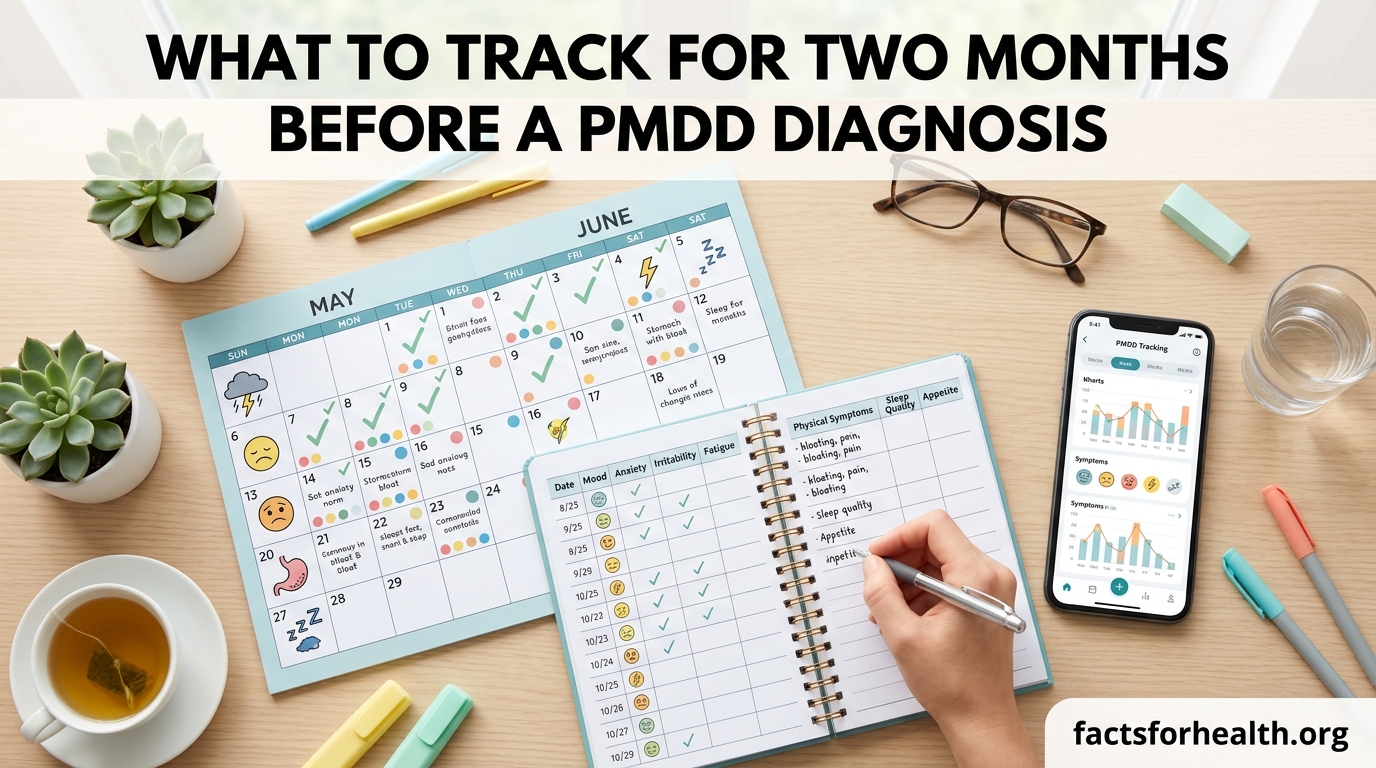
If you are reading this, you probably already suspect something is wrong. For one or two weeks before your period, you may feel like a completely different person. The sadness, rage, anxiety, or hopelessness can feel unbearable. Then your period starts, and the fog lifts almost as suddenly as it arrived.
You are not imagining it. But to get a formal PMDD diagnosis, your doctor needs proof. That proof comes from what you track for two months before a PMDD diagnosis appointment. Not from memory, not from a quiz, and not from a blood test. From daily, written documentation of your symptoms across at least two full menstrual cycles.
The DSM-5, which is the diagnostic manual clinicians use, requires prospective daily symptom tracking for at least two consecutive cycles before PMDD can be confirmed. This means the tracking itself is not optional. It is the diagnostic test.
In this guide, we will walk through exactly what to record, how to rate symptoms, which cycle details matter most, and how to present your data so your doctor takes it seriously. We will also cover common tracking mistakes, what to do if your symptoms are dismissed, and how to handle tracking when your cycles are irregular.
People in PMDD support communities frequently report waiting two to three years or more before getting a correct diagnosis. Many are told it is “just PMS” or are misdiagnosed with depression, anxiety, bipolar disorder, or ADHD first. The single most powerful thing you can do to shorten that timeline is to bring two months of structured, daily tracking data to your appointment.
Table of Contents
Why PMDD Cannot Be Diagnosed Without Two Months of Tracking
There is no blood test, brain scan, or hormone panel that can diagnose PMDD. The condition is defined entirely by a specific pattern of symptoms tied to the menstrual cycle. That pattern can only be confirmed through daily documentation over time.
The two-cycle requirement exists for a critical reason. Retrospective recall, meaning trying to remember your symptoms after the fact, is notoriously unreliable. Research shows people consistently overestimate or underestimate symptom severity when they rely on memory alone. You might remember the worst day but forget the five milder days surrounding it. Or you might minimize a terrible week because you felt better by the time your appointment arrived.
Prospective symptom tracking means recording your symptoms in real time, every day, before you know how the cycle will end. This eliminates recall bias and gives your clinician an accurate picture of what actually happened.
Two cycles are needed because PMDD is defined by its repetition. A single bad luteal phase could be caused by a stressful life event, an illness, poor sleep, or a fluke hormonal fluctuation. But when the same severe symptoms return in the same cycle phase two months in a row, that repetition is the clinical signature of PMDD.
This is also why clinicians cannot diagnose PMDD from a one-time questionnaire. A quiz might suggest PMDD is possible, but only daily tracking across two cycles can confirm it. The tracking data is the evidence.
The DSM-5 Criteria Explained Simply: The 5-in-11 Rule
The DSM-5 lists 11 specific symptoms associated with PMDD. To meet diagnostic criteria, you must experience at least 5 of these 11 symptoms during the luteal phase, in at least two consecutive menstrual cycles. At least one of those five must be from the first four symptoms on the list, which are considered the core emotional symptoms.
Here are the 11 DSM-5 PMDD symptoms, broken into categories:
Core emotional symptoms (must have at least one):
- Marked depression, hopelessness, or self-deprecating thoughts
- Marked anxiety, tension, or feeling keyed up or on edge
- Sudden sadness or tearfulness, with increased sensitivity to rejection
- Persistent and marked anger, irritability, or increased interpersonal conflicts
Additional symptoms (need enough to reach 5 total):
- Decreased interest in usual activities, hobbies, or work
- Difficulty concentrating
- Lethargy, fatigue, or marked lack of energy
- Marked change in appetite, food cravings, or overeating
- Hypersomnia (sleeping too much) or insomnia (trouble sleeping)
- Feeling overwhelmed or a sense of loss of control
- Physical symptoms such as breast tenderness, bloating, weight gain, or joint and muscle pain
These symptoms must also cause significant functional impairment, meaning they interfere with your work, school, relationships, or daily activities. They must appear in the week before your period starts and improve within a few days after menstruation begins. And critically, they must not be just a worsening of another existing condition like depression or anxiety.
Understanding this framework helps you know exactly what to track. When you rate each of these 11 symptoms daily, you give your doctor the precise data they need to confirm whether you meet DSM-5 criteria.
The 11 Core Symptoms to Track Every Single Day
Knowing what to track for two months before a PMDD diagnosis means understanding each symptom in practical terms. Here is what each one looks like in daily life, so you can rate it accurately.
Depressed Mood and Hopelessness
This is not everyday sadness. PMDD depression can feel like a heavy, suffocating despair that arrives suddenly and lifts just as suddenly when your period starts. You might feel hopeless about your future, worthless, or have thoughts that life is not worth living. Track this even if the thoughts scare you. Your doctor needs to know.
Anxiety and Tension
You might feel physically on edge, unable to relax, or consumed by worry about things that did not bother you the week before. Some people experience panic attacks, racing thoughts, or a constant sense of dread. Rate this separately from depression because both can occur together.
Tearfulness and Sensitivity to Rejection
Crying over small things, feeling suddenly overwhelmed by emotion, or feeling deeply hurt by comments that would normally roll off you. This mood lability can be one of the most noticeable signs for people close to you.
Anger, Irritability, and Rage
This is often the symptom that disrupts relationships most. PMDD rage can feel disproportionate and out of character. You might snap at loved ones, feel consumed by frustration over minor inconveniences, or experience bursts of anger that surprise even you. Many people in PMDD forums describe this as “the rage that comes from nowhere.”
Loss of Interest in Usual Activities
Hobbies, social plans, and work tasks that usually bring satisfaction suddenly feel pointless or impossible. You might cancel plans, avoid friends, or struggle to engage with things you normally enjoy. This can look like depression but follows the cyclical PMDD pattern.
Difficulty Concentrating and Brain Fog
Forgetting simple things, struggling to finish tasks at work, losing your train of thought mid-sentence, or feeling like your brain is wrapped in cotton. Many people with PMDD report that this cognitive disruption is what scares them most because it affects their professional performance.
Fatigue and Low Energy
This goes beyond normal tiredness. PMDD fatigue can make getting out of bed feel impossible, even after a full night of sleep. Your limbs might feel heavy and every task might require enormous effort.
Appetite Changes and Cravings
Sudden intense cravings, particularly for carbohydrates or sweets, or a marked increase in appetite. Some people find themselves eating far more than usual or feeling unable to feel satisfied regardless of how much they eat.
Sleep Disruption
Either inability to fall asleep or stay asleep despite exhaustion, or sleeping excessively and still feeling tired. Track hours slept and sleep quality if possible.
Feeling Overwhelmed and Loss of Control
A sense that everything is too much, that you cannot cope with normal demands, or that you are losing your grip on your life and emotions. This feeling of being overwhelmed is distinct from anxiety and is specifically listed in the DSM-5 criteria.
Physical Symptoms
Breast tenderness or swelling, abdominal bloating, weight gain, headaches, joint pain, muscle aches, or a general feeling of physical discomfort. These physical symptoms alone are not enough for a PMDD diagnosis, but they are part of the picture and should be tracked.
Functional Impact Tracking: Documenting How PMDD Disrupts Your Life
DSM-5 criteria require that your symptoms cause marked functional impairment. This means they must noticeably interfere with your daily functioning. Your tracking needs to capture not just what symptoms you feel, but how they affect your actual life.
For each day, note whether symptoms caused any of the following:
- Missed work, school, or important obligations
- Reduced productivity or difficulty completing tasks
- Conflict with a partner, family member, friend, or coworker
- Social withdrawal or canceling plans
- Difficulty parenting or caring for dependents
- Inability to do household chores or basic self-care
- Safety concerns, including any thoughts of self-harm
Be specific and honest. If you snapped at your partner and they left the room, write that down. If you could not finish a work presentation, note it. If you stayed in bed all day, record that too. These real-world impacts are often what convince a skeptical doctor that this is not just routine PMS.
One person in a PMDD support community shared that their breakthrough came when they brought in tracking data showing luteal-phase severity scores of 5 to 6 alongside follicular-phase scores of 1 to 2, plus documentation of missed workdays and relationship conflicts. That concrete evidence changed their doctor’s response from dismissive to seriously engaged.
The Daily Rating Format: How to Rate Symptoms for Maximum Diagnostic Value
The gold standard tool for PMDD tracking is the Daily Record of Severity of Problems, or DRSP. This is the validated instrument that researchers and clinicians use in PMDD studies. You do not need the official DRSP form specifically, but you should use the same rating approach.
Here is the 1 to 6 severity scale used in the DRSP:
- 1 means not at all. The symptom is absent.
- 2 means minimal. Barely noticeable.
- 3 means mild. Present but does not interfere with your day.
- 4 means moderate. Noticeable and somewhat disruptive.
- 5 means severe. Significantly interferes with daily activities.
- 6 means extreme. Debilitating, unable to function normally.
Rate each of the 11 symptoms on this scale every single day. Also rate functional impairment using the same 1 to 6 scale. Consistency matters more than perfection. If you are not sure whether something is a 3 or 4, pick one and move on. The pattern over two months is what matters, not any individual day.
Set a daily reminder on your phone for the same time each evening. Most people find that rating the day takes less than three minutes. The key is doing it every day, including days when you feel fine, because those low-score days are what establish the contrast that defines PMDD.
Avoid the temptation to only track on bad days. If you only record symptoms when they are severe, your data will show constant high scores without the cyclical pattern. That could actually work against you because it obscures the luteal-phase-specific timing that defines PMDD.
What to Track for Two Months Before a PMDD Diagnosis: Cycle Phase and Timing Data
Symptom ratings alone are not enough. You also need to track where you are in your menstrual cycle every day. This timing data is what allows your doctor to see whether your symptoms are truly luteal-phase-specific.
Here is the cycle information to record:
Period start date. Mark the first day of full menstrual flow as Day 1 of your cycle. This is your anchor point for everything else.
Period end date. Note when your bleeding stops.
Cycle day number. Count forward from Day 1. Most people ovulate around Day 14, and the luteal phase runs from ovulation until the next period starts, typically Days 14 through 28.
Cycle phase. Label each day as follicular (Days 1 to 13 approximately), ovulatory (around Day 14), or luteal (Days 15 to 28 approximately). If you do not know your exact ovulation day, that is fine. The luteal phase is approximately the last two weeks before your period.
Next period prediction. If you know your typical cycle length, note when you expect your next period to start.
The timing data creates the visual pattern your doctor needs. When they can see symptom scores of 1 to 2 during the follicular phase and 4 to 6 during the luteal phase, with improvement within days of your period starting, that is the clinical fingerprint of PMDD.
Without cycle timing, your symptom data is just a list of numbers. With it, the data tells a clear story that maps directly onto DSM-5 diagnostic criteria.
Tracking Methods: Apps vs Printable Charts vs Paper Diary
There are three main approaches to tracking, and each has advantages. The best method is whichever one you will actually use consistently for two full months.
PMDD-specific tracking apps are designed with the DRSP rating scale built in. They can automatically chart your symptoms against your cycle phase and generate visual reports for your doctor. The downside is that some apps have privacy concerns, and free versions may be limited. If you use an app, look for one that allows you to export or print a summary report.
Printable tracking charts give you a structured format on paper. You can find free DRSP-based templates online through organizations like IAPMD, the International Association for Premenstrual Disorders. The advantage is that you own your data, there are no privacy concerns, and you can bring the physical charts directly to your appointment. The disadvantage is that you need to remember to fill them in and carry them with you.
A simple paper notebook or journal works if you prefer flexibility. Write the date, cycle day, and rate each symptom 1 to 6. The advantage is total customization. The disadvantage is that summarizing two months of freeform notes into a format your doctor can quickly read is more difficult.
General period tracker apps are not ideal for PMDD diagnosis because they typically track only physical symptoms and period dates, not the detailed daily mood and cognitive ratings that PMDD diagnosis requires. If you already use one, you can keep it for cycle timing but add a separate PMDD-specific tracker for symptom ratings.
Whatever method you choose, the critical factor is daily consistency. A tracking method you use every day for two months beats a sophisticated system you abandon after one week.
Lifestyle Triggers to Track Alongside Your Symptoms
While not strictly required for diagnosis, tracking lifestyle factors alongside your symptoms can reveal patterns that help both you and your doctor. Some triggers may worsen PMDD symptoms, and identifying them gives you more information to work with.
Consider noting these factors daily or weekly:
- Sleep: Hours slept and quality. Sleep deprivation can dramatically worsen mood symptoms.
- Stress level: Rate 1 to 6. Major life stressors can amplify PMDD symptoms and make the pattern harder to read.
- Alcohol and caffeine intake: Both can affect mood, sleep, and anxiety levels.
- Exercise: Type and duration. Some people find exercise helps, while others feel too fatigued during the luteal phase.
- Diet changes: Significant changes in eating patterns, especially sugar or carbohydrate intake.
- Medications and supplements: Anything you take, including over-the-counter items, birth control, or herbal supplements.
Be careful not to confuse correlation with causation. If you craved sugar and felt terrible on the same day, the sugar may not have caused the mood symptoms. Both may be effects of the luteal phase hormonal shift. Tracking lifestyle factors is about gathering information, not assigning blame to yourself.
Your doctor may find this additional data useful when discussing treatment options after diagnosis. Some lifestyle patterns can inform recommendations around sleep hygiene, stress management, or nutritional support.
The PMDD Pattern in Data: What Two Cycles Will Show Your Doctor
When you track consistently for two months, a recognizable pattern should emerge if you have PMDD. Clinicians sometimes describe this as the “over the cliff and back” pattern.
Here is what the data typically looks like when PMDD is present:
During the follicular phase, roughly the first two weeks of your cycle starting from Day 1 of your period, symptom scores are low. You might rate most symptoms as 1 or 2. You feel like yourself. Energy is normal, mood is stable, concentration is clear.
As you enter the luteal phase, typically 7 to 10 days before your next period, scores begin climbing. By the final week before your period, multiple symptoms may hit 4, 5, or 6. The contrast between your follicular baseline and your luteal peak is dramatic and noticeable.
Then, within a few days of your period starting, the scores drop again. The symptoms resolve. You feel like yourself again, sometimes with startling speed.
This pattern, repeated across two cycles, is the evidence your doctor needs. The key elements are:
- Symptoms appear in the luteal phase, not throughout the cycle
- Symptoms are severe enough to cause functional impairment
- Symptoms improve within days after menstruation begins
- The pattern repeats in at least two consecutive cycles
If your scores are elevated throughout the entire cycle without a clear luteal-phase spike, that may indicate a different condition such as premenstrual exacerbation (PME) of an underlying mood disorder, rather than PMDD itself. This distinction matters because it affects treatment recommendations.
PMDD vs PMS vs PME: Why Distinguishing Them Matters
Understanding the difference between these three conditions helps you track more accurately and interpret your data correctly.
PMS (Premenstrual Syndrome) involves mild to moderate physical and emotional symptoms before your period. The key difference from PMDD is severity. PMS symptoms are annoying but do not cause significant functional impairment. You might feel bloated and irritable, but you can still go to work and maintain your relationships.
PMDD (Premenstrual Dysphoric Disorder) is severe and disabling. Symptoms cause marked impairment in daily functioning. The emotional symptoms are intense enough to disrupt work, relationships, and sometimes safety. PMDD is classified as a psychiatric condition in the DSM-5 because of its severity.
PME (Premenstrual Exacerbation) is different from both. In PME, a person has an underlying condition like depression, anxiety, or ADHD that exists throughout the entire cycle. But symptoms get noticeably worse during the luteal phase. Tracking shows elevated scores throughout the cycle with a spike before the period, rather than the clean baseline-and-spike pattern of PMDD.
This distinction is important because treatment differs. PMDD often responds to SSRIs taken only during the luteal phase. PME requires treating the underlying condition continuously. Misidentifying one as the other can lead to ineffective treatment.
Your tracking data is what makes this distinction possible. Two months of daily ratings will show whether your baseline is truly symptom-free or whether symptoms exist throughout the cycle with a premenstrual spike.
Common Tracking Mistakes That Can Delay Your Diagnosis
Even with the best intentions, certain tracking errors can undermine your data and prolong your diagnostic journey. Here are the most common mistakes to avoid.
Only tracking on bad days. If you only log symptoms when you feel terrible, your data shows constant high scores without the cyclical contrast. This can actually make it harder to confirm PMDD because the luteal-phase-specific pattern is invisible. Track every day, including good ones.
Filling in entries retroactively. Trying to reconstruct a week of symptoms from memory introduces the same recall bias that prospective tracking is meant to eliminate. Even filling in yesterday from memory is less reliable than rating in real time. Set a daily alarm and rate each evening.
Not tracking cycle timing. Symptom ratings without cycle day information are just numbers. Your doctor cannot determine whether symptoms are luteal-phase-specific without knowing where you are in your cycle. Always include cycle day, period dates, and cycle phase.
Tracking for less than two full cycles. One cycle is not enough. The DSM-5 requires confirmation across at least two consecutive cycles. If you stop after one, you may need to start over before your doctor can officially diagnose you.
Being too vague. Writing “felt bad” or “moody” does not give your doctor useful data. Use the 1 to 6 scale for each specific symptom. The structured ratings are what allow comparison across days and cycles.
Stopping too soon. Some people start feeling better after their period and stop tracking during the follicular phase. But those low-score follicular days are essential evidence. The contrast is the point.
What to Do If Your Doctor Dismisses Your Tracking Data
This is one of the most common and painful experiences in the PMDD community. You spend two months carefully tracking, you bring your data, and your doctor says it is just PMS or suggests you try birth control without further evaluation. What do you do?
First, know that this experience is widespread. Many people report needing to see multiple providers before finding one who takes PMDD seriously. You are not alone, and this dismissal does not mean your symptoms are not real.
Here are strategies that have worked for people in PMDD communities:
Ask directly about DSM-5 criteria. Say something like, “My tracking shows I meet the DSM-5 criteria for PMDD. I have at least 5 of the 11 symptoms during the luteal phase across two cycles, with significant functional impairment. Can we discuss this against the diagnostic criteria?” Using clinical language signals that you have done your research.
Request a referral. If your primary care provider or gynecologist is not familiar with PMDD, ask for a referral to a reproductive psychiatrist or a provider who specializes in premenstrual disorders. The IAPMD website maintains a provider directory.
Bring printed documentation. Have a one-page summary showing your average follicular scores versus your average luteal scores, plus a list of which DSM-5 symptoms you experience and how they impact your daily functioning. A clean summary is harder to dismiss than raw data.
Get a second opinion. You are always entitled to seek care from a different provider. If you feel dismissed or your concerns are minimized, finding a provider who listens is not unreasonable. It is advocating for your health.
Document the dismissal. If a provider dismisses your symptoms, note what was said, the date, and any alternative explanations they offered. This record can be useful if you later need to establish the timeline of your diagnostic journey or if you file a complaint.
Tracking With Irregular Cycles: PCOS, Perimenopause, and Beyond
Tracking for PMDD is more complicated when your cycles are irregular. Conditions like PCOS, perimenopause, breastfeeding, or coming off hormonal birth control can make it difficult to predict when your luteal phase begins and ends.
If your cycles are unpredictable, here is how to adapt your tracking:
Keep rating your symptoms daily regardless of where you think you are in your cycle. The DRSP scale and symptom list still apply. Ovulation test strips can help you identify when the luteal phase begins, since the luteal phase starts after ovulation and lasts roughly 14 days regardless of total cycle length.
Mark any bleeding as a potential period start. If you have very long cycles, your luteal phase is still approximately the last two weeks before bleeding starts. Focus on the relationship between symptom onset and the days leading up to bleeding.
Tracking may take longer than two months if your cycles are very long or irregular. You still need two full cycles of data, but those cycles might span three or four months of calendar time. Be patient and keep tracking.
If you recently stopped hormonal birth control, your natural cycle may take several months to regulate. Clinicians often recommend waiting until your cycle stabilizes before beginning PMDD tracking, because hormonal contraception suppresses the natural cycle that PMDD tracking is designed to measure.
Talk to your doctor about how your specific situation affects the tracking timeline. They may adjust the approach based on your individual cycle pattern.
What to Bring to Your First PMDD Appointment
After two months of daily tracking, you want to make the most of your appointment. Preparation is key, especially if you only have 15 to 20 minutes with the provider.
Bring the following items:
- Complete tracking data from two full cycles. Bring the raw daily logs, whether that is printed charts, exported app reports, or your notebook.
- A one-page summary highlighting your average symptom scores during the follicular phase versus the luteal phase, which DSM-5 symptoms you experienced, and specific examples of functional impact.
- Your medical history including any previous mental health diagnoses, current medications, and family history of mood or reproductive disorders.
- A list of questions you want to ask. Appointments go fast, and having your questions written down ensures you do not forget what matters most.
- Notes on what you have already tried to manage symptoms, including any over-the-counter supplements, lifestyle changes, or previous medications.
Consider bringing a trusted friend or partner if you tend to minimize your symptoms when speaking with doctors. They can help ensure your experience is accurately represented and provide emotional support.
Questions worth asking include: Do my symptoms meet DSM-5 criteria for PMDD? What treatment options do you recommend? Should I continue tracking during treatment? Can you refer me to a reproductive mental health specialist if needed?
When to Seek Immediate Help: Crisis Resources
PMDD can cause severe psychological distress, including suicidal thoughts. If you ever feel unsafe or have thoughts of harming yourself, do not wait for your next appointment. Seek help immediately.
If you are in the United States, call or text 988 to reach the Suicide and Crisis Lifeline, available 24 hours a day. You can also text HOME to 741741 to connect with the Crisis Text Line.
If you are outside the US, contact your local emergency services or look up crisis resources in your country. The International Association for Suicide Prevention maintains a directory of international crisis lines at iasp.info.
Write down these numbers now, before you need them. Keep them where you can find them during a difficult luteal phase. Tell someone you trust that you are struggling so they can check on you.
Severe PMDD symptoms are a medical issue, not a personal failing. If your symptoms are severe enough to involve safety concerns, that information is important for your doctor to know and should be documented in your tracking data.
FAQs
How long does it take to be diagnosed with PMDD?
A formal PMDD diagnosis requires prospective daily symptom tracking for at least two consecutive menstrual cycles, so the minimum timeline is about two months from when you start tracking. However, many people wait much longer because symptoms are initially dismissed as PMS or misdiagnosed as depression, anxiety, or bipolar disorder. The two months of tracking is the clinical requirement, but finding a provider who recognizes PMDD can add additional time.
How do you track PMDD for diagnosis?
To track PMDD for diagnosis, rate each of the 11 DSM-5 symptoms daily on a 1 to 6 severity scale, note your cycle day and phase, mark your period start and end dates, and document how symptoms impact your work, relationships, and daily activities. Use a structured tool like the DRSP or a PMDD-specific tracking app. Do this every day for at least two complete menstrual cycles and bring the full data set to your appointment.
What are the red flags of PMDD?
PMDD red flags include severe mood swings or rage that feel out of character, suicidal thoughts or hopelessness that appear cyclically before your period, anxiety or panic attacks tied to the luteal phase, brain fog that clears after menstruation, and symptoms severe enough to disrupt work or relationships. The defining red flag is the cyclical pattern: symptoms appear in the one to two weeks before your period and resolve within days after bleeding starts.
Does lamotrigine help with PMDD?
Lamotrigine has been studied as a potential treatment for PMDD mood symptoms but is not a first-line treatment. SSRIs are typically the first pharmaceutical option recommended for PMDD. Some research suggests lamotrigine may help certain individuals, but more studies are needed. Discuss all treatment options with a healthcare provider who is knowledgeable about premenstrual disorders.
Is there a lab test or blood test for PMDD?
No, there is no blood test, hormone panel, or scan that can diagnose PMDD. PMDD is diagnosed based on documented symptom patterns alone. Doctors may order blood tests to rule out other conditions like thyroid disorders, but these tests cannot confirm or rule out PMDD. Daily prospective symptom tracking across two cycles remains the only diagnostic method.
Can a gynecologist diagnose PMDD or do I need a psychiatrist?
Both gynecologists and psychiatrists can diagnose PMDD, as can primary care providers who are familiar with the condition. The diagnosis is based on your tracking data and DSM-5 criteria, which any trained clinician can apply. However, if your case is complex or involves overlapping mental health conditions, a reproductive psychiatrist who specializes in premenstrual disorders may provide the most informed evaluation.
Can PMDD be mistaken for depression or bipolar disorder?
Yes, PMDD is frequently misdiagnosed as depression, anxiety, bipolar disorder, or ADHD. This happens because the mood symptoms overlap significantly. The key difference is timing. PMDD symptoms are strictly tied to the luteal phase and resolve after your period starts, while depression and bipolar symptoms persist throughout the cycle. Two months of daily tracking data makes this distinction clear and helps prevent misdiagnosis.
What is the difference between PMDD and PME?
PMDD involves symptoms that appear only during the luteal phase and resolve completely after your period starts. PME, or premenstrual exacerbation, involves an underlying condition like depression or anxiety that exists throughout the entire cycle but gets worse during the luteal phase. Tracking shows the difference: PMDD has a symptom-free follicular baseline, while PME shows elevated symptoms throughout the cycle with a premenstrual spike.
What should I bring to my PMDD appointment?
Bring your complete daily tracking data from two full cycles, a one-page summary of your average follicular versus luteal scores, a list of which DSM-5 symptoms you experience, examples of functional impact on your daily life, your medical history, current medications, and a list of questions. Having organized documentation makes it much easier for your provider to evaluate whether you meet diagnostic criteria.
How many cycles do I need to track for a PMDD diagnosis?
The DSM-5 requires at least two consecutive menstrual cycles of prospective daily symptom tracking to confirm a PMDD diagnosis. One cycle is not sufficient because PMDD is defined by its repetition across cycles. If your cycles are irregular or very long, those two cycles may span more than two calendar months, but the two-cycle minimum remains the diagnostic standard.
Conclusion
Knowing what to track for two months before a PMDD diagnosis can dramatically shorten your path to answers. The daily ratings, cycle timing, functional impact notes, and lifestyle observations you collect become the evidence that transforms your experience from a feeling into a documented clinical pattern.
Start today. Pick your tracking method, set a daily reminder, and begin rating your symptoms on the 1 to 6 scale. Do not wait for the perfect moment or the perfect tool. Two months from now, you will have the data you need to walk into your appointment with confidence and clarity.
You know your body. You know when something feels wrong. Two months of structured tracking is how you prove it. And once you have that diagnosis, you and your doctor can work together on a treatment plan that actually addresses what you have been living through.
You deserve answers. Start tracking, and do not stop until you get them.