
When your mother with dementia asks where her own mother is, and her mother passed away thirty years ago, what do you say? If you tell her the truth, she experiences the grief of losing her mother all over again. Then ten minutes later, she asks the same question, and the cycle of pain repeats endlessly. This is the daily reality for millions of dementia caregivers, and it is exactly the situation that therapeutic fibbing was designed to address.
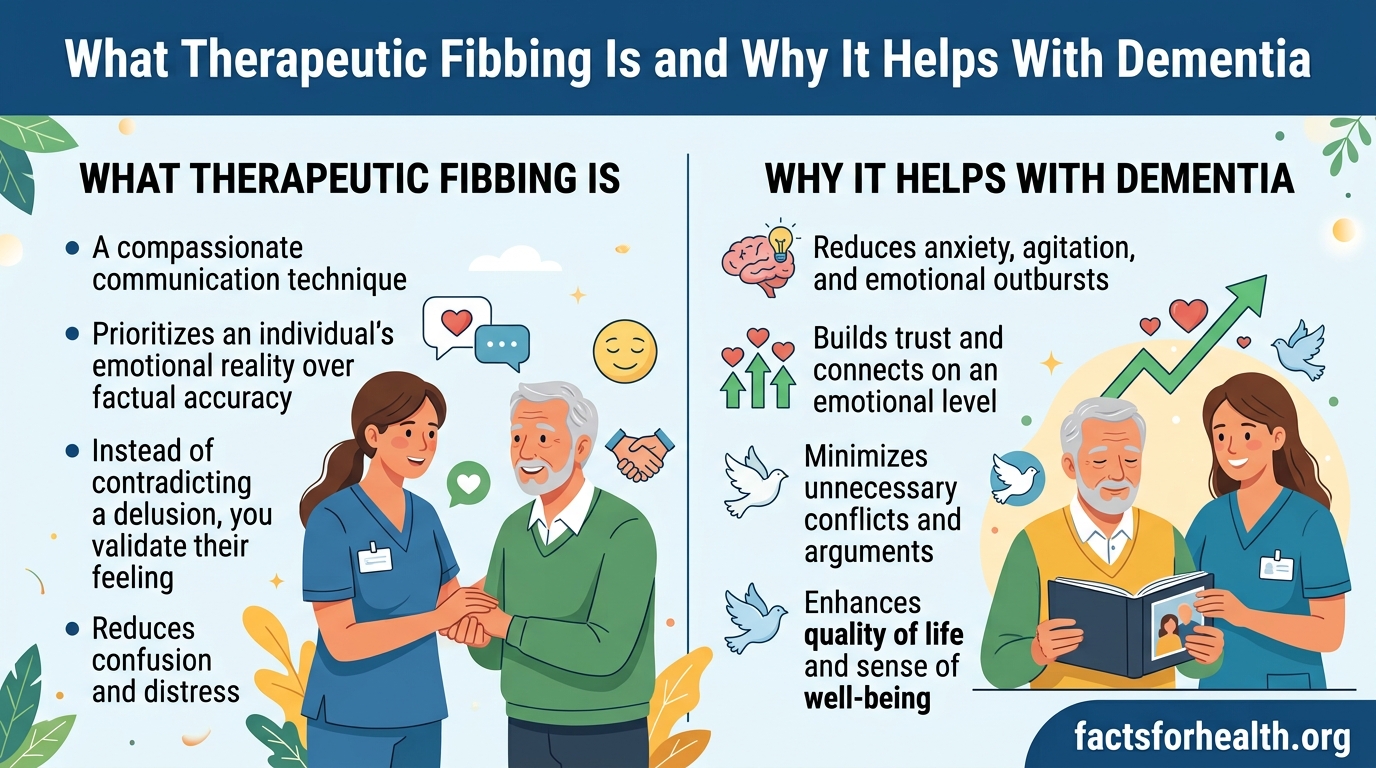
Therapeutic fibbing is a dementia care communication technique where caregivers gently bend the truth or tell small white lies to meet a person with dementia in their own perceived reality. Instead of correcting someone who is confused, you enter their world. The goal is simple: reduce suffering, prevent unnecessary distress, and protect emotional well-being when factual accuracy would only cause pain.
If you are caring for someone with Alzheimer’s disease or another form of dementia, you have probably already faced this dilemma without knowing there was a name for it. You may feel guilty about not telling the truth. Our team has dug into the research, caregiver forums, and expert guidance to put together a comprehensive guide that explains what therapeutic fibbing is, why it works, when to use it, and how to handle the emotional weight that comes with it.
Table of Contents
Quick Summary: Therapeutic Fibbing at a Glance
Here are the key points about therapeutic fibbing in dementia care:
- Definition: Therapeutic fibbing means telling gentle, compassionate untruths (sometimes called “fiblets”) to avoid causing distress when a person with dementia believes something that is not factually correct.
- Purpose: It reduces agitation, anxiety, and repeated grief cycles by prioritizing emotional comfort over factual accuracy.
- Endorsed by professionals: Surveys show approximately 96% of dementia care professionals use therapeutic fibbing or similar techniques in care settings.
- Not the same as lying: Regular lying serves the liar’s interests. Therapeutic fibbing serves the person with dementia by preventing unnecessary suffering.
- When to use: When the truth would cause distress and cannot be retained anyway (e.g., asking about a deceased loved one).
- When not to use: When safety, medical treatment, or legal matters are involved, or when the person has mild cognitive impairment and can still process reality.
- Alternatives: Validation therapy, redirection, and distraction can complement or replace therapeutic fibbing in some situations.
What Is Therapeutic Fibbing?
Therapeutic fibbing is the practice of telling small, compassionate lies or bending the truth to align with the reality that a person with dementia currently experiences. Rather than forcing someone to accept facts they can no longer process, the caregiver meets them where they are. This approach is sometimes called therapeutic lying, and the small untruths themselves are often referred to as “fiblets.”
The term “fiblet” was popularized in dementia care circles as a softer, more accurate way to describe what is happening. A fiblet is not a malicious deception. It is a small bending of facts designed to prevent suffering. Dementia care expert Rachael Wonderlin describes this approach as “embracing their reality.” Her philosophy is straightforward: when someone with dementia is living in a different time or place in their mind, joining them there is kinder and more effective than dragging them into a reality they cannot hold onto.
To understand why therapeutic fibbing is necessary, it helps to understand what dementia does to the brain. Dementia progressively damages the areas responsible for forming new memories, processing logic, and distinguishing between past and present. A person in the middle stages of Alzheimer’s disease might genuinely believe their deceased spouse is still alive, or that they need to go pick up their children from school, even though those children are now adults in their fifties.
In their mind, this is not confusion. It is their reality. The memories they access feel as real to them as your memories of yesterday feel to you. When you tell them they are wrong, their brain cannot update the information. They will not retain the correction, and within minutes they will return to their original belief, often now upset because you contradicted them.
This is what makes therapeutic fibbing fundamentally different from ordinary lying. When you lie in everyday life, you do it for your own benefit. When you use therapeutic fibbing in dementia care, you do it entirely for the other person’s well-being. You are choosing compassion over accuracy because accuracy has lost its usefulness.
Why Therapeutic Fibbing Helps With Dementia
The core reason therapeutic fibbing helps is that it prevents unnecessary emotional suffering. When someone with dementia asks about a deceased loved one, telling them the truth forces them to relive the grief of that loss. Because their brain cannot store the new information, they will ask again shortly after, and you will have to deliver the painful news once more. Each time, the grief is fresh and raw.
Caregivers on support forums describe this cycle vividly. One Reddit caregiver shared that their father asked about his deceased sister more than twenty times a day. Each time they told him she had passed away, he reacted as though hearing it for the first time, with shock and tears. After switching to therapeutic fibbing, the agitation dropped dramatically.
Therapeutic fibbing also reduces agitation and anxiety, two of the most challenging behavioral symptoms in dementia care. When you argue with someone who has dementia, or repeatedly correct their version of reality, they often become fearful, angry, or combative. They cannot understand why you are disagreeing with what feels absolutely real to them. By validating their reality through a gentle fib, you remove the source of conflict entirely.
There is a saying in dementia care, often attributed to Maya Angelou’s famous quote about how people remember how you made them feel: “They will forget what you said, but they will never forget how you made them feel.” This principle lies at the heart of why therapeutic fibbing works. People with dementia retain emotional memory far longer than factual memory. If you make them feel safe, comforted, and understood, that feeling persists even after the specific conversation fades.
The research backs this up. A UK survey found that the vast majority of healthcare professionals believed occasional therapeutic lying was in a patient’s best interest. Australia’s dementia care guidelines have taken a similar stance, acknowledging that honesty is not always the most compassionate policy when dealing with advanced cognitive impairment. In one telling statistic shared by nursing professionals on online forums, approximately 96% of dementia care staff report using therapeutic fibbing regularly in their work.
The Alzheimer’s Association recommends creative communication strategies, including therapeutic fibbing, as part of its caregiver education materials. The consensus among professionals is clear: when used thoughtfully, this technique improves quality of life for both the person with dementia and the caregiver.
Real-World Examples: What to Say vs. What Not to Say
Concrete examples make this approach much easier to understand. Here are common dementia scenarios with the typical truth-based response compared to the therapeutic fibbing alternative.
Scenario 1: Asking about a deceased spouse.
Instead of saying: “Your husband died three years ago.”
Try saying: “He’s at work right now, but he loves you very much and will see you soon.”
Scenario 2: Wanting to go home when they are already home.
Instead of saying: “You are home. This is your house.”
Try saying: “We will go home soon. Let’s have a cup of tea while we wait.”
Scenario 3: Wanting to go to work when they retired years ago.
Instead of saying: “You retired fifteen years ago. You do not work anymore.”
Try saying: “It’s your day off today. Let’s enjoy it together.”
Scenario 4: Asking to see their mother.
Instead of saying: “Your mother passed away decades ago.”
Try saying: “She’s not here right now, but she thinks about you all the time.”
Scenario 5: Refusing to see a doctor.
Instead of saying: “You have dementia and you need to see a specialist.”
Try saying: “We are going to get your regular checkup. The doctor just wants to make sure you are healthy.”
Notice the pattern in each example. The therapeutic fibbing response avoids confrontation, acknowledges the person’s emotional need, and gently redirects. The truth-based response, while factually correct, would likely trigger distress, argument, or a fresh wave of grief.
When to Use Therapeutic Fibbing (and When Not To)
Knowing when to use therapeutic fibbing is just as important as knowing how. Not every situation calls for a fiblet, and using one in the wrong moment can create real problems. Here is a practical framework to help you decide.
A Simple 3-Step Decision Framework
Step 1: Ask yourself, “Will the truth cause significant distress?” If the person is asking about a deceased loved one, expressing a harmless belief, or stuck in a loop of anxiety, the answer is likely yes.
Step 2: Ask yourself, “Can they retain the correct information?” If they have moderate to advanced dementia and cannot hold onto new facts, correcting them accomplishes nothing except repeated pain. If they have mild cognitive impairment and can still process and remember corrections, a gentle version of the truth may be more appropriate.
Step 3: Ask yourself, “Is there a safety or medical concern?” If the situation involves medication, medical treatment, legal decisions, or physical safety, the truth is non-negotiable. Therapeutic fibbing is for emotional comfort, not for situations where accuracy affects well-being.
When Therapeutic Fibbing Is Appropriate
Use therapeutic fibbing when the person asks repeated questions about deceased family members, believes they need to perform outdated routines like going to work or catching a bus, or expresses confusion about where they are. It is also useful when someone resists necessary activities like bathing, eating, or attending a day program, and a gentle redirection through a fiblet can ease the transition.
When Therapeutic Fibbing Is Not Appropriate
Do not use therapeutic fibbing when medical information must be communicated accurately, when legal or financial decisions are being made, or when the person is in early-stage dementia and still capable of understanding and retaining the truth. It is also not appropriate to use fiblets for your own convenience rather than the person’s well-being. If you are telling a lie because it makes your day easier rather than making them feel better, it is time to reconsider.
When Therapeutic Fibbing Can Backfire
In some cases, therapeutic fibbing can make a situation worse. People with dementia who have prominent paranoia or suspicion as part of their condition may catch inconsistencies and become more agitated. Frontotemporal dementia, in particular, can preserve sharp language skills while impairing judgment, meaning the person might detect the fib and lose trust in you. If you notice that a fiblet is escalating the situation rather than calming it, abandon the approach immediately. Switch to validation therapy, redirection, or simply sitting with them in silence until the moment passes.
Alternative Dementia Communication Techniques
Therapeutic fibbing is one tool in a broader toolkit of non-pharmacological dementia care strategies. Understanding the alternatives helps you choose the right approach for each situation.
Validation Therapy: Developed by Naomi Feil, validation therapy involves acknowledging and validating the person’s emotions rather than correcting their facts. Instead of agreeing with a false belief or denying it, you focus on the feeling behind it. If someone says they need to find their mother, you might ask, “What do you miss about your mom?” This approach works well for people who still have some capacity for emotional dialogue, but it can be less effective in advanced stages where language skills have significantly deteriorated.
Redirection: Redirection means gently shifting the person’s attention to a different topic or activity. When someone is fixated on leaving to go home, you might say, “Before we go, let’s grab a snack” and then guide them toward an engaging activity. Redirection pairs naturally with therapeutic fibbing and is often used as a follow-up step.
Distraction: Distraction is the simplest technique of all. You introduce a new stimulus, such as playing favorite music, offering a familiar object, or starting a conversation about a beloved topic, to break the cycle of fixation. Distraction works well in early to moderate dementia but becomes harder as the condition progresses.
No single technique is perfect for every situation. The best caregivers develop fluency in all of these approaches and move fluidly between them based on what the moment requires. Therapeutic fibbing, validation, redirection, and distraction are complementary strategies, not competing ones.
Common Mistakes Caregivers Make With Therapeutic Fibbing
No competitor we reviewed covers this topic, and it is one of the most valuable sections for caregivers who are new to this approach. Here are the mistakes we see most often in caregiver forums and support groups.
Mistake 1: Overcomplicating the fib. Keep your fiblets short and simple. Elaborate lies with excessive detail are harder to deliver convincingly and easier for the person to detect. “Your husband is at the store” works better than a ten-minute story about exactly which store and what he is buying.
Mistake 2: Using fiblets for caregiver convenience. If you find yourself lying to avoid a conversation you do not want to have, rather than to prevent the person distress, you have crossed a line. Always ask whether the fib serves them, not you.
Mistake 3: Being inconsistent. If you tell one family member’s fiblet version and your sibling tells a different one, the inconsistency can confuse and upset the person with dementia. Coordinate with other caregivers so your stories align.
Mistake 4: Forgetting that early-stage dementia is different. In early-stage dementia, the person may still be aware of their diagnosis and able to process and retain information. Using therapeutic fibbing too early can feel patronizing and damage trust. Reserve this technique for when factual correction has clearly stopped working.
Mistake 5: Not reading the room. If the person becomes more agitated after your fiblet, continuing to push the lie will make things worse. Always watch their emotional response and pivot if needed.
Dealing With Caregiver Guilt
If you feel guilty about using therapeutic fibbing, you are not alone. Caregiver guilt is the single most common emotional challenge mentioned in dementia support forums. Multiple Reddit threads in r/CaregiverSupport and r/dementia feature caregivers expressing deep moral conflict about lying to a parent or spouse they love.
Here is the perspective that helps: you are not lying to deceive. You are bending the truth to prevent suffering. The person you love would not want to experience fresh grief twenty times a day. If they could understand what was happening to their brain, most would tell you to do whatever reduces their pain.
One of the most common sources of guilt is not the person with dementia at all. It is other family members. Siblings, adult children, and extended family who are not involved in daily caregiving often criticize therapeutic fibbing because they have not experienced the exhausting cycle of repeated corrections. If you face this situation, the best approach is education. Share this article or resources from the Alzheimer’s Association with skeptical family members. Explain the 3-step decision framework. Invite them to spend a full day providing care so they can experience the reality of dementia communication firsthand.
For your own emotional well-being, consider joining a caregiver support group, whether in person or online. Connecting with others who understand this experience validates what you are going through. Professional caregivers overwhelmingly endorse therapeutic fibbing when used with good intentions, and hearing that from people who do this work every day can ease the burden of self-doubt.
FAQs
What is therapeutic lying for dementia patients?
Therapeutic lying, also called therapeutic fibbing, is a dementia care technique where caregivers tell small compassionate untruths to meet a person with dementia in their own perceived reality. Instead of correcting false beliefs that the person cannot retain, the caregiver gently aligns with the person’s version of events to prevent distress, agitation, and repeated grief.
Does therapeutic fibbing really work?
Yes. Research and professional consensus support therapeutic fibbing as an effective non-pharmacological approach to reducing agitation and anxiety in dementia care. Surveys show approximately 96% of dementia care professionals use it regularly, and the Alzheimer’s Association recommends creative communication strategies including therapeutic fibbing as part of standard caregiver education.
Is therapeutic fibbing ethical?
Therapeutic fibbing is widely considered ethical in dementia care when used compassionately and in the person’s best interest. It differs from ordinary lying because it serves the person with dementia rather than the caregiver. However, it should not be used when medical accuracy, safety, or legal matters are involved, or when the person still has the cognitive ability to process and retain the truth.
What activities help with dementia?
Activities that help with dementia include listening to familiar music, looking through photo albums, doing simple crafts or puzzles, gardening, cooking familiar recipes, taking short walks, and participating in reminiscence therapy. Activities that connect to the person’s past interests and identity tend to be most effective at reducing agitation and improving mood.
Can therapeutic fibbing make dementia worse?
Therapeutic fibbing does not worsen dementia itself, since dementia is a progressive brain disease unaffected by communication techniques. However, using fiblets inappropriately, such as with someone who has prominent paranoia or who is in early-stage dementia with preserved awareness, can increase suspicion and agitation. Always monitor the person’s response and switch techniques if a fiblet is causing more distress.
Compassion Over Correctness
Understanding what therapeutic fibbing is and why it helps with dementia can transform your experience as a caregiver. This technique is not about deception or taking the easy way out. It is about recognizing that when someone you love can no longer hold onto reality, the kindest thing you can do is meet them where they are. By choosing emotional comfort over factual accuracy, you reduce their suffering, preserve their dignity, and protect your relationship with them.
If you are struggling with caregiver guilt or family disagreements about this approach, remember the professionals who work in dementia care every day overwhelmingly support it. Connect with a local caregiver support group, reach out to the Alzheimer’s Association for resources, and give yourself permission to prioritize compassion. The person you are caring for may not remember what you said, but they will always remember that you made them feel safe and loved.