
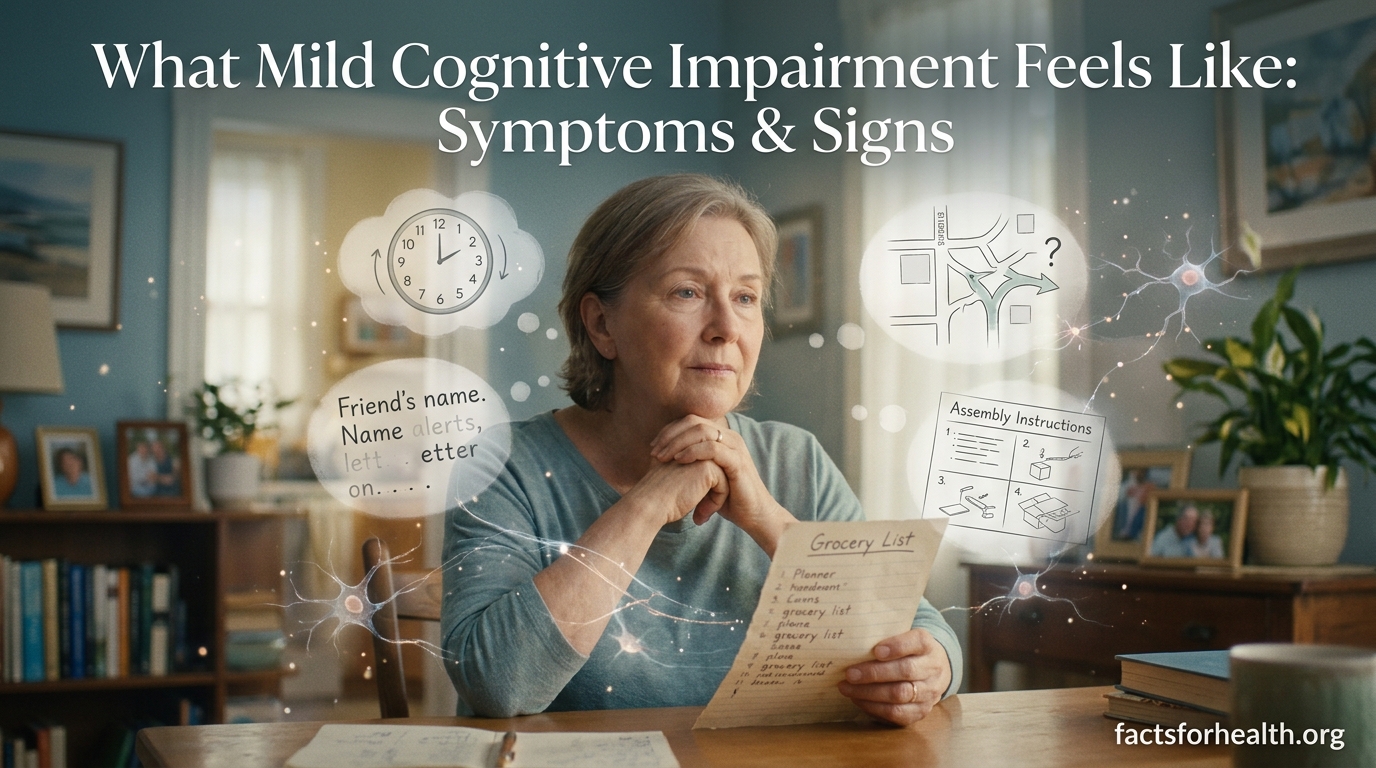
If you have found yourself searching for what mild cognitive impairment feels like, you are probably worried about changes you or someone you love has been experiencing. Maybe you walked into a room and forgot why. Maybe you stopped mid-sentence because the word you needed simply vanished. Maybe a family member has mentioned something that left you wondering if these moments add up to something more than getting older.
You are not alone in asking this question. Thousands of people search for this every month, and many more wonder silently. The experience of mild cognitive impairment, or MCI, is something that sits in a confusing gray area. It is not quite normal aging, and it is not dementia. It is its own condition, and the way it feels day to day is something medical resources rarely describe in human terms.
In this guide, our team breaks down what mild cognitive impairment feels like from the inside. We cover the symptoms people actually notice, the emotional weight of living with MCI, how it differs from normal forgetfulness, and what you can do about it. Whether you are here for yourself or for someone you care about, you will find clear, honest, and specific information.
This article is written for 2026 and reflects the most current understanding of MCI from major medical sources including Mayo Clinic, Cleveland Clinic, and the National Institute on Aging. We have also drawn from real experiences shared in patient and caregiver communities to give you the full picture of what MCI feels like in real life.
Table of Contents
What Mild Cognitive Impairment Actually Feels Like
Understanding what mild cognitive impairment feels like starts with recognizing that it is not one single sensation. It is a collection of small disruptions that build over time. Each one might seem minor on its own, but together they create a pattern that something has shifted.
People with MCI often describe a feeling like their brain is working through fog. Thoughts that used to come instantly now take a moment longer to arrive. The information is still there, but retrieving it requires more effort. One person described it as “like reaching for a book on a shelf and having to stretch just a little further than before.”
Here is what that can look like in everyday life. Imagine you are at the grocery store. You have your list, but halfway through, you realize you cannot remember whether you already picked up the milk. You walk back to the dairy aisle to check. A week earlier, you would have known without thinking. Now there is a flicker of doubt that was not there before.
Or picture yourself in a conversation with friends. Someone asks you a question about a movie you watched last weekend. You know the answer. You can see the actor’s face. But the name will not come. You feel the word sitting right on the tip of your tongue, and seconds pass. The conversation moves on, and you feel a small flash of frustration that lingers.
Many people with MCI describe a growing awareness that they are compensating more than they used to. They start setting more alarms, writing more notes, relying on routines to carry the load their memory used to handle alone. This compensation often works well enough that people around them do not notice anything is wrong. But internally, the effort required to stay on top of things has increased.
Some describe a subtle shift in confidence. Tasks that once felt automatic, like navigating to a familiar restaurant or following the plot of a novel, now require more concentration. The book you are reading suddenly feels harder to track. You flip back a few pages because you cannot quite remember what happened in the last chapter. These moments are not catastrophic, but they accumulate.
It is worth noting that MCI does not typically interfere with your ability to live independently. You can still manage your household, pay your bills, cook your meals, and maintain your relationships. That is actually part of what defines MCI. If these activities become significantly impaired, the diagnosis would shift toward dementia. With MCI, you are functioning, but you are aware that something has changed.
The experience can also feel isolating because it is largely invisible. Unlike a physical condition that others can see, cognitive changes happen internally. Family members may not fully understand what you are going through, which can make the experience feel lonelier than it needs to be. This is one reason why support groups and shared experiences matter so much for people living with MCI.
Common Symptoms of Mild Cognitive Impairment
The symptoms of mild cognitive impairment fall into several categories. Some affect memory, others affect language, and still others touch judgment, attention, or spatial awareness. Most people experience a mix, though one area may stand out more than the rest.
Here are the most common symptoms people notice, described in terms of what they actually feel like day to day.
Memory Changes
Forgetting things more often than you used to is the most frequently reported symptom of MCI. This goes beyond occasionally misplacing keys. It is a pattern of forgetting recent conversations, upcoming appointments, or information you just learned. You might ask the same question twice without realizing it, or forget that someone told you something important earlier in the day.
Many people describe walking into a room and having no idea why they went there. This happens to everyone occasionally, but with MCI it happens more frequently and feels more complete. The intent is not just delayed, it is gone, and you have to retrace your steps to figure out what you were doing.
Word-Finding Difficulties
Trouble finding the right word is one of the most frustrating symptoms people with MCI describe. You know exactly what you want to say. The concept is clear in your mind. But the specific word you need feels just out of reach. You might substitute a related word, or describe the word instead of saying it. “The thing you cook on” instead of “stove.” “That red fruit” instead of “apple.”
This tends to happen most with less common words or names. Common, everyday vocabulary usually remains intact. But proper names, whether of people, places, or objects, can become surprisingly elusive. Some people describe it as having the filing cabinet of their vocabulary still intact, but the labels have gotten harder to read.
Losing Your Train of Thought
Many people with MCI describe losing their train of thought mid-sentence or mid-task. You are explaining something and suddenly the next idea is gone. Or you are working on a project and forget what step comes next. This can feel like a mental hiccup, a brief blank where continuity used to be.
In conversations, this can lead to awkward pauses or abrupt topic changes. You might start telling a story, get interrupted, and then find you cannot pick up where you left off. The thread has slipped away, and even though you remember the general point, the specific details have dissolved.
Trouble Following Conversations
Difficulty following conversations, especially in groups or noisy environments, is another common experience. When multiple people are talking, or when the conversation moves quickly between topics, keeping track becomes exhausting. You might lose the thread of a discussion and find yourself nodding along without fully tracking what is being said.
This can also extend to following the plot of a movie, TV show, or book. Characters blend together. Timeline events get confused. You might need to rewind or reread passages more often than you used to. This is not about intelligence or attention span. It is about the working memory that holds multiple pieces of information simultaneously, which can be affected by MCI.
Misplacing Items
Misplacing items more frequently is a hallmark symptom. This is not just about losing keys sometimes. It is about putting items in unusual places and having no memory of doing so. Finding the remote control in the refrigerator. Discovering your wallet in the bathroom cabinet. These moments can be jarring because they suggest a lapse that goes beyond ordinary absentmindedness.
What makes this different from normal forgetfulness is the frequency and the oddness of the locations. Everyone forgets where they parked occasionally. But with MCI, the pattern repeats, and the hiding spots become stranger and harder to retrace logically.
Difficulty With Navigation and Directions
Some people with MCI experience confusion with directions, even in familiar areas. You might take a wrong turn on a route you have driven dozens of times. Or you might struggle to follow a set of directions that used to feel straightforward. In unfamiliar places, navigating can feel more overwhelming than it once did.
This symptom is more common in non-amnestic MCI, which affects spatial skills and visual perception. But it can occur in any type. Some people describe a moment of brief disorientation, like a flash of not knowing which way to turn, before their internal map reasserts itself.
Trouble Making Decisions
Poor judgment and difficulty making decisions can also be part of the MCI experience. This does not mean catastrophic errors. It is more about a sense that decisions which once felt quick and natural now require more deliberation. You might second-guess yourself more, or feel less confident in choices that used to be automatic.
Falling behind on bills, missing deadlines, or struggling to manage complex tasks that involve multiple steps can also occur. These are often the symptoms that family members notice first, because they have a visible impact on daily life even if the person with MCI does not fully recognize the change.
Becoming Easily Distracted
Many people with MCI find they become easily distracted and have more trouble maintaining focus on tasks. Completing something that requires sustained attention, like doing taxes or following a recipe with multiple steps, feels harder. Your mind wanders more quickly, and getting back on track takes longer.
This can feel like a reduction in mental stamina. Tasks that you once powered through now require breaks. Your tolerance for cognitive demand has decreased, and you find yourself avoiding activities that feel mentally exhausting.
The Emotional Experience of Living With MCI
One of the most under-discussed aspects of what mild cognitive impairment feels like is the emotional toll. Medical resources tend to list depression and anxiety as symptoms, but they rarely explore what it actually feels like to live with the awareness that your cognition has changed.
For many people, the first emotion is fear. The moment you realize your memory is not what it used to be, the thought jumps immediately to dementia. Am I getting Alzheimer’s? Is this the beginning of something terrible? This fear can be overwhelming, especially before a formal diagnosis provides clarity.
Then comes frustration. Living with MCI means living with small failures that add up. The word you could not find in a meeting. The appointment you forgot. The story you could not finish. Each one is minor, but the cumulative weight can feel heavy. People describe a sense of grief for the mental sharpness they used to have.
Anxiety about memory loss is extremely common. People with MCI often monitor themselves constantly, testing their memory, worrying about every lapse. This self-surveillance can become exhausting and can actually worsen the experience of symptoms. When you are anxious about forgetting, your attention is split, which makes forgetting more likely.
Depression and MCI frequently coexist. Research suggests that depression can both be a risk factor for MCI and a consequence of living with it. The relationship goes both ways. Some people experience apathy, a loss of interest in activities they once enjoyed. Others become more irritable or short-tempered, which can strain relationships.
There is also a process of adjustment that comes after a diagnosis. Some people feel relief at having a name for what they are experiencing. Others feel a sense of loss or uncertainty about the future. The prognosis of MCI is genuinely uncertain, which means living with ambiguity. Some people stay stable for years. Some improve. Some progress to dementia. Holding all of that at once is emotionally demanding.
Forum discussions reveal that people with MCI and their caregivers deeply value honest conversations about these feelings. They want to hear from others who have navigated the same terrain. Support groups, whether in person or online, can be a lifeline. Knowing you are not the only person who feels this way can make a real difference.
If you are experiencing depression, anxiety, or persistent distress related to MCI, please talk to your doctor. Mental health support is a legitimate and important part of managing this condition. You do not have to white-knuckle through the emotional impact alone.
Types of Mild Cognitive Impairment
Not all mild cognitive impairment looks the same. Doctors classify MCI into different types based on which cognitive skills are most affected. Understanding which type you or your loved one has can help explain why certain symptoms stand out more than others.
Amnestic MCI
Amnestic MCI is the most common type and primarily affects memory. People with this type forget recent events, struggle to recall conversations, and have difficulty retaining new information. The memory changes are the most prominent feature, while other cognitive skills like language and reasoning remain relatively intact.
Amnestic MCI is the type most closely associated with a higher risk of progressing to Alzheimer’s disease. This is because the memory changes often reflect early involvement of the hippocampus, the brain structure most affected in Alzheimer’s. However, having amnestic MCI does not mean you will definitely develop Alzheimer’s. Many people remain stable for years.
Non-Amnestic MCI
Non-amnestic MCI affects cognitive skills other than memory. This can include language, attention, visual perception, or executive function. People with this type might have more trouble with word-finding, navigation, decision-making, or multitasking than with remembering events.
Non-amnestic MCI is more often associated with conditions other than Alzheimer’s, such as vascular cognitive impairment, Lewy body disease, or frontotemporal degeneration. The specific pattern of symptoms can give doctors clues about what underlying brain changes might be responsible.
Single-Domain vs Multi-Domain MCI
MCI can also be classified by how many cognitive areas are affected. Single-domain MCI involves impairment in one cognitive area, such as memory alone. Multi-domain MCI involves two or more areas, such as memory plus language, or attention plus executive function.
Multi-domain MCI may carry a somewhat higher risk of progression to dementia, though this depends heavily on the underlying cause. Your neurologist or cognitive specialist can explain which type you have and what it might mean for your outlook.
MCI vs Normal Age-Related Forgetfulness
One of the most common questions people have is how to tell the difference between normal aging and MCI. This distinction matters because it determines whether you should seek medical evaluation. The line between the two can feel blurry, but there are clear patterns that separate them.
Normal age-related changes include occasionally forgetting names or appointments but remembering them later. Walking into a room and forgetting why, then recalling it after a moment. Misplacing items occasionally but being able to retrace your steps to find them. These experiences are universal and do not necessarily indicate a problem.
MCI involves changes that are more frequent, more noticeable, and more disruptive. The key difference is that the lapses occur more often than they used to, and you may not recover the information later. Others may start to notice. You may begin compensating with strategies like notes and alarms.
To make this comparison clearer, here is a side-by-side breakdown across three categories.
- Normal aging: Occasionally forgets a word but recalls it later. MCI: Frequently struggles to find words and may not recall them. Dementia: Regularly substitutes incorrect words or loses vocabulary entirely.
- Normal aging: Sometimes misplaces keys or glasses. MCI: Frequently misplaces items in unusual locations. Dementia: Puts items in bizarre places and has no memory of doing so.
- Normal aging: Momentarily forgets the date but figures it out. MCI: Loses track of time or appointments more often. Dementia: Consistently confused about dates, seasons, and time passing.
- Normal aging: Occasionally needs help with new technology. MCI: Struggles with familiar tasks like managing finances or following a recipe. Dementia: Cannot independently manage daily tasks like cooking, cleaning, or paying bills.
- Normal aging: May make a rare poor decision. MCI: Shows some decline in judgment or decision-making. Dementia: Significant impairment in judgment, often with no awareness of the problem.
- Normal aging: Independent in daily living. MCI: Still independent but working harder to stay on top of things. Dementia: Requires increasing assistance with daily activities.
The most important distinction is functional independence. With normal aging, you function the way you always have. With MCI, you are still independent but you notice the effort has increased. With dementia, independence itself begins to erode. If you are unsure where you or your loved one falls, that uncertainty is itself a reason to talk to a doctor.
What Causes Mild Cognitive Impairment?
The causes of mild cognitive impairment are not fully understood, and in many cases no single cause can be identified. MCI appears to result from a combination of factors that affect brain health over time. Understanding these causes helps explain why the symptoms feel the way they do.
One major factor is physical changes in the brain. As we age, the brain naturally undergoes some shrinkage, particularly in regions involved in memory and executive function. In MCI, this shrinkage may be slightly more pronounced. The hippocampus, the brain structure critical for forming new memories, often shows measurable volume loss in people with amnestic MCI.
Protein accumulation also plays a role. Beta-amyloid plaques and neurofibrillary tangles, the same protein deposits found in Alzheimer’s disease, can begin building up in the brain years before symptoms appear. In MCI, these deposits may be present at intermediate levels. Not yet at the threshold for an Alzheimer’s diagnosis, but more than what is seen in healthy aging.
Vascular factors are another significant contributor. Reduced blood flow to the brain, whether from small strokes, chronic high blood pressure, or other cardiovascular issues, can damage brain tissue over time. This is sometimes called vascular cognitive impairment. The symptoms may look similar to other forms of MCI but the underlying mechanism is different.
Several treatable medical conditions can cause or worsen cognitive symptoms that mimic MCI. These include medication side effects, which are an especially common culprit in older adults. Many medications, including antihistamines, sleep aids, and certain blood pressure drugs, can cause cognitive fog. Depression and anxiety can also produce MCI-like symptoms, as can thyroid disorders, vitamin B12 deficiency, and infections.
Sleep disorders, particularly sleep apnea, are increasingly recognized as a cause of cognitive symptoms. When your brain does not get enough oxygen during sleep, or when sleep quality is chronically poor, thinking and memory suffer. Treating sleep apnea can sometimes reverse cognitive symptoms entirely.
This is why a thorough medical evaluation is so important when MCI is suspected. Identifying and treating a reversible cause can make a meaningful difference. Not every case of cognitive decline is permanent or progressive. Some have straightforward solutions.
Risk Factors for Cognitive Decline
Certain factors increase the likelihood of developing MCI. Some cannot be changed, but many can be modified through lifestyle and medical management. Here are the most significant risk factors identified by current research.
- Age: The risk of MCI increases significantly after age 65. The condition affects an estimated 15 to 20 percent of adults in this age group.
- Genetics: The APOE-e4 gene variant is associated with a higher risk of both MCI and Alzheimer’s disease. Having this gene does not guarantee you will develop either condition, but it does increase susceptibility.
- Family history: A family history of dementia or Alzheimer’s raises your risk, suggesting a hereditary component.
- Cardiovascular conditions: High blood pressure, high cholesterol, diabetes, and heart disease all increase risk by affecting blood flow to the brain over time.
- Depression: Depression is both a potential cause and consequence of cognitive decline. The relationship is complex and bidirectional.
- Sleep apnea: Untreated sleep apnea deprives the brain of oxygen and quality sleep, contributing to cognitive symptoms.
- Hearing loss: Significant hearing loss is now recognized as a major modifiable risk factor for cognitive decline. The exact mechanism is still being studied but may involve reduced cognitive stimulation and social isolation.
- Traumatic brain injury: A history of head injuries, particularly repeated concussions, increases long-term risk of cognitive problems.
- Sedentary lifestyle: Physical inactivity is associated with faster cognitive decline, while regular exercise appears protective.
- Smoking: Smoking damages blood vessels throughout the body, including those supplying the brain.
- Social isolation: Limited social engagement and intellectual stimulation are linked to faster cognitive decline.
- Low education level: Lower levels of formal education and lifelong intellectual engagement are associated with higher risk, possibly due to lower cognitive reserve.
Having one or more risk factors does not mean you will definitely develop MCI. Many people with multiple risk factors never experience significant cognitive decline. But understanding your risk profile can help you and your doctor take proactive steps to protect your brain health.
How Mild Cognitive Impairment Is Diagnosed
Getting a diagnosis of MCI involves several steps. There is no single test that definitively confirms the condition. Instead, doctors use a combination of cognitive assessments, medical history, and sometimes brain imaging to build a complete picture.
The process usually begins with a conversation about what you have been noticing. Your doctor will ask about specific symptoms, when they started, whether they have worsened, and how they are affecting your daily life. They will also ask about your medical history, medications, family history, and lifestyle.
Cognitive testing is a central part of the evaluation. Common screening tools include the Montreal Cognitive Assessment, known as the MoCA, and the Mini-Mental State Examination, known as the MMSE. These tests take 10 to 30 minutes and assess memory, language, attention, and spatial skills. They give a snapshot of how well your brain is performing across different domains.
If screening suggests cognitive concerns, your doctor may refer you for more detailed neuropsychological testing. This involves several hours of comprehensive assessments administered by a neuropsychologist. The results provide a detailed profile of your cognitive strengths and weaknesses, which helps distinguish MCI from normal aging, dementia, and other conditions.
Blood tests are typically ordered to rule out treatable causes of cognitive symptoms. These check for thyroid dysfunction, vitamin B12 deficiency, signs of infection, and other medical issues that can affect thinking and memory. Medication review is also important, as drug side effects are a common and reversible cause of cognitive complaints.
Brain imaging, usually an MRI, may be recommended to look for structural changes. An MRI can reveal evidence of small strokes, brain atrophy, tumors, or other abnormalities. While imaging alone cannot diagnose MCI, it helps rule out other causes and provides baseline information about your brain health.
In some cases, particularly when Alzheimer’s disease is suspected, a doctor may recommend a lumbar puncture to test cerebrospinal fluid for biomarkers like beta-amyloid and tau proteins. This is more invasive and is not part of routine evaluation, but it can provide valuable diagnostic information in certain situations.
Treatment and Management of MCI
There is currently no FDA-approved medication specifically for mild cognitive impairment. This can feel discouraging, but it does not mean nothing can be done. In fact, there is strong evidence that lifestyle changes and proactive management can make a real difference in how people feel and function with MCI.
The first step in management is identifying and treating any reversible causes. If your cognitive symptoms are related to a medication side effect, adjusting that medication may resolve the problem. If sleep apnea is contributing, treatment with a CPAP machine can improve both sleep quality and cognition. Vitamin deficiencies, thyroid problems, and depression are all treatable conditions that, when addressed, can improve cognitive function.
For MCI that is not caused by a treatable condition, the focus shifts to lifestyle interventions. Physical exercise is one of the most evidence-supported strategies. Aerobic exercise, such as walking, swimming, or cycling, improves blood flow to the brain and appears to support cognitive function. Aim for at least 150 minutes of moderate exercise per week, as recommended by major health organizations.
Mental stimulation helps keep your brain engaged. Learning new skills, reading, doing puzzles, playing musical instruments, and taking classes all provide cognitive challenge. The key is variety and novelty. Doing the same crossword puzzle every day is less beneficial than continually exposing your brain to new types of challenges.
Social engagement is another protective factor. Staying connected with friends, family, and community provides cognitive stimulation and emotional support. Social isolation is a known risk factor for cognitive decline, so maintaining relationships is not just enjoyable, it is genuinely good for your brain.
The Mediterranean and MIND diets have shown promise for brain health. These eating patterns emphasize vegetables, fruits, whole grains, fish, olive oil, and nuts while limiting processed foods, red meat, and added sugars. While no diet has been proven to reverse MCI, these patterns are associated with slower cognitive decline in research studies.
Managing chronic conditions is also part of the picture. Keeping blood pressure, cholesterol, and blood sugar within healthy ranges protects your blood vessels and, by extension, your brain. If you have diabetes or hypertension, working closely with your doctor to manage these conditions is one of the most impactful things you can do.
Some doctors recommend cognitive rehabilitation programs, such as the HABIT program developed at Mayo Clinic. These structured programs combine memory training, compensation strategies, wellness education, and support groups to help people live well with MCI. They teach practical skills for managing daily life and building confidence.
It is also important to plan for the future. This includes organizing legal and financial documents, discussing advance directives, and having honest conversations with family. None of this means you are giving up. It means you are taking control and making sure your wishes are known, regardless of what the future holds.
Prognosis: Does MCI Always Lead to Dementia?
This is one of the most common and anxiety-producing questions people have after an MCI diagnosis. The honest answer is that MCI does not always lead to dementia, but it does increase the risk compared to someone without MCI.
Research suggests that approximately 10 to 15 percent of people with MCI progress to dementia each year. Over a span of several years, a significant portion of people with MCI will develop dementia. But this also means that many people do not. Some remain stable at the MCI level for years or even indefinitely. Some actually improve and return to normal cognitive function.
Several factors influence the likelihood of progression. People with amnestic MCI, particularly those with positive biomarkers for Alzheimer’s disease, have a higher risk of progressing. Multi-domain MCI also tends to carry more risk than single-domain. Older age, the presence of the APOE-e4 gene, and evidence of significant brain changes on imaging all increase the likelihood of progression.
It is important to remember that these are population statistics, not individual predictions. No one can tell you with certainty what your personal trajectory will be. This uncertainty is one of the hardest parts of living with MCI, and it is completely valid to find it stressful.
Life expectancy with MCI is generally not affected by the condition itself. MCI is not a terminal diagnosis. People with MCI can and do live full, meaningful lives. The focus of management is on maximizing quality of life, maintaining independence for as long as possible, and monitoring for any changes that might warrant further evaluation.
Preventing Mild Cognitive Impairment
While there is no guaranteed way to prevent MCI, research consistently shows that certain lifestyle habits are associated with a lower risk of cognitive decline. These same habits are recommended for people who already have MCI, because they may help slow progression.
Here is a brain-healthy habits checklist you can start implementing today.
- Exercise regularly, aiming for at least 150 minutes of moderate aerobic activity each week.
- Follow a brain-healthy diet like the Mediterranean or MIND diet, rich in vegetables, fruits, whole grains, and healthy fats.
- Stay mentally active by learning new skills, reading, and challenging your brain with novel activities.
- Maintain strong social connections with family, friends, and your community.
- Prioritize quality sleep, aiming for 7 to 8 hours per night, and get evaluated if you suspect sleep apnea.
- Manage chronic conditions like high blood pressure, diabetes, and high cholesterol through regular medical care.
- Avoid smoking and limit alcohol consumption.
- Protect your head by wearing seatbelts, using helmets during sports, and taking steps to prevent falls.
- Get your hearing checked regularly, and use hearing aids if needed. Treating hearing loss is now recognized as one of the most impactful modifiable risk factors for dementia prevention.
- Manage stress through practices like meditation, deep breathing, or activities you find calming and restorative.
None of these strategies offer a guarantee, but together they represent the best available evidence for protecting your cognitive health. Think of them as investments in your brain’s future, much like saving for retirement. The earlier you start, the more benefit you accumulate.
When to See a Doctor About Memory Concerns
If you are worried about your memory or cognitive function, talk to your doctor. That is the simple, most important advice. You do not need to wait until symptoms are severe. You do not need to be certain something is wrong. Concern alone is a valid reason to seek evaluation.
Specific signs that warrant a medical conversation include memory changes that are more frequent or severe than before, difficulty with familiar tasks, trouble finding words on a regular basis, getting lost in familiar places, and family members expressing concern about your cognition. If any of these resonate with you, schedule an appointment.
Early evaluation has several benefits. It can identify treatable causes, establish a baseline for monitoring changes over time, provide a clear diagnosis, and connect you with resources and support. Even if the evaluation shows no cause for concern, the peace of mind is worth the visit.
FAQs
What does it feel like to have mild cognitive impairment?
Mild cognitive impairment feels like a collection of small disruptions in thinking and memory. You might forget recent conversations, struggle to find words, lose your train of thought, or feel like your brain is working through fog. These changes are noticeable to you but do not typically prevent you from living independently.
How to slow down mild cognitive impairment?
You can slow cognitive decline with regular aerobic exercise, a Mediterranean or MIND diet, mental stimulation through new learning, quality sleep, social engagement, and careful management of conditions like high blood pressure, diabetes, and sleep apnea. Treating hearing loss and avoiding smoking also help protect brain health.
Is mild cognitive impairment a disability?
MCI itself is not classified as a disability. Most people with MCI remain independent in daily activities. However, if cognitive symptoms significantly impair your ability to work or perform major life activities, you may qualify for accommodations under the ADA depending on severity and impact.
What are the symptoms of cognitive decline in the elderly?
Common symptoms include forgetting things more often, losing track of conversations, misplacing items in unusual places, trouble finding words, difficulty following directions, poor judgment, becoming easily distracted, and struggling with complex tasks like managing finances. These changes go beyond normal age-related forgetfulness in frequency and impact.
How fast does mild cognitive impairment progress?
Progression varies widely. Approximately 10 to 15 percent of people with MCI progress to dementia each year, but many remain stable for years and some improve. Amnestic MCI and multi-domain MCI tend to carry higher progression risk, but individual trajectories cannot be predicted with certainty.
Can mild cognitive impairment be reversed?
Some cases of MCI improve or resolve entirely when the underlying cause is treatable. Medication side effects, depression, vitamin B12 deficiency, thyroid disorders, and sleep apnea can all cause cognitive symptoms that reverse with proper treatment. MCI caused by neurodegenerative changes is not currently reversible, but lifestyle changes may slow progression.
Conclusion
Understanding what mild cognitive impairment feels like is the first step toward taking meaningful action. Whether you are noticing changes in yourself or supporting someone you love, recognizing the signs matters. MCI is a real condition with real symptoms, but it is not a guarantee of decline. Many people live full, independent lives while managing it.
The most important things you can do are seek a thorough medical evaluation, address any treatable causes, adopt brain-healthy habits, and build a support system. You do not have to face this alone. There are doctors, support groups, and communities of people who understand exactly what you are going through.
If you take one thing from this article, let it be this: noticing changes in your cognition does not mean giving up. It means paying attention. And paying attention is exactly what allows you to take the right steps to protect your brain and your quality of life for the years ahead.