
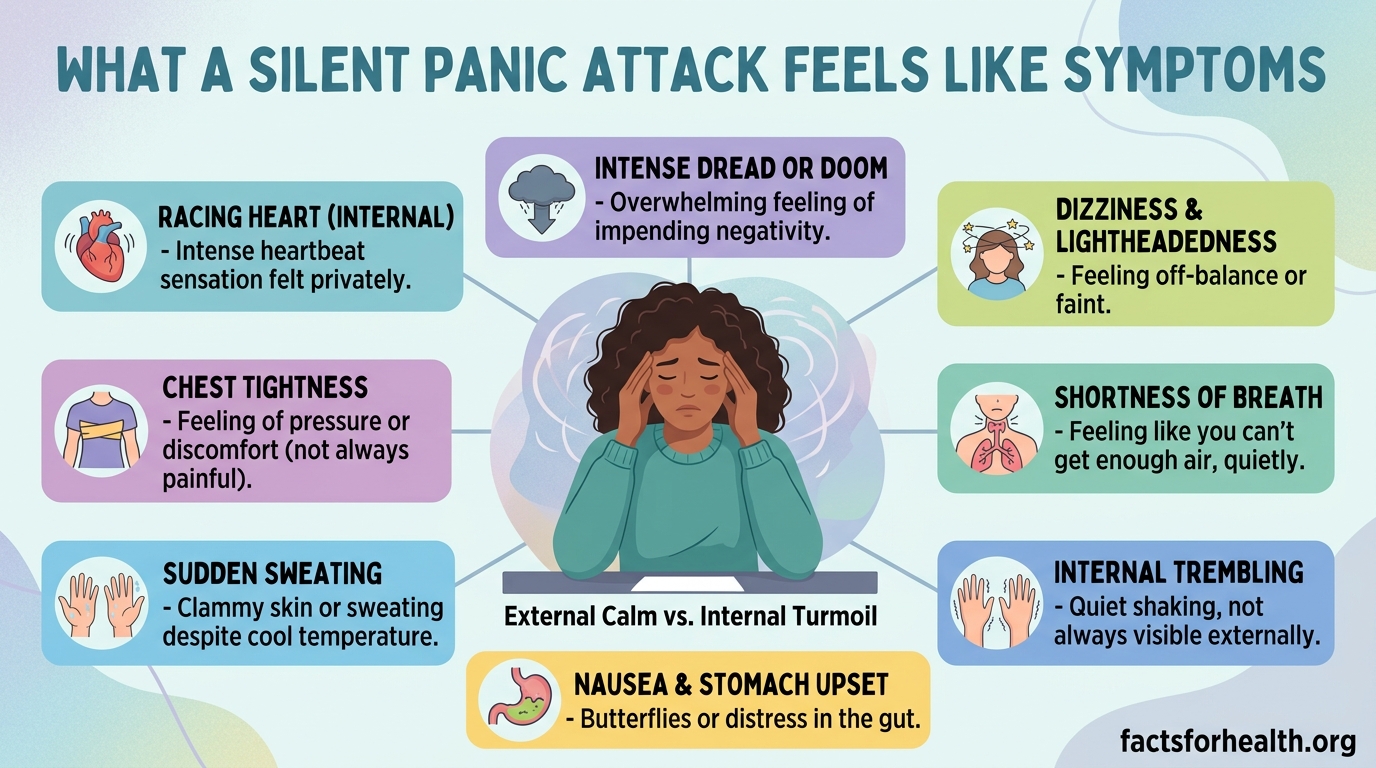
A silent panic attack is an intense episode of anxiety that produces severe internal symptoms, rapid heartbeat, chest tightness, overwhelming fear, and dizziness, without any visible external signs that others can notice. You appear calm on the outside while your body and mind race with the same intensity as a full-blown, visible panic episode.
If you have ever sat through a meeting, a dinner, or a conversation with your heart pounding so hard you could hear it in your ears, yet no one around you noticed anything was wrong, you already know what a silent panic attack feels like. The experience is real, and it is far more common than most people realize.
Our team analyzed discussions across anxiety forums, clinical resources from the National Institute of Mental Health, and lived-experience accounts from hundreds of people who experience these covert episodes. What we found is a gap between how these attacks are described clinically and how they actually feel to the person going through them. This guide closes that gap.
Whether you are trying to understand your own experience or support someone you love, understanding what a silent panic attack feels like is the first step toward managing it.
Table of Contents
What a Silent Panic Attack Feels Like
What a silent panic attack feels like is this: a storm raging inside your body while your exterior remains perfectly composed. Your heart may be racing at 120 beats per minute, your chest may feel like it is being squeezed, and your mind may be screaming that something is terribly wrong, yet to an outside observer, you look completely fine.
One person in an anxiety support community described it this way: “I can function, or at least appear to, perfectly well during a panic attack. My heart is racing, my hands are shaking, my chest feels tight, but nobody can tell. I just sit there smiling and nodding while feeling like I am about to die.”
That disconnect between internal chaos and external calm is what makes silent panic attacks so disorienting. You may even question whether what you are experiencing is real, because there are no visible signs to validate what you feel. This self-doubt is one of the most common and painful aspects of a quiet anxiety attack.
The internal panic attack triggers the same fight-or-flight response as a regular panic attack. Your sympathetic nervous system floods your body with adrenaline and cortisol. The only difference is that the outward expression, the gasping, the visible shaking, the crying, is suppressed or simply not present.
10 Silent Panic Attack Symptoms You Might Not Recognize
Silent panic attack symptoms span physical sensations, emotional experiences, and dissociative states. Here are ten of the most common, including several that are rarely discussed in clinical literature but appear constantly in forum discussions.
1. Heart palpitations and a racing heart. Your heart pounds so forcefully you can feel it in your throat, your ears, and your fingertips. Your resting heart rate may jump from 70 to over 120 beats per minute in seconds, even though you are sitting still.
2. Chest tightness and pressure. A squeezing sensation in your chest that can mimic heart attack symptoms. One Reddit user described it as feeling like “someone is sitting on my chest while I am trying to breathe normally and hold a conversation.” This tightness is one of the most frightening silent panic attack symptoms because it is hard to ignore.
3. Depersonalization. You feel detached from your own body, as though you are watching yourself from across the room. Your hands may feel like they belong to someone else. You speak and move, but it feels automatic, like you are on autopilot. Depersonalization is one of the most underrecognized symptoms of covert panic attacks.
4. Derealization. The world around you feels unreal, distant, or dreamlike. Rooms you know well suddenly feel unfamiliar. People’s faces may seem slightly distorted or two-dimensional. Derealization often accompanies depersonalization, and together they create a deeply unsettling sense that reality itself is breaking down.
5. Tunnel vision and hyper-focus. Your visual field narrows. You may fixate on a single object or person while everything around the edges blurs. Your attention locks onto whatever feels threatening, even if you cannot identify what that is.
6. Throat tightness and difficulty swallowing. A lump in your throat that makes swallowing feel difficult. As one forum member put it: “I breathe fine, but I feel pressure in my chest and throat. It is just not visible to others.” This globus sensation is extremely common during internal panic attacks.
7. Numbness and tingling sensations. Pins and needles in your fingers, toes, lips, or face. This occurs because rapid, shallow breathing changes the carbon dioxide levels in your blood, even if you are not visibly hyperventilating. The tingling can spread and feel alarming if you do not understand its cause.
8. A sense of impending doom. An overwhelming conviction that something terrible is about to happen, even when there is no identifiable threat. You may feel certain you are going to die, lose control, or go crazy, even though you remain outwardly composed. This sense of doom is a hallmark feature of panic disorder.
9. Lightheadedness and dizziness. You feel like you might faint, even though fainting during a panic attack is actually rare. The room may seem to tilt or sway. This dizziness stems from the same breathing pattern changes that cause tingling.
10. Post-attack numbness and exhaustion. After the panic subsides, you do not simply return to normal. You feel emotionally shut down, physically drained, and mentally foggy. One person described the aftermath: “After my panic attacks, I do not feel calm or better. I feel completely numb. Emotionally shut down. Physically exhausted.” This post-attack crash is rarely discussed but is one of the most disruptive aspects of silent panic attacks.
Silent Panic Attack vs Regular Panic Attack vs Anxiety
Many people confuse silent panic attacks with regular panic attacks or with general anxiety. While they share underlying mechanisms, the experience differs in important ways.
A regular panic attack is visible. You may gasp for air, cry, shake visibly, or need to leave the room. Others around you can usually tell that something is wrong, even if they do not understand exactly what. The outward signs make it easier to recognize and seek help.
A silent panic attack, by contrast, is invisible. You maintain your composure externally while experiencing the same internal intensity. This makes it harder to recognize, harder to validate, and harder to explain to others. People may even dismiss your experience because they cannot see it.
Generalized anxiety is a persistent, low-level state of worry and tension that can last for hours, days, or weeks. It is chronic rather than episodic. A panic attack, silent or otherwise, is an acute spike of intense fear that peaks within minutes. Someone with an anxiety disorder may experience both background anxiety and periodic panic attacks.
Key differences: silent panic attacks are episodic and intense, anxiety is persistent and moderate. Silent panic attacks are invisible, regular panic attacks are visible. Both can occur as part of panic disorder or alongside other anxiety disorders.
What Triggers a Silent Panic Attack
What triggers a silent panic attack varies widely from person to person, but several patterns emerge consistently across clinical research and community discussions.
1. Chronic stress. Prolonged stress at work, in relationships, or from financial pressure builds up until the nervous system reaches a tipping point. The panic attack may seem to come out of nowhere, but it is often the cumulative result of weeks or months of elevated stress hormones.
2. Trauma and past experiences. Unresolved trauma, whether from childhood or adulthood, can trigger panic responses when something in the present echoes the original experience. These triggers can be subtle, a smell, a tone of voice, a specific setting, and operate below conscious awareness.
3. Caffeine and stimulants. High caffeine intake can mimic panic symptoms by elevating heart rate and triggering the same adrenaline response. For people prone to panic attacks, even moderate caffeine can be enough to push the nervous system over the edge.
4. Crowded or enclosed spaces. Meetings, public transit, shopping malls, and social gatherings can trigger silent panic, especially when you feel trapped or unable to leave without drawing attention.
5. Sleep deprivation. Lack of sleep lowers your threshold for stress and makes your nervous system more reactive. Many people report their first silent panic attack occurred during a period of severe sleep debt.
6. Health anxiety. Worrying about your health, noticing a skipped heartbeat or a strange sensation in your chest, can itself trigger a panic attack. The fear of having a medical emergency becomes a self-fulfilling prophecy.
7. Suppressed emotions. People who habitually suppress their feelings, often described as having a high-functioning exterior, are particularly susceptible to silent panic attacks. The panic expresses what the conscious mind has been holding back.
8. Social evaluation. Situations where you feel judged, evaluated, or scrutinized, job interviews, presentations, performance reviews, can trigger covert panic. The pressure to appear competent amplifies the internal stress response.
How Long Do Silent Panic Attacks Last
A typical silent panic attack peaks within 10 minutes and resolves within 20 to 30 minutes. However, the full experience, including the buildup, the peak, and the post-attack exhaustion, can stretch over several hours.
Some people experience waves of panic that come and go over an afternoon or evening. Each wave may only last a few minutes, but the cumulative effect is exhausting. The post-attack period, marked by emotional numbness and physical fatigue, can last the rest of the day.
The Hidden Toll: Isolation, Numbness, and Exhaustion
One of the most significant gaps in how silent panic attacks are discussed is the emotional aftermath. Most clinical resources focus on the attack itself and skip what happens next. Forum discussions tell a different story.
The isolation is profound. When no one can see your distress, it is easy to feel like you are making it up. As one community member shared: “I felt wrong saying I have panic attacks because there are no visible or external signs. Like I was faking it somehow.” This self-doubt prevents many people from seeking help or even acknowledging what they are going through.
The invisibility also means you suffer alone. Friends, family, and coworkers do not know to check on you. You may sit through an entire workday experiencing wave after wave of silent panic, and no one asks if you are okay. Over time, this erodes your sense of connection and trust in others.
Post-attack numbness is another widely shared but rarely discussed experience. After the adrenaline fades, you do not simply return to baseline. You feel emptied out, disconnected, and too tired to engage with anything. This emotional crash can last hours and makes it difficult to function normally.
Recognizing these aftereffects as normal parts of the panic cycle, rather than signs that something else is wrong, can reduce the secondary anxiety that often follows an attack.
How to Calm a Silent Panic Attack: 7 Grounding Techniques
Grounding techniques work by pulling your attention out of the internal storm of panic and anchoring it in the present physical moment. Here are seven strategies that forum users and clinicians consistently recommend.
1. The 5-4-3-2-1 Method. This is the most recommended grounding technique in anxiety communities, yet few resources explain it fully. Here is how to do it step by step. Name five things you can see around you right now, describe them in detail, their color, shape, texture. Then name four things you can physically feel, the chair beneath you, your feet on the floor, the fabric of your shirt. Next, identify three sounds you can hear, near and far. Then name two things you can smell, or two scents you enjoy. Finally, name one thing you can taste, even if it is just the inside of your mouth. This process forces your brain to process sensory input instead of spiraling into fear, and it takes about 60 to 90 seconds.
2. Box breathing. Inhale for four seconds, hold for four seconds, exhale for four seconds, hold for four seconds. Repeat this cycle at least four times. Box breathing directly counteracts the rapid, shallow breathing pattern that fuels panic symptoms like tingling, dizziness, and chest tightness.
3. Cold water exposure. Splash cold water on your face or hold an ice cube in your hand. The sudden temperature drop activates the mammalian dive reflex, which slows your heart rate and interrupts the panic cycle. This is one of the fastest ways to short-circuit an escalating attack.
4. Progressive muscle relaxation. Starting at your toes and working up to your head, tense each muscle group for five seconds, then release. This releases the physical tension that builds during a panic attack and helps your body recognize the difference between tension and relaxation.
5. Object grounding. Carry a small object with a distinct texture, a smooth stone, a textured coin, a piece of fabric. When panic hits, focus all your attention on feeling every detail of that object. The tactile input grounds you in physical reality.
6. Mental counting or math. Count backward from 100 by sevens. Multiply two-digit numbers in your head. This forces your prefrontal cortex, the logical part of your brain, to engage, which helps override the amygdala-driven fear response.
7. Name your experience. Silently tell yourself: “This is a panic attack. It has happened before. It will end. I am not in danger.” Naming the experience reduces its power by shifting it from an unnamed threat to a known, temporary event.
Panic Attack vs Heart Attack: Knowing the Difference
Chest pain during a silent panic attack can feel indistinguishable from a heart attack, which is why panic attacks are one of the most common reasons for emergency room visits. Knowing the difference matters.
Panic attack chest pain is typically sharp, localized, and brief. It may worsen when you breathe in or change position. Heart attack pain is more often described as a heavy, crushing pressure that spreads to the arm, jaw, or back and persists over time.
If you are unsure, especially if you have risk factors like high blood pressure, smoking history, or family history of heart disease, seek emergency medical care. It is always better to err on the side of caution.
When to Seek Professional Help
If you are experiencing silent panic attacks regularly, meaning more than once a month, or if they are interfering with your daily life, work, or relationships, it is time to seek professional support. You do not have to wait until things become unbearable.
Cognitive behavioral therapy, or CBT, is the gold standard treatment for panic disorder. It works by helping you identify and reframe the thought patterns that trigger panic, and by gradually reducing your fear of the physical sensations themselves. Many people see significant improvement within 12 to 16 sessions.
Medication may also help. Selective serotonin reuptake inhibitors, or SSRIs, can reduce the frequency and intensity of panic attacks over time. Beta-blockers, originally designed for high blood pressure, can blunt the physical symptoms of panic and are sometimes prescribed for situational use.
Working with a therapist who understands the hidden nature of silent panic attacks is especially important. You need someone who validates that your experience is real, even though it is invisible to others, and who can help you develop a personalized toolkit of coping strategies.
FAQs
Am I having a panic attack?
You may be having a panic attack if you experience a sudden surge of intense fear accompanied by physical symptoms like a racing heart, chest tightness, dizziness, shortness of breath, numbness or tingling, and a sense of impending doom. These symptoms peak within minutes. If they appear without an obvious external trigger and feel overwhelming, a panic attack is likely. Silent panic attacks produce the same internal intensity without visible signs.
Can you have a panic attack quietly?
Yes. Silent panic attacks, also called covert or internal panic attacks, produce the same intense fear and physical symptoms as regular panic attacks but without visible external signs. You may appear perfectly calm while experiencing a racing heart, chest pressure, depersonalization, and overwhelming dread. This is a well-documented phenomenon that affects many people with anxiety disorders.
What triggers a silent panic attack?
Common triggers include chronic stress, unresolved trauma, caffeine and stimulants, crowded or enclosed spaces, sleep deprivation, health anxiety, social evaluation pressure, and suppressed emotions. Triggers can be obvious or subtle, and sometimes a panic attack seems to come out of nowhere because the trigger operates below conscious awareness.
How to stop a panic attack fast?
The fastest ways to stop a panic attack include the 5-4-3-2-1 grounding method, which engages all five senses, box breathing, inhale for 4 seconds, hold for 4, exhale for 4, hold for 4, splashing cold water on your face to trigger the dive reflex, and mentally naming the experience as a panic attack that will pass. These techniques work by interrupting the fear cycle and anchoring your attention in the present moment.
Are silent panic attacks dangerous?
Silent panic attacks are not physically dangerous, even though they feel life-threatening. The symptoms, chest pain, racing heart, dizziness, and numbness, are the result of your body’s fight-or-flight response and will pass on their own. However, frequent panic attacks can severely impact quality of life, and chest pain should always be evaluated by a doctor to rule out cardiac causes.
How long do silent panic attacks last?
A silent panic attack typically peaks within 10 minutes and resolves within 20 to 30 minutes. The post-attack period of emotional numbness and physical exhaustion can last several hours. Some people experience waves of panic that come and go over an extended period, with each wave lasting only a few minutes but the overall episode stretching much longer.
You Are Not Alone in This
Understanding what a silent panic attack feels like is the first step toward managing it. These episodes are real, they are common, and they are treatable, even though no one around you can see what you are going through. The invisibility does not make them any less valid.
If you recognize yourself in the symptoms and experiences described here, the most important thing to know is that you are not faking it, you are not overreacting, and you are not alone. Thousands of people navigate silent panic attacks every day while maintaining their composure at work, at home, and in social settings.
Start with the grounding techniques in this guide. Try the 5-4-3-2-1 method the next time you feel an episode building. If silent panic attacks are recurring and disrupting your life, reach out to a mental health professional who understands anxiety disorders. CBT and other evidence-based treatments can significantly reduce the frequency and intensity of these hidden attacks, and you deserve that relief.