
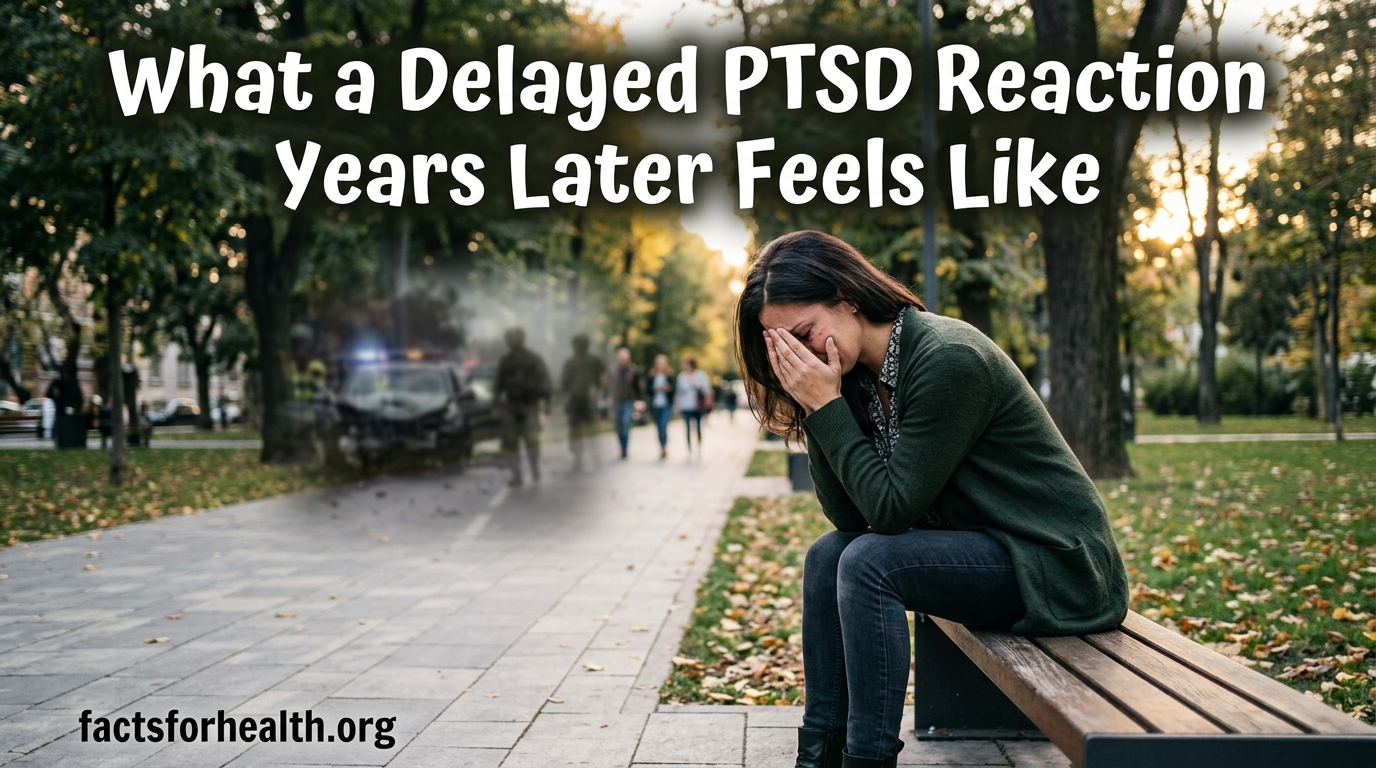
It feels like the ground beneath you suddenly gives way. One day you are managing your life, going to work, maintaining relationships, and functioning. Then something shifts. A sound, a smell, a life transition, or sometimes nothing identifiable at all. Your body starts reacting in ways you cannot explain or control.
A delayed PTSD reaction years later can feel like your nervous system finally ran out of ways to hold everything together. The symptoms do not announce themselves politely. They arrive as flashbacks, panic, emotional numbness, hypervigilance, and a sense that you are no longer safe in a life you built carefully over years or decades.
If you are reading this because something inside you has shifted and you do not understand why, you are not alone. Research suggests that approximately 24.5% of PTSD cases involve delayed onset. That means roughly one in four people who develop PTSD do not experience full symptoms until months or years after the traumatic event. Your experience is real, it is documented in clinical literature, and it is not a sign of weakness.
Our team has spent time studying the research, listening to first-person accounts from trauma communities, and consulting the clinical literature on delayed expression PTSD. What follows is an honest, detailed guide to what a delayed PTSD reaction years later actually feels like, why it happens, and what healing can look like.
Table of Contents
What a Delayed PTSD Reaction Years Later Feels Like
Describing what a delayed PTSD reaction feels like requires honesty about the body, because trauma lives in the nervous system as much as in the mind. People who contact us and share their stories describe a common thread: the feeling of suddenly being overtaken by something that was always there but never fully acknowledged.
Physically, it can feel like your body has gone on high alert and forgotten how to stand down. Your heart races without reason. Sleep becomes shallow or impossible. You startle at sounds that never bothered you before. A door slamming, a car backfiring, a specific tone of voice, any of these can trigger a full physiological response as if the original danger is happening right now.
Emotionally, the experience often feels like being hollowed out. Many people describe emotional numbness alternating with waves of grief, rage, or terror that seem disproportionate to what is happening around them. One person on a trauma support forum described it this way: their entire life had been one big distraction from their trauma, and it took over 40 years before everything they had pushed aside came flooding to the surface.
Relationally, a delayed PTSD reaction can feel like a wall going up between you and the people you love. Avoidance creeps in. You might stop going to certain places, seeing certain people, or engaging in activities that once brought joy. Intimacy can feel threatening. Connection can feel dangerous. You might find yourself withdrawing without understanding why.
The most disorienting part is the timeline. When PTSD develops immediately after a traumatic event, there is a clear cause-and-effect relationship that helps make sense of the symptoms. With a delayed reaction, the original trauma may have occurred 5, 10, or 20 years ago. The gap between the event and the symptoms creates confusion, self-doubt, and a feeling that something is fundamentally wrong with you.
Forum users we have studied consistently describe this confusion. One person shared that it took two years for their symptoms to fully manifest and another two years before flashbacks began. They only started experiencing intrusive memories after finally reaching a safe living situation. This pattern, where symptoms emerge after safety is achieved, is one of the most documented and least understood aspects of delayed PTSD.
What Is a Delayed Trauma Response?
A delayed trauma response is the emergence of PTSD symptoms six months or more after a traumatic event. The DSM-5 classifies this pattern as delayed expression PTSD, recognizing that trauma does not always produce immediate symptoms. Instead, the nervous system may hold, suppress, or partially process the experience for years before symptoms break through.
This is not the same as simply remembering a difficult event. A delayed trauma response involves the full clinical picture of PTSD: intrusion symptoms like flashbacks and nightmares, avoidance of trauma-related stimuli, negative changes in mood and cognition, and marked changes in arousal and reactivity. The difference is timing.
Approximately 24.5% of PTSD cases involve delayed onset, according to meta-analytic research. This means delayed expression is not rare or unusual. It is a recognized pattern that affects a substantial portion of people who develop PTSD. If you are experiencing this, your experience is backed by decades of clinical research.
Delayed trauma responses are sometimes preceded by subthreshold symptoms. These are milder or partial patterns that can include trouble sleeping, emotional blunting, mild hypervigilance, or subtle avoidance behaviors. These subthreshold symptoms may persist for years, intensifying later when stress accumulates or when a life change shifts the balance.
How the Nervous System Stores Trauma
To understand why a delayed PTSD reaction years later happens, it helps to understand how the nervous system processes and stores traumatic experiences. Trauma is not simply stored as a conscious memory. It lives in the body’s implicit memory systems, the deep brain structures responsible for threat detection, survival responses, and emotional regulation.
When you experience something traumatic, your nervous system activates survival mode. The amygdala, your brain’s threat detection center, flags the experience as dangerous and creates powerful associations that go beyond conscious recall. These associations are stored implicitly, meaning they can be activated by sensory cues without you consciously remembering the original event.
The hippocampus, responsible for organizing memories into a coherent narrative, may not fully process traumatic experiences at the time they occur. This leaves the trauma stored as fragmented sensory and emotional data rather than as a completed memory. The experience remains, in a sense, unfinished. The nervous system stays partially activated, waiting for the threat to return.
For many people, the nervous system compensates for years. It develops survival strategies that allow daily functioning despite the unprocessed trauma underneath. You might throw yourself into work, avoid certain situations, numb emotions through routine or substances, or simply keep moving so fast that the trauma cannot catch up. These are not failures of character. They are survival strategies your nervous system developed to keep you going.
One trauma survivor on a support forum described this with striking clarity: delayed reactions do not mean we are weak or broken. They mean our nervous systems finally ran out of ways to hold everything together. This is not a metaphor. It reflects what neuroscience tells us about regulatory capacity. The nervous system has limits, and when those limits are reached, symptoms surface.
What Triggers Delayed PTSD Reactions
Delayed PTSD reactions are often activated by specific triggers or life changes. Understanding these triggers can help explain why symptoms appear when they do, sometimes decades after the original trauma.
One of the most common triggers is reaching a place of safety. This sounds paradoxical, but it follows the logic of the nervous system. When you are in an ongoing dangerous or stressful situation, your survival systems stay engaged. You function because you have to. When the danger passes and you finally feel safe, the nervous system relaxes its guard, and the unprocessed trauma surfaces because there is finally space for it.
Major life transitions frequently activate delayed reactions. These can include retirement, the end of a long-term relationship, the death of a loved one, becoming a parent, a career change, or a significant health diagnosis. Each of these transitions disrupts the routines and compensatory strategies that have been holding the trauma in place.
Cumulative stress is another powerful trigger. Small stressors that accumulate over time, work pressure, financial strain, caregiving responsibilities, or relationship difficulties, can gradually erode your nervous system’s regulatory capacity. Eventually, a tipping point is reached. One forum user described how trauma hit them many years later because their body and mind simply did not know how to let go of it before.
Sensory triggers can also activate delayed responses. A specific smell, sound, visual cue, or physical sensation that was present during the original trauma can suddenly reactivate the implicit memory networks. These triggers often operate below conscious awareness, which is why the resulting symptoms can feel like they come from nowhere.
Anniversaries and milestones matter too. The anniversary of a traumatic event, the age a lost loved one would have reached, or seeing a child reach the age you were when trauma occurred can all serve as powerful emotional triggers that unlock delayed symptoms.
The High-Functioning Until Crisis Pattern
Many people who experience delayed PTSD reactions share a common history: they were high-functioning for years before the crisis hit. This pattern is one of the most confusing aspects of delayed onset, because it creates the illusion that everything was fine.
High-functioning does not mean trauma is absent. It means the nervous system has developed effective compensatory strategies. You might excel at work, maintain relationships, and appear successful from the outside. Internally, however, the system is running on overdrive, using enormous amounts of energy to suppress, redirect, or manage the unprocessed trauma.
These compensatory strategies can include perfectionism, overachievement, people-pleasing, emotional detachment, chronic busyness, or rigid control over your environment. Each of these strategies serves a purpose. They keep the trauma contained. But they require enormous energy to maintain, and they are not sustainable indefinitely.
The crisis typically arrives when the compensatory strategies fail. This can happen because of a life transition, accumulated stress, a new traumatic event, or simply the passage of time. When the strategies break down, the full weight of the unprocessed trauma becomes apparent. Symptoms that were held at bay for years or decades suddenly flood in.
This pattern explains why so many people describe their delayed PTSD as arriving out of nowhere. From their perspective, they were managing fine. From the nervous system’s perspective, the system had been operating at maximum capacity for years and finally exceeded its limits. Recognizing this pattern can reduce the shame and self-blame that often accompany delayed reactions.
Delayed PTSD vs C-PTSD: Understanding the Difference
Delayed PTSD and Complex PTSD (C-PTSD) are related but distinct concepts, and understanding the difference matters for making sense of your experience.
Delayed PTSD refers to the timing of symptom onset. The symptoms are the same as standard PTSD, but they emerge six months or more after the traumatic event. The trauma itself may have been a single incident or a series of events.
Complex PTSD refers to the type and duration of trauma. C-PTSD develops from repeated, prolonged trauma that typically occurs in situations where escape is impossible, such as ongoing childhood abuse, domestic violence, human trafficking, or being held captive. C-PTSD includes all standard PTSD symptoms plus additional features: difficulties with emotional regulation, chronic feelings of worthlessness, persistent relationship difficulties, and alterations in meaning systems.
People often ask whether C-PTSD is a brain injury. The answer is nuanced. C-PTSD is not classified as a traumatic brain injury in the traditional sense, because it does not result from physical impact to the head. However, prolonged trauma does produce measurable changes in brain structure and function. The amygdala can become enlarged and hyperreactive. The hippocampus may shrink. The prefrontal cortex, responsible for executive function and emotional regulation, can show reduced activity. These changes are real, measurable, and in many cases reversible with appropriate treatment.
What does C-PTSD mean in practical terms? It means the nervous system has been shaped by prolonged exposure to danger in ways that affect every aspect of functioning. Recovery is possible, but it often requires a longer and more comprehensive approach than standard PTSD treatment.
What Recovery and Healing Look Like
Will you ever heal from C-PTSD or delayed PTSD? The answer is yes, with important qualifications. Healing does not mean erasing the past. It means giving your nervous system new experiences of safety, connection, and regulation so that the trauma no longer controls your daily life.
Evidence-based treatments for delayed PTSD and C-PTSD include trauma-focused therapies that have been extensively researched. Trauma-focused cognitive behavioral therapy (TF-CBT) helps process traumatic memories and change the thought patterns that maintain symptoms. Eye movement desensitization and reprocessing (EMDR) uses bilateral stimulation to help the brain reprocess traumatic memories that remain stuck in implicit memory systems.
Prolonged exposure therapy helps by gradually and safely confronting trauma-related memories, feelings, and situations that have been avoided. Somatic therapies work directly with the body’s nervous system, recognizing that trauma lives in the body as much as in the mind. These approaches help regulate the survival responses that keep the nervous system stuck in fight, flight, or freeze.
Recovery is rarely linear. Many people describe it as a process of gradual improvement with periods of intensification, especially during stressful times or when new layers of trauma surface. This is normal. It does not mean treatment is failing. It means the nervous system is processing material it has held for a long time.
What does healing feel like? People who have progressed in recovery describe a gradual return of choice. Instead of being hijacked by triggers, they notice the trigger and have a moment to decide how to respond. Sleep improves. Relationships deepen. The emotional numbness begins to give way to a fuller range of feelings, both difficult and joyful. The nervous system becomes more flexible, bouncing back from stress rather than getting stuck in survival mode.
One of the most important things to know is that seeking help is not a sign of weakness. It is a sign that your nervous system is ready to process what it has been holding. Many people find that delayed PTSD reactions actually signal readiness for healing, because the compensatory strategies that kept trauma buried are finally no longer needed or sustainable.
FAQs
What is a delayed trauma response years later?
A delayed trauma response years later is when PTSD symptoms emerge six months or more after a traumatic event. The DSM-5 classifies this as delayed expression PTSD. Approximately 24.5% of PTSD cases involve delayed onset, making it a recognized and relatively common pattern rather than an unusual occurrence.
Will I ever heal from C-PTSD?
Yes, healing from C-PTSD is possible with appropriate treatment. Evidence-based approaches include trauma-focused CBT, EMDR, prolonged exposure therapy, and somatic therapies. Recovery is typically gradual and non-linear, but many people achieve significant improvement in symptoms, relationships, and quality of life. Healing means developing new nervous system patterns of safety and regulation, not erasing the past.
Is C-PTSD a brain injury?
C-PTSD is not classified as a traumatic brain injury because it does not result from physical impact to the head. However, prolonged trauma does produce measurable changes in brain structure and function, including amygdala hyperreactivity, hippocampal volume reduction, and altered prefrontal cortex activity. These changes are real and in many cases reversible with treatment.
What does C-PTSD mean?
C-PTSD stands for Complex Post-Traumatic Stress Disorder. It develops from repeated, prolonged trauma in situations where escape is impossible, such as ongoing childhood abuse or domestic violence. C-PTSD includes all standard PTSD symptoms plus difficulties with emotional regulation, persistent feelings of worthlessness, relationship challenges, and alterations in systems of meaning.
Can PTSD appear 10 or 20 years later?
Yes, PTSD can appear decades after a traumatic event. Delayed expression PTSD is recognized by the DSM-5 and accounts for roughly one in four PTSD cases. Symptoms often emerge after major life transitions, accumulated stress, or when a person finally reaches safety and their nervous system relaxes its compensatory strategies.
Why do PTSD symptoms appear after years of feeling fine?
PTSD symptoms can appear after years of feeling fine because the nervous system develops compensatory strategies that temporarily contain unprocessed trauma. These strategies require enormous energy and eventually reach their limits. When stress accumulates, a life transition disrupts routines, or safety is achieved, the compensatory system can fail and symptoms surface.
If you are experiencing a delayed PTSD reaction years later, what you are feeling is real, documented, and treatable. Your nervous system did not fail you. It carried you through difficult circumstances using the best strategies it had. Now it is asking for help processing what it has been holding.
Understanding what a delayed PTSD reaction years later feels like is the first step toward healing. The next step is reaching out to a trauma-informed mental health professional who can guide you through evidence-based treatment. You do not have to carry this alone, and recovery is not just possible. It is something countless people have achieved, one step at a time.