
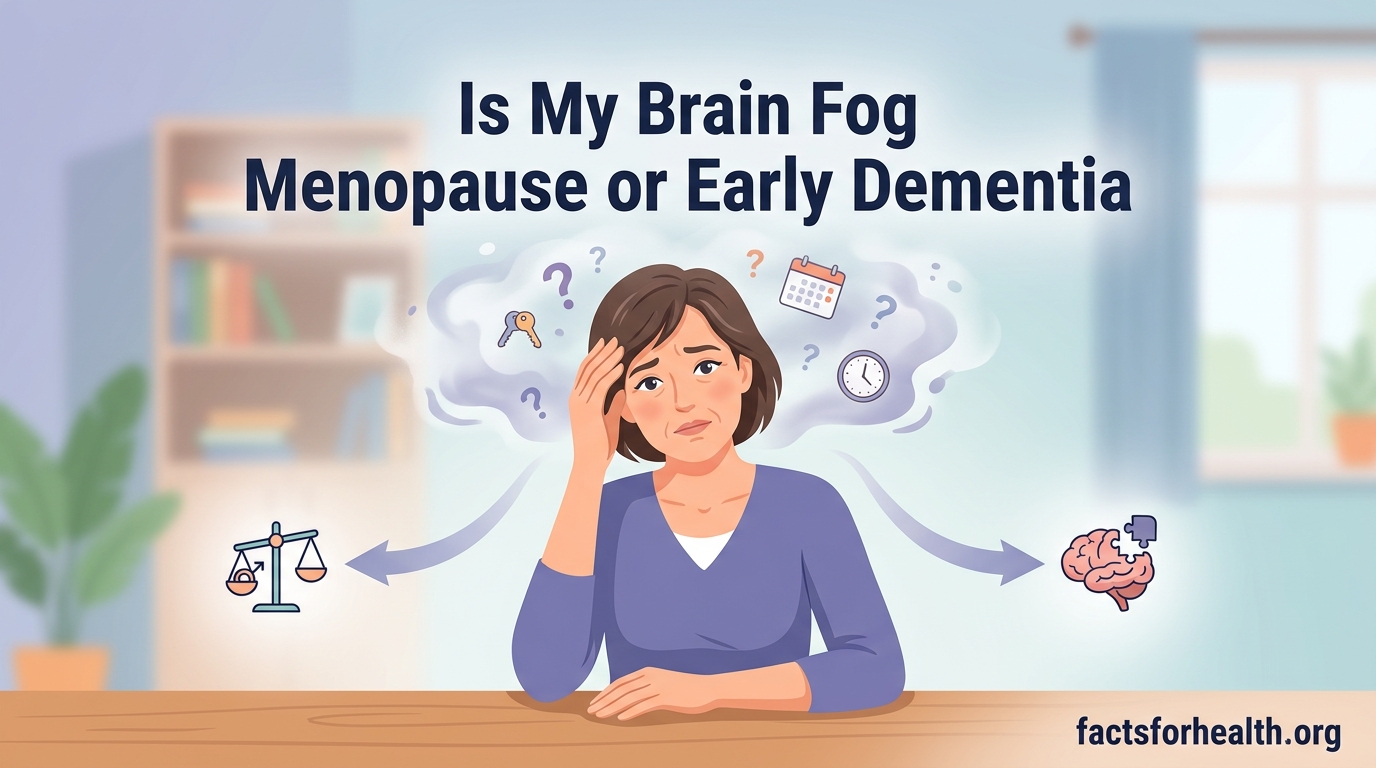
You walk into a room and forget why. You lose your train of thought mid-sentence in a meeting. You reach for a word you have used a thousand times, and it is simply gone. If you are in your late forties or early fifties, these moments can feel terrifying, and a single question starts looping in your head: is my brain fog menopause or early dementia?
You are not alone in this fear. Thousands of women search for this exact question every month, and the anxiety behind it is real. Women on the r/Menopause subreddit describe forgetting their own phone numbers, losing track of conversations, and worrying they are developing early-onset Alzheimer’s. One woman wrote that her brain fog was “the scariest part of perimenopause,” and that she felt like she was “losing herself.”
Here is the reassuring truth: research shows that approximately 60% of women experience cognitive changes during perimenopause, and the vast majority of these cases are menopause-related brain fog, not dementia. Brain fog during the menopause transition is common, it is real, and it is almost never a sign of early dementia.
But that does not mean you should ignore what you are experiencing. Understanding the difference between menopause brain fog and early dementia can help you sleep at night, advocate for yourself at the doctor’s office, and take steps to feel sharper and more like yourself again. In this guide, we will walk through what menopause brain fog actually is, how it differs from dementia, what else could be causing your symptoms, and when it is time to make an appointment.
Table of Contents
Quick Answer: Is It Menopause Brain Fog or Early Dementia?
For most women in their forties and fifties, brain fog is caused by hormonal changes during perimenopause or menopause, not early dementia. The two conditions share some surface-level symptoms like forgetfulness and word-finding difficulty, but they differ fundamentally in pattern, progression, and impact on daily life.
Menopause brain fog tends to come and go. You might have a terrible week followed by a sharp, clear week. It responds to sleep, stress levels, and symptom management. Early dementia, by contrast, is progressive and persistent. Symptoms worsen steadily over months and years, and they begin to interfere with daily functioning in ways that menopause brain fog typically does not.
Use this quick comparison to orient yourself, and then read on for the details that matter.
| Feature | Menopause Brain Fog | Early Dementia |
|---|---|---|
| Pattern | Inconsistent, comes and goes | Progressive, steadily worsening |
| Daily function | Annoying but manageable | Increasingly difficult to manage tasks |
| Self-awareness | You notice and worry about it | Others often notice before you do |
| Word-finding | Tip-of-the-tongue, recovers | Substitutes wrong words, does not self-correct |
| Navigation | No issues finding your way | Getting lost in familiar places |
| Response to sleep | Improves with rest | No meaningful improvement with sleep |
What Is Menopause Brain Fog?
Menopause brain fog is not a formal medical diagnosis. It is a term women use to describe a cluster of cognitive symptoms that emerge during the menopause transition, including forgetfulness, difficulty concentrating, slower recall, and that frustrating tip-of-the-tongue sensation when a word just will not surface.
According to the Mayo Clinic, brain fog is one of the most commonly reported symptoms during menopause. Women describe their thinking as “cloudy,” “cotton-wool,” or “underwater.” You might forget why you walked into a room, struggle to track a complex conversation, or find yourself rereading the same paragraph three times.
The Estrogen-Brain Connection
Estrogen is not just a reproductive hormone. It plays a direct role in brain function, influencing memory formation, attention, brain cell communication, and even sleep regulation. Estrogen receptors are dense in the hippocampus and prefrontal cortex, the brain regions responsible for memory and executive function.
During perimenopause, estrogen levels do not simply decline in a straight line. They fluctuate dramatically, sometimes swinging from high to low within days. This hormonal roller coaster forces the brain to constantly adapt, and the result is the inconsistent cognitive symptoms we call brain fog. When estrogen eventually stabilizes at lower levels after menopause, many women find their cognitive symptoms improve.
Which Cognitive Domains Are Affected?
Research, including studies by Dr. Pauline Maki and colleagues published in the journal Menopause, has identified the specific cognitive areas most impacted during the menopause transition:
Working memory: Holding and manipulating information in your mind, like doing mental math or following a multi-step instruction.
Verbal memory: Recalling words, names, and verbal information. This is why word-finding difficulty is such a common complaint.
Attention and concentration: Staying focused on a task, especially in distracting environments.
Importantly, executive function tends to be relatively spared during menopause. Your ability to plan, reason, and make decisions typically remains intact. This is a key distinction from dementia, where executive function decline is an early and prominent feature.
How Long Does Menopause Brain Fog Last?
This is one of the most searched questions on this topic, and for good reason. Women want to know when the fog will lift.
For most women, brain fog begins during perimenopause, which typically starts in the mid-to-late forties and lasts an average of four to seven years. The cognitive symptoms tend to peak during late perimenopause and the first year or two after the final menstrual period. After that, as hormone levels stabilize, most women report gradual improvement.
A study from the Study of Women’s Health Across the Nation (SWAN) found that cognitive performance generally improves after women complete the menopause transition. In other words, the fog is temporary, and your brain does adapt.
How Bad Can Brain Fog Get During Menopause?
Brain fog severity varies widely. Some women notice only occasional word-finding slips. Others experience cognitive symptoms severe enough to interfere with work performance, especially in demanding professional roles. Women on the r/Menopause forum have described losing their train of thought during presentations, forgetting client names mid-meeting, and struggling to complete tasks that used to take half the effort.
Even when severe, menopause brain fog does not mean your brain is damaged. It means your brain is working under suboptimal hormonal conditions, often compounded by sleep disruption, hot flashes, anxiety, and stress. Addressing these contributing factors often leads to meaningful improvement.
Brain Fog vs. Early Dementia: Key Differences
Can menopause brain fog feel like dementia? Absolutely. That is exactly why so many women end up searching for answers online at two in the morning. The subjective experience of forgetting a word or losing your keys can feel indistinguishable from what you imagine early Alzheimer’s must feel like.
But when doctors and researchers evaluate these conditions, the differences become clear. Here are the key distinctions that separate menopause brain fog from early dementia.
1. Inconsistent vs. Progressive
This is the single most important distinction. Menopause brain fog is inconsistent. You might struggle on Monday and feel perfectly sharp on Wednesday. Your cognitive performance varies with sleep quality, stress, timing in your cycle, and other factors. Some days you feel like yourself; some days you do not.
Early dementia is progressive. The symptoms do not come and go. They are present every day, and they slowly get worse over months and years. A bad cognitive day with menopause brain fog is followed by a better one. With dementia, there is no return to baseline.
2. Self-Awareness
Women with menopause brain fog are acutely aware of their cognitive changes. They notice every forgotten word, every lost train of thought. They worry about it, research it, and talk about it with friends and doctors. This high level of self-awareness is actually a reassuring sign.
In early dementia, family members and close friends often notice the changes before the person experiencing them does. If your spouse or colleague is expressing concern about your memory and you yourself do not see a problem, that pattern is more concerning than if you are the one who is worried.
3. Impact on Daily Function
Menopause brain fog is annoying and sometimes embarrassing, but it rarely prevents you from doing the things you need to do. You might take longer to complete a task or need to write more things down, but you can still function independently at work and home.
Early dementia begins to interfere with daily functioning in meaningful ways. This might look like struggling to manage finances you have always handled, getting confused by familiar recipes, or having difficulty following the plot of a television show. The functional decline is what separates normal cognitive aging, menopause brain fog, and mild cognitive impairment from dementia.
4. Type of Memory Problems
Menopause brain fog primarily affects working memory and verbal memory. You forget a word but it comes to you five minutes later. You walk into a room and forget why, then remember. You misplace your keys but eventually find them in a logical (if absent-minded) spot.
Dementia involves a different quality of forgetting. You do not just temporarily lose a word. You forget recent events entirely and cannot recall them later. You might put your keys in the refrigerator and have no idea how they got there. You might ask the same question repeatedly because you do not remember asking it. The memory loss is permanent, not transient.
5. Navigation and Spatial Awareness
Getting lost in familiar places is one of the classic warning signs of dementia. If you suddenly cannot find your way home from a route you have driven hundreds of times, that is a red flag.
Menopause brain fog does not affect spatial navigation. You might walk into a room and forget why you are there, but you always know where “there” is. You never feel lost in your own neighborhood or confused about how to get home.
6. Emotional Response
The emotional response to cognitive symptoms can itself be telling. Women with menopause brain fog are frustrated, anxious, and sometimes frightened by their symptoms. They actively seek answers and solutions. This distress is a sign that the brain is still working well enough to recognize a problem.
In dementia, the person experiencing symptoms may seem indifferent, flat, or unaware. Apathy and loss of interest in previously enjoyed activities can be early dementia signs that family members notice before cognitive symptoms become obvious.
Other Causes of Brain Fog in Midlife
While menopause is a leading cause of midlife brain fog, it is not the only one. Many women in their forties and fifties are dealing with multiple overlapping factors that can all contribute to cognitive symptoms. If your doctor dismisses your brain fog as “just menopause” or “just stress,” consider asking about these other potential contributors.
Sleep Disruption
Poor sleep is one of the most underappreciated causes of brain fog. During perimenopause, night sweats and hot flashes can fragment sleep badly. Even if you do not fully wake up, your sleep architecture is disrupted, and the deep, restorative sleep stages that consolidate memory and clear brain metabolites are compromised.
Sleep apnea is also more common in postmenopausal women than many people realize, and it is frequently misdiagnosed as menopause-related fatigue or brain fog. If you snore, wake up gasping, or never feel rested, ask your doctor about a sleep study.
Thyroid Problems
Hypothyroidism becomes more common with age and shares many symptoms with menopause, including brain fog, fatigue, weight changes, and mood swings. A simple blood test (TSH and free T4) can check your thyroid function. If your thyroid is underactive, treatment typically resolves cognitive symptoms quickly.
Vitamin B12 Deficiency
Vitamin B12 deficiency can cause memory problems, confusion, and difficulty concentrating, and it becomes more common as we age because absorption decreases. If you eat a plant-based diet or take certain medications like metformin or proton pump inhibitors, your B12 levels may be low. A blood test can check this, and supplementation is straightforward if levels are low.
Depression and Anxiety
Depression and anxiety both produce cognitive symptoms that can mimic brain fog. Difficulty concentrating, slowed thinking, forgetfulness, and mental fatigue are hallmark symptoms of both conditions. Perimenopause increases the risk of mood changes due to hormonal fluctuations, and it is not uncommon for women to experience anxiety or depression for the first time during this transition.
The relationship goes both ways: worrying about dementia can itself cause anxiety, which in turn worsens brain fog, creating a vicious cycle. Treating the underlying mood disorder often improves cognitive symptoms significantly.
ADHD
Some women are diagnosed with ADHD for the first time during perimenopause. They may have compensated adequately for mild attention issues earlier in life, but the cognitive demands of midlife, combined with hormonal changes, make those strategies insufficient. If you have a lifelong history of disorganization, time blindness, and attention difficulty that is now worse, ADHD may be worth exploring with a qualified professional.
Long COVID
Long COVID is an increasingly recognized cause of persistent brain fog. If your cognitive symptoms began after a COVID-19 infection, regardless of how mild the initial illness was, long COVID could be a contributing factor. Research is ongoing, but cognitive symptoms following COVID appear to involve inflammation and vascular changes in the brain.
Medication Side Effects
Many common medications can cause brain fog as a side effect, including antihistamines, sleep aids, certain blood pressure medications, and anti-anxiety drugs. If you started a new medication around the time your brain fog began, talk to your doctor or pharmacist about whether cognitive side effects could be involved.
When to See a Doctor: Warning Signs Checklist
Menopause brain fog is not dangerous, but how do you know when cognitive symptoms cross the line from normal to concerning? Use this self-assessment checklist to evaluate whether your symptoms warrant a conversation with your healthcare provider.
Make an appointment if you experience any of the following:
1. Getting lost in familiar places. If you become disoriented in your own neighborhood or cannot find your way home from a regular route, this warrants immediate evaluation.
2. Difficulty with familiar tasks. Struggling to cook a recipe you have made dozens of times, manage bills you have always handled, or operate appliances you use daily.
3. Forgetting recent events entirely. Not just drawing a blank temporarily, but having no memory of conversations, events, or experiences that happened in the last few days.
4. Repeating questions or stories. Asking the same question multiple times within a short period because you do not remember already asking it.
5. Personality or behavior changes. Sudden mood swings, apathy, social withdrawal, or uncharacteristically poor judgment that others have noticed.
6. Language problems beyond word-finding. Struggling to follow or join a conversation, using incorrect words for objects (calling a watch a “hand clock”), or losing the ability to write coherently.
7. Symptoms that others notice before you do. If family members or colleagues are expressing concern about your memory or cognitive function and you do not share their concern.
8. Poor judgment or decision-making. Making financial errors, falling for scams, or making impulsive decisions that are out of character.
You should also see a doctor if: your brain fog is severe enough to interfere with your daily life or work, your symptoms are steadily worsening rather than fluctuating, you have a strong family history of early-onset dementia, or your symptoms are causing you significant anxiety or distress.
What to Expect at a Cognitive Screening
If you make an appointment, your doctor will likely start with a thorough medical history and basic lab work to rule out thyroid problems, vitamin deficiencies, and other reversible causes. They may also administer a brief cognitive screening test, such as the MoCA (Montreal Cognitive Assessment) or the Mini-Mental State Examination.
These screening tools take about ten minutes and assess memory, attention, language, and spatial skills. They are not diagnostic on their own, but they help your doctor determine whether further evaluation by a neurologist or memory clinic is warranted.
Come prepared with specific examples of what you have been experiencing. Write down instances of forgetfulness, confusion, or cognitive difficulty, including when they happen and how they affect you. The more specific you can be, the better your doctor can help.
Treatment and Management Options
The good news is that there are many evidence-based strategies for managing menopause brain fog. While no single approach works for everyone, most women find meaningful improvement through a combination of lifestyle changes, symptom management, and, in some cases, medical treatments.
1. Prioritize Sleep
Sleep is the foundation of cognitive health. During deep sleep, your brain consolidates memories, clears metabolic waste, and repairs neural connections. If hot flashes or night sweats are disrupting your sleep, treating those vasomotor symptoms can have a dramatic effect on brain fog.
Practice good sleep hygiene: keep your bedroom cool, maintain a consistent sleep schedule, limit screens before bed, and avoid alcohol and caffeine in the evening. If night sweats persist, talk to your doctor about treatment options, because better sleep may be the single most effective brain fog intervention.
2. Exercise Regularly
Physical activity is one of the most well-researched interventions for brain health. Aerobic exercise increases blood flow to the brain, promotes the release of brain-derived neurotrophic factor (BDNF), and improves cognitive function in midlife women. Aim for at least 150 minutes of moderate aerobic activity per week, plus strength training twice weekly.
You do not need to run marathons. Brisk walking, swimming, cycling, and dancing all count. The key is consistency. Exercise also improves sleep quality, reduces stress, and helps manage weight, all of which indirectly support cognitive function.
3. Manage Stress
Chronic stress elevates cortisol, which over time can impair memory and concentration. For midlife women juggling careers, aging parents, teenage children, and hormonal changes, stress is often at an all-time high. Mindfulness practices, meditation, yoga, and deep breathing exercises have all shown benefits for cognitive function and stress reduction.
Even five minutes of mindful breathing before a stressful situation can help clear the mental fog. The goal is not to eliminate stress entirely but to manage your response to it.
4. Eat a Brain-Healthy Diet
The Mediterranean diet and the MIND diet (a hybrid of Mediterranean and DASH diets designed specifically for brain health) have the strongest evidence for supporting cognitive function in midlife and beyond. These diets emphasize vegetables, fruits, whole grains, fish, olive oil, nuts, and limited processed foods.
Omega-3 fatty acids, found in fatty fish, walnuts, and flaxseed, are particularly important for brain health. If you do not eat fish regularly, a high-quality omega-3 supplement may be worth discussing with your doctor.
5. Stay Mentally and Socially Active
Mental stimulation helps maintain cognitive reserve, the brain’s resilience to age-related changes. Read, take a class, learn a new skill, or tackle puzzles that genuinely engage you. The evidence on commercial brain-training apps is mixed, but real-world cognitive challenges like learning a language or playing an instrument are consistently beneficial.
Social engagement matters too. Studies show that people with strong social connections maintain better cognitive function over time. Stay connected with friends, join community groups, and prioritize relationships during the menopause transition.
6. What About HRT and Brain Fog?
Hormone replacement therapy (HRT) is one of the most asked-about treatments for menopause brain fog, and the evidence is more nuanced than many women expect. The International Menopause Society notes that HRT is highly effective for vasomotor symptoms like hot flashes and night sweats, and improving sleep can indirectly help cognitive symptoms.
However, HRT is not specifically recommended for treating brain fog alone. Research on whether estrogen directly improves cognitive function during menopause has produced mixed results. Some studies suggest cognitive benefits when HRT is started early in the menopause transition (the “timing hypothesis”), while other studies show no significant effect on memory or concentration.
If you are considering HRT, have a thorough conversation with your healthcare provider about your personal risk factors, symptoms, and goals. HRT may help your brain fog indirectly by improving sleep, mood, and overall quality of life, even if it is not prescribed specifically for cognitive symptoms.
7. Supplements for Menopause Brain Fog
This is a top search topic with surprisingly little quality competitor coverage. While no supplement has been definitively proven to reverse menopause brain fog, several have enough evidence to be worth considering.
Vitamin B12: If your levels are low, supplementation can improve cognitive symptoms. This is worth testing, as deficiency becomes more common with age.
Vitamin D: Low vitamin D is associated with cognitive impairment. Many midlife women are deficient, particularly in northern climates. Ask your doctor to check your level.
Omega-3 fatty acids: DHA and EPA support brain cell membrane health and have anti-inflammatory properties. Evidence for cognitive benefit is moderate but promising.
Ginkgo biloba: Some studies suggest modest benefits for memory and concentration, though results are inconsistent and it can interact with blood thinners.
Black cohosh and maca: These are commonly used for menopause symptoms, and some women report cognitive benefits, though research specifically on brain fog is limited.
Always talk to your doctor before starting supplements, especially if you take prescription medications, as interactions can occur. Supplements should complement, not replace, the foundational lifestyle strategies described above.
FAQs
How long does brain fog last in menopause?
For most women, brain fog begins during perimenopause, peaks in late perimenopause and the first year or two after the final menstrual period, and gradually improves as hormone levels stabilize. The entire menopause transition typically lasts four to seven years. Studies from the SWAN cohort show that cognitive performance generally improves after women complete the transition, meaning the fog is temporary for the majority of women.
How can you tell the difference between brain fog and early dementia?
The key differences are pattern, progression, and daily function. Menopause brain fog is inconsistent (it comes and goes), you remain aware of it, and it does not prevent you from managing daily tasks. Early dementia is progressive (symptoms steadily worsen), family members often notice before you do, and it interferes with familiar activities like managing finances, cooking, or navigation. If your symptoms fluctuate from day to day and you are the one who is most worried, that pattern points toward menopause brain fog rather than dementia.
Does low estrogen cause brain fog?
Yes. Estrogen receptors are concentrated in the hippocampus and prefrontal cortex, brain regions responsible for memory and attention. During perimenopause, estrogen levels fluctuate dramatically before declining, forcing the brain to constantly adapt. This hormonal instability is the primary driver of menopause brain fog, affecting working memory, verbal memory, and concentration.
Can menopause brain fog feel like dementia?
Yes, absolutely. The subjective experience of forgetting words, losing your train of thought, or struggling to concentrate can feel indistinguishable from what you imagine early dementia must feel like. This is why so many women search for reassurance. The distinction is that menopause brain fog is inconsistent and does not interfere with daily functioning, navigation, or self-awareness, while dementia is progressive and increasingly disabling.
Can menopause trigger dementia?
No, menopause does not trigger dementia. The cognitive symptoms you experience during the menopause transition are temporary and related to hormonal fluctuations, not neurodegeneration. Research shows that cognitive performance typically improves after the menopause transition is complete. Having brain fog during menopause does not increase your risk of developing dementia later in life.
What are early signs of dementia in females?
Warning signs that warrant medical evaluation include getting lost in familiar places, struggling with familiar tasks like cooking or managing finances, forgetting recent events entirely (not just temporarily), repeating the same questions, using incorrect words for objects, personality changes like apathy or withdrawal, and poor judgment. If family members express concern about your memory before you notice a problem yourself, that pattern is more concerning than if you are the one who is worried.
Can HRT help with brain fog?
HRT may help brain fog indirectly by improving sleep, mood, and vasomotor symptoms like hot flashes. However, it is not specifically recommended for treating cognitive symptoms alone, and research on direct cognitive benefits has produced mixed results. Some evidence suggests benefits when HRT is started early in the menopause transition. Talk to your doctor about whether HRT is appropriate for your individual situation.
What supplements are good for menopause brain fog?
The supplements with the most evidence include vitamin B12 (if deficient), vitamin D (if deficient), and omega-3 fatty acids (DHA and EPA). Ginkgo biloba has shown modest benefits in some studies. Always check with your doctor before starting supplements, as some can interact with medications. Supplements work best as part of a broader strategy that includes sleep, exercise, and stress management.
Conclusion
If you have been asking yourself whether your brain fog is menopause or early dementia, the answer is almost certainly menopause. About 60% of women experience cognitive changes during perimenopause, and the vast majority find that their symptoms improve after the transition is complete. The fear you are feeling is valid and shared by thousands of women, but it does not mean the worst.
Remember the key differences: menopause brain fog is inconsistent, you remain self-aware, and your daily functioning is preserved. If your symptoms are fluctuating and you are the one who is most worried, that pattern strongly favors menopause over dementia. If you notice any red flag symptoms like getting lost in familiar places or struggling with tasks you have always handled easily, make an appointment with your doctor for a thorough evaluation.
In the meantime, prioritize sleep, stay active, manage stress, and give yourself grace. Your brain is navigating a major hormonal transition, and with the right strategies and support, the fog will lift.