
Every January, millions of people pour their last drink on New Year’s Eve and commit to 31 alcohol-free days. But how many actually follow through, and does the effort pay off? If you are wondering is Dry January actually worth it, you are not alone. It is one of the most searched health questions at the start of each year.
I have dug through the clinical studies, analyzed expert opinions from major medical institutions, and read through hundreds of Reddit threads from real people who have tried it. The goal is simple: give you an honest, evidence-based answer without the preachy tone or the hype.
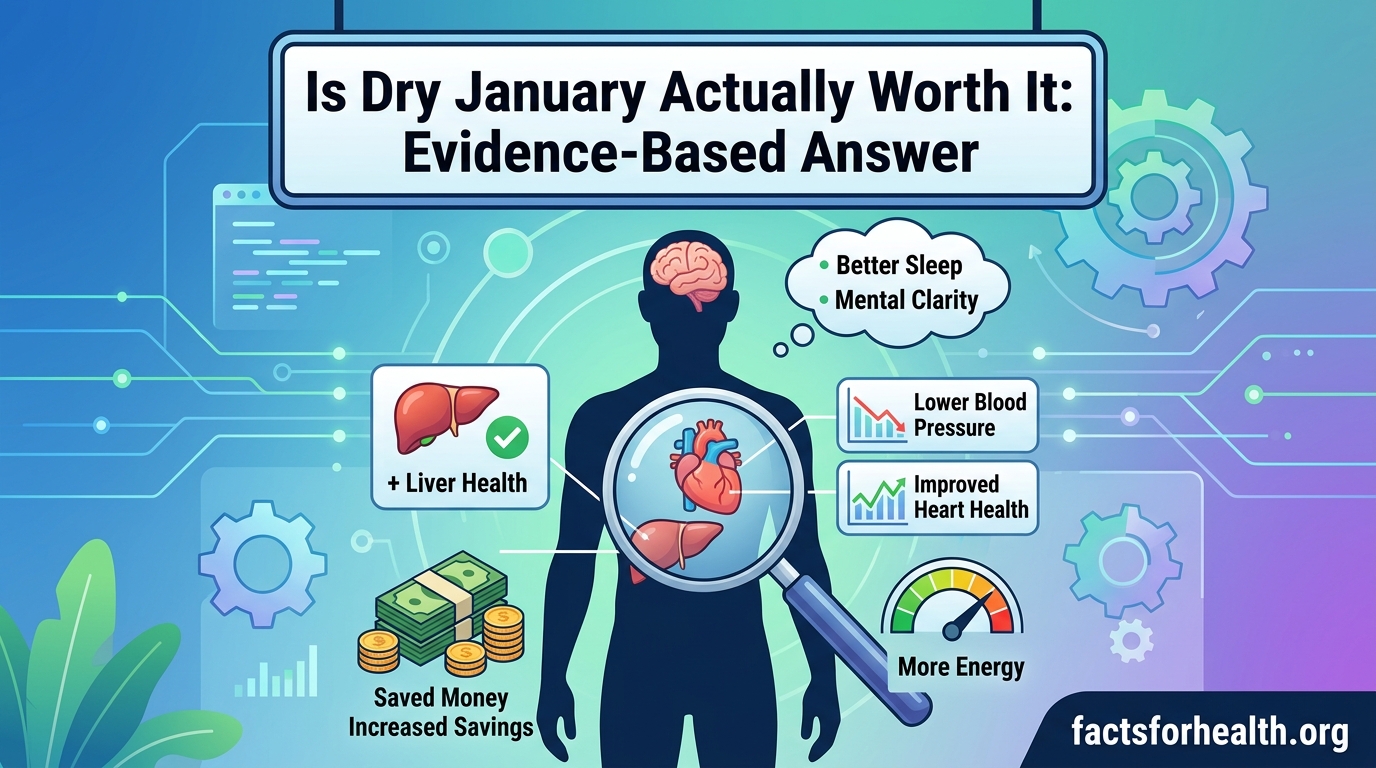
Here is the short version: yes, Dry January is worth it for most moderate drinkers. Research shows measurable improvements in sleep, weight, liver function, blood pressure, and mental clarity within just a few weeks. But it is not a magic reset button, and it is not safe for everyone.
The nuance matters. A casual drinker who does Dry January gets a different experience than someone drinking nightly. Some people rebound hard in February. Others use the month as a springboard to permanently rethink their relationship with alcohol. The data on who benefits most and who should steer clear might surprise you.
In this guide, I will walk you through what the science actually says, break down the benefits week by week (something no major health publication currently does), calculate the real financial savings, explain the 2-2-2 drinking rule as an alternative, and share practical tips from people who have been through it. No judgment, no lectures, just facts.
Table of Contents
The Quick Answer: Is Dry January Actually Worth It?
Yes, Dry January is worth it for most people who drink moderately. A landmark study published in BMJ Open found that one month of alcohol abstinence led to an average weight loss of about 4 pounds, a 5 percent reduction in blood pressure, improved insulin resistance, and reduced liver fat. Participants also reported better sleep and increased energy. Research from the University of Sussex shows that six months after completing Dry January, participants were still drinking less than before.
However, Dry January is not appropriate for people with alcohol use disorder, as sudden cessation can trigger dangerous withdrawal symptoms including seizures and delirium tremens. For everyone else, the benefits are real, measurable, and worth the effort.
What Is Dry January?
Dry January is a public health challenge where participants abstain from alcohol for the entire month of January. The campaign was launched in 2013 by Alcohol Change UK, a charity focused on reducing alcohol-related harm. What started as a small initiative has grown into the world’s most popular alcohol-free month campaign.
An estimated 8.8 million people in the UK alone participated in Dry January in 2026, and the trend has spread globally. In the United States, participation has grown steadily, with health systems like UC Davis, MD Anderson, and Tufts School of Medicine all publishing guidance on the challenge.
The concept is simple: no alcohol from January 1 through January 31. Some people go completely dry, while others adopt a “drier January” approach, significantly cutting back without total abstinence. The official Dry January campaign encourages complete abstinence, arguing that the full break gives your body a genuine rest from alcohol and helps reset habits more effectively than partial reduction.
The appeal is easy to understand. After a holiday season filled with parties, dinners, and celebrations, many people feel physically depleted and ready for a reset. Dry January provides a structured, socially acceptable window to pause, reflect, and let the body recover.
What the Science Says: Evidence-Based Benefits of Dry January
The benefits of Dry January are not just anecdotal. A growing body of clinical research backs them up. Here is what the studies show across the major areas of health.
Weight Loss and Body Composition
Alcohol is calorically dense. A single pint of beer contains roughly 200 calories, a glass of wine about 120, and a mixed drink can easily top 250 calories. These are what nutritionists call empty calories because they provide energy without meaningful nutrients.
When you remove alcohol for a month, the calorie reduction adds up fast. The BMJ Open study found that moderate drinkers lost an average of about 4 pounds during their alcohol-free month. Reddit users report similar results, with many sharing losses of 5 to 15 pounds depending on their baseline drinking level.
Part of this weight loss comes from reduced calorie intake. But there is a secondary effect: people tend to eat less when they are not drinking. Alcohol lowers inhibitions and stimulates appetite, leading to late-night snacking, larger portions, and poorer food choices. Remove the alcohol, and the mindless eating often drops off too.
Reduced bloating is another commonly reported benefit. Alcohol is inflammatory, and many people notice their face, stomach, and extremities look less puffy within the first two weeks.
Sleep Quality Improvements
This is one of the most immediate and dramatic benefits. Alcohol might help you fall asleep faster, but it destroys sleep quality. It suppresses REM sleep, increases sleep fragmentation, and causes you to wake up during the second half of the night as the sedative effect wears off.
UC Davis Health specifically highlights sleep improvement as a primary benefit of Dry January. When you stop drinking, your sleep architecture begins to normalize within days. Deep sleep, also called restorative sleep, increases. Growth hormone production, which occurs during deep sleep and is critical for physical repair, rebounds.
Reddit users consistently rank better sleep as the number one benefit they notice. Many report waking up feeling genuinely rested for the first time in years. Some even mention that they need less sleep overall because the sleep they do get is so much more efficient.
Liver Health and Regeneration
Your liver bears the brunt of alcohol consumption. It processes roughly 90 percent of the alcohol you drink, and chronic drinking leads to fat accumulation, inflammation, and eventually scarring (cirrhosis). The good news is that the liver has a remarkable capacity to heal.
The BMJ Open study found that participants who abstained from alcohol for one month showed significant reductions in liver fat. Dr. Gautam Mehta from University College London, who has studied this extensively, notes that even a short period of abstinence allows liver cells to begin regenerating.
GI specialist Dr. Neeral Shah from UVA Health puts it bluntly: the answer to whether Dry January is worth it is “a resounding yes” because that pause allows your body to recover. Blood markers of liver stress, including certain liver enzymes, tend to improve during an alcohol-free month.
It is worth noting that one month of abstinence does not reverse years of heavy drinking damage. But it does demonstrate to your body what is possible, and it gives your liver a much-needed break.
Blood Pressure Reduction
Alcohol raises blood pressure through multiple mechanisms, including increased sympathetic nervous system activity and changes in blood vessel function. The BMJ Open study documented approximately a 5 percent reduction in blood pressure among participants after one month of abstinence.
A 5 percent reduction might sound small, but in the context of cardiovascular health, it is significant. For someone with borderline high blood pressure, a drop of that magnitude can mean the difference between needing medication and managing through lifestyle changes alone.
This benefit is most pronounced in people who drink regularly and above recommended limits. Light drinkers may see smaller changes, but the trend is consistently positive.
Cancer Risk Reduction
This is an area where MD Anderson Cancer Center provides particularly strong guidance. Alcohol is classified as a Group 1 carcinogen by the International Agency for Research on Cancer. It is linked to at least seven types of cancer: oral, throat, esophageal, liver, colorectal, breast, and laryngeal.
The American Association for Cancer Research noted in a 2026 report that there is no safe level of alcohol consumption when it comes to cancer risk. Every drink increases risk. So while one month of abstinence does not erase long-term cancer risk, it does eliminate ongoing exposure during that period.
MD Anderson frames Dry January as an opportunity to reassess your relationship with alcohol in the context of cancer prevention. The thinking is that if you can go a month without drinking, you might be motivated to reduce your overall intake year-round, which would have a more meaningful impact on long-term cancer risk.
Mental Health: Anxiety, Mood, and Clarity
One of the most searched Dry January topics is its effect on mental health, and for good reason. The relationship between alcohol and mental health is complex. Alcohol is a central nervous system depressant, and while it might provide temporary relaxation, it worsens anxiety over time.
The Reddit community has popularized the term “hangxiety” to describe the spike in anxiety that follows a night of drinking. This is a real physiological phenomenon. Alcohol withdrawal, even mild overnight withdrawal, triggers cortisol release and disrupts neurotransmitter balance, leading to heightened anxiety the next day.
During Dry January, many people report that this background anxiety fades away. Without the cycle of drinking and recovery, mood stabilizes. Mental clarity improves. Brain fog lifts. People describe feeling sharper, more focused, and more emotionally even-keeled.
However, the mental health picture is not universally positive. Some people experience a temporary increase in anxiety or irritability during the first week as their body adjusts. And for people who use alcohol as a coping mechanism for underlying mental health issues, removing that coping tool without alternatives can be challenging. This is an important nuance that deserves honest discussion.
Gut Microbiome Repair
MD Anderson highlights gut health as a key benefit of giving up alcohol. Alcohol disrupts the balance of bacteria in your gut, promoting harmful bacteria while suppressing beneficial strains. This can contribute to what is sometimes called “leaky gut,” where the intestinal lining becomes more permeable and allows inflammatory compounds to enter the bloodstream.
Within a couple of weeks of abstinence, the gut microbiome begins to rebalance. Beneficial bacteria start to recover, inflammation decreases, and digestion often improves. Many Dry January participants report less bloating, more regular bowel movements, and a general improvement in how their stomach feels.
Dry January Benefits Timeline: Week by Week
One of the most common questions I found across Reddit and search data is: when do the benefits kick in? No major health publication currently breaks this down, so here is a week-by-week timeline based on clinical research and aggregated user experiences.
Week 1 (Days 1-7): The Adjustment Period
The first week is the hardest for most people. Your body is adjusting to the absence of alcohol, and depending on your baseline drinking level, you might experience mild withdrawal-like symptoms. Headaches, irritability, difficulty sleeping, and sugar cravings are commonly reported during the first three to five days.
Here is what is happening physically: your liver is beginning to clear accumulated toxins. Your sleep cycle is recalibrating. Blood sugar levels are stabilizing. If you were a daily drinker, the first few nights might actually involve worse sleep as your body adjusts to falling asleep without the sedative effect of alcohol.
By the end of week one, most people start to notice the first real benefits. Sleep begins to deepen. Morning energy improves. The mental fog from constant mild hangovers starts to lift. Some people report waking up without an alarm for the first time in months.
Reddit users emphasize that the first week is about survival. It gets easier. If you can push through days 3-5, which tend to be the most difficult, the remaining weeks are significantly more manageable.
Week 2 (Days 8-14): Physical Changes Become Visible
This is where things get rewarding. By the second week, your body has largely adjusted to the absence of alcohol, and the benefits become more pronounced and visible.
Sleep quality typically improves dramatically during week two. Deep sleep increases, REM sleep normalizes, and people report waking up feeling genuinely refreshed. Energy levels throughout the day stabilize without the afternoon crashes that alcohol-induced sleep disruption causes.
Physical changes start to show. Bloating decreases. Skin often looks clearer and more hydrated as alcohol’s dehydrating effect is removed. Some people notice their face looks less puffy, particularly around the eyes and cheeks.
Mentally, the anxiety reduction becomes noticeable. The constant low-grade “hangxiety” that many habitual drinkers carry fades. Concentration improves. Many people report being more productive at work during this period.
Weight loss may start to register on the scale during week two, particularly for those who were drinking multiple drinks per day. The combination of fewer empty calories and better food choices starts to add up.
Week 3 (Days 15-21): Deep Health Benefits
Week three is when the deeper physiological benefits kick in. Your liver is well into its recovery process. Blood markers of liver stress continue to improve. If you had blood work done at this point, you would likely see lower liver enzyme levels compared to your baseline.
Blood pressure reductions become more measurable. For people with elevated blood pressure, the improvements during this period can be clinically significant. Blood sugar regulation improves as insulin sensitivity increases.
Mood and mental health benefits continue to deepen. Many people describe a sense of emotional clarity that they had forgotten was possible. Without the mood swings associated with the drinking cycle, emotional regulation improves. People report feeling more present in their relationships and more engaged with their daily lives.
The gut microbiome is substantially rebalanced by week three. Digestion is more regular. Inflammation throughout the body is reduced. Some people report that chronic issues like acid reflux or mild stomach discomfort improve significantly.
Cravings typically diminish by this point. The habit loop of reaching for a drink at a certain time of day starts to weaken. Many people find that the psychological pull of alcohol is much weaker than it was in week one.
Week 4 (Days 22-31): Full Reset
The final week is about consolidation. By now, most of the acute benefits are established, and the focus shifts to maintaining them and deciding what comes next.
By the end of week four, the research shows significant cumulative effects. The BMJ Open study’s findings align with this timeline: average weight loss of about 4 pounds, blood pressure reduction of roughly 5 percent, improved insulin resistance, and substantially reduced liver fat.
Sleep patterns are fully restructured. Energy levels are consistently high. Mental clarity is sharp. Many people report that their relationship with alcohol has fundamentally shifted during this month. They no longer see it as a necessary component of socializing, relaxation, or celebration.
This is also the week where the question of what happens next becomes pressing. Research from the University of Sussex found that 50 percent of Dry January participants were still drinking less at the six-to-eight-month follow-up. The month serves as a genuine reset for many people, not just a temporary break.
The Financial Case: How Much Money You Save
Not a single major health publication covers the financial benefits of Dry January, which is surprising because it is one of the most relatable and motivating factors. Let me break down the real cost of drinking and what you save by taking a month off.
Consider a moderate drinker who has two drinks per day at an average cost of $8 each (a conservative estimate for a cocktail or glass of wine at a bar or restaurant). That is $16 per day, or about $496 per month. Over January, that is nearly $500 saved.
For someone who drinks more heavily, say four drinks per day at $10 each, the monthly savings jump to $1,240. Even a light drinker who has three drinks per week at $8 each saves about $96 in a month.
The savings extend beyond the direct cost of alcohol. When you are not drinking, you tend to eat out less, order fewer late-night food deliveries, and skip the impulse purchases that alcohol-fueled nights often generate. Taxi rides, cover charges, and the “just one more round” purchases add up quickly.
Reddit users frequently cite the financial benefit as unexpected and significant. Many say they did not realize how much they were spending on alcohol until they stopped and saw the money accumulate. Some redirect those savings toward gym memberships, fitness equipment, or experiences they actually remember.
If you want extra motivation, try this: every time you would normally buy a drink, transfer that amount to a savings account. At the end of January, look at the total. For many people, the number is eye-opening.
Dry January Drawbacks and Limitations
An honest answer to whether Dry January is worth it requires looking at the downsides. The benefits are real, but so are the limitations. Here is what the research and real-world experience reveal.
The Rebound Effect
The most commonly cited concern is rebound drinking. Some experts, including Professor Marcus Munafo from the University of Bristol, warn that a month of strict abstinence can lead to a “reward” mindset where people overindulge in February to compensate.
Reddit data supports this concern. Multiple users in the r/DryJanuary and r/whiskey communities report going hard in February, sometimes drinking more than they did before January. The risk is real, particularly for people who view Dry January as a punishment or a deprivation rather than an opportunity for reflection.
However, the Sussex University research suggests that for most participants, the opposite happens. Six months after Dry January, the majority are drinking less, not more. The key seems to be intention. People who use January to genuinely reassess their drinking habits tend to maintain reductions. People who white-knuckle through the month just to get back to drinking are more likely to rebound.
Short-Term Benefits Without Long-Term Change
Professor Matt Field from the University of Sheffield raises an important point: one month of abstinence does not undo years of drinking. The liver improvements, blood pressure reductions, and weight loss are real but temporary if you return to your previous drinking patterns in February.
The health benefits of Dry January only persist if your drinking habits change for the longer term. If you treat January as a one-time detox and go straight back to nightly drinking, the positive effects will fade within weeks.
Social Challenges
This is one of the most under-discussed aspects of Dry January. The Reddit community is vocal about how socially isolating it can feel. Declining drinks at gatherings, navigating questions from friends, and dealing with the assumption that you must have a “drinking problem” if you are not drinking can be exhausting.
People report feeling like outsiders at social events. Some friendships are built heavily around drinking culture, and removing alcohol can strain those connections. Finding non-alcoholic options at bars and restaurants is getting easier, but it is still a challenge in many places.
The fear of missing out, or FOMO, is real. Alcohol is deeply woven into how many people socialize, celebrate, and relax. Removing it requires finding alternative ways to do all three, which takes effort and creativity.
Initial Physical Side Effects
Depending on your baseline drinking level, the first few days can be physically uncomfortable. Headaches, lethargy, irritability, and sleep disruption are common during the first week. These are mild withdrawal symptoms, and while they are not dangerous for moderate drinkers, they are unpleasant enough that some people quit before the benefits kick in.
Sugar cravings are another common side effect. Alcohol raises blood sugar, and when you remove it, your body craves the quick energy hit from sweets instead. Many people inadvertently gain weight from increased sugar consumption during the first week of Dry January if they are not mindful of this.
Who Should Avoid Dry January
Dry January is not safe or appropriate for everyone. This section could be the most important one in this article, so please read it carefully.
People With Alcohol Use Disorder
If you have alcohol use disorder, or if you drink heavily on a daily basis, suddenly stopping can be dangerous. Alcohol withdrawal can escalate from mild symptoms (tremors, anxiety, nausea) to severe complications including seizures and delirium tremens, which can be fatal.
MD Anderson provides specific guidance: if you drink more than 7 drinks per week (women) or 14 drinks per week (men under 55), quitting cold turkey carries real risk. Tufts School of Medicine echoes this warning, noting that delirium tremens is a medical emergency that requires immediate treatment.
If you think you might have alcohol dependence, talk to a healthcare provider before attempting Dry January. They can help you safely reduce your intake, possibly with medication support, and connect you with resources like the SAMHSA National Helpline (1-800-662-4357), which provides free, confidential treatment referral and information.
People Prone to All-or-Nothing Thinking
If you tend to view slip-ups as total failures, Dry January might backfire. The rigid nature of the challenge can create psychological pressure that makes a single drink feel like a catastrophe. Some people give up entirely after one slip, which defeats the purpose.
Tufts School of Medicine suggests that a “drier January” approach might be healthier for these individuals. Reducing your drinking significantly, rather than eliminating it completely, can still produce meaningful benefits without the psychological stress of perfectionism.
People Using Alcohol to Cope With Underlying Issues
If you drink to manage anxiety, depression, trauma, or stress, simply removing alcohol without addressing the underlying issue can leave you without a coping mechanism. This is not a reason to keep drinking, but it is a reason to approach Dry January thoughtfully.
Consider pairing your alcohol-free month with therapy, support groups, or new coping strategies. Removing the Band-Aid without treating the wound underneath can lead to increased distress, which is the opposite of what Dry January is supposed to achieve.
The 2-2-2 Drinking Rule: A Moderate Alternative
One of the most common questions people ask when researching Dry January is: what is the 2-2-2 drinking rule? It appeared as a “People Also Ask” question, and notably, no major health publication currently explains it.
The 2-2-2 drinking rule is a simple guideline for moderate alcohol consumption: no more than 2 drinks per day, no more than 2 days per week, and no more than 2 consecutive days of drinking. It is a harm-reduction framework that sits between heavy drinking and complete abstinence.
Think of it as the middle ground between Dry January and unrestricted drinking. Instead of going cold turkey for a month and potentially rebounding, the 2-2-2 rule encourages consistent, sustainable moderation year-round.
For context, the CDC defines moderate drinking as 2 drinks or less per day for men and 1 drink or less per day for women. The 2-2-2 rule is more restrictive than this, adding limits on frequency and consecutive days, which makes it a good option for people who want structure without total abstinence.
Who does the 2-2-2 rule suit best? People who find Dry January too rigid. People who have rebounded after past Dry January attempts. People who want to reduce their drinking permanently rather than taking a one-month break. And people who enjoy drinking socially but want clear boundaries to prevent escalation.
The 2-2-2 approach aligns with what Tufts School of Medicine calls the harm reduction model: meeting people where they are rather than insisting on an all-or-nothing approach. If you are choosing between heavy drinking and the 2-2-2 rule, the rule wins every time. If you are choosing between the 2-2-2 rule and Dry January, it depends on your goals and personality.
Is Dry January Worth It for Different Types of Drinkers?
The value of Dry January varies significantly depending on your baseline drinking habits. Here is a breakdown for different types of drinkers.
For Light Drinkers (1-3 drinks per week)
If you rarely drink, Dry January might not produce dramatic physical changes. The health difference between 2 drinks per week and 0 drinks per week is relatively small in the short term. However, you might still benefit from the mental reset, the awareness of habits, and the financial savings. The challenge is less about physical recovery and more about intentionality.
For Moderate Drinkers (4-14 drinks per week)
This is the sweet spot for Dry January benefits. Moderate drinkers tend to see the most noticeable improvements in sleep, weight, energy, and mental clarity. The body has been under enough alcohol stress that a break produces visible results, but the withdrawal risk is low. If you fall into this category, Dry January is likely worth it.
For Heavy Drinkers (15+ drinks per week)
If you are in this category, please talk to a doctor before attempting Dry January. The physical benefits of reducing alcohol are enormous, but sudden cessation carries real medical risks. A healthcare provider can help you taper safely or provide medical support for the transition. Dry January is absolutely worth it for heavy drinkers, but the approach needs to be medically supervised.
Practical Tips: How to Succeed at Dry January
Based on expert advice from UC Davis, MD Anderson, and BBC Good Food, plus hundreds of real experiences from Reddit communities, here are the most effective strategies for completing Dry January.
1. Tell People You Are Doing It
Accountability is powerful. Tell your friends, family, and coworkers about your Dry January commitment. When people know, they are less likely to offer you drinks, and you have created social pressure to follow through. Reddit users who completed Dry January consistently mention that having an accountability partner or a group challenge dramatically improved their success rate.
2. Stock Up on Non-Alcoholic Alternatives
Having appealing alcohol-free options available removes the feeling of deprivation. Stock your fridge with sparkling water, kombucha, non-alcoholic beer, and ingredients for mocktails. UC Davis provides mocktail recipes that make the alcohol-free experience feel indulgent rather than restrictive. Having something to hold and sip at social events makes a big psychological difference.
3. Identify Your Triggers
Most people have specific triggers that prompt them to drink: a time of day, an emotional state, a social situation, or even a physical location. BBC Good Food recommends trigger identification as a core strategy. Once you know your triggers, you can plan alternatives. If 6 PM is your wine hour, plan a walk or a workout for that time. If stress triggers drinking, have a list of alternative stress-relief strategies ready.
4. Plan Ahead for Social Events
Social situations are where most people slip up. Before attending any event where alcohol will be present, decide what you will drink, how you will respond to offers of alcohol, and when you will leave. Having a plan removes the need for in-the-moment willpower, which is unreliable.
5. Track Your Progress and Savings
Use an app, a journal, or a simple calendar to mark each alcohol-free day. Track the money you are saving, the pounds you are losing, and the sleep improvements you are noticing. Visible progress is deeply motivating. The official Dry January app from Alcohol Change UK is a popular choice, but a notebook works just as well.
6. Reward Yourself
BBC Good Food emphasizes the importance of treats and rewards. Use the money you are saving from not buying alcohol to treat yourself to something you enjoy: a massage, new workout gear, a nice dinner, or a weekend trip. Positive reinforcement helps rewire your brain to associate not drinking with reward rather than deprivation.
7. Find New Ways to Relax and Socialize
If drinking was your primary way to unwind or connect with friends, you need alternatives. Exercise, meditation, reading, cooking, and creative hobbies can replace the relaxation function of alcohol. For socializing, suggest activities that are not centered on drinking: hiking, coffee meetups, movie nights, or game nights.
8. Expect the First Week to Be Hard
Knowledge is power. Knowing that the first 3-5 days will be the most difficult helps you push through. Prepare for sugar cravings, sleep disruption, irritability, and cravings. Remind yourself that these symptoms are temporary and that the benefits kick in shortly after.
9. Do Not Let a Slip-Up Derail You
If you have a drink during Dry January, it is not a failure. It is data. Reddit users strongly emphasize this point. Analyze what triggered the slip, adjust your strategy, and continue. One drink does not erase the benefits of the days you did not drink. The goal is progress, not perfection.
10. Plan Your Post-January Strategy Before February Arrives
This is the tip that prevents rebound drinking. Before January ends, decide what your February drinking will look like. Will you return to your old habits? Will you adopt the 2-2-2 rule? Will you continue alcohol-free? Having a plan prevents the “I made it, time to celebrate” mentality that leads to overindulgence.
What Real People Say: Mixed Experiences From the Community
The research data is important, but so are real experiences. I combed through Reddit threads from r/DryJanuary, r/stopdrinking, r/whiskey, and other communities to find patterns in what people actually go through.
The positive camp is substantial. Users report losing 5 to 15 pounds, sleeping better than they have in years, saving hundreds of dollars, and feeling mentally sharper. Many describe it as “life-changing” and continue the practice well beyond January. Several mention that their tolerance dropped, making subsequent drinking feel less appealing.
The mixed camp is equally important for an honest picture. Some users report feeling socially isolated, bored, and irritable. Some say they did not notice any significant changes and did not find it worth the effort. Others completed January successfully but drank more in February than they did before.
The negative camp is smaller but real. Some users with underlying anxiety or depression found that removing their primary coping mechanism worsened their mental health temporarily. Others found the social cost too high, particularly in friend groups where drinking is the primary activity.
The consensus from the community: Dry January is worth trying at least once. Even people who did not love it say they learned something valuable about their relationship with alcohol. And the people who benefit most are often the ones who were skeptical going in.
FAQs
Are there any real benefits to Dry January?
Yes. Studies published in BMJ Open show that one month of alcohol abstinence leads to an average weight loss of about 4 pounds, a 5 percent reduction in blood pressure, improved insulin resistance, and reduced liver fat. Participants also report better sleep quality, increased energy, improved mental clarity, and reduced anxiety. Research from the University of Sussex found that participants were still drinking less six to eight months after completing the challenge.
Why should I not do Dry January?
Dry January may not be right for you if you have alcohol use disorder, as sudden cessation can cause dangerous withdrawal symptoms including seizures and delirium tremens. You should also reconsider if you tend to rebound and drink heavily after periods of restriction, if the rigid all-or-nothing format causes you psychological distress, or if you use alcohol as a primary coping mechanism for anxiety or depression without alternative strategies in place.
What is the 2-2-2 drinking rule?
The 2-2-2 drinking rule is a moderate drinking guideline: no more than 2 drinks per day, no more than 2 days per week, and no more than 2 consecutive days of drinking. It is a harm-reduction alternative to complete abstinence programs like Dry January, designed for people who want consistent, sustainable limits on their alcohol intake rather than a one-month break followed by a potential rebound.
Is life actually better without alcohol?
For many people, yes. Research and user reports show that reducing or eliminating alcohol leads to better sleep, more energy, weight loss, improved mental clarity, reduced anxiety, and financial savings. However, the degree of improvement depends on your baseline drinking level and whether you maintain changes long-term. People who drink lightly may notice fewer changes, while heavier drinkers tend to see more dramatic improvements.
Final Verdict: Is Dry January Actually Worth It?
After reviewing the clinical evidence, expert opinions from institutions like MD Anderson, Tufts, UC Davis, and UVA Health, and hundreds of real user experiences, the answer to whether Dry January is actually worth it is a qualified yes for most moderate drinkers.
The benefits are well-documented and measurable: weight loss, better sleep, lower blood pressure, reduced liver fat, improved mental clarity, and meaningful financial savings. The week-by-week timeline shows that real changes start within days and compound throughout the month. For moderate drinkers, the risk is low and the upside is significant.
But Dry January is not a universal prescription. If you have alcohol use disorder, it can be dangerous without medical supervision. If you are prone to all-or-nothing thinking, a moderation approach like the 2-2-2 rule might serve you better. And if you complete January only to rebound in February, the benefits evaporate.
The most successful approach treats Dry January not as a one-time detox but as an opportunity to reset your relationship with alcohol. Use the month to notice how you feel, identify your triggers, and decide what role you want alcohol to play in your life going forward. That is what makes Dry January genuinely worth it.
If you are considering trying it, start by assessing your current drinking level honestly. If you are a moderate drinker, go for it. If you are a heavy daily drinker, talk to your doctor first. And whatever you decide for February, make it a conscious choice rather than an automatic return to old habits.