
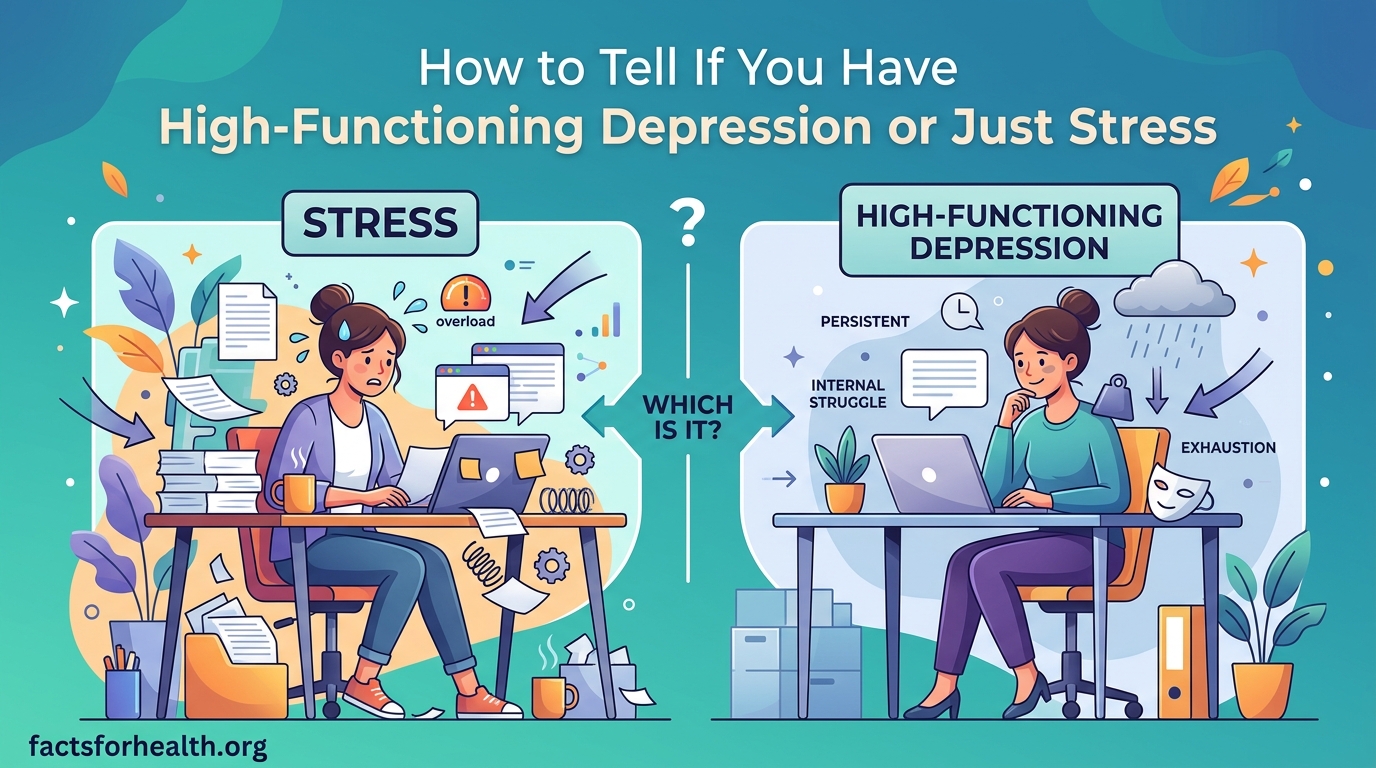
You show up to work on time. You meet your deadlines. Your friends think you are doing great. But underneath the surface, you feel exhausted, numb, and disconnected from the life you appear to be living so well.
If that sounds familiar, you are not alone in wondering what is really going on. Many high-achieving adults ask the same question: am I just stressed, or is something deeper happening? Learning how to tell if you have high functioning depression or just stress can be the first step toward feeling like yourself again.
High-functioning depression is not an official clinical diagnosis, but it describes a very real experience. People who live with it maintain their responsibilities and appear fine to others while struggling with persistent depressive symptoms internally. The gap between how they look and how they feel is what makes it so hard to recognize, even for the person experiencing it.
In this guide, we will walk through what high-functioning depression actually feels like, how it differs from stress and burnout, and the signs that suggest it may be time to seek professional support.
Table of Contents
What Is High-Functioning Depression?
High-functioning depression describes a state where someone experiences ongoing depression symptoms while continuing to meet their daily responsibilities at work, school, and home. The term is commonly used by mental health professionals and patients alike, even though it does not appear as a standalone diagnosis in the DSM-5.
Clinically, what people call high-functioning depression most closely aligns with persistent depressive disorder, also known as dysthymia. This condition involves a chronic, low-grade depressed mood that lasts for at least two years. Some people with major depressive disorder also maintain outward functionality while suffering internally, which is another reason the term gets used.
Mental health professionals often use the duck analogy to explain it. A duck gliding across a pond looks calm and effortless above the water. But underneath, its legs are paddling frantically just to stay afloat. That is what high-functioning depression feels like for many people. Everything looks smooth on the surface while enormous effort goes into keeping it that way.
The key point is this: functioning well on the outside does not mean the depression is mild. In fact, the energy required to maintain appearances can make the internal experience more exhausting over time.
How to Tell If You Have High-Functioning Depression: 10 Signs
Recognizing the signs of high-functioning depression requires looking past what others see and tuning in to what you actually feel. Here are 10 common indicators that your experience may be more than everyday stress:
- You feel exhausted no matter how much you rest. Sleep does not restore you, and you wake up already tired. This fatigue is physical, mental, and emotional all at once.
- You have stopped enjoying things you used to love. This is called anhedonia, and it is one of the hallmark depression symptoms. Hobbies, socializing, and activities that once brought joy now feel like obligations.
- You are functioning but feel empty inside. You get things done, but there is no sense of satisfaction or accomplishment. Completing tasks feels mechanical rather than meaningful.
- You experience emotional numbness rather than sadness. Many people expect depression to feel like constant sadness. High-functioning depression often shows up as feeling nothing at all, a flat emotional state that can be deeply unsettling.
- You are more irritable than usual. Small frustrations trigger disproportionate reactions. You may snap at loved ones or feel a constant low-grade annoyance that you cannot explain.
- Your sleep or appetite has shifted. You might be sleeping too much, too little, or experiencing poor quality sleep. Appetite changes, whether eating more or less than usual, are also common.
- Concentration feels harder than it used to. Simple tasks take longer. You reread the same paragraph multiple times or lose your train of thought mid-conversation.
- You feel guilty about not feeling better. From the outside, your life looks good. You have a job, relationships, and stability. The guilt of not appreciating it or not feeling happy can be overwhelming.
- Your energy collapses when you stop performing. Many people describe a pattern of holding it together all week and then crashing completely on weekends. The contrast between weekday performance and weekend depletion is striking.
- You engage in harsh self-criticism. Your internal monologue is relentless. No achievement feels like enough, and you regularly question whether you are a fraud who will eventually be exposed.
Experiencing several of these signs consistently for two weeks or longer is a strong signal that what you are dealing with extends beyond temporary stress.
High-Functioning Depression vs Stress: Key Differences
Telling the difference between stress and high-functioning depression matters because the two require different responses. Stress is typically a reaction to a specific pressure or demand. It eases when the pressure is removed or resolved. Depression, by contrast, persists regardless of external circumstances.
One of the clearest distinctions is duration. Stress comes and goes with life events. If you feel depleted for months on end, even during periods when life is relatively calm, that pattern points more toward depression than stress.
Another important difference is the emotional quality. Stress tends to feel like overwhelm, anxiety, or tension. Depression more often feels like emptiness, numbness, or a heavy flatness. If you feel wound up and overstimulated, that leans toward stress. If you feel hollowed out and disconnected, that leans toward depression.
The table below summarizes the key distinctions between stress, burnout, and high-functioning depression:
| Factor | Stress | Burnout | High-Functioning Depression |
|---|---|---|---|
| Primary trigger | Specific external pressures | Chronic work or caregiving stress | Not tied to one trigger |
| Duration | Comes and goes with events | Builds over months of overload | Persists for months or years |
| Dominant feeling | Overwhelm, anxiety, tension | Exhaustion, cynicism, detachment | Numbness, emptiness, flatness |
| What happens when you rest | You recover relatively quickly | Recovery requires extended break | Rest does not resolve it |
| Enjoyment of activities | Still enjoyable when stress lifts | Reduced interest in work specifically | Pervasive loss of interest |
| Self-image | Temporarily shaken but recovers | Feeling ineffective at work | Persistent feelings of worthlessness or guilt |
Burnout sits in the middle ground. It is specifically linked to chronic work or caregiving overload. Burnout improves with rest, time off, or changes to your work situation. High-functioning depression does not resolve with a vacation or a lighter schedule.
Why High-Functioning Depression Goes Unnoticed
One of the most painful aspects of high-functioning depression is how invisible it is. People who experience it often hear variations of “But you seem fine!” from friends, family, and colleagues. This well-meaning response can make the struggle feel even more isolating.
The reason it goes unnoticed comes down to what mental health professionals call functional camouflage. When someone continues performing at a high level, others naturally assume that performance reflects their internal state. No one sees the extra hours of preparation, the mental rehearsals before social events, or the recovery time needed after seemingly normal activities.
Many people describe feeling like they are living a double life. They are competent and composed at work, then collapse into exhaustion the moment they get home. The gap between their public performance and private reality creates a sense of fraudulence that feeds the depression itself.
The condition also goes unnoticed by the person experiencing it. When you have functioned this way for years, it starts to feel normal. You may assume everyone operates at this level of internal effort. The thought that something is wrong may not even occur to you until a crisis forces the question.
Forum discussions on Reddit reveal how common this experience is. People in communities like r/depression and r/mentalhealth frequently describe being dismissed by others who cannot understand how someone who appears successful can also be struggling. The validation that this experience is real and recognized matters enormously.
Self-Assessment: Am I Depressed or Just Stressed?
No online checklist can replace a professional evaluation, but asking yourself the right questions can help you decide whether to take the next step. Consider the following indicators honestly.
Duration check: Have these feelings lasted for two weeks or longer without significant improvement? Stress usually fluctuates with circumstances. Depression persists.
Circumstance check: Do you feel this way even when nothing particularly stressful is happening in your life? If the emptiness and exhaustion remain during calm periods, depression is more likely.
Interest check: Have you lost interest in activities that previously brought you genuine pleasure? This loss of interest, or anhedonia, is one of the most reliable indicators of depression versus stress.
Rest check: Does taking time off or getting extra sleep actually make you feel better? If rest and self-care do not improve your mood, that is a strong signal that something deeper is going on.
Self-talk check: Is your internal monologue dominated by harsh self-criticism, hopelessness, or feelings of worthlessness? Stress tends to produce anxious thoughts about specific situations. Depression produces a more generalized negative view of yourself.
Energy check: Is your energy consistently low regardless of how much sleep you get? Chronic fatigue that does not respond to rest is a hallmark of depression.
If you answered yes to three or more of these questions, especially if the feelings have persisted for two weeks or more, it is worth speaking with a mental health professional for a proper assessment.
When to Seek Professional Help
Knowing when to seek help can feel difficult, especially when you are accustomed to handling things on your own. But certain signs clearly indicate it is time to reach out to a professional.
You should seek help if your symptoms have lasted more than two weeks, if they are interfering with your relationships or quality of life, or if they are getting progressively worse rather than improving.
Certain warning signs require immediate attention. If you are having thoughts of self-harm or suicide, feeling hopeless about the future, using alcohol or substances to cope, or experiencing a significant inability to function even when trying, reach out right away.
If you are in crisis, call or text 988 to reach the Suicide and Crisis Lifeline in the United States. It is free, confidential, and available 24 hours a day, 7 days a week. You can also text HOME to 741741 to connect with the Crisis Text Line.
Starting the conversation with a professional does not require a perfect description of what you are feeling. You can simply say, “I think I might be depressed, but I am not sure. Can you help me figure it out?” That is enough. A therapist or psychiatrist is trained to ask the right questions to guide the conversation from there.
Treatment Options for High-Functioning Depression
The good news is that high-functioning depression is treatable. Most people benefit from a combination of therapy, lifestyle changes, and in some cases medication. Treatment is always personalized based on your specific symptoms and circumstances.
Cognitive behavioral therapy (CBT) is one of the most widely recommended approaches. It helps you identify and change thought patterns that contribute to depression, develop healthier coping strategies, and gradually reconnect with activities and relationships that bring meaning.
Medication may also play a role. SSRIs (selective serotonin reuptake inhibitors) and SNRIs (serotonin-norepinephrine reuptake inhibitors) are commonly prescribed for persistent depressive symptoms. For treatment-resistant cases, other options like esketamine or transcranial magnetic stimulation may be considered under psychiatric supervision.
Lifestyle approaches support formal treatment but do not replace it. Regular physical activity, consistent sleep routines, meaningful social connection, and limiting alcohol can all contribute to improvement. These changes work best alongside professional care rather than as a substitute.
The most important step is simply starting. Many people with high-functioning depression delay treatment because they believe they should be able to handle it on their own. But getting support is not a sign of weakness. It is a practical, evidence-based decision to address a condition that responds well to intervention.
FAQs
What does high-functioning depression feel like?
High-functioning depression feels like maintaining a normal exterior while experiencing persistent emptiness, exhaustion, and emotional numbness inside. Many people describe feeling like they are going through the motions of life without truly connecting to it. You may perform well at work and in relationships but feel drained, hollow, or detached much of the time.
How do I know if I’m depressed or just stressed?
The main difference is duration and recovery. Stress comes and goes with external pressures and improves when the pressure is removed. Depression persists for two weeks or longer regardless of circumstances, does not improve with rest, and is often accompanied by loss of interest in activities, emotional numbness, and feelings of worthlessness. If rest and removing stressors do not help, it may be depression.
How to get out of high-functioning depression?
Start by acknowledging that what you are experiencing is real and valid, even if you appear fine to others. Reach out to a mental health professional for an assessment. Evidence-based treatments include cognitive behavioral therapy (CBT), medication such as SSRIs or SNRIs if recommended, regular exercise, consistent sleep, and meaningful social connection. Recovery takes time, but treatment is effective for most people.
What is the best medication for high-functioning depression?
There is no single best medication. SSRIs like fluoxetine, sertraline, and escitalopram are commonly prescribed first because they are well-tolerated by most people. SNRIs such as venlafaxine or duloxetine may be recommended depending on your specific symptoms. A psychiatrist will determine the right medication based on your medical history, symptom profile, and any other conditions. Always follow professional medical guidance.
Moving Forward
Understanding how to tell if you have high functioning depression or just stress starts with one core insight: being able to function does not mean you are okay. The fact that you are meeting your responsibilities does not invalidate the exhaustion, numbness, or emptiness you may be feeling.
Stress is temporary and situational. It lifts when the pressure does. Depression persists, drains your capacity for joy, and does not respond to rest alone. If you recognize yourself in the signs we covered, the most empowering step you can take is to talk with a mental health professional who can help you sort through what is happening.
You do not have to wait until things fall apart to get support. The earlier you reach out, the more effective treatment tends to be. What you are experiencing is real, it is recognized, and it is treatable.