
If you are reading this, you have probably answered the same question five, ten, maybe twenty times today already. You are not failing. You are not impatient. You are human, and what you are experiencing is one of the most emotionally draining aspects of dementia caregiving.
Repetitive questioning is a common symptom of dementia caused by damage to the brain’s memory and communication centers, making it impossible for the person to remember they have already asked a question or received an answer. It is not attention-seeking behavior. It is not stubbornness. It is the disease.
In this guide, we will walk through how to handle repetitive questions from a loved one with dementia using practical, field-tested techniques. You will learn why repetition happens, what to say (and what never to say), how to manage your own frustration, and how strategies should shift as dementia progresses through different stages.
Our team drew from caregiver experiences shared in dementia support communities, clinical guidance from the Alzheimer’s Association and UCLA Health, and insights from dementia care nurses who work with families every single day. What follows is not theory. These are strategies that real caregivers use to get through the hardest days.
By the time you finish this article, you will have a toolkit of at least seven concrete techniques you can try today. Some will work better than others depending on your loved one’s personality, stage of dementia, and the time of day. The key is having options because no single approach works every time.
Table of Contents
Quick Overview: How to Handle Repetitive Questions from a Loved One with Dementia
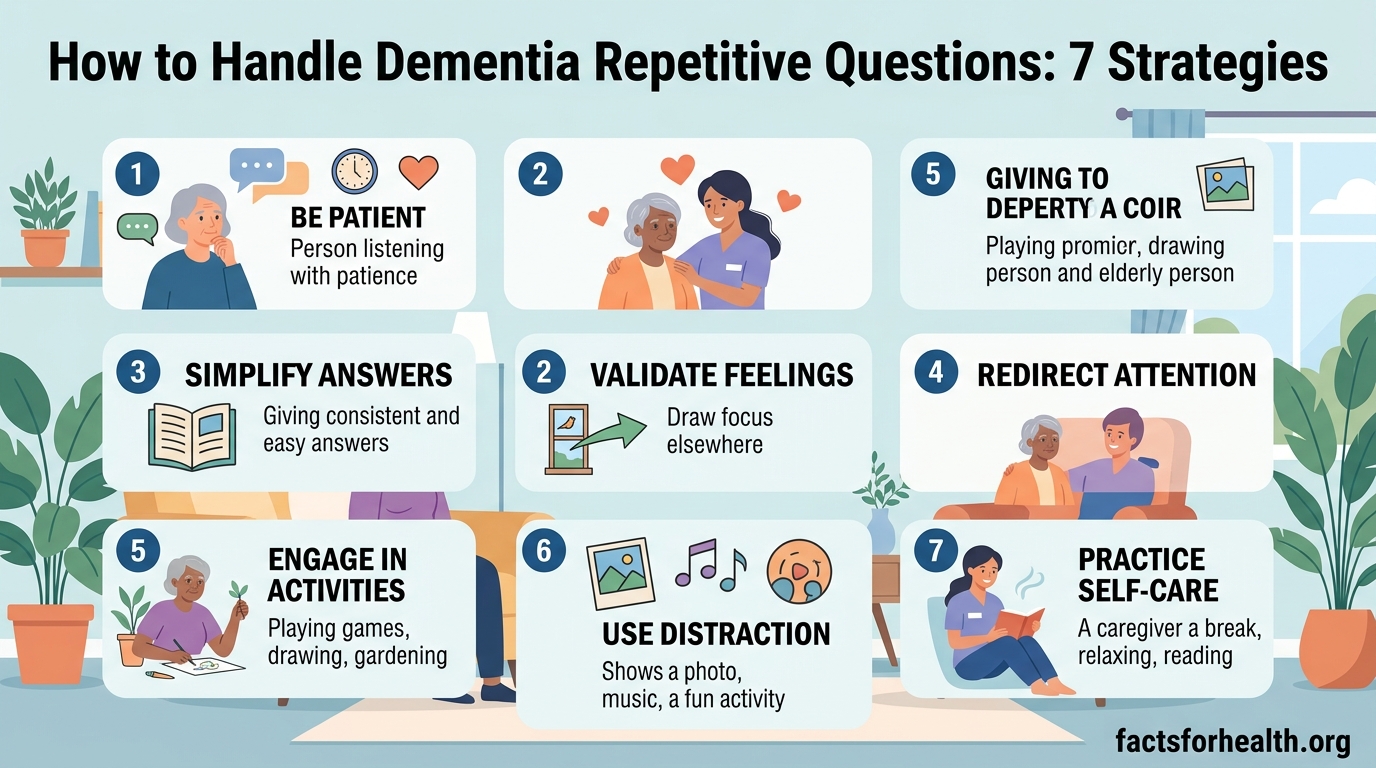
Here is a rapid summary of the seven core strategies we cover in detail below. Think of these as tools in your caregiving toolkit, not a rigid sequence to follow.
- Answer with calm reassurance – Keep responses brief, warm, and consistent each time
- Respond to the emotion, not the words – Look for the anxiety or fear underneath the question
- Search for unmet needs – Hunger, pain, thirst, or bathroom needs can drive repetition
- Use visual cues and memory aids – Whiteboards, clocks, and sticky notes reduce questions
- Redirect with activities – Offer a snack, a simple task, or favorite music
- Apply the 90-second rule – Stay engaged for 90 seconds before trying to redirect
- Address object fixation directly – Create a designated safe spot for phone, wallet, keys
Bookmark this page. On the days when nothing seems to work, come back and try a different strategy from this list. Sometimes a fresh approach is all it takes to break a loop.
Why Does Dementia Cause Repetitive Questions?
Understanding the “why” behind repetitive questioning changes how you respond to it. When you know what is happening inside your loved one’s brain, the repetition becomes less infuriating and more understandable. Let us break down the science in plain language.
Short-Term Memory Damage
Dementia damages the hippocampus, the part of the brain responsible for forming new memories. When this region deteriorates, your loved one literally cannot encode the answer you just gave them into memory. Imagine someone erased the last two minutes of your life every sixty seconds. That is what short-term memory loss feels like from the inside.
The question about whether it is Tuesday, or whether the doctor appointment is tomorrow, or when your sister is coming to visit feels completely fresh to them each time they ask it. They are not ignoring your answer. Their brain did not save it.
This is why repeating yourself does not work. No matter how clearly or firmly you answer, the information slips away within seconds or minutes. The Alzheimer’s Association explains that this deterioration of brain cells is progressive, meaning memory function will continue to decline over time.
Language Center Impairment
Dementia also affects the language centers of the brain, particularly in the temporal and parietal lobes. This means your loved one may struggle to find the right words to express what they are actually feeling or needing. A question about what time it is might actually be a question about whether they are safe. A repeated question about going home might really be expressing that they feel unsettled or anxious.
When the brain cannot form the complex thought “I am feeling anxious because I do not recognize this room even though I have lived here for thirty years,” it defaults to a simpler, more accessible question. Often that simpler question is one they have practiced thousands of times: “When are we leaving?” or “Is it time for dinner yet?”
Anxiety, Fear, and Unmet Needs
One of the most important things dementia care professionals emphasize is that repetitive questions are rarely just about getting information. They are often an expression of anxiety, fear, or an unmet physical need.
A person might repeatedly ask “Where is my mother?” not because they expect their long-deceased parent to walk through the door, but because they are searching for comfort and safety. Another might ask “What time is it?” ten times in an hour because they are hungry, thirsty, in pain, or need to use the bathroom but cannot articulate it.
Before trying any response strategy, run through this unmet needs checklist:
- Are they hungry or thirsty?
- Do they need to use the bathroom?
- Are they too hot or too cold?
- Is something causing pain or discomfort?
- Are they bored or understimulated?
- Are they overstimulated by noise, light, or activity?
- Do they feel anxious or unsafe in their current environment?
Caregivers in online dementia support communities consistently report that addressing these basic needs resolves repetition more effectively than any communication technique. As one Reddit caregiver put it: “Maybe try to get to the root of the issue. Are they anxious about something? Fearful? They might think they’ve forgotten an item or an appointment.”
The Sundowning Connection
If you notice that repetitive questioning gets significantly worse in the late afternoon or early evening, you are experiencing sundowning. Sundowning is a well-documented phenomenon where dementia symptoms intensify as daylight fades, affecting up to two-thirds of people with Alzheimer’s disease.
During sundowning hours, the brain’s already compromised ability to regulate emotion and cognition drops even further. Your loved one may feel confused, anxious, or afraid as shadows lengthen and the environment looks unfamiliar. This amplifies repetitive questioning dramatically.
Strategies that work perfectly at 10 AM may fail completely at 5 PM. Planning for this pattern by scheduling quiet, low-demand time during late afternoon hours can help reduce the intensity. Close curtains before shadows form, turn on familiar lights, and avoid introducing new activities or visitors during this window.
Dementia Looping: What It Is and How It Differs
You may have heard caregivers talk about “dementia looping” and wondered how it differs from repetitive questioning. Looping refers to a pattern where a person with dementia repeats the same phrase, question, or action continuously in a tight cycle, sometimes for hours, with almost no break between repetitions.
While repetitive questioning involves asking the same question multiple times throughout the day, looping is more intense and circular. The person becomes stuck like a record skipping, unable to break out of the pattern on their own. This is different from asking about lunch at 9 AM, again at 11 AM, and again at noon.
Looping often signals deeper anxiety or a more advanced stage of cognitive decline. If your loved one is looping, standard response strategies may not be enough. You may need to physically change the environment, introduce a completely different sensory experience like stepping outside for fresh air, or consult with their doctor about whether medication adjustments could help.
Do They Know They Are Repeating Themselves?
This is one of the most common questions caregivers ask, and the answer is almost always no. Because the damage is to short-term memory, your loved one genuinely has no memory of having asked the question before. Each repetition feels like the first time to them.
Telling them they already asked does not help. It actually causes confusion and distress because, from their perspective, they are asking for the first time. Imagine someone abruptly telling you that you already said something you have no memory of saying. It would feel disorienting and frightening.
This understanding is the foundation for every strategy that follows. When you truly accept that your loved one cannot remember, it becomes easier to answer with patience. The repetition is not a choice. It is a symptom.
How to Handle Repetitive Questions from a Loved One with Dementia: 7 Practical Strategies
Now let us get into the techniques. These seven strategies come from a combination of clinical guidance and real caregiver experience. Try them in any order, combine them, and adapt them to your loved one’s personality and preferences. There is no single right answer, only what works in your specific situation.
Strategy 1: Answer with Calm Reassurance Every Time
The simplest and most effective approach is also the hardest: answer the question again, calmly, as if it is the first time you have heard it. Use a warm, gentle tone. Make eye contact. Keep your answer brief because long explanations will not be remembered and may cause additional confusion.
If your loved one asks “What time is dinner?” for the sixth time, a simple “Dinner is at 6 o’clock, and I am making your favorite spaghetti” works better than a detailed explanation of the evening schedule. Short, warm, consistent answers provide security without overwhelming a damaged memory system.
Consistency matters here. If you answer the same way each time, your loved one gets the same reassurance each time. Varying your response or showing frustration introduces unpredictability, which can actually increase anxiety and make the repetition worse.
One technique that helps: gently touch their hand or arm while you answer. Physical contact combined with verbal reassurance creates a stronger emotional anchor than words alone. The Alzheimer’s Association recommends gentle touch as a communication tool because it conveys safety and connection that bypasses the damaged language centers.
Strategy 2: Respond to the Emotion Behind the Question
Every repetitive question carries an emotional undercurrent. When you learn to hear the feeling instead of the words, you can address the root cause rather than the surface question. This approach is endorsed by family caregiving experts and dementia care nurses.
If your mother repeatedly asks “When is your father coming home?” she is likely not asking for a schedule update. She is expressing loneliness, insecurity, or a longing for connection. Responding “Dad passed away three years ago, remember?” will only cause fresh grief and confusion.
Instead, respond to the emotion: “I know you miss Dad. I miss him too. He loved us so much, didn’t he?” This validates the feeling without correcting the factual error. In dementia care, this approach is sometimes called therapeutic lying or compassionate deception, and most dementia care professionals consider it an appropriate and kind response.
Here is a quick reference for common repetitive questions and the emotions behind them:
- “When are we going home?” often means “I feel unsafe or unsettled here”
- “Where is my mother?” often means “I need comfort and reassurance”
- “What time is it?” often means “I feel anxious and need structure”
- “When is dinner?” often means “I am hungry or bored”
- “Where are my things?” often means “I feel a loss of control”
Strategy 3: Identify and Address Unmet Needs
Before reaching for communication techniques, check whether your loved one has a physical or emotional need that is driving the repetition. Many caregivers are amazed by how quickly repetitive questions stop once a hidden need is met.
Run through the unmet needs checklist from earlier in this article. Offer a glass of water or a small snack. Check if clothing is too tight or if the room temperature is uncomfortable. Ask about pain, even if they cannot articulate it clearly. Sometimes a person who has been asking the same question for an hour simply needed to use the bathroom and could not figure out how to get there.
One caregiver on AgingCare shared: “You can repeat yourself till you’re blue in the face but the only thing that works is distraction.” Often that distraction works because it involves a snack, a drink, or a physical activity that meets an underlying need the caregiver had not identified.
Keep a simple log for a few days. Note when repetitive questioning peaks and what was happening just before. You may discover patterns that reveal hidden triggers. For example, if repetition always spikes around 3 PM, your loved one may be hungry for a mid-afternoon snack. If it worsens after visitors leave, the trigger may be overstimulation that requires a quiet recovery period.
Strategy 4: Use Visual Cues and Memory Aids
Visual cues work because they bypass the damaged short-term memory system entirely. Instead of relying on your loved one to remember information, you put the answer in their environment where they can see it whenever the question arises. This is one of the most underused strategies among family caregivers.
A whiteboard placed near your loved one’s favorite chair can answer the most common daily questions. Write the day of the week, the date, the weather, today’s meals, and any scheduled activities. Update it each morning. One Reddit caregiver shared: “I write answers to common questions on a white board by her chair. Today is Friday. Spaghetti for supper. Haircut tomorrow.”
Here are visual cue tools that caregivers consistently recommend:
- Large-print digital clocks that display the day, date, and time clearly
- Wall calendars with large text and marked appointments
- Sticky notes on doors, cabinets, and mirrors with simple labels
- Photo labels on room doors and dresser drawers
- Reminder signs like “Dinner is at 6:00” posted in the kitchen
- Memory notebooks where caregivers log daily events for the person to reference
The key is making information visible and impossible to miss. Place cues at eye level in locations your loved one naturally looks. A clock on the far wall that requires squinting will not help. A large-print clock directly in their line of sight while seated will be checked dozens of times a day, each time answering the question before it is asked.
Be patient with this approach. It may take time for your loved one to develop the habit of checking the whiteboard or clock. But once it becomes part of their routine, visual cues can dramatically reduce the frequency of repetitive questions.
Strategy 5: Redirection and Distraction Techniques
Redirection involves gently shifting your loved one’s attention away from the repetitive question and toward a different topic or activity. It works because the brain’s attention system, while impaired, can still be captured by a new and engaging stimulus.
The most effective redirections involve activities that are familiar, repetitive, and satisfying. Try these options:
- Folding laundry – The repetitive motion is calming and gives a sense of purpose
- Listening to favorite music – Music memory survives longer than verbal memory in dementia
- Looking at photo albums – Familiar faces trigger long-term memories that remain intact
- Simple food preparation – Washing vegetables, buttering bread, or setting a table
- Going for a walk – A change of environment physically breaks the mental loop
- Petting a cat or dog – Animal therapy reduces anxiety and provides sensory engagement
- Sorting objects – Coins, buttons, or playing cards give the hands something to do
The technique matters as much as the activity. Do not say “Stop asking that, let us do something else.” Instead, join their reality first, then pivot. Try: “That is a great question. While we think about it, can you help me fold these towels? I could really use your help.” This approach validates their question, provides a compliment, and redirects in one smooth motion.
Offer a snack or favorite beverage alongside the activity. The combination of a physical task, a pleasant taste, and your company creates a multi-sensory experience that can completely reset the mental loop.
Strategy 6: The 90-Second Rule
The 90-second rule is a technique borrowed from neuroscience and adapted for dementia caregiving. The principle is simple: when your loved one asks a repetitive question, fully engage with them for at least 90 seconds before attempting to redirect or change the subject.
Ninety seconds is approximately how long it takes for an initial emotional response to move through the body’s nervous system. By staying present and attentive for that duration, you give your loved one the feeling of being truly heard and connected with. Often, this alone satisfies the underlying need for attention and breaks the repetition cycle naturally.
Here is how to apply it. When the question comes, stop what you are doing. Make eye contact. Take their hand. Answer warmly. Then ask a follow-up question or comment on something related. “Dinner is at 6 o’clock. Are you getting hungry? I was thinking about making chicken tonight, what do you think?” Maintain this engagement for about a minute and a half.
Many caregivers report that the 90-second rule works because it addresses the emotional need driving the repetition rather than just the surface question. Your loved one may not remember your answer, but they will remember the feeling of being attended to and cared for.
This technique also helps you, the caregiver. Ninety seconds of mindful, intentional engagement is easier to sustain than hours of reactive frustration. It transforms the interaction from a burden into a brief moment of connection.
Strategy 7: Handling Object Fixation Specifically
Object fixation is a specific subtype of repetitive behavior that deserves its own approach. If your loved one obsessively asks about the location of their phone, wallet, keys, cigarettes, or other personal items, they are experiencing fixation. This is extremely common and incredibly frustrating for caregivers.
One Reddit caregiver described it perfectly: “My dad has this thing where he HAS to know where his things are at all seconds of the day, his cell phone, wallet, cigarettes. Even if it’s not something related to what he’s talking about.” This need for constant reassurance about possessions stems from a loss of control and security. When memory fails, knowing where your things are becomes an anchor.
Here is a system that works for many families:
First, create a designated spot for each important item. A specific drawer, hook, or basket that is always used. Label it clearly with both words and a picture. Train yourself to always return items to this spot immediately after use.
Second, make the spot visible and accessible. If your loved one cannot see the item, they will not believe it is safe. A clear container or open shelf works better than a closed drawer.
Third, when the fixation question arises, walk them to the spot together. Let them see and touch the item. This physical confirmation is more powerful than verbal reassurance alone.
For items that cannot be provided safely, like car keys for someone who should not drive, consider substitute objects. An old set of keys on a decorative keychain, a non-functional phone, or an empty wallet with a few photos inside can satisfy the fixation without creating risk.
What NOT to Say to Someone with Dementia
Knowing what to avoid saying is just as important as knowing what to say. Certain common responses, while well-intentioned, actually make the situation worse. Here are the phrases to eliminate from your vocabulary and why they backfire.
“I already told you that.” This is the most common mistake caregivers make. From your perspective, you are stating a fact. From their perspective, you are telling them something impossible and slightly accusatory. It causes confusion, embarrassment, and sometimes anger.
“You just asked me that.” Same problem, with the added sting of implied criticism. Your loved one feels corrected but cannot understand why, which increases anxiety and often leads to more repetition, not less.
“Don’t you remember?” No, they do not remember. That is the entire point of the disease. Asking this question highlights their deficit in a painful way and serves no purpose.
“I said it five minutes ago.” References to time are meaningless to someone with short-term memory damage. Five minutes ago might as well be five years ago. This response only frustrates both of you.
“Stop asking me that.” Commands to stop are counterproductive. The person cannot stop, and being told to do something impossible creates distress that often manifests as agitation or behavioral symptoms.
Instead of any of these, take a breath, remind yourself that they genuinely cannot remember, and answer as if it is the first time. This is hard. It is one of the hardest things about dementia caregiving. But it is also the most effective approach for reducing distress on both sides.
What to Do When Redirection Stops Working
A pain point that comes up repeatedly in caregiver forums is the moment when standard redirection techniques lose their effectiveness. Multiple caregivers report that after months of using the same strategies, nothing seems to work anymore. This is normal and does not mean you are failing.
When redirection stops working, the first step is to reassess for new triggers. Has your loved one’s condition changed? Are they in a new stage of dementia? Is there a new source of pain, discomfort, or environmental stress? What worked three months ago may not work today because the underlying situation has shifted.
Try a completely different category of intervention. If verbal redirection has stopped working, switch to sensory redirection. Step outside for fresh air and a change of scenery. Run warm water over their hands. Offer an ice cube to hold. Play music they have not heard in a while. The brain responds to novelty, and a fresh sensory experience can sometimes break through where familiar strategies cannot.
If repetitive questioning has become constant, looping, and unresponsive to all strategies, it is time to consult their doctor. Medication changes, underlying infections like urinary tract infections, or undiagnosed pain can all cause sudden increases in repetitive behavior. A medical evaluation can rule out treatable causes.
How Strategies Change Across Dementia Stages
No competitor in the current search results breaks down repetitive questioning strategies by dementia stage. But this matters enormously because what works in early-stage dementia can be ineffective or even harmful in late-stage. Let us address that gap here.
Early Stage: Repetition as Anxiety Expression
In early-stage dementia, your loved one is often aware that something is wrong with their memory. This awareness creates anxiety, and that anxiety frequently drives repetitive questioning. They may ask the same question repeatedly because they are checking, double-checking, and triple-checking to make sure they did not miss or forget something important.
In this stage, visual cues and memory aids work well because your loved one can still read, understand, and use them independently. A well-placed calendar or whiteboard empowers them to check answers themselves without needing to ask. Written checklists for daily routines can preserve independence and reduce anxiety.
Honest, reassuring conversations about memory are still possible. You can say things like “I know you are worried about forgetting. Let us write that down together so you have it.” Acknowledging their fear validates their experience and builds trust.
Middle Stage: Peak Repetition and Communication Challenges
Middle-stage dementia is typically when repetitive questioning reaches its peak intensity. Short-term memory is significantly impaired, language skills are declining, and anxiety levels are often high. This is the stage where most caregivers seek help and where the strategies in this article are most needed.
Visual cues remain helpful but may need simplification. Replace text labels with pictures. Use larger fonts and brighter colors. Your loved one may not be able to read a sentence, but they can still recognize a photograph of a toilet on the bathroom door.
Redirection becomes more central to your approach. Your loved one may not be able to follow a conversation about why they should stop asking, but they can be gently guided toward a new activity. Physical tasks like folding laundry or sorting objects become increasingly important because they engage the body when the mind cannot engage.
Object fixation often appears or intensifies during this stage. Implement the designated-spot system described earlier. Be prepared to reassure about item locations many times per day. Consider whether substitute objects might reduce fixation-driven anxiety.
Late Stage: Shift from Verbal to Nonverbal Strategies
In late-stage dementia, repetitive questioning often decreases, not because the anxiety has resolved, but because verbal communication skills have declined. Your loved one may no longer be able to form the question, but the underlying anxiety, fear, or need remains. They may express it through repetitive sounds, movements, or facial expressions instead.
Nonverbal strategies become essential. Gentle touch, soothing music, and a calm environment are more effective than any verbal response. If your loved one is repeating a sound or motion, look for physical causes: pain, hunger, discomfort, or the need for a position change.
Continue addressing unmet needs. Even when your loved one cannot tell you what is wrong, the most common causes of agitation in late-stage dementia are still hunger, thirst, pain, and bathroom needs. Regular, scheduled attention to these basics prevents much of the distress that manifests as repetitive behavior.
This stage requires significant professional support. If you have not already connected with hospice services, palliative care, or a memory care facility, late-stage dementia is typically when these resources become necessary. You cannot do this alone, and you should not have to.
How to Handle Your Own Frustration and Protect Your Wellbeing
Every other guide on this topic treats caregiver self-care as an afterthought, a brief paragraph at the end saying “remember to take care of yourself.” That approach fails to address the reality: caregiver frustration is the number one pain point reported by people dealing with repetitive questioning. If we do not address your emotional experience directly, none of the strategies above will be sustainable.
The Reality of Caregiver Frustration
Let us be honest about what happens. After answering the same question for the tenth time in an hour, your patience wears thin. By the fifteenth time, you may feel your jaw clench or your chest tighten. By the twentieth time, you might snap. And then immediately feel a wave of guilt for snapping.
This cycle of frustration and guilt is not a sign that you are a bad caregiver. It is a normal human response to an extraordinarily difficult situation. Caregivers in online support communities describe this experience with remarkable consistency. One Reddit user wrote: “I get that he can’t remember, but I don’t know how to deal with it patiently any longer.”
Acknowledging your frustration is the first step toward managing it. Suppressing the feeling does not make it go away. It builds until it erupts. Instead, name what you are feeling. “I am frustrated. This is hard. I need a break.” Saying it out loud, even to yourself, creates a small pause between the emotion and your response.
Techniques for Managing Frustration in the Moment
When you feel yourself losing patience, try these immediate techniques before responding to another question.
Take three deep breaths. This is not a platitude. Deep breathing activates the parasympathetic nervous system, which counteracts the fight-or-flight stress response triggered by repetitive questioning. Three slow breaths can lower your heart rate and give you the split-second pause you need to respond calmly.
Step into another room for two minutes. Physical distance, even briefly, resets your emotional state. Go to the bathroom, get a glass of water, or step outside for fresh air. Two minutes away will not harm your loved one and may be the difference between a calm response and a sharp one.
Remind yourself of the cause. Silently repeat: “This is the disease, not the person.” Your loved one is not doing this on purpose. They are not trying to annoy you. Their brain is damaged, and this symptom is outside their control. This cognitive reframing, practiced consistently, genuinely changes how frustration feels.
Use a code word or phrase. Some caregivers develop a private signal, like touching a piece of jewelry or saying a specific word silently, that reminds them to reset. One caregiver shared that she silently says “this is the disease” each time she feels frustration rising. Over time, this becomes an automatic emotional regulation tool.
Managing Caregiver Guilt
The guilt that follows losing patience can be as draining as the repetition itself. You snap, your loved one looks hurt or confused, and you spend the next hour berating yourself. This guilt is nearly universal among dementia caregivers, and it deserves direct attention.
Here is the truth: every caregiver loses patience sometimes. Every single one. The family caregiving resource FamilyCaregiversOnline puts it well: “If you do lose your temper, it’s because you’re human.” You are doing a job that would challenge a trained professional, and you are doing it without training, without breaks, and without enough support.
When you snap, apologize and move on. A simple “I am sorry, I am feeling tired today” is enough. Your loved one likely will not remember the incident, and a sincere apology helps you let go of the guilt. Do not spiral into self-criticism. Identify what triggered your reaction, plan how to handle it differently next time, and forgive yourself.
Compassion fatigue is a recognized condition among professional caregivers and family caregivers alike. It develops when you give so much emotional energy that you have nothing left. Recognizing the signs, emotional exhaustion, irritability, withdrawal, and hopelessness allows you to take action before burnout takes hold.
Building Sustainable Self-Care
Self-care for dementia caregivers is not a luxury. It is a medical necessity. You cannot pour from an empty cup, and the demands of repetitive questioning will drain you completely if you do not actively refill your reserves.
Here are self-care practices that experienced caregivers identify as non-negotiable:
- Join a support group – Whether in person or online, connecting with others who understand is the single most effective stress reducer for dementia caregivers
- Schedule regular respite care – Even four hours a week of professional caregiving gives you time to recharge
- Maintain your own health appointments – Do not skip your own doctor visits because you are too busy caring for someone else
- Keep one hobby or activity – Hold onto at least one thing that is yours alone and brings you joy
- Ask for and accept help – From family members, friends, neighbors, and community organizations
- Consider therapy or counseling – Professional support helps you process the grief, anger, and loss that accompany caregiving
The Alzheimer’s Association operates a 24/7 helpline at 1-800-272-3900 that provides free support, resources, and a listening ear. You do not need to be in crisis to call. If you are overwhelmed, lonely, or just need someone who understands, that is reason enough.
When to Seek Professional Help
There comes a point for most dementia caregivers when professional help becomes necessary. This is not a failure. It is an appropriate recognition that dementia is a progressive, terminal disease that eventually exceeds what one person can manage at home.
Consider professional support when repetitive questioning is accompanied by physical aggression, severe sleep disruption, wandering, or complete inability to be left alone safely. These signs indicate that the care burden has grown beyond what family caregiving alone can address.
Options include in-home care aides for a few hours per day, adult day programs that provide structured activities and social engagement, residential memory care facilities with 24-hour specialized care, and hospice services for end-of-life support. Each of these resources exists to support both your loved one and you.
Talk to your loved one’s doctor about what level of care is appropriate for their current stage. You can also contact your local Area Agency on Aging for a needs assessment and information about services in your community. Planning ahead, before a crisis forces the decision, gives you more options and more control.
FAQs
What to do when someone with dementia keeps asking the same question?
Answer with calm reassurance each time, keeping your response brief and warm. Look for an underlying unmet need such as hunger, pain, or anxiety. Use visual cues like a whiteboard or clock to provide answers without verbal repetition. Never say you already told them. Redirect to a pleasant activity like listening to music or folding laundry if the repetition continues.
What stage of dementia is repetitive questions?
Repetitive questioning is most common in the middle stage of dementia, when short-term memory is significantly impaired but verbal communication skills remain relatively intact. It can begin in early-stage dementia as anxiety-driven checking behavior and may decrease in late-stage dementia as verbal abilities decline. However, every person’s progression is unique.
Do dementia patients know they are repeating themselves?
No, in the vast majority of cases they do not know. Damage to the brain’s short-term memory centers means they have no memory of having asked the question before. Each repetition feels like the first time to them. This is why pointing out the repetition causes confusion and distress rather than helping.
Is it okay to tell someone with dementia they already asked that?
No, it is not recommended. Telling someone with dementia they already asked a question does not help because they cannot remember asking it. It only causes confusion, embarrassment, and sometimes anger. Instead, answer the question again calmly as if it is the first time, or redirect their attention to a new topic or activity.
Does repetition get worse as dementia progresses?
Repetitive questioning typically peaks during the middle stage of dementia and may decrease in late stages as verbal communication declines. However, the underlying anxiety or need often persists and may express itself through repetitive sounds or movements instead of words. Sundowning can also cause repetition to worsen temporarily during late afternoon and evening hours at any stage.
What is the 90-second rule for dementia?
The 90-second rule means fully engaging with your loved one for at least 90 seconds when they ask a repetitive question before attempting to redirect. Make eye contact, hold their hand, answer warmly, and ask a follow-up question. This sustained attention addresses the emotional need driving the repetition and often breaks the cycle naturally without needing redirection.
You Are Doing More Than You Realize
Learning how to handle repetitive questions from a loved one with dementia is not about finding the one perfect response. It is about building a toolkit of strategies and knowing when to use each one. Some days, the whiteboard will save your sanity. Other days, a snack and a walk will work when nothing else does. The key is flexibility and self-compassion.
Remember these core principles: your loved one cannot remember, so each question is genuinely new to them. Look for the emotion and the unmet need behind the words. Never correct, never scold, and never say “you already asked that.” Use visual cues, redirection, and the 90-second rule as your primary tools. And above all, take care of yourself because you cannot sustain this without support.
If you take only one thing from this article, let it be this: the repetition is the disease, not the person you love. They are still in there, searching for security, connection, and comfort. Every time you answer with patience, you are giving them exactly what they need, even if they ask again in five minutes.
Reach out to the Alzheimer’s Association at 1-800-272-3900 for free, confidential support at any time. Join a caregiver support group, either locally or online. You are not alone in this, and you do not have to figure it out by yourself. There are people and resources ready to help you carry this weight.