
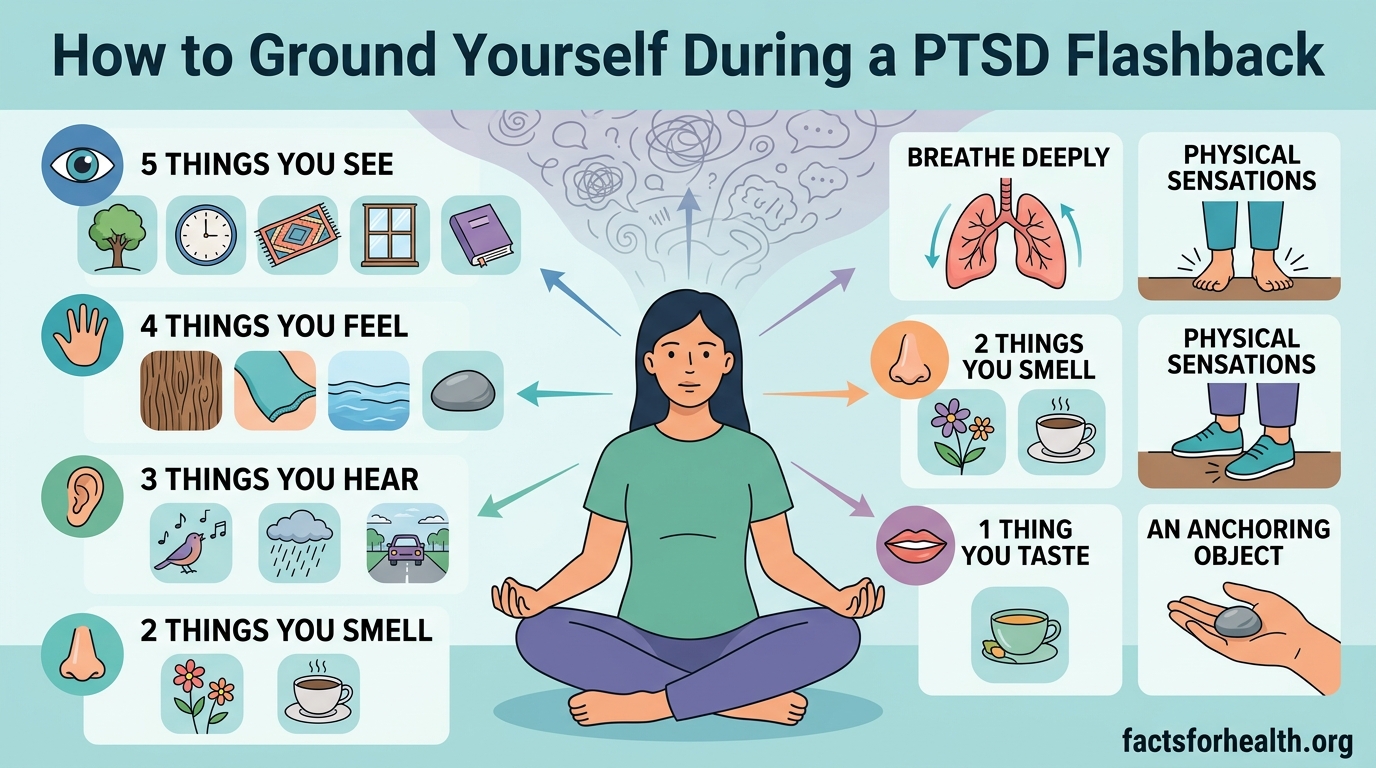
Grounding is a set of practical techniques that help you reconnect with the present moment during a PTSD flashback by using your five senses, physical sensations, or mental exercises to pull your awareness away from a traumatic memory and back to your current, safe environment. If you have ever felt trapped inside a memory that felt like it was happening all over again, you already know how disorienting and terrifying that experience can be. Learning how to ground yourself during a PTSD flashback is one of the most powerful coping skills you can add to your recovery toolkit.
Our team has spent years researching trauma recovery methods, and we have compiled the most effective grounding techniques drawn from clinical practice, lived experience, and the latest mental health research. Whether you experience visual flashbacks, emotional flashbacks, dissociation, or panic attacks tied to trauma, the strategies in this guide are designed to work in real-world situations, not just in theory. We focus on techniques you can use at home, at work, in public, and even when no one else knows you are using them.
People living with PTSD, C-PTSD, and other trauma-related conditions often tell us that standard advice like “just breathe” feels impossible to follow mid-flashback. That is why we have included techniques that range from quick physical interventions to cognitive exercises, along with the science behind why they work. We also cover what to do when common grounding methods fail and how to build a personalized grounding plan before a crisis hits.
This guide is not a replacement for professional therapy. EMDR, cognitive behavioral therapy, and other trauma-focused treatments remain the gold standard for long-term recovery. But when a flashback strikes in the middle of your day, you need tools you can use right now. That is exactly what you will find here.
Table of Contents
What Are PTSD Flashbacks?
A PTSD flashback is a vivid, intrusive re-experiencing of a traumatic event that makes you feel as though the trauma is happening again in the present moment. Unlike an ordinary memory, a flashback can override your current awareness, pulling you out of the here and now and into the sights, sounds, physical sensations, and emotions of the original event. Understanding what flashbacks are is the first step toward learning how to ground yourself during a PTSD flashback.
Flashbacks are a core symptom of post-traumatic stress disorder and complex PTSD. They can be triggered by anything associated with the original trauma, including sounds, smells, certain words, environments, dates, or even internal bodily sensations. Sometimes a flashback arrives with an obvious trigger, and other times it seems to come out of nowhere, which can make them even harder to manage.
Visual Flashbacks
Visual flashbacks are what most people picture when they hear the word “flashback.” You may see images of the traumatic event playing out in front of you, sometimes so vividly that you lose awareness of your actual surroundings. These can last anywhere from a few seconds to several minutes, and during that time your brain may struggle to distinguish between the memory and present reality.
Visual flashbacks often come with intense physical reactions. Your heart may race, your breathing may become shallow, and your muscles may tense as your body enters fight-or-flight mode. You might sweat, feel dizzy, or experience a sense of impending doom even though you are physically safe.
Emotional Flashbacks
Emotional flashbacks are different from visual ones but can be just as overwhelming. Instead of seeing the traumatic event, you suddenly feel the emotions associated with it, such as fear, shame, helplessness, or despair, without any visual component. These are especially common in complex PTSD (C-PTSD) resulting from prolonged or repeated trauma, such as childhood abuse or ongoing domestic violence.
One of the hardest things about emotional flashbacks is that they can be difficult to identify. You might suddenly feel an overwhelming sense of worthlessness or danger and not immediately connect it to a trauma response. This is why naming what is happening, “I am having an emotional flashback, and this feeling belongs to the past,” is itself a grounding step.
Dissociation During Flashbacks
Dissociation is another experience that can accompany flashbacks. You may feel detached from your body, as though you are watching yourself from the outside (depersonalization), or your surroundings may feel unreal, dreamlike, or foggy (derealization). Dissociation is your nervous system’s way of protecting you from overwhelming distress, but it can make grounding feel like an uphill battle.
If you dissociate during flashbacks, you are not broken or losing your mind. Dissociation is a recognized trauma response, and there are specific grounding techniques, particularly strong sensory stimulation like cold water or intense smells, that are especially effective for snapping back into your body and the present moment.
What Grounding Techniques Are and Why They Work
Grounding techniques are practical exercises that redirect your attention away from intrusive trauma memories and toward your present-moment sensory experience. The goal is simple: remind your brain that you are here, right now, in a safe environment, and that the traumatic event is in the past. When you learn how to ground yourself during a PTSD flashback, you give your nervous system the information it needs to stand down.
To understand why grounding works, it helps to know what happens in your brain during a flashback. The amygdala, your brain’s threat-detection center, essentially hijacks your nervous system, sending you into fight-or-flight mode as if the original danger has returned. Your prefrontal cortex, the part of your brain responsible for logic and rational thinking, goes offline. This is why simply telling yourself “I am safe” often does not work on its own. Your body does not believe it.
Grounding forces your brain to process real-time sensory input from your current environment. When you focus on what you can see, touch, hear, smell, or taste right now, your brain has to redirect resources away from the trauma memory and toward present-moment awareness. This reactivates your prefrontal cortex and sends signals to your nervous system that the immediate danger has passed.
The Role of the Vagus Nerve
Many grounding techniques work by stimulating the vagus nerve, a major nerve that runs from your brainstem through your body and plays a central role in regulating your nervous system. When your vagus nerve is activated, it triggers the parasympathetic nervous system, which is responsible for rest, digest, and calm states. Deep breathing, cold water exposure, humming, and certain physical movements all stimulate the vagus nerve and help shift your body out of fight-or-flight.
This is why cold water on your wrists or face can feel like hitting a reset button during a flashback. The sudden temperature change activates the vagus nerve, which in turn signals your heart rate to slow and your nervous system to regulate. Understanding this mechanism can help you choose techniques that work with your body’s biology rather than against it.
Grounding Is Not the Same as Suppression
One common misconception is that grounding means suppressing or avoiding trauma memories. This is not the case. Grounding is a short-term coping strategy that helps you manage distress in the moment so you can function and stay safe. Processing trauma memories happens in therapy, with a trained professional, in a controlled environment. Grounding keeps you stable enough to get through your day and engage in that deeper healing work.
How to Ground Yourself During a PTSD Flashback: Quick Overview
The fastest way to pull yourself out of a PTSD flashback is to engage your strongest sensory input with an intense, present-moment stimulus. For most people, this means using cold temperature (splashing cold water on your face or holding an ice cube), physical movement (stamping your feet, shaking your body, or standing on one leg), or the 5-4-3-2-1 sensory method. These techniques work because they force your brain to attend to immediate physical reality rather than the trauma memory.
If you only remember three things from this article, let it be these: cold snaps you back, movement reconnects you to your body, and engaging multiple senses at once is more powerful than any single technique. Keep a mental shortlist of two or three techniques you can deploy immediately, because mid-flashback is not the time to be browsing a list of options.
Here is a quick reference of the fastest grounding techniques, organized by how quickly they tend to work:
- Immediate (under 30 seconds): Splash cold water on your face, hold an ice cube, or press a cold can against your wrists.
- Fast (30 to 60 seconds): Stamp your feet on the ground, shake your hands and arms vigorously, or stand on one leg.
- Steady (1 to 3 minutes): Run through the 5-4-3-2-1 method, practice square breathing, or do a body scan from head to toe.
- Ongoing: Listen to calming music, hold a grounding object from your toolkit, or repeat a grounding affirmation.
The 5-4-3-2-1 Sensory Grounding Method
The 5-4-3-2-1 grounding technique is one of the most widely recommended methods for PTSD flashbacks because it systematically engages all five senses and is easy to remember even when your brain is overwhelmed. Here is how to use it, step by step:
- Find 5 things you can see. Look around your environment and name five objects you can see right now. Say them out loud if possible, or clearly in your mind. Example: a lamp, a book on the shelf, the window frame, a coffee mug, and the pattern on the rug.
- Find 4 things you can touch. Notice four things you can physically feel. This might be the texture of your clothing, the chair beneath you, the floor under your feet, or the cool surface of a desk. Press your attention into each sensation.
- Find 3 things you can hear. Identify three sounds in the environment. A clock ticking, traffic outside, the hum of a refrigerator, or birds outside the window. If it is quiet, notice the sound of your own breathing.
- Find 2 things you can smell. Notice two scents around you. If you cannot smell anything immediately, think of two smells you enjoy, like coffee, fresh rain, or a favorite lotion, and try to locate a source.
- Find 1 thing you can taste. Notice one taste in your mouth right now, or take a sip of water, bite into a mint, or chew gum to create a taste sensation. Focus on the flavor fully.
By the time you reach the final step, your brain has processed a large amount of present-moment sensory data, which helps interrupt the flashback loop. Many people find that going through the list once is enough to significantly reduce distress. If you still feel activated, run through it again or combine it with deep breathing.
Physical Grounding Techniques
Physical grounding techniques use your body and sensory input to pull you back to the present. These tend to be the most effective methods during an active flashback because they require no complex cognitive processing, something your brain may not be capable of mid-flashback. When you cannot think clearly, your body can do the work for you.
Cold Water and Ice Techniques
Cold temperature stimulation is repeatedly cited by PTSD survivors as one of the most effective grounding methods available. The shock of cold activates your dive reflex, slows your heart rate, and stimulates the vagus nerve, all of which help bring your nervous system back to a regulated state.
- Splash cold water on your face: Go to the nearest sink and splash cold water on your face three to five times. The temperature shock forces your brain to attend to the physical sensation immediately.
- Hold an ice cube: Grab an ice cube and hold it in your hand until it melts. Focus entirely on the cold, the sting, and the water running over your palm. This technique is discreet enough for home or office use.
- Cold water on your wrists: Run cold water over the inside of your wrists for 30 to 60 seconds. This is one of the most discreet grounding techniques and can be done in any public restroom without drawing attention.
- Press something cold against your neck: A cold can of soda, a frozen gel pack, or even a cold bottle pressed against the back of your neck provides a strong sensory jolt that can interrupt a flashback quickly.
Movement-Based Grounding
Physical movement reconnects your brain to your body, which is especially important during dissociation or when you feel detached from your physical self. You do not need to do anything elaborate. Simple, deliberate movements are often enough.
- Stamp your feet: Stand up and stamp each foot on the ground firmly, alternating left and right, for 30 seconds. Feel the impact travel up through your legs and into your hips.
- Shake it off: Shake your hands, arms, and whole body vigorously for 15 to 30 seconds. It may look unusual, but survivors report that this physically shakes off the flashback state.
- Stand on one leg: This technique is surprisingly effective. Balancing on one leg for 30 seconds forces your brain to engage its balance and logic centers, which directly competes with the trauma response.
- Mindful walking: Walk slowly and deliberately, paying attention to each foot as it lifts off the ground and makes contact again. Notice the texture of the floor or ground beneath you with each step.
- Stretch or clap: If you are in a setting where you cannot walk around, stretch your arms above your head, clap your hands together firmly, or wiggle your toes inside your shoes.
Tactile Grounding Objects
Carrying a physical object with a strong texture, scent, or temperature can give you something immediate to focus on when a flashback hits. The key is to have these items readily accessible in your pocket, bag, or desk drawer.
- A rough hair band or textured stone: Keep a hair band with a rough texture or a stone with an interesting surface in your pocket. Squeeze it, rub it between your fingers, or press it into your palm.
- An orange or citrus fruit: One survivor reported carrying an orange in their pocket and digging their nails into it during a flashback. The sharp citrus smell combined with the tactile sensation of the peel created a powerful grounding effect.
- A lavender pouch or essential oil: Smell is one of the strongest senses tied to memory. A lavender pouch or a small bottle of essential oil can drag you back to the present when other techniques fail. Simply open the container and inhale deeply.
- A grounding bracelet or fidget item: A bracelet with beads, a textured ring, or a fidget tool gives your hands something to do and provides consistent tactile feedback.
Body Scan Technique
A body scan involves mentally checking in with each part of your body, from your toes to the top of your head, noticing sensations without trying to change them. Start by bringing your attention to your feet. What do they feel? Are they warm, cold, tense, relaxed? Move slowly up through your legs, your stomach, your chest, your arms, your neck, and finally your face. By the time you reach the top, you have reconnected with your physical body and grounded yourself in present-moment sensation.
Progressive Muscle Relaxation
Progressive muscle relaxation involves tensing and then releasing each muscle group in your body, one at a time. Start with your feet: tense the muscles as tightly as you can for five seconds, then release. Move up to your calves, thighs, stomach, hands, arms, shoulders, and face. This technique not only grounds you but also releases the physical tension that builds up during a flashback.
Mental Grounding Techniques
Mental grounding techniques use cognitive tasks to redirect your brain away from trauma memories. These work by forcing your prefrontal cortex back online through problem-solving, counting, or categorization. While physical techniques are usually faster during an active flashback, mental techniques are excellent for the recovery phase or for milder emotional flashbacks.
Counting Exercises
Counting requires focused attention, which makes it a powerful tool for interrupting intrusive memories. The key is to make the counting task demanding enough that your brain cannot simultaneously maintain the flashback.
- Count backward from 100 by 7s: This is a classic technique used in clinical settings. Counting backward by 7s (100, 93, 86, 79…) requires enough mental effort to override the trauma response.
- Multiplication tables: One survivor shared that doing times tables in their head during panic attacks in public helped them stay grounded without anyone noticing.
- Count everything in the room: Count all the blue objects, all the chairs, or all the items on your desk. The specificity forces your brain to scan your present environment rather than the trauma memory.
Categorization Games
Categorization tasks engage your brain’s organizational systems, which are housed in the prefrontal cortex, the exact area that goes offline during a flashback. Try these:
- Name categories: Pick a category like “fruits,” “cities,” or “movies” and list as many items as you can. The more specific the category, the harder your brain has to work.
- Alphabet games: Go through the alphabet and name one item in a category for each letter. For example, an animal for every letter from A to Z.
- Detail a familiar object: Pick an object in front of you and describe it in as much detail as possible. What color is it? What material? What is its weight, texture, and shape?
Anchoring Statements
An anchoring statement is a factual sentence about your present reality that you repeat to yourself to reinforce where and when you are. Unlike affirmations, which focus on positive emotions, anchoring statements focus on objective facts that your brain cannot argue with.
Try a statement like this: “My name is [your name]. I am [your age] years old. Today is [day of the week], and I am in [your location]. The year is 2026. I am safe right now. The event I am remembering happened in the past, and it is over.”
Repeat the statement slowly, either out loud or in your mind, until the facts begin to feel real. This technique is especially helpful for emotional flashbacks, where you may not realize you are re-experiencing trauma until the feeling has already taken hold.
Safe Place Visualization
Safe place visualization involves imagining a location where you feel completely calm and secure. This could be a real place you have visited, like a beach or a forest, or an entirely imagined space designed for comfort. Picture the details: what do you see, hear, smell, and feel in this place? Who is there with you, if anyone?
This technique works best when you practice it regularly while calm, so the visualization becomes familiar and easy to access during distress. Over time, simply closing your eyes and thinking of your safe place can trigger a relaxation response. One survivor shared that they started by holding a photograph of a happy memory during visualization, and eventually the photo became unnecessary because the mental image was strong enough on its own.
Drawing or Doodling
If you have paper and a pen available, drawing circles on the palm of your hand or doodling shapes can serve as both a tactile and mental grounding technique. Focus on the movement of the pen, the sensation of it on your skin or paper, and the shapes you are creating. This is a discreet technique that can be used in meetings, classrooms, or waiting rooms.
Soothing Grounding Techniques
Soothing grounding techniques focus on self-compassion, comfort, and emotional regulation. These are not typically the first technique you would reach for during an intense flashback, but they are excellent for the recovery period after the immediate crisis has passed or for managing milder emotional flashbacks and anxiety.
Self-Compassionate Affirmations
Affirmations for PTSD are not about toxic positivity. They are about reminding yourself that what you are experiencing is a normal trauma response and that you deserve care. Try repeating statements like: “This is a flashback, and it will pass. I survived the original event, and I will survive this memory. I am safe now. My feelings make sense given what I have been through.”
Say these affirmations slowly and with as much self-kindness as you can muster. If saying them silently does not feel real, try writing them down or saying them out loud. The act of speaking activates different neural pathways than thinking alone.
Listening to Calming Sounds
Sound can be a powerful regulator of the nervous system. Many survivors report that specific types of audio help them recover from flashbacks and dissociative episodes. Options include:
- Shamanic drumming or rhythmic beats: One survivor described using shamanic drumming during dissociative episodes because the grounding rhythm helped them reconnect with their body.
- A ticking watch: Listening to a steady, rhythmic ticking sound can help regulate your breathing and provide a focal point for your attention.
- Familiar music: Choose music that makes you feel safe or happy. Avoid anything connected to the traumatic event or period.
- Nature sounds: Rain, ocean waves, or birdsong can signal safety to your nervous system and create a calming auditory environment.
Using Pets for Grounding
If you have a pet, especially a cat or dog, interacting with them can be a remarkably effective grounding technique. The sound of a cat purring, the warmth of a dog’s body, and the repetitive motion of stroking their fur all engage multiple senses simultaneously and help calm the nervous system. Several survivors in our research specifically mentioned using their pets for grounding during flashbacks.
Warmth and Comfort
Wrapping yourself in a weighted blanket, holding a warm mug of tea, or taking a warm shower can all provide the physical comfort that helps your nervous system settle after a flashback. These techniques are best used after you have addressed the immediate crisis with a faster method like cold water or movement.
Grounding Techniques for Different Settings
Not every technique works in every situation. A method that is perfect at home may be impossible to use at work, in a meeting, or on public transportation. Having a range of discreet techniques means you are never without options, no matter where a flashback catches you.
Grounding at Work
Workplace flashbacks are particularly challenging because you need techniques that are invisible to colleagues and do not draw attention. Try these options:
- Run cold water over your wrists in the restroom. This takes 30 seconds and no one will know.
- Press your feet firmly into the floor and focus on the pressure and the texture of the floor beneath you.
- Count backward from 100 by 7s while appearing to think or take notes.
- Squeeze a textured object like a pen grip, a stone, or a hair band stored in your pocket or desk.
- Take a discreet break to walk to the water cooler, step outside for air, or use the restroom, combining movement with a change of environment.
Grounding in Public
Public settings add the pressure of feeling watched or judged, which can intensify anxiety during a flashback. The goal here is maximum effectiveness with minimum visibility. Cold water on your wrists, tapping gently between your nose and upper lip, counting in your head, and carrying a small scented item like a lavender pouch are all excellent options. You can also try slow, deliberate breathing while focusing on a single visual point in your environment.
Grounding at Night
Nighttime flashbacks and nightmares are common in PTSD, and grounding in the dark presents unique challenges because your visual sense is limited. Turn on a light immediately to reorient yourself to your surroundings. Hold something cold, like a glass of water from your bedside table. Say your anchoring statement out loud to break the silence. Some people keep a grounding kit on their nightstand with a scented item, a textured object, and a bottle of cold water so they do not have to think about what to reach for.
How to Help Someone Having a PTSD Flashback
If someone you care about is having a flashback, your instinct may be to touch them or tell them everything is okay. But well-meaning actions can sometimes make things worse. Here is what to do, and what to avoid.
Do:
- Ask before touching. Say their name calmly and ask, “Can I help you? Is it okay if I touch your arm?” Unexpected touch can feel like a threat during a flashback.
- Tell them what is happening. Gently say, “I think you are having a flashback. You are safe. It is 2026, and you are in [location] with me.”
- Encourage grounding. Suggest they try a technique they already know, like breathing slowly or noticing things in the room. Offer cold water if available.
- Stay calm yourself. Your regulated nervous system can help co-regulate theirs. Speak in a steady, low voice and move slowly.
- Be patient. Flashbacks take time to pass. Do not rush them or act frustrated.
Don’t:
- Do not grab or shake them. This can feel like an attack and escalate the trauma response.
- Do not tell them to calm down or snap out of it. These phrases feel dismissive and can intensify shame.
- Do not demand details about the memory. Flashbacks are not the time for processing trauma. That belongs in therapy.
- Do not leave them alone unless they ask you to. Simply being present, even silently, can be grounding.
Building a Personal Grounding Toolkit
A grounding toolkit is a physical collection of items you keep with you or in key locations to use during flashbacks. Having a pre-assembled kit eliminates the need to think about what to reach for in a crisis, which matters because decision-making is impaired during a flashback.
Assemble a small kit for your bag or pocket with items that engage multiple senses: a scented item like a lavender pouch or essential oil roller, a textured object like a stone or rough hair band, a pack of strong mints or gum for taste, and a small card with your anchoring statement written on it. Keep a larger version at home by your bed and another at your desk at work.
Practice using these items when you are calm, not just during a crisis. Repetition builds neural pathways that make each technique more accessible when your brain is overwhelmed. The goal is for your toolkit to feel as familiar as locking your front door.
When to Seek Professional Help
Grounding techniques are powerful tools for managing flashbacks in the moment, but they are not a substitute for professional treatment. If flashbacks are frequent, severe, or interfering with your ability to work, maintain relationships, or enjoy life, it is time to seek help from a trauma-informed therapist.
Two evidence-based therapies are particularly effective for PTSD flashbacks. EMDR (Eye Movement Desensitization and Reprocessing) uses bilateral stimulation to help your brain reprocess traumatic memories so they no longer trigger intense flashbacks. Cognitive behavioral therapy (CBT) helps you identify and change the thought patterns that maintain PTSD symptoms. Both have strong research backing and are considered gold-standard treatments for trauma.
If you are in immediate danger of harming yourself or someone else, call your local emergency number or go to the nearest emergency room. In the United States, you can also call or text 988 to reach the Suicide and Crisis Lifeline, available 24 hours a day. You do not have to be suicidal to call; the lifeline is there for anyone in crisis.
Frequently Asked Questions
What is the fastest way to stop a PTSD flashback?
The fastest way to stop a PTSD flashback is to use intense sensory stimulation, particularly cold temperature. Splash cold water on your face, hold an ice cube, or press a cold object against your wrists or neck. The cold triggers your dive reflex, slows your heart rate, and forces your brain to attend to the present-moment sensation. Combine this with stamping your feet or shaking your body for maximum effectiveness.
What is the 5-4-3-2-1 grounding method for PTSD?
The 5-4-3-2-1 grounding method involves identifying 5 things you can see, 4 things you can touch, 3 things you can hear, 2 things you can smell, and 1 thing you can taste. This technique systematically engages all five senses and forces your brain to process present-moment information, which helps interrupt the flashback loop.
What do PTSD flashbacks look like?
PTSD flashbacks can be visual, where you see images of the traumatic event, or emotional, where you suddenly feel the emotions of the trauma without visual imagery. Visual flashbacks can make you lose awareness of your surroundings. Emotional flashbacks, common in C-PTSD, bring intense feelings of fear, shame, or helplessness. Both types can trigger physical reactions like racing heart, shallow breathing, and dissociation.
How do you pull yourself out of a PTSD flashback?
To pull yourself out of a PTSD flashback, use physical grounding techniques like cold water, stamping your feet, or holding a textured object. Run through the 5-4-3-2-1 sensory method. Repeat an anchoring statement with facts about your present reality. Combine multiple techniques for a stronger effect. The key is to engage your senses with present-moment stimuli that compete with the trauma memory.
What should I do when grounding techniques do not work?
If grounding techniques are not working, try switching to a different sensory channel. If mental techniques fail, switch to physical ones like cold water or vigorous movement. If one method triggers more anxiety, abandon it and try another. Practice techniques when calm so they become easier to access during crisis. If flashbacks persist despite grounding, seek professional help from a trauma therapist trained in EMDR or CBT.
Can grounding techniques help with emotional flashbacks from C-PTSD?
Yes, grounding techniques can help with emotional flashbacks from complex PTSD. Strong sensory techniques like cold water, ice cubes, and intense smells are particularly effective because they cut through the emotional overwhelm. Naming the experience as an emotional flashback and repeating an anchoring statement also helps. Emotional flashbacks may take longer to resolve than visual ones, so be patient and use multiple techniques in sequence.
How often should I practice grounding techniques?
Practice grounding techniques daily when you are calm, not just during flashbacks. Regular practice builds neural pathways that make each technique more accessible during a crisis. Even 5 to 10 minutes a day of practicing breathing exercises, body scans, or the 5-4-3-2-1 method can make a significant difference. Think of it like building muscle memory so that grounding becomes automatic when you need it most.
How to comfort someone having a PTSD flashback?
To comfort someone having a flashback, speak calmly, tell them they are safe and what year and location they are in, ask before touching them, and encourage them to use a grounding technique they already know. Do not grab them, tell them to calm down, or demand details about the memory. Stay present and patient. Your calm nervous system can help co-regulate theirs.
Conclusion
Learning how to ground yourself during a PTSD flashback is a skill that takes practice, but it can make a profound difference in your ability to navigate daily life with trauma. The techniques in this guide, from cold water and ice cubes to the 5-4-3-2-1 method, anchoring statements, and movement-based exercises, give you a toolkit you can draw from in any situation. The key is to practice them regularly while calm so they become second nature when you need them most.
Remember that no single technique works for everyone, and that is okay. Experiment with different methods, build a personalized grounding kit, and identify your two or three go-to techniques for different settings. If grounding alone is not enough to manage your flashbacks, reach out to a trauma-informed therapist. EMDR and CBT are highly effective treatments that address the root causes of PTSD, and you deserve that level of support.
You are not alone in this. Flashbacks are a recognized trauma response, not a personal failing, and with the right tools and support, they become manageable. Start by picking one technique from this guide and practicing it today.