
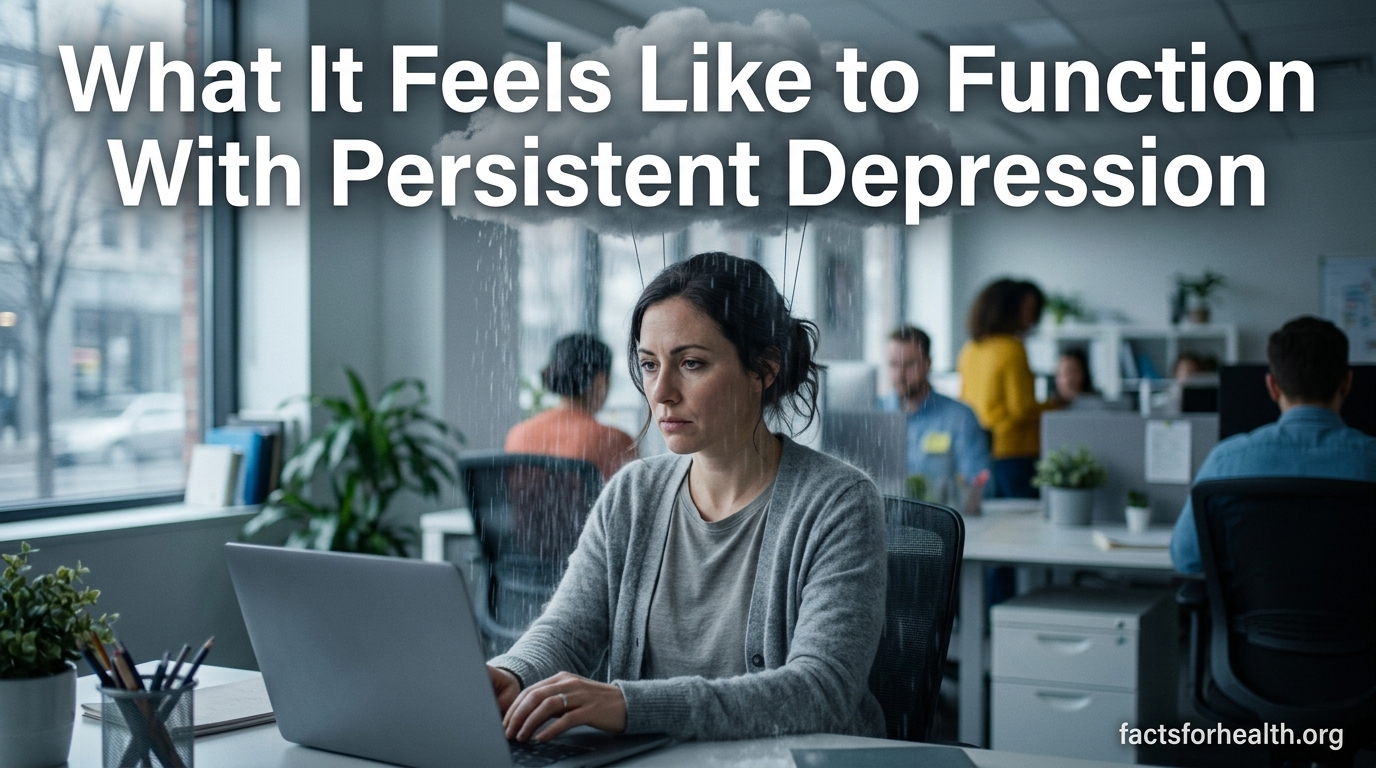
You wake up, get dressed, make coffee, go to work. You answer emails, sit through meetings, laugh at a coworker’s joke. From the outside, everything looks fine. But inside, there is a heaviness that has been there so long you have almost forgotten what it feels like without it.
That quiet, constant weight is what it feels like to function with persistent low grade depression. Clinically, it is called persistent depressive disorder, or dysthymia. It is not the kind of depression that flattens you completely. It is the kind that sits in the background, draining the color from everything just enough that life feels like you are watching it through frosted glass.
If you have ever wondered why you can hold down a job, maintain relationships, and meet your obligations, yet still feel persistently hollow, you are not alone. Up to 3 percent of people in the United States live with this condition at any given time. Many of them never get diagnosed because they are, by all external measures, functioning just fine.
In this article, we are going to talk about what this actually feels like from the inside. Not just the clinical checklist, but the real, daily experience of living with a low grade depression that others cannot see.
Table of Contents
What It Actually Feels Like to Function With Persistent Low Grade Depression
Understanding what it feels like to function with persistent low grade depression starts with recognizing that the experience is not dramatic. There is usually no crisis moment. No breakdown that forces you to seek help. Instead, it is a slow, grinding erosion of color and energy that becomes your new normal so gradually that you stop questioning it.
People who have lived with dysthymia for years often describe it as feeling like they are operating in slow motion. Everything takes more effort than it should. Simple decisions feel overwhelming. Joy feels muted, as though someone turned the volume down on every positive emotion and left sadness and irritation at full strength.
Here is what that lived experience actually looks like, broken down into the feelings people describe most often.
The Grey Filter: Muted Emotions and Anhedonia
One of the most common descriptions from people living with dysthymia is that the world feels grey. Not sad in an acute, crying-every-day way. Just flat. Colors are literally described as muted by some people. A beautiful sunset is acknowledged intellectually but not felt emotionally.
This is anhedonia, the clinical term for losing the ability to experience pleasure. With dysthymia, it is not total. You might still enjoy moments here and there. But the baseline is lower. Things that used to excite you now barely register. You go through the motions of hobbies and activities but the spark is gone, or so faint you wonder if you imagined it.
Happiness does not feel inaccessible exactly. It just feels distant, like trying to grab something at the bottom of deep water. You can see it. You might even reach it briefly. But the effort required to sustain it is exhausting.
The Exhaustion of Appearing Fine
People with persistent low grade depression often become experts at masking. They show up to work smiling. They attend social events. They respond to texts. And then they go home and collapse, because maintaining that appearance took every ounce of energy they had.
This is what gets called high-functioning depression, and it is one of the most isolating aspects of the condition. When you seem fine, people assume you are fine. When you try to explain that you are struggling, the response is often confusion. But you seem so together. You went to that party last week. You are doing great at work.
The disconnect between how you look and how you feel creates a deep loneliness. You start to wonder if your experience is valid. Maybe you are just lazy. Maybe everyone feels this tired and you are just weaker than most. This self-doubt is itself a symptom, but when you are inside it, it feels like truth.
Going Through the Motions: Life on Autopilot
Many people with dysthymia describe a pervasive sense of going through the motions. Days blur together. You wake up, do what needs doing, go to sleep, and repeat. There is a robotic quality to it. You are technically participating in your own life, but it does not feel like you are really there.
This detachment extends to relationships. You might love your partner, your kids, your friends. But the feeling is dulled. You show up for them because you know you should, not because you feel pulled toward them with genuine warmth. The guilt about this is enormous. You tell yourself you should feel more, try harder, be more present. But the illness makes genuine emotional presence feel like trying to run underwater.
The Fog: Cognitive Effects of Chronic Depression
Persistent low grade depression does not just affect mood. It affects thinking. People describe a constant brain fog. Difficulty concentrating. Trouble making even small decisions, like what to eat for dinner. Forgetting conversations you just had. Reading the same paragraph three times without absorbing it.
This cognitive slowdown is real and documented. Chronic depression affects the prefrontal cortex and hippocampus, areas of the brain responsible for memory, decision-making, and executive function. It is not laziness or carelessness. Your brain is literally operating under reduced capacity, day after day, year after year.
Understanding Persistent Depressive Disorder (Dysthymia)
Persistent depressive disorder, formerly known as dysthymia or dysthymic disorder, is a continuous, long-term form of depression. According to the DSM-5, diagnosis requires a depressed mood lasting for at least two years, present more days than not, accompanied by at least two additional symptoms such as low energy, poor concentration, changes in appetite or sleep, low self-esteem, feelings of hopelessness, or irritability.
The key word is persistent. This is not a depressive episode that lifts after a few months. It is a baseline state. Many people cannot remember a time they did not feel this way, because the onset is often gradual and begins in childhood, adolescence, or early adulthood.
Because the symptoms are milder than major depression on any given day, dysthymia often goes undiagnosed for years or even decades. People normalize it. They think they are just a gloomy person, a low-energy person, an introvert. The idea that they have a treatable medical condition never crosses their mind, because they have been this way for so long it feels like personality rather than illness.
This is what makes understanding what it feels like to function with persistent low grade depression so important. Recognition is the first step toward treatment. And many people do not recognize it until someone else points it out or they stumble across a description that matches their experience for the first time.
How Dysthymia Differs From Major Depression
The main difference between dysthymia and major depressive disorder comes down to severity versus duration. Major depression is intense and episodic. It hits hard, often rendering people unable to function at all, and then it may lift. Dysthymia is milder per day but relentless, lasting years without reprieve.
Think of it this way. Major depression is like a storm that tears through and leaves devastation. Dysthymia is like a slow leak in your roof. On any single day, the damage seems small. But over years, the structural damage compounds. The ceiling weakens. Mold grows. And one day you realize the damage from that slow drip is just as severe as a single flood.
People with dysthymia can also experience episodes of major depression on top of their chronic low mood. This is called double depression, and it is more common than you might think. The baseline of dysthymia makes a person more vulnerable to major depressive episodes, which can be devastating because they are starting from an already depleted position.
Another key difference is recognizability. Major depression is visible. People cannot get out of bed. They stop bathing. They cry openly. Dysthymia is invisible. The person is at work, at the dinner table, at the school play. They are technically present. But the internal experience is one of quiet suffering that no one around them can see or measure.
The Hidden Signs Others Miss
Because people with persistent low grade depression are often functioning at a high level, the signs are easy to miss. They do not look like the depression most people picture. The signs are quieter, more insidious, and often misread as personality traits rather than symptoms of a medical condition.
What Looks Like Laziness Is Illness
One of the most damaging misconceptions about dysthymia is that the person is lazy. They procrastinate. They cancel plans. Their home is messier than they would like. They struggle to start tasks that seem simple to others. From the outside, it looks like a motivation problem. From the inside, it is an energy deficit so profound that every task feels like climbing a mountain.
This misread causes real harm. People with dysthymia internalize the label of lazy and it reinforces the low self-esteem that is already a core symptom. The truth is that their brain is fighting a constant uphill battle against depleted neurotransmitters and chronic fatigue. What looks like not trying is actually trying harder than anyone around them realizes.
Irritability as a Primary Symptom
While sadness is the symptom most associated with depression, irritability is often more prominent in dysthymia, especially in the moment to moment experience. Small annoyances feel unbearable. Patience runs thin. You snap at people you love and immediately feel guilty about it.
This irritability is not a character flaw. It is the natural result of operating at a chronic energy deficit. When your reserves are already depleted, even minor stressors feel overwhelming. The frustration of being unable to function at the level you expect from yourself leaks out as shortness with the people around you.
Social Withdrawal Disguised as Introversion
Many people with dysthymia gradually withdraw from social life in ways that look like preference rather than pathology. They stop initiating plans. They decline invitations more often. They tell themselves and others that they are just more introverted than they used to be.
In reality, the withdrawal is driven by the exhaustion of social interaction when you are running on empty. Every social engagement requires emotional energy that people with dysthymia simply do not have in reserve. Over time, the social world shrinks, which deepens the isolation, which deepens the depression. It is a cycle that feeds itself.
How It Affects Your Work, Relationships, and Daily Life
The impact of persistent low grade depression is not limited to mood. It seeps into every area of life, often so gradually that the person does not realize how much ground they have lost. Here is how dysthymia typically affects the major domains of daily functioning.
Work Performance and Career Impact
People with dysthymia often maintain their jobs for years. They show up. They meet expectations. But they rarely exceed them, because exceeding requires an energy surplus they do not have. Career advancement stalls, not because of lack of ability, but because the drive and initiative needed to push forward are constantly suppressed by the illness.
The cognitive symptoms create additional workplace challenges. Missed deadlines, forgotten commitments, and difficulty concentrating in meetings can all occur. Colleagues may notice a pattern of underperformance relative to the person’s obvious intelligence and capability, but attribute it to lack of ambition rather than untreated depression.
The emotional toll is significant. People with dysthymia often watch peers advance while they stay in place, and they blame themselves. They know they are capable of more. They just cannot access that capability through the fog. This creates a cycle of frustration and self-blame that deepens the depressive state.
Relationships and Emotional Availability
Perhaps the most painful impact of dysthymia is on close relationships. Partners often describe feeling shut out, unable to reach the person they love. The emotional flatness of dysthymia makes genuine connection difficult. Even when the person wants to be present and engaged, the illness creates a barrier between their intention and their capacity.
Sex drive is often diminished. Affection may decrease. The person may seem distant or disinterested when they are actually just depleted. Partners can misread this as a loss of love or attraction, when it is actually a symptom of a medical condition that the person may not even know they have.
Explaining this gap is incredibly difficult. How do you tell someone you love that you feel muted, without making them feel like they are the problem? Many people with dysthymia simply do not try. They let the distance grow, hoping it will resolve on its own, which it rarely does without intervention.
Daily Tasks and Self-Care Erosion
The small daily tasks of living become significant obstacles. Cooking a real meal feels monumental, so you order takeout again. Exercise falls away because the energy to start is simply not there. Medical appointments get postponed. Home maintenance slides. None of this happens all at once. It erodes gradually, like a shoreline.
Self-care is often the first casualty. When you have limited energy, you spend it on obligations to others. Work, family, social commitments. What is left for yourself is usually nothing. Over months and years, this creates a compounded deficit that makes everything harder, because the self-care activities that would help manage depression, like exercise, sleep hygiene, and nutrition, are exactly the things that fall away first.
The Cumulative Weight of Years
Perhaps the hardest part of dysthymia to convey is the cumulative weight. Living with a low grade depression for five, ten, twenty years builds a kind of exhaustion that goes beyond physical tiredness. It is bone-deep weariness with the effort of existing. People who have lived with it for decades often describe a sense of grief for the life they might have had without it.
One person in a mental health forum described it this way: the weight of feeling sad for over three decades has become incredibly burdensome. Another said they can get up out of bed each day and be at least minimally functional, but everything feels grey and flat. These are not dramatic cries for help. They are quiet descriptions of a daily reality that millions of people share.
How to Cope With Persistent Low Grade Depression
While dysthymia is chronic, it is also treatable. Many people see significant improvement with the right combination of professional treatment and daily coping strategies. The key is recognizing that this is not something you can simply push through with willpower, and that seeking help is a sign of strength, not weakness.
Small Daily Habits That Help
The most effective daily coping strategies for dysthymia are small and consistent rather than dramatic. Here are the habits that people with lived experience and mental health professionals consistently recommend.
1. Anchor your day with one non-negotiable activity. This could be a short walk, making your bed, or drinking a glass of water first thing in the morning. The goal is not the activity itself but the message it sends your brain: you are worth taking care of.
2. Lower the bar for what counts as success. When energy is low, aiming for average is enough. A ten-minute walk counts. A frozen meal counts. A five-minute shower counts. Perfectionism feeds depression by making every task feel too big to start.
3. Protect your sleep fiercely. Sleep disruption worsens every symptom of dysthymia. Going to bed and waking at consistent times, limiting screens before sleep, and treating sleep as a medical priority rather than a luxury can make a measurable difference in daily functioning.
4. Use the five-minute rule. When a task feels impossible, commit to doing just five minutes. Often, starting is the hardest part. If after five minutes you genuinely cannot continue, you have permission to stop. But you might find you can keep going.
5. Track your mood without judgment. A simple daily note about how you felt, on a scale of one to ten, can help you spot patterns and share useful information with a therapist. It also creates evidence that moods fluctuate, which counteracts the hopelessness that says you will always feel exactly this way.
How to Explain Dysthymia to Others
One of the hardest parts of living with persistent low grade depression is explaining it to people who have never experienced it. Here are approaches that people with dysthymia have found effective.
Use the battery analogy. Tell people it is like having a phone battery that never fully charges. You start every day at 60 percent, no matter how much you slept or how well you ate. Everything you do drains that battery, and it recharges slowly, if at all. Social interactions, work tasks, and emotional labor all cost more than they used to.
Explain that looking fine does not mean feeling fine. Compare it to a chronic physical condition. Someone with lupus or fibromyalgia might look perfectly healthy on the outside while dealing with significant internal symptoms. Dysthymia works the same way. The fact that you showed up does not mean it did not cost you.
Be honest about what you need. You are not obligated to explain the neuroscience of dysthymia to every person in your life. But for the people closest to you, being direct about what helps and what does not can prevent the misunderstandings that breed resentment on both sides.
Professional Treatment Options
Dysthymia responds well to professional treatment. The most effective approach typically combines psychotherapy with medication, though many people benefit from either one alone.
Cognitive behavioral therapy, or CBT, is the most studied and recommended form of therapy for persistent depressive disorder. It helps identify and reframe the negative thought patterns that reinforce the depressive state. Over time, CBT can help shift the cognitive baseline that dysthymia has lowered.
Antidepressant medication, particularly SSRIs and SNRIs, can also be effective. Because dysthymia involves disrupted neurotransmitter activity, medication can help correct the underlying brain chemistry. It often takes several weeks to see results, and finding the right medication may require trying more than one. But for many people, the combination of therapy and medication produces more improvement than either alone.
Other approaches, including interpersonal therapy, mindfulness-based cognitive therapy, and in some cases newer treatments like transcranial magnetic stimulation, may also be options worth discussing with a mental health professional.
When to Seek Professional Help
If you have identified with the descriptions in this article, the most important thing to know is that you do not have to keep pushing through alone. Here are the signs that it is time to reach out for professional support.
You should consider speaking with a mental health professional if you have felt persistently down for more than a few months, if your energy and motivation are consistently lower than you believe they should be, if activities that used to bring you joy no longer do, or if you have begun to wonder whether this is just how life is going to be.
Other indicators include difficulty concentrating that affects your work, irritability that is straining your relationships, sleep changes, appetite changes, or a persistent sense that you are going through the motions without really living. If you have any thoughts of self-harm, reach out immediately. You can call or text 988 in the United States to reach the Suicide and Crisis Lifeline, available 24 hours a day.
Recognizing that what you are experiencing has a name and a treatment is not a weakness. It is the first step toward feeling better than you may have felt in years, or even decades. Many people with dysthymia cannot remember a time before their symptoms, which means treatment can feel like meeting yourself for the first time.
FAQs
Can people with dysthymia still be happy?
Yes, people with dysthymia can still experience moments of happiness. However, the happiness often feels muted or short-lived compared to what they remember or what others seem to experience. People with dysthymia are not perpetually sad. They can laugh, enjoy activities, and feel connection. But the baseline mood is lower, and the ceiling for positive emotions can feel reduced. Treatment can raise that baseline significantly.
What does it feel like to have dysthymia?
Dysthymia feels like living with a constant, low-grade heaviness that drains the color and energy from daily life. People describe feeling like they are moving in slow motion, watching life through a grey filter, or going through the motions without genuine engagement. It is not acute sadness but a chronic flatness, where joy is muted, tasks take enormous effort, and maintaining the appearance of being fine is exhausting.
How to cope with persistent depressive disorder?
Effective coping strategies include maintaining consistent sleep habits, engaging in regular physical activity even in small amounts, practicing the five-minute rule to overcome task paralysis, tracking mood patterns, lowering perfectionist standards, and seeking professional treatment. The most effective approach combines cognitive behavioral therapy with medication when appropriate. Small, consistent daily habits matter more than dramatic lifestyle overhauls.
How do people with dysthymia act?
People with dysthymia often appear functional and even successful to others. They show up to work, maintain relationships, and handle daily responsibilities. But they may seem emotionally flat, easily irritated, socially withdrawn, or perpetually tired. They often cancel plans, procrastinate on tasks, or seem disengaged. Because they mask their symptoms well, most people around them have no idea they are struggling.
Can you have dysthymia your whole life?
Yes, many people develop dysthymia in childhood, adolescence, or early adulthood and live with it for decades without diagnosis. Because the onset is gradual and the symptoms are milder than major depression per day, people often mistake it for their personality. Some cannot remember ever feeling differently. However, dysthymia is treatable at any age, and many people see significant improvement with therapy and medication even after years of symptoms.
Is persistent depression common?
Persistent depressive disorder affects approximately 1.3 to 3 percent of people in the United States at any given time. It is one of the most common forms of chronic depression, though it is significantly underdiagnosed because the symptoms are subtle and people often function at a level that masks the condition. Many people live with dysthymia for years before seeking help or receiving a proper diagnosis.
If you have read this far and recognized yourself in these descriptions, please hear this. What you are experiencing is real. It is not a personality flaw. It is not laziness. It is not weakness. It is a recognized medical condition with established, effective treatments, and you deserve to know what life feels like without that constant grey filter.
Understanding what it feels like to function with persistent low grade depression is the first step. The next step is reaching out. Talk to your primary care doctor. Find a therapist. Call a helpline. Tell one person you trust. You do not have to have the perfect words. You just have to start the conversation.
Recovery from dysthymia is rarely dramatic, just as the condition itself is rarely dramatic. It happens in increments. A slightly brighter morning. A moment of genuine laughter. A task that felt impossible last month that now feels manageable. Over weeks and months of treatment, the grey begins to lift, not all at once, but enough to remind you that color was always there, waiting underneath.
You have been carrying this weight long enough. It is time to set some of it down.