
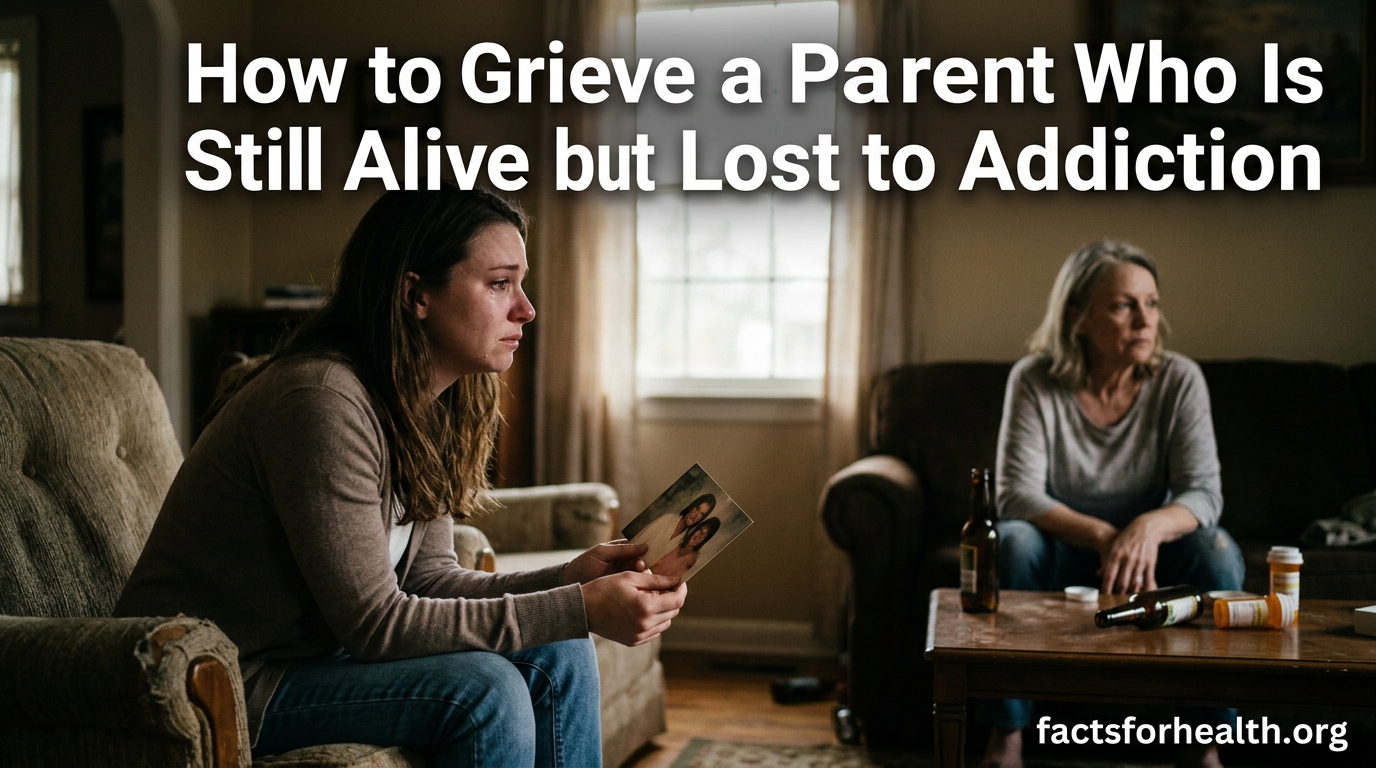
If you are reading this, you already know the feeling. Your parent is physically here, maybe even sitting in the same room, but the person you knew and needed has been slowly disappearing behind substance use disorder. Learning how to grieve a parent who is still alive but lost to addiction is one of the most confusing, isolating experiences a person can go through. You are mourning someone who is still breathing, and almost no one in your life seems to understand why that hurts so much.
I want you to hear this right away: your grief is real. It is valid. And you are far from alone in feeling it.
Therapists and grief researchers call this experience ambiguous grief, also known as ambiguous loss. It is the mourning of someone who is still physically present but psychologically or emotionally absent. When addiction reshapes the person who raised you, the loss is devastating even though no one has died. This guide will walk you through what ambiguous grief is, why it feels so painful, and practical strategies to help you cope, set boundaries, and find support.
Table of Contents
What Is Ambiguous Grief?
Ambiguous grief is the emotional response to losing someone who is still alive but no longer fully present. The term was pioneered by Dr. Pauline Boss, a family therapist who recognized that not all losses involve death. When a parent is consumed by addiction, they may be physically in your life but emotionally unreachable, and that absence creates a very real grief response.
Unlike traditional grief, ambiguous loss has no clear endpoint. There is no funeral, no obituary, no culturally recognized mourning period. Your parent might call you tomorrow and sound like their old self for five minutes, only to disappear again. This back-and-forth keeps the wound open in a way that death does not.
People on grief support forums describe this experience vividly. One person wrote, “I wish I didn’t have to grieve someone who is sitting right next to me.” Another shared, “The grief is not the same as when someone passes away. It’s a silent grief that no one talks about. It is buried in shame and despair.”
That silence is part of what makes ambiguous grief so heavy. Society has rituals for death but not for this kind of loss. You might feel like you need permission to mourn, or that people expect you to just be grateful your parent is “still alive.” But gratitude and grief can exist at the same time. You can be thankful they are here and still heartbroken that they are not truly present.
There is also a distinction between ambiguous grief and complicated grief. Complicated grief typically refers to a grief reaction that is unusually intense and prolonged after a death. Ambiguous grief, on the other hand, involves an ongoing, unresolved loss where the person is still physically present. Both are painful, but they require different coping approaches because ambiguous grief has no closure.
Why Grieving a Living Parent Feels So Hard
Grieving someone who is still alive can feel even harder than grieving someone who has passed. That sounds counterintuitive, but the reasons become clear when you look closely at what makes this loss unique.
With death, there is a finality that eventually allows the grieving process to move forward. With addiction, that finality does not exist. Your parent may have moments of clarity, periods of sobriety, or stretches where they seem like themselves again. Each time that happens, hope flares up. And each time the addiction returns, you grieve the loss all over again. People who have lived through this describe it as grieving the same person over and over.
The emotional landscape is also more complicated. Alongside sadness, you may feel intense anger at your parent for choosing substances over the family. You might feel guilt for not being able to save them, even though their addiction was never your responsibility. Disappointment, resentment, and love can all exist simultaneously, and that emotional tangle can be exhausting.
One HuffPost writer who lost her father to addiction described it this way: “What lingers is the grief, the heartbreak, anger, disappointment and guilt.” She wrote about a childhood marked by unfulfilled promises, prison visits, and being stood up. These are common themes for adult children of addicts, and they compound the grief in ways that are hard to articulate.
Then there is the societal dismissal. When someone dies, people bring casseroles and offer condolences. When your parent is alive but lost to addiction, people often do not know what to say. Some may even judge you for grieving, as if the loss is not legitimate because no one has died. This can make you feel like you have to hide your grief or explain it away, which deepens the isolation.
Another layer of difficulty comes from the loss of the childhood you deserved. Many adult children of addicts grieve not just the parent as they are now, but the parent they needed growing up. You may be mourning birthday parties that never happened, advice you never received, and safety that was never provided. That kind of grief runs deep and often surfaces in therapy years later.
It is also common to struggle with a sense of limbo. You cannot fully mourn because the person is still here. You cannot fully hope because addiction has burned you before. You are stuck between letting go and holding on, and that in-between space is where ambiguous grief lives.
How to Grieve a Parent Who Is Still Alive but Lost to Addiction: Coping Strategies
Learning how to grieve a parent who is still alive but lost to addiction takes time, patience, and a willingness to sit with uncomfortable emotions. There is no single fix, but there are practical strategies that can help you process the grief and protect your own well-being day by day.
Here are seven coping strategies that mental health professionals and people who have lived through this experience recommend:
1. Name your grief out loud. The first step is acknowledging that what you are experiencing is grief. Say it to yourself, write it down, or tell someone you trust. Giving your experience the right name, ambiguous grief, can be incredibly validating. It tells your brain that your pain makes sense and that you are not overreacting.
2. Use the 3-3-3 grounding rule. When grief or anxiety feels overwhelming, the 3-3-3 rule can bring you back to the present moment. Name three things you can see, identify three sounds you can hear, and move three parts of your body. This simple exercise activates your senses and interrupts the spiral of emotional flooding. Many therapists recommend it because it takes less than a minute and works almost anywhere.
3. Write a letter you will not send. Pour out everything you wish you could say to your parent. The anger, the love, the disappointment, the memories of who they used to be. Writing externalizes the pain and gives it somewhere to go. You can keep the letter, burn it, or rewrite it as many times as you need. This practice can be particularly helpful on days when contact with your parent leaves you feeling raw.
4. Honor the parent you remember. Just because your parent is still alive does not mean you cannot honor who they were before addiction. Cook a meal they used to make, listen to music they loved, or look at old photographs. Creating a small ritual around positive memories allows you to hold onto the love without pretending the addiction does not exist.
5. Practice radical acceptance. Radical acceptance, a concept from Acceptance and Commitment Therapy, means acknowledging reality as it is rather than fighting against it. This does not mean you approve of the addiction or give up hope. It means you stop exhausting yourself trying to control something that is not yours to fix. Acceptance creates space for you to focus on your own life and healing.
6. Connect with others who understand. Isolation feeds grief. Finding a community of people who have been through similar experiences can be transformative. Whether it is an in-person support group, an online forum, or a single trusted friend who gets it, being heard and understood reduces the shame and loneliness that ambiguous grief thrives on.
7. Grieve in waves, not all at once. Ambiguous grief does not follow a neat timeline. Some days will feel manageable, and others will knock you off your feet. Let yourself feel what you feel without judgment. Trying to force the grief into a schedule only adds pressure to an already heavy situation.
Setting Boundaries While Grieving
One of the hardest parts of loving a parent with addiction is figuring out how to stay connected without destroying yourself in the process. Boundaries are not punishment for your parent. They are a way to protect your mental health so you can continue to function, grow, and eventually heal.
Start by identifying what contact feels safe and what feels harmful. You might decide to talk on the phone once a week but avoid in-person visits when your parent is actively using. You might choose not to lend money or cover for their behavior. These decisions are deeply personal, and there is no universally right answer.
It is also important to understand the difference between enabling and loving support. Enabling means shielding someone from the natural consequences of their addiction, which can unintentionally prolong the problem. Loving support means showing you care while allowing them to experience the outcomes of their choices. This distinction can feel cruel, but mental health professionals who specialize in addiction, including those trained in the CRAFT approach (Community Reinforcement and Family Training), emphasize that boundaries actually create healthier conditions for everyone involved.
Codependency is another pattern to watch for. If your sense of self-worth depends on fixing your parent or managing their life, you may be caught in a codependent cycle. Recognizing this pattern is not about blame. It is about freeing yourself from a role that was never yours to carry.
Remember that setting a boundary does not mean you have stopped loving your parent. You can hold love and limits at the same time. In fact, doing so is one of the healthiest responses to a situation you did not create and cannot control.
How to Explain This Grief to Others
One of the most common frustrations people share in grief forums is that friends and family do not understand this type of loss. You may hear things like, “But at least they’re still alive,” or “Can’t you just be grateful?” These responses, even when well-intentioned, can feel deeply dismissive.
Having a few prepared responses can help. Here are some ways to explain what you are going through:
“My parent is physically alive, but addiction has changed who they are. I’m grieving the relationship we used to have and the parent I needed.” This frames the loss in terms anyone can understand without requiring them to know the clinical terminology.
“It’s called ambiguous grief. It’s a recognized type of loss where someone is still present but emotionally unavailable.” Using the clinical term can lend weight and legitimacy to your experience, especially with people who tend to respect professional frameworks.
“I know they’re alive, and I’m grateful for that. But I still lost the parent I grew up wanting, and that loss hurts in its own way.” This acknowledges the other person’s perspective while gently insisting that your grief is real.
You do not owe anyone a detailed explanation. If someone cannot hold space for your grief, it is okay to change the subject or step back from that conversation. Protecting your emotional energy is part of coping, not a failure to communicate.
If you are wondering what to say when casual acquaintances ask, “How is your parent?” a simple response like “They’re managing, but it’s been hard” is perfectly acceptable. You get to decide how much to share and with whom.
Finding Support and Resources
You do not have to carry this grief alone. There are organizations, support groups, and therapeutic approaches specifically designed for families affected by addiction.
Support groups can be one of the most powerful resources available. Al-Anon and Nar-Anon are free, widely available support groups for family members of people with alcohol and drug addiction. These groups connect you with others who understand exactly what you are going through. Adult Children of Alcoholics (ACA) focuses specifically on the experiences of people who grew up with addicted parents, addressing the childhood grief that often continues into adulthood.
Therapy is another important avenue. A therapist who specializes in addiction, family systems, or grief counseling can help you process complex emotions in a safe environment. Evidence-based approaches like Acceptance and Commitment Therapy (ACT), Cognitive Behavioral Therapy (CBT), and the CRAFT approach have all shown effectiveness for family members navigating a loved one’s addiction. Grief counseling specifically trained in ambiguous loss can also help you work through the unique aspects of this experience.
Helplines are available if you need immediate support. The SAMHSA National Helpline (1-800-662-4357) is a free, confidential, 24/7 service that provides information and referrals for individuals and family members facing mental health and substance use disorders. The Partnership to End Addiction offers a helpline and text line staffed by specialists who can provide guidance for families.
Online communities can supplement in-person support. Forums like Reddit’s r/AdultChildren and r/GriefSupport have active communities where people share experiences, advice, and validation. Reading stories from others who have lived through similar situations can reduce the feeling that you are the only one experiencing this.
You might wonder when it is time to seek professional help. If your grief is interfering with your ability to work, maintain relationships, sleep, or function day to day, a therapist can help. If you are experiencing persistent depression, anxiety, or thoughts of self-harm, reach out immediately. There is no threshold you have to meet to “deserve” support. If you are hurting, that is reason enough.
FAQs
What is it called when you grieve someone that is still alive?
It is called ambiguous grief or ambiguous loss. This term describes the mourning process for someone who is physically alive but emotionally or psychologically absent due to addiction, illness, or other circumstances. The concept was developed by family therapist Dr. Pauline Boss.
How long does ambiguous grief last?
There is no set timeline for ambiguous grief. Because the person is still alive and the situation may fluctuate, this type of grief can resurface repeatedly over months or years. It tends to ease when you develop coping strategies, build a support system, and practice acceptance, but it may always be part of your emotional landscape to some degree.
Is it normal to grieve someone who is still alive?
Yes, absolutely. Grief is a natural response to any significant loss, including the loss of a relationship with someone who is still living. Therapists and grief experts widely recognize ambiguous grief as a valid and common experience for family members of people struggling with addiction.
Should you forgive an addicted parent?
Forgiveness is a personal choice, not an obligation. Some people find that forgiveness brings peace, while others find that acceptance is enough. Forgiveness does not mean excusing harmful behavior or resuming an unhealthy relationship. A therapist can help you explore what forgiveness means for you on your own timeline.
Does the pain of losing a parent to addiction ever go away?
The intensity of the pain typically lessens over time, especially with support and healthy coping strategies. However, because the loss is ongoing when the parent is still alive, the grief may resurface during difficult moments. Many people find that the pain transforms into something more manageable rather than disappearing entirely.
Are children of addicts more likely to struggle with addiction?
Research shows that children of parents with substance use disorders are at a higher risk for addiction, mental health challenges, and codependency patterns. This is due to a combination of genetic and environmental factors. Awareness of this risk can help you make informed choices about your own health and seek preventive support if needed.
Conclusion: Moving Forward With Grief and Hope
Learning how to grieve a parent who is still alive but lost to addiction is not something you do once and finish. It is an ongoing process of acknowledging what you have lost, protecting what you still have, and building a life that holds space for both grief and hope.
Your parent’s addiction is not your fault, and fixing it is not your responsibility. What you can do is take care of yourself, seek support from people who understand, and allow your grief to exist without shame. The pain may not disappear entirely, but it can become something you carry with more strength and less isolation over time.
If you are struggling right now, reach out. Call the SAMHSA National Helpline at 1-800-662-4357, find a local Al-Anon or Nar-Anon meeting, or talk to a therapist who understands addiction and family grief. You deserve support, and you do not have to walk through this alone.
Recovery, both for your parent and for yourself, is possible. But your healing does not have to wait for theirs to begin.