
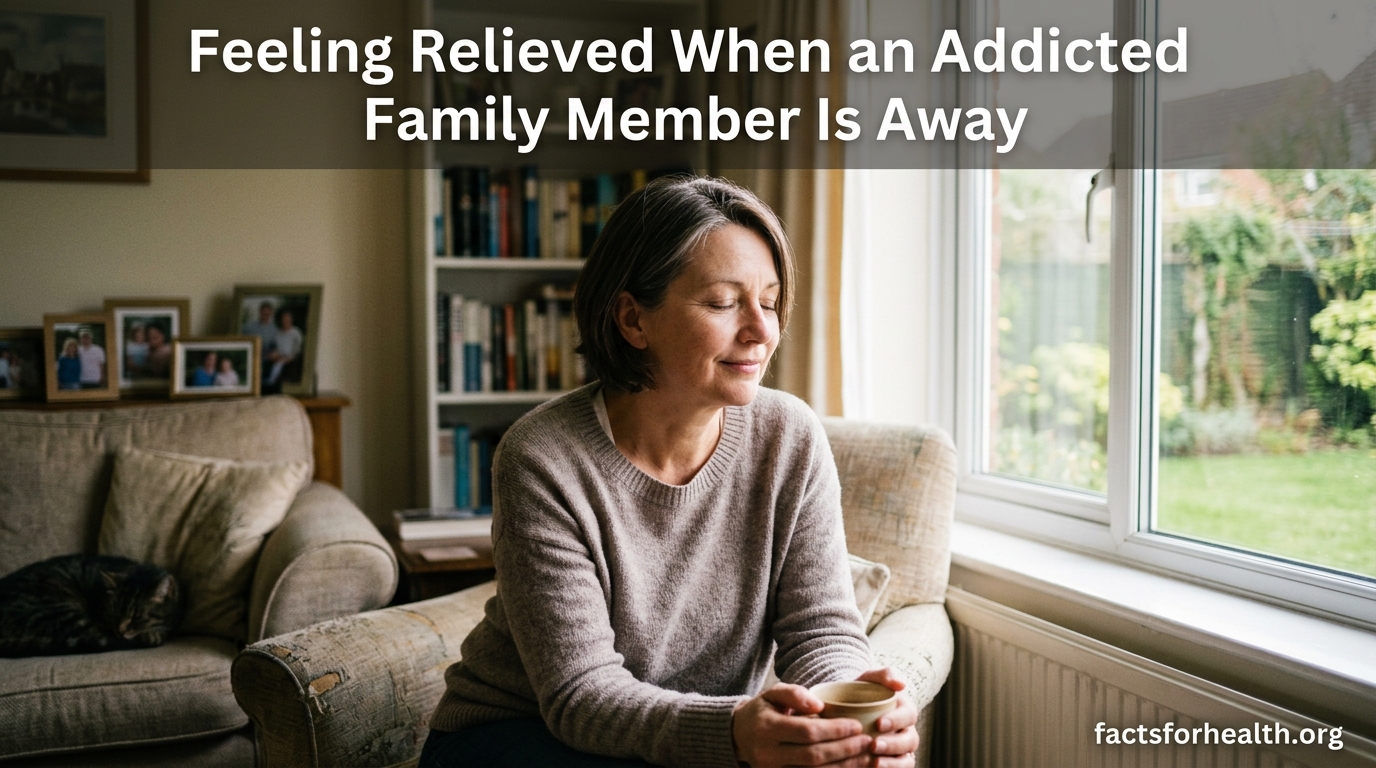
No, it is not wrong to feel relieved when an addicted family member is away. That relief is one of the most common, most normal, and most misunderstood emotions that families touched by addiction ever experience. If you have found yourself breathing easier when your loved one leaves the house, goes to rehab, or simply is not around for a stretch, you are not broken, you are not cold, and you are not a bad person. You are exhausted.
This article explains exactly why relief happens, how it differs from grief after a death, and what to do with the guilt that often follows. We will walk through the cycle of relief and guilt that families experience when an addicted person leaves and returns, and we will give you practical strategies for managing these feelings in real time. By the end, you will have a clearer understanding of what your emotions mean and what to do next.
Our team has spent years researching the family side of addiction, and the question of whether it is wrong to feel relieved when an addicted family member is away comes up again and again in support groups like Al-Anon, in therapy offices, and in online communities. The short answer is that relief is your nervous system finally getting a break. The longer answer is what follows.
Table of Contents
Is It Wrong to Feel Relieved When an Addicted Family Member Is Away?
No. It is not wrong, and the vast majority of mental health professionals, addiction counselors, and family therapists will tell you the same thing. Feeling relieved when an addicted family member is away is a natural response to prolonged stress, fear, and emotional exhaustion. You have been living in a state of high alert, and when the source of that stress is temporarily removed, your body and mind relax. That is called relief, and it is a survival mechanism, not a character flaw.
Many people in this situation describe the relief as finally being able to breathe. One person in a Reddit r/AdultChildren thread put it bluntly: people stumble all over themselves to say we should empathize with the addict, but they cannot understand why those of us who deal with the fallout feel relief. That gap between what society expects you to feel and what you actually feel is where most of the guilt comes from.
The guilt is the problem, not the relief. When you judge yourself for feeling relieved, you add a second layer of pain on top of an already painful situation. You start asking whether you are a bad parent, a bad child, a bad sibling, or a bad spouse. You wonder whether relief means you do not love the person anymore. It does not. Relief and love can coexist, and they very often do.
Bereavement counselors who work with families affected by addiction hear this constantly. A counselor quoted in a Marie Curie resource on grief put it simply: there are no rules around grief, and surprising emotions like relief are entirely normal. The same principle applies when the addicted family member is away rather than deceased. The chronic stress has been lifted, and your system responds accordingly.
So if you are asking whether it is wrong to feel relieved when an addicted family member is away, the answer from psychology, from counseling, and from thousands of families who have walked this path is a clear and consistent no. The relief is information. It is telling you something about what you have been carrying.
Why Relief Happens When an Addicted Loved One Leaves
Relief is not a choice. It is a physiological response. When you live with someone in active addiction, your body is flooded with stress hormones like cortisol and adrenaline on a near-constant basis. You never know what mood they will be in, whether money will go missing, whether there will be an argument, or whether you will get a phone call with bad news. That unpredictability keeps your nervous system stuck in fight-or-flight mode.
Fight-or-flight is meant to be a temporary state. It is your body preparing to deal with an immediate threat. But when the threat is ongoing and lives in your own home, that state becomes chronic. Chronic stress affects your sleep, your digestion, your immune system, your concentration, and your mood. It wears you down physically and emotionally over months and years.
When the addicted family member leaves, whether for a weekend, a rehab stay, or a longer separation, the threat is removed. Your nervous system detects that the danger has passed, and it begins to stand down. Your heart rate may drop, your muscles may unclench, and you may suddenly notice that the house feels quiet in a way it has not felt quiet in a long time. That is your body recovering from sustained stress.
This is also why relief can feel disorienting. You may not have realized how tense you were until the tension was gone. People often describe a strange floating sensation, or a sudden wave of exhaustion, when the addicted family member leaves. That is the adrenaline crash. Your body has been running on emergency energy, and now it is trying to return to baseline.
Understanding the biology behind relief removes the moral judgment. You are not choosing to feel relieved any more than you are choosing to feel thirsty after a long walk. Your body is responding to a change in its environment. The more you can accept that relief is a physical response rather than a moral failing, the easier it becomes to sit with it without spiraling into guilt.
The Cycle of Relief and Guilt
Here is something almost no resource talks about: the cycle. When an addicted family member leaves, you feel relief. Then you feel guilty about the relief. Then the person returns, and the stress comes back. Then they leave again, and the cycle repeats. This emotional rollercoaster is one of the most exhausting parts of loving someone with an addiction, and it is uniquely painful because it never fully resolves.
Families describe this cycle as whiplash. One week you are at peace, the next week you are walking on eggshells again. The constant switching between relief and hypervigilance is harder on your nervous system than a single stressful event would be. Your body has to keep recalibrating, and that takes a toll.
The guilt in this cycle is often the heaviest part. Each time you feel relief, the guilt tells you that you should be missing them, worrying about them, or doing something to help. Each time they come back, you may feel ashamed that part of you did not want them to return. These feelings do not make you a bad person. They make you a person who has been through something difficult for a long time.
There is also a fear component that rarely gets addressed. Many families feel relief when the addicted member is away, but that relief is mixed with dread about what will happen when they return. Will they be sober? Will they be angry? Will the chaos start over? This anticipatory anxiety can make the relief feel tainted, like you cannot fully relax because you know the peace is temporary.
The cyclical nature of relief and guilt is exactly why ongoing support matters so much. A single conversation with a therapist or a single Al-Anon meeting will not break the cycle, but consistent support helps you build tolerance for the emotional ups and downs. Over time, you learn to recognize the cycle for what it is rather than interpreting every wave of relief or guilt as a verdict on your character.
Relief During Active Addiction vs. After Death or Long-Term Separation
Most existing resources on relief and addiction focus on what happens after the addicted person dies. That is an important conversation, but it is not the only one. Feeling relieved when an addicted family member is away is a different experience with its own texture, and it deserves its own attention.
When an addicted family member is away but still alive, your relief is mixed with ambiguity. You do not know if they are safe. You do not know if they will come back changed or the same. You may be fielding phone calls from them, from their friends, or from institutions. The separation is not clean, and neither are the emotions.
After a death, relief is often mixed with finality and grief. There is no more hoping things will change and no more disappointment when they do not. That is a different kind of weight. After a temporary separation, hope is still alive, and hope can be exhausting. You hope this time will be different, even though you have hoped that before.
Relief during active addiction is also more likely to come with guilt because the person is still here. Society has a script for grief after death, even complicated grief that includes relief. There is no widely accepted script for feeling relieved that your living family member is not in your house right now. That absence of cultural permission makes the guilt harder to shake.
Recognizing the difference between these two types of relief helps you understand why your emotions feel so tangled. You are not grieving a clean ending. You are living in an unresolved middle. That ambiguity is genuinely difficult, and naming it is a step toward managing it.
When Relief Signals a Need for Change
Relief is not just a feeling to be tolerated. It is also information. The intensity and frequency of your relief can tell you something important about whether your current living situation is sustainable.
If you feel a small, occasional sense of relief when your addicted family member goes out for the evening, that is normal. Everyone needs a break from a difficult situation. But if you feel overwhelming relief every time they leave the house, or if you find yourself wishing they would stay away longer, or if the only time you feel at peace is when they are gone, your relief may be telling you that the situation has become unlivable.
This does not necessarily mean you need to end the relationship. It may mean you need to change the terms of it. That could look like asking the person to move out, setting firmer boundaries about behavior in the home, requiring treatment as a condition of continued support, or restructuring your involvement in their life.
Therapists who specialize in addiction and family systems often say that the family member’s recovery is just as important as the addicted person’s recovery. If your mental and physical health are deteriorating because of someone else’s addiction, your relief is a signal that you need your own recovery process. That might involve therapy, a support group, a medical evaluation, or simply giving yourself permission to step back.
The question is not whether you are allowed to feel relieved. The question is what your relief is trying to tell you. Listen to it the way you would listen to physical pain, as a signal that something needs attention.
Practical Coping Strategies for Managing Relief and Guilt
Understanding your emotions is important, but you also need tools for dealing with them day to day. The following strategies come from addiction counselors, family therapists, and members of Al-Anon and similar support groups who have lived through this experience.
1. Name the feeling without judging it. When relief shows up, say to yourself, I am feeling relieved, and that makes sense given what I have been dealing with. Do not add the word but. Do not qualify it. Just name it and let it be there.
2. Separate relief from love. Relief does not mean you stopped loving the person. You can feel deeply relieved that they are gone right now and still love them intensely. These two things can exist in the same person at the same time. Practicing this distinction reduces guilt significantly.
3. Use the peace intentionally. When your addicted family member is away, use the time to rest, eat well, sleep, and reconnect with yourself. Many families lose their own identity to the addicted person’s chaos. Use the relief periods to rebuild your own reserves.
4. Find a support group. Al-Anon, Nar-Anon, and adult children of alcoholics groups exist specifically for family members. Hearing other people describe the exact same relief and guilt you feel is one of the most powerful forms of validation available. You do not have to speak. Just listening can be transformative.
5. Work with a therapist who understands addiction. A therapist who specializes in addiction and family systems can help you process the complex emotions, set boundaries, and develop coping strategies tailored to your situation. Look for someone who uses approaches like CBT, family systems therapy, or who is familiar with Al-Anon principles.
6. Practice detachment with love. This is a core Al-Anon concept. It means caring about the person without taking responsibility for their choices. You can love someone and still accept that you cannot control their addiction. Detachment with love is not abandonment. It is a healthy recognition of your own limits.
7. Keep a journal. Writing down what you feel, when you feel it, helps you see patterns over time. You may notice that your relief is stronger after certain behaviors, or that your guilt spikes at particular times. This information helps you understand yourself better and gives you material to discuss with a therapist or sponsor.
8. Build a life outside the addiction. One of the best ways to cope with the cycle of relief and guilt is to invest in relationships, hobbies, and activities that have nothing to do with the addicted family member. When your entire emotional world revolves around someone else’s addiction, every change in their status becomes a crisis. A broader life gives you stability.
Setting Boundaries Without Feeling Like a Villain
One of the most common pain points families describe is the difficulty of setting boundaries without feeling like a terrible person. Society often frames boundary-setting with addicted family members as abandonment or cruelty, but mental health professionals see it very differently. Boundaries are a form of self-care, and they are often the healthiest thing you can do for the relationship.
A boundary is not a punishment. It is a statement of what you will and will not accept in your own life. For example, you might decide that you will not allow substance use in your home, that you will not provide money that could be used for drugs or alcohol, or that you will not engage in arguments when the person is under the influence. These are reasonable limits, not acts of cruelty.
The guilt around boundaries usually comes from confusing them with enabling. Enabling is when you shield the addicted person from the consequences of their behavior. Boundaries are the opposite. They allow natural consequences to happen, which is often what ultimately motivates someone to seek help.
There is a meaningful difference between supporting someone and enabling them. Supporting means encouraging their recovery, being available when they are making healthy choices, and offering emotional backing. Enabling means covering for them, lying for them, paying their way, or absorbing the damage they cause so they never have to face it. Learning to tell the difference is one of the most important skills a family member can develop.
When you set a boundary and the addicted family member reacts with anger or guilt-tripping, that reaction is about their addiction, not about your worth. You are not responsible for how they respond to your limits. You are responsible for your own wellbeing, and boundaries are how you protect it.
FAQs
Is it normal to feel relieved when an addicted family member is away?
Yes. Relief is a normal physiological response to the removal of chronic stress. When you live with someone in active addiction, your nervous system stays in fight-or-flight mode. When they leave, your body finally relaxes. This is a survival mechanism, not a sign that you do not care.
Why do I feel guilty when my addicted family member leaves?
Guilt happens because society expects you to feel sad or worried rather than relieved. That expectation creates a gap between what you feel and what you think you should feel. The guilt is a learned response, not evidence that the relief is wrong.
How to cope with a drug addicted family member?
Join a support group like Al-Anon or Nar-Anon, work with a therapist who understands addiction, set clear boundaries, practice detachment with love, and build a life outside the addiction. Self-care is not selfish. It is what keeps you resilient enough to handle the ongoing challenges.
Is it wrong to leave a drug addict?
No. If the relationship is damaging your mental or physical health, leaving is a valid and often necessary choice. You cannot control someone else’s addiction, and you are not obligated to stay in a situation that is destroying you. Leaving does not mean you do not care. It means you are protecting yourself.
Does feeling relief mean I do not love my addicted family member?
No. Relief and love coexist all the time. You can deeply love someone and simultaneously feel relieved when the chaos they bring is temporarily gone. These are not contradictory emotions. They are both responses to a genuinely difficult situation.
What is detachment with love?
Detachment with love is an Al-Anon principle that means caring about someone without taking responsibility for their choices or absorbing the consequences of their addiction. You can love the person while accepting that you cannot fix them. It is a healthy boundary, not abandonment.
Is it normal to feel relief when a loved one dies?
Yes. Bereavement counselors confirm that relief is a common and normal emotion after a death, especially when the person had a long illness or struggled with addiction. Relief in that context often reflects the end of suffering for both the person and the family. There is no wrong way to grieve.
How do I stop feeling guilty about relief from an addicted family member?
Recognize that relief is a physical response, not a moral judgment. Separate relief from love. Talk about your feelings with a therapist or in a support group. Practice naming the feeling without qualifiers. Over time, the guilt tends to ease as you build a framework for understanding your emotions.
You Are Allowed to Feel What You Feel
If there is one thing to take away from all of this, it is that it is not wrong to feel relieved when an addicted family member is away. The relief is your body and mind responding to the absence of chronic stress. It does not define your love, your loyalty, or your worth as a family member.
The guilt that follows relief is the harder emotion, but it is also the more treatable one. With support, with self-compassion, and with a clearer understanding of why these feelings happen, the guilt does lighten. You do not have to carry it alone, and you do not have to carry it forever.
If you are in this situation right now, consider reaching out to a therapist who understands addiction, attending an Al-Anon or Nar-Anon meeting, or simply talking to someone who has been there. Your feelings make sense. Your exhaustion is real. And your relief is not something to be ashamed of. It is something to understand, and understanding it is the first step toward healing.