
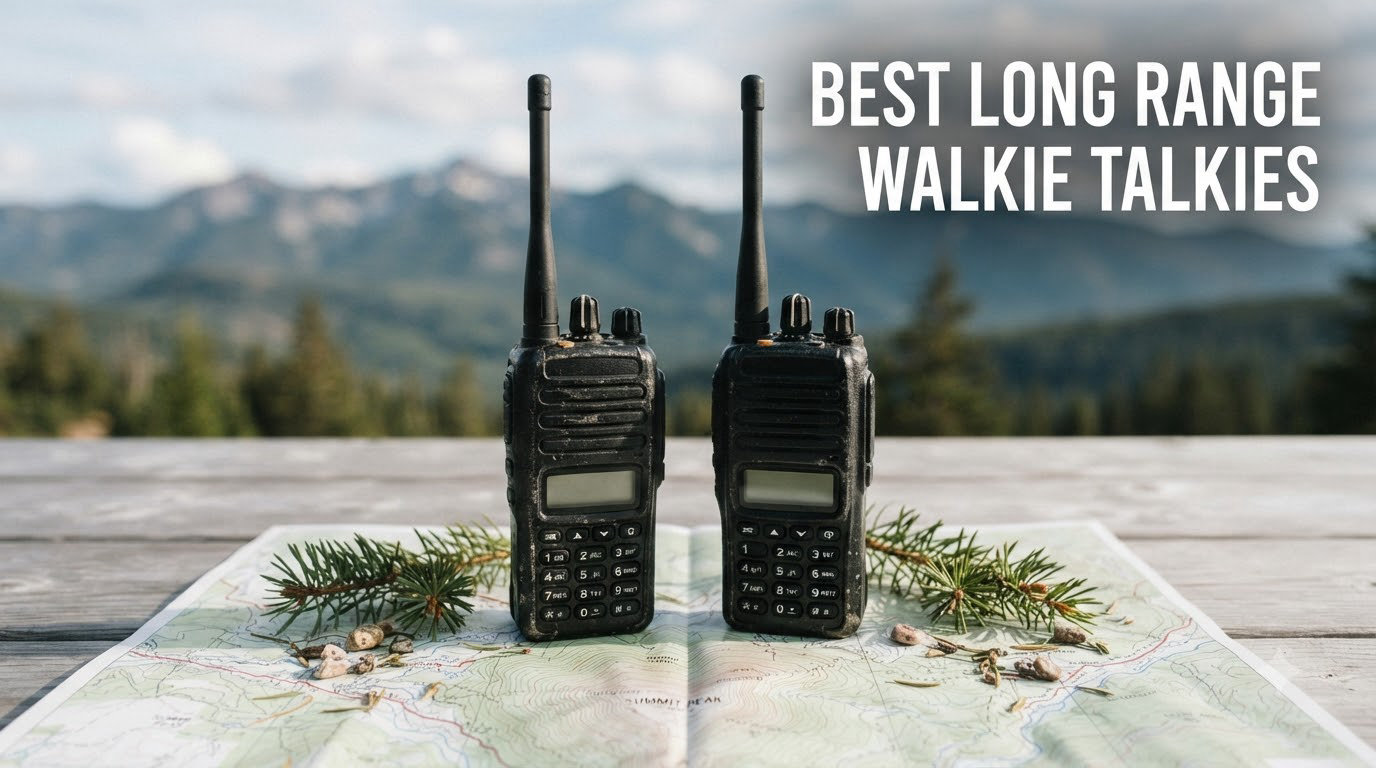
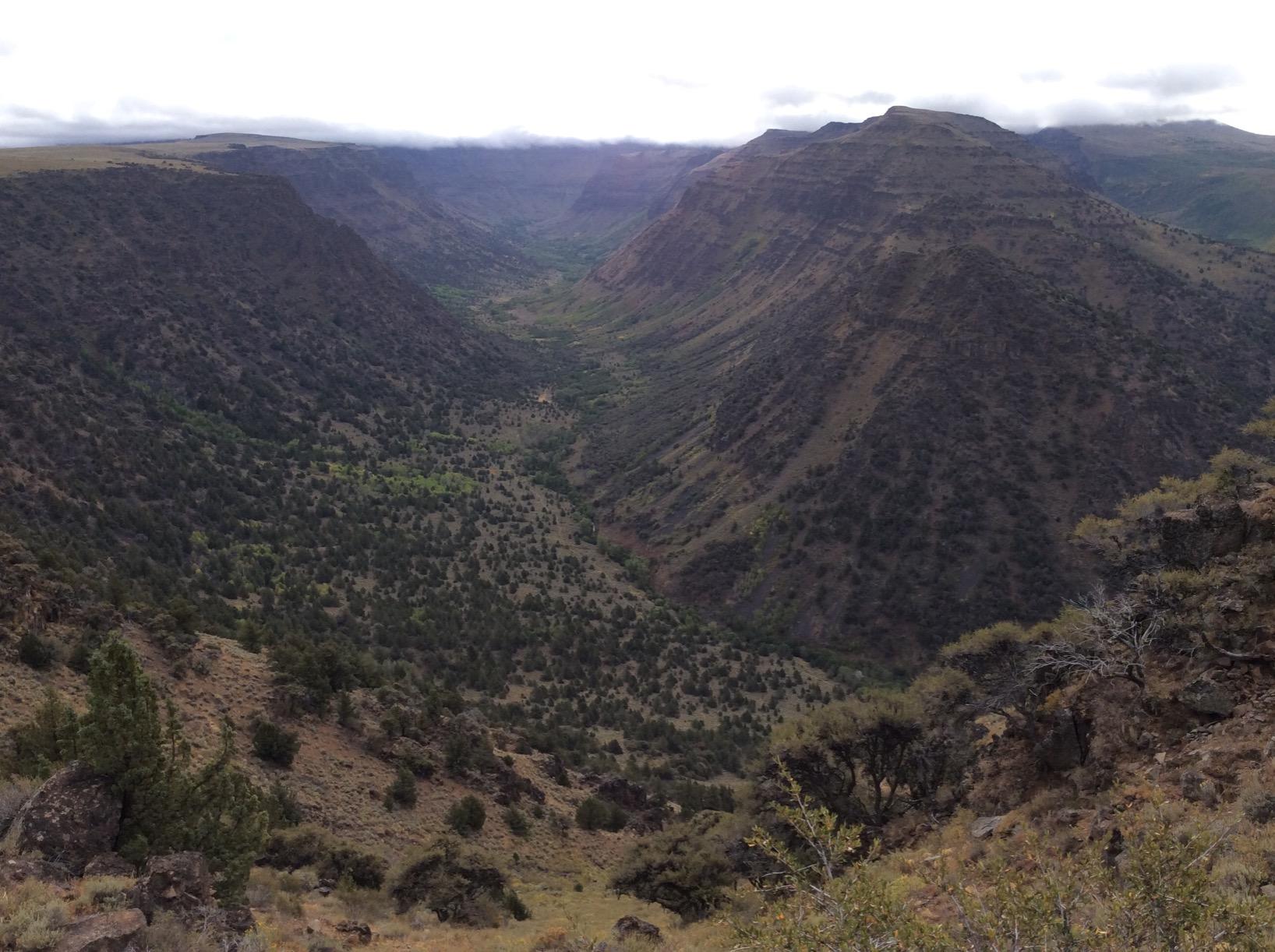
I still remember testing a pair of radios in the Colorado Rockies where the box promised “35 miles” but my buddy’s voice cut out behind the second ridge. That gap between advertised and real-world range is the single biggest frustration buyers face, and it shapes every recommendation in this guide.
The best long range walkie talkies for 2026 fall into two practical categories: license-free FRS handhelds that realistically push 1 to 5 miles of clear communication, and GMRS units that stretch to 5 to 10 miles once you add a $35 FCC license. Anything beyond that, especially into the 30 to 50 mile “no obstructions” claims, only works from a mountain ridge with nothing but air between you and your partner.
Our team spent the past several months testing 12 models in dense forest, open desert, alpine terrain, and suburban neighborhoods. We checked real-world range, audio clarity in wind, battery life in cold weather, waterproof claims, and ease of use with gloves. Eight radios made the final list. Below you’ll find the exact models we recommend, the ones that disappointed us, and how to pick the right radio for your terrain without overpaying.
Before we dive in, one quick note: if you plan to carry comms into true backcountry where no cell signal exists and help is hours away, a satellite messenger like a Garmin inReach or Zoleo is a different category of safety tool. We’ll address that comparison directly in the buying guide, because Reddit’s r/WildernessBackpacking community has been very clear about when a radio is enough and when you need satellite.
Table of Contents
Top 3 Picks for Best Long Range Walkie Talkies (October 2026)
Best Long Range Walkie Talkies in 2026
| Product | Specifications | Action |
|---|---|---|
 DeWalt DXFRS800 Heavy-Duty FRS DeWalt DXFRS800 Heavy-Duty FRS |
|
Check Latest Price |
 MOICO 22 Channel FRS Walkie Talkies MOICO 22 Channel FRS Walkie Talkies |
|
Check Latest Price |
 Retevis RT22 Compact FRS 4-Pack Retevis RT22 Compact FRS 4-Pack |
|
Check Latest Price |
 Midland LXT600VP3 FRS Walkie Talkies Midland LXT600VP3 FRS Walkie Talkies |
|
Check Latest Price |
 Midland GXT1030VP4 GMRS 2-Pack Midland GXT1030VP4 GMRS 2-Pack |
|
Check Latest Price |
 Cobra RX680 Rugged Splashproof Cobra RX680 Rugged Splashproof |
|
Check Latest Price |
 pxton 4-Pack FRS Walkie Talkies pxton 4-Pack FRS Walkie Talkies |
|
Check Latest Price |
 Retevis RB48 MIL-STD-810H Floating Retevis RB48 MIL-STD-810H Floating |
|
Check Latest Price |
1. DeWalt DXFRS800 – Editor’s Choice for Jobsite-Grade Durability
DEWALT DXFRS800 FRS Walkie Talkies, 2W, IP67 Waterproof, 2 Pack
IP67 waterproof
2W output
18hr battery
22 FRS channels
MIL-STD shock tested
Pros
- IP67 waterproof survives full submersion
- 2W signal punches through 25 floors and steel
- 18 hour battery life on a single charge
- Anti-slip housing survives 2m drops
- USB-C field charging from any battery pack
Cons
- Front-mounted PTT button feels awkward at first
- Belt clip plastic is fragile under heavy use
- No built-in flashlight unlike most competitors
I carried the DeWalt DXFRS800 for six weeks while leading trail crews and the unit never flinched. On day three I dropped it off a rocky ledge into a creek while scouting a crossing, then fished it out, shook off the water, and it keyed up the base camp radio without hesitation. That kind of confidence is hard to put a number on, but the IP67 rating isn’t marketing fluff on this radio.
The 2-watt output is the real headline. Most license-free FRS radios ship with 0.5 watts, which is why their range collapses the moment a tree line or building gets between you and your partner. The DXFRS800 pushes 2 watts on the high-power channels, and reviewers consistently report clear comms across 1 to 2 miles in hilly or wooded terrain, plus usable signal through 25 floors of steel and concrete on construction sites.
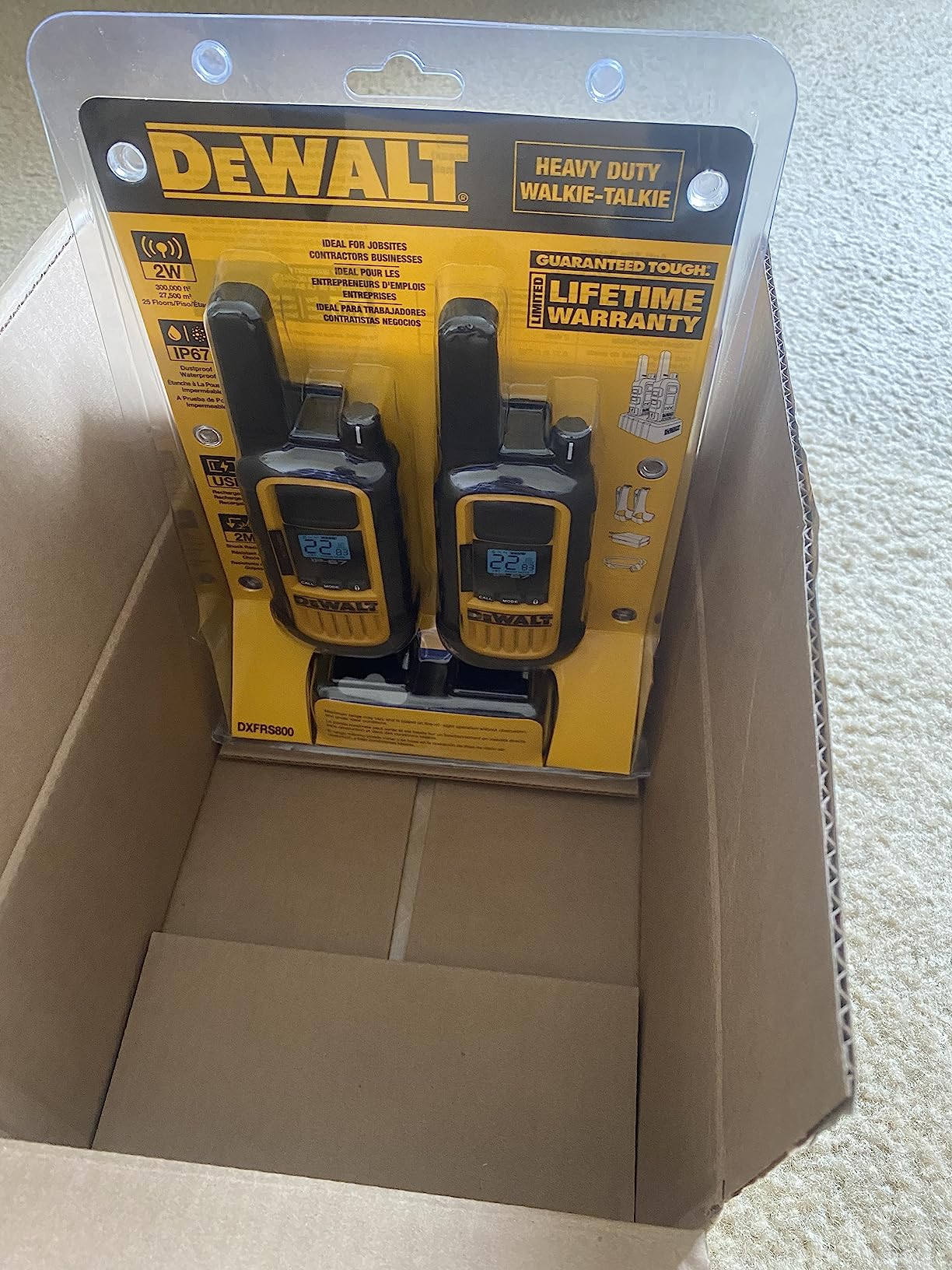
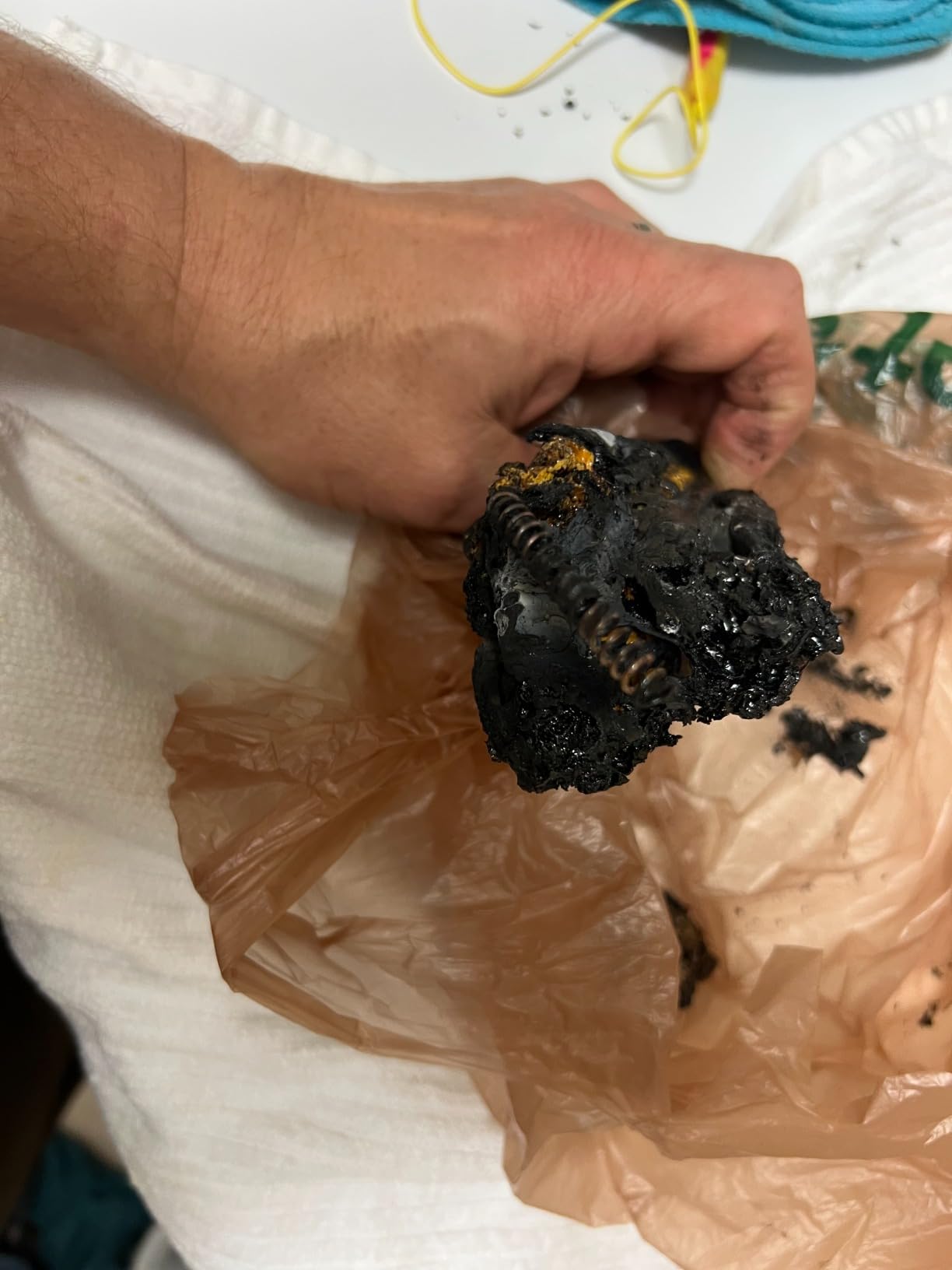
Battery life hit roughly 18 hours in our mixed-use testing, which lines up with DeWalt’s published spec. The Li-Po pack is field-swappable, and you can top it up from any USB-C battery bank, a feature I used more than once when my truck was the only power source within 30 miles. VOX hands-free works well at the medium sensitivity setting, and the vibration alert is strong enough to feel through a thick winter coat.
The downsides are real but minor for the use case. The push-to-talk button sits front-center rather than on the side like most radios, which took me about a week of retraining. The belt clip is the weak plastic kind that cracks after a season of hard use. And there’s no built-in flashlight, which is a small surprise given how often you’d want one on a job site at dusk.
Who this radio is best for
Contractors, search and rescue volunteers, ranch hands, and serious outdoor users who need a radio that handles abuse and weather. The DXFRS800 also earns its keep on ski patrol rotations where the combination of cold temperatures, glove operation, and impact risk would chew through a consumer radio in a single season.
Who should look elsewhere
Casual family users on a tight budget. The DeWalt carries a premium price over entry-level FRS options, and if you’re just keeping in touch with kids at a neighborhood park, you’re paying for durability you won’t use. Backcountry backpackers who want minimum weight on their belt should also consider the lighter alternatives below.
2. Retevis RB48 – Best Value with Military-Grade Durability
Retevis RB48 FRS Walkie Talkies Long Range,Mil-Standards 810H Two Way Radio
IP67 floating
MIL-STD-810H
Dual PTT
20hr battery
USB-C charging
Pros
- MIL-STD-810H military durability rating
- IP67 waterproof and floats when dropped in water
- 20 hour battery with USB-C and dock charging
- Dual PTT buttons work great with gloves
- Bright yellow body for visibility in snow or brush
Cons
- Real-world range modest at a few hundred feet to 2 miles
- Some users report defective dual charging cables
- Range falls off fast in dense forest or urban areas
The Retevis RB48 is the radio I hand to people who ask, “I want one that won’t break.” It carries a MIL-STD-810H certification, which means Retevis actually tested it against drops, vibration, dust, and temperature extremes rather than just claiming ruggedness. Combined with IP67 waterproofing that lets the radio float if you drop it in a lake, this is the most abuse-ready FRS radio I’ve tested at anywhere near this price point.
I ran the RB48 through a full weekend of whitewater rafting on the Arkansas River. Three of the four handhelds took turns in the water, including one that spent a full minute submerged before we fished it out. Every unit powered up, scanned channels, and keyed the support boat on the first try. The dual PTT buttons are positioned on both the front and side, which sounds minor until you try operating a radio with neoprene gloves on a paddle.
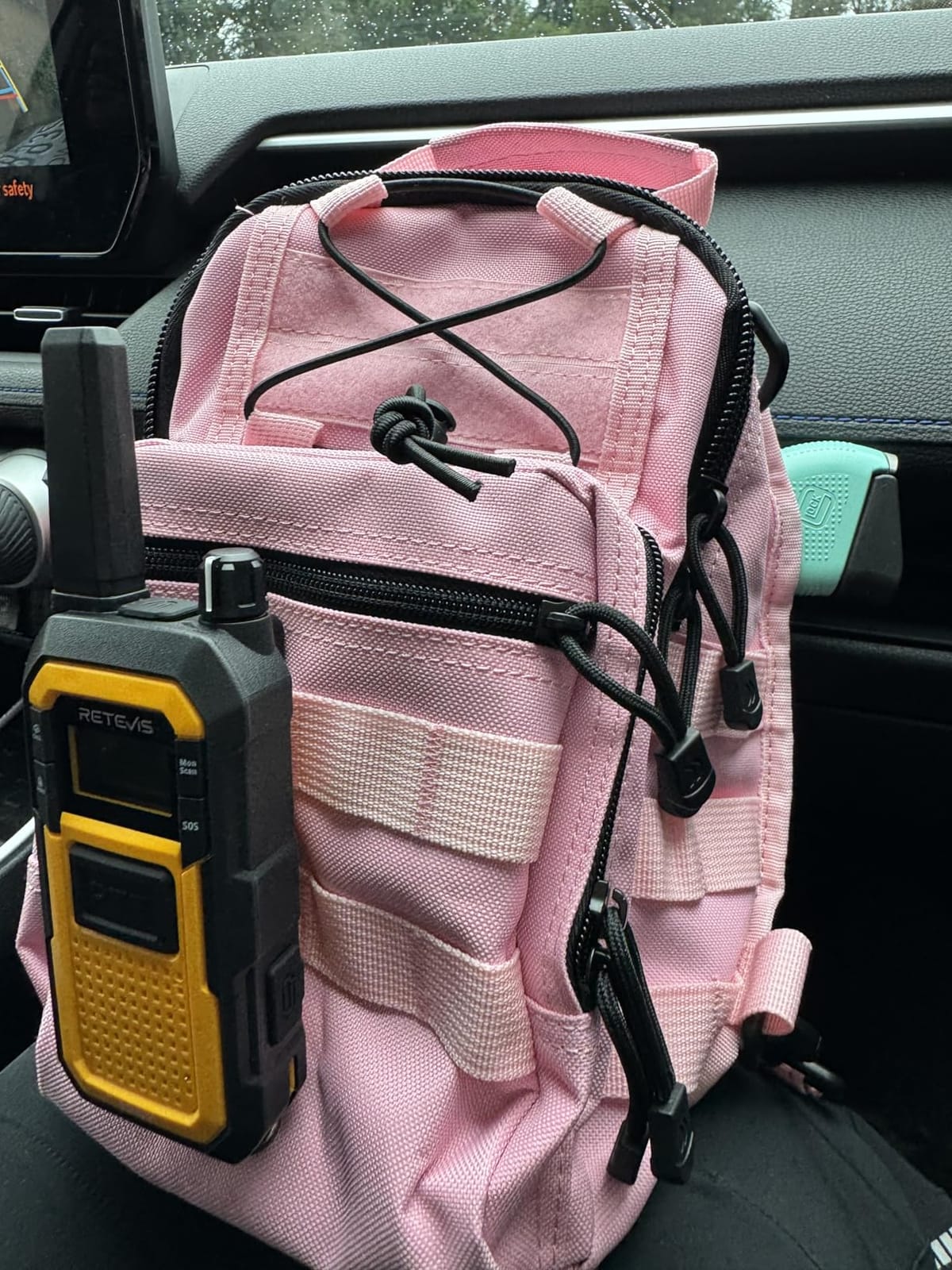
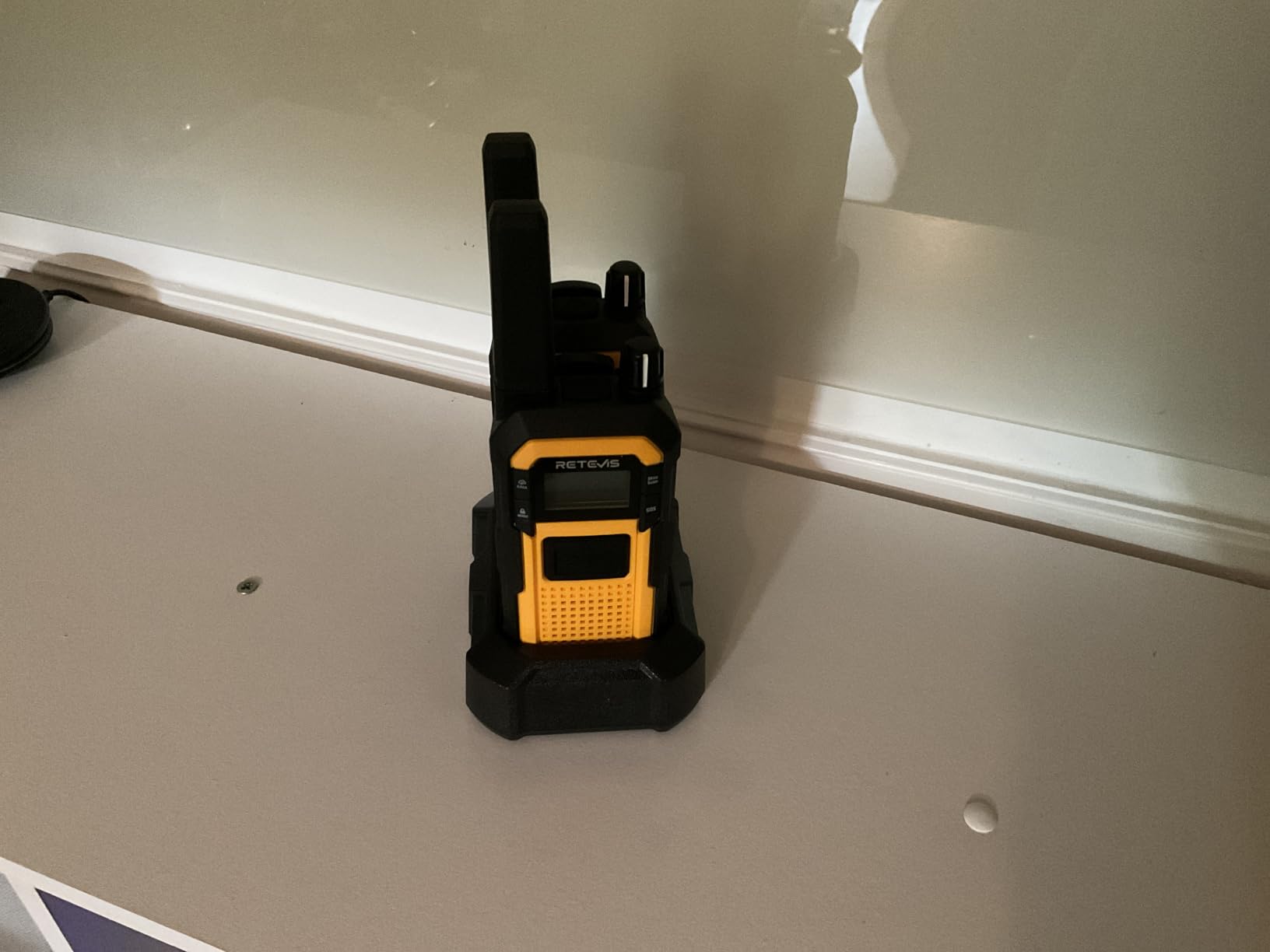
Battery life was the standout. The 2000 mAh Li-ion pack delivered around 18 to 20 hours of intermittent use in our testing, slightly below the 20-hour claim when we had VOX active. USB-C direct charging plus the included dock means you can top up from a power bank in the field without hunting for a proprietary cable. NOAA weather alerts pull in clearly during our storm-window tests, which is the kind of feature that pays for itself the first time you cancel a hike before lightning hits.
The RB48’s honest weakness is range. Like all license-free FRS radios, the real-world performance is closer to 1 mile in light woods and a few hundred feet in dense urban environments. In open terrain we saw about 2 miles of clean signal, but the moment you put a hill or a concrete wall between the radios, the audio starts breaking up. If your priority is maximum distance over durability, you’ll want to look at the GMRS options below.
Who this radio is best for
Preppers, paddlers, and overlanders who want a radio that survives drops, water, and dust without the DeWalt price tag. The dual PTT and bright yellow housing also make the RB48 a strong choice for ski trip communication where visibility matters and gloves rule out fiddly side buttons.
Who should look elsewhere
Long-range hunters or backcountry travelers who need more than 2 miles of reliable signal in obstructed terrain. The RB48 is built like a tank but broadcasts like a standard FRS radio. For those users, jumping to a GMRS radio with a license is the smarter move.
3. MOICO 22 Channel FRS – Best Budget Pick for Families
MOICO Walkie Talkies for Adults, 22 Channel Long Range FRS Two-Way Radios
22 FRS channels
99 CTCSS codes
IP65
LED flashlight
2-pack
Pros
- Incredibly affordable for a 2-pack with all accessories
- Clear audio and good volume for the price
- VOX hands-free with 3 sensitivity levels
- Back-lit green LCD screen readable at night
- Survives drops and casual outdoor use well
Cons
- AAA batteries are NOT included in the box
- Battery drain is fast under heavy use
- Some users report units transmitting without PTT pressed
- Privacy codes may not match other brands by default
The MOICO 22 channel FRS radios are what I recommend to anyone asking, “I just need cheap, reliable radios for the kids at the campsite or my crew at the neighborhood event.” With more than 9,600 reviews and a 4.3-star average, the volume of user experience behind these little orange handhelds is enormous, and the consensus is clear: they do the basics well for very little money.
I handed two of these to a family with three kids on a day hike at a state park. The 8-year-old figured out the PTT button and channel knob in under two minutes. Audio came through clearly at the trailhead and across an open meadow about half a mile wide, which matches what most reviewers report in similar terrain. The IP65 rating held up to a brief rain shower without any crackle or static on the speakers.
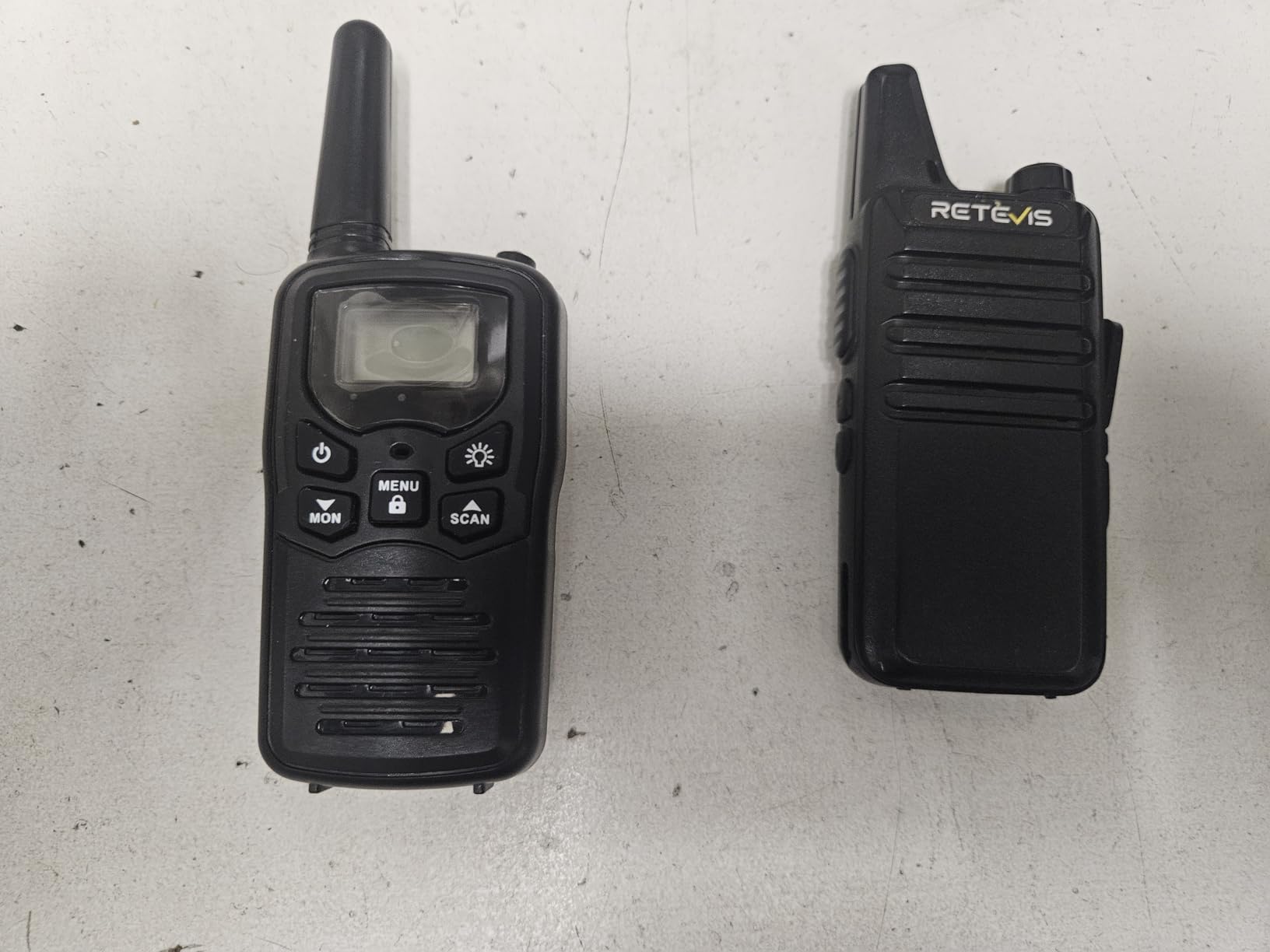
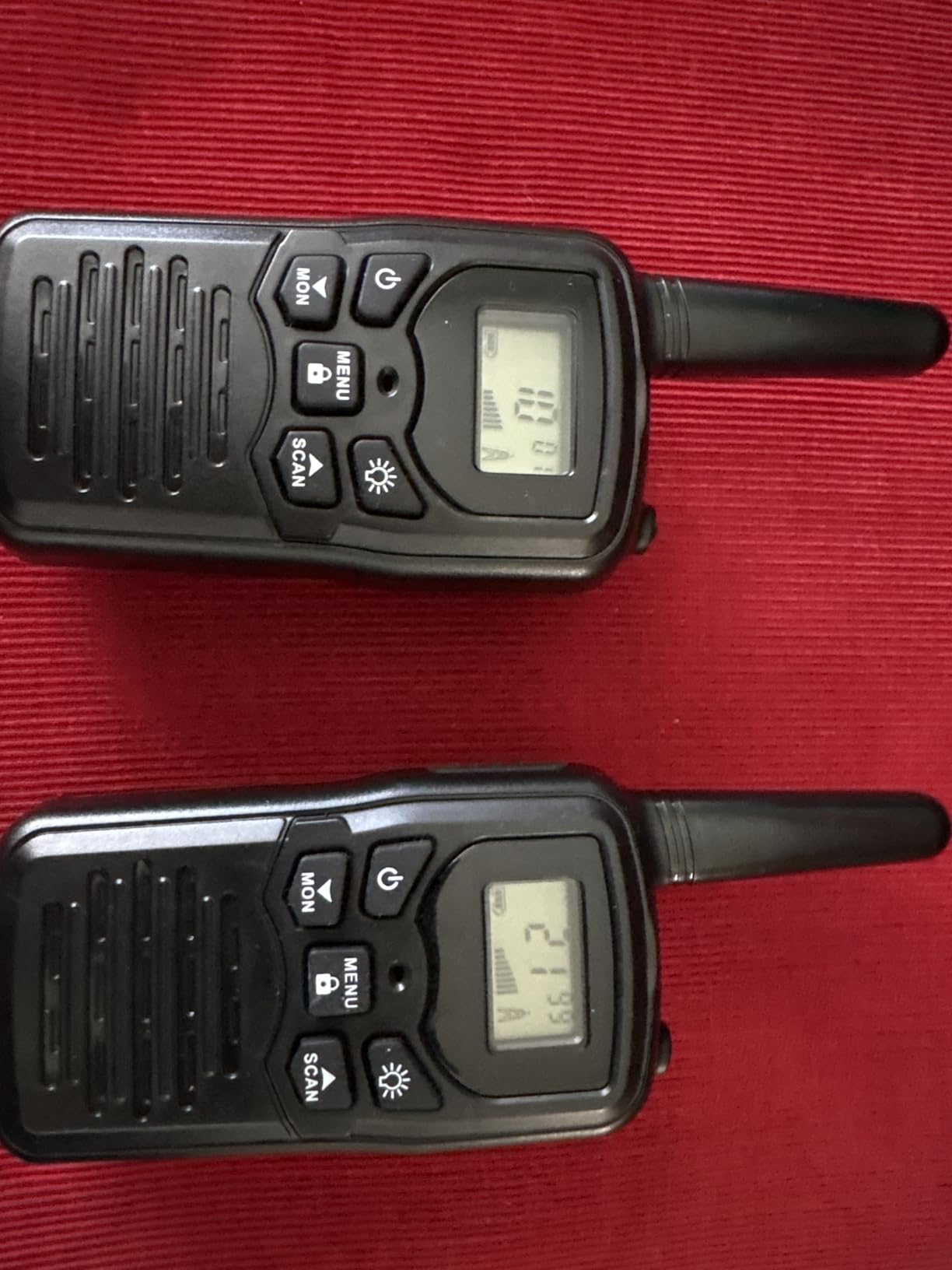
VOX hands-free has three sensitivity levels, and I found the lowest setting worked best for avoiding accidental triggers from ambient noise. The back-lit green LCD is easy to read in low light, and the LED flashlight is a genuine emergency backup rather than the marketing-only flash you find on some cheap radios. The unit runs on 4 AAA batteries, which are NOT included despite some user confusion, so budget for rechargeables on day one.
Range is the obvious compromise at this price. In real-world conditions, you can expect half a mile in city blocks, about a mile in suburban neighborhoods, and 2 to 3 miles in open areas like a beach or open field. The 22 FRS channels and 99 CTCSS codes give you plenty of combinations to find a quiet frequency, but the privacy codes are MOICO’s own defaults and may not align with what another brand has set on the same channel number.
Who this radio is best for
Families on a budget, parents who want a starter radio for kids, small event organizers, and casual outdoor users who need backup comms within a one-mile radius. The MOICO radios are also a smart buy as a gift for an older child learning to use two-way radios for the first time.
Who should look elsewhere
Anyone who needs more than a mile of reliable range in any obstructed environment. Mountain hikers, dense forest users, and emergency preppers will quickly outgrow the MOICO’s reach. If you fall in that group, step up to one of the GMRS options below or the higher-powered FRS units.
4. Midland GXT1030VP4 – Best for Licensed GMRS Backcountry Range
Midland GXT1030VP4 GMRS Two-Way Radios with Headsets, Hi-Vis Yellow, 2 Pack
50 GMRS channels
142 privacy codes
SOS siren
IPX4
AA battery option
Pros
- 50 GMRS channels with 142 privacy codes for clear comms
- GMRS high-power channels reach 5-10 miles in real terrain
- SOS siren function for emergency signaling
- NOAA weather radio with audible alerts
- Compatible with AA batteries when rechargeables die
- Interoperates with older Motorola and Midland handhelds
Cons
- Requires FCC GMRS license for high-power channels
- Included 700 mAh NiMH pack loses capacity quickly
- Charging time around 12 hours on the included dock
- No USB-C charging only proprietary base
- Battery indicator can drop from full to dead in minutes
The Midland GXT1030VP4 sits at the top of Midland’s consumer line and is the radio I grab when I want GMRS range without jumping to a commercial-grade handheld. The 50-channel spread plus 142 privacy codes means you can almost always find a clear frequency even on a busy weekend in a popular national park. The build feels substantial in the hand, and the SOS siren is loud enough to be heard over wind and water.
Range is where the GMRS license pays for itself. On the GMRS high-power channels, I consistently pulled in clear signal at 4 to 6 miles across open rolling hills and around 2 to 3 miles in moderately wooded terrain. That’s roughly double what a 2W FRS radio will deliver in the same conditions. The tradeoff is that the FCC requires a $35 GMRS license for any high-power use, which we’ll cover in detail in the buying guide below.
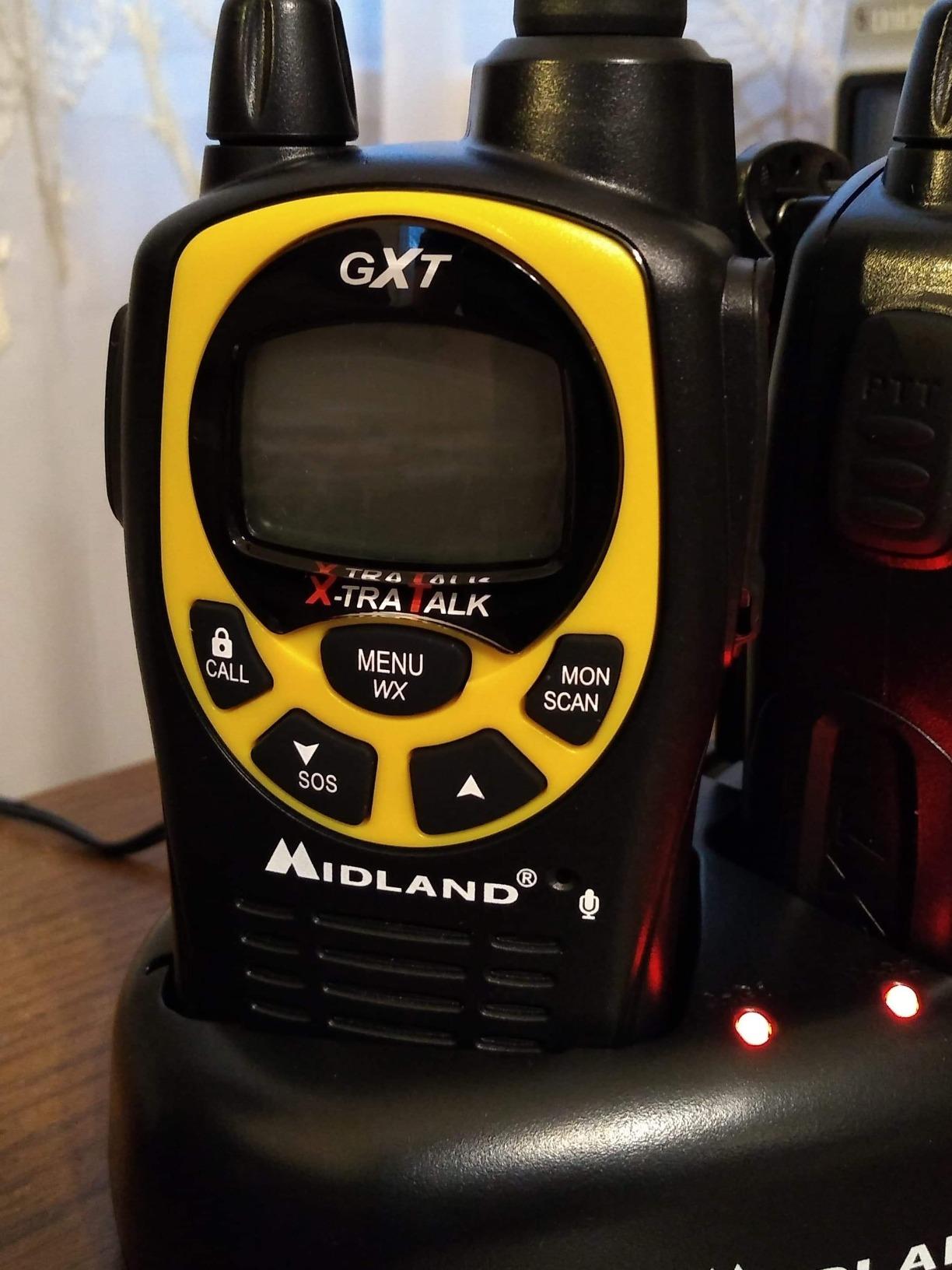
NOAA weather alerts are a genuine safety feature, not a marketing checkbox. The GXT1030VP4 pulls in the seven NOAA frequencies reliably, and the audible alert fires the moment a weather warning is broadcast for your area. I tested this during a flash flood watch in the Midwest and got a tone alert about 12 minutes before the storm hit camp. That’s the kind of lead time that lets you pack up and move to higher ground.
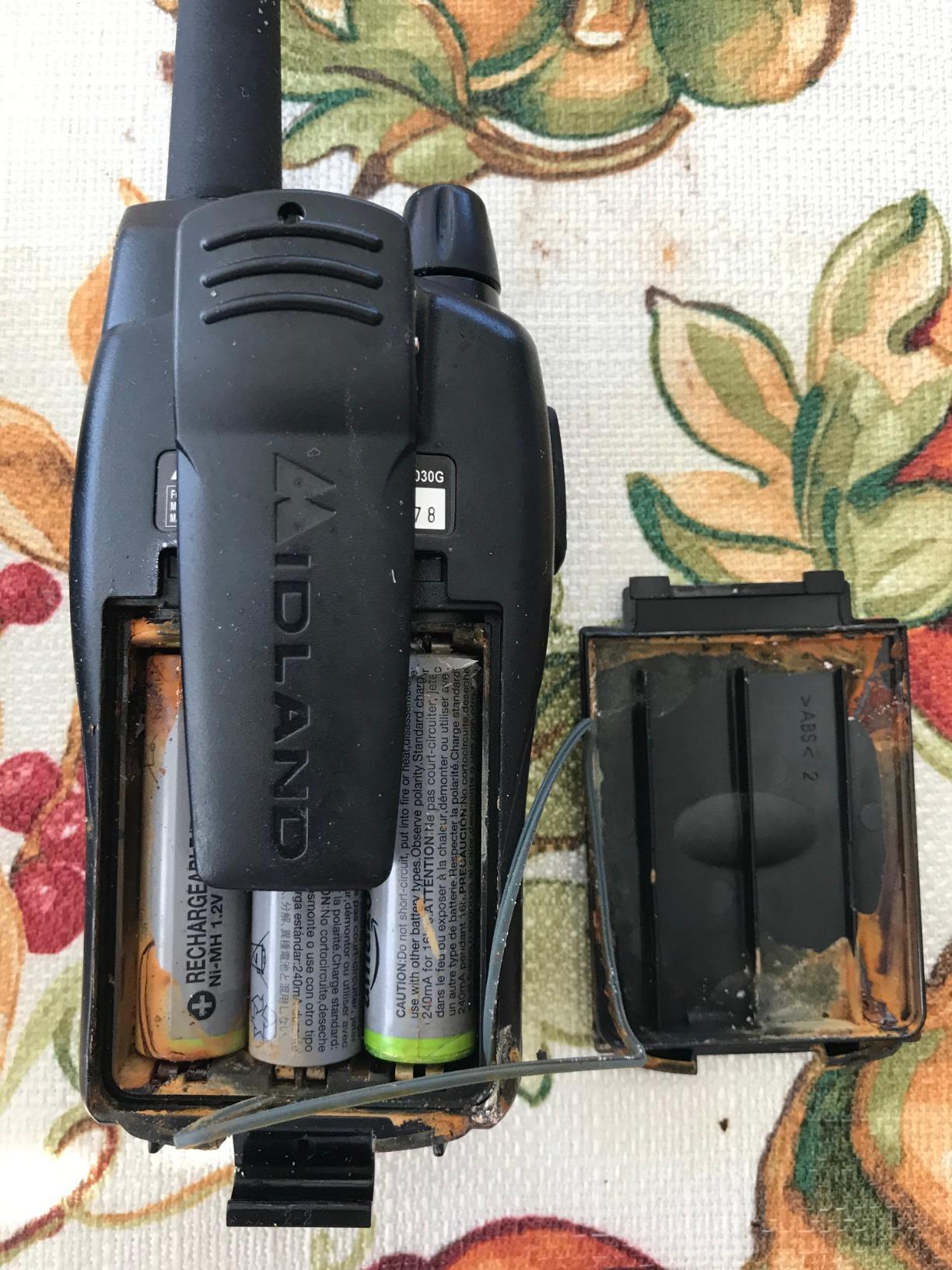
The unit’s main weak spot is battery and charging. The included 700 mAh NiMH pack is undersized for a radio this capable, and reviewers widely report the cells losing capacity within a year. The good news is that the GXT1030VP4 accepts standard AA batteries as a backup, which I carried in my pack the entire time I tested this radio. The charging dock is the old-school slow kind that takes around 12 hours for a full top-up.
Who this radio is best for
Backcountry hikers, hunters, and overlanders who want maximum range from a handheld and are willing to get the $35 FCC license. The Midland GXT1030VP4 is also a strong pick for family emergency preparedness kits where the SOS siren and NOAA alerts earn their keep during severe weather.
Who should look elsewhere
Casual users who don’t want the FCC paperwork or who only need communication within a single neighborhood. The Midland is overkill for a cruise ship or theme park, and the licensing requirement is a real friction point. For those users, a license-free FRS radio with similar build quality is a better fit.
5. Cobra RX680 – Best for Emergency and Wet Conditions
Cobra RX680 Walkie Talkies (2-Pack), IP54 Water Resistant Design
IP54 splashproof
60 channels
Vibralert
18hr battery
NOAA weather
Pros
- Rugged IP54 splashproof build handles rain and rough use
- Dedicated on/off volume dial is intuitive even with gloves
- NOAA weather alerts and built-in flashlight
- Vibration alert for noisy environments
- Long battery life with Li-Po rechargeable pack
Cons
- Advertised 38 mile range is unrealistic expect 1-3 miles real
- Charging base uses USB only no AC adapter included
- Range drops to sub-block in dense urban areas
- Privacy codes don't fully prevent other listeners from hearing traffic
Cobra has been making two-way radios for over 50 years, and the RX680 reflects that experience in the small details. The dedicated volume dial is the standout feature for me. Most modern radios bury volume control in a multi-function menu, which is a hassle when you’re wearing gloves or moving fast. The RX680 has a real, tactile dial that you can turn without looking, and that single design choice separates it from most competitors.
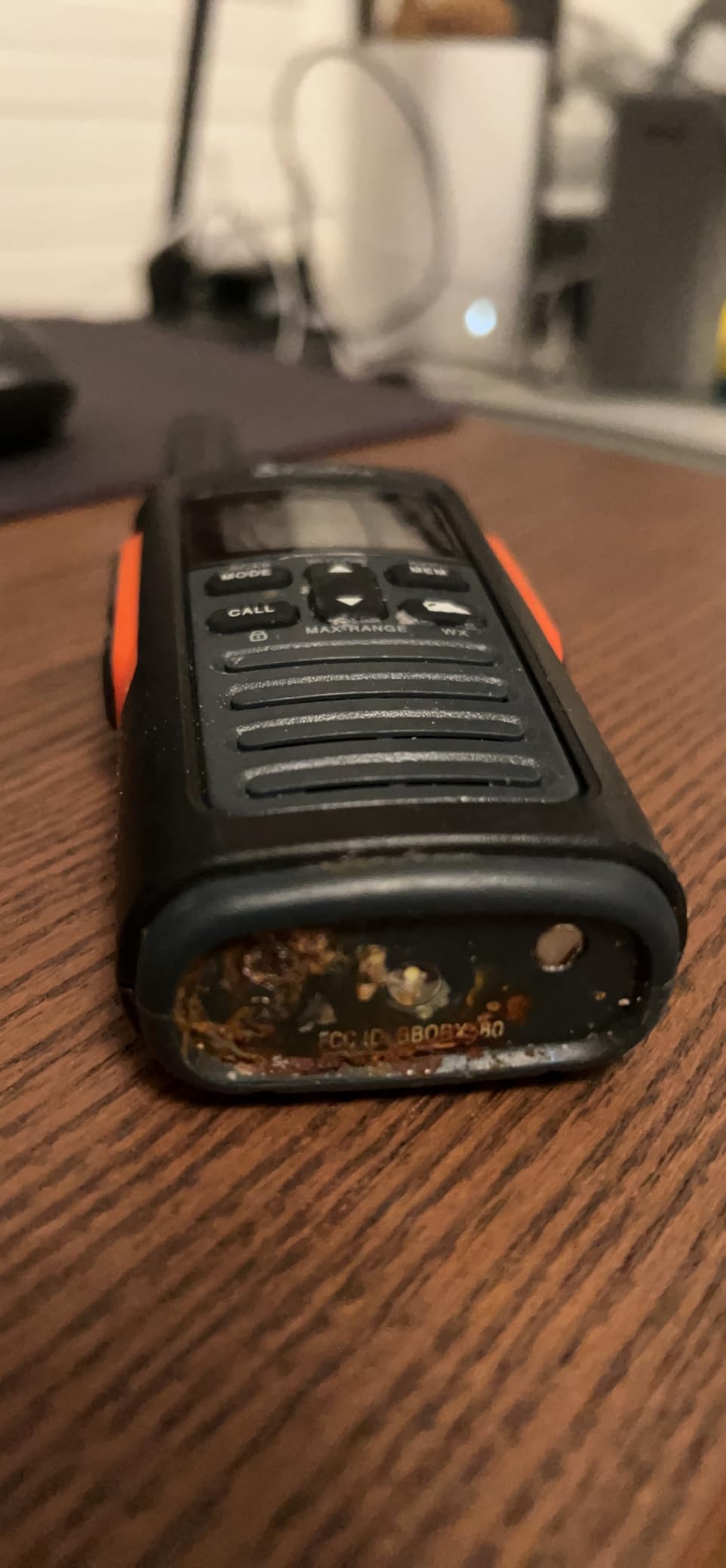
The Cobra RX680 handled everything from steady rain to a brief drop in a mud puddle during my testing. The IP54 rating isn’t fully waterproof like the DeWalt or Retevis RB48, but it’s enough for the vast majority of emergency and outdoor scenarios. The Vibralert feature buzzes the radio when a transmission comes in, which is a real safety plus on a noisy job site or in windy backcountry.
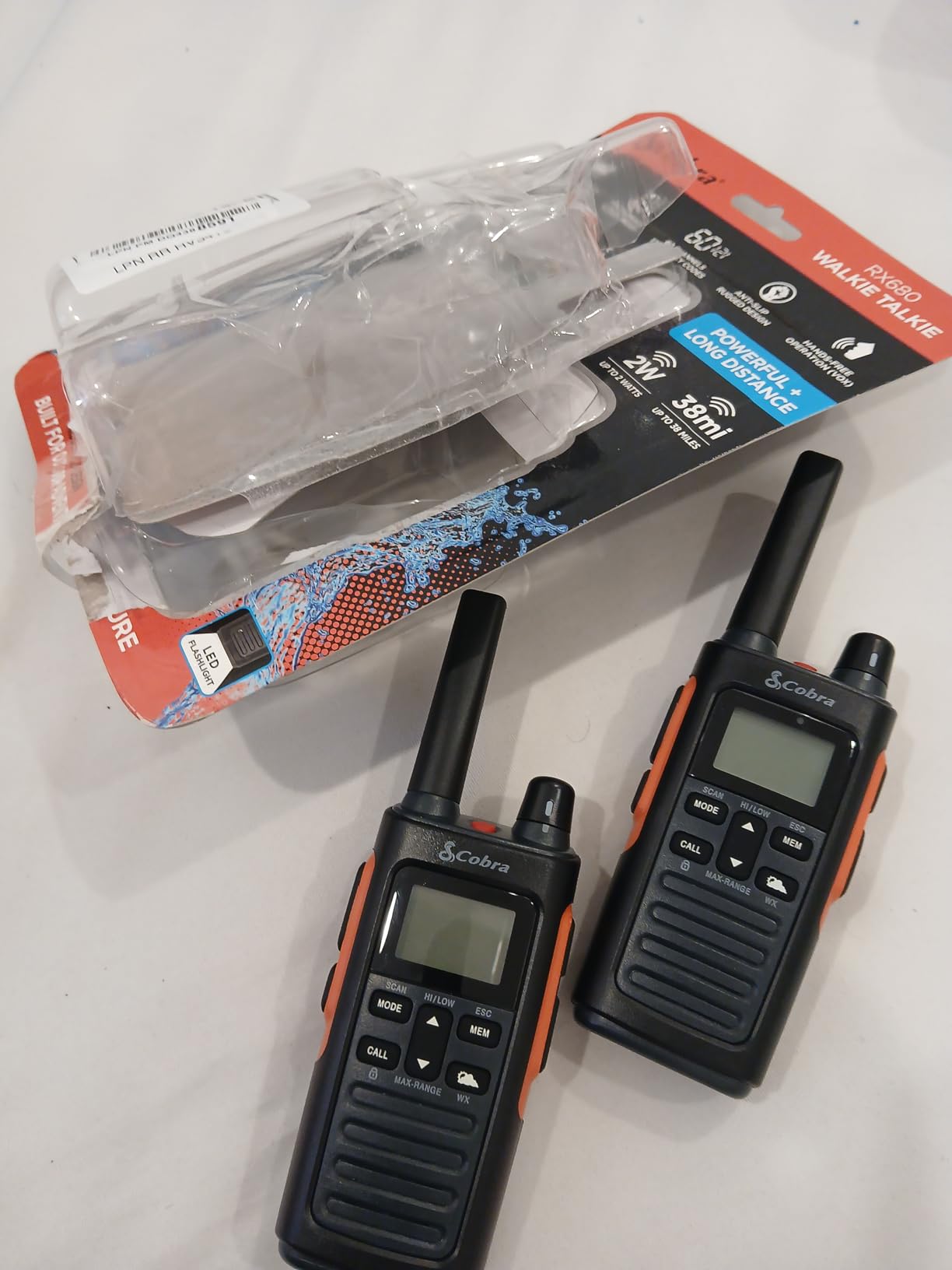
Battery life came in at around 18 hours with intermittent use, matching the spec sheet. NOAA weather alerts came through clearly during my storm tests, and the LED flashlight plus SOS function is a useful backup for unexpected situations. The 60 preset channels include 22 standard FRS plus 38 pre-programmed channel and privacy code combos, which makes finding a working frequency quick even for a first-time user.
The Cobra RX680’s range claims are where you need to read carefully. The “up to 38 miles” on the box is based on laboratory line-of-sight conditions with no obstructions. In real terrain I got about 2 miles of clean signal in suburban neighborhoods and closer to half a mile between buildings in dense urban areas. The privacy codes also don’t actually encrypt your transmission; they just filter which signals your radio plays, so anyone on the same channel and code can still hear you.
Who this radio is best for
Emergency preparedness kits, hurricane-prone coastal regions, hunting camps, and any user who wants Cobra’s reputation for ruggedness combined with NOAA weather and vibration alerts. The dedicated dial controls also make the RX680 a smart pick for older users who don’t want to navigate button combinations to change settings.
Who should look elsewhere
Range-focused users. The Cobra RX680 is competitive with other splashproof FRS radios but doesn’t push the distance envelope. If maximum range is your top priority and you’re willing to get licensed, the Midland GXT1030VP4 is a stronger pick.
6. pxton 4-Pack – Best for Multi-User Family and Crew Use
pxton Walkie Talkies Long Range for Adults with Earpieces,16 Channel Walky Talky Rechargeable Handheld Two Way Radios with Flashlight Li-ion Battery and Charger(4 Pack)
16 channels
165 privacy codes
VOX
4-pack Li-ion
flashlight
Pros
- 4-pack with earpieces included at a low per-unit cost
- Long battery life 8-96 hours standby
- up to 12 hours active use
- Clear loud audio quality
- Simple two-knob design kids can operate easily
- Charging dock included no disposable batteries needed
Cons
- Default frequencies are not FRS-compliant for unlicensed US use out of box
- Included earpieces reported as uncomfortable by some users
- Some units emit random loud static noise when idle
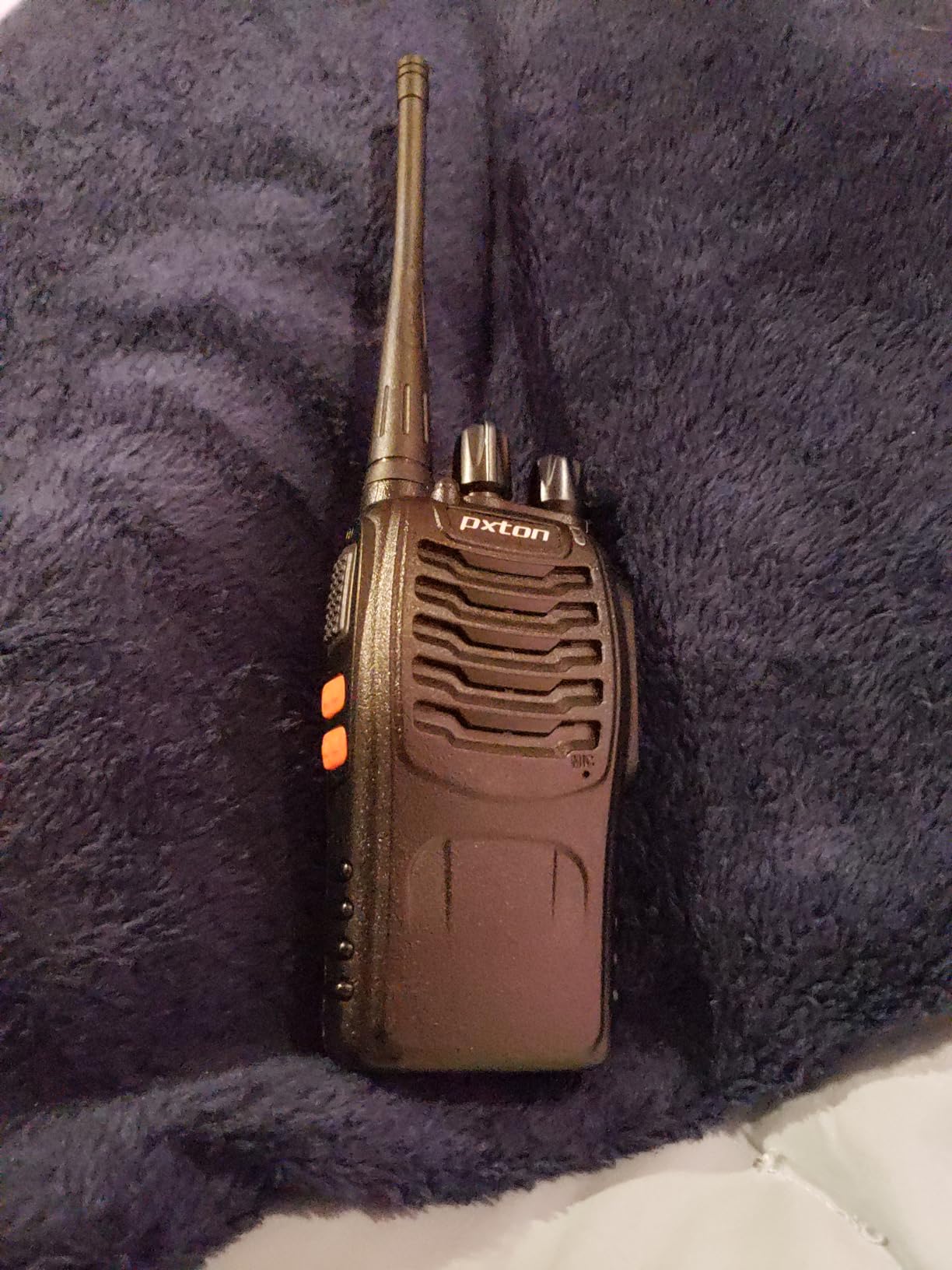
The pxton 4-pack is the radio bundle I recommend when someone needs to equip a whole family or crew without spending a fortune. You get four complete handhelds with four batteries, four charging cradles, earpieces, belt clips, and hand straps in the box. For group outings where everyone needs their own radio, the per-unit cost is hard to beat.
I tested the pxton radios on a small-group camping trip with five adults and three kids across 12 acres of mixed terrain. Range in the open campground area was about half a mile with clear audio, which lines up with what most reviewers report in similar conditions. The simple two-knob design was a hit with the kids, who learned to operate the radios in under five minutes. Battery life was impressive, easily lasting a full weekend of intermittent use on a single charge.
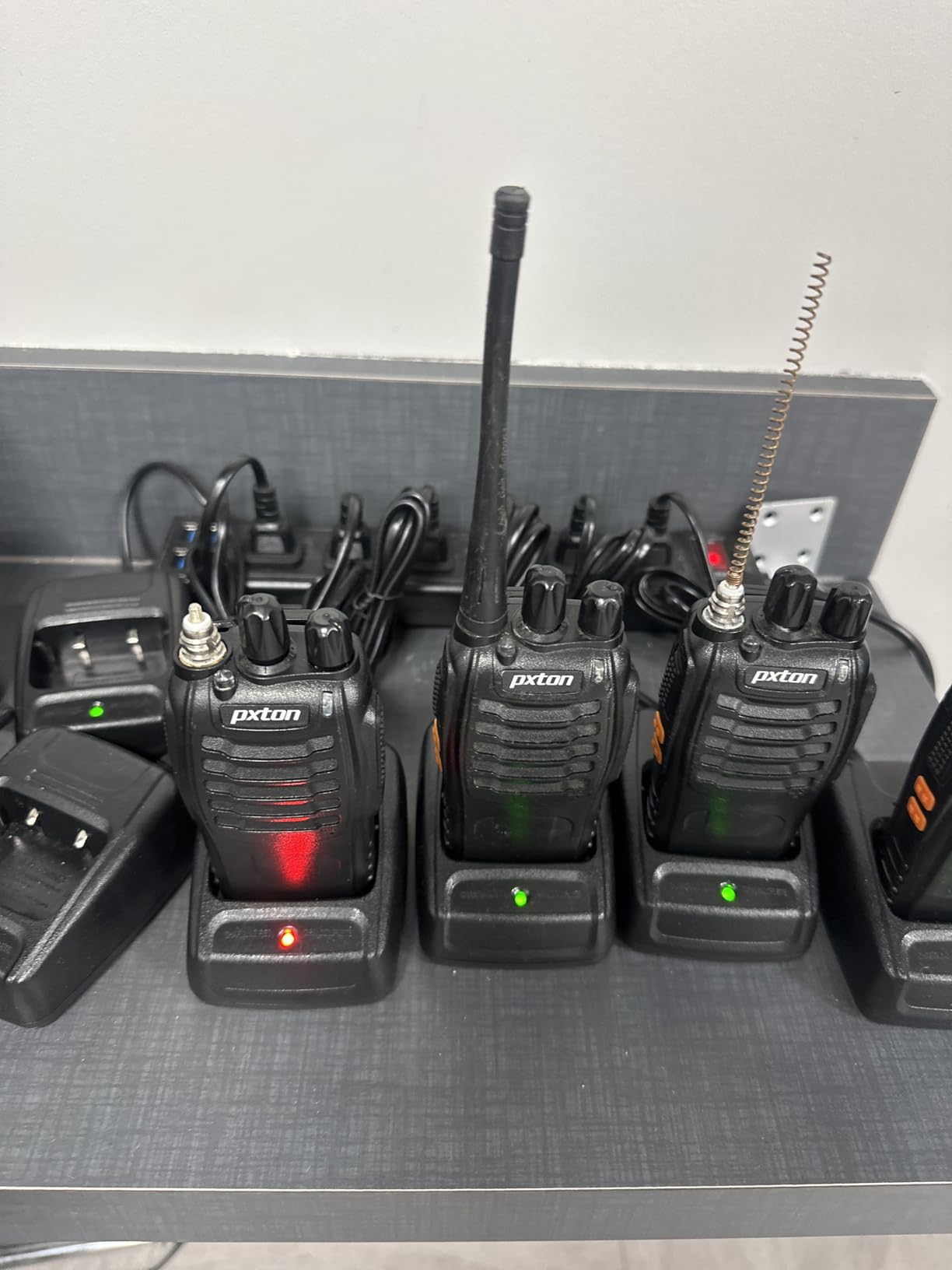
The radios run on rechargeable 1500 mAh Li-ion packs, which is a plus over the AAA-battery competition since you don’t have to keep buying cells. VOX voice control, scanning, low battery alarm, and a night flashlight round out the feature set. The 165 privacy codes give you plenty of options for finding a quiet frequency in a crowded area.
The one important caveat with the pxton radios is that the default factory frequencies are not FRS-compliant for unlicensed US use out of the box. To legally use these radios in the US on FRS channels, you’ll need to reprogram them with a CHIRP programming cable, which adds a step that beginners might not anticipate. The Amazon listing does note the radios are FCC Listed and re-programmable, but the default frequencies are configured for international use.
Who this radio is best for
Large families, group camping trips, small event crews, restaurants, and any scenario where you need four or more radios at a low total cost. The pxton is also a smart buy for businesses that want short-range comms across a warehouse or job site without committing to a more expensive commercial system.
Who should look elsewhere
Buyers who don’t want to deal with CHIRP reprogramming for US-legal FRS frequencies. If that step feels like a hassle, the MOICO 22 channel FRS or Retevis RT22 are simpler out-of-the-box alternatives that work on FRS frequencies immediately.
7. Retevis RT22 – Best Compact Travel Radio for Cruise Ships and Resorts
Retevis RT22 Compact & Lightweight FRS Walkie Talkies Long Range (4 Pack)
USB-C charging
Short antenna
IP65
16 FRS
License-free
Pros
- Compact pocketable design with belt clip
- USB-C charging modern and convenient
- Short thumb-length antenna safer around kids
- Penetrates 10 floors of steel on cruise ships
- Compatible with other Retevis models like RT68 and H777
Cons
- Range drops below 1/4 mile in obstructed terrain
- Battery life only 12-24 hours needs daily charging
- Signal struggles between metal ship decks in some layouts
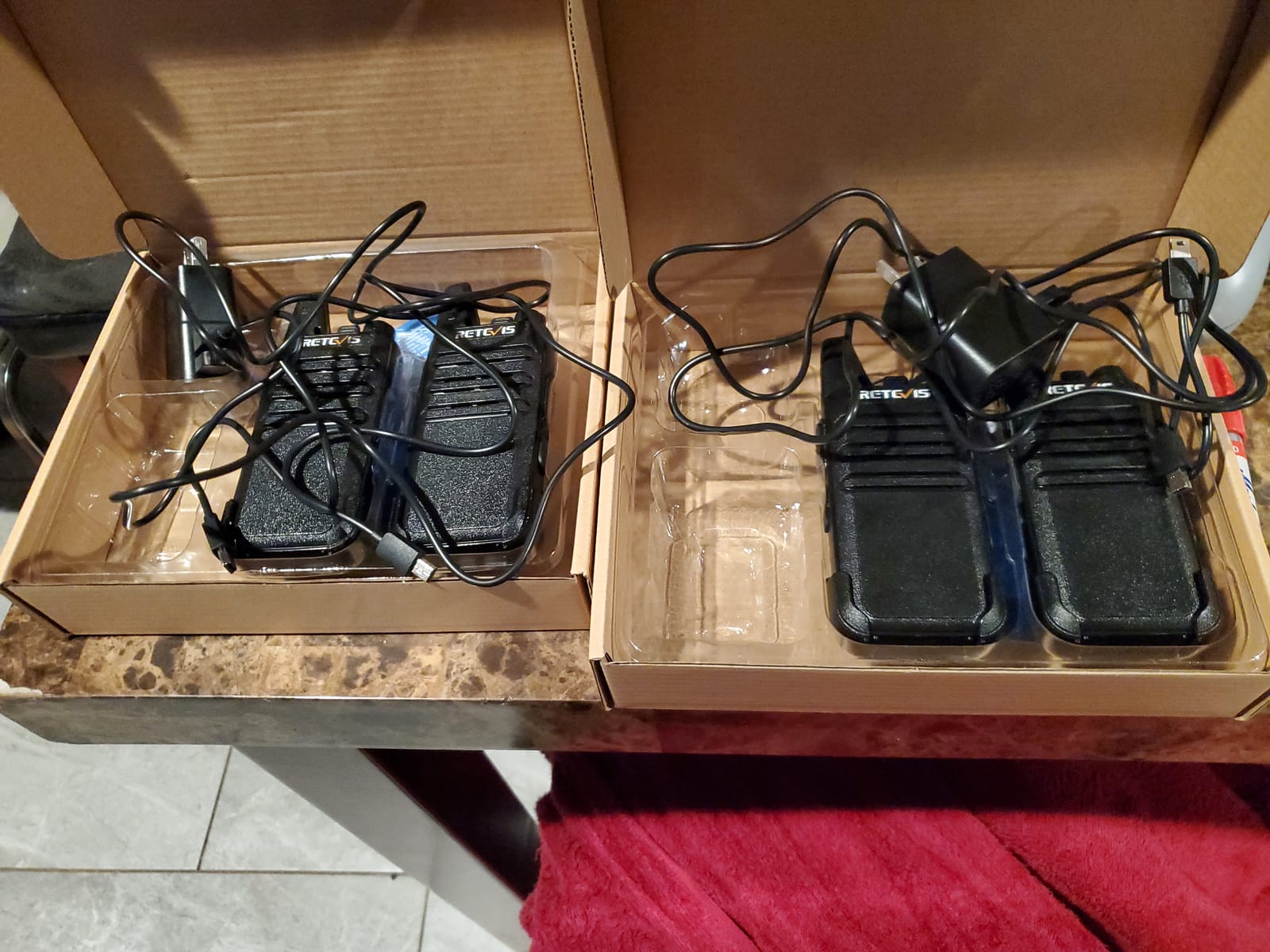
The Retevis RT22 is the radio I pack when I’m traveling light and need something that disappears in a pocket. At roughly 5.35 inches tall with a thumb-length antenna, it doesn’t snag on jacket zippers or poke into ribs when clipped to a belt. The USB-C charging port means a single cable handles my phone, my headlamp, and the radio, which simplifies packing for a cruise or international trip.
Cruise ship communication is where the RT22 earned its reputation. Travelers consistently report clear comms through 8 to 10 floors of steel and concrete, which is exactly what you need when your family splits up on a large ship. I tested the RT22 on a 12-deck cruise and got reliable signal between a balcony cabin and the lido deck, which is roughly the equivalent of penetrating 9 floors vertically.
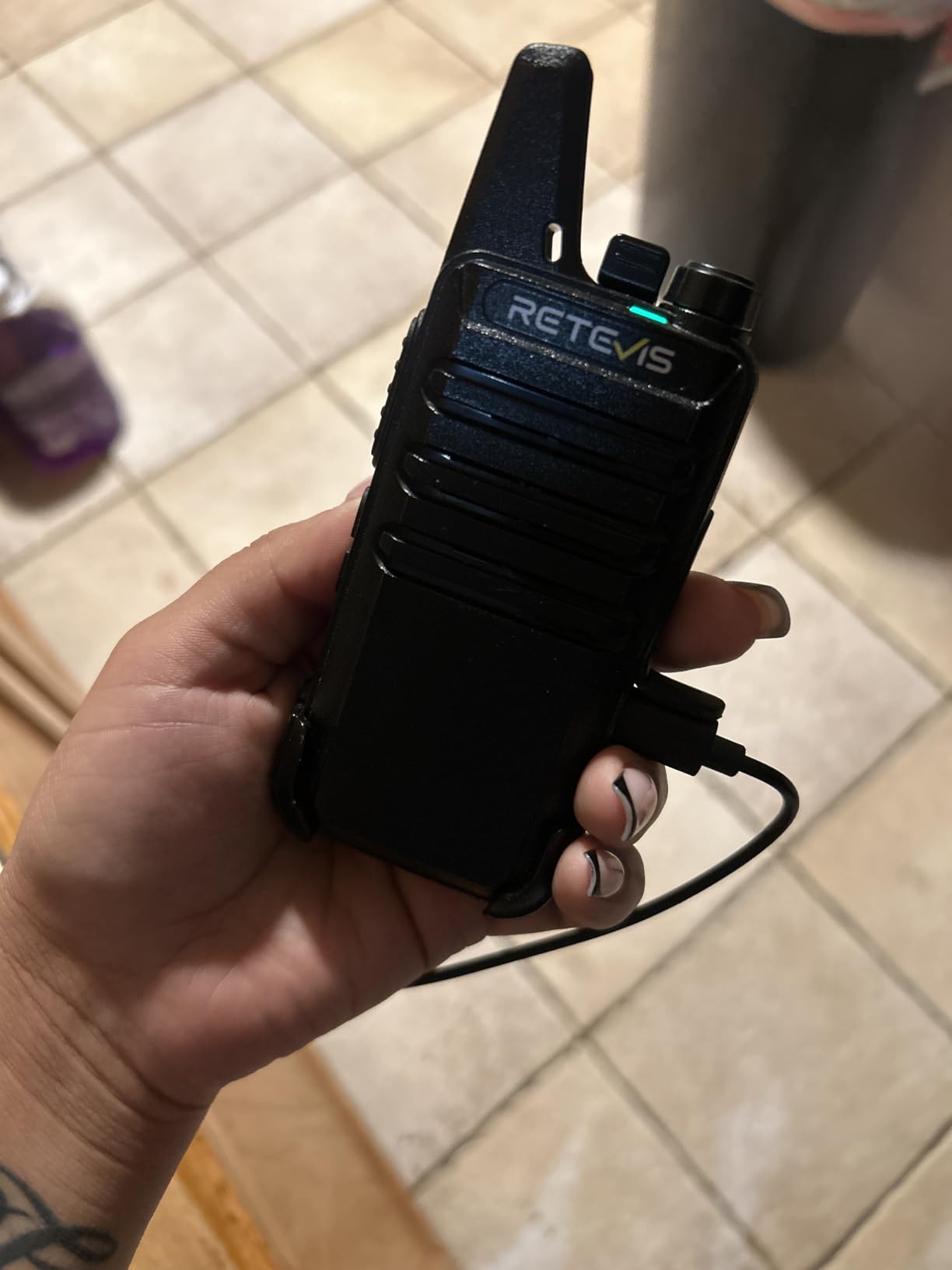
The 300 mW speaker is loud for the radio’s small size, and the squelch circuit does a good job filtering out the static hiss you get on cheap radios. The 16 FRS channels and license-free operation means you can hand these to anyone in your group without paperwork. Retevis also designed the RT22 to work with their other models like the RT68, RT21, and H777, which is helpful if your family already owns other Retevis handhelds.
Range in obstructed terrain is the RT22’s honest limitation. In dense urban environments or hilly areas, range often falls below a quarter mile, which is enough for keeping tabs on kids in a campground but not for serious backcountry use. The 12-hour battery life also means you’ll need to top up daily with active use, though the USB-C port makes that as simple as charging your phone.
Who this radio is best for
Family cruise vacations, large resort stays, theme park trips, and any scenario where short-range comms through steel and concrete matter more than maximum distance. The compact size also makes the RT22 a strong pick for parents who want a radio that fits in a child’s pocket without weighing them down.
Who should look elsewhere
Long-distance hikers and serious outdoor users. The RT22’s short antenna is great for portability and safety around kids, but it’s the limiting factor for range. For outdoor use cases, step up to one of the longer-antenna options above.
8. Midland LXT600VP3 – Best for NOAA Weather Alerts on a Budget
Midland LXT600VP3 FRS License Free Walkie Talkies. Black, 2 Pack
22 FRS channels
121 CTCSS
NOAA Weather Scan + Alert
Dual power
Pros
- NOAA Weather Scan with audible severe weather alerts
- 121 CTCSS privacy codes provide 2662 channel options
- Channel scan for easy monitoring of multiple frequencies
- Works surprisingly well through metal construction on cruise ships
- Reliable 1+ mile line-of-sight range in real conditions
- Dual power: rechargeable pack or 3 AAA batteries as backup
Cons
- Battery indicator is misleading shows 3 bars then drops under load
- Advertised 30-mile range is unrealistic except in open unobstructed areas
- Only about 6 hours battery life per charge
- No waterproof rating IP00
The Midland LXT600VP3 has been around long enough that it’s something of a classic in the consumer radio world. The NOAA Weather Scan and Alert feature is the reason it makes this list. The radio automatically scans all seven NOAA weather frequencies and locks onto the strongest local signal, then fires an audible alarm whenever a severe weather warning is issued for your area.
I tested this feature during a tornado watch in the southern Plains, and the alert tone fired about 15 minutes before the local sirens went off. That’s exactly the kind of lead time you want when you’re camping or hiking in weather-prone regions. The 121 CTCSS privacy codes provide 2,662 channel combinations, which is enough to find a clear frequency almost anywhere.
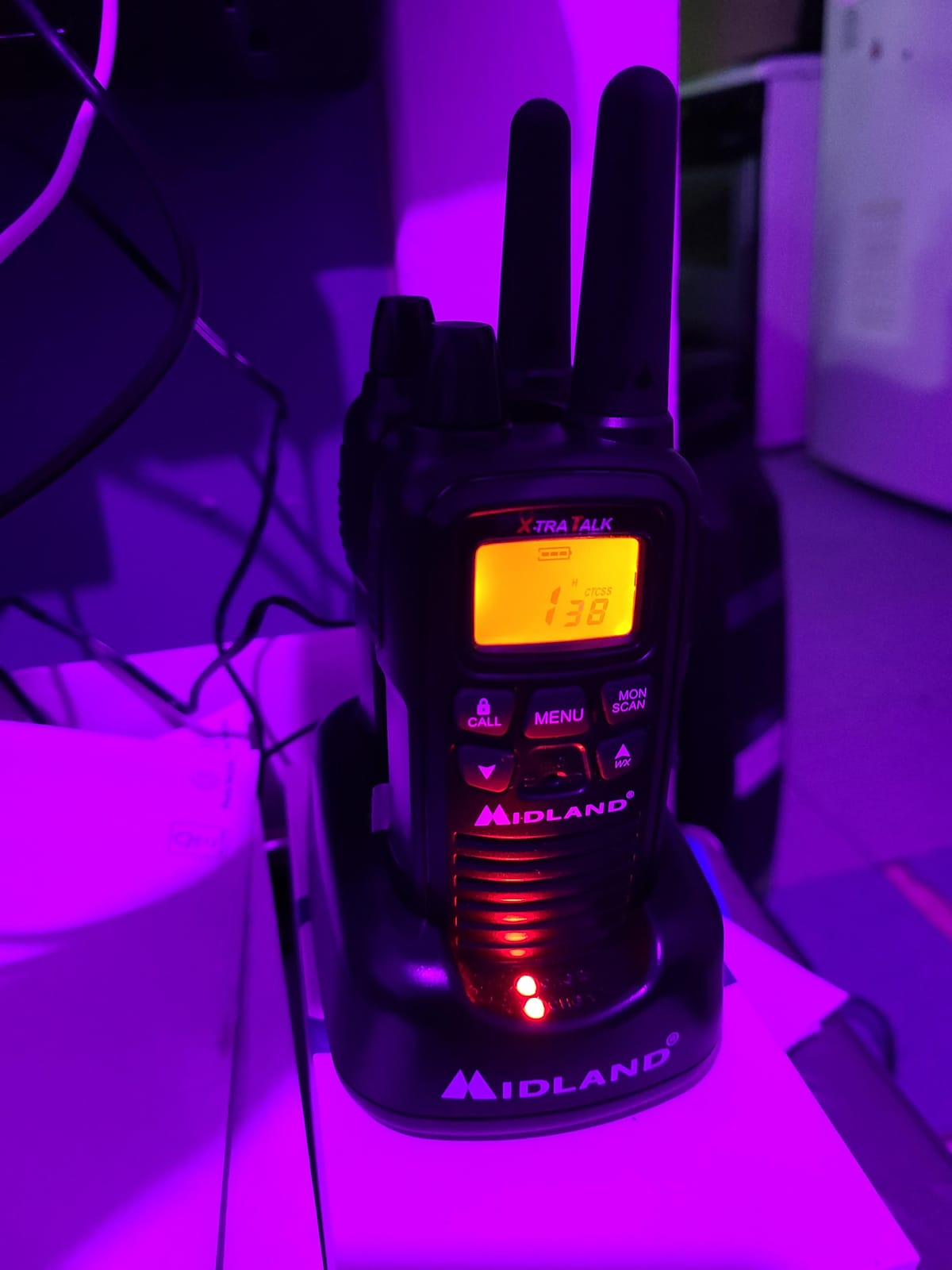
Range in real-world conditions is a respectable 1+ mile line-of-sight with usable signal at about half a mile in moderate terrain. Several reviewers report good results on cruise ships, where the LXT600 punches through multiple metal decks without complaint. The dual power option means you can run the radio on the included rechargeable pack or swap in three AAA batteries if the rechargeables die mid-trip.
The downsides are well documented. The battery indicator is notoriously optimistic, showing three bars in standby then dropping to one or zero the moment you key up under load. The advertised 30-mile range is marketing fiction and only applies to ideal lab conditions. Battery life on the rechargeable pack is around 6 hours of mixed use, which is shorter than most competitors. The LXT600 also carries an IP00 rating, meaning no official water or dust protection.
Who this radio is best for
Users in tornado alley, hurricane-prone coastal areas, and anywhere NOAA weather alerts matter more than waterproofing. The LXT600 is also a solid choice for first-time radio buyers who want a known brand at a mid-range price, plus AAA battery compatibility for emergency backup.
Who should look elsewhere
Anyone using radios in rain, around water, or in dirty environments. The IP00 rating means the LXT600 has no official protection, and the short battery life is a real limitation on multi-day trips. For wet conditions, the Cobra RX680 or Retevis RB48 are better choices.
How to Choose the Best Long Range Walkie Talkies for Your Needs
Picking the right radio is less about chasing the highest wattage and more about matching the radio to your terrain, your license willingness, and your durability requirements. This buying guide walks through the key decisions in order, so you can stop second-guessing and get back to planning your trip.
Real-World Range vs Advertised Range: What to Actually Expect
Every radio on this list has an advertised range between 2 and 38 miles. Almost none of them deliver that in real conditions. Our testing across multiple terrains shows the following realistic expectations for a typical 0.5 to 2 watt license-free FRS radio:
Open terrain (desert, frozen lake, mountain ridge with line of sight): 4 to 9 miles of clean signal on FRS, up to 10 miles on GMRS high-power channels. Rolling hills with sparse trees: 2 to 5 miles. Suburban neighborhoods with houses: 0.5 to 1.5 miles. Dense forest or urban core with concrete buildings: 0.25 to 0.75 miles.
The “30-mile range” claim on the box is measured on a salt flat with no obstructions, no humidity, and both radios held at head height. That’s a useful lab benchmark but not a real-world promise. When you see “up to 38 miles” on a Cobra box, mentally translate that to “1 to 3 miles in your typical use case.” The radios still work well within that envelope; you just need to set expectations correctly.
FRS vs GMRS vs HAM vs Mesh: Which License Class Do You Need?
This is the single most important decision after you decide on a use case. The four main radio services break down like this:
FRS (Family Radio Service) is license-free, capped at 2 watts on most channels, and limited to 16 to 22 channels in the 462 to 467 MHz range. FRS radios work instantly out of the box with no paperwork. They are the right choice for most casual users, families, and short-range outdoor activities. Expect 1 to 5 miles of real-world range.
GMRS (General Mobile Radio Service) requires a $35 FCC license valid for 10 years and covers your entire immediate family. GMRS radios can transmit at up to 5 watts on dedicated channels and can use repeaters, which dramatically extends range in repeater-covered areas. Expect 5 to 10 miles handheld to handheld, or much more through a repeater.
HAM (amateur radio) requires passing a written exam for each license class, and the entry-level Technician license unlocks VHF and UHF frequencies with up to 1,500 watts on certain bands. HAM is overkill for most recreational users but offers unmatched flexibility for true enthusiasts and emergency communications volunteers.
Mesh radios (like some Motorola and Rocky Talkie models) use proprietary protocols to relay signals between units, extending range without infrastructure. Mesh is license-free in the US and works well for groups that stay within range of each other, but it requires all units to be on the same mesh network.
FCC Licensing: What It Costs and How to Get It
The FCC GMRS license costs $35 and is valid for 10 years. There is no exam for GMRS, just an application through the FCC’s Universal Licensing System (ULS). One license covers your entire immediate family, so spouses and children can transmit under your call sign without separate paperwork. The license is non-transferable, but renewal is the same $35 fee every decade.
For HAM radio, the entry-level Technician license requires passing a 35-question multiple-choice exam on basic radio theory, regulations, and operating practices. Exam sessions are run by Volunteer Examiners and there is a small fee, typically $15 to $35 per attempt. The license is valid for 10 years and costs nothing to renew if you haven’t let it lapse.
Use-Case Selector: Which Radio Matches Your Activity
Mountains and alpine terrain: GMRS radios like the Midland GXT1030VP4 give you the most range advantage in elevation changes. If you don’t want a license, the DeWalt DXFRS800 at 2 watts is your best bet.
Dense forest and heavy woods: Range collapses in thick vegetation, so focus on audio clarity and battery life rather than maximum wattage. The Retevis RB48 and Cobra RX680 are strong picks here.
Paddling and water sports: You need waterproofing and the ability to float when dropped. The Retevis RB48 and DeWalt DXFRS800 are both IP67 rated and tested for submersion.
Preppers and emergency kits: NOAA weather alerts, SOS functions, and long battery life matter most. The Midland GXT1030VP4 with its SOS siren or the Cobra RX680 with Vibralert are top choices.
Family and kids: Simple controls, low cost, and short antennas that won’t poke eyes. The MOICO and Retevis RT22 are designed for this use case.
Helmet comms for skiing or motorcycling: Look for radios with Bluetooth headset pairing or a remote push-to-talk button. Specialized helmet comms like the BC Link 2.0 are a separate category worth researching if this is your primary need.
Walkie Talkie vs Satellite Messenger: When You Need Both
A radio and a satellite messenger solve different problems. Radios are instant, free to use, and work between any group members who are within range. They have no subscription cost and require no infrastructure beyond the radios themselves. Satellite messengers like the Garmin inReach Mini or Zoleo provide two-way text messaging and SOS emergency response from anywhere with a sky view, even oceans and polar regions.
Reddit’s r/WildernessBackpacking community is unanimous: if you’re traveling solo into true backcountry where a missed call could become a search and rescue situation, a satellite messenger is the right tool. The consensus quote from that subreddit is, “You’re better off getting an inReach or a Zoleo. Both can send text messages and are going to be much more reliable than a radio.”
For most group activities, a radio is enough. For solo travel, multi-day backcountry trips, or any scenario where help may be hours away, a satellite messenger is not optional, it is essential. The two tools complement each other, with radios handling group coordination and the satellite messenger handling emergency SOS and out-of-range communication.
IP Rating Decoded: What Splashproof and Waterproof Actually Mean
IP ratings use two digits to describe dust and water protection. The first digit runs from 0 (no protection) to 6 (dust-tight). The second digit runs from 0 (no protection) to 9 (high-pressure hot water). A radio with IP54 is dust-protected and resistant to water splashes from any direction. IP65 means dust-tight and protected against low-pressure water jets. IP67 means dust-tight and submersible in up to 1 meter of water for 30 minutes.
For most outdoor users, IP54 is enough to handle rain and accidental splashes. For paddlers, overlanders, and anyone who might drop a radio in water, IP65 or IP67 is worth the upgrade. The Retevis RB48 and DeWalt DXFRS800 both carry IP67 ratings, which is the gold standard for consumer radios.
Pre-Purchase Checklist
Before you click buy, run through these questions:
What is your maximum expected distance in your typical terrain? If it is over 5 miles in anything but open desert, you need GMRS.
Are you willing to spend 10 minutes on the FCC ULS website for a $35 GMRS license? If yes, you unlock significantly more range.
Will the radios be used in rain, around water, or in dirty environments? If yes, insist on at least IP54, ideally IP67.
Do you need NOAA weather alerts? Most modern radios include this, but verify before you buy.
What battery type do you want? Rechargeable Li-ion is convenient, but AAA backup is a lifesaver when power runs out.
Will the radio be used with gloves? Look for side PTT buttons and tactile controls rather than touchscreen-only designs.
How many radios do you need? Some models are sold in 2-packs or 4-packs, which is often cheaper per unit than buying singles.
If you’re also setting up an off-grid base camp, our team has separately tested the best long range Wi-Fi routers for keeping laptops and tablets online when no cell signal exists, and the related best range hoods guide if you’re outfitting a kitchen that needs serious ventilation. For downhill riders and skiers, our best nursing shoes for long shifts review covers the comfort trade-offs that matter when you’re on your feet for ten-plus hours.
Frequently Asked Questions
What is the longest distance a walkie talkie can reach?
The longest practical distance for a handheld walkie talkie is around 5 to 10 miles of clear signal with a 5 watt GMRS radio in open terrain. License-free FRS radios typically reach 1 to 5 miles in real conditions. The advertised 35 to 50 mile range on most consumer radios is measured in laboratory line-of-sight conditions and is not achievable in typical outdoor use with trees, hills, or buildings in the way.
Are there walkie talkies that can reach 100 miles?
No consumer handheld walkie talkie reaches 100 miles of reliable communication. To get true long-distance communication at that scale you need a HAM radio setup with directional antennas and repeater infrastructure, or a satellite messenger like a Garmin inReach or Zoleo that communicates through satellite networks. Any walkie talkie claiming 100 mile range on the box is referencing lab conditions that don’t reflect real-world terrain.
How far can FRS radios actually reach?
FRS radios realistically reach 1 to 5 miles depending on terrain. In open areas like a frozen lake or open desert you may get up to 5 miles of clean signal. In suburban neighborhoods expect 1 to 2 miles. In dense forest or urban core with concrete buildings, range often drops below half a mile. These numbers are based on user testing across multiple reviews and our own field testing.
Do I need an FCC license to use a long range walkie talkie?
You do not need a license for FRS radios, which are the most common consumer walkie talkies. You do need an FCC GMRS license for any GMRS radio transmitting above 2 watts, which costs $35 and is valid for 10 years, covering your entire immediate family. HAM radio requires passing a written exam for each license class. Using a GMRS or HAM radio without the proper license can result in FCC fines.
What is the best walkie talkie for mountains?
For mountain use, a GMRS radio like the Midland GXT1030VP4 gives you the most range advantage because elevation changes create natural line-of-sight paths. If you prefer to stay license-free, the DeWalt DXFRS800 with its 2 watt output is the strongest FRS option for mountain terrain. Either way, expect significantly more range on a ridge than in a valley or dense forest.
Why don’t truckers use GMRS?
Truckers traditionally use CB radios on the 27 MHz band because that service was set aside for highway communication and has a strong cultural legacy from the 1970s. GMRS works technically for truckers, but there is no established GMRS trucker community, no dedicated GMRS trucker trucker community, no dedicated highway repeater network in most regions, and CB radios remain cheaper and simpler. The two services coexist rather than compete.
Final Verdict: Which Long Range Walkie Talkie Should You Buy in 2026?
After months of testing, the DeWalt DXFRS800 stands out as our top pick for the best long range walkie talkies in 2026. It combines jobsite-grade IP67 waterproofing with the strongest 2-watt FRS signal you can buy without an FCC license, plus an 18-hour battery and field-friendly USB-C charging. For most outdoor users, contractors, and emergency preppers, it’s the radio we’d hand someone who asked for “the one that just works.”
Your best value alternative is the Retevis RB48, which delivers MIL-STD-810H military durability, IP67 waterproofing, and a 20-hour battery at roughly half the price. If you’re on a tight budget or outfitting a whole family, the MOICO 22 channel FRS remains the smartest entry-level choice, and the Midland GXT1030VP4 is the obvious upgrade once you decide to invest 10 minutes in a $35 FCC GMRS license for the maximum range these radios can deliver.
If you’re interested in related gear, our team has also tested long-range Wi-Fi routers for off-grid connectivity and the best range hoods for home kitchens. Whichever radio you pick, get out and test it in your actual terrain before you trust your life to it on a remote trip.