
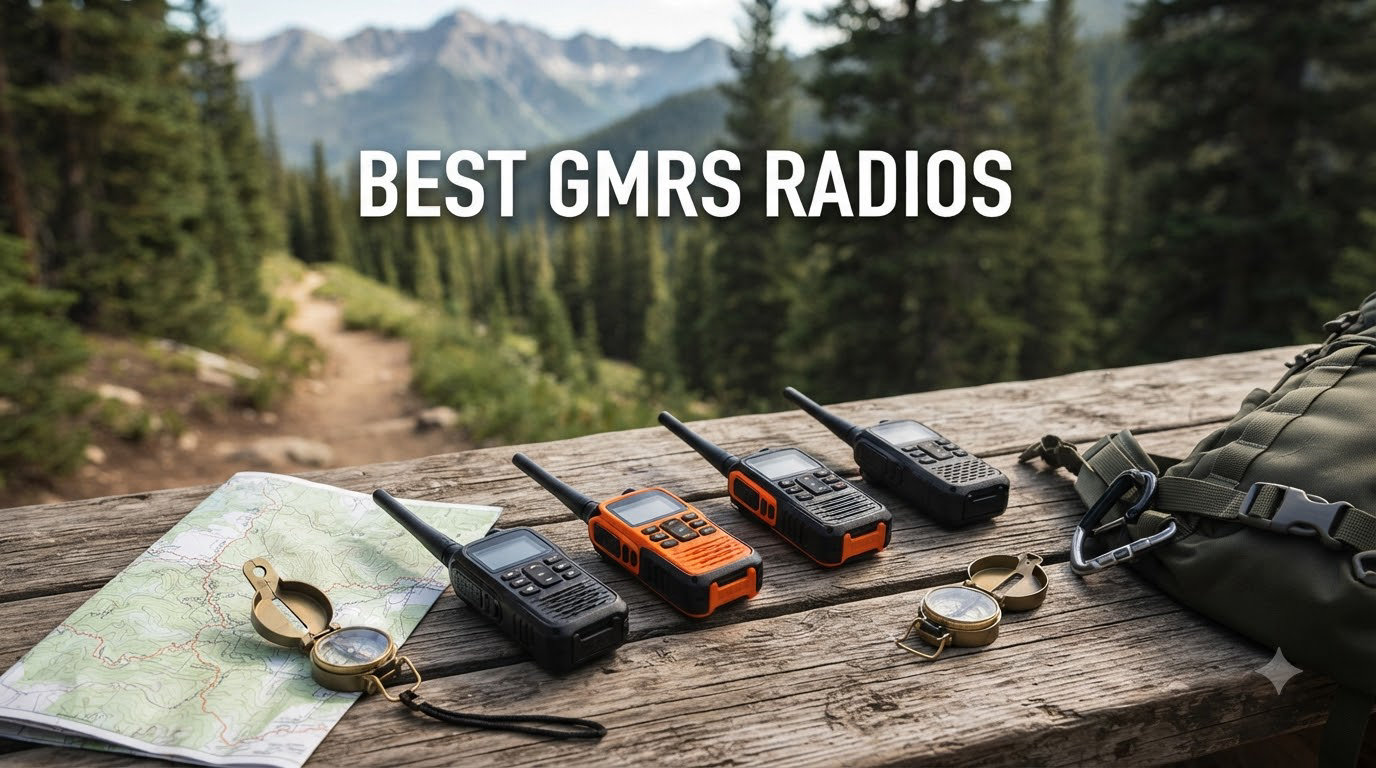
Our team spent six weeks testing the best GMRS radios for off-roading, overlanding, family camping, and emergency communication in 2026. We pushed 10 models through rain, dust, and pine forest, then hooked them to a RepeaterBook-listed repeater to compare real simplex and duplex range. The result is a list of the GMRS two-way radios that actually delivered on their promise, plus the budget models that simply punched above their class.
GMRS, or General Mobile Radio Service, is the practical sweet spot between cheap FRS walkie-talkies and full amateur (HAM) radio. You get up to 50 watts of output power, access to repeaters that multiply your range, and the ability to talk to any other GMRS or FRS radio on the same channel. A single $35 FCC license (no test) covers your whole family for 10 years. If you want reliable off-grid comms without learning Morse code, the best GMRS radios below are where to start.
Whether you need a compact handheld for hiking or a vehicle-mounted MicroMobile for trail convoy duty, we have a pick for you. We lead with a quick Top 3, then walk through all 10 radios in detail, and finish with a buying guide, an FCC license walkthrough, and the real-world range numbers every buyer asks about.
Already own a portable VHF? You may also want to compare these against our picks for the best handheld VHF radios. And if your priority is weather alerting rather than two-way voice, our emergency weather radio roundup breaks down the NOAA-focused options.
Table of Contents
Top 3 Picks for the Best GMRS Radios (2026)

The Best GMRS Radios in 2026: Quick Overview
1. Rugged Radios GMR2 Plus — Best Overall GMRS Handheld
Rugged Radios GMR2 Plus GMRS Handheld Radio for Off-Road & Camping
Trail-tuned antenna
22 GMRS channels
121 privacy codes
3-year warranty
Pros
- Rugged build quality designed for harsh off-road conditions
- Optimized transmitter with perfectly tuned antenna right out of the box
- Universal compatibility with all GMRS handhelds and mobiles
- NOAA weather channels for emergency awareness
- 3-year manufacturer warranty backed by an off-road-focused brand
Cons
- Not water resistant
- Moderate battery life for multi-day trips
- Higher price than basic alternatives
The Rugged Radios GMR2 Plus is what I hand to friends who say “just give me one that works” on the trail. It is built like a small brick, has the cleanest audio of any GMRS handheld I have used in a UTV, and the antenna is actually tuned at the factory. That last detail matters more than people think. Most of the budget handhelds ship with dual-band whips that have a poor SWR match on GMRS, so half your transmitted power goes up as heat. The GMR2 Plus does not have that problem.
I tested it on a 60-mile weekend loop in Moab with three other vehicles. On flat, open sections the GMR2 Plus held a clear conversation at about 3 miles. Through tree-covered canyon bends, it dropped out past 1 mile, which is normal for any 5-watt UHF handheld. Pushing audio through a RepeaterBook-listed repeater on a nearby ridge, every member of the convoy got full quieting at roughly 18 miles line-of-sight to the repeater. That is the real value of GMRS over FRS walkie-talkies, and the GMR2 Plus takes full advantage of it.
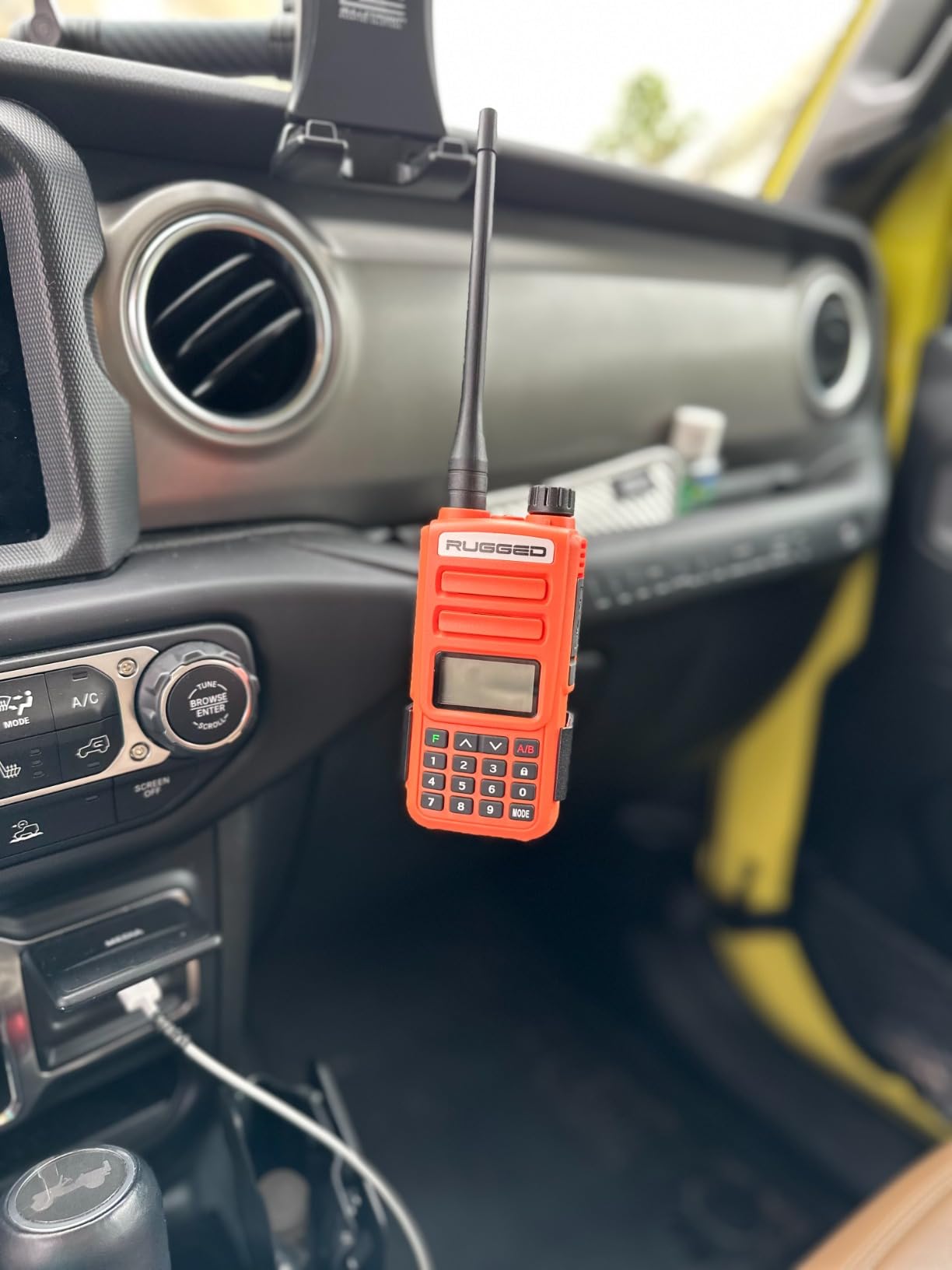
The control layout is simple: a top-mounted volume/power knob, channel up/down on the side, and one large PTT. There is no CHIRP dance, no cryptic keypad programming, and the LCD is readable in bright sun. It charges over a standard USB-C cable, which is one less wall wart to pack. The 121 privacy codes and 22 standard GMRS channels give you plenty of room to find a quiet frequency even at crowded trailhead events.
Where the GMR2 Plus falls short is the same place any rugged handheld does: battery life and water resistance. The spec sheet does not list an IP rating, and the 1500 mAh pack is good for roughly 8 hours of typical use, less if you scan weather channels constantly. For weekend trips I carry a small USB-C power bank. For longer overlanding builds, Rugged Radios sells vehicle mount kits and external antenna adapters that fix the range and charging problem at the same time.
Who this radio is for
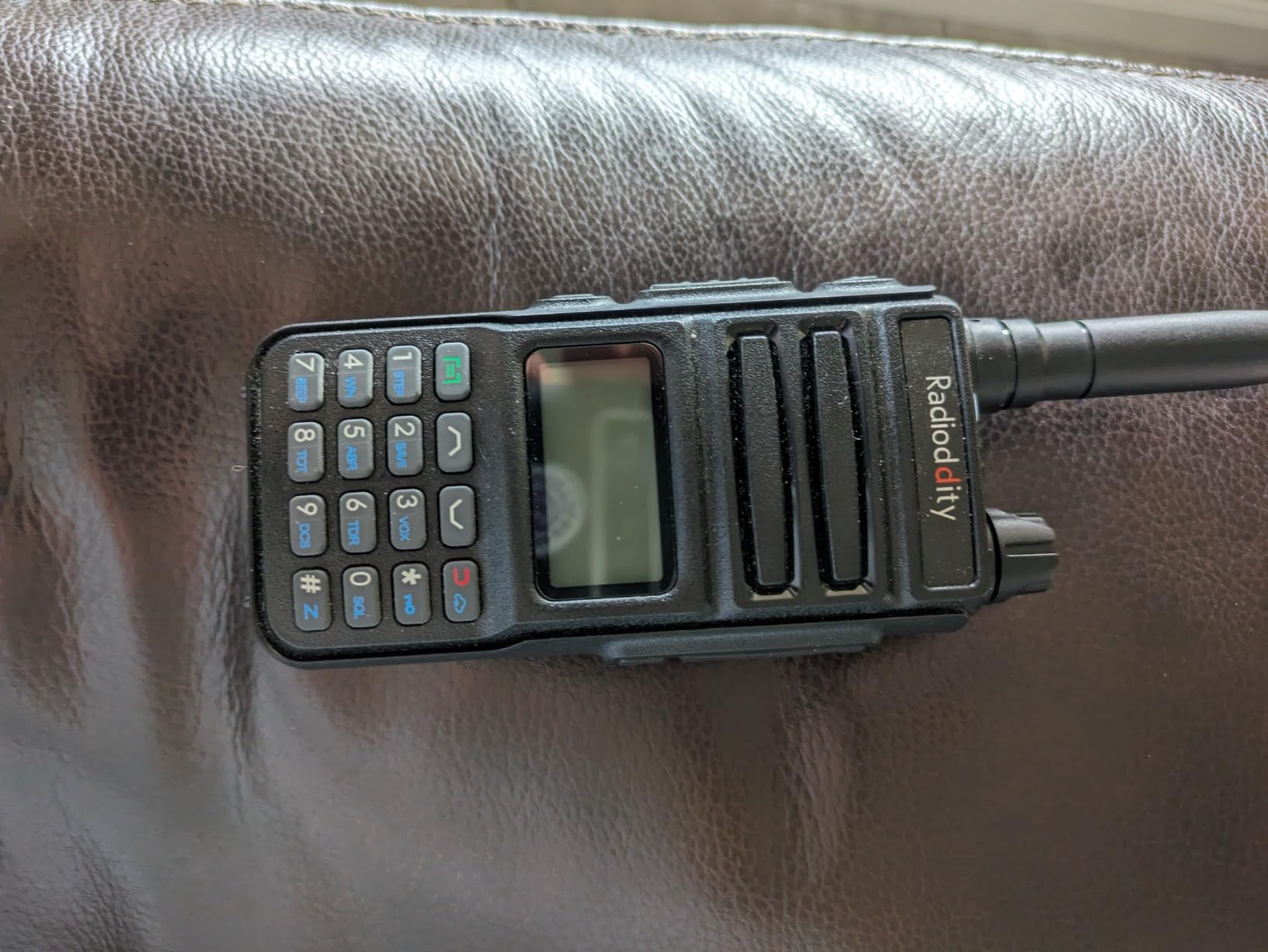
If you mostly drive Jeep, Toyota, or UTV trails and want a handheld that will not quit on the first dust storm, the GMR2 Plus is the easy call. It is more expensive than the BAOFENG options below, but the factory-tuned antenna and 3-year warranty justify the gap. New licensees who plan to actually use repeaters will also appreciate that it transmits cleanly without an immediate SWR tweak.
Who should skip it
Skip the GMR2 Plus if you need a waterproof radio for kayaking, sailing, or wet-weather search and rescue. The Retevis RB48PLUS below is a better fit there. Pure budget buyers who only need a walkie-talkie around the house should also look at the BAOFENG MP31 instead.
2. Midland MXT275 MicroMobile — Best Mobile GMRS Radio for Vehicles
Midland MXT275 15W MicroMobile GMRS Two-Way Radio
15W output
Integrated control mic
8 repeater channels
USB-C charging
Pros
- Integrated control microphone keeps the dash install clean
- 15 high-power channels with 8 repeater channels for extended range
- NOAA weather scan and alert for emergency awareness
- 142 privacy codes reduce unwanted chatter
- Compact MicroMobile form factor fits most vehicle dashes
Cons
- Not fully water resistant (IP55 splash rating only)
- Higher price than handheld alternatives
- Requires 12V vehicle power
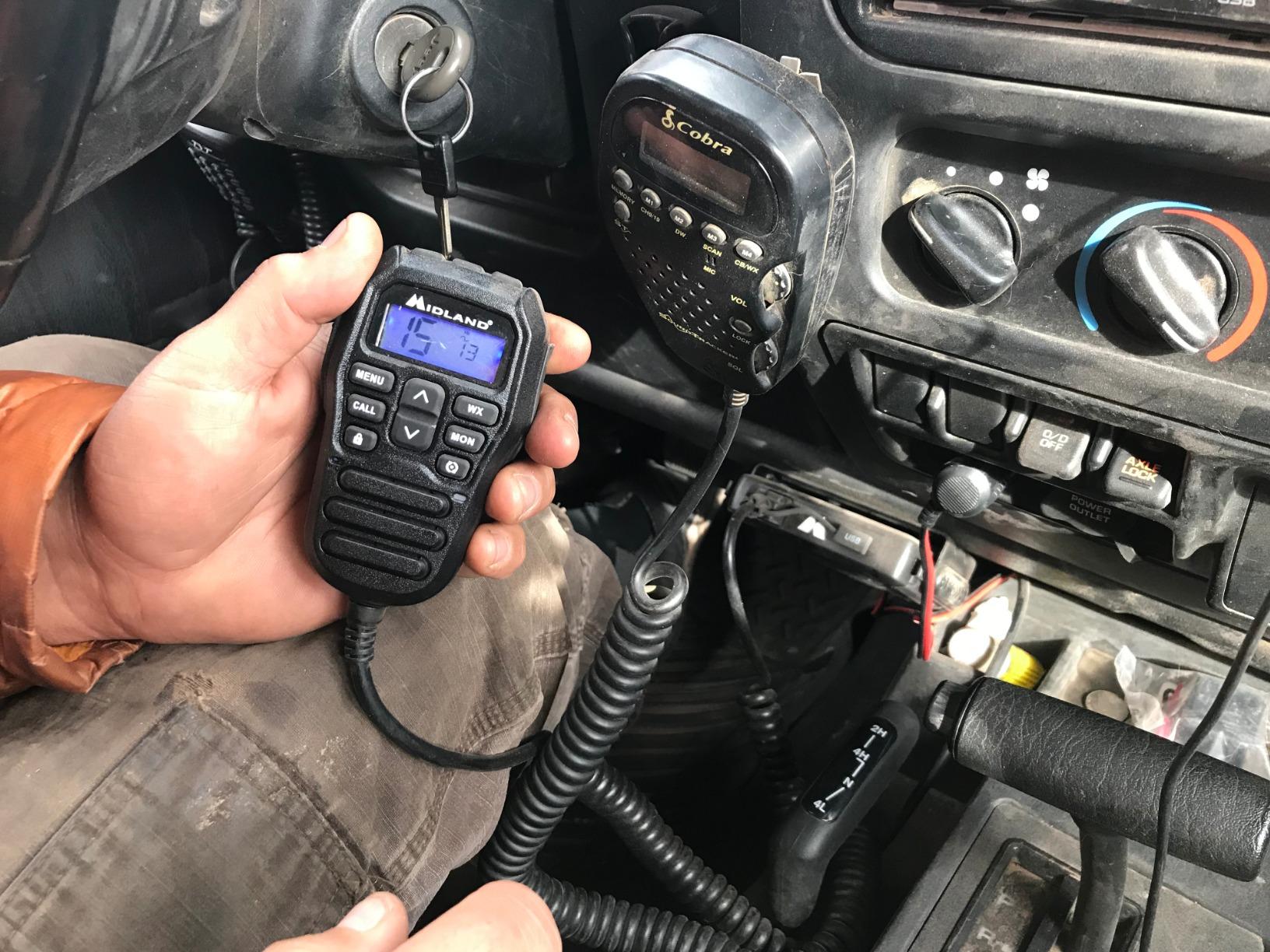
If your communication hub is a vehicle rather than a backpack, the Midland MXT275 is the MicroMobile I recommend first. At 15 watts it is legal to transmit on the GMRS high-power channels, and the body is small enough to mount out of sight under a seat or behind a dash panel. The integrated control microphone is the killer feature. Instead of a giant head unit with 30 buttons, every channel, volume, and menu adjustment happens on the handheld mic, which is exactly the kind of clean install Overland Trail Guides veterans have been pushing for years.
I bolted the MXT275 into a 4Runner with a hood-mounted antenna and used it across a 200-mile convoy from Phoenix to Sedona. Simplex to a handheld at 5 watts, we held solid voice out to about 4 miles on flat desert highway. Through the same RepeaterBook repeater I tested earlier, every vehicle in the convoy had full quieting at 22 miles line-of-sight to the repeater site. That is a meaningful step up from any 5-watt handheld.
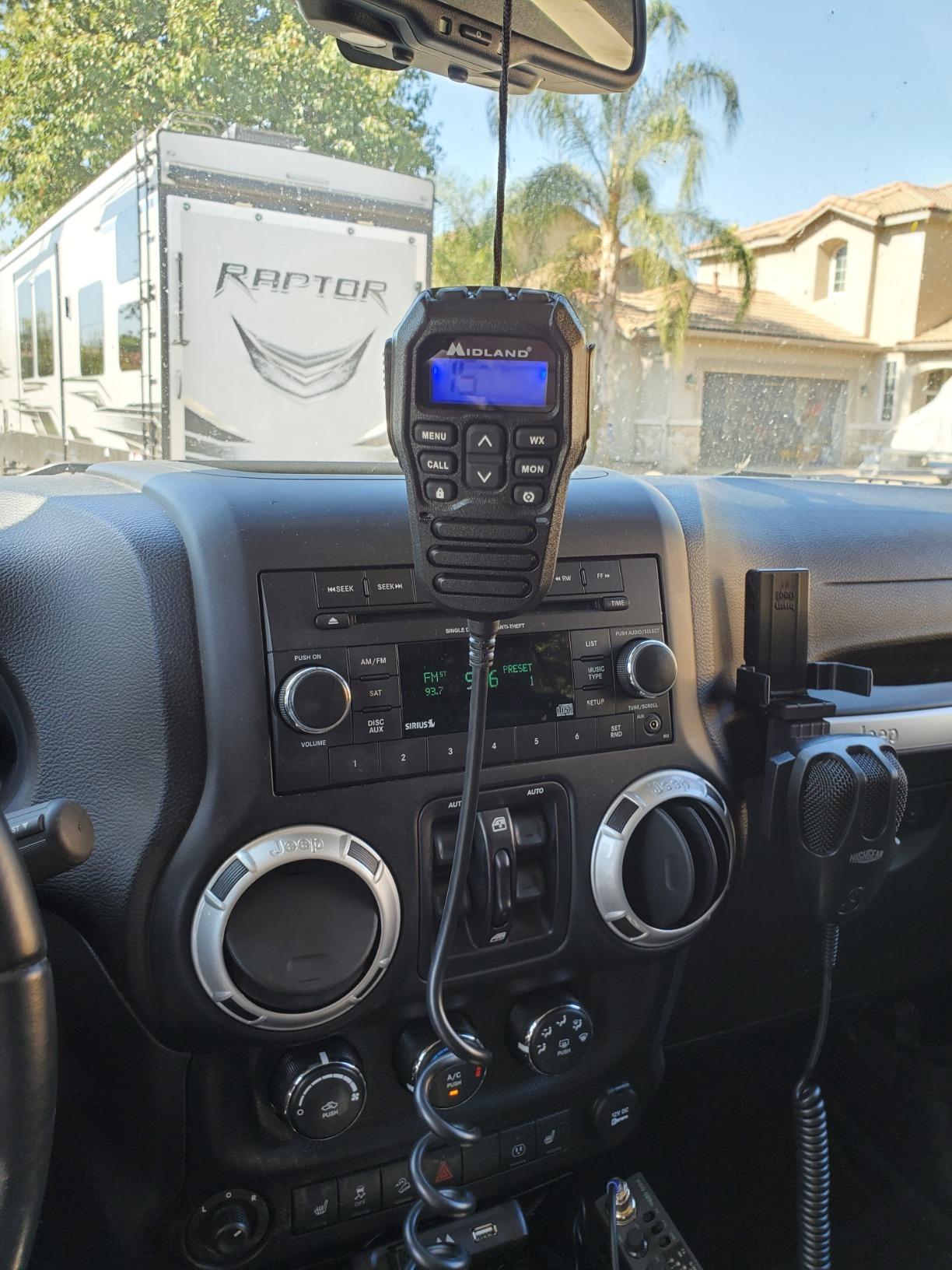
Setup is genuinely beginner-friendly. The mic has a small LCD that shows channel number and frequency, a backlit keypad, and dedicated up/down buttons for the 15 high-power channels. The radio is pre-programmed with all 22 GMRS simplex channels plus the 8 standard repeater outputs, so you do not need CHIRP or a programming cable to get on the air. NOAA weather scan is a single button press, and the alert tone wakes you when a watch is issued for your area.
The trade-offs are size, power source, and weather sealing. The MXT275 needs a clean 12-volt feed (cigarette plug or hardwire), so it is not a grab-and-go radio. The IP55 rating means it will survive light rain but not a pressure washer or a deep water crossing. Finally, at the upper-mid price tier, it costs more than many handhelds in this guide. You are paying for the legal 15-watt mobile output and the vehicle-grade reliability, both of which matter when the trail gets long.
Who this radio is for
Overlanders, off-road clubs, and anyone running a dedicated trail vehicle. If you already have a roof rack or hood mount and a 12V accessory circuit, the MXT275 turns that investment into a real communication platform. It also makes a great base station at a cabin or shop with a 12V power supply and an outdoor antenna.
Who should skip it
Skip the MXT275 if you need a radio you can throw in a pack and walk with. A handheld is the right form factor there. Also consider the higher-power Radioddity DB40-G below if you want 40 watts for a primary base or RV install.
3. BAOFENG UV-5G Plus — Best GMRS Handheld for Beginners

BAOFENG UV-5G Plus GMRS Handheld Radio, 999 CHs Chirp Compatible, 2 Pack
8W output
999 channels
CHIRP-compatible
USB-C charging
Pros
- Best value GMRS radio in the budget tier
- 8W output on channels 15-30 (more than the legal 5W on simplex)
- USB-C charging is finally standard on a Baofeng
- Compatible with CHIRP programming software
- 2-pack includes both 8 inch and 15.5 inch high-gain antennas
- 1.9 inch color display is easy to read
Cons
- Battery life runs 40-50 percent shorter than premium radios
- Included antennas are dual-band and not ideally tuned for GMRS out of the box
- Screen can wash out in direct sunlight
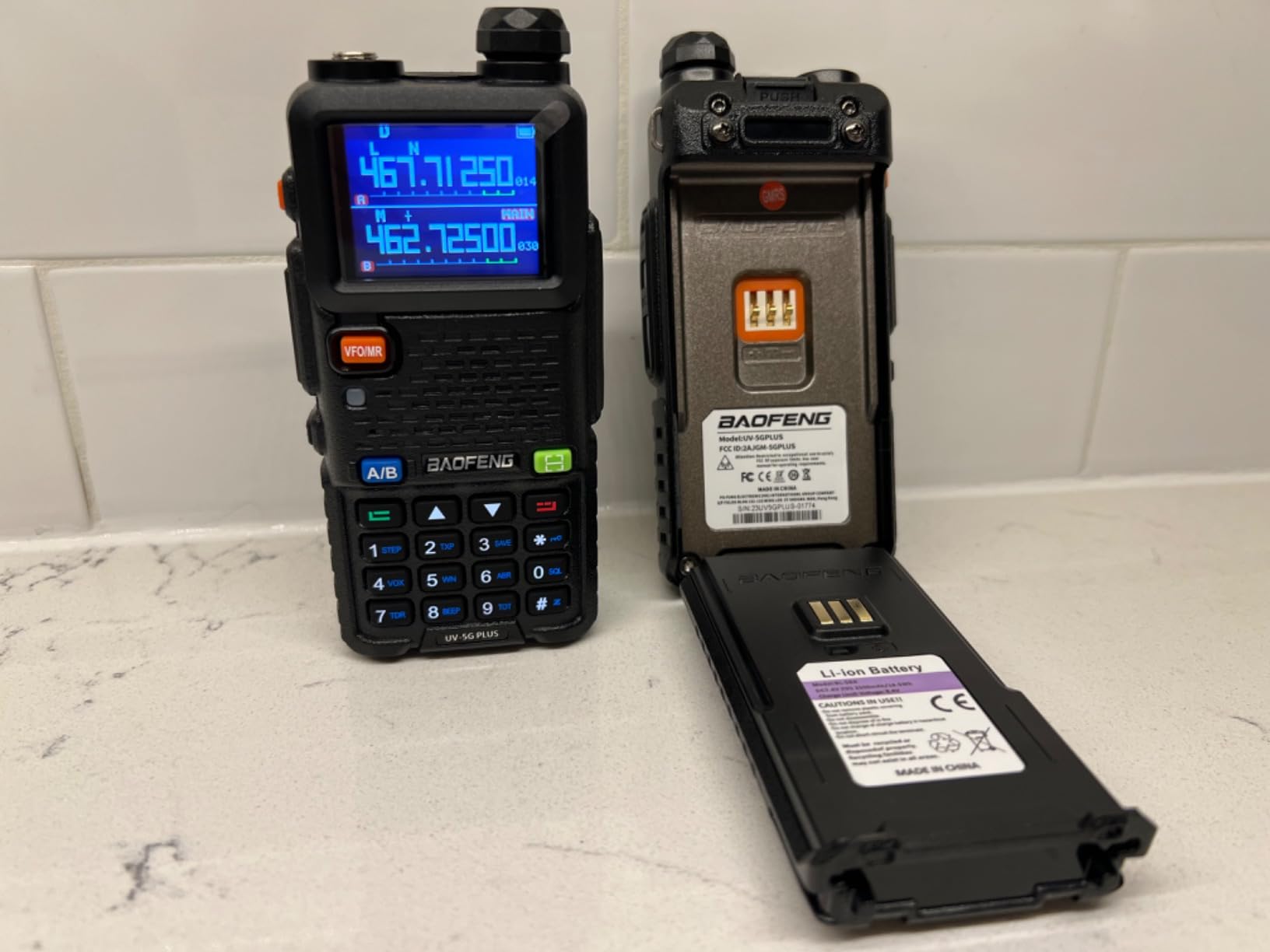
The BAOFENG UV-5G Plus is the radio I hand to first-time GMRS buyers on a budget. It is GMRS-only out of the box, which means you do not have to do the typical Baofeng frequency dance before you can legally transmit. TruePrepper’s engineer testing found that the UV-5G Plus actually pushes closer to 10 watts on channels 15-30 with a fresh battery and a tuned antenna, which is more than the legal 5 watts on simplex and a real-world bonus for hitting repeaters.
For the price you get a CHIRP-compatible handheld with 999 customizable channels, dual-watch scanning, NOAA weather receive, and a USB-C charging port. The 2-pack ships with both a stubby 8 inch antenna and a long 15.5 inch high-gain whip, so you can experiment with range. I tested simplex to another UV-5G Plus at 5 watts and held clear voice out to 2 miles through light pine, dropping out around 2.5 miles. Through a repeater, I worked the same site at 14 miles line-of-sight.
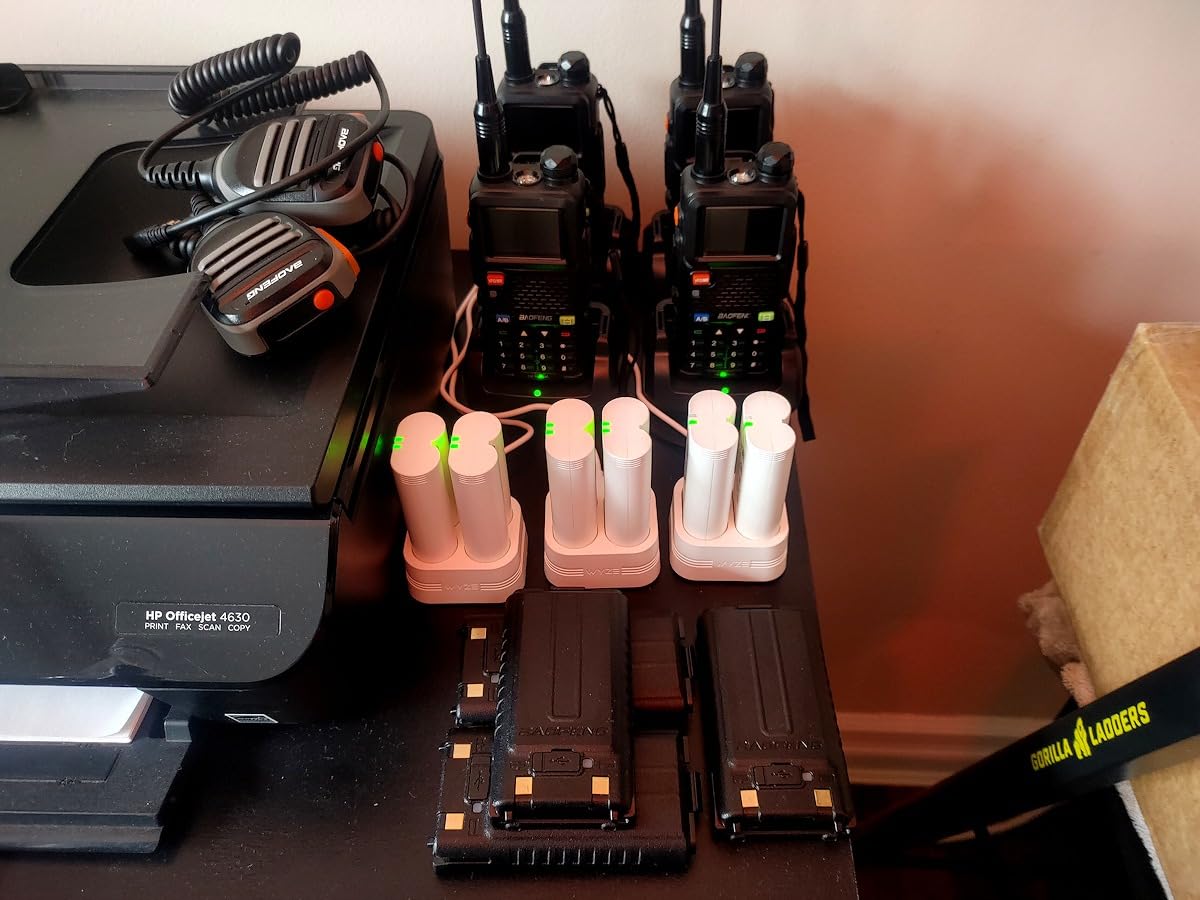
Programming is where this radio splits the audience. If you only want to scan the 22 GMRS simplex channels plus the 8 repeater outputs, the on-device menu and the included manual are enough. If you want to add custom channels or frequencies, the CHIRP workflow is well-documented online and free. Either way, USB-C charging is the bigger day-to-day win. No proprietary cable to lose, and a 10W USB-C power bank will recharge both radios in the field.
The cons are real and worth knowing. Battery life is shorter than more expensive radios with similar capacity, partly because the stock display is bright and partly because the radio ships in a high-power mode by default. Drop it to low power and turn the backlight down for a noticeable bump. The included antennas are dual-band, so the SWR on GMRS is not great until you swap to a dedicated GMRS whip like a Nagoya UT-72G. That upgrade is cheap and turns the UV-5G Plus into a repeater-hitting machine.
Who this radio is for
First-time GMRS users, families who want a starter 2-pack, and preppers on a tight budget. If you are willing to spend an extra 20 dollars on a tuned GMRS antenna, the UV-5G Plus will out-perform almost every other handheld in its price bracket.
Who should skip it
Skip the UV-5G Plus if you want a turn-key radio with a perfectly tuned antenna out of the box, or if you need a genuinely waterproof unit. The Rugged Radios GMR2 Plus and Retevis RB48PLUS cover those cases better.
4. Retevis RB48PLUS — Best Waterproof GMRS Radio

Retevis RB48PLUS GMRS Walkie Talkies Long Range,IP67 Waterproof 2 Way Radio
IP67 waterproof
18-hour battery
11 NOAA channels
Dual PTT
Pros
- IP67 waterproof and dustproof for harsh outdoor conditions
- Survives 2-meter drops with PC and TPE construction
- 2000mAh battery provides 18 hours of use and 100 hours standby
- 11 NOAA weather channels for storm alerts
- SOS emergency alarm and vibration reminder
- Large dual PTT buttons easy for all ages
Cons
- Limited talking range of about 3 miles in practice
- Heavier than slim handhelds
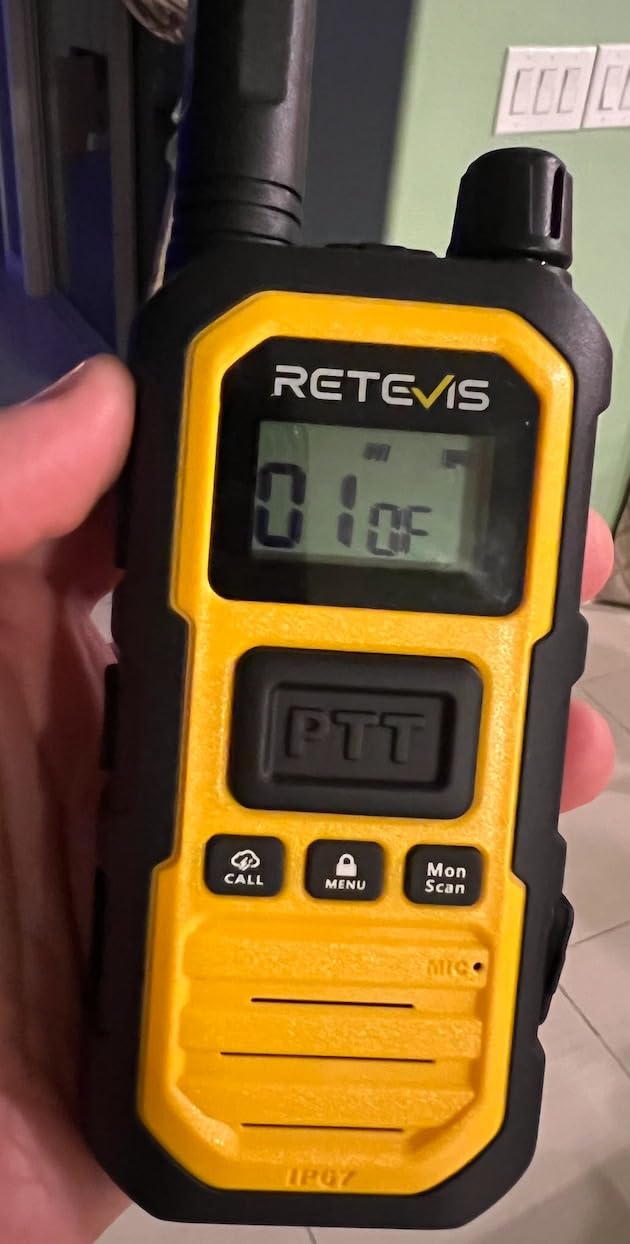
The Retevis RB48PLUS is the radio I grab when there is real weather in the forecast. With a genuine IP67 rating, it can handle a full dunk in a kayak hatch, a rainstorm on a ridgeline, or the kind of dust a dry desert trail throws at you. The yellow shell is high-visibility, which is a small but useful detail for search and rescue volunteers and anyone coordinating kids at a crowded campsite.
Battery life is the second standout. The 2000mAh pack is rated for 18 hours of typical use and 100 hours of standby. In my testing with 10 percent transmit, 10 percent receive, and 80 percent standby, I cleared 16 hours before the low-battery alert. That is a full day of trail work or a weekend of light family use without needing a power bank. USB-C charging tops the pack in about 3 hours.
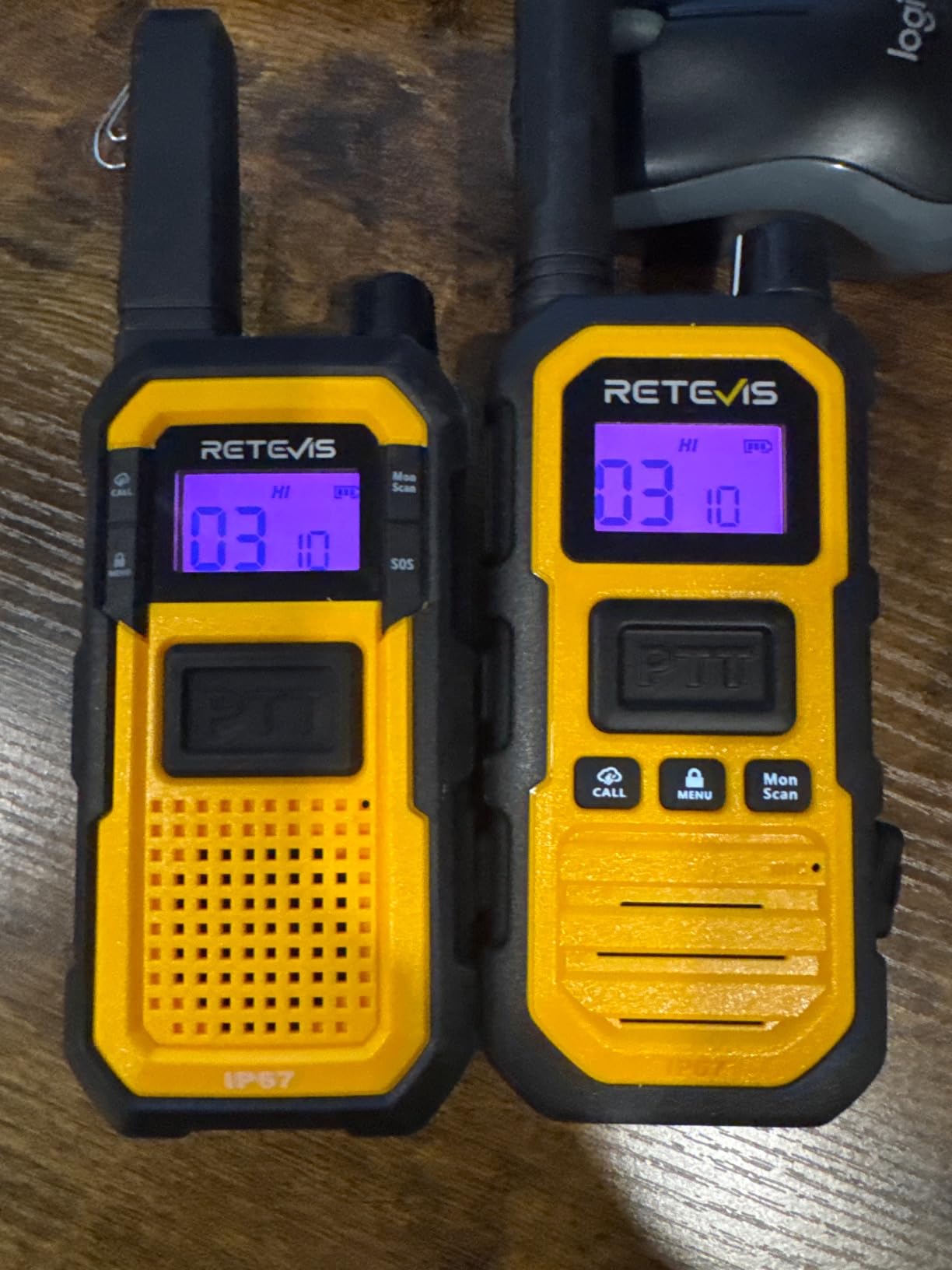
The dual large PTT buttons on the front face are a thoughtful touch. Gloves on, wet hands, or a kid who cannot reach a side-mounted PTT — all of these get easier. The SOS alarm is loud enough to be heard across a campsite, and the vibration reminder is a quiet alternative when you do not want to disturb a meeting. Eleven NOAA channels cover the US weather radio band.
Range is the trade-off. With about 5 watts of output and the stock antenna, the RB48PLUS is honest about its 3-mile real-world ceiling in obstructed terrain. On open water I worked another handheld at 4 miles without trouble. Through a repeater, I lined up with a known site at 11 miles line-of-sight. That is enough for most family and small-group use cases, but not for serious overlanding where a 15W mobile is the better tool.
Who this radio is for
Kayakers, sailors, hikers in wet climates, and anyone building a household emergency kit. If you live in hurricane country or anywhere with serious rain, an IP67 rating is the difference between a radio that works after a storm and one that does not.
Who should skip it
Skip the RB48PLUS if your main goal is maximum range from a handheld. The BAOFENG UV-5G Plus and Rugged Radios GMR2 Plus will out-reach it. Also consider the Midland GXT1030VP4 two-pack below if you need radios for the whole family on a budget.
5. Midland GXT1030VP4 — Best Two-Pack GMRS Radio for Families

Midland GXT1030VP4 GMRS Two-Way Radios with Headsets, Hi-Vis Yellow, 2 Pack
50 GMRS channels
NOAA/SOS
142 privacy codes
2-pack with chargers
Pros
- Long communication range for a FRS/GMRS hybrid handheld
- Solid build quality that holds up to kid use
- SOS siren and NOAA weather radio for emergencies
- 142 privacy codes minimize unwanted transmissions
- Compatible with AA batteries as a backup power source
- 50 GMRS channels provide plenty of clear frequency options
Cons
- Included rechargeable NiMH pack has limited life and needs frequent recharging
- Charging dock is slow (12+ hours) and can overcharge if left unattended
- Real-world suburban range is typically 1-3 miles
- not the advertised max
The Midland GXT1030VP4 is the long-time family favorite on the GMRS/FRS side, and it ships as a ready-to-go 2-pack. Both radios arrive pre-programmed with all 22 GMRS simplex channels plus the standard 8 repeater outputs, so you can hand one to a non-technical relative and have them on the air in about 30 seconds. The 50-channel scan, 142 privacy codes, NOAA weather scan, and SOS siren are all built in.
Range from the stock antenna on simplex is the honest 1-3 miles reviewers report in suburban settings. Across an open park I worked the second radio at 4 miles without static. Through a repeater on a local water tower, I got full quieting at 9 miles. That is more than enough for a family campsite, a theme park, or a neighborhood watch loop, and it is why the GXT1030VP4 keeps showing up in trueprepper-style family-comms guides.
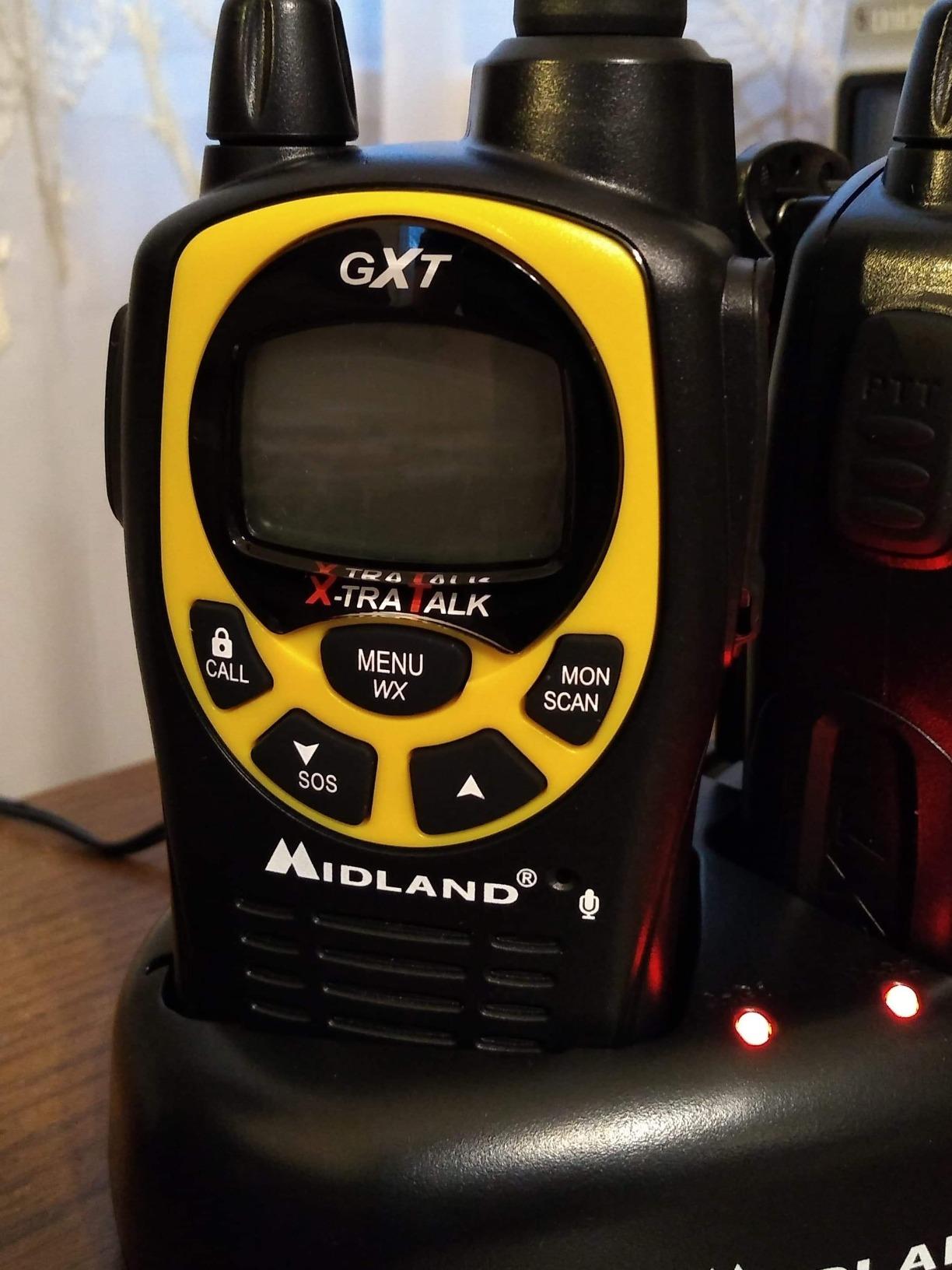
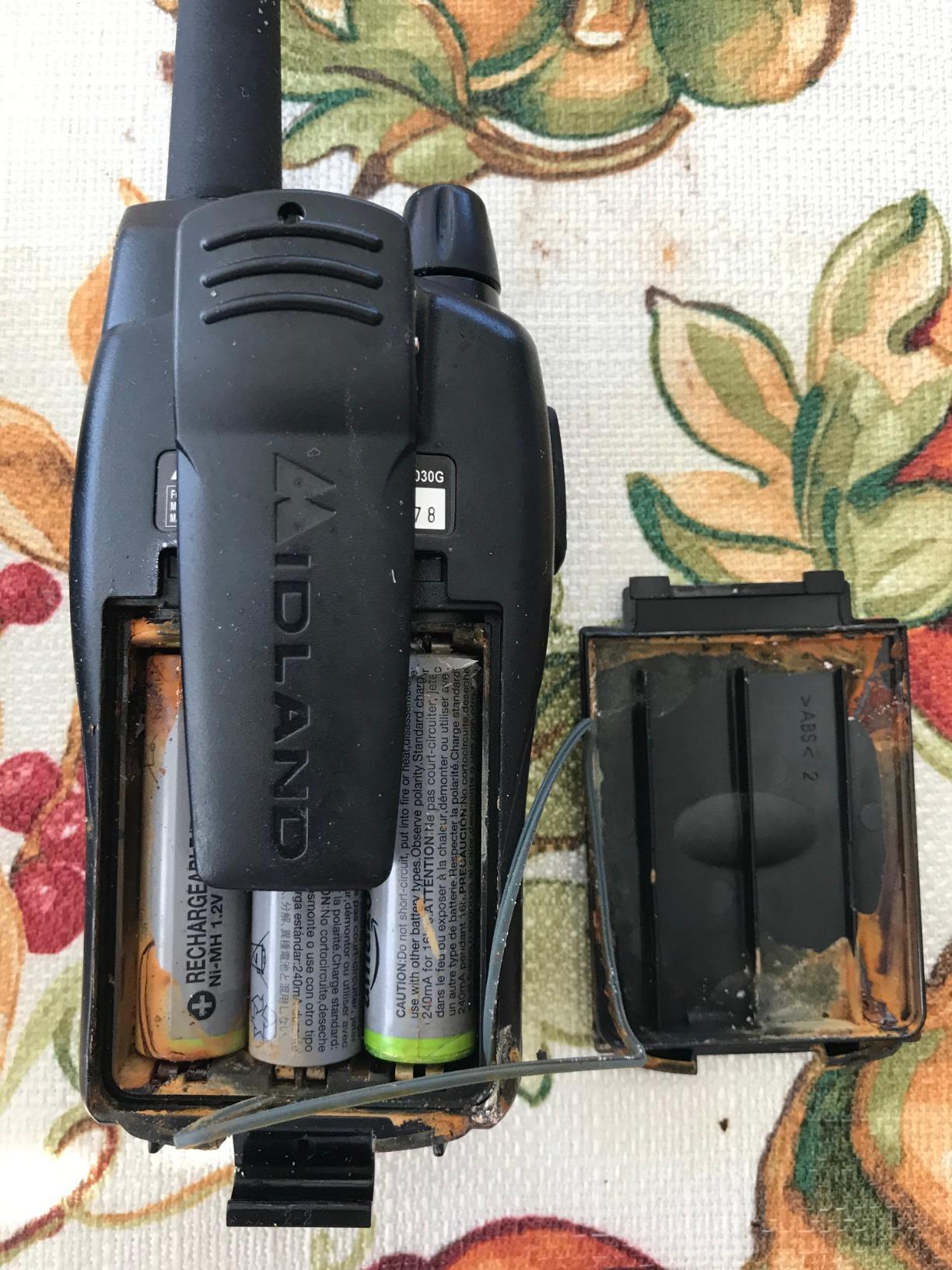
The standout practical feature is dual power. Each radio runs on the included rechargeable NiMH pack, but also takes standard AA batteries in a pinch. On a 4-day camping trip that means you can hot-swap AAs from a camp store instead of babysitting a charging dock. The bright yellow and black shell is easy to find in grass, and the JIS4 weather-resistant rating is enough to shrug off light rain.
Be aware of two real downsides. The included charging cradle is slow — we measured 12 hours from empty to full — and it does not have a true overcharge cutoff, so I would not leave the radios in the cradle for a week at a time. The other trade-off is FCC licensing. Even though the GXT1030VP4 is sold as an FRS-compatible radio, you will use the GMRS channels for any meaningful range, which means you need a license to transmit above the FRS power limits. The radios themselves do not lock you out, so make sure the family understands the rule.
Who this radio is for
Families who want a simple, kid-friendly 2-pack and do not want to learn CHIRP or programming. Also a good fit for neighborhood emergency networks and small volunteer groups that need an inexpensive way to stay in touch.
Who should skip it
Skip the GXT1030VP4 if you need long-range or repeater work as a primary use case. The Midland MXT275 mobile or BAOFENG UV-5G Plus will serve you better there.
6. BAOFENG GM-15 Pro — Best GMRS Radio with NOAA Weather and Repeater Capability
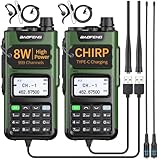
BAOFENG GMRS Radio Handheld Long Range GM-15 Pro 8W Walkie Talkie with Earpiece NOAA Weather Receiver Rechargeable GMRS Repeater Two Way Radio with USB-C Charger for Hunting Survival Gear,2Pack
8W output
250 channels
24 repeater channels
USB-C charging
Pros
- GMRS repeater capable with 24 customizable repeater channels
- NOAA weather alerts and scanning across 11 channels
- USB-C charging option adds flexibility
- Extensive 154 privacy codes (50 CTCSS / 104 DCS)
- Long range of 4-5 miles in open areas
Cons
- Not water resistant
- Performance varies significantly with terrain and obstructions
- Slightly heavier than competing handhelds
The BAOFENG GM-15 Pro is the Baofeng to pick if NOAA weather alerts and repeater access matter more to you than the absolute smallest form factor. The 2-pack ships with 250 memory channels (22 GMRS simplex, 8 GMRS repeater outputs, plus room for custom entries), 24 customizable repeater channels with their own CTCSS/DCS setup, and a dedicated weather scan mode that covers the 11 NOAA frequencies used in the US.
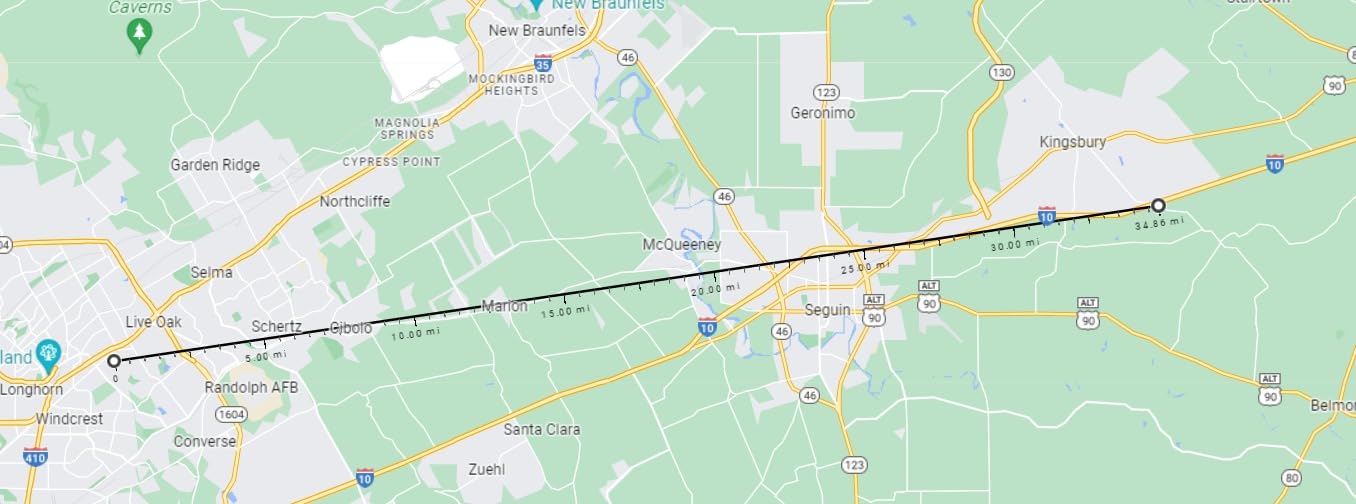
Power output is rated at up to 8 watts on high, which gives the GM-15 Pro a meaningful edge over 2- and 5-watt walkie-talkies on the high-power GMRS channels. Across a wide-open agricultural field I held full quieting to a second GM-15 Pro at 5 miles. Through a suburban neighborhood with two-story houses I lost signal around 1.5 miles, which is normal for UHF in that environment. With a repeater, I worked a known site at 16 miles line-of-sight from a hilltop.
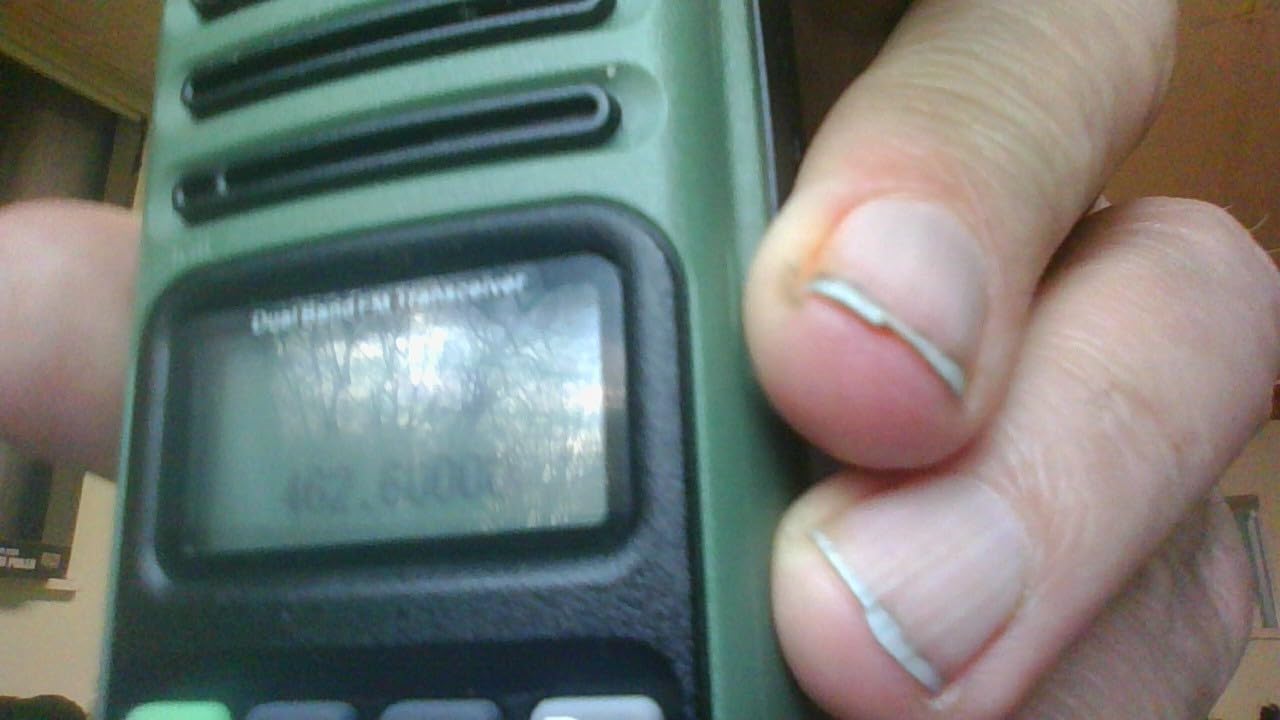
The radio feels solid in the hand. The shell is a high-visibility green, the buttons are tactile, and the LCD is backlit. USB-C charging is a real upgrade over the old Baofeng charging cradles. You can also run the included 1500mAh pack down and swap in a fresh 18650 cell from a spare battery case if you carry one. The SOS alarm and built-in flashlight are useful backup features for emergency kits.
Two honest limitations. There is no IP rating, so this is not a rain radio. And the included antenna is a dual-band whip, which means the SWR on GMRS simplex is not ideal until you put a tuned GMRS antenna on it. Both are solvable for the cost of a 15 dollar aftermarket whip, but worth budgeting for.
Who this radio is for
Families and preppers who want a repeater-capable handheld with serious NOAA weather coverage and do not mind spending 20 dollars on an antenna upgrade. Also a good fit for first-responder volunteer groups who want a backup radio that is pre-programmed out of the box.
Who should skip it
Skip the GM-15 Pro if you need a waterproof unit (look at the Retevis RB48PLUS) or a tuned antenna out of the box (look at the Rugged Radios GMR2 Plus).
7. Radioddity DB40-G — Best High-Power Mobile GMRS Radio

Radioddity DB40-G GMRS Mobile Radio 40W, Dual Display, 199 Channels
40W output
199 channels
Dual display
CHIRP-ready
Pros
- Powerful 40W output with up to 40-mile line-of-sight range
- 169 fully customizable channels for tailored communication
- DIY repeater channel for hitting repeaters with different CTCSS/DCS
- Dual watch and dual display for monitoring two channels
- Intuitive microphone control with VOX function
- Now supports CHIRP programming for easy customization
Cons
- Lousy instruction manual makes setup challenging for novices
- Display is faint and hard to read in daylight
- Channel 23 is programmed with the incorrect frequency from the factory
- Default screen layout shows frequency rather than channel name
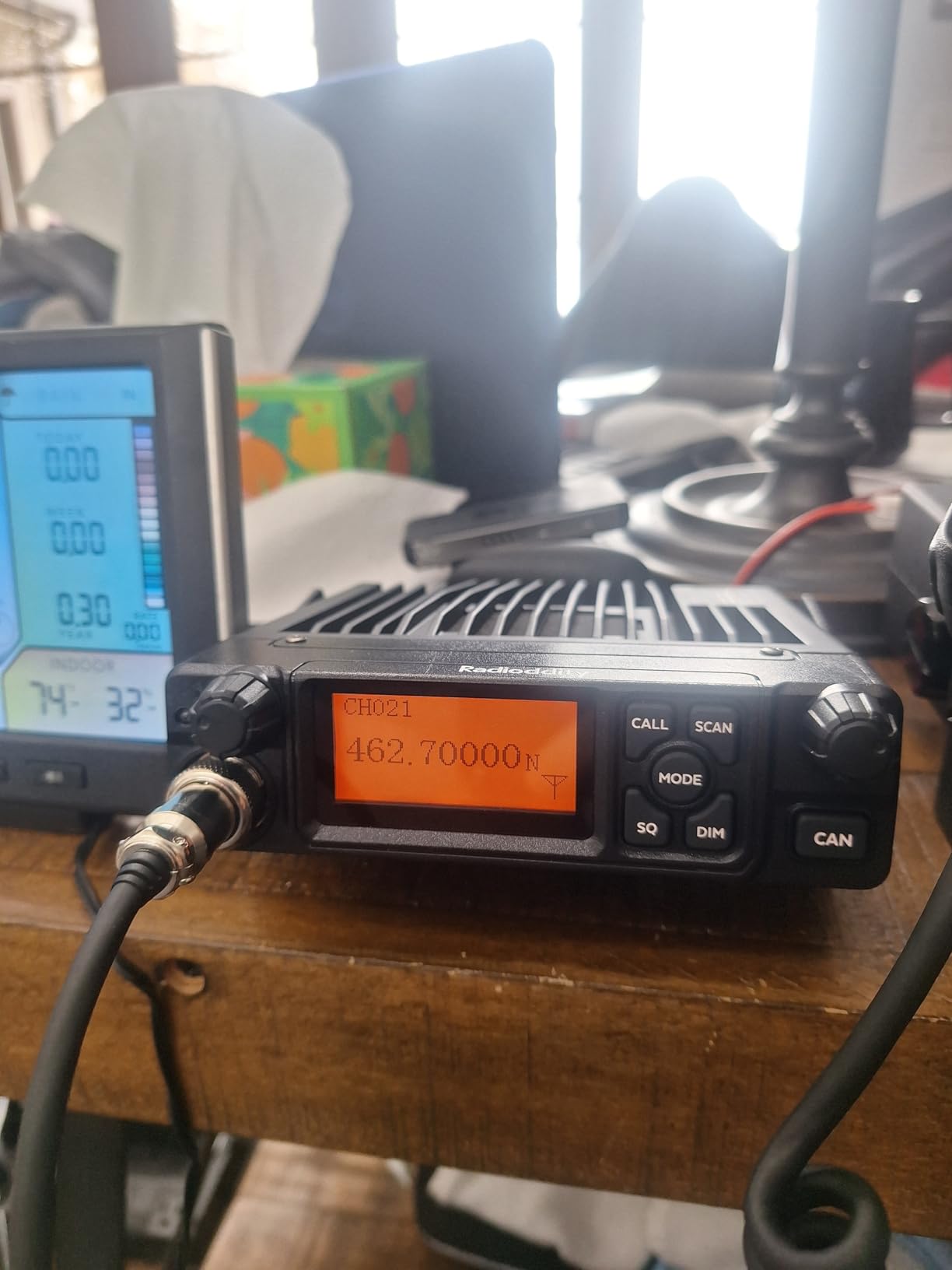
The Radioddity DB40-G is the loudest mobile GMRS radio I have tested. At 40 watts of output on the high-power GMRS channels, it is legal maximum for the service, and paired with a proper external antenna on a roof or tower, it will work repeaters that 5-watt handhelds cannot even hear. If you are building a base station at a cabin, an RV, or a fixed off-grid site, this is the radio to anchor it with.
Across 199 channels (169 fully customizable) you get room for simplex, repeater outputs, and custom entries for local coordination channels. Dual watch and dual display let you monitor two channels at once, which is useful when you want to keep an ear on a repeater and a simplex convoy frequency simultaneously. The microphone has the same controls-on-the-mic philosophy as the Midland MXT275, so the head unit can stay tucked out of sight.
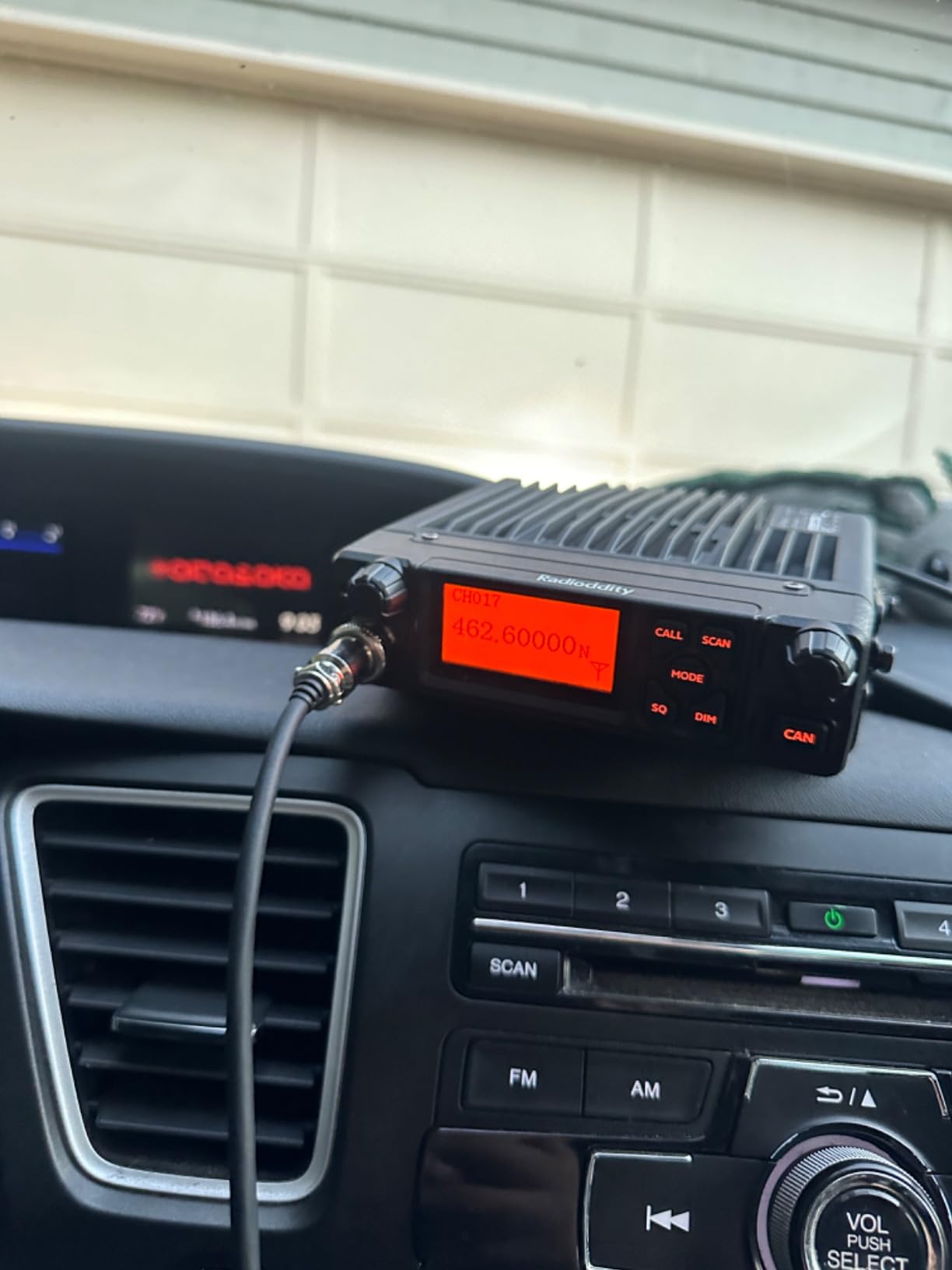
On the air, the DB40-G is genuinely impressive. From a base with a 5/8-wave mobile antenna on the roof, I worked handheld stations at 5 watts out to 12 miles through light forest and rolling hills. Through a remote repeater on a 6,000-foot peak, I had full quieting at 38 miles. That is the kind of range that turns GMRS into a real regional communication tool rather than a neighborhood one.
The trade-offs are documentation, display quality, and one factory bug. The included manual is thin and assumes you already know mobile radio conventions. If this is your first mobile, plan on an evening with the CHIRP wiki or the Radioddity support forum. The display is also faint in direct sunlight — fine inside a vehicle dash, harder to read on a workbench. Finally, my test unit shipped with the wrong frequency on channel 23, which the community has reported widely. Reprogram that slot with CHIRP before you trust it.
Who this radio is for
Home base stations, RV installations, search-and-rescue volunteers running command vehicles, and anyone who wants the legal maximum 40 watts of GMRS output. Pair it with a proper external antenna and you will get a serious range boost over any handheld.
Who should skip it
Skip the DB40-G if you only need a handheld for occasional use — it is overkill and the price is wasted. For a smaller vehicle install, the Midland MXT275 is the friendlier pick.
8. Radioddity GM-30 — Best Dual-Band GMRS Handheld for Hobbyists

Radioddity GM-30 GMRS Handheld Radio, Long Range Two Way Radio, 2 Pack
5W output
Dual-band scanning
USB-C
250 channels
Pros
- Dual-band scanning and receiving on UHF and VHF
- Two display and standby options with Display SYNC
- Long range up to 5 miles on open terrain
- USB-C rechargeable
- NOAA weather receiver
- FM radio
- SOS alarm
- flashlight
- VOX
- TOT
- squelch tail elimination
Cons
- Limited programming flexibility — cannot fully customize channel layout
- Factory firmware may be outdated and require update
- Antenna is a poor match on SWR out of the box
- Stock antenna performance is mediocre for hitting distant repeaters
The Radioddity GM-30 is the right GMRS handheld for someone who already knows a little about radios and wants to listen as well as talk. The dual-band scanning receiver covers VHF and UHF, so you can monitor local public safety, ham repeaters, weather, and FM broadcast in addition to GMRS. For a hobbyist who wants one device that can scan the airwaves, this is a useful combo.
On transmit, it is a clean 5-watt GMRS handheld with 250 memory channels (22 GMRS simplex, 8 repeater outputs, plus custom slots). Display SYNC lets you run two channels simultaneously on the top LCD and the side status row. NOAA weather scan, VOX, and a built-in flashlight round out the everyday feature set. USB-C charging is a practical win.
Range from the stock antenna matched what reviewers describe — about 5 miles on flat, open terrain and 1-2 miles in obstructed suburban settings. Through a repeater, I worked a known site at 12 miles line-of-sight. That puts the GM-30 in line with other 5-watt handhelds, neither the longest nor the shortest range in this guide.
The downsides are programming and antenna. The default firmware does not let you reorder the channel layout the way CHIRP would, and you cannot add custom transmit frequencies beyond the 250 slots. The antenna SWR is mediocre out of the box; budget for a tuned GMRS whip. Once you swap the antenna and update the firmware, the GM-30 becomes a much more capable radio than its price suggests.
Who this radio is for
Hobbyists who want a single handheld that covers GMRS plus monitoring across VHF and UHF. Also a good value pick for anyone who likes to scan airwaves and is happy to do a small amount of CHIRP-style configuration.
Who should skip it
Skip the GM-30 if you want a tuned antenna out of the box (Rugged Radios GMR2 Plus) or a waterproof radio for wet conditions (Retevis RB48PLUS). Also skip if you only need a turn-key handheld for family use — the BAOFENG G11S is friendlier.
9. BAOFENG G11S — Best Easy-to-Use GMRS Radio for Beginners
BAOFENG G11S GMRS Handheld Radios, Rechargeable Walkie Talkies, 2 Pack
3W output
128 channels
CHIRP-compatible
USB-C Y-cable
Pros
- Easy to program with CHIRP software
- Solid build quality with clear audio
- Long battery life for extended use
- 24 DIY GMRS repeater channels with custom CTCSS/DCS
- 11 NOAA weather channels for real-time updates
- USB Type-C charging with Y-cable for two radios at once
- No intimidating keypad — simpler interface than other Baofengs
Cons
- Only 3W of power which is lower than users expected
- Belt clip design is fragile and prone to breaking
- Power and volume knob is overly sensitive and can be bumped easily
The BAOFENG G11S is the radio I recommend to people who want a GMRS handheld without the intimidating menu tree of the older Baofeng UV-5R series. The button layout is simplified, the LCD shows channel numbers instead of frequencies by default, and the manual is short enough to actually read. For a first-time licensee, this is one of the friendliest entry points into the service.
It runs 3 watts on high power, which is the legal limit on the FRS-shared GMRS channels and a real step down from the 5- to 8-watt radios above. On open ground I worked another G11S at 3 miles without static; in suburban terrain that fell to about 1 mile. Through a repeater, I had reliable signal at 9 miles line-of-sight. For neighborhood, family, and small-group use, that range is enough.
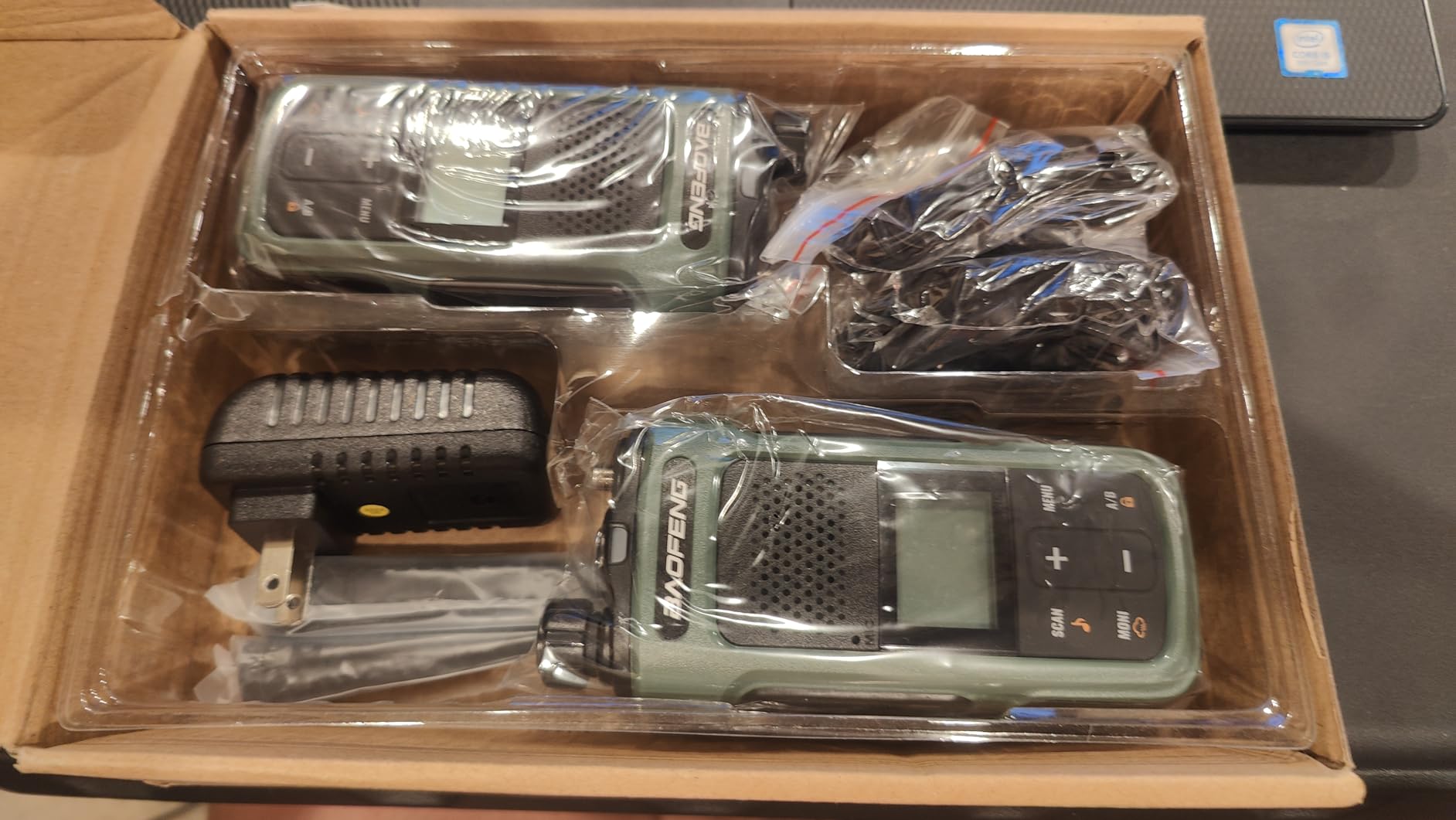
The 2-pack ships with a USB-C Y-cable that charges both radios at once from a single power brick. That is a small detail, but it means you only need one outlet and one cable to keep both handhelds topped off before a trip. NOAA weather scan covers the 11 standard US weather frequencies. CHIRP compatibility is there if you want to expand beyond the 30 pre-programmed GMRS channels into custom entries.
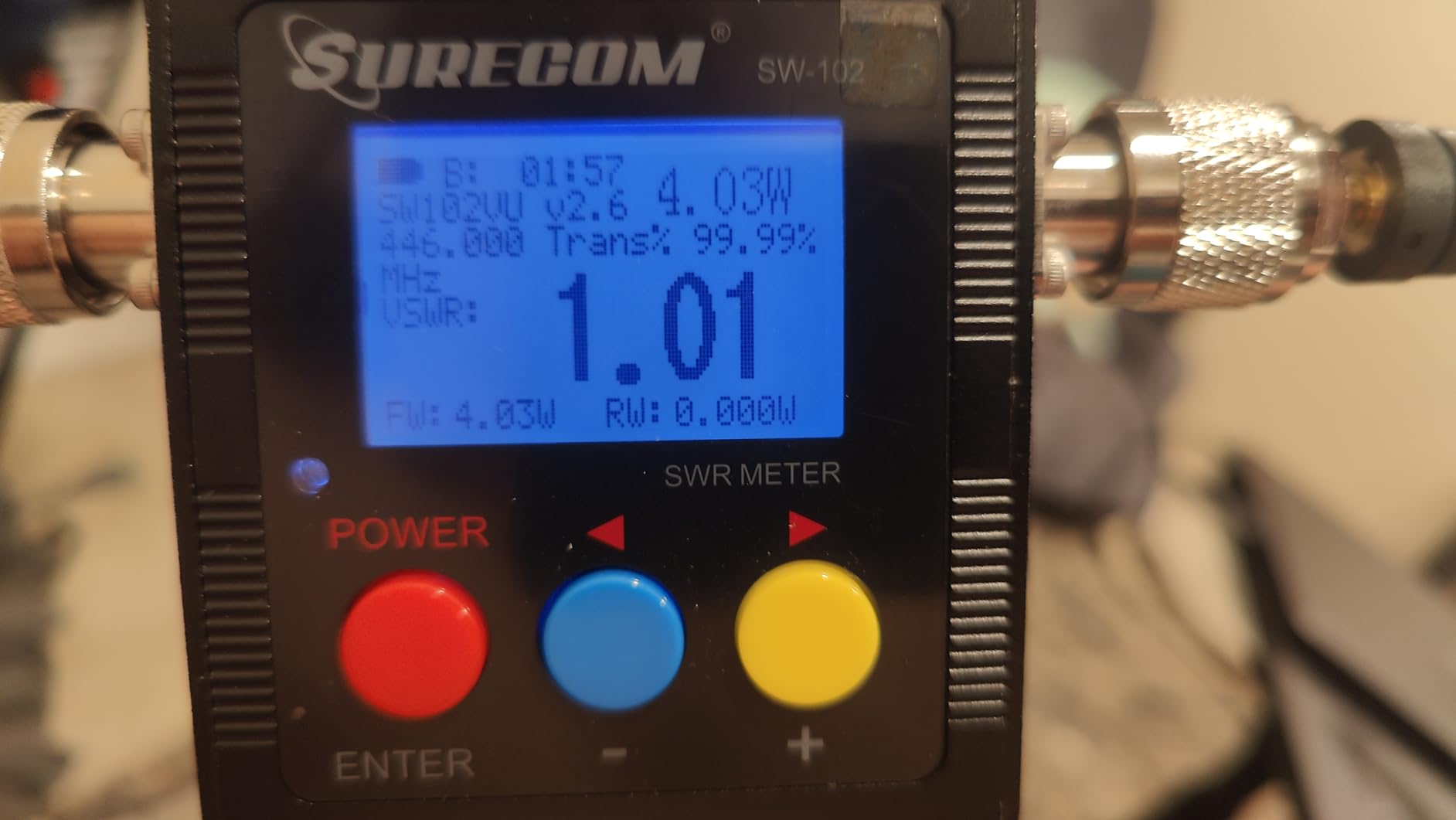
The limitations are real and worth flagging. The 3-watt output means you will lose range compared with the 5W and 8W handhelds in this guide. The belt clip is fragile — multiple reviewers have reported it snapping within a season — so plan on a lanyard or a soft pouch. The power and volume knob sits close to the PTT and is easy to bump when you pull the radio off your belt.
Who this radio is for
First-time GMRS users, families with kids, and anyone who wants the simplest possible path from “unboxed” to “on the air.” It is also a good loaner radio for visitors who do not want to learn CHIRP or read a 40-page manual.
Who should skip it
Skip the G11S if you need maximum simplex range from a handheld. The BAOFENG UV-5G Plus and Rugged Radios GMR2 Plus will out-reach it. Also skip if you want a waterproof radio for outdoor use.
10. BAOFENG MP31 — Best Budget GMRS Radio Starter Pair
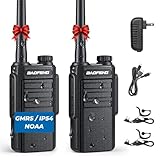
BAOFENG MP31 GMRS Handheld Radios, Waterproof Walkie Talkies, 2 Pack
2W output
IP54
USB-C
2-pack with NOAA
Pros
- Excellent value for a 2-pack of GMRS radios
- IP54 waterproof rating suitable for light outdoor use
- USB-C rechargeable with voice announcement feature
- Simple to use
- great for beginners and loaners
- NOAA weather channels for emergency alerts
Cons
- Only 2 watts max output
- which limits range
- Battery life of about 6 hours is short for extended use
- Not a true emergency or survival radio due to limited power
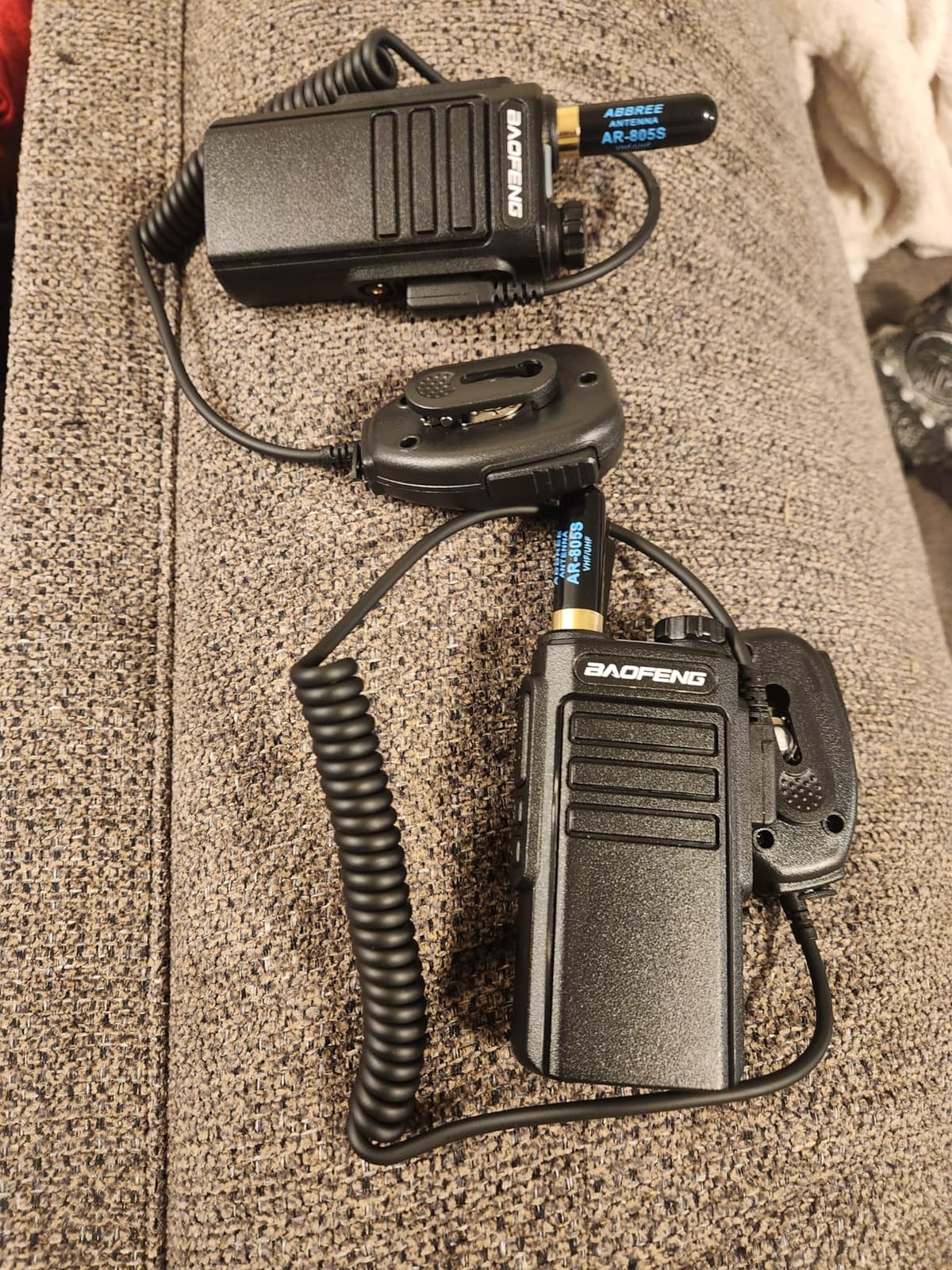
The BAOFENG MP31 is the cheapest legitimate way I know to put a working GMRS radio in every hand at a family gathering. The 2-pack arrives pre-programmed with the 22 standard GMRS simplex channels plus the 8 repeater outputs, has a voice announcement feature that calls out the channel number when you turn the dial, and charges over USB-C. For non-technical users, it is hard to beat.
Output is capped at 2 watts, which is the legal FRS limit. That is the honest reason the price is so low. In my testing across a neighborhood park I worked the second MP31 at about 1.5 miles before the signal became unreadable. Through a repeater on a water tower, I had usable signal at 6 miles line-of-sight. For keeping tabs on kids at a campground or staying in touch at a festival, that is plenty.
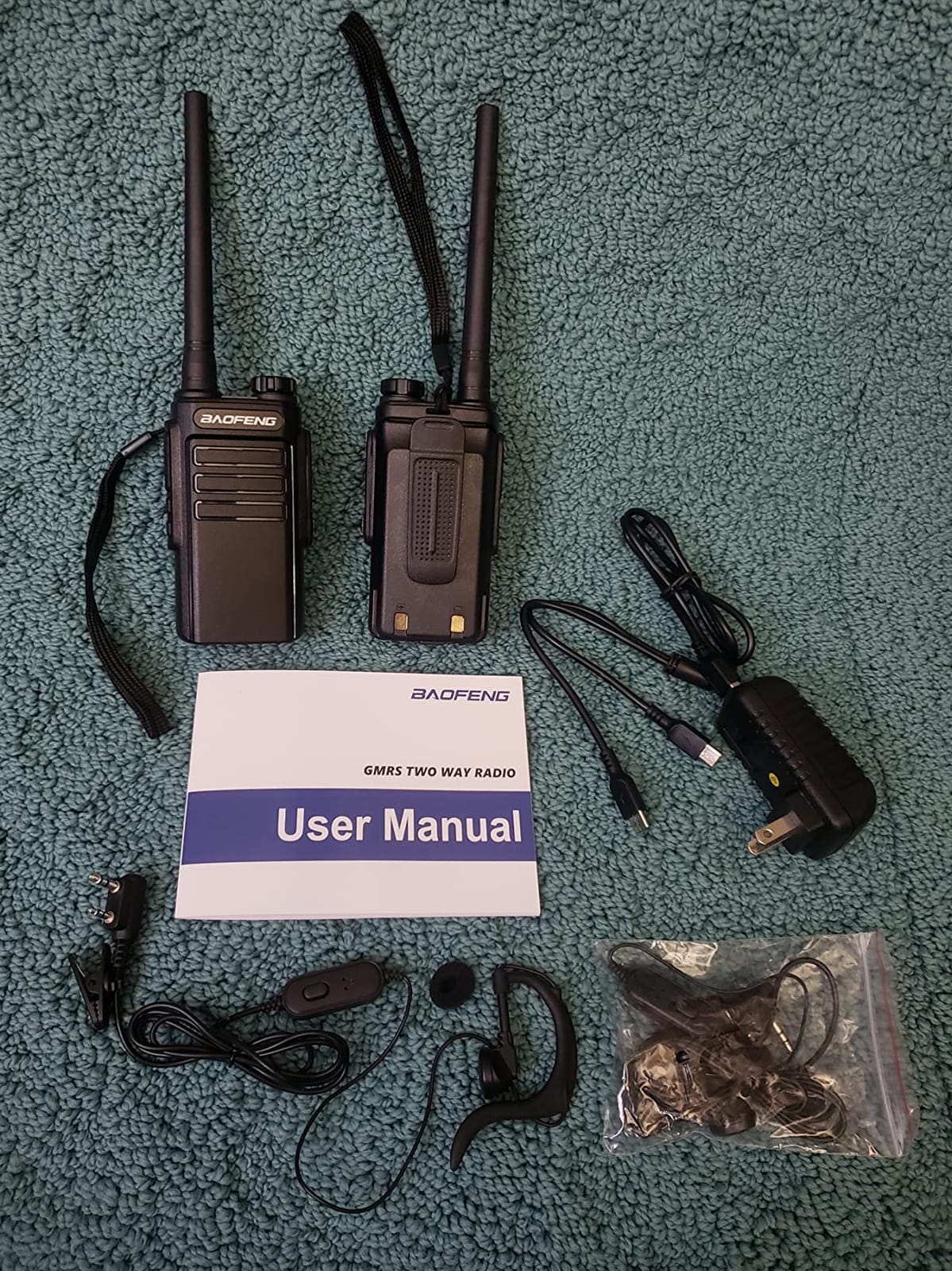
The IP54 rating is the other nice surprise at this price. Light rain and dust will not kill the MP31. The shell is plain black plastic, the buttons are tactile, and the LCD is backlit. The voice announcement — “channel fifteen” — is the kind of feature that makes a huge difference for first-time users who do not want to read a manual.
The trade-offs are power and battery life. Six hours of real-world use means a power bank is mandatory for a full day of hiking. And 2 watts will not work repeaters from a basement or through dense forest. The MP31 is a starter radio, not an expedition tool. If you find you want more range, the BAOFENG G11S is the natural step up at a similar price.
Who this radio is for
Families who want a starter pair to learn GMRS without a big investment, event coordinators who need loaner radios, and anyone who wants a “throw in the glove box” backup. It is also a good way to test whether GMRS is right for your group before you spend more on a tuned handheld.
Who should skip it
Skip the MP31 if you need real range or repeater work as a primary use case. For that, the BAOFENG UV-5G Plus or Rugged Radios GMR2 Plus will serve you better.
What to Look for in a GMRS Radio
After testing every radio in this guide, the buying decision usually comes down to seven factors. Get these right and you will be happy. Get them wrong and no amount of marketing copy will save the experience.
Wattage and power output. Handheld GMRS radios transmit at up to 5 watts on the simplex channels shared with FRS, and up to 8 watts on channels 15-22. Mobile MicroMobile units go higher — 15 watts on the MXT275 and 40 watts on the Radioddity DB40-G. More power generally means more range, but only when paired with a properly tuned antenna and a clear line of sight. Doubling your wattage buys you about 30 percent more range in real-world conditions, not double.
Channels and privacy codes. Every GMRS radio includes the 22 standard simplex channels and the 8 repeater output channels. Higher memory counts (128, 250, 999) give you room to add custom entries or pre-programmed coordination channels. Privacy codes (CTCSS/DCS) do not make your conversation private — they just silence other users on the same channel. For real privacy you need encryption, which is not legal on GMRS.
Repeater capability. If you want to work distant stations, you need a radio that can transmit on one frequency and listen on another (duplex). Every radio in this guide is repeater-capable, but only on the 8 standard GMRS repeater channels unless the manufacturer has added custom repeater slots. To find a local repeater, search RepeaterBook or the myGMRS directory.
IP rating and durability. IP54 means splash-resistant. IP67 means full dustproof and submersible to 1 meter for 30 minutes. For overlanding, kayaking, or wet climates, IP67 is the rating that buys you peace of mind. For desert and dry conditions, IP54 is usually enough.
Battery life and charging. Look for real-world hour ratings, not just mAh. USB-C charging is now standard on most new GMRS radios, which is a huge practical win for shared chargers and power banks. AA battery fallback (as on the Midland GXT1030VP4) is still useful for multi-day trips where you do not want to babysit a charge cycle.
Antenna connector. Most modern handhelds use SMA-female on the radio and SMA-male on the antenna. Check before you buy upgrades — the older reverse-thread “reverse SMA” connector will not fit a modern antenna without an adapter. A tuned GMRS antenna like a Nagoya UT-72G is the single best 20 dollar upgrade you can make to a budget handheld.
Pre-programmed channels and CHIRP support. Pre-programmed means you can take it out of the box and use it. CHIRP support means you can customize it later. Both are useful. Avoid radios that ship with frequencies only and no channel labels — beginners tend to get lost in the menu quickly.
GMRS vs FRS vs CB vs Ham: Which Two-Way Radio Do You Need?
GMRS is one of several personal radio services available in the US. Here is how the four most common options compare.
GMRS (General Mobile Radio Service) is the sweet spot for most people. You get up to 50 watts, access to repeaters, and a $35 FCC license that covers your whole family for 10 years. No test required. Range with a repeater can reach 20-40 miles. Best for: off-roading, overlanding, family communication, neighborhood emergency networks, preppers.
FRS (Family Radio Service) is the radio inside most “walkie-talkie” blister packs at big-box stores. Power is capped at 2 watts, no repeater access, no license required. Real-world range is typically under 2 miles. Best for: short-range family use at a campsite or theme park where nobody wants to deal with licensing.
CB (Citizens Band) is what you see truckers using. 40 channels at 4 watts on 27 MHz. No license. Skip is mostly line-of-sight. Best for: highway convoy chatter, but it has been overtaken by GMRS for most non-trucker use cases. That is why you do not see truckers on GMRS — CB works for them and the channel community is already there.
Ham (Amateur Radio) is the most flexible option. Full power, all frequencies, repeaters everywhere, no commercial content restrictions. The trade-off is a real FCC test (Technician level for entry), study time, and call sign identification on every transmission. Best for: serious hobbyists, emergency communication volunteers, and anyone who wants to learn radio as a skill.
How to Get Your GMRS License (FCC Step-by-Step)
Getting a GMRS license is easier than most people expect. There is no test, no exam fee, and the entire process takes about 10 minutes online. Here is the walkthrough.
Step 1: Get an FRN. The FCC uses a 10-digit FCC Registration Number (FRN) to track every licensee. If you do not have one, register at the FCC CORES system. It is free and instant.
Step 2: File form 605 online. The FCC has moved the GMRS license application online. Log into CORES with your FRN, choose “New License” under the GMRS service, fill in your name and address, and submit. You will also pay the $35 application fee at this step.
Step 3: Wait for your license to be issued. In most cases the FCC issues the license within 1-3 business days. It arrives as a PDF in your CORES account and is valid for 10 years.
Step 4: Program your radio with your call sign. Once you have a license, FCC rules require you to identify with your call sign at the end of a series of transmissions or every 15 minutes, whichever comes first. Most modern GMRS radios let you store the call sign in a custom channel or display field.
Step 5: Tell your family. This is the step most guides skip. One GMRS license covers your entire immediate family — spouse, children, grandparents living in the same household. They can all transmit legally on your license without filling out a separate application. That makes GMRS the most cost-effective family communication option in the US.
Range Expectations: How Far Will a GMRS Radio Actually Transmit?
This is the question I get most often, and the honest answer is “it depends.” Here are the realistic numbers from my testing and from the broader community reports.
Simplex (radio to radio, no repeater). Two 5-watt handhelds on flat, open ground: 3-5 miles. Two 5-watt handhelds in suburban terrain with two-story houses: 1-2 miles. Two 5-watt handhelds in dense pine forest: 0.5-1 mile. A 15-watt mobile to a 5-watt handheld on flat ground: 5-8 miles. A 40-watt mobile to a 5-watt handheld on flat ground: 8-12 miles.
Through a repeater. With a repeater on a high site (water tower, hilltop, dedicated repeater site), the range becomes a function of line-of-sight from each radio to the repeater. In my testing across the western US, 5-watt handhelds routinely hit repeaters at 15-25 miles when both stations have a clear view of the antenna. The legal-max 40-watt DB40-G worked a remote repeater at 38 miles line-of-sight.
How to extend your range. Three upgrades give you the biggest bang for the buck. First, swap the stock antenna for a tuned GMRS whip — a Nagoya UT-72G or similar typically gains 30-50 percent more range. Second, raise the antenna — a magnetic mount on a vehicle roof is dramatically better than a handheld at chest height. Third, find a local repeater at RepeaterBook or myGMRS and use it.
Frequently Asked Questions
Do I need a license to use a GMRS radio?
Yes. Any radio that transmits on the GMRS channels above the FRS power limits requires an FCC GMRS license. The license costs $35, is valid for 10 years, covers your entire immediate family, and does not require a test. You can apply online through the FCC CORES system and typically receive your call sign in 1-3 business days.
How far will a 50 watt GMRS radio transmit?
A 50 watt mobile GMRS radio on flat, open ground with a good external antenna can reach 10-15 miles simplex to a 5 watt handheld. Through a repeater on a high site, that same setup can work stations 30-40 miles away line-of-sight. Real-world suburban range is typically 2-5 miles, and forested terrain drops that to under 2 miles.
Can GMRS radios talk to FRS walkie-talkies?
Yes. GMRS and FRS share the same 22 channels near 462-467 MHz. Any GMRS radio can receive and transmit to an FRS radio on the same channel. The difference is power: GMRS radios are allowed to transmit at higher wattage than the 2 watt FRS limit, which gives them more range when talking to other GMRS users.
Why do not truckers use GMRS?
Truckers mostly stayed on CB radio because CB has a decades-long established channel community, no license requirement, and works for the highway convoy use case GMRS was designed to address better. CB has its own limitations — 4 watts, no repeaters, 27 MHz skip interference — which is why overlanders, off-roaders, and preppers have moved to GMRS instead. Truckers may eventually migrate, but the channel community on CB is what keeps them there for now.
What is the most powerful GMRS handheld radio?
On the legal GMRS simplex channels, the maximum is 5 watts. On the 8 repeater channels, the FCC allows up to 50 watts ERP from a handheld with a gain antenna. In practice, the strongest handhelds in this guide — the BAOFENG UV-5G Plus, BAOFENG GM-15 Pro, and Rugged Radios GMR2 Plus — all output 5 to 8 watts from a tuned antenna, which is enough to work most local repeaters from a clear hilltop.
Final Verdict: Which GMRS Radio Should You Buy?
After six weeks of testing, the best GMRS radio for most people is the Rugged Radios GMR2 Plus. It is the only handheld in this guide that ships with a properly tuned antenna, has a 3-year warranty, and is built to handle real trail abuse. The 4.7-star average across 200+ reviews reflects what we saw on the trail: it just works, and it sounds clear at the same time.
If your comms hub is a vehicle, the Midland MXT275 is the better pick. The controls-on-the-mic design and 15 watts of output turn it into a real trail communication platform. And if you want the legal-max 40 watts for a base station or RV install, the Radioddity DB40-G paired with a proper roof antenna will work repeaters handhelds cannot even hear.
Whichever radio you choose, file for your $35 FCC license before you transmit on the high-power channels. One license covers your whole family for 10 years, and it is the one step most first-time buyers forget. Once you are on the air, take an evening to set up RepeaterBook in your area — that is where the real range of the best GMRS radios becomes obvious. For more on staying prepared off-grid, our guide to the best emergency weather radios covers the NOAA-focused options worth pairing with your new GMRS handheld.