
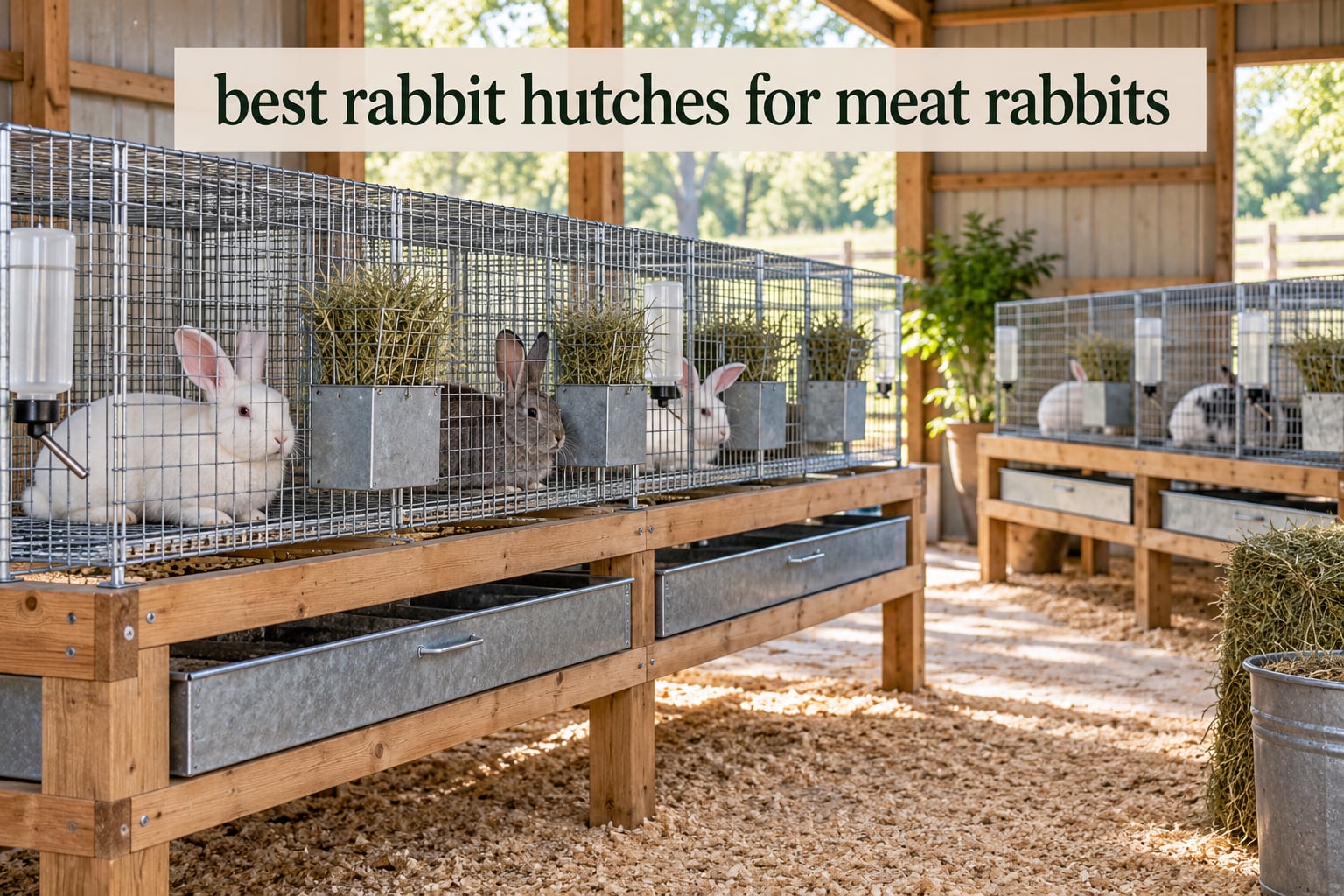
A pet-store rabbit hutch is built for a single house rabbit that spends its day on a rabbit pad. A meat rabbit setup does not work that way. You are housing bucks, does with litters, and growout fryers in numbers, and every one of them is producing waste that you need to fall through the floor instead of sitting in a shallow plastic tray. That single design difference decides whether a hutch works for you.
We spent weeks comparing the best rabbit hutches for meat rabbits on the market, focusing on floor type, mesh gauge, tray depth, cleaning access, and whether the frame survives a rabbit that chews everything in reach. We also read the breeder forums where people running New Zealand White and Rex herds talk about what actually held up after ten years.
Here is the honest summary before the individual reviews: for production, an all-wire galvanized cage with a 1/2 x 1 inch floor beats a wooden pet hutch every time. Wood walls absorb urine, trays sized for one rabbit turn into an ammonia problem at eight rabbits, and small doors make it hard to pull a full-size buck out safely. The hutches below are the ones that come closest to production standards, and we tell you where each one falls short.
If you are still working out whether you need outdoor housing at all, our guide to the best rabbit hutches for outdoor use covers the seasonal and weatherproofing side before you commit.
Table of Contents
Top 3 Picks for Meat Rabbit Housing in 2026

Aivituvin AIR24-B Wire Floor Hutch
- Removable wire floor over deep leak-proof tray
- Four casters with two brakes
- Two roofs side windows and two doors

Ferplast Krolik Extra-Large Cage
- Wire cage with wood hutch extension
- Detachable 5.5 inch deep base
- Water bottle bowl and hay feeder included

Pet Lodge 30×36 Galvanized Wire Cage
- Galvanized steel frame
- Stackable four high with frame kit
- Standard 24x24 30x30 and 30x36 sizes
All 12 Rabbit Hutches Compared in 2026
| Product | Specifications | Action |
|---|---|---|
| Aivituvin AIR24-B Wire Floor Hutch |
|
Check Latest Price |
 Aivituvin AIR19-B 62 Inch Hutch Aivituvin AIR19-B 62 Inch Hutch |
|
Check Latest Price |
 Aivituvin AIR15 Two-Layer Hutch Aivituvin AIR15 Two-Layer Hutch |
|
Check Latest Price |
 GUTINNEEN AIR19 61 Inch Hutch GUTINNEEN AIR19 61 Inch Hutch |
|
Check Latest Price |
| Ferplast Krolik Extra-Large Cage |
|
Check Latest Price |
 TRIXIE natura Two-Story Hutch TRIXIE natura Two-Story Hutch |
|
Check Latest Price |
 GDLF 62 Inch Two-Level Hutch GDLF 62 Inch Two-Level Hutch |
|
Check Latest Price |
 Mcage Deluxe 2-Level Wire Cage Mcage Deluxe 2-Level Wire Cage |
|
Check Latest Price |
| Pet Lodge 30×36 Wire Cage |
|
Check Latest Price |
 GUTINNEEN Three-Level Hutch GUTINNEEN Three-Level Hutch |
|
Check Latest Price |
 Mayugardening Two-Story Hutch Mayugardening Two-Story Hutch |
|
Check Latest Price |
 GUTINNEEN Metal-Frame Rabbit Hutch GUTINNEEN Metal-Frame Rabbit Hutch |
|
Check Latest Price |
1. Aivituvin AIR24-B Wire Floor Hutch for Meat Rabbits
Aivituvin Rabbit Hutch Indoor Bunny Cage Outdoor Bunny House with Wire Floor Leakproof Plastic Tray, Brown
Removable wire floor above a deep tray
39.76 x 21.33 x 7.55 inch base
37.55 pounds, four casters
Pros
- Removable wire floor lifts rabbits off waste
- Deep pull-out tray with raised lip does not leak
- Four casters with two brakes make it movable
- Two open roofs side windows and two front doors
Cons
- Wood frame is chewable and needs sealing outdoors
- Side mesh is thin by production standards
- 37.55 pounds makes it awkward on its own
This is the hutch we keep coming back to for meat rabbits, and the reason is the floor. The removable metal wire netting sits above the tray, so a rabbit stands on wire instead of standing in its own droppings. Most wooden pet hutches in this list force you to accept a solid floor, and a solid floor in a production setup is the beginning of urine burn and ammonia problems.
The tray is deeper than the one on most store-bought hutches, and it pulls out from underneath so you can hose it down. Reviewers consistently single out the tray as the reason they bought a second one, and the fact that it does not leak urine is the detail that matters when you have more than one cage sitting side by side.
At 39.76 by 21.33 inches with a 7.55 inch base, this is a compact footprint rather than a long run. That works well for a buck or a growout, and a pair of them can sit side by side under a shed roof. For a doe with a litter you would step up to the 30×36 sizing I cover later in this guide.
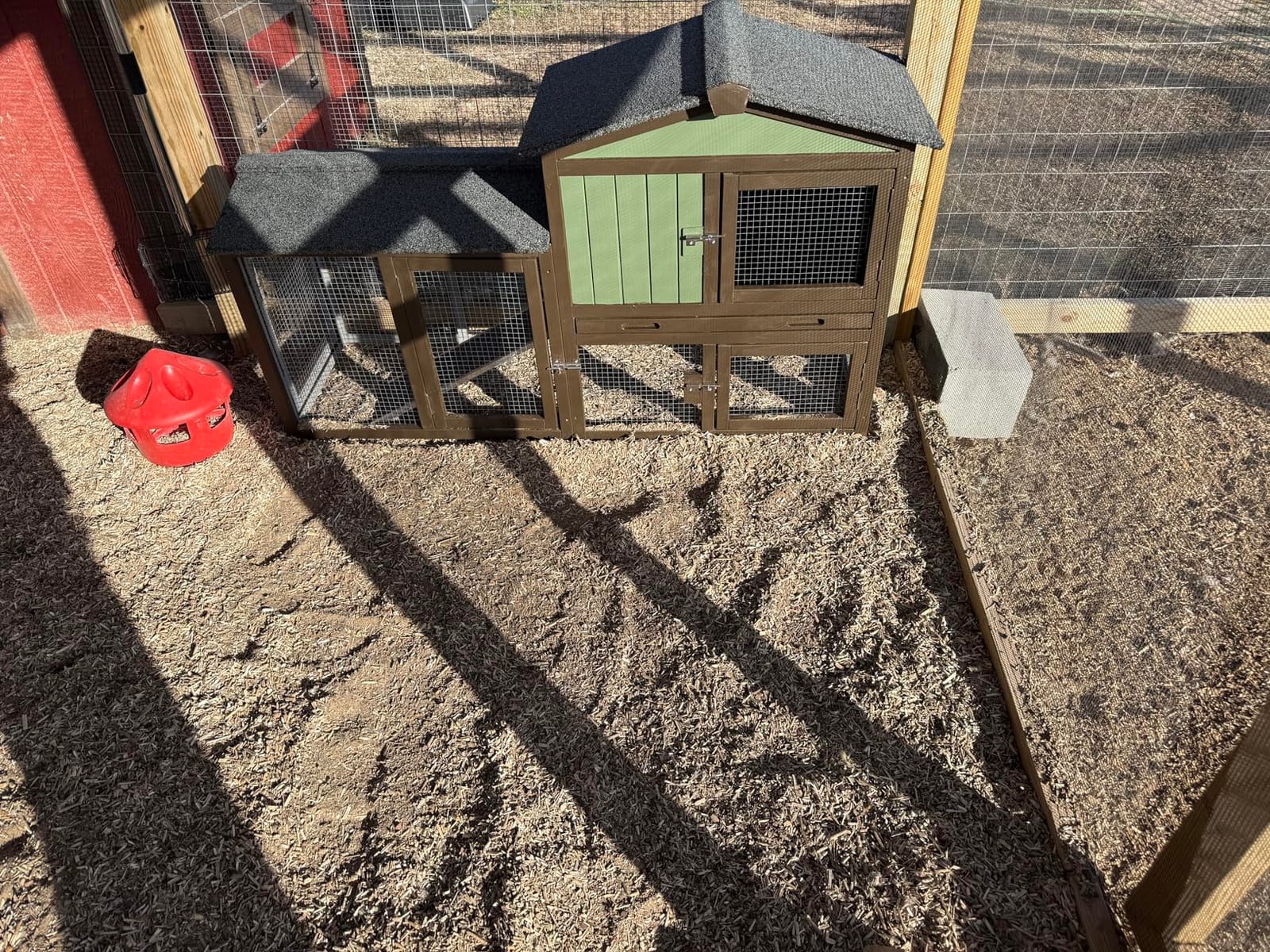
Two open roofs, side windows and two front doors give you more access angles than most hutches in this set. When you need to catch a rabbit for a health check, the ability to reach it from above instead of chasing it through one small door saves real time, and the four casters with two brakes let you roll the whole hutch out for cleaning.
Where this hutch holds up best
It holds up best as a buck cage or a growout unit in a covered outdoor run or an open shed. The wire floor and the pull-out tray mean cleaning is a two-minute job rather than a fifteen-minute one, which matters when you have eight cages to do every morning.
Reviewers also like that it expands with the matching pet playpen if you want to give a rabbit more floor space on a mild day. Just note that the expansion panel is wire-sided and does not solve predator pressure, so it is an indoor or fenced-area answer.
Where it falls short for meat rabbits
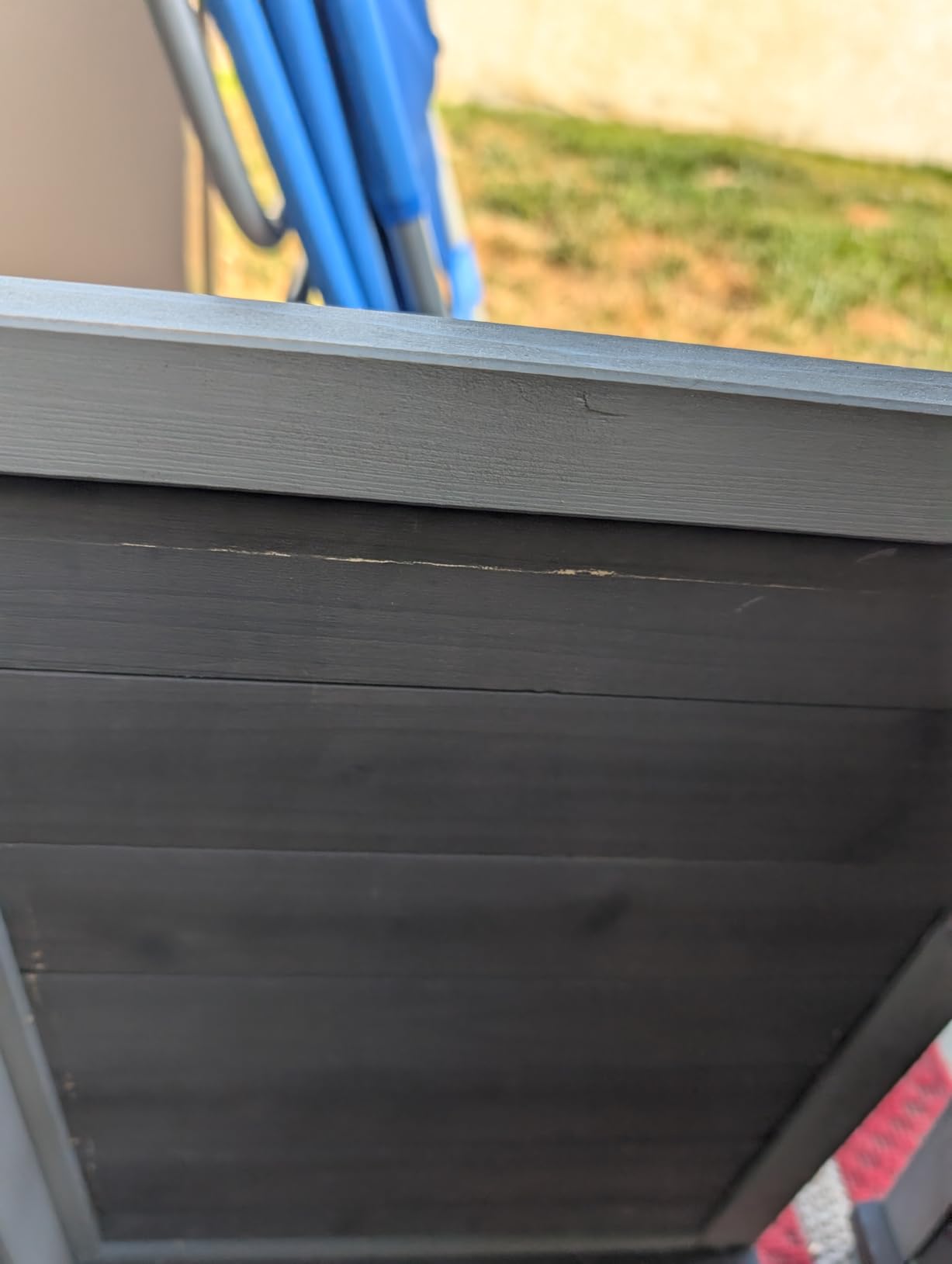
The wood frame is the weak point. Rabbits chew, and once the frame edge is gnawed the panels loosen, so reviewers recommend sealing the wood before any outdoor placement and treating chewed corners with a deterrent spray.
The side mesh is thin, which is fine against rabbits and a problem against anything with teeth and intent. If you plan to run this outdoors in ground with foxes, raccoons or neighborhood dogs, treat the mesh as a boundary you reinforce, not a barrier you rely on alone.
2. Aivituvin AIR19-B 62 Inch Hutch for Growout Pens
Aivituvin Rabbit Hutch 62″ Rabbit Cage Indoor Outdoor Chicken Coop Guinea Pig Cage on Wheels Bunny Cage with 3 Deep No Leakage Pull Out Tray,Waterproof Roof (Brown)
62 x 22.6 x 33.5 inches, 41 pounds
Three deep pull-out trays from front and back
Waterproof asphalt roof
Pros
- Three deep trays pull out from front and back
- Long 62 inch footprint suits growout groups
- Waterproof asphalt roof sheds rain
- Six wheels with two locking casters
Cons
- Strong cedar smell needs airing out first
- Ramp is steep and slippery for some rabbits
- Plastic latches and soft chewable wood
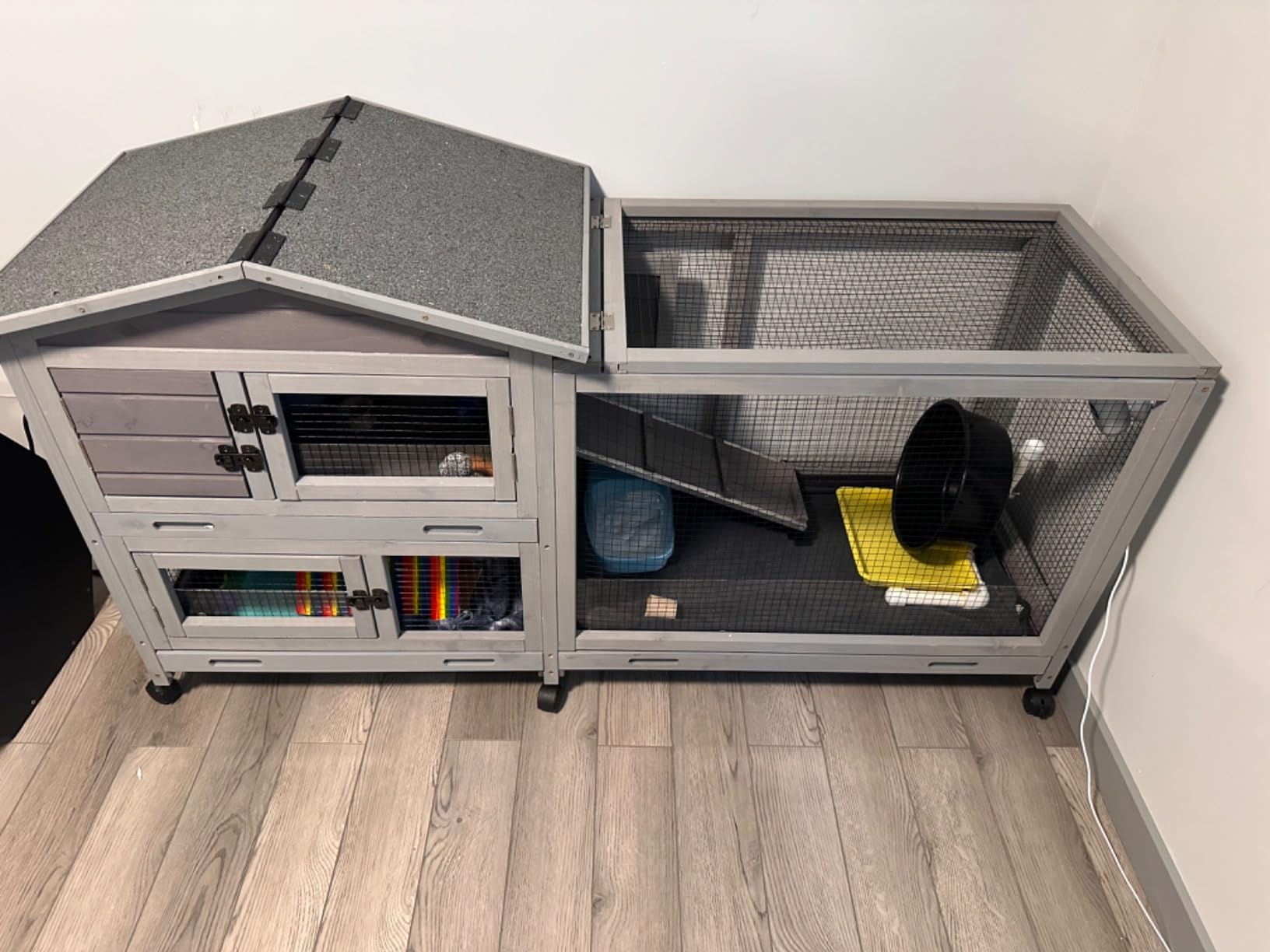
At 62 by 22.6 by 33.5 inches this is a large hutch, and that length is exactly what a growout group needs. Meat rabbits reach their adult size fast, and the question you always face is whether to house a group together or one per cage. A cage this long gives you the option to keep two or three fryers in one run on wire while you finish them out.
The three deep pull-out trays are the reason this one made our list. Each tray pulls out from the front or the back, so you can work from whichever side has space. On a cage this size, the tray volume is what determines whether you clean twice a day or once, and deeper trays buy you time on busy days.
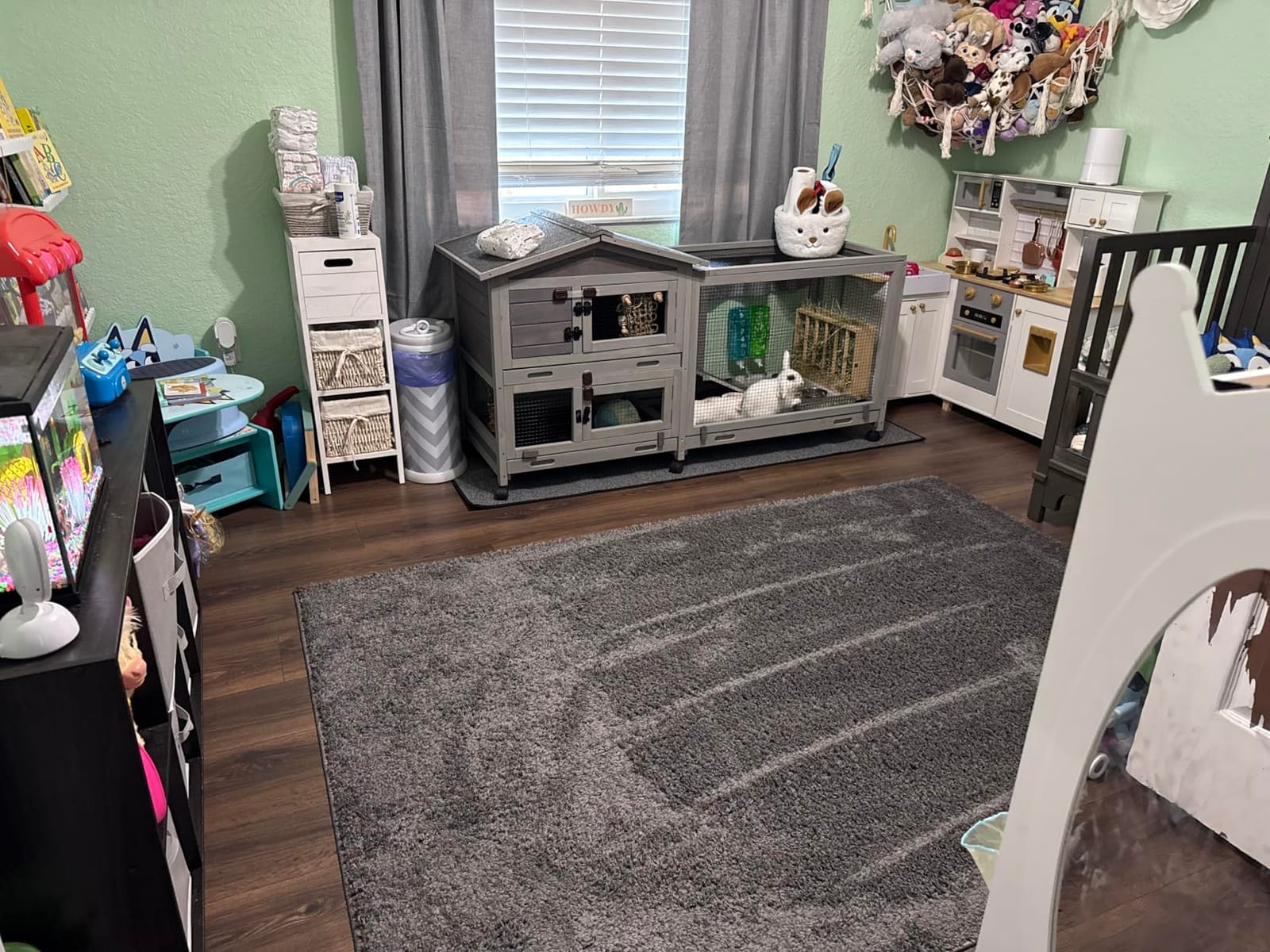
The asphalt roof is genuinely waterproof rather than merely coated, and the large open roof section with three big front doors plus a sliding middle door means you can reach any animal without dismantling anything. The included metal feeder and chew toy are minor, but they take one decision off your list on day one.
Be aware of the arrival experience. Reviewers report a strong cedar smell that needs a few days of airing, and a ramp that some rabbits find too steep or slippery. Lining the ramp with a strip of carpet or a wood shim solves the traction problem in about a minute.
What to check before you buy
Check the tray seams. A few reviewers noted small gaps where waste escaped at the tray edges, and on a wooden hutch the plastic tray lip can separate from the wood frame over time. Seal any gap you find with a bead of exterior sealant before you fill it with rabbits.
Also plan on treating the wood. This is a chewable softwood hutch, so a bitter deterrent sprayed on the frame edges is cheap insurance against a buck that works on one corner all afternoon.
How it handles weather and predators
The asphalt roof and the deep trays make it a reasonable covered-outdoor option, but the flimsy side mesh and plastic latches mean it is not a predator-proof cage on its own. In an open shed with a fence around the perimeter, it works. Sitting alone in a yard, it will not hold against determined raccoons.
Six wheels with two locks let you reposition it with one hand, which is genuinely useful when you want to move the whole run out of the afternoon sun during heat stress.
3. Aivituvin AIR15 Two-Layer Hutch for Indoor Production
Aivituvin [Upgrade Version] Rabbit Hutch Bunny Hutch, Rabbit Cage with Two No Leak Trays, Indoor & Outdoor Waterproof Cage for Bunny, Upgraded Bottom Wire Netting,Grey,Large, Camel
38.6 x 25.6 x 44.2 inches, 52 pounds
Extra wire netting above two deep trays
Ramp connects the two levels
Pros
- Wire netting keeps rabbits off accumulated waste
- Two deep no-leak plastic trays
- Two-level layout uses vertical space well
- Four casters with two brakes
Cons
- Roof sheds asphalt granules over time
- 52 pounds needs two people to move
- Wood finish quality varies between cages
This is the AIR15, and it is the one we would choose for an indoor rabbitry in a garage or basement where the temperature is already controlled. The upper wire netting above the bottom tray is the same idea as our top pick, and it is the single feature that most separates production-appropriate hutches from pet hutches.
The two-level layout uses vertical space in a way the single-level designs here cannot match. A doe with a litter uses the upper level, the ramp gives her a private area away from the tray, and you gain usable space without growing the footprint. When you are trying to fit a workable number of cages into a limited basement corner, vertical space is the cheapest space available.
![Aivituvin [Upgrade Version] Rabbit Hutch Bunny Hutch, Rabbit Cage with Two No Leak Trays, Indoor & Outdoor Waterproof Cage for Bunny, Upgraded Bottom Wire Netting,Grey,Large, Camel customer photo 1](https://factsforhealth.org/wp-content/uploads/2026/10/B07QFVT3GV_customer_1.jpg)
Two deeper no-leak plastic trays pull out for cleaning, and the three access doors plus the ramp make it easy to reach an animal on either level. The free metal feeder and chew toy are included, which saves you a trip.
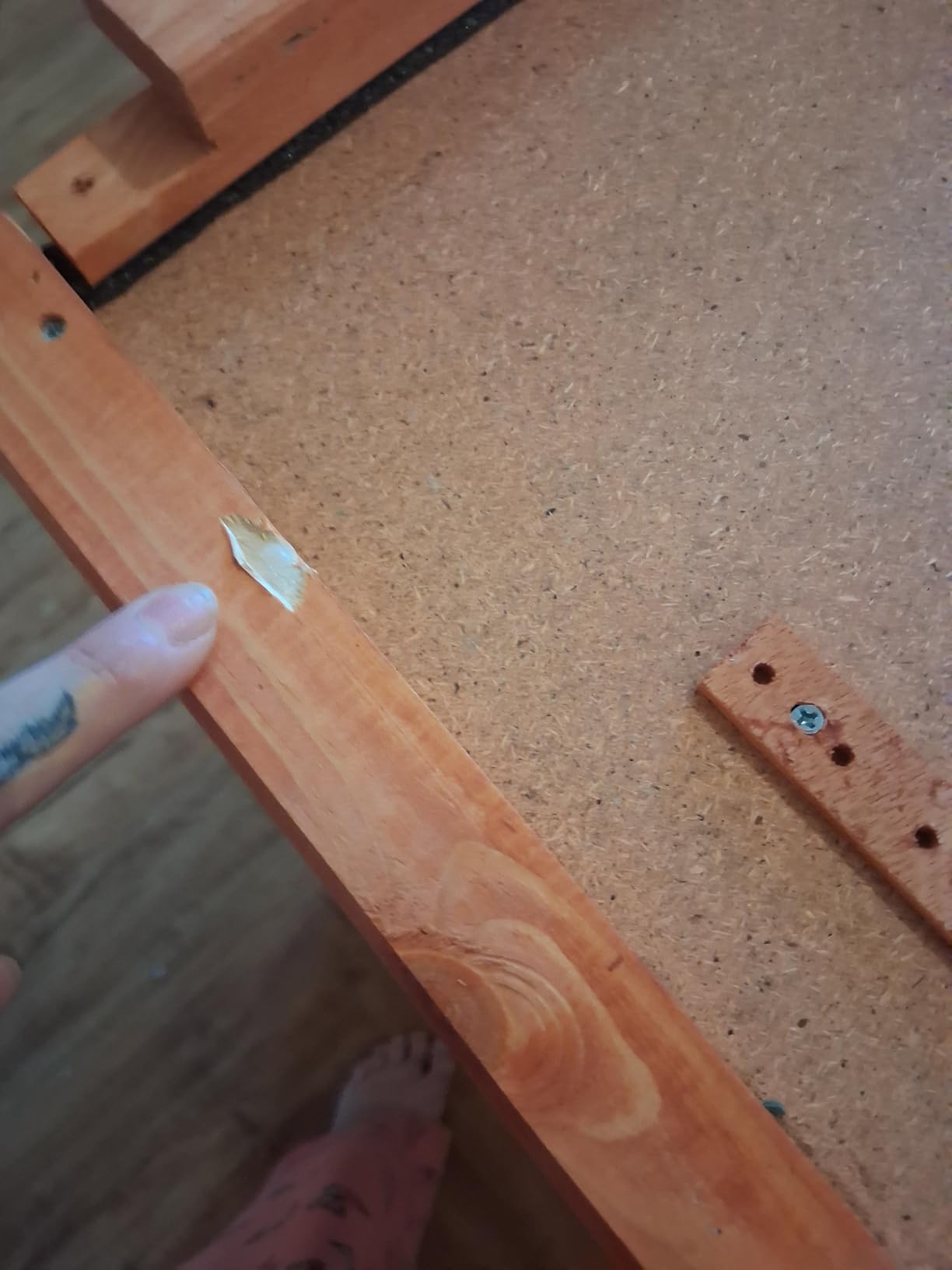
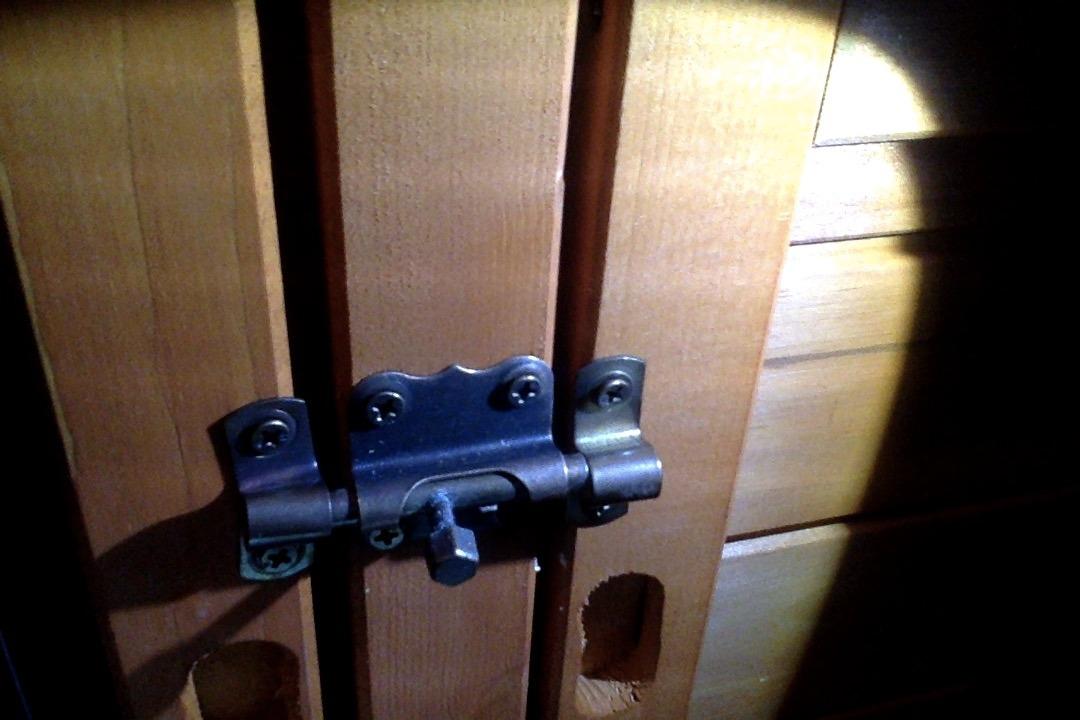
Assembly is the part people complain about. Drill slowly and watch the ramp orientation, because overtightened screws strip the particle board and the back panel seam can loosen with time. At 52 pounds this is not a one-person lift, so plan the placement before you assemble it where it is going to live.
![Aivituvin [Upgrade Version] Rabbit Hutch Bunny Hutch, Rabbit Cage with Two No Leak Trays, Indoor & Outdoor Waterproof Cage for Bunny, Upgraded Bottom Wire Netting,Grey,Large, Camel customer photo 2](https://factsforhealth.org/wp-content/uploads/2026/10/B07QFVT3GV_customer_2.jpg)
Best use case for this model
It works best as an indoor cage in a temperature-controlled space, housing one to two rabbits. A buck cage, a quarantine cage for a new arrival, or a pair of growout rabbits on wire are all good fits for the two-level layout.
If your space is outdoors and unsheltered, think twice. Reviewers consistently point out that long-term outdoor exposure degrades the finish and the roof sheds granules, so it belongs under cover with a roof overhead.
Weak points to plan around
The ramp placement is the most common assembly complaint, so read the orientation before you drive screws. Some units arrive with misaligned pre-drilled holes, which means you may need to drill your own pilot holes rather than forcing alignment.
The two-story ramp is also the surface most likely to be chewed first. A strip of metal edging or a deterrent spray on the ramp edges buys you months of extra service life for very little effort.
4. GUTINNEEN AIR19 61 Inch Hutch with Front and Back Trays
Bunny Cage Indoor and Outdoor Rabbit Hutch with Casters Waterproof Roof, Pull Out Tray from Back and Front 61.2″ L x 22.6″ W x 33.5″ H
61.2 x 22.6 x 33.5 inches, 49.5 pounds
Three deep trays pull from front or back
Waterproof asphalt roof
Pros
- Trays accessible from both front and back
- Long run area with a large open roof
- Waterproof asphalt roof
- Strong sales rank in its category
Cons
- Top lid can be blocked by the roof edge
- Trays have no mesh underneath during cleaning
- Ramp needs added grip
This GUTINNEEN uses the same 61 inch footprint idea as the AIR19-B, and the practical difference is that all three trays pull out from either the front or the back. That matters more than it sounds. In a tight row of cages against a wall, being able to pull a tray from the aisle side rather than reaching behind the whole hutch saves real labor every single day.
The large open roof over the run area and the big front doors give you a wide catch angle, which is what you want with a group of fryers that are fast and slippery when they are eight weeks old. The asphalt roof handles rain without leaking onto the trays.
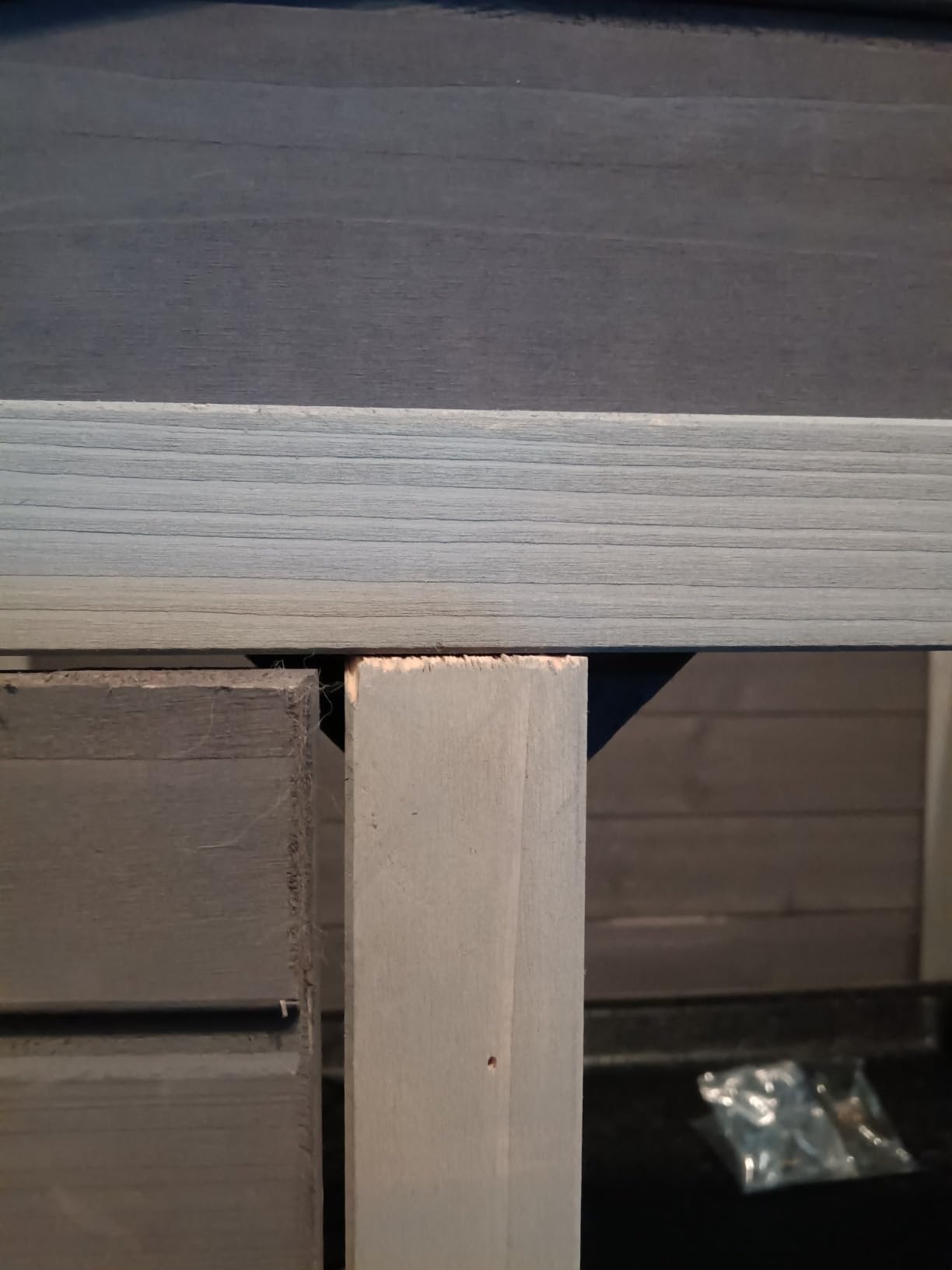
Two details deserve attention before you commit. The top lid does not always swing fully open because the roof edge blocks it, so plan to do deep cleaning through the front doors. And the trays have no mesh underneath, which means a rabbit can slip out while you are pulling the tray if you are not holding the door shut.
Ramp traction is the other recurring complaint. Carpet strips or a wood shim on the ramp resolve it quickly and cost almost nothing. Reviewers also mention occasional alignment issues on assembly, so check the frame is square before tightening everything down.
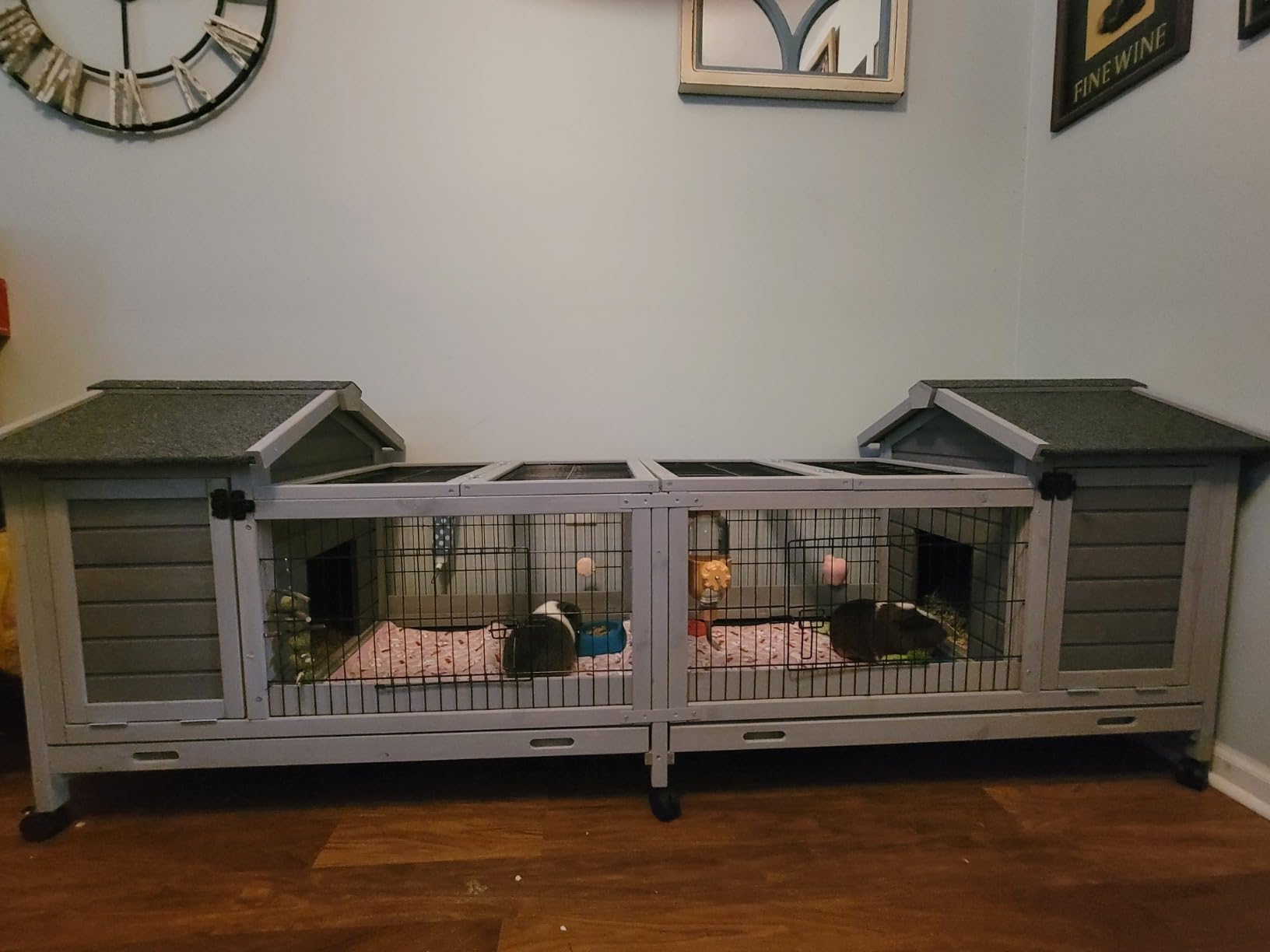
Where it fits a first rabbitry
For a first backyard setup with a small number of animals, this is a sensible shape. The long run lets you keep two rabbits comfortably without the floor area feeling cramped, and six wheels make repositioning easy as the sun moves.
It is best used indoors or under cover in a mild climate. The mesh sides are light gauge, and the finish is not built for years of full weather exposure, so put a roof over it rather than trusting it to the seasons alone.
What to fix on day one
Add grip to the ramp and add a retaining lip or a clip over the tray edge so a rabbit cannot drop into the gap while the tray is out. Those two ten-minute fixes remove the two most common problems owners report with this style of cage.
Keep the trays on a regular schedule. Three deep trays on a 61 inch cage can look like they will last, but with two rabbits in it you will be emptying them daily in warm weather to keep ammonia down.
5. Ferplast Krolik Extra-Large Cage with Wood Hutch Extension
Ferplast Krolik Extra-Large Rabbit Cage w/ Wood Hutch Extension Rabbit Cage Includes All Accessories and Measures 55.9L x 23.62W x 19.68H and Includes ALL Accessories
55.91 x 23.62 x 19.69 inches, 29.08 pounds
5.5 inch deep detachable base
Wood hutch mounted into plastic
Pros
- Detachable 5.5 inch deep base makes cleaning thorough
- Wood hutch stays dry because it is mounted in plastic
- Long-standing design with multi-year owners
- Includes water bottle bowl and hay feeder
Cons
- Assembly needs two people and a drill
- Instructions are picture only
- Plastic shelf and door wire can be flimsy
The Ferplast Krolik has been listed since 2015, and that longevity shows up in the reviews. People report owning theirs for years, which is exactly the kind of track record you want from a cage you are putting production animals into. It carries a one year manufacturer warranty as well.
The design detail that makes it work in a rabbitry is how the wood hutch is mounted into the plastic body. Because the wood sits above the plastic rather than against it, the hutch stays dry and the wood does not sit in urine the way a fully wooden frame does. That single construction choice removes the most common failure mode of wooden outdoor hutches.
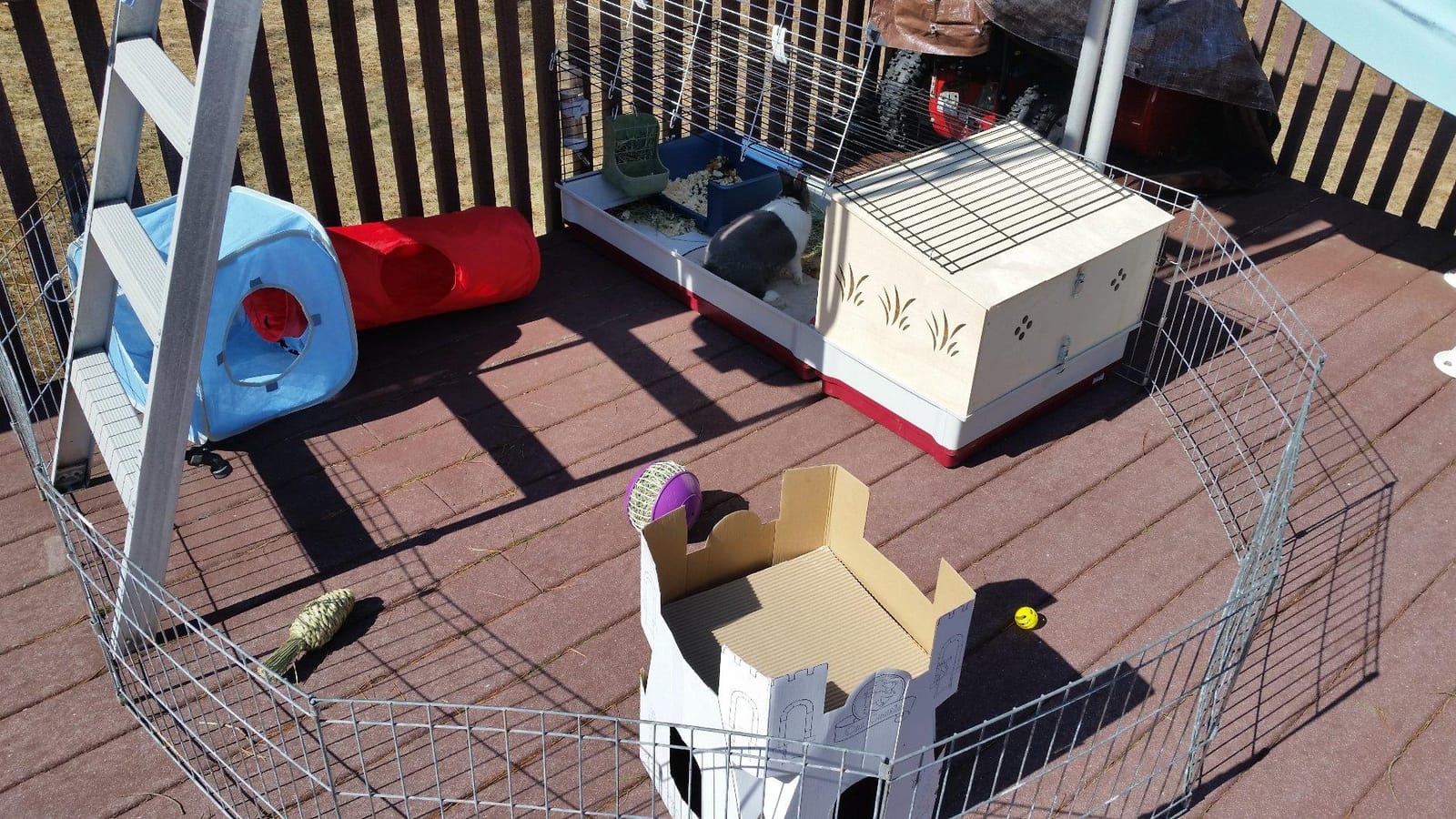
The 5.5 inch deep base holds litter and debris, and the entire base detaches for cleaning or dumping. On a cage that has been used by does with litters, being able to lift the whole base out and hose it is a meaningful time saver compared with scraping a fixed tray.
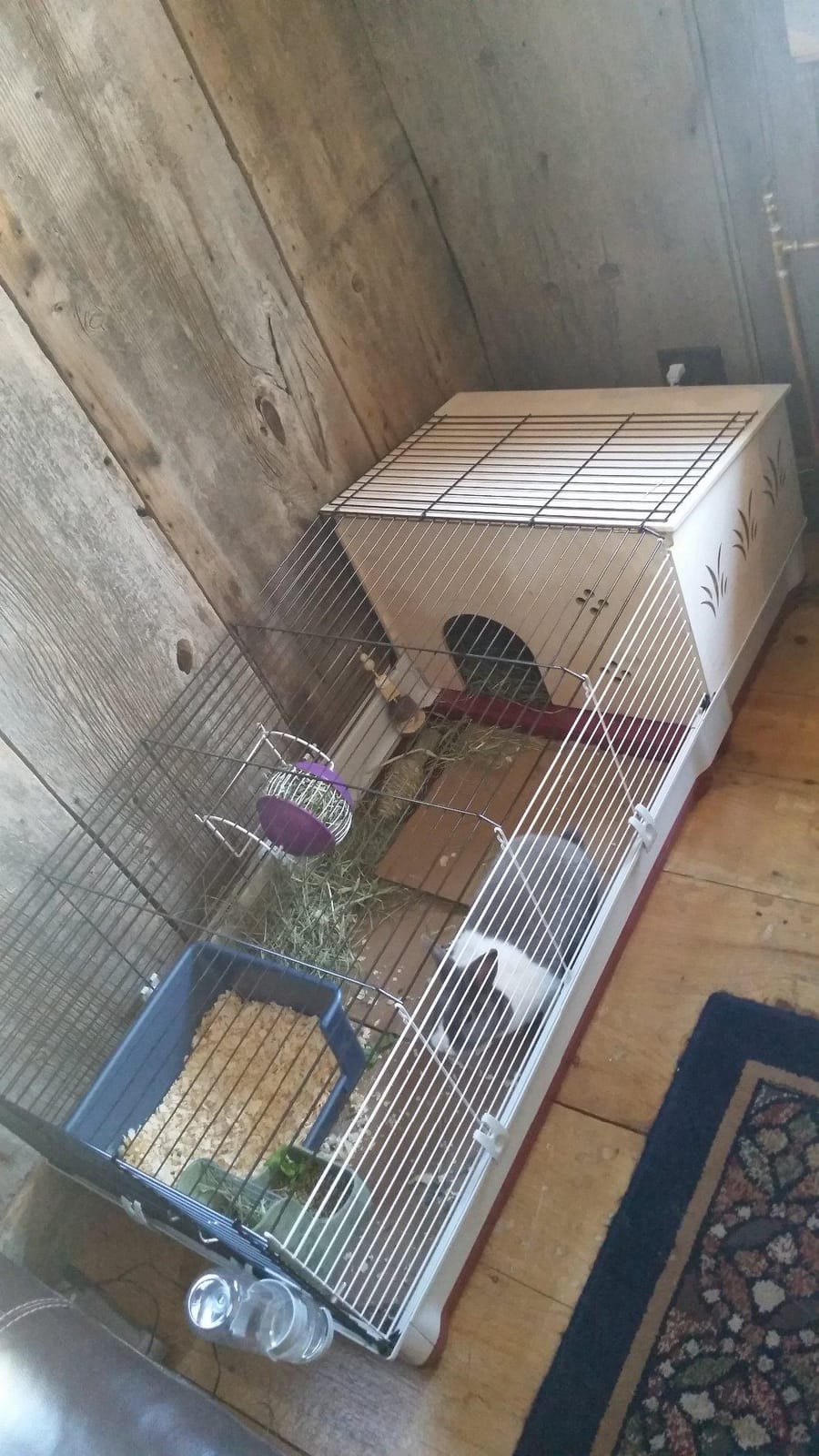
It measures 55.91 by 23.62 by 19.69 inches, which is a long low profile. That length suits a buck or a pair of growouts, and the wood hutch extension gives a doe a private nesting area away from the rest of the cage.
Why it lasts where wood hutches do not
The separation of wood and plastic is the whole trick. Urine and water hit the plastic base and get wiped away, and the hutch stays a dry private space. In a fully wooden hutch the base and walls absorb moisture, and once that happens the smell and the wood damage are permanent.
For production use, the included accessories matter too. The large water bottle, feeding bowl, hay feeder and elevated feeding area are all in the box, so you are not buying a feeder for every cage on day one.
Where it does not suit you
Assembly needs two people and a drill, and the instructions are picture only with no text. Plan an afternoon with a second set of hands rather than fighting it alone, and expect to buy a few extra clips.
It is also a plastic base with wire walls rather than an all-wire production cage, so if you are building a full hanging cage system under a shed roof, this will not slot into that framework. Use it as a sturdy standalone cage for a buck or a litter, not as a component of a rack.
6. TRIXIE natura Two-Story Outdoor Hutch
TRIXIE natura Outdoor Rabbit Hutch with Run – 2-Story Rabbit Cage with Non-Slip Ramp – Medium Elevated Small Animal House with Secure Playpen, Hinged Roof & Pull-Out Tray – in Brown
40.75 L x 38 W x 20.5 H inches, pine
Non-slip ramp between levels
Hinged roof and pull-out tray
Pros
- Hinged roof gives full top-down access
- Non-slip ramp handles small rabbits well
- Pull-out tray cleans without dismantling
- Glazed pine with weather-resistant finish
Cons
- 40.75 inch length is tight for large meat rabbits
- Limited vertical space per level
- Divider reduces usable floor area
The TRIXIE natura is a well-built small hutch in this group, and we want to be clear about where that fits. At 40.75 by 38 by 20.5 inches it is compact, and a New Zealand White doe with a litter needs more room than this gives her. It is a good fit for a young rabbit, a small breed, or a growout finishing stage.
What earns it a place is the hardware. Four doors, a hinged roof for top-down access, a divider panel, and a pull-out tray give you more ways into the cage than most designs of this size. The non-slip ramp and the glazed pine finish with a weather-resistant coating are thoughtful touches you often have to add yourself.
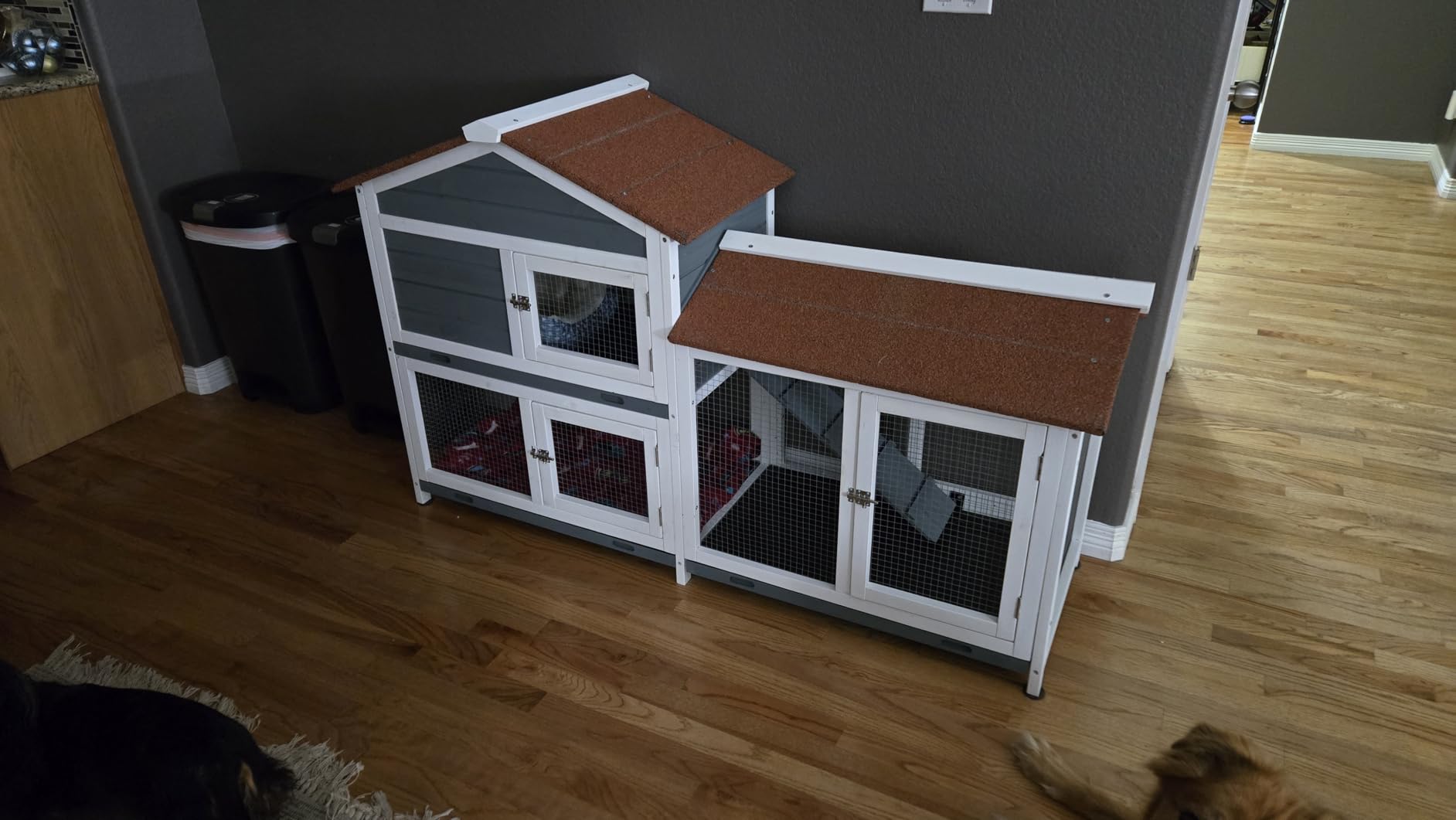
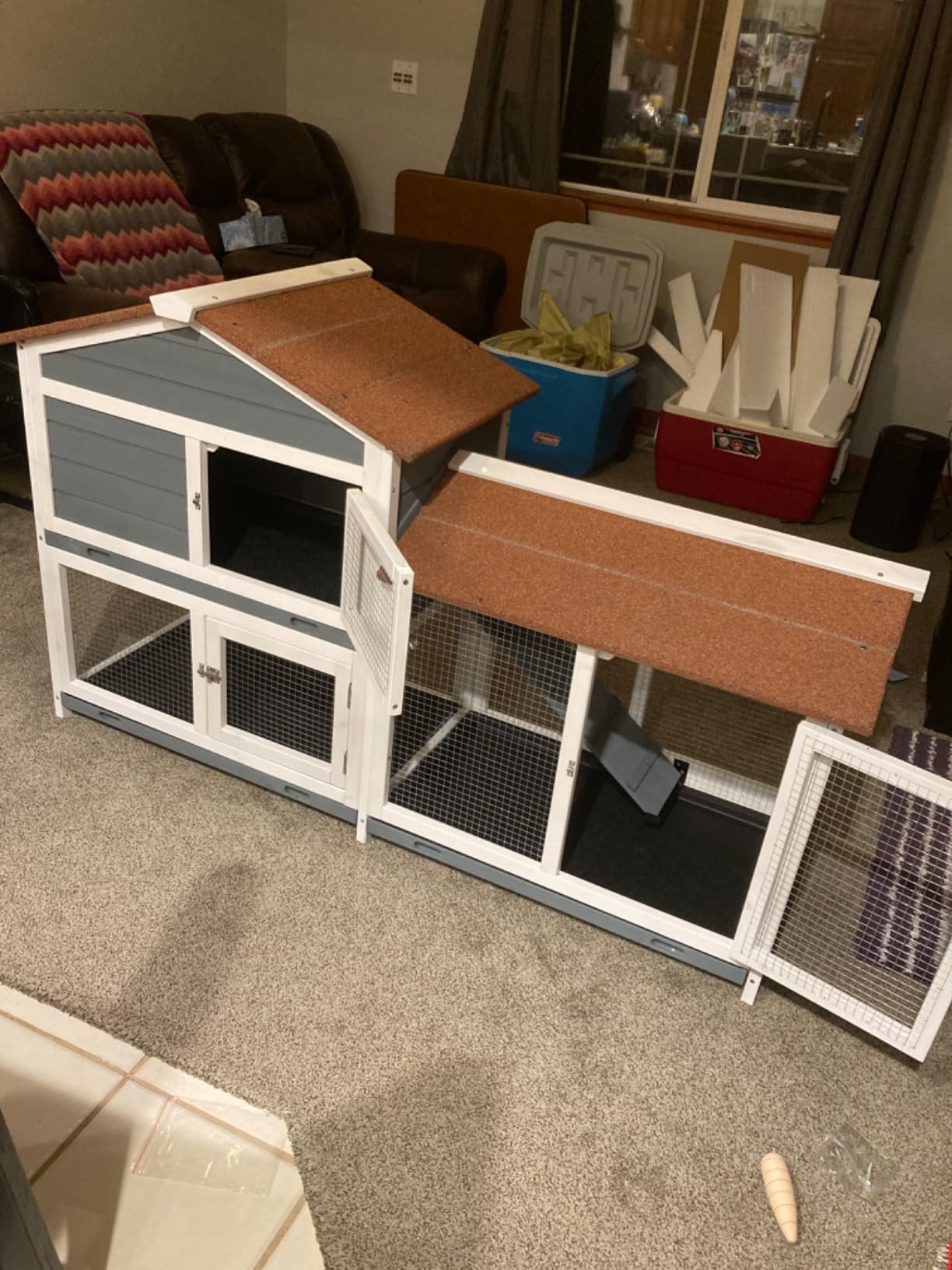
The two-story layout works well because the upper level stays dry and the lower run stays ventilated. For a rabbit on a mild day you can put the animal on the lower level and open the upper door, which creates a genuine airflow path rather than a sealed box.
Do note the divider. It reduces the usable floor area of whichever level it is fitted to, so check the actual interior measurement rather than the exterior figure before you commit for a meat rabbit.
Good for and not good for
Good for a young rabbit being raised toward butcher weight, a smaller breed, or a guinea pig. The hinged roof makes weekly deep cleaning straightforward, which is the reason this design keeps showing up on recommendation lists.
Not good for a full-size New Zealand White doe with a litter, and not good as the primary cage in a rabbitry where you are counting animals per cage. For those jobs the length is the limiting factor, and no amount of added accessories fixes it.
Weather and maintenance notes
The glazed pine finish handles light weather well, and the raised design keeps the base off wet ground. It still needs to sit under cover for long-term use, and the ramp is the first surface a chewing buck will work on.
Plan on re-checking the hinge and door latches every few months. Pine expands and contracts with humidity, and a door that no longer closes square is usually a hinge that needs a drop of oil rather than a replacement hutch.
7. GDLF 62 Inch Two-Level Hutch with Anti-Slip Ramp
GDLF 62″ Rabbit Hutch, Bunny Hutch Indoor Outdoor with Ramp, Cleaning Tray
62 x 21 x 37 inches exterior, 49.7 pounds
27.5 inch upper house
Removable sliding bottom tray
Pros
- Rating of 4.4 across 796 reviews
- Timber ridges give real ramp traction
- Removable sliding tray cleans fast
- Pitched roof sheds rain
Cons
- Initial off-gassing fumes need airing out
- Not predator-proof on its own
- Mesh can bend under heavy pressure
The GDLF has the highest rating in this roundup at 4.4 across 796 reviews, and the feature that earns most of that praise is the ramp. It has timber ridges cut into the surface, which is a real anti-slip solution rather than the bare smooth plastic or bare wood ramps most hutches ship with. Traction matters more than it sounds when a full-size rabbit launches down a ramp at feeding time.
The 62 by 21 by 37 inch exterior breaks down to a 27.5 by 18 by 20.5 inch upper house, and the sliding door and ramp connect the levels. That upper house is roughly a 30×18 space, which is on the snug side for a large doe with a litter but workable for a buck.
The removable sliding bottom tray is another production-friendly detail. Because it slides rather than lifts, you can clear it without carrying a full tray of wet waste across the shed, and the pitched roof keeps rain off the run area below.
Reviewers rate the fir wood and the eco-friendly waterproof varnish highly for looks and for how well the frame holds together. Assembly takes about half an hour with a drill, though the instructions are picture only and the pre-drilled holes are not always accurate.
Why the rating is high
Most of it comes from the tray and the ramp. People are tired of slippery ramps that send a rabbit tumbling into the corner, and the timber ridges solve that without anyone having to buy carpet strips. The sliding tray gets the same reaction for the same reason.
Be aware of the arrival experience. Initial off-gassing and roof grit mean you should assemble and air it out somewhere ventilated for several days before putting a rabbit in it.
Outdoor limits you should plan around
This is not a predator-proof cage. Owners report it does not stop determined predators on its own, which is fine if you have it inside a fenced run or a shed with a locked door, and not fine if it is standing alone in an open yard.
The wire mesh can bend under heavy items, so do not stack storage bins or equipment on top of it. For an all-wire floor rather than this solid tray approach, you would be looking at a hanging cage instead.
8. Mcage Deluxe 2-Level Wire Cage for Growout Rabbits
Deluxe 2-Level in/Outdoor Rabbit Hutch Guinea Pigs Puppy Kitten Cage
26.5 L x 17.5 W x 24 H inches, 17 pounds
2 inch deep leak-proof slide-out tray
Removable mesh floor with urine guard
Pros
- Removable raised mesh floor with urine guard
- Two inch deep leak-proof tray
- Tool-free assembly with pop-in casters
- Light at 17 pounds so one person can move it
Cons
- 26.5 inch length is small for meat rabbits
- Mesh floor may need covering for foot health
- Light build is less stable with a jumping rabbit
The Mcage is a wire cage like the Pet Lodge, and it has the feature you want for meat rabbits: a removable raised plastic mesh floor with a urine guard. The urine guard catches spillage that misses the tray, which is the difference between a cage that smells clean and one that does not.
It also assembles with no tools, using clipped-on connectors and pop-in wheels. That matters more than the specification sheet suggests. When you are setting up a rabbitry over a weekend, the hours you do not spend with a drill are hours you spend building more cages later.
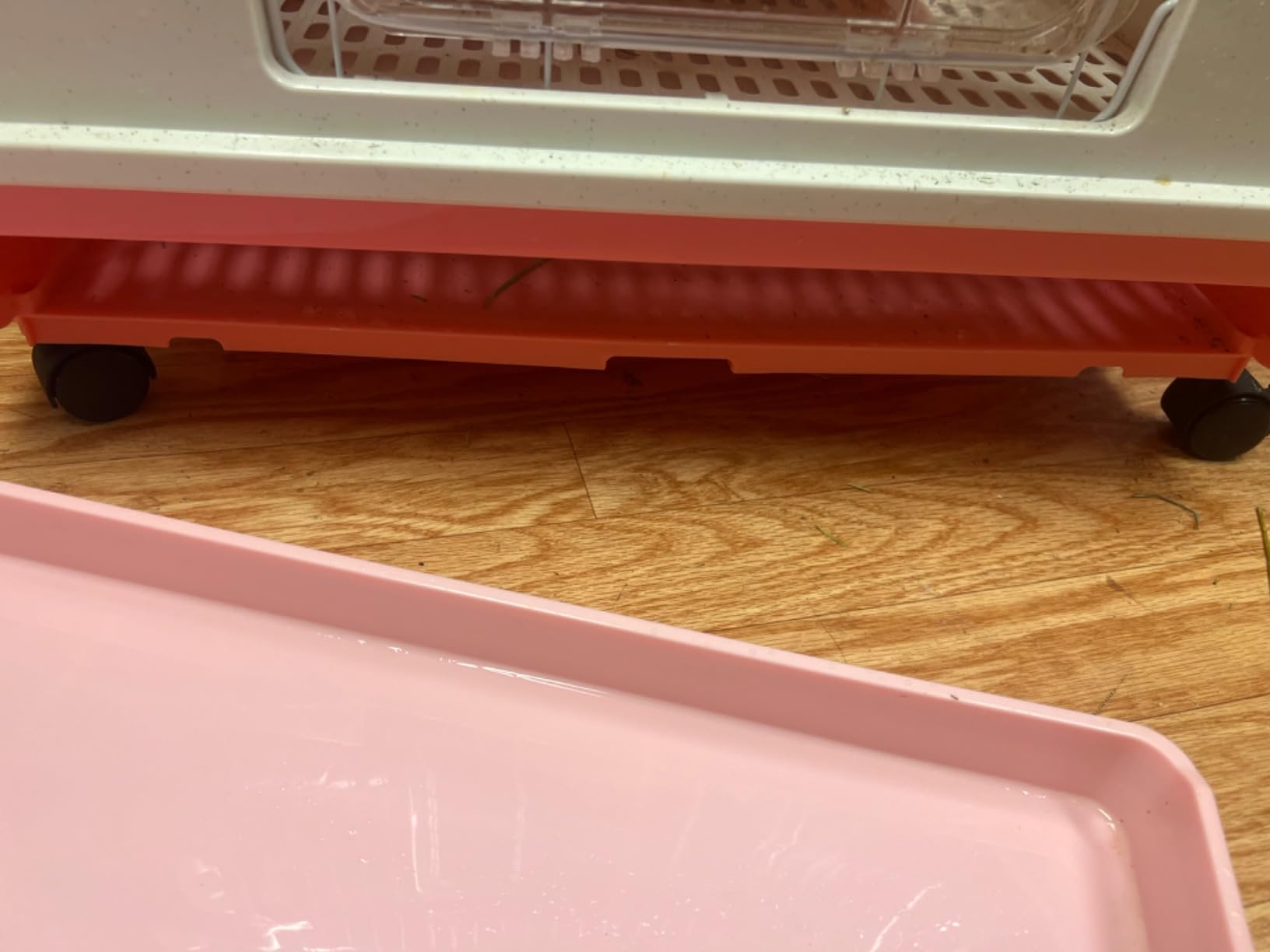
The two level design with a paw safe solid plastic platform and an anti-slip step ramp is well executed, and the 0.9 inch wire spacing suits rabbits and guinea pigs. Four lockable casters mean you can move the whole cage to a different wall or out of direct sun.
Size is the limitation. At 26.5 by 17.5 by 24 inches, this is a cage for a small rabbit, a guinea pig, or a young fryer. It is not a cage for a New Zealand White buck at full size, and the wire construction means it is not an outdoor hutch in any real weather sense.
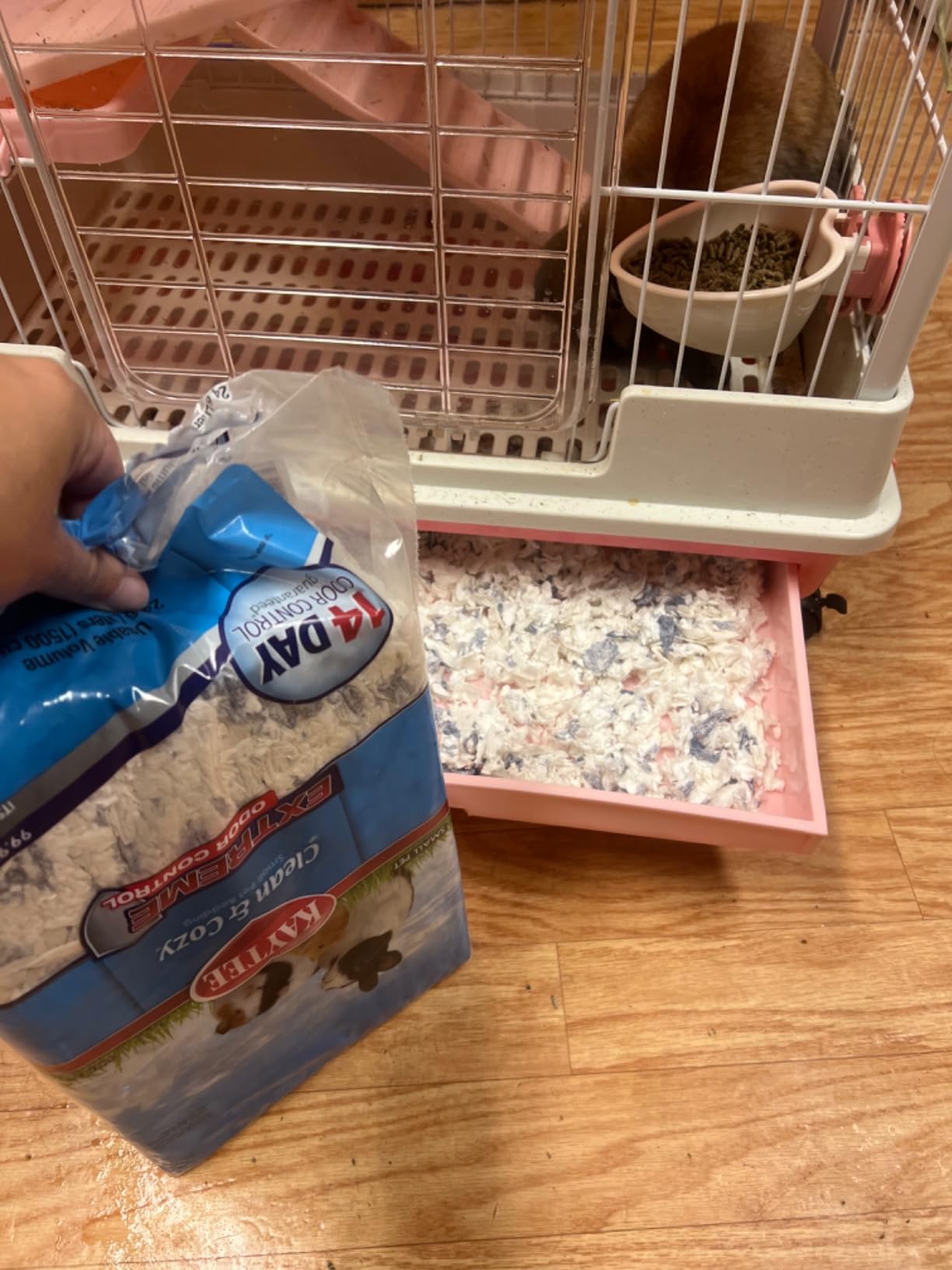
Where the budget pick earns its place
It earns its place as a quarantine or isolation cage, a growout finishing cage for younger animals, and a temporary holding cage. Those are real jobs in a working rabbitry and this fills them at the entry point of this list.
The child safety corner and side bar protectors are a small touch that tells you the manufacturer thought about households, and the lockable casters plus front door lock are genuinely useful features for a cage that moves.
What to watch with a mesh floor
Reviewers note the mesh floor may need covering for foot health. That is the sore hock issue, and it is real: a rabbit on wire all day develops sore hocks. A resting board or mat on part of the floor is the standard mitigation, and this cage is designed so you can add one.
The 17 pound weight is both its advantage and its problem. Easy to move means easy to knock over with a determined rabbit, so place it where it cannot be shoved and cannot be reached by a dog.
9. Pet Lodge 30×36 Galvanized Wire Cage for Production
Pet Lodge® Wire Rabbit Hutch | Rust Resistant Galvanized Wire Mesh | Easy to Assemble Stackable Rabbit Cage | Made in USA | 30 X 36
30 x 36 x 16 inch height, 12.2 pounds
Galvanized steel frame, rust resistant
Stackable four high with frame kit
Pros
- Galvanized frame does not corrode in urine
- Standard 30x36 size is the production default
- Stackable four high with the frame kit
- Made in the USA with vinyl door guards
Cons
- 16 gauge floor wire where 14 gauge is tougher
- J clip pliers sold separately
- Wire cage only
- no roof or tray
This is the first product here that comes close to the cage experienced breeders actually build. The Pet Lodge is an all-wire galvanized steel frame at 30 by 36 inches with a 16 inch height, and 30×36 is the standard production size you will see recommended over and over for does and for growout.
Galvanized steel is the reason it lasts. Urine is corrosive, and a painted or bare steel cage will show rust at the tray line within a couple of seasons. A galvanized frame shrugs that off, which is why working rabbitries use this construction rather than wood.
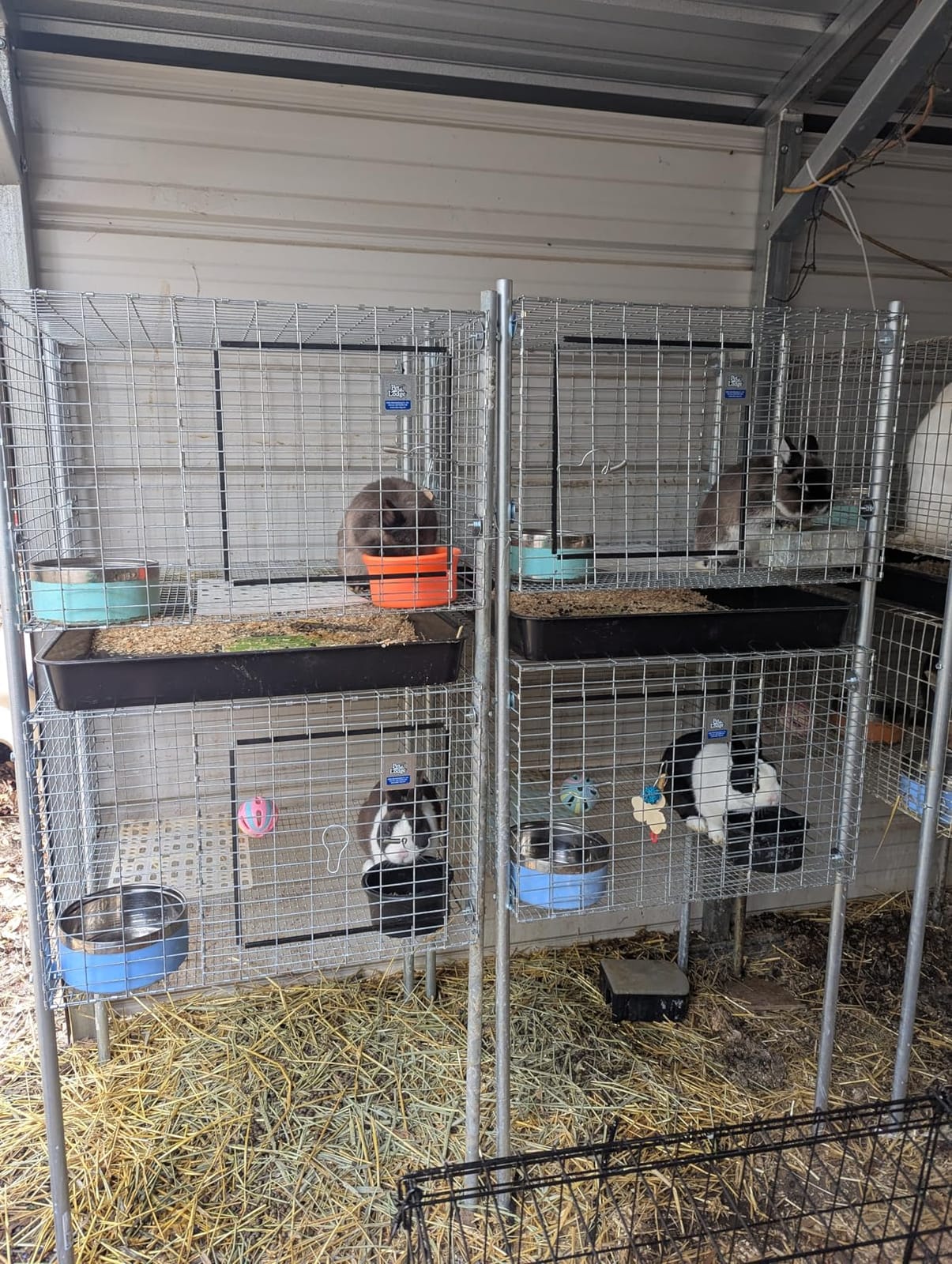
It is stackable up to four high when used with the Pet Lodge frame kit, and the spring latch door with protective vinyl guards stops the nose injuries and latch loss that plague caged rabbits. Made in the USA, with sizes at 24×24, 30×30 and 30×36 so you can match a layout.
Be clear about what you are buying. This is a wire cage, not a hutch. There is no roof, no tray and no shelter, and J clip pliers are not included. You are assembling a component, and you need to provide the roof, the tray or collection system, and any weather cover yourself.
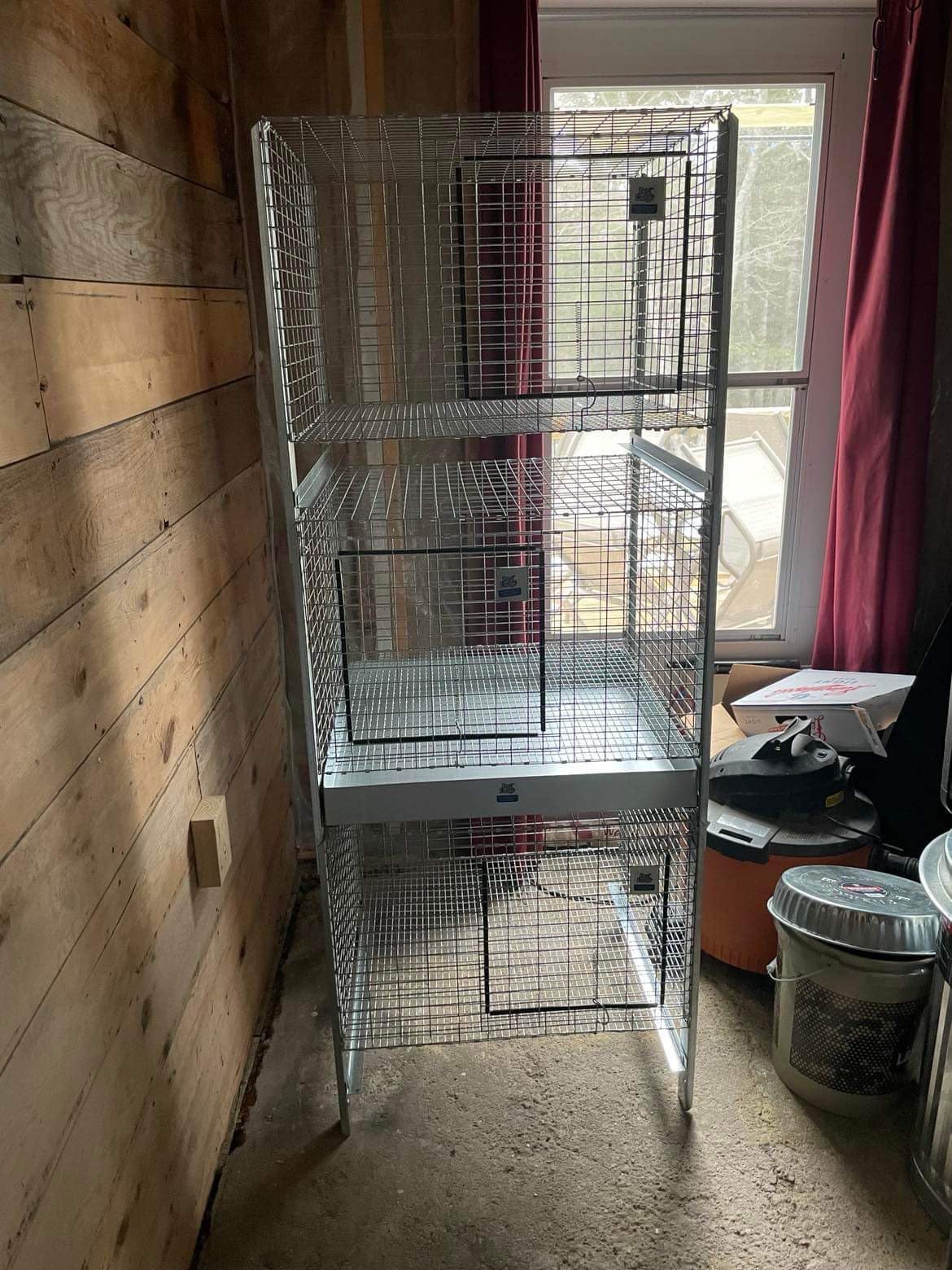
Why breeders choose galvanized wire
Wire cages let droppings fall straight through to a collection tray or compost bin, which keeps the animals cleaner and gives you a manure harvest you can compost. They also ventilate better than any wooden hutch, and ammonia stays low because there is no enclosed corner where urine soaks into wood.
The standard sizes are a practical advantage you do not fully appreciate until you own several. Replacement parts, doors and dividers for a 30×36 layout are easy to source, which a custom-sized build never will be.
What you need to add before using it
Budget for J clip pliers, a feed and water setup, and a roof over the whole stack. Many breeders hang these cages from a frame in a shed, which is how the stackable design is meant to be used.
The floor wire is 16 gauge, and reviewers who keep larger breeds note that 14 gauge is tougher for heavier animals. Add a resting board so part of the floor is solid, and plan on replacing the floor mesh with 14 gauge at some point as the herd grows.
10. GUTINNEEN Three-Level Hutch for Small and Medium Rabbits
Indoor Outdoor Rabbit Hutch, Large Bunny Cage Small Animal Houses & Habitats, Guinea Pig Cage with Removable Tray-Waterproof Roof (Grey)
51.6 x 25.2 x 36.2 inches, 40 pounds
Deep tray with a generous lip
Waterproof asphalt roof
Pros
- Three usable levels including main room and patio
- Deep tray lip resists urine and water overflow
- Three front doors plus a top door
- Waterproof asphalt roof
Cons
- Wood chewing needs a deterrent spray
- Newer listing with a shorter review history
- Seal the wood before outdoor use
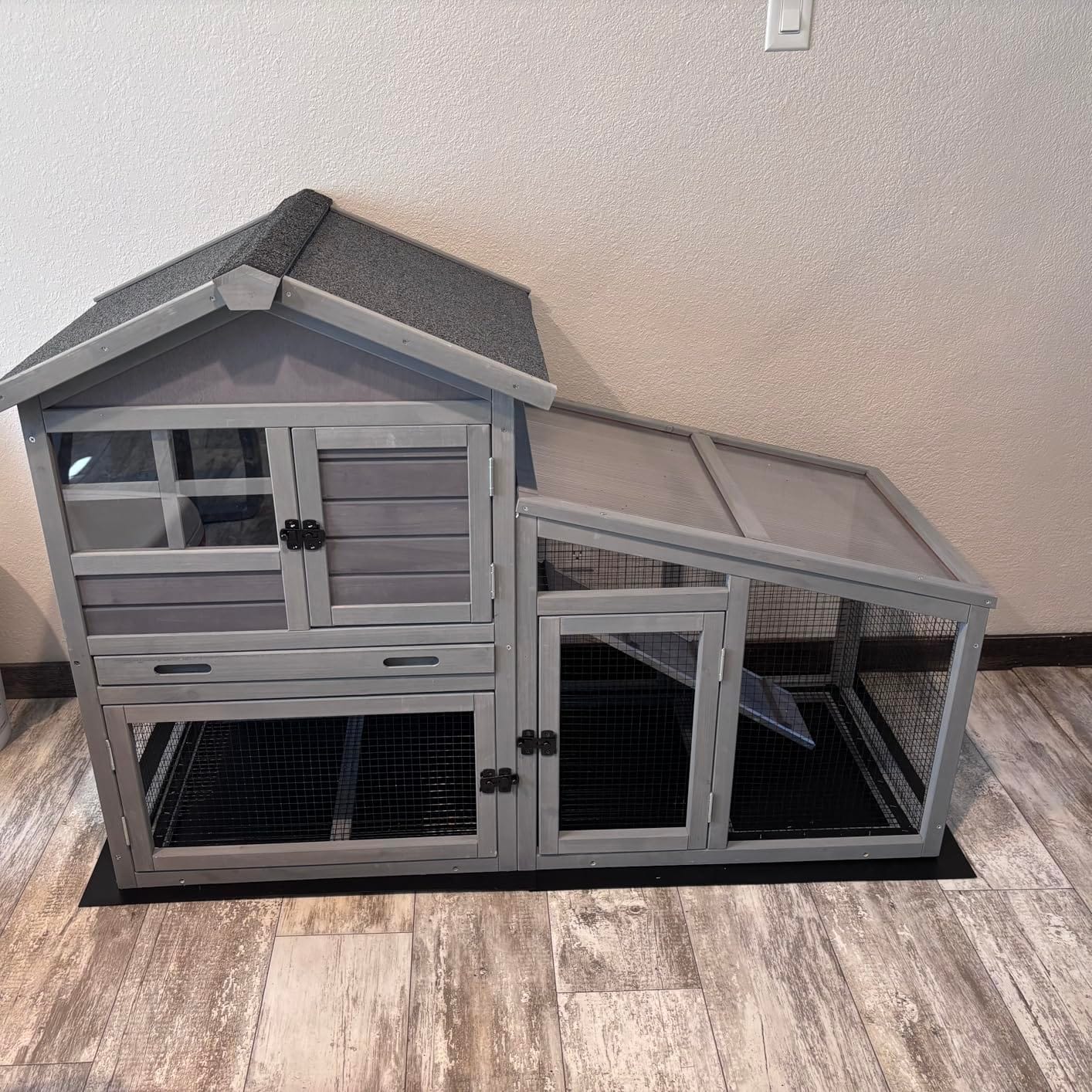
The three-level layout is what separates this GUTINNEEN from the rest of the wooden hutch group. It gives you a main room for living and sleeping, a side patio for play, and a bottom floor for running around. For a rabbit that needs more usable space without a bigger footprint, that third level is genuinely useful.
At 51.6 by 25.2 by 36.2 inches it has more floor area than most of the 62 inch single-run hutches, because the space is distributed vertically rather than stretched horizontally. For medium rabbits that works well, and it is a comfortable fit for a pair.
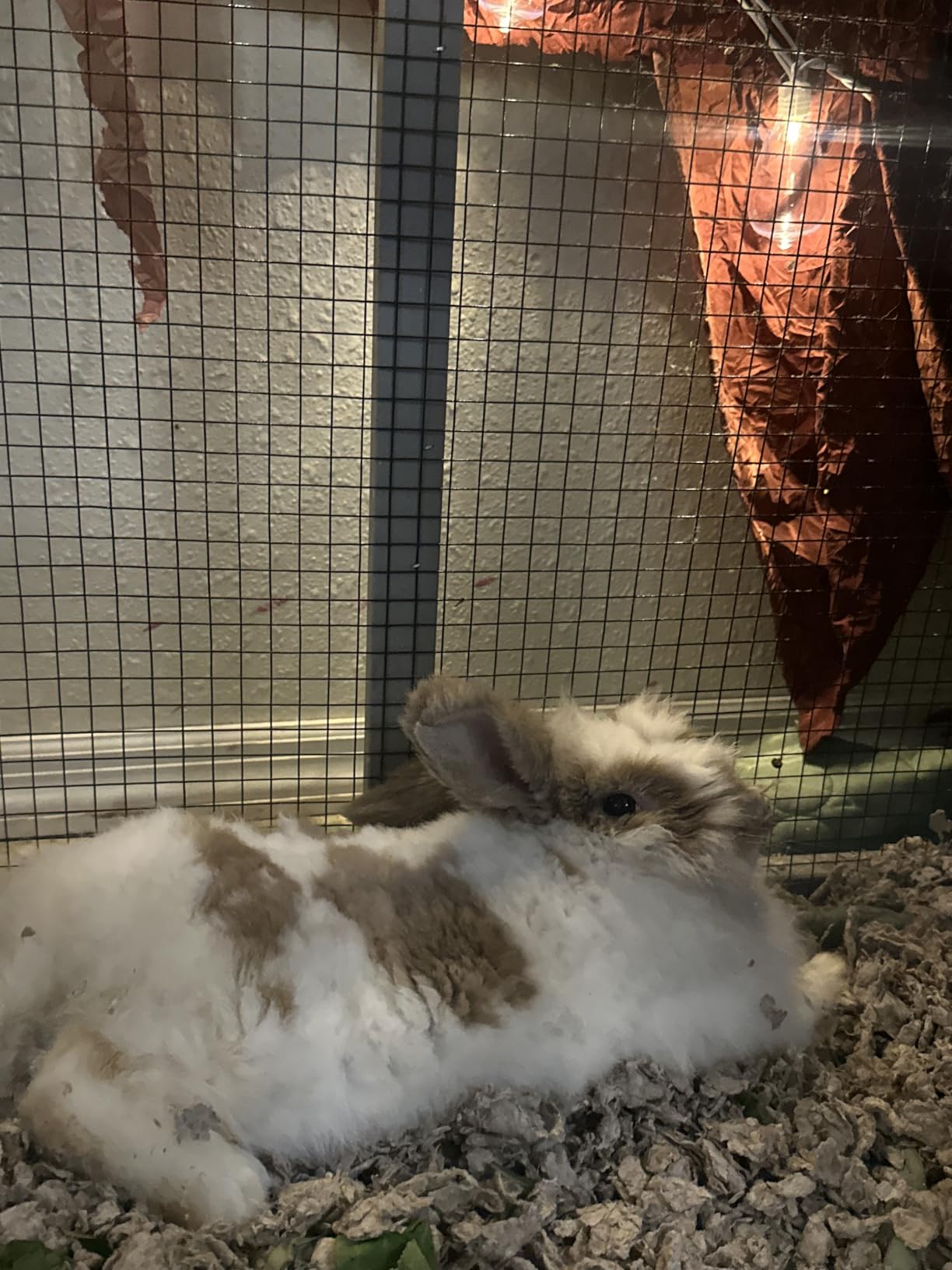
The deep pull-out tray has a generous lip, and the manufacturer states it will not leak urine or water over the edges. That lip is the difference between a tray that needs emptying every day and one that holds overnight, so it is worth checking the lip seal after the first few weeks of use.
Three big front doors and a top open door give you access from nearly every direction, and the asphalt roof keeps rain out. The manufacturer includes no weight limit, which matters less for you than the indoor or covered outdoor placement this needs.
Best suited to
Medium rabbits and pairs, particularly if you are housing them in a shed or a covered run where vertical space matters. The main room works as a sleeping space and the patio gives a change of environment without needing a second cage.
The review history here is shorter than most in this set at 320 reviews, so we would treat the long term durability claims as less tested than the ones on the older models. That is not a criticism of the design, just a reason to inspect it more often in the first year.
Maintenance notes
Treat the wood with a bitter deterrent spray, which the manufacturer itself recommends, and seal the frame before any outdoor placement. Rabbits will find the frame edges first, and a rabbit that gnaws through a corner panel will have a path out.
The open top door is convenient but also the weak point for predator access. If this sits outside, the door has to be secured closed and the whole unit has to be inside a fenced run, because the frame is not designed to resist determined animals.
11. Mayugardening Two-Story Hutch with Chew-Resistant Ramp
2 Story Rabbit Hutch Outdoor Indoor, Wooden Bunny Cage with 6 Lockable Wheels, 3 Removable No Leakage Pull Out Trays, Chew-Proof Ramp & Waterproof Roof, Ideal for Rabbit & Guinea Pig
55.3 x 17.8 x 34.5 inches, 38.6 pounds
Three seamless one-piece leak-proof trays
Ramp with dual metal guards
Pros
- Chew-resistant ramp has metal guards on both sides
- Three seamless one-piece trays with no leak seams
- Six locking casters for stability
- Asphalt-coated roof over a solid frame
Cons
- Narrow width of 17.8 inches for a large meat rabbit
- Lowest rating in the set at 3.9
- Newest model with limited long term data
The idea behind this Mayugardening model is the ramp, and the idea is correct. Almost every wooden hutch fails at the ramp first because rabbits chew it, and this one reinforces the ramp edges with metal guards on both sides. It is the single most chew-sensitive part of any wooden hutch and the manufacturer addressed it directly.
The three trays are molded as single pieces with no seams, which should solve the leak problem that reviewers report on seam-based trays. A seamless tray has no gap for urine to escape through, and smooth plastic wipes down in seconds.
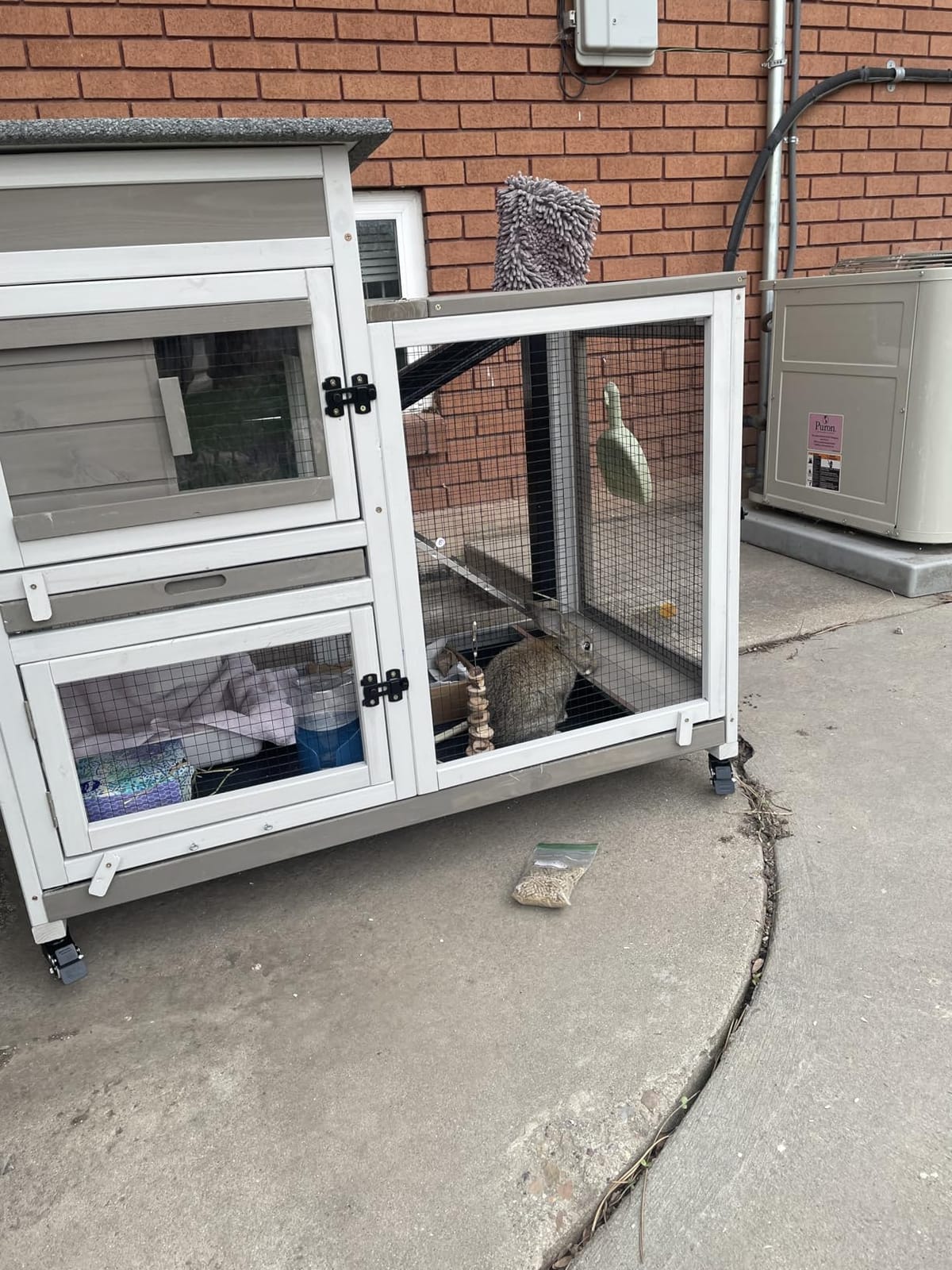
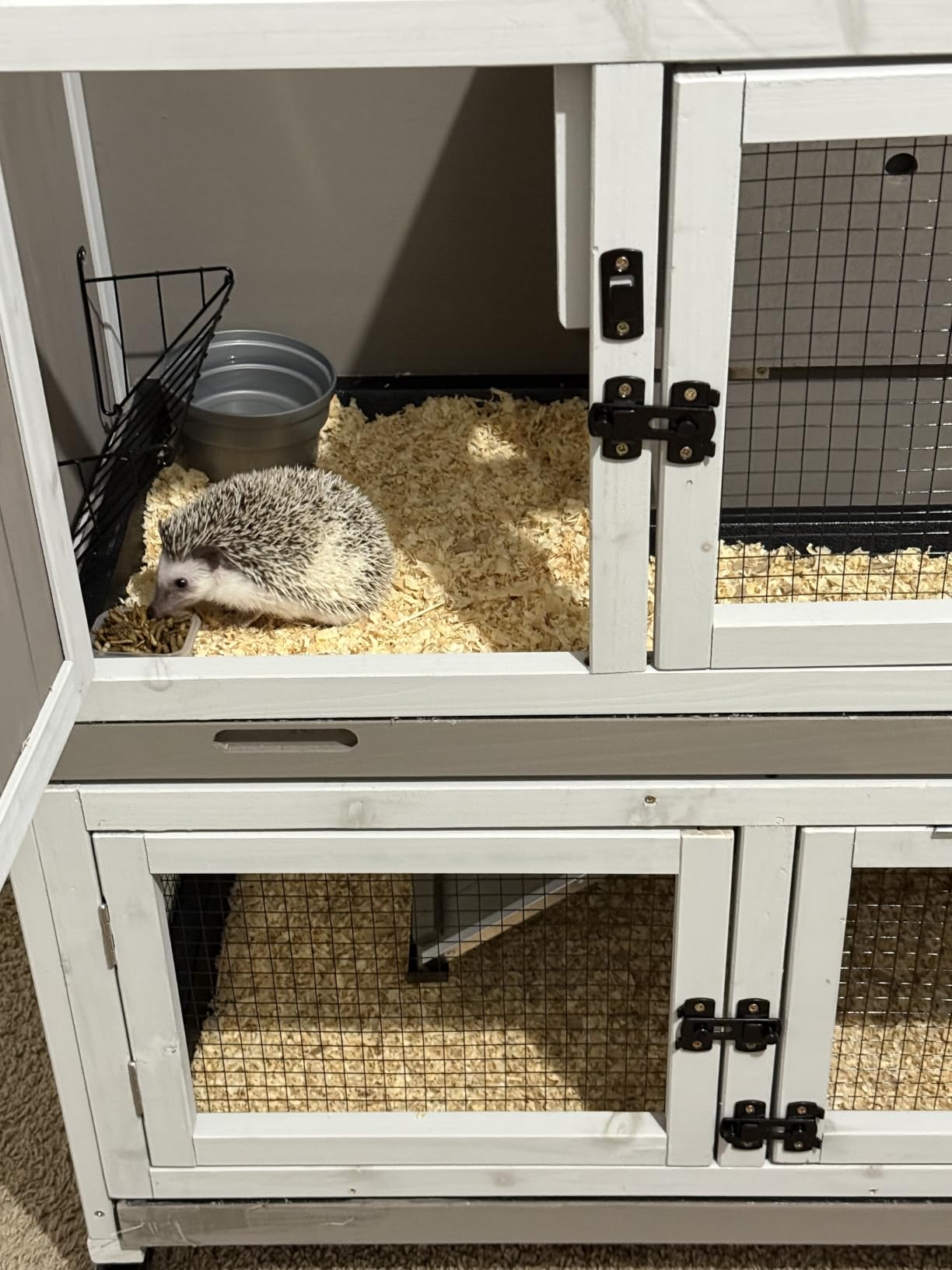
Six locking casters and a solid waterproof frame add stability, and the asphalt-coated roof is described as keeping the interior dry. At 55.3 by 17.8 by 34.5 inches the length is generous but the width is on the narrow side, and that is the number to check against your rabbits.
The rating sits at 3.9 from 210 reviews, and it is a recent model with limited long term data. The feedback is mixed on overall build quality, which is what you would expect from a new design. We would treat it as a promising option rather than a proven one.
Where the width matters
A rabbit turns around and stretches out to full length when it settles. In a 17.8 inch wide cage, a full size New Zealand White can almost do that, and a Rex with a heavier body will feel it. Measure the length of your own rabbits before you commit to a narrow cage.
The elevated two-level design does compensate somewhat, since the vertical space gives a rabbit somewhere to go even if the horizontal space is tight. For two rabbits in one cage, width becomes the constraint rather than length.
How to buy this one carefully
Since this is the newest design in the set, inspect it on arrival. Check the tray seals and the roof coating, and confirm the casters all lock. Reviews mention mixed quality, so the first week of use is when you find out whether you got a good one.
The chew-resistant ramp makes this a good choice for a buck that works on his cage furniture, which is common in intact males once they reach adult size.
12. GUTINNEEN Metal-Frame Reinforced 62 Inch Hutch
GUTINNEEN 2-Story Rabbit Hutch with Chew-Proof Full Metal Frame for Indoor/Outdoor – 62″ Bunny Cage with 6 Locking Casters & 2 Pull-Out Trays for Rabbits, Guinea Pigs, Small Pets (Brown)
62 x 22.6 x 33.5 inches, 10.93 square feet
55 pounds, aluminum alloy reinforced frame
Three lockable deep pull-out trays
Pros
- Aluminum alloy reinforced frame resists chewing and warping
- Three trays lock so they cannot slide out during handling
- Five access doors plus an openable run roof
- Pre-drilled holes make assembly quick
Cons
- Wood is very soft and screws split it easily
- Side mesh is thin
- Roof material flakes badly
This is a well-built design for a rabbit that chews. The frame is solid wood reinforced with aluminum alloy, which is a direct answer to the single most common complaint about wooden hutches. Rabbits chew frames, and a reinforced frame buys you years where a plain wood frame buys you months.
At 62 by 22.6 by 33.5 inches it works out to 10.93 square feet of living space, which is among the largest footprints here and a genuinely comfortable size for a doe with a litter or a small growout group. Three deep trays that lock in place are a nice touch, since a tray that slides out while you are handling a rabbit is how you lose an animal.
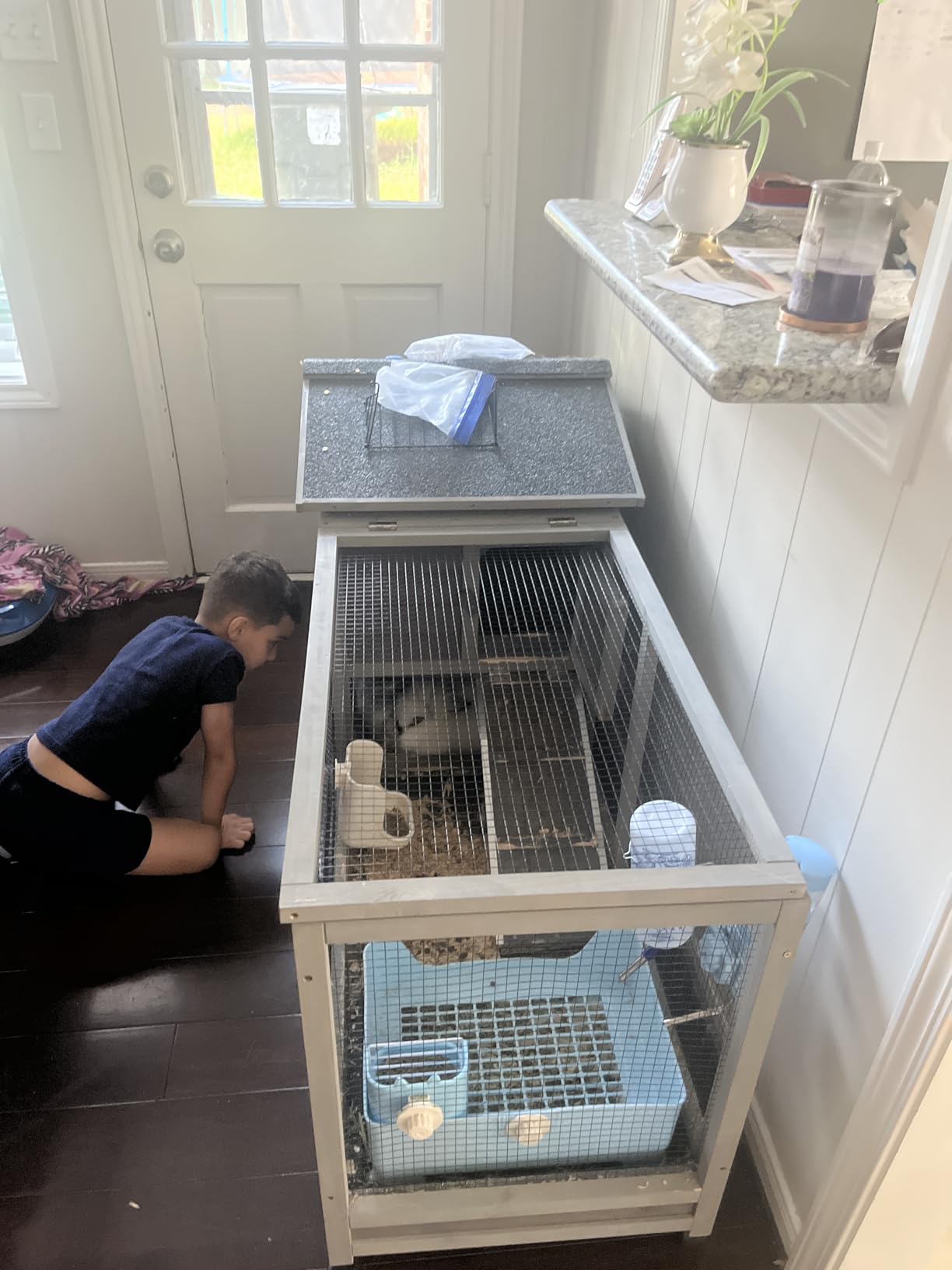
Five access doors plus an openable roof over the run mean you can reach any corner without crouching and reaching blind. Six swivel casters with two brakes let you roll the whole hutch, and at 55 pounds it is heavy enough to stay put even with a rabbit pushing against a door.
The weakness is the wood itself. Reviewers describe the wood as very soft and thin, and the pre-drilled holes do not include pilot holes for sharp screws, so screws split the wood if you drive them straight. Drill pilot holes yourself and this becomes a much better cage.
Best for and worst for
Best for an outdoor covered setup where a chewing buck would otherwise destroy a plain wood frame in a season, and best for anyone who wants the floor area of a 62 inch run with reinforced structure. The ventilation from the durable wire mesh keeps ammonia down in warm weather.
Worst for anyone without a drill or patience at assembly, because the soft wood demands careful pilot drilling. It is also a recent model from May 2025 with a shorter track record than the older designs here.
Long term outlook
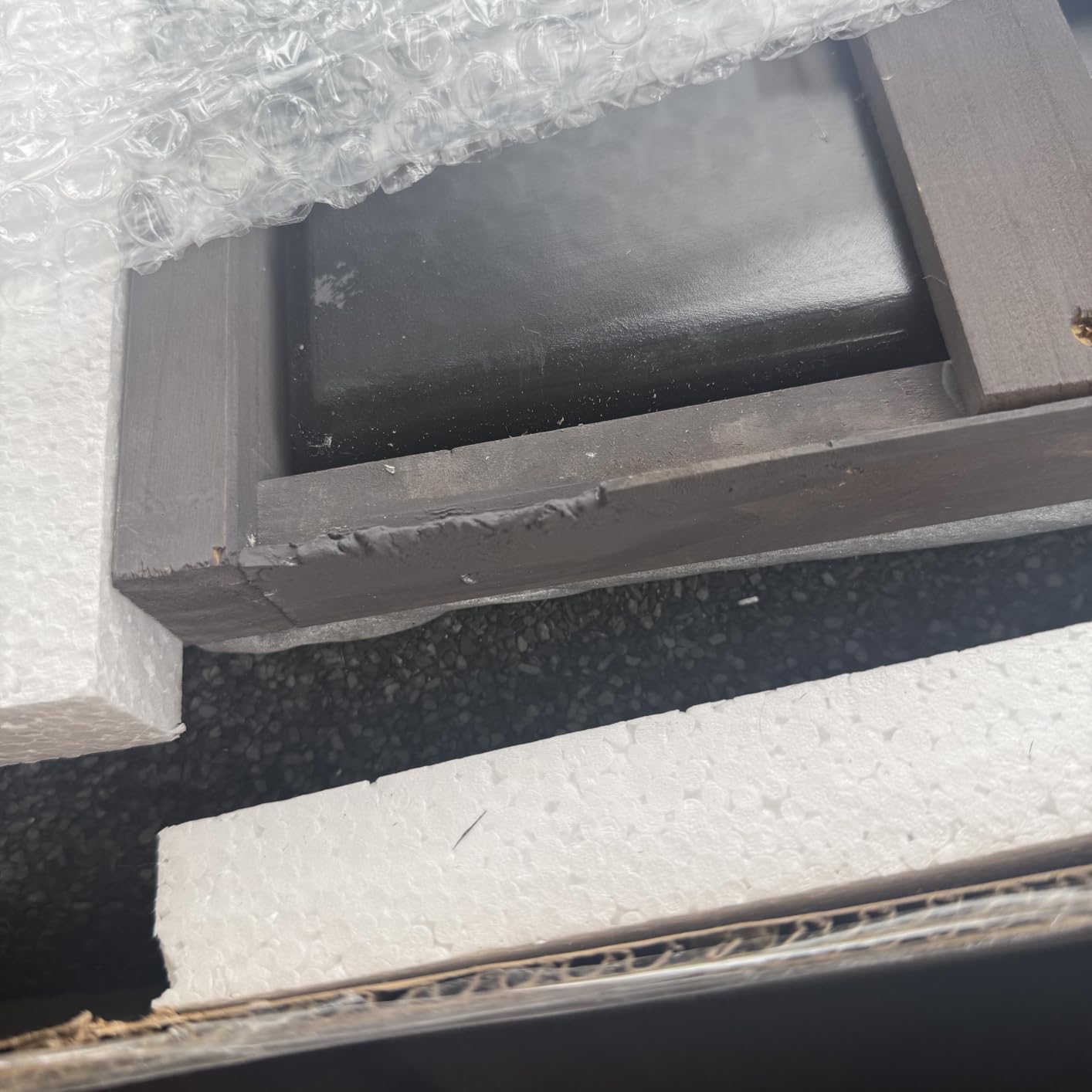
The mesh is thin and some cages arrived with damaged mesh, so check the whole hutch on arrival and replace any bent panel before you load it with rabbits. The roof flakes, which is cosmetic unless the flakes reach the tray.
Seal the wood, use the reinforced frame to your advantage, and keep it under cover. Done that way this is a chew-resistant wooden hutch that should outlast plain wood frames.
How to Choose a Rabbit Cage Size by Use
Size is the first decision, and it depends entirely on what goes in the cage. Experienced meat breeders told us repeatedly that a clean, dry 30×30 inch cage is perfectly workable for a New Zealand White, provided the floor is right and the cage stays dry. That is smaller than most pet rabbit guidance suggests, because a production rabbit is in a predictable familiar space rather than being asked to exercise in it.
Here is how to size for each job:
Buck: 30 x 30 inches is the standard working size. Add a second cage of the same size if you keep more than one buck, because they cannot be housed together.
Doe with litter: 30 x 36 inches at minimum, and 36 x 36 inches is better for a New Zealand White with a large litter. The extra depth lets her build a nest away from the tray without blocking the whole cage.
Doe without litter, or a growout single: 30 x 30 inches works.
Growout group: two fryers per 30 x 36 inch cage is a workable ratio once they are past the point of fighting. Below eight weeks, keep them separated by size.
Nest box: the box itself should sit outside the cage on a shelf, not inside it. That keeps the litter out of the tray and off the wire floor, and it gives the litter a dark enclosed space.
If your available floor space is tight, the cheapest square footage you can buy is vertical. Stacking cages four high with a frame kit, as the Pet Lodge is designed for, turns one footprint into four cages and is the standard move once a rabbitry passes six or eight animals.
Wire and Flooring Guide for Meat Rabbit Cages
Most housing mistakes trace back to wire specification, so this section is worth reading before you buy anything. The numbers are simple and specific.
Floor wire: 14 gauge galvanized welded wire at 1/2 x 1 inch is the production standard. It holds a heavy rabbit without flexing and it lets droppings fall through to the tray.
Side and back wire: 14 gauge at 1 x 1 inch. Anything wider and a young rabbit can push its head through; anything narrower and you pay for wire you do not need.
Sore hocks: a rabbit that lives on wire develops sore hocks, which is a painful inflammation of the foot pad. The mitigation is a resting board or mat covering part of the floor, and the prevention is solid floor area for part of the day. Mesh at 1/2 x 1 inch is better than 1/2 x 1/2 inch because it gives the pad more support.
Chicken wire: do not use it. Hexagonal chicken wire stretches and rabbits push through it, and it rusts within a season. It is the single most common error in cheap DIY builds.
Galvanized over painted: galvanized steel survives urine. Painted steel corrodes at the tray line and the cage fails from the bottom up.
Urine guard: a lip or guard around the tray edge catches spillage that misses the tray. It is a small feature that meaningfully reduces odor and damp corners.
Droppings board: a removable solid board under part of the cage gives the rabbit a dry place to sit and makes manure collection cleaner.
Why wire mesh at all instead of solid walls? Airflow. Solid-sided cages trap ammonia and moisture, and in a rabbitry with several cages close together the odor and the respiratory irritation become a herd-level problem. Wire walls ventilate in both directions and let you see every animal without opening a door.
Indoor Shed or Barn vs an Outdoor Setup
Where you put the cages matters as much as which cages you buy. An indoor setup in a shed, garage or outbuilding gives you temperature control and predator protection, and it is the right default for anyone starting out.
An outdoor setup gives your rabbits daylight, air and more room, and it is where predator defense becomes your problem. The people running outdoor setups successfully layer their defense rather than relying on one fence, and Rabbit Talk breeders describe combining chain link with cattle panels, baited trap stations, and guard dogs patrolling outside the fence line. Any single layer fails eventually.
A pole-and-tarp shelter anchored with stone filled buckets is the common no-barn approach, and it works in mild areas, but be aware that lightweight structures are a liability in wind. In deep cold, rabbits in an unheated outdoor cage burn energy they need for growth, and water in the lines can freeze.
If you process rabbits you raise, you will also want equipment that handles them efficiently. Our picks for the best electric meat slicers cover the processing side once the rabbits come out of the cage.
Cleaning Routine and Manure Harvest
A wire cage with a pull-out tray is designed around a fast daily routine, and getting into that habit early is what keeps a small herd healthy. Here is the sequence we would use:
Empty the trays every morning. Droppings and urine go straight into a compost bin or a manure pile. Daily removal is what keeps ammonia at a level rabbits tolerate.
Scrape the tray edges and the urine guard. Films that dry on the plastic tray lip are the source of the smell that makes people believe their cage stinks permanently.
Check the floor and droppings board weekly. Wire that has bent or a board that has shifted under weight is a sore hock waiting to happen.
Wash and disinfect between animals. A diluted bleach solution or a vinegar rinse on trays, doors and removable parts, followed by a full dry before the next rabbit goes in.
Move the manure to the compost pile immediately. Rabbit manure is high in nitrogen and hot in a pile, so keep it away from the compost you are trying to cure.
Cage design decides how much of this you can do quickly. Three deep trays pulling out from both sides, and wire floors that let waste fall straight through, are why the hutches with those features save hours a week compared with a solid-floored single-tray hutch.
Frequently Asked Questions
What is the ideal size hutch for meat rabbits?
A 30 by 36 inch cage is the practical minimum for a doe with a litter, and 36 by 36 inches is better for a full size New Zealand White. A 30 by 30 inch cage works well for a single buck or for one growout rabbit. Group growout fryers two per 30 by 36 inch cage once they are past eight weeks and no longer fighting. Keep nest boxes outside the cage on a shelf.
What type of wire is best for rabbit cages?
Use 14 gauge galvanized welded wire. For the floor, 1/2 x 1 inch mesh supports a heavy rabbit and lets droppings fall through to the tray. For the sides and back, 14 gauge at 1 x 1 inch is enough to stop a rabbit pushing through without costing more than you need. Never use chicken wire, which stretches and rusts within a season. Add a resting board or mat on part of the floor to protect against sore hocks.
Should I buy or build rabbit cages?
Buy when you are starting, because buying is faster than building and you can be housing animals this week. Build when you pass roughly six to eight animals, because at that point a hanging all-wire system with shared frames and trays costs less per cage and is far easier to clean. The common midpoint is buying a few now and building a hanging system from 14 gauge galvanized wire when the herd justifies it.
Can a rabbit stay in a cage all day?
In a production setup, yes, and experienced meat breeders work this way deliberately. A clean, dry 30 by 30 inch cage with a correct floor is workable, because rabbits raised that way settle into a familiar predictable space. What matters far more than size is floor type, dryness, ventilation and how often the tray is emptied. Adding a solid resting board or mat gives them a dry spot to sit and reduces sore hock risk.
What is the 3-3-3 rule for rabbits?
The 3-3-3 rule is a pet rabbit guideline that suggests three hours of exercise, three hours of roaming space outside the cage, and three hours of interaction each day. It was not written for meat rabbit production, where rabbits are housed individually for controlled breeding and growth. Applying it to a meat rabbit setup usually leads people to buy oversized hutches that are harder to clean and worse ventilated. Size cages by the job: doe with litter, buck, or growout.
Conclusion: Our Top Rabbit Hutches for Meat Rabbits in 2026
After comparing all twelve, the Aivituvin AIR24-B remains our pick for the best rabbit hutches for meat rabbits, because its removable wire floor over a deep leak-proof tray is the combination that matters most, and it has 3828 reviews behind it. For a long indoor rabbitry the Ferplast Krolik wins on durability, and for building a real production system the Pet Lodge galvanized 30×36 cage is the piece of hardware you will still be using in ten years.
Whichever you pick, put a wire floor over a tray you can pull out, size by job rather than by pet rabbit guidance, and treat the wood before it meets a rabbit. Once your herd passes about eight animals, move to 14 gauge galvanized hanging wire cages and skip the wooden hutch entirely.
If you also process your own meat, our tested picks for the best electric meat grinders are the natural next step after slaughter.