
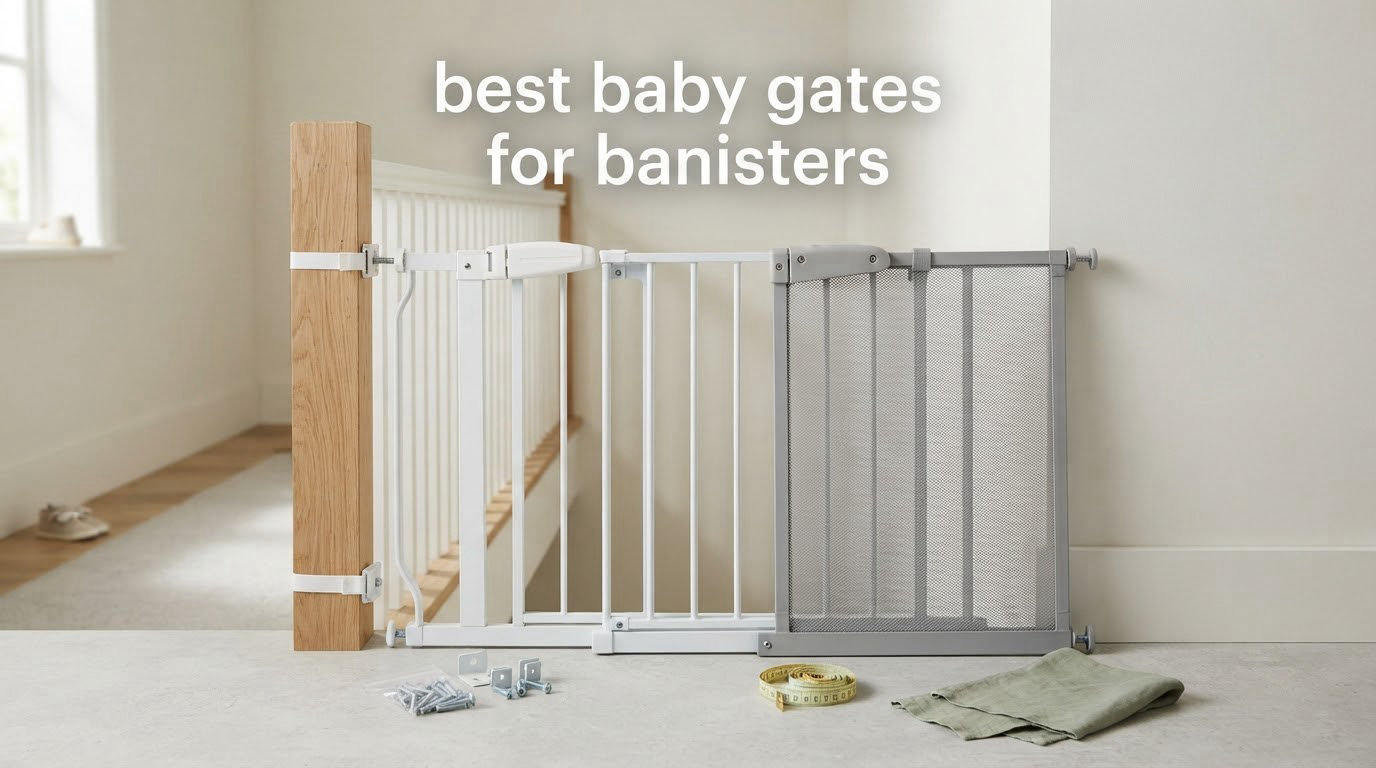
Quick answer: the Cumbor 30-46 inch baby gate is the best baby gate for banisters overall. It converts between pressure and hardware mounting, it comes with two Y-bolt adapters for round banisters, and it carries the most reviews of any gate we examined at more than 21,000 with a 4.6 average. The one caveat that matters more than any feature: never use a pressure-mounted configuration at the top of a staircase. It has no positive anchor at the bottom of the frame, and a toddler leaning on it at the stair head is exactly the situation that ends in a fall.
A banister is the least forgiving surface in the whole childproofing world. A doorway gives a gate two flat, parallel, vertical planes. A banister gives you a rounded or square post, a sloped run of spindles, and often nothing at all on the other side. That single difference changes which gates you can use, which brackets you need, and whether your installer spends twenty minutes or an entire afternoon.
We spent weeks comparing ten of the most-reviewed gates in the category against the specific problems a banister creates: uneven contact points, angled openings, spindles too wide to clamp, glass you cannot drill, and stair heads where a pressure bar becomes a trip hazard at 2am. Everything below is scored on how it behaves on a railing, not on how it looks in a doorway. If you want a broader look at gates for flat openings, our [general baby gate roundup](https://factsforhealth.org/best-baby-gates/) covers those separately.
Table of Contents
Top 3 Picks for Best Baby Gates for Banisters in 2026

Cumbor 30-46 Inch Baby Gate
- Pressure or hardware mount
- Y-bolts for round banisters
- Auto-close walk-through door
- Carbon steel frame

Babelio 26-40 Inch PressGuard
- Triple-lock latch
- No-drill pressure mount
- Tested to 260 N
- Fits 26-40 inches

Ingenuity Stairway 48W
- Hardware mounted
- 30-48 inch span
- Oak wood panels
- No bottom threshold
Quick Overview: All 10 Baby Gates for Banisters Compared (October 2026)
| Product | Specifications | Action |
|---|---|---|
| Cumbor 30-46 Inch Baby Gate |
|
Check Latest Price |
| Ingenuity The Stairway 48W |
|
Check Latest Price |
 Cardinal Gates SS30 Stairway Special Cardinal Gates SS30 Stairway Special |
|
Check Latest Price |
| Babelio 26-40 Inch PressGuard |
|
Check Latest Price |
 Toddleroo Easy Swing and Lock Toddleroo Easy Swing and Lock |
|
Check Latest Price |
 InnoTruth 29.6-44.6 Inch Baby Gate InnoTruth 29.6-44.6 Inch Baby Gate |
|
Check Latest Price |
 Mumeasy 29.7-46 Inch Baby Gate Mumeasy 29.7-46 Inch Baby Gate |
|
Check Latest Price |
 keny 29.7-46 Inch Baby Gate keny 29.7-46 Inch Baby Gate |
|
Check Latest Price |
 Babelio 31.5-55 Inch No Bottom Bar Gate Babelio 31.5-55 Inch No Bottom Bar Gate |
|
Check Latest Price |
 Minne Baby Railing Mesh Net Minne Baby Railing Mesh Net |
|
Check Latest Price |
Yes, You Can Put a Baby Gate on a Banister – Here Is How It Differs
Yes, you can put a baby gate on a banister, but only a hardware-mounted one if the gate is going anywhere near the top of a staircase. The mechanism is simple: two brackets at the top of the frame screw or clamp into the banister post or rail, two matching brackets at the bottom of the frame do the same, and the gate holds because both pairs are anchored to something solid. That is what stops a child leaning on it from moving it.
A pressure-mounted gate has no bottom anchor at all. It relies on friction from a spring-loaded bolt pushing against a surface, and on the gate being a rectangle in a rectangular hole. A spindle run is neither flat nor parallel, so the pressure bolts bear at an angle and the frame racks. Parents on r/HomeImprovement describe exactly this failure mode when they ask about mounting a staircase gate with only one banister available, and the recurring answer from experienced commenters is that the gate needs screw-in hardware on the banister side, not a bolt pressed against a spindle.
Three situations make a banister genuinely hard. The first is an angled or sloped stair head, where the top bracket and the bottom bracket land on different verticals and the gate ends up racked unless the design allows angle adjustment. The second is a glass or tempered panel, which cannot be drilled and offers no flat clamp face. The third is a banister-to-banister opening with no wall on either side, which is a different product category entirely and the one thing none of the mainstream doorway gates are designed for.
There is also a quieter problem. A gate at the top of a staircase blocks the opening, but it does nothing about the spindles on the other half of the run. If the gap between your balusters is wide enough for a small head, you need spindle guards or railing fillers as well. Threads on r/HomeImprovement about iron balusters and cable railings tend to converge on the same conclusion: add guards whether or not a gate is present.
For homes where the staircase is not the only concern, our [baby playpen comparison](https://factsforhealth.org/best-baby-playpens/) covers the other half of the open-plan problem, since moving a toddler to a playpen on the same floor as the stairs solves nothing.
1. Cumbor 30-46 Inch Baby Gate – Best Overall for Banisters
Cumbor 30-46″ Baby Gate for Stairs, Auto Close Dog Gate for Doorways White
Carbon steel,46 inch wide by 30.5 inch tall,Pressure or hardware mount with two Y-bolt banister adapters
Pros
- Works as a pressure mount or a hardware mount
- Y-bolt adapters clamp to round banisters
- Auto-close walk-through door with one-hand release
- Carbon steel frame survives jumping and dogs
Cons
- Assembly warning stickers bond hard to the finish
- Wide frame is heavy to handle
- Pressure bolts may need heavy-duty ties to reuse
This is the gate we keep coming back to because it makes you choose a mounting style rather than a gate. Most units in this set are either pressure-mounted or hardware-mounted and stay that way, and several convert between the two. The Cumbor’s combination of hardware and pressure modes plus the included Y-bolts is what makes it the most flexible option against a banister, which matters in a home with a banister at the stair head and a wide doorway on the main floor.
The banister hardware is the part that matters here. Two Y-bolt adapters are included in the box, and they are designed to bite around a round banister post rather than press against it. That is a genuinely different mechanical principle from a pressure bolt, and it is why this gate can hold on a railing when most of the category cannot.
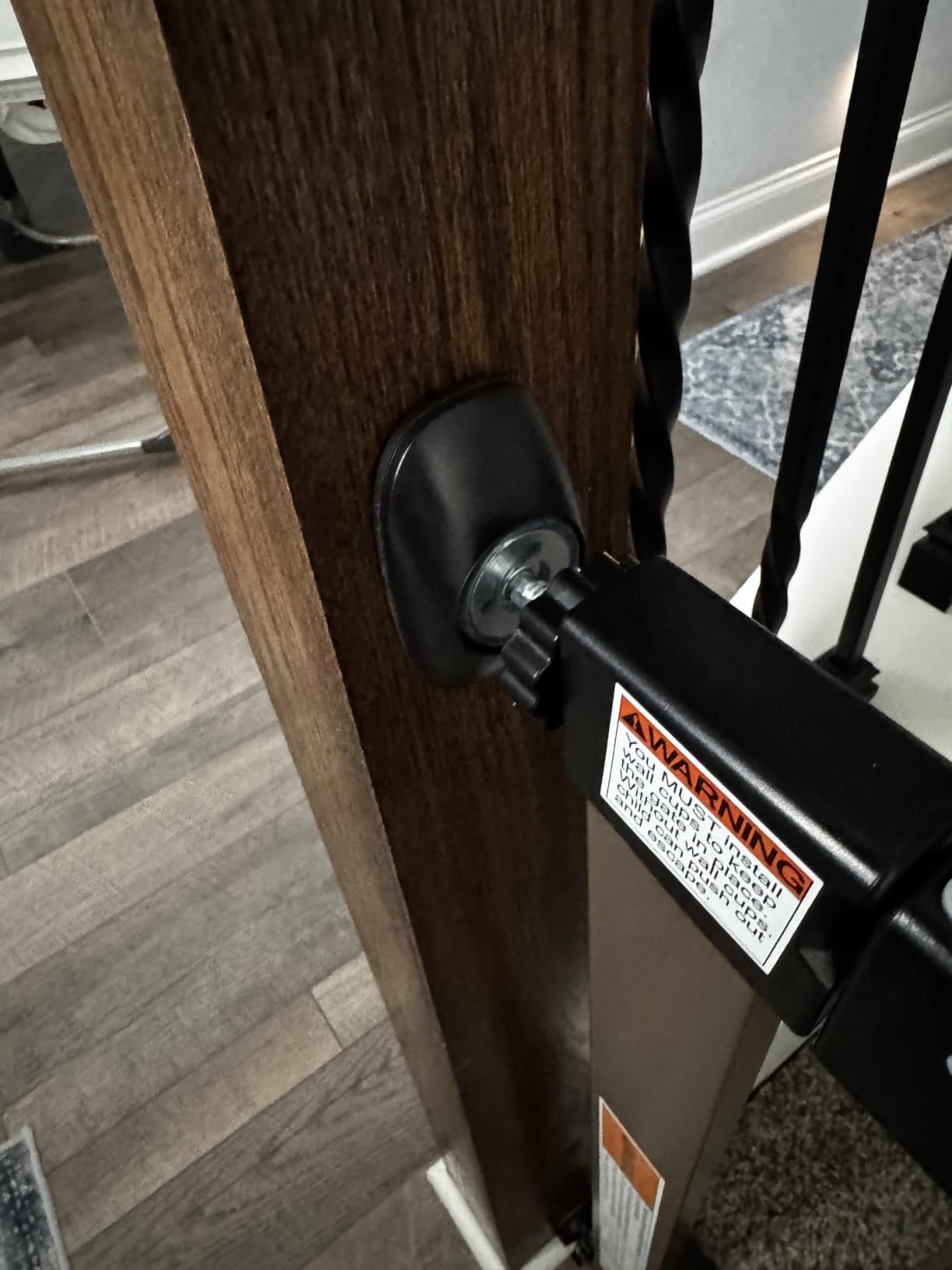
At 30.5 inches tall and up to 46 inches wide, it covers the majority of standard stair openings without an extension piece. The walk-through door auto-closes when opened less than 90 degrees and stays open past that, and the double-lock latch is coordinated enough that adults open it one-handed while a two-year-old generally cannot.
With more than 21,000 reviews behind it, this is the most-proven gate we looked at. Reviewers repeatedly single out the included banister adapters and the ability to move the unit between banister, wall and post configurations without buying anything else.
What it fits and what it costs you
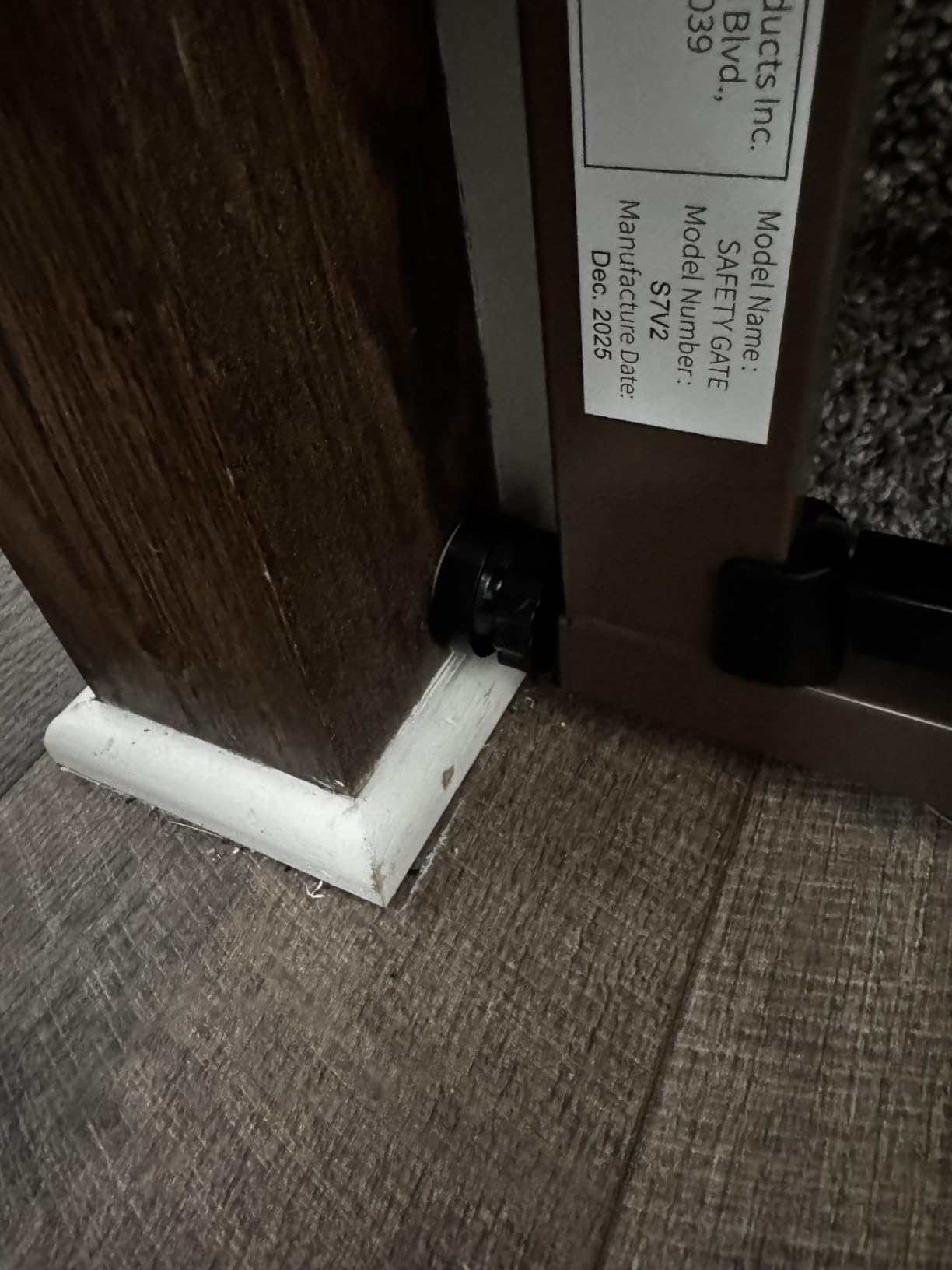
It handles a round newel post, a spindle run wide enough to accept the Y-bolts, and a flat wall. The 30-46 inch span covers most residential stair heads, and extension hardware is available for wider runs.
The trade-off is weight. At 13.5 pounds, this is a two-person lift for most adults, particularly on a staircase where you are already working at an awkward height.
Where it is the wrong pick
Do not use the pressure configuration at the top of a staircase. Use the hardware mode with the Y-bolts seated on solid material, and confirm the bolts bite something that is not a hollow decorative spindle.
Keep the red installation zip tie in place until the gate is mounted. Reviewers warn that cutting it early lets the frame spread and the latch stop lining up.
2. Ingenuity The Stairway 48W – Best Wide Wood-Look Gate
Ingenuity The Stairway 48W Series, 30′-48′ Wide, 32″ Tall, Baby Gate for Stairs with Door, Wood Safety Gate for Doorways and Stairways – Oak Wood
Oak wood and metal,48 inch wide by 32 inch tall,7.4 pounds,Hardware mount for walls and flat banisters
Pros
- Hardware mounted for permanent top-of-stairs use
- 30-48 inch span with no bottom threshold
- Oak finish that looks like furniture
- Low-profile hardware clears baseboards
Cons
- Included drywall anchors and screws are weak
- Plastic latch handle rather than metal
- Banister mounting kit sold separately
The Ingenuity Stairway 48W is the one we recommend when the banister is a flat-topped square post rather than a round one, and when you would rather the staircase gate not look like a piece of nursery hardware. The stained oak panels are the reason: they read as a piece of furniture in a hallway where a white steel gate reads as a warning.
At 32 inches tall it is one of the taller units in this group, which matters if you have a toddler who treats low gates as furniture. The 30-48 inch span also covers more width than most single-piece gates here.
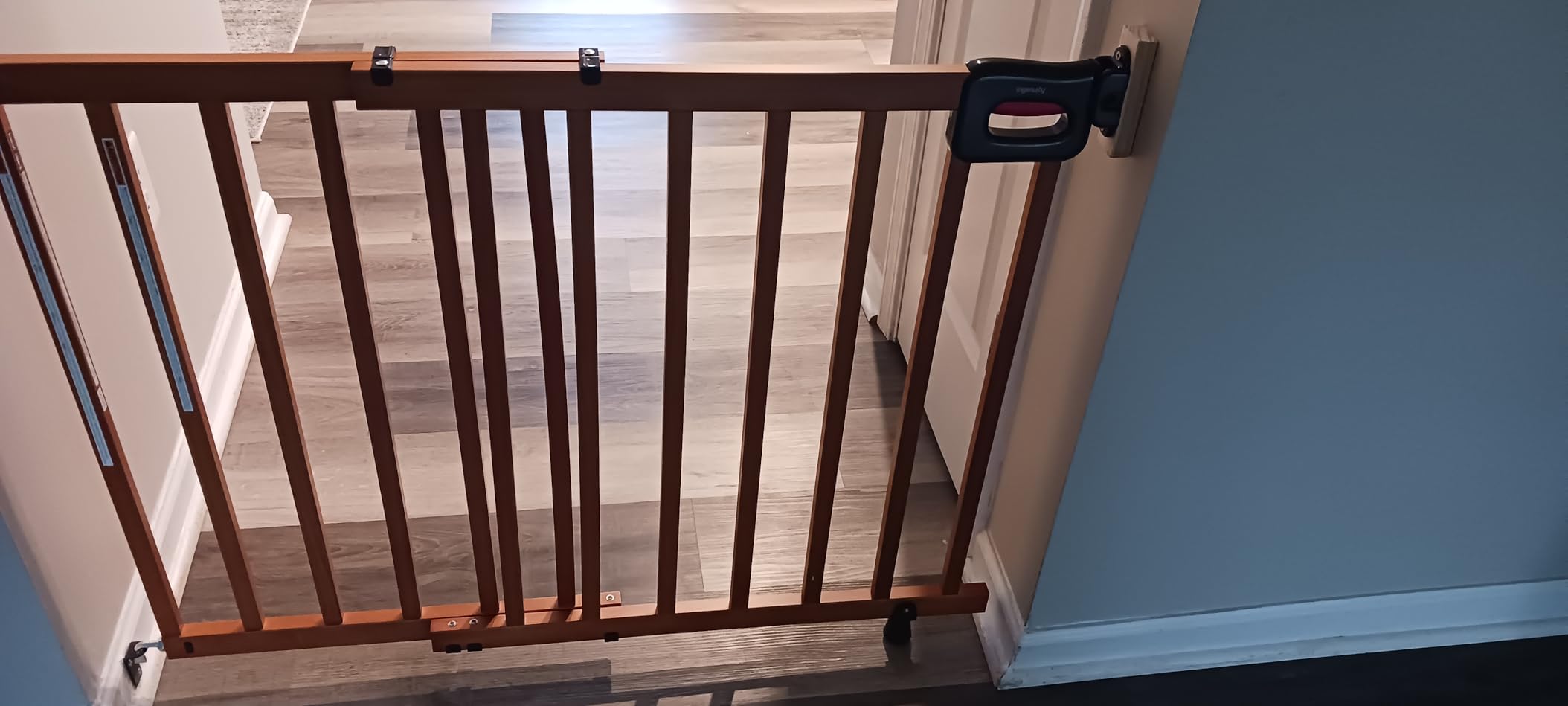
The walk-through door opens without a bottom bar, so there is no threshold for a night-time trip and nothing to trap a toy wheel. Owners of wide openings and angled walls consistently praise the low-profile mounting hardware, which slides under baseboard trim where most gates stop dead.
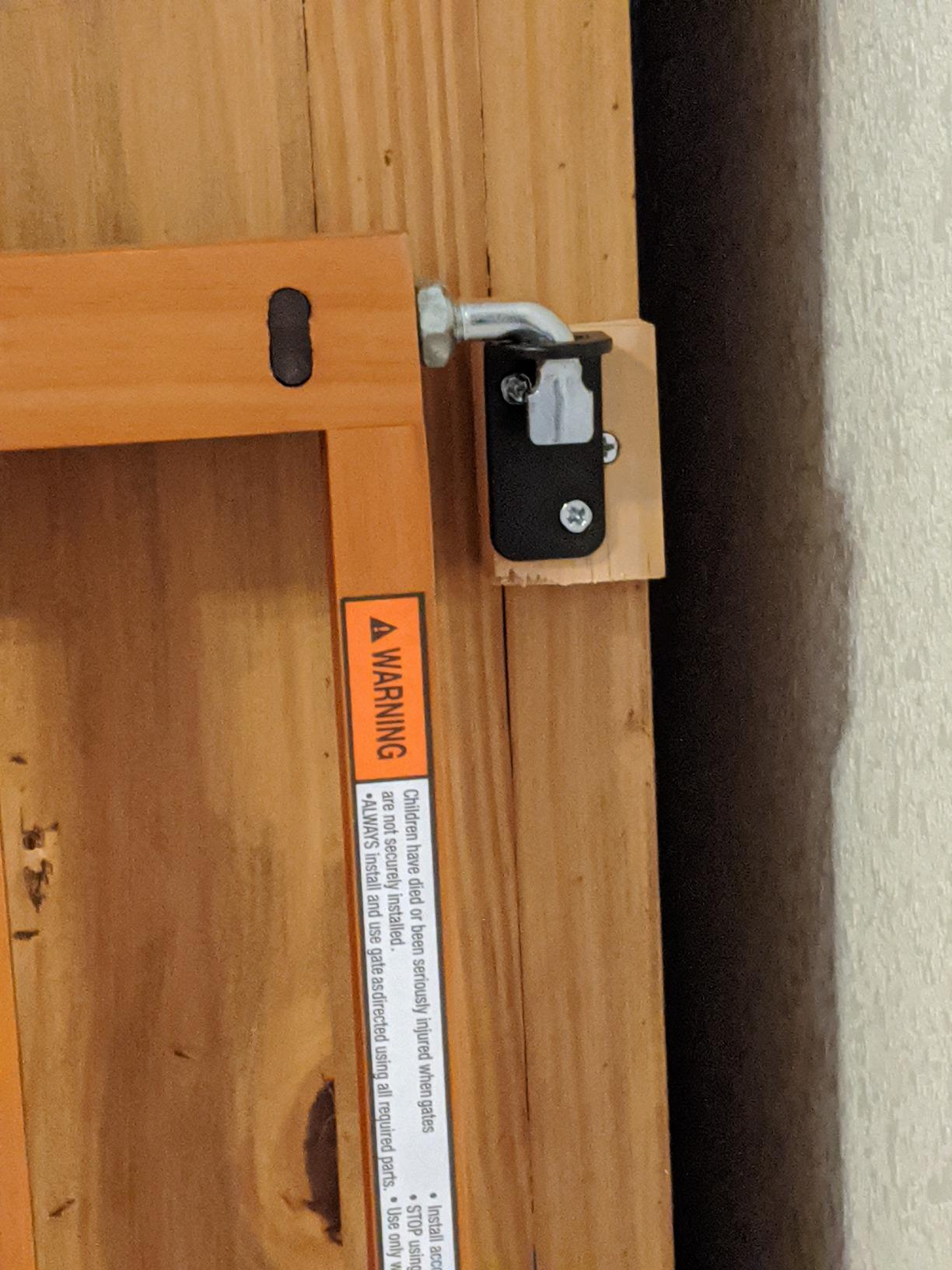
Almost every reviewer makes the same recommendation: throw out the supplied anchors and screws and buy proper hardware before you drill. The included fasteners are the single most common complaint on this gate.
What it fits and what it costs you
It fits walls, doorways, hallways and flat-topped banister posts, with an accessory kit available separately for a banister-specific mount. The stained wood panels blend into a finished interior in a way a steel frame does not.
The 7.4 pound weight is light for a gate that spans 48 inches, so a single adult can usually handle it on a flat floor. On a staircase you would still want a second pair of hands.
Where it is the wrong pick
Skip it if your banister is round, spindled, or glass. The gate assumes a flat, vertical mounting face and the banister kit is an extra purchase.
Also consider the latch. The handle is plastic rather than metal, and the instructions are widely criticised as hard to follow with no clear video walkthrough.
3. Cardinal Gates SS30 Stairway Special – Best for Angled Openings
Cardinal Gates SS30 Stairway Special Baby and Pet Gate, 27-42.5 in, White
All-metal aluminum,27 to 42.5 inch adjustable width,Hardware mounted,Swings 180 degrees to sit flush at an angle
Pros
- Swings flush against angled walls and banisters
- All-metal build with no plastic latch parts
- Keeps the full stair width open
- Width adjusts with no threshold bar
Cons
- Latch needs practice to operate
- Included screws and anchors may be insufficient
- Long mounting rod may not clear a low handrail
Every gate in this roundup struggles at an angled stair head, and this is the one that was designed for it. The SS30’s swing control lets the gate rotate a full 180 degrees so the open panel lies flat against a wall or banister that is not perpendicular to the opening. When a gate swings outward into a wall at an angle, that geometry is what stops the panel from hammering the trim every time a toddler pushes it.
It is also an all-metal gate, with no plastic in the frame or the locking mechanism, which is a real consideration in a category with a long recall history around plastic latches and entrapment geometry.
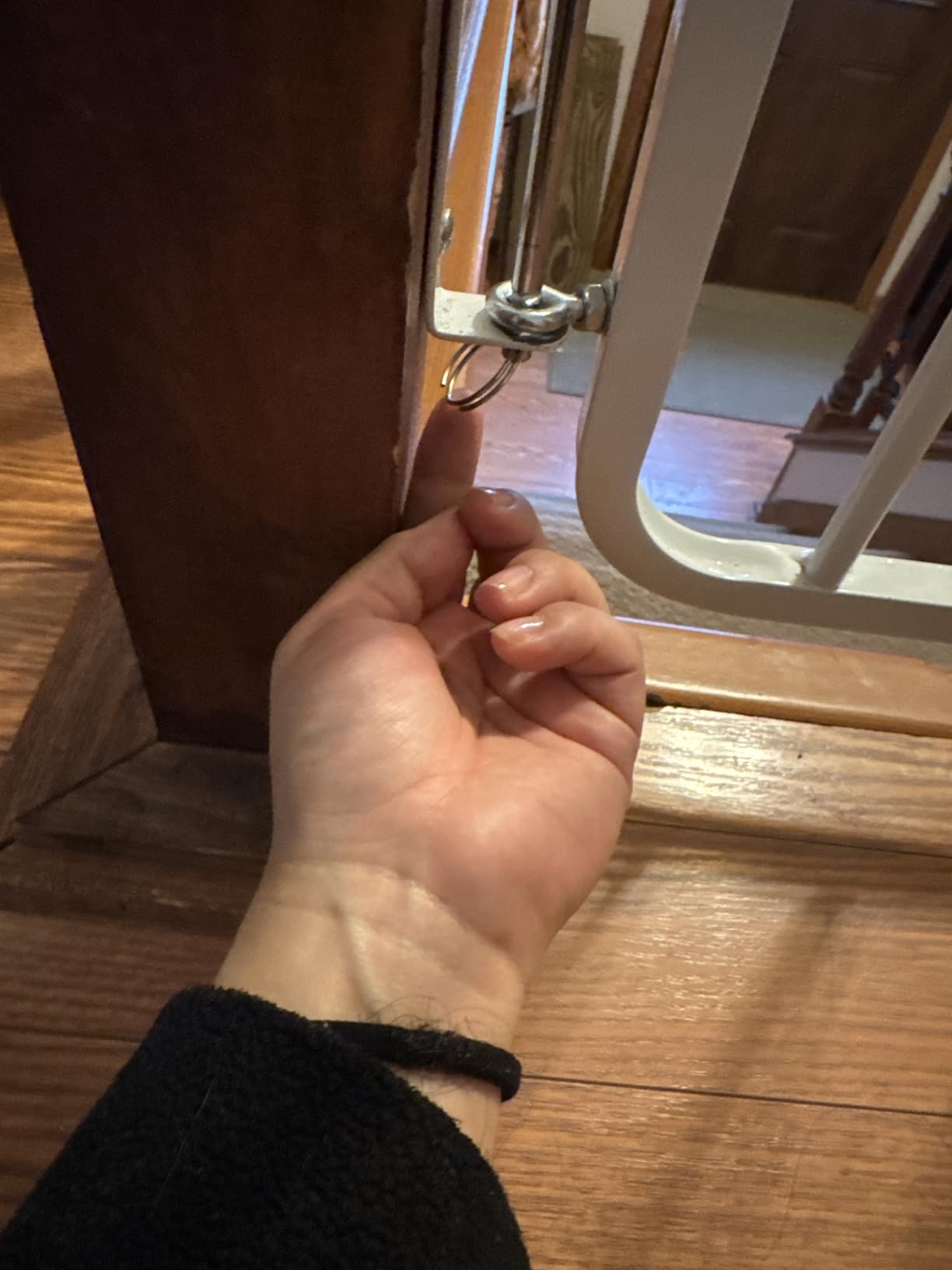
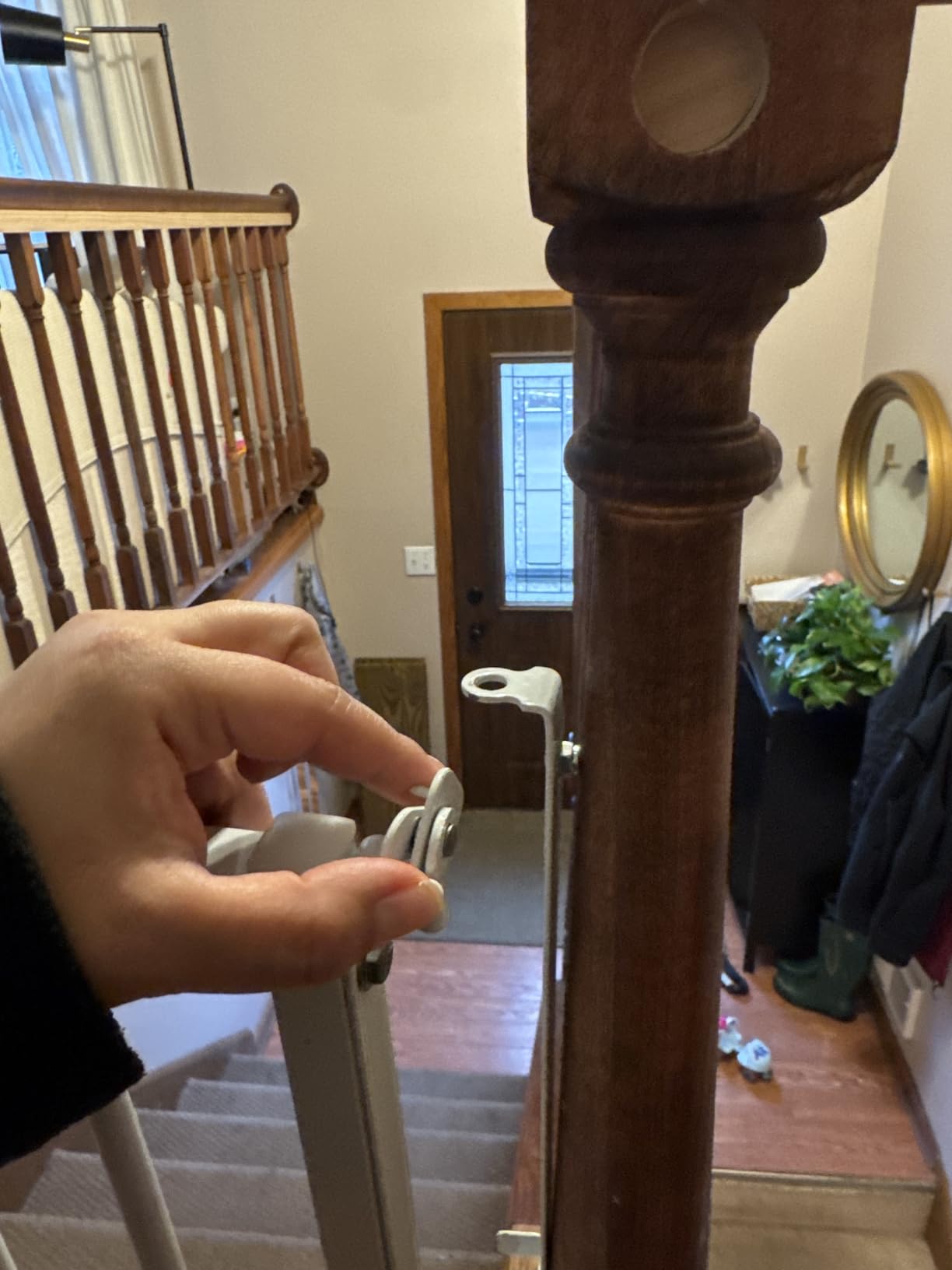
Reviewers repeatedly describe this as the solution for banister configurations where other gates simply refuse to mount. The width adjusts smoothly across 27 to 42.5 inches with no bottom bar to trip over, and extension hardware is available for larger openings.
Opinions split on the latch. Parents who have seen it once operate it without thinking, but guests and grandparents often need to be shown. That is a design choice for child resistance, not an oversight, but plan on a thirty-second demonstration when relatives visit.
What it fits and what it costs you
It fits angled walls, sloped stair heads, and flat banister runs where the top and bottom mounting points are not vertically aligned. The 27-42.5 inch span suits most standard residential openings.
Verify handrail clearance before you order. Several reviewers report the long mounting rod cannot clear a low-profile handrail, and that is not a problem you can solve after delivery.
Where it is the wrong pick
It is not a wide-opening gate. If your opening runs past 42.5 inches you need the extension hardware, and past about 55 inches you need a different product entirely.
Also know that the width adjustment is a one-time operation, and the act of adjusting it dents the aluminium. Decide on your final width before you tighten anything.
4. Babelio 26-40 Inch PressGuard – Best Value Gate for Banister Setups
Babelio 26-40″ Pressure Mounted Baby Gate for Stairs, PressGuard Dog Gate
Metal and plastic,40 inch wide by 30 inch tall,Pressure or wall mount,Triple-lock door with 260 N force testing
Pros
- Triple-lock latch is genuinely child resistant
- Auto-close works more consistently than rivals
- No-drill install leaves walls undamaged
- Width adapters help achieve a snug fit
Cons
- Pressure bolts are hard to thread for some users
- One reviewer received a faulty tension bolt
- Latch release needs a lift as well as a press
The Babelio PressGuard is the value pick because it is the gate we would put at the bottom of a staircase in a rental, where drilling into a banister or a wall is not allowed and the surface is not perfectly square. It pressure-mounts in minutes, leaves no marks, and moves to a different opening when the layout changes.
It is also force tested to 260 N, roughly double the ASTM F1004 minimum for this category. That figure is a manufacturer test result rather than our own measurement, but it explains why the frame feels rigid when a large dog leans on it.
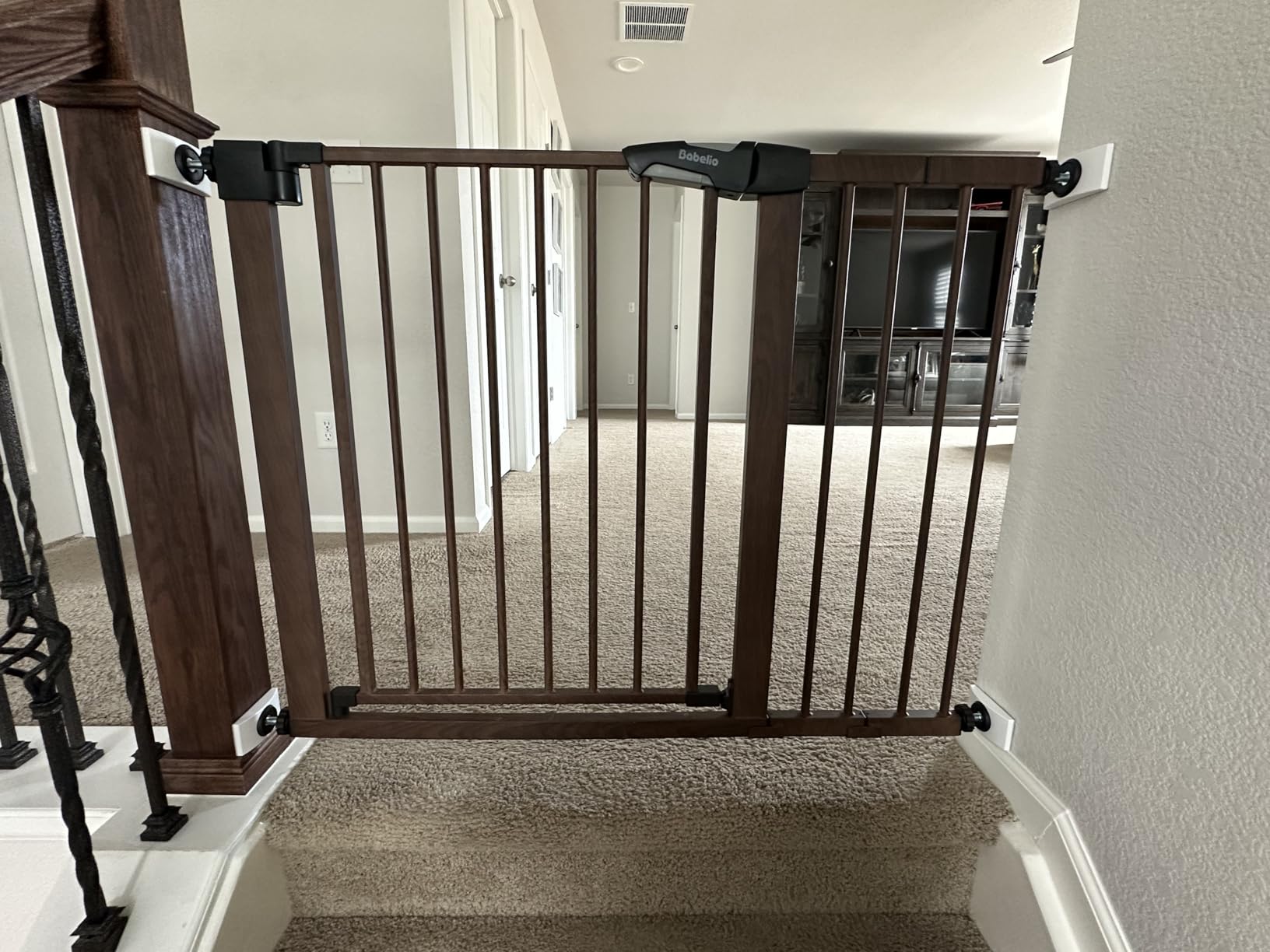
The three-action latch is the standout feature in a pressure-mounted design, and reviewers who own several of this type rate its auto-close as engaging more reliably than competing units. Owners who have tried many pressure gates single this one out for those two features.
Almost all of the critical reviews concern installation hardware rather than safety performance: a defective tension bolt, a small plastic part that cracked, or bolts that resist threading for anyone with limited hand strength.
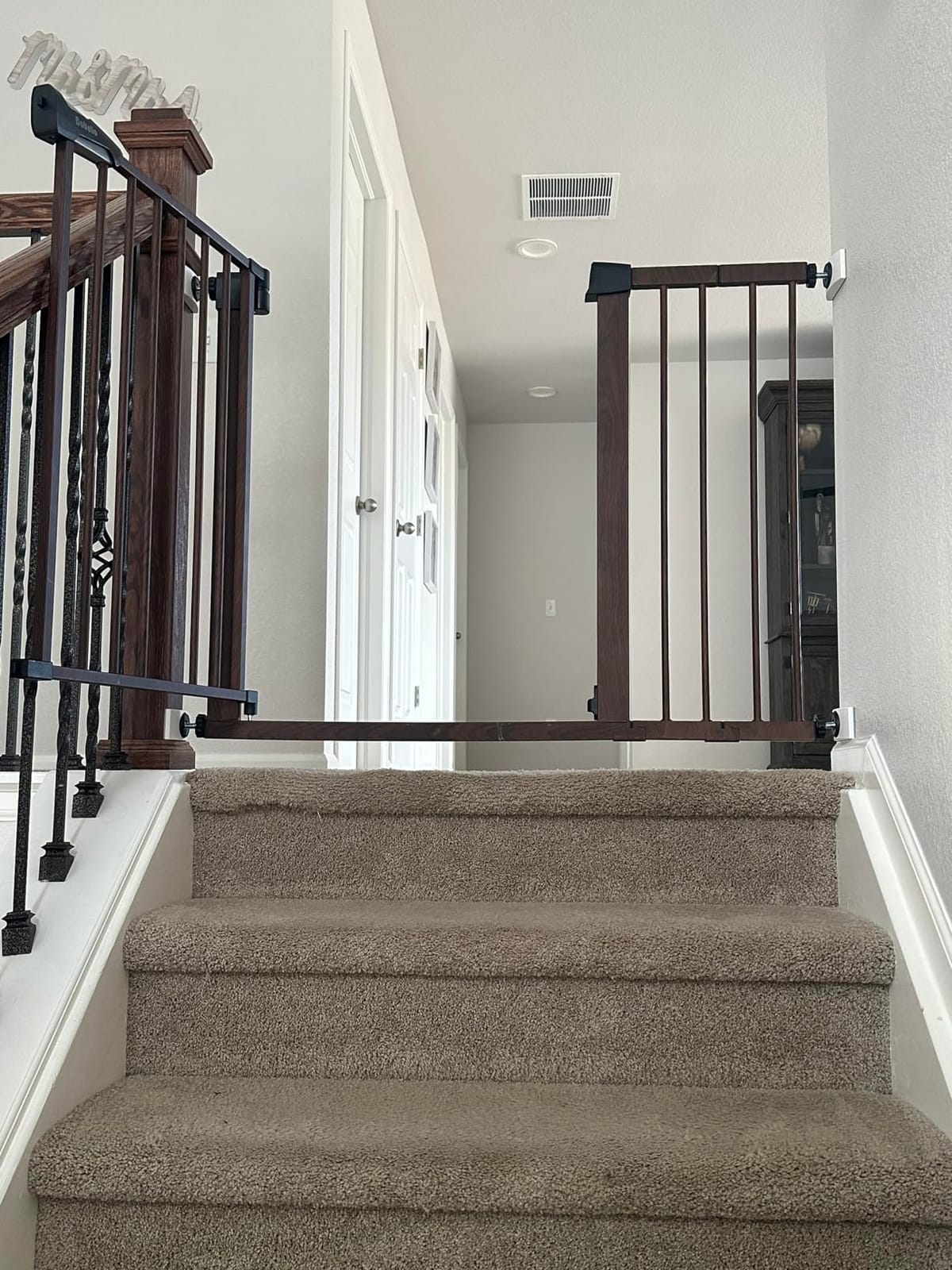
What it fits and what it costs you
It fits openings from 26 to 40 inches wide and at least 30 inches high. At the bottom of a staircase or in a hallway, that covers most situations where no drilling is permitted.
The included width adapters are the part people miss. Without them you get a gap at the side of the frame, and a gap is exactly what a determined toddler tests.
Where it is the wrong pick
Not at the top of a staircase. A pressure gate has no positive anchor at the stair head, and a fixed bottom bar is exactly the kind of thing an adult catches a toe on in a dark hallway.
Also not ideal for very small pets. Reviewers note it will not reliably contain a kitten or a small cat, which is a real limitation if you are solving a pet problem rather than a baby problem.
5. Toddleroo Easy Swing and Lock – Best for the Top of the Stairs
Toddleroo Easy Swing & Lock Baby Gate for Top of Stairs: 31″ Tall, Bronze
Metal,47.9 inch wide by 31 inch tall,8.3 pounds,Hardware mount,Baby Safety Alliance and ASTM certified
Pros
- Entire panel swings open with no bottom bar
- Hardware mounted for permanent stair protection
- One-hand thumb press and lift latch
- No horizontal bars to climb
Cons
- Requires drilling and predrilling long wood screws
- Does not auto-close after use
- Folding paper template can misalign the holes
This is the gate we would put at the top of a staircase in a home where a toddler is already climbing. It is Baby Safety Alliance and ASTM certified, it is hardware mounted, and there are no horizontal bars anywhere in the frame for small hands and feet to work with.
The whole panel swings aside instead of a narrow door within a door, so an adult carrying laundry or a child on their hip walks straight through. There is no bottom bar to trip on and no floor-level threshold to catch a toy or a sock.
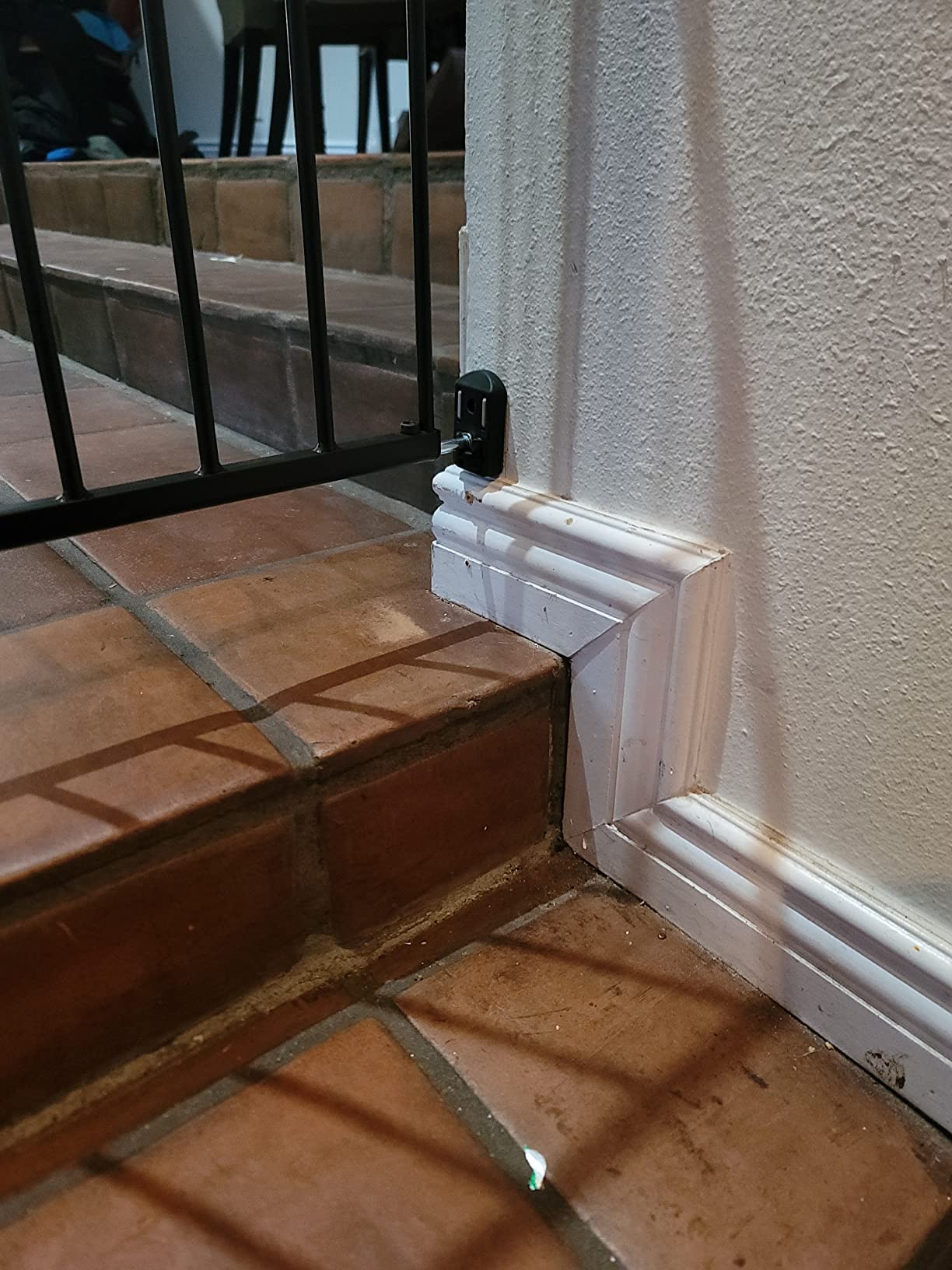
It adjusts from 28.68 to 47.85 inches, which is wide enough for most stair heads without an extension piece, and the swing direction is selectable so you can set it to open away from the stairs.
The matte bronze finish is worth mentioning because it does not read as industrial the way a black steel gate does. Reviewers consistently choose this model for the top of the stairs for the swing-through panel and the permanent mounting.
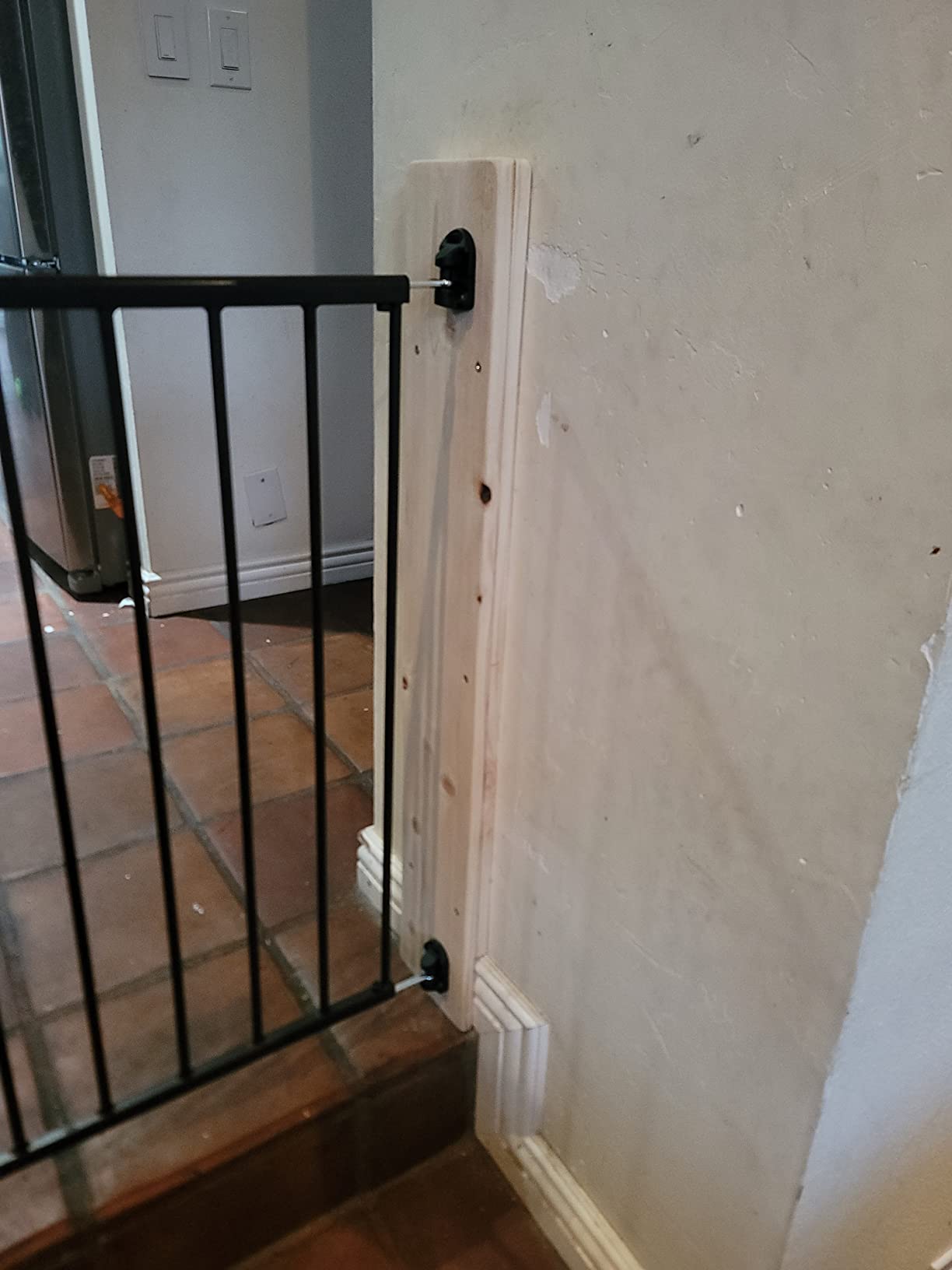
What it fits and what it costs you
It fits a stair head bracketed by two solid surfaces, whether those are walls, newel posts, or flat banister sections with enough material to take a screw. Expect to drill.
Budget real time for it. This is not a twenty-minute install if you have never predrilled long wood screws, and two adults make the job considerably easier.
Where it is the wrong pick
It does not auto-close, and several reviewers note it gets left swinging open. If nobody in the house will close it reliably, a gate that is routinely open is worse than no gate because everyone stops treating it as a barrier.
It is also the wrong shape for a round or spindled banister. The frame needs flat, solid, screwable material on both sides.
6. InnoTruth 29.6-44.6 Inch Baby Gate – Best for Wide Walk-Throughs
InnoTruth 29.6-44.6 in Wide Baby Gate for Stairs and Doorways, White
Metal,44.6 inch wide by 28 inch tall,10.4 pounds,Pressure or hardware mount,22.63 inch walk-through door
Pros
- Y-bolts included for round stair banisters
- Bottom ramp helps strollers roll through
- Auto-close under 90 degrees
- Tool-free pressure mounting
Cons
- 28 inch height is shorter than most stair gates
- Pressure mounting can feel loose on non-flat surfaces
- Latch can eventually be figured out by a persistent toddler
The InnoTruth is the one to look at if your main constraint is getting a stroller or a laundry basket through the gate. The 22.63 inch walk-through door is unusually wide for a gate in this class, and the included bottom ramp means a wheel does not have to be lifted.
It comes with Y-bolts for round stair banisters, so it can work on a railing rather than only in a doorway, and it converts between pressure and hardware mounting depending on the surface.
The important thing to check is height. At 28 inches this is one of the shortest gates here, which is fine in a hallway or at the bottom of a staircase and a problem at the top of one where a climbing toddler can reach the frame. Reviewers make the same observation: the height suits stair openings and hallways, but it is below the 30-36 inch range generally recommended for top-of-stairs use.
It ranks near the top of the Door and Stair Baby Gates category on the strength of that walk-through width and the included banister hardware. The recurring criticism is that pressure mounting feels loose against a surface that is not perfectly flat, which is precisely the banister situation.
What it fits and what it costs you
It fits openings from 29.6 to 44.6 inches wide, which covers most standard stair heads and most hallway gaps between a wall and a banister post.
For a round banister, use the Y-bolts. For a flat spindled run, verify there is solid material for the bolts to bite before you trust the pressure mode.
Where it is the wrong pick
Skip it at the top of a staircase with a climber. Twenty-eight inches is low enough that a determined toddler can get a foot on the top rail.
Skip it on glass. Nothing in this design addresses a panel that cannot be drilled and has no flat clamp face.
7. Mumeasy 29.7-46 Inch Baby Gate – Best Low-Profile Build
Mumeasy 29.7-46″ Baby Gate for Stairs, Auto Close Dog Gate for Doorways
Reinforced carbon steel,46 inch wide by 30 inch tall,6.28 kg,Pressure or hardware mount,Integrated anti-stumble pedal
Pros
- Reinforced carbon steel feels sturdier than most
- Anti-stumble pedal on the bottom rail
- Tool-free install in under ten minutes
- Door swings both ways with auto-close
Cons
- Printed instructions cover drilling but not pressure
- Very determined dog can pull it down
- Door opens under 90 degrees only
The Mumeasy is the design we would copy. The integrated anti-stumble pedal on the bottom rail is the detail that separates it: instead of a bar you step over, the frame has a low, wide ramp that a stroller wheel or a bare foot travels across without catching.
It is rated to 1000 N impact resistance, backed by a three-year warranty, and built from reinforced carbon steel. Owners of older homes with finished woodwork specifically value the pressure mount, which installs in under ten minutes without drilling anything.
Y-bolts for round banisters are included, so the same unit covers a railing and a doorway, and the door swings in both directions with auto-close on one side.
The recurring note in reviews is that the printed instructions cover the drilled mounting method thoroughly and the pressure method barely at all. Read the manual, then find the pressure method elsewhere, or the first ten minutes will confuse you.
What it fits and what it costs you
It adjusts from 29.7 to 46 inches using expansion kits, so wider-than-standard hallways and landings are within reach.
The black finish reads as neutral hardware rather than nursery white, which suits a modern staircase where a bright frame draws the eye.
Where it is the wrong pick
Do not hang heavy things on it. Reviewers report that a very determined dog can pull a pressure-mounted gate down, which is exactly the failure mode the top of a staircase punishes hardest.
Buyers expecting a fully open door should know the panel opens under 90 degrees rather than swinging flat.
8. keny 29.7-46 Inch Baby Gate – Best for Determined Dogs
keny 29.7″-46″ Baby Gate for Stairs, Auto Close Dog Gates for Doorways
Metal,46 inch square footprint,30 inch tall,15.32 pounds,Pressure mount with extension kits,Double lock
Pros
- Metal bars contain smart dogs and rabbits
- Walk-through door means no stepping over
- Extension kits reach wider-than-usual hallways
- Auto-close swings shut and latches on its own
Cons
- A determined two year old worked out the latch
- Pressure mount sits uneven until bolts are tight
- Latch misalignment looks odd before adjustment
If your real problem is a large dog that has already escaped lighter gates, the keny is the one. The metal bar spacing is tight enough that reviewers running escape-artist pets report success where lighter gates failed, and the steel frame does not visibly flex when a large dog puts a paw through it.
It adjusts from 29.7 to 46 inches with extension kits, and the walk-through door means an adult never has to climb over the gate, which matters when you are carrying a dog leash and a toddler.
The double lock is coordinated for one-handed adult operation, and the gate auto-closes when opened less than 90 degrees. At 15.32 pounds it is the heaviest unit in this roundup, and you will feel that on a staircase.
On the toddler side of the equation, one review stands out: a determined two-year-old worked out the latch after a few uses. Nothing in a double lock prevents that forever, and it is the main reason to move up to a hardware-mounted gate once climbing starts.
What it fits and what it costs you
It mounts with pressure and no drilling, so it suits a rental, a finished staircase, or an opening you expect to move the gate away from later.
Stair-railing installation options are supported, and the extension kits cover openings wider than the base 46 inch span.
Where it is the wrong pick
Never at the top of a staircase. Pressure mount, heavy frame, and a child who may figure out the latch is the wrong combination for a set of stairs.
Expect to spend time adjusting. Reviewers note the pressure mount sits uneven and the latch looks misaligned until every bolt is fully tightened.
9. Babelio 31.5-55 Inch No Bottom Bar Gate – Best for Extra-Wide Spans
Babelio 31.5-55″ No Bottom Bar Baby Gate Extra Wide, 2-in-1 Auto Close Dog Gate for The House, Stairs and Doorways, with Large Walk Thru Door, White
All-steel,31.5 to 55 inch adjustable width,28 inch tall,Hardware mounted,No bottom bar walk-through door
Pros
- Extra wide adjustable span from 31.5 to 55 inches
- No bottom bar for sill-free walking
- Full-width hardware-mounted door
- Auto-close with stay-open feature
Cons
- Lowest average rating of the ten at 4.2
- Hardware mounting requires drilling
- 28 inch height is short for a climber
This gate exists for one reason: openings that are wide. At 31.5 to 55 inches, it covers a broad landing or a stair head where the gap between two newel posts runs past what the other nine gates here can span.
The no-bottom-bar design is the second reason. There is nothing at floor level to step over, which is the detail that matters most in a dark hallway or at a stair head at 2am.
It is all-steel, hardware mounted, and designed with stairs and banisters specifically in mind. The door opens the full width of the stair, auto-closes, and holds open when you want it to stay put.
It also carries the lowest average rating in this group at 4.2, with a larger share of critical reviews than the similarly positioned models. We include it because the width is genuinely unmatched, not because the build quality is the strongest here.
What it fits and what it costs you
It fits wide stair openings and landings where the span runs past 46 inches, which is exactly the situation where two narrower gates plus an extension post are the usual workaround.
Hardware mounting means drilling, and you will want better screws than the ones in the box, as with most hardware-mounted gates in this category.
Where it is the wrong pick
Skip it with a climbing toddler. At 28 inches tall it is short, and the extra width does not compensate for a reachable top rail.
Skip it in a rental, and skip it on glass. This is a drilled, screw-mounted steel frame that assumes solid material on both sides of the opening.
10. Minne Baby Railing Mesh Net – Best No-Drill Rental Fix
Baby Gates for Stairs with Banister, Guard Safety Net for Baby, 10ft x 3ft Stair Railing Mesh Barrier for Kids, Cats, Dogs, Child Safety Rail Guard, White
100 percent polyester,10 ft long by 3 ft high,41 zip ties included,Mesh openings under 0.5 cm,Waterproof tear-resistant fabric
Pros
- Tool-free install with 41 included zip ties
- See-through mesh blends into home decor
- Blocks children and pets squeezing through railings
- Survives heavy rain and dust
- Non-permanent alternative to drilling
Cons
- Not designed to support weight or climbing
- Listed 3 ft height measures closer to 2 ft 7 in
- Hem lacks the reinforced holes shown in images
- Stretching at top and bottom widens the gaps over time
Be clear about what this is: a mesh net, not a gate. It does not stop a child from falling down a staircase and it is not a barrier in the structural sense. It stops a crawling baby from squeezing between spindles, and for an older home with a non-code railing, that is often the more urgent problem.
It solves the renters’ problem outright. Forty-one zip ties are included, the install needs no tools, and there is no drilling into a banister, a newel post, or a wall that a landlord has to approve.
Reviewers praise it as a clean retrofit for an old stair railing, noting the fast installation and the fact that the see-through honeycomb mesh is nearly invisible against a spindled banister.
Two caveats come up repeatedly. The listed 3 foot height measures closer to 2 feet 7 inches in practice, and some deliveries arrive without the reinforced eyelet holes shown in the product images, so check the hem on arrival. Trim the cut zip tie ends with a tie gun, because sharp stubs are a hazard to small hands.
What it fits and what it costs you
It fits railings, balconies, decks, patios and loft areas. The adjustable length lets you cover a long spindle run rather than a single stair opening.
Mesh openings under 0.5 cm block fingers, small toys, and objects, which is the whole point of the product.
Where it is the wrong pick
Never as a substitute for a gate at the top of a staircase. It is not load-bearing, it is not climb-resistant, and some units stretch at the top and bottom over time, which quietly widens the gaps.
Also skip it if the spindles are more than about 4 inches apart, since the net needs something to tie to at regular intervals.
How to Measure a Banister Opening Before You Buy
Measure at the height the gate will actually sit, not at the handrail and not at floor level. A staircase opening is wider at the top of the stair than it is a few inches down, and most gate widths are quoted at their widest point. If the manufacturer lists a 30 to 48 inch range, that is the range across the top of the frame, not across the baseboard.
Measure twice, once at the top of the frame and once at the bottom, and use the smaller figure. A sloped run or a landing taper will show you a difference, and that difference is the number that determines whether the gate sits square or racked.
Check what is on each side. A newel post is a solid, often square post that takes a screw easily. A spindle run is a row of thin vertical balusters that does not. A glass panel takes neither a screw nor a clamp without a specialist fitting.
Check the height of the handrail at the mounting point. Several reviewers of the Cardinal Gates SS30 discovered after delivery that the long mounting rod could not clear a low-profile handrail. Measure clearance, not just width.
Note the width of your balusters. Y-bolt adapters are sized for standard round spindles, usually around 1 inch or 1.25 inch. Unusually thin or unusually thick spindles need a different adapter or a different product.
Finally, check spindle spacing on the run itself. If a toddler’s head fits between two balusters, a gate at the top of the stairs will not stop them slipping through halfway down, and you need guards or fillers as well. Our [baby bouncer and play yard guides](https://factsforhealth.org/best-baby-bouncers/) cover the soft-surface side of that setup.
Hardware-Mounted vs Pressure-Mounted: What Banisters Require
A hardware-mounted gate has brackets that screw or clamp into the mounting surface at the top and bottom of the frame. It does not move when a child leans on it, and it is the only category we will consider for the top of a staircase. Against a banister, the brackets are the weak link: they need to bite solid wood, not a hollow decorative spindle or a thin decorative moulding.
A pressure-mounted gate uses a spring-loaded bolt pushing against a surface, relying on friction and on the opening being a clean rectangle. It is fast, it is renter-friendly, and it is genuinely fine at the bottom of a staircase where the consequence of a gate shifting is a bump rather than a fall down a set of stairs.
Against a banister, pressure mounting is the wrong tool. A spindle run is round, sloped, and often unevenly spaced, so the bolt bears at an angle and the frame racks under load. Parents describe this as a gate that is firm on Monday and visibly crooked by Friday.
Third, there is the retractable mesh type. It is the least safe option for stairs in this category and we have not included one here, because the tensioned mesh is the least rigid structure and the anchor points are the fewest. Many manufacturers also state on their own packaging that their retractable gates are not for stair use.
Retractable gates are excellent in a doorway you use daily and a poor choice at a stair head, and the reason is mechanical: a barrier that is only tensioned against a surface cannot resist a body weight pushing outward over a drop.
Banister Types and How Each One Gets Mounted
Newel post to wall is the easy case. Both sides are solid and flat, so a standard hardware-mounted gate fits directly, and the screws bite properly. This is the scenario most gates were drawn for.
Newel post to newel post is the common stair head, and it works with any hardware-mounted gate whose width range covers the measured span. This is where a walk-through door with no bottom bar pays off, because there is no threshold to trip on.
Spindle run with no post on one side is the scenario parents ask about most on r/HomeImprovement, and the honest answer is that it needs a bracket that clamps around a spindle rather than a screw plate. Y-bolt adapters handle a round spindle, and beyond that you are looking at a custom bracket or a professional install.
Glass panels cannot be drilled and offer no flat clamp face. A glass-mounted gate uses padded U-bolt clamps that wrap the panel without penetrating it, and those fittings are a specialist purchase rather than something in the box with a stair gate. Our roundup does not include a dedicated glass fitting for that reason.
Metal and wrought iron railings have uneven spindle spacing that prevents even contact at the top and bottom of the frame. A banister adapter kit that equalises the two contact points is the practical answer, and it is a separate purchase for most brands.
An angled or sloped banister run at the top of the stairs is the case where a generic gate racks. The Cardinal Gates SS30 handles it best here because its swing control lets the panel sit flush against a surface that is not perpendicular to the opening.
Banister to banister with no wall on either side is a separate product category, and the honest answer for most homes is that this is where you call a childproofing professional. The gate has to carry itself between two railings, and the ratings, the fixings, and the swing geometry are all different from a wall-mounted unit. It is also the single most common question in forums and the one with the fewest product answers.
How to Mount a Baby Gate on a Banister, Step by Step
Confirm the gate is approved for top-of-stairs use before anything else. If it is a pressure gate and you are at the stair head, stop and buy a different gate.
Measure the opening at the height the frame will sit, top and bottom, and use the smaller number. Confirm the width falls inside the gate’s stated range with no forcing.
Identify your contact points. The top and bottom brackets need to land on solid, screwable material, and they need to be vertically aligned with each other. On an uneven spindle run, this is where most installs go wrong.
Fit a banister adapter kit if the contact points are not aligned or not flat. This is the fix professionals reach for first, and it corrects more failed installs than a different brand of gate.
Pre-drill every hole with a bit slightly narrower than the screw. This matters more on banisters than on drywall, because a hardwood spindle splits easily and a split spindle will not hold a screw.
Mount the bottom brackets first, then the top. Check the frame sits square with a level before you tighten the last screw, and correct the alignment now rather than after the gate is hung.
Close the gate and test it yourself. Push hard on the latch side with your body weight, then pull on the open panel. If the frame moves at all, the fixings are in decorative material rather than structure and you need a different anchor.
Check the swing path. Make sure the open panel cannot swing out over the stairs, and fit the directional swing stop if the gate includes one.
Do a final gap check with a ruler. Anything above roughly 3 inches is wide enough for a small child to work with, and the fix is filler or a guard rather than a tighter latch.
When You Need a Banister Adapter Kit
You need an adapter kit when the top bracket and the bottom bracket of the gate would otherwise land on different verticals, or on surfaces at different angles. That is the defining feature of most banister installs, and it is why a wall-mount instruction book does not get you a square frame.
You also need one when the banister is round. Most gate brackets are flat plates with screw holes, and a round post gives you a curved surface where the screw will sit at an angle and walk out over time. A round-banister bracket or a Y-bolt adapter converts the flat plate into a clamp.
And you need one when the spindles are too thin to take a screw cleanly. Clamping around a spindle is a better load path than driving a screw into a hollow decorative baluster, and it is reversible.
Two practical notes. The kit is usually sold separately, so check what is in the box before you assume it is included. And buy the kit from the same brand as the gate where you can, because the geometry is usually matched to that frame.
Installation Mistakes That Make a Banister Gate Unsafe
Using a pressure-mounted gate at the top of the stairs is the first and most serious mistake. There is no bottom anchor, and the consequence of failure is a fall.
Mounting into decorative spindles or thin moulding is the second. A screw in a hollow decorative baluster looks correct and holds for a while, then lets go under load. Test every fixing with your body weight before you call the job done.
Skipping the adapter kit on an uneven run is the third. A racked frame looks cosmetically imperfect but it means the latch is not fully engaged, which defeats the entire design.
Leaving a gap wider than about 3 inches anywhere in the frame is the fourth, and it is the failure that a latch cannot fix.
Placing the gate at the wrong point on the run is the fifth. A pressure gate with a threshold bar needs to sit back far enough from the top step that an adult is not walking into the bar in the dark, and hardware gates need to bracket the opening rather than the drop.
Forgetting the railing itself is the sixth. A gate protects the top of a staircase. It does nothing about wide baluster spacing on the run below, and a toddler who can slip through the spindles does not need to reach the gate.
Last, leaving a gate permanently open. Adults back off gates that are always swung aside, and the barrier stops functioning without anyone deciding to remove it. If your household will not close it reliably, fix the latch or remove the gate.
When to Remove a Baby Gate
Remove the gate when your child can reliably climb over it, walk through the latch, or scale the spindles beside it. A gate that a toddler can defeat is a hazard in itself, because it invites the climbing it was meant to prevent.
Also remove it when the opening widens beyond the gate’s range, when the mounting surface weakens, or when a pressure gate has been nudged out of square for months and the latch no longer catches cleanly.
Rental homes are the other clear case. Remove every gate and every screw, fill the holes, and take the deposit-friendly approach. The mesh net option exists precisely for that scenario, because it leaves nothing behind.
Before you take a stair gate down, check the CPSC recall database for the brand and model. Child gates are recalled more often than most nursery products, and a recall can surface years after purchase. It is a five-minute check that takes the guesswork out of it.
Frequently Asked Questions
What is the best baby gate for stairs with banister?
The Cumbor 30-46 inch gate is the best overall for banisters because it converts between pressure and hardware mounting in one frame, and it includes two Y-bolt adapters for round banisters. At the top of a staircase, use the hardware mode with the Y-bolts seated on solid wood and never the pressure configuration.
Can you put a baby gate on a banister?
Yes, but only a hardware-mounted gate if it is near the top of a staircase. The brackets screw or clamp into the banister post or rail at the top and bottom of the frame so the gate holds when a child leans on it. A pressure gate relies on friction against a flat surface, and a spindle run is round, sloped and uneven.
What kind of baby gate is suitable for a glass banister?
Glass cannot be drilled and has no flat clamp face, so a standard gate will not hold. The correct fitting is a padded U-bolt clamp that wraps the glass panel without penetrating it, and those are a specialist purchase rather than an included accessory. Never drill or clamp with hard metal directly onto tempered glass.
How do you measure a banister for a baby gate?
Measure the opening at the height the gate will sit, not at the handrail and not at floor level, because a stair opening is wider higher up. Measure the top and the bottom of the frame and use the smaller figure. Then check handrail clearance at the mounting point and confirm the adapter fits your spindle diameter.
Are pressure-mounted baby gates ever safe at the top of stairs?
No. A pressure gate has no anchor at the bottom of the frame and depends on friction, so a child leaning on it at the stair head can move it. The threshold bar those gates use is also a trip hazard in low light. Use a hardware-mounted gate at the top of a staircase and reserve pressure gates for flat openings and the bottom of the stairs.
Conclusion: The Best Baby Gates for Banisters in 2026
The best baby gates for banisters come down to one rule: hardware mounting at the top of a staircase, and a banister adapter kit whenever the contact points are not flat and aligned. Our overall pick is the Cumbor 30-46 inch gate, which converts between mounting styles and includes the Y-bolt adapters. For an angled stair head, the Cardinal Gates SS30 handles geometry nothing else here does, and for a rental where nothing can be drilled, the Minne Baby mesh net handles the spindles while you plan a proper install.
Measure at the height the gate will sit, check the spindle spacing on the run itself, and test every fixing with your body weight before you trust it. If the opening has no wall on either side, that is a call to a childproofing professional rather than an afternoon with a drill. For the wider childproofing picture, our [baby gate roundup](https://factsforhealth.org/best-baby-gates/) and our [driveway gate picks](https://factsforhealth.org/best-driveway-gates/) cover the rest of the property.