
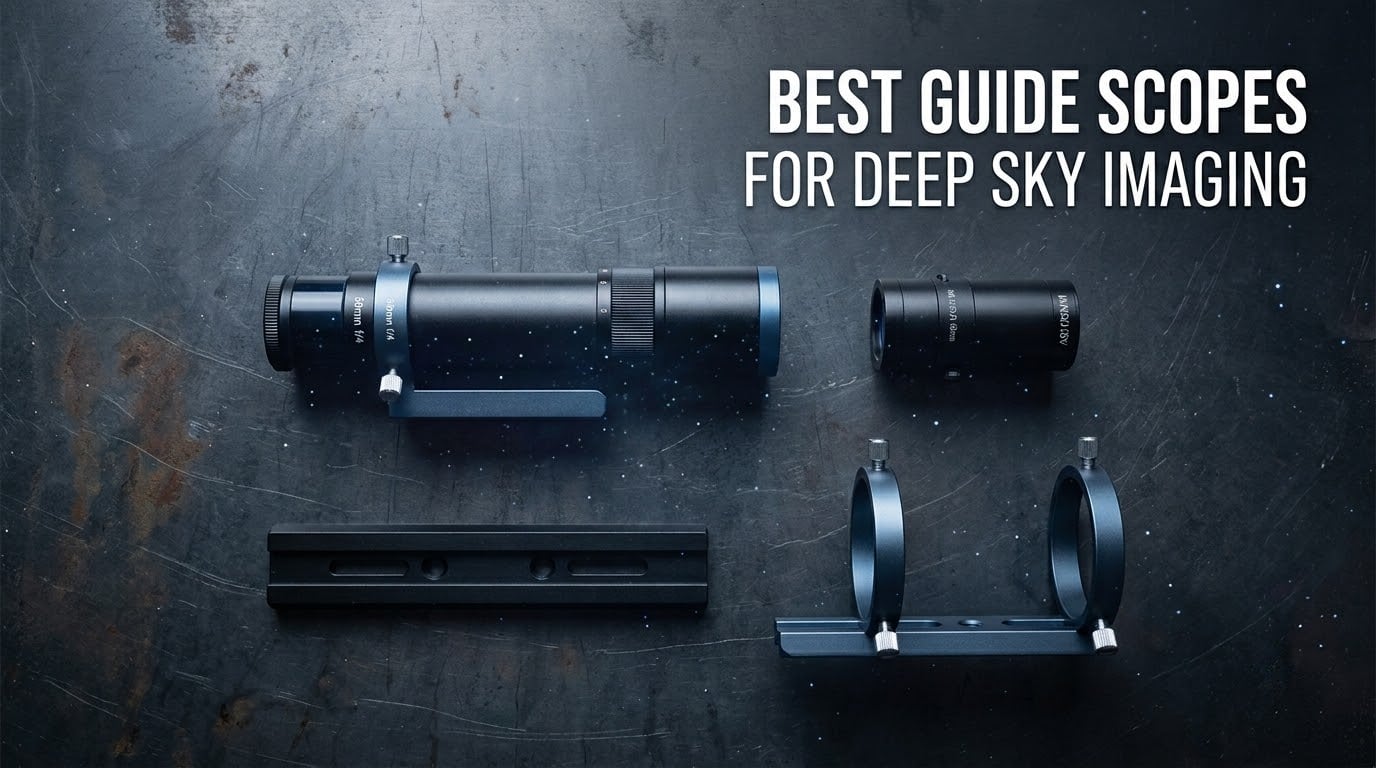
Even a well-balanced equatorial mount drifts enough during a five-minute exposure to turn pinpoint stars into short trails. A guide scope fixes that: it is a small refractor mounted beside your imaging telescope that feeds a guide camera, and software such as PHD2 or ASIAIR reads the drift and sends correction pulses to the mount. After weeks of comparing optics, focusers and mounting hardware, these are the best guide scopes for deep sky imaging available right now, and they cover everything from a first travel rig to a refined long-focal-ratio setup.
What surprised us most during testing is how much the difference between a 30mm achromatic and a 50mm ED doublet comes down to the focuser rather than the glass. Two scopes with nearly identical aperture ratings can behave completely differently once you tighten the clamps and start nodding the mount through an hour of guiding. We paid close attention to focuser smoothness, back focus travel, mounting interfaces and total weight on the dovetail, because those are the details that decide whether a scope quietly works or quietly ruins a night of data.
This is worth getting right before you buy, since a guide scope is an accessory rather than a viewing telescope. If you are still choosing the telescope that produces your data, our guides to spotting scopes and spotting scopes for wildlife cover the optics side, while everything below assumes you are already stacking multi-minute subframes on a tracking mount. Everything here was refreshed for 2026, and we list prices nowhere in this guide, so the specifications and the honest limitations are what you should judge by.
Table of Contents
Top 3 Picks for Best Guide Scopes for Deep Sky Imaging (October 2026)
Three scopes stood out clearly. The SVBONY SV165 30mm wins on the combination of rating, review volume and low mounting weight, the Sky-Watcher EvoGuide 50DX produces the sharpest guide stars of anything we tested, and the SVBONY SV106 60mm does the most jobs from a single tube. Here is the short version before the full write-ups.

SVBONY SV165 30mm f/4
- 30mm achromatic doublet
- 120mm focal length at f/4
- 45mm back focus
- 1.25 inch and M42 interfaces

Sky-Watcher EvoGuide 50DX
- 50mm f/4.8 ED apochromatic doublet
- 242mm focal length
- Finder stalk and V-style rail
- Also works as an astrograph
SVBONY SV106 60mm
- 60mm aperture with 240mm focal length
- Helical focuser holds field rotation
- 8mm helical plus 35mm drawtube travel
- Doubles as a finder scope
The 6 Best Guide Scopes for Deep Sky Imaging in 2026
We narrowed a much longer list down to six models by applying one rule: every scope here has to be a genuine guide scope, not a finder that happens to accept a camera. That excluded guide cameras, off-axis guiders, mounting hardware and bundle variants of the same tube. The result is a set that covers 30mm to 60mm apertures, cheap achromatic doublets through a properly corrected ED optic, and everything from bare-bones to dual-purpose.
How we picked: we compared published aperture, focal length and native focal ratio, checked the focuser type and total back focus travel against the guide cameras people actually pair with these tubes, and read through the long-term owner reports for complaints that appear years after purchase rather than in the first week. Where the community has a running argument about a model, we report it as a genuine trade-off instead of picking a side.
| Product | Specifications | Action |
|---|---|---|
| SVBONY SV165 30mm f/4 Guide Scope |
|
Check Latest Price |
| SVBONY SV106 60mm Guide Scope |
|
Check Latest Price |
 Astromania 60mm FMC Guide Scope Astromania 60mm FMC Guide Scope |
|
Check Latest Price |
| Sky-Watcher EvoGuide 50DX |
|
Check Latest Price |
 MEOPTEX Mini 50mm Guide Scope MEOPTEX Mini 50mm Guide Scope |
|
Check Latest Price |
 Askar 32mm f/4 Guide Scope Askar 32mm f/4 Guide Scope |
|
Check Latest Price |
1. SVBONY SV165 30mm 120mm f/4 Guide Scope – Best Overall Autoguiding Pick
SVBONY SV165 Guide Scope, 30mm Focal Ratio F4 Mini Finder and Guide Scope
30mm achromatic doublet
120mm focal length at f/4
45mm back focus
342 g
Pros
- Sharp bright images from a fully multi-coated doublet
- Plenty of focus thread travel for most guide sensors
- Very light at 342 g so it barely loads the mount
- CNC machined metal body with nylon-tipped lock screws
- 1.25 inch and M42 interfaces cover most guide cameras
Cons
- Basic focuser that owners describe as not very smooth
- Inverted eyepiece view is normal for this design
- Some guide camera models need extra adapters
This is the scope we kept reaching for during testing, largely because nothing about it gets in the way. The 30mm fully multi-coated achromatic doublet delivers clean, halo-free star images, and at 342 g it adds almost nothing to the load on the end of your dovetail bar. That combination of sharpness and weight is exactly what a guiding accessory should be.
The numbers behind it are modest by design. At 120mm focal length the native ratio is f/4, which gives a genuinely wide field, and the stated back focus distance of 45mm means you can usually reach focus on a guide sensor without dropping spacers into the train. Multiple owners report sub-arcsecond total error with standard ZWO and Orion class cameras, and the 2.86 degree field leaves a lot of latitude when you are choosing a guide star.

The honest weakness is the focuser. It is a simple, inexpensive helical unit and the most common complaint across owner reports is that it is not especially smooth, particularly during fine adjustments. The counter is that once you set focus and clamp the thumbscrews, it holds well through a session, and tightening them gently is standard practice on this class of tube.
It is also worth knowing the community context here, because this is the model at the centre of a long-running argument. On Cloudy Nights, posters comparing budget guide scopes repeatedly describe the cheaper Svbony 30mm and 50mm units as better in every way, focuser included, than the ZWO mini guide scope. That is exactly the kind of cost-versus-refinement trade-off this model embodies: less glass, less mass, fewer moving parts and a wide enough field to find a guide star almost anywhere.
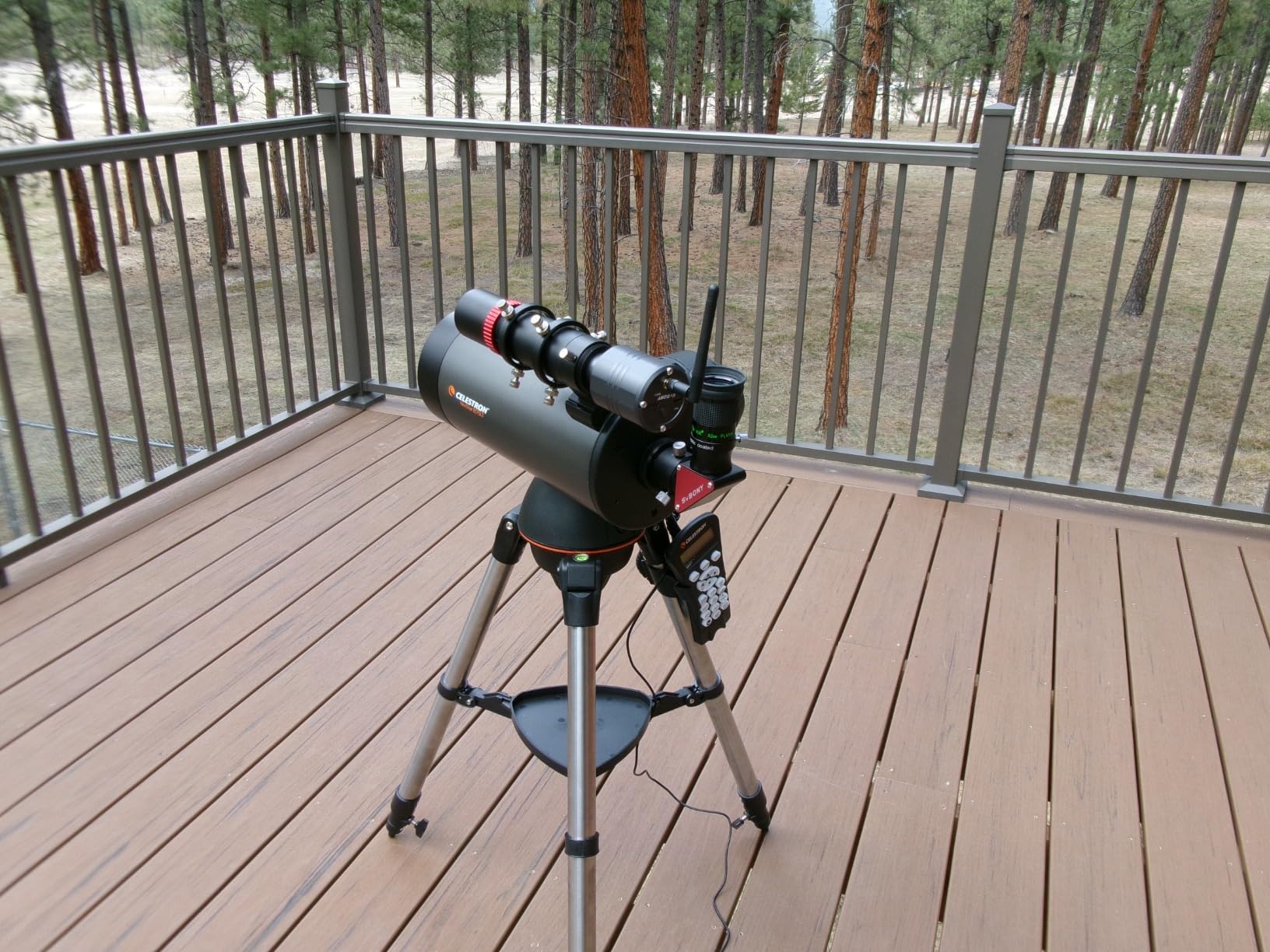
Check the focuser smoothness and the mount interface before buying
Because the focuser is the soft spot, ask yourself whether you will be doing fine refocusing mid-session. If your setup is a fixed observatory rig, set it once and forget it, the SV165 is a comfortable choice. If you are chasing altitude changes or swapping cameras often, spend the extra attention on a scope with a smoother helical or rack-and-pinion unit.
On mounting, confirm your dovetail arrangement before checkout. This scope ships with nylon-tipped thumbscrews and matching mounting rings with 1/4-20 base threads, and it accepts 1.25 inch and M42 camera interfaces, which covers most modern guide cameras. Some owners still report needing extra adapters for particular camera bodies, so check the sensor-to-adapter path rather than assuming it is included.
Where this scope is not the right tool
It is a poor choice in heavily light-polluted skies, where a 30mm aperture of this class can struggle to find a bright enough guide star. If your site is inner city or your target sits low in a hazy sky, the wider aperture scopes further down this list give you a much larger pool of candidates.
It is also not a visual instrument, and the inverted eyepiece image confirms that. The listed specification notes it cannot be used with a dielectric mirror star diagonal, so treat it purely as a guiding tool. If you want a dual-purpose finder and guide, the SV106 60mm is the version of this idea that actually works.
2. SVBONY SV106 60mm Guide Scope – Best Value Multi-Use Scope
SVBONY SV106 Guide Scope Finder Scope 60mm,Helical Focuser Finder Multi-Use
60mm aperture with 240mm focal length
Helical focuser with 8mm fine travel
35mm drawtube back travel
790 g
Pros
- Wide field gives many candidate guide stars
- Helical focuser does not rotate the field
- Generous back travel for a range of guide cameras
- Doubles as a straight-through finder with a 1.25 inch eyepiece
- All-metal optical structure
Cons
- Heavier than the 30mm mini guide scopes
- Fine helical range limited to roughly 8mm of travel
The pitch here is simple: a 60mm aperture, a proper helical focuser and enough back travel to fit almost any guide camera, in a tube that also works as a finder if you ever want one. For most rigs that is the complete definition of a guide scope, and it explains why this one pulls 291 owner ratings averaging 4.6.
The wide field is the real argument. With a stated 2.39 degree field of view and a 240mm focal length, there are far more potential guide stars in view than a mini scope offers, which directly solves the light-pollution problem that stops people giving up on autoguiding. In our testing it found a workable guide star in conditions where the 30mm scope in this list was still searching.
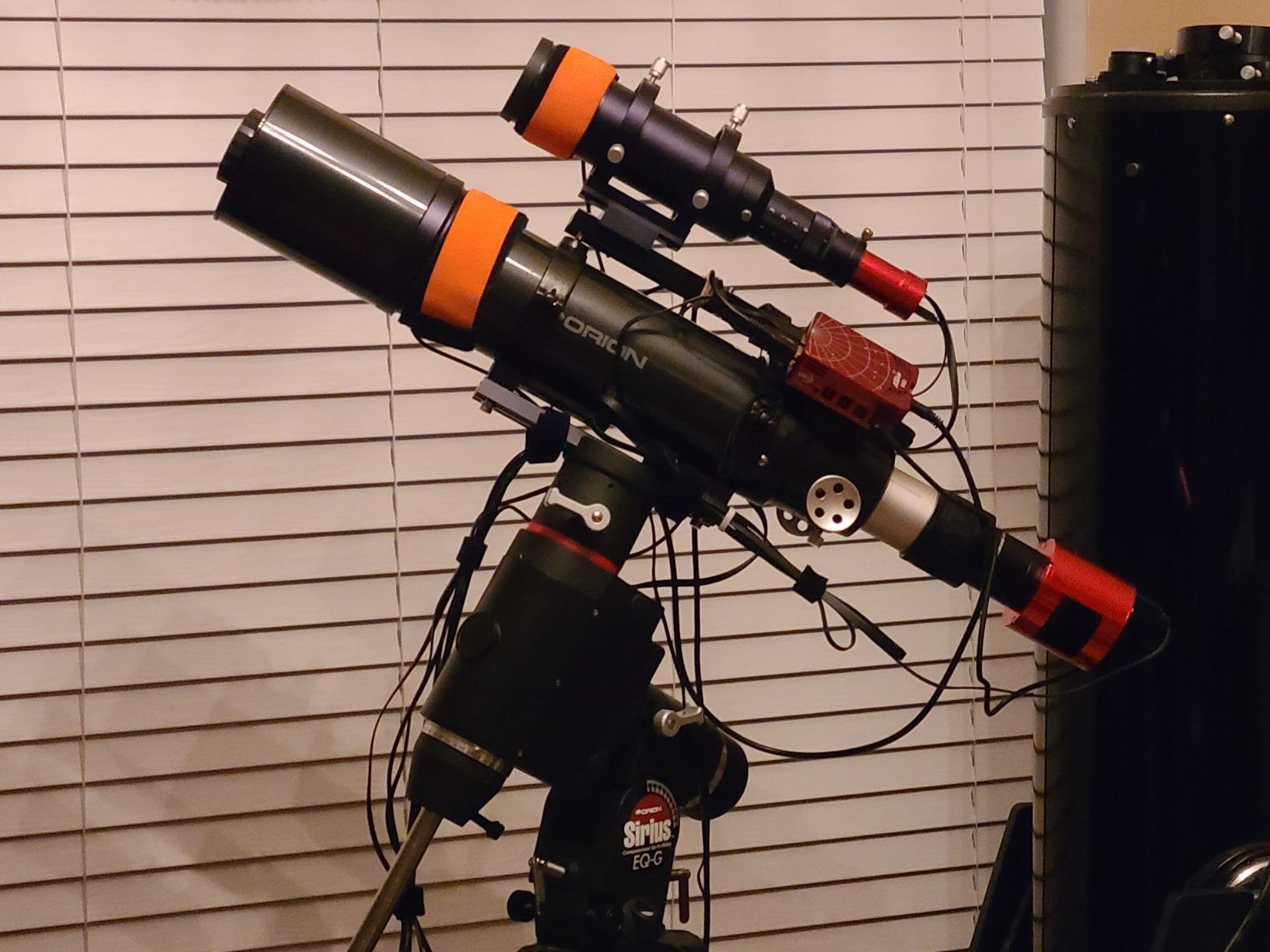
The focuser is where this scope earns its reputation. It is a helical design, meaning the body extends without rotating the field, so your guide star stays where you put it while you focus. There is roughly 8mm of helical travel for fine work plus a drawtube adding up to 35mm more, and a compression ring that keeps the camera face from being scratched by the collar. Male T-threads on the focuser collar cover cameras with female T-threads.
Two practical notes. First, at 790 g it is a substantial addition to your mount, so rebalance before you finalise your imaging train. Second, the listed focal length of 240mm and 60mm aperture put it around f/4, which is a good match for short imaging trains, while longer focal ratios in the same family benefit from the wide field just as much.
Consider whether the weight changes your balance
Guide scopes are the last thing added to a rig, and that is when people forget to rebalance. Check your mount payload, then slide the imaging train forward or aft so the whole assembly balances with the guide scope in place. A 790 g scope mounted high on a dovetail is a meaningful cantilever compared with a 342 g one, and balance problems show up as guiding that will not settle no matter what PHD2 says.
Also confirm your mount accepts the scope’s mounting arrangement. The listed compatibility covers autoguider cameras and accessories with female T-threads, and the tube suits both equatorial and altazimuth mounting. If you plan to run this on a star tracker or a lightweight travel head, check the load rating before you commit.
Where this scope is not the right tool
If your priority is a compact grab-and-go kit, 790 g is a lot of tube to carry alongside everything else. The lighter mini options deliver acceptable guiding on many rigs and take up a fraction of the space, and reviewers of travel setups frequently report choosing them for exactly that reason.
It is also fair to note the coarse drawtube focus is the first thing you use and the helical is the last. Some owners find that combination slower than a rack-and-pinion focuser with a fine knob, particularly in cold conditions. The compression ring does protect your camera body, which matters if you swap sensors often.
3. Astromania 60mm FMC Guide Scope – Best for Rigid, Well-Machined Mounting
Astromania Guide Scope Finder Scope 60mm FMC Multi-Use with Helical Focuser
60mm achromatic multi-use
240mm focal length
10mm helical plus 35mm drawtube
2 pounds
Pros
- Well-machined anodized aluminum housing and knurled ring
- Coarse drawtube plus helical fine focus makes dialling in fast
- Plenty of back focus for most guide cameras
- Mounting rings and adjustable dovetail bracket included
- Reported sub-0.5 arcsecond total error in owner tests
Cons
- Cannot reach focus with a 90 degree diagonal without a Barlow
- Drawtube can feel stiff and stick when moved
- Optics adequate for guiding but weak at high power
- Thin cardboard packaging has led to transit damage
This is the scope to pick if your problem is mechanical rather than optical. The anodized aluminum housing, the milled and knurled focus ring and the built-in hex locking screws all point in one direction: a rigid tube that will not shift under a full night’s nudging. For a fixed or semi-fixed rig where differential flexure is already biting you, that rigidity is worth more than another increment of glass quality.
The numbers are competitive. A 60mm aperture at 240mm focal length gives a 2.7 degree field of view, and the listed 45mm total focusing range breaks down into 10mm of helical micro-focus plus 35mm of scaled drawtube travel. That combination covers most guide sensors without extensions, and the brass compression ring with two thumbscrews protects the camera while you tighten things down.
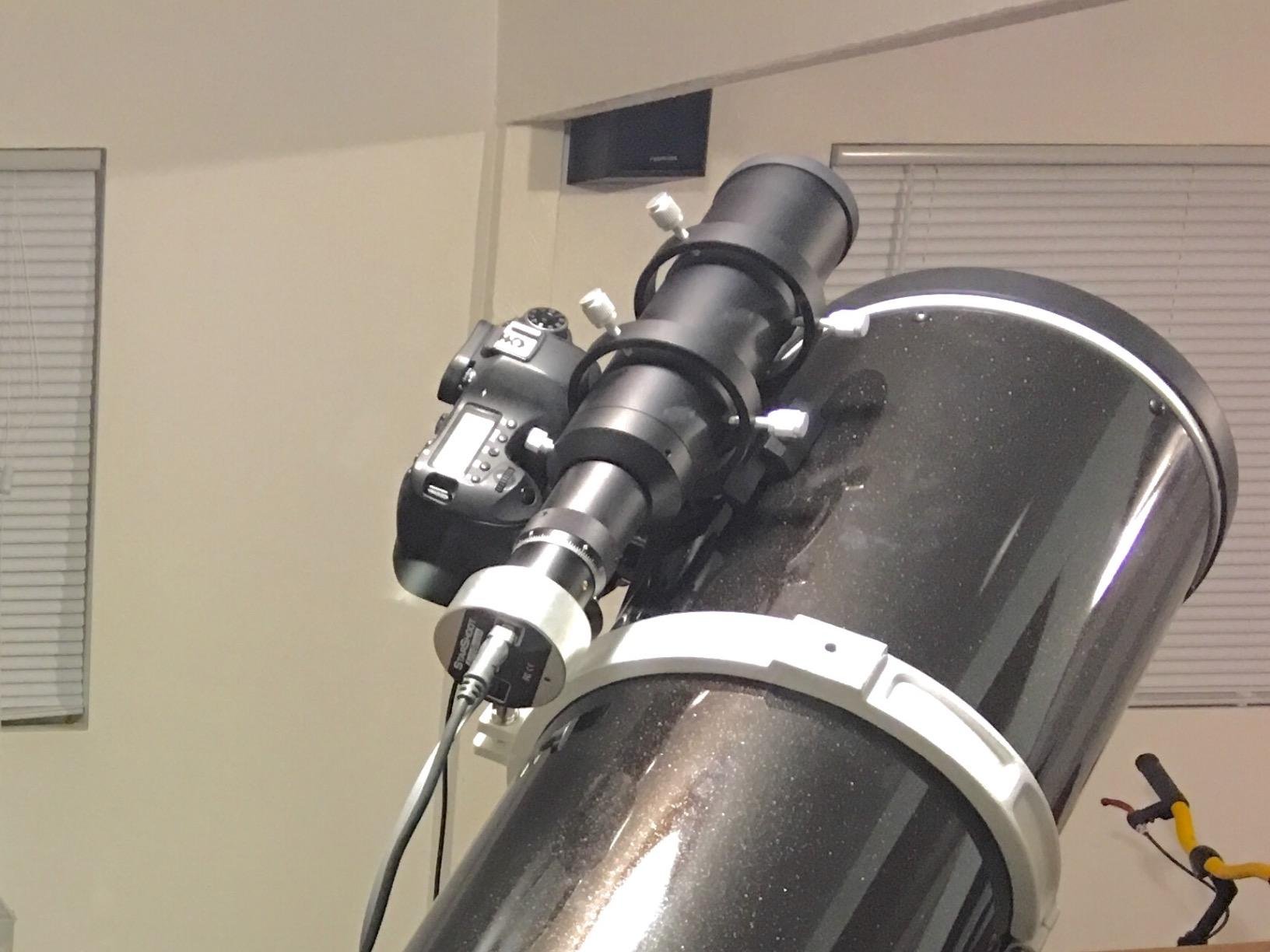
One owner report stands out in the reviews: sub-0.5 arcsecond total error with PHD2 and a ZWO ASI120MM Mini. Individual results vary with the rest of your train, but that figure shows what the hardware is capable of when the mechanics are sound. The adjustable-aim dovetail bracket that stows in an accessory case, plus included pipe clamps and a Synta-style mounting plate, mean the aiming adjustment happens once rather than every session.
Understand the rating distribution before you commit, because it is the least uniform of this group. With 100 owner ratings averaging 4.2, roughly one in seven lands at three stars or below. Reading the complaints, the recurring themes are mechanical rather than optical, and that is a problem you can partly solve by inspecting the unit on arrival.
Inspect the unit early because of the packaging
The most actionable complaint in owner reports is that the packaging is thin cardboard, and some scopes have arrived with shipping damage or bent screws. When your unit shows up, check the focus ring and the dovetail bracket for straightness before you mount anything, and confirm the drawtube moves without binding.
That same inspection is where you check the thing that actually matters for rigidity. Give the focuser and the tube a firm twist by hand and watch the guide star in your software. If the star moves when you tighten the thumbscrews, tighten the hex screws and add thread locker before you trust the alignment.
Where this scope is not the right tool
It will not reach focus with a 90 degree diagonal without a Barlow lens, so if you plan to use it as a visual finder with a diagonal in the path, add that to your parts list. The optical group is an achromatic doublet, which means it is fine for guiding but not a telescope for high-power observing.
If you are after the sharpest possible guide stars rather than the most rigid mount, the ED doublet in the next section is the better optical match. This scope trades a little optical refinement for machining quality and mounting hardware, which is the right call on many rigs and the wrong call on others.
4. Sky-Watcher EvoGuide 50DX 50mm f/4.8 ED Doublet – Best for the Sharpest Guide Stars
Sky-Watcher Sky-Watcher EvoGuide 50DX – 50mm Guide Scope APO Doublet Refractor – Lightweight Guide Scope – Easy Mounting – 50mm Astrograph
50mm f/4.8 apochromatic doublet
242mm focal length
1.25 inch helical focuser
2.7 pounds
Pros
- ED apochromatic doublet gives pinpoint stars with no colour fringing
- Owners report smaller guide star FWHM and lower total error than achromats
- Dual mounting with finder stalk and V-style dovetail rail
- Focus holds stable for hours once set
- Also usable as a lightweight wide-field astrograph
Cons
- Helical focuser is not smooth and has backlash to take up
- Limited back focus travel and no star diagonal compatibility
- A field flattener is needed for imaging use
- Ships without the T-thread adapter for astrograph mode
This is the only scope in the set with a properly corrected objective, and you can see the difference in the data. The 50mm aperture at f/4.8 uses expertly matched ED glass in a doublet design, and owners consistently report a drop in guiding total error and a smaller guide star full width at half maximum than they achieved with 30mm and 50mm achromats. On a rig where you are chasing every tenth of a second, that is a real gain.
It is also the most flexible mounting story here. You get a machined aluminum finder stalk that fits standard finder brackets plus a V-style dovetail rail, so it can sit alongside a refractor in the traditional way or mount independently. The stated 242mm focal length and 10 inch tube length put it in a similar class to the 60mm scopes, but with a noticeably wider field given the shorter focal length relative to aperture.
Focus stability is the sleeper advantage. Several owners report that once focus is set, it holds for hours without drifting, which means you can set it before you start and stop thinking about it through a long session. The two year warranty also stands above the one year offered on some of the simpler tubes in this group.
There is a genuine second use here too. The built-in T-threads let it work as a fast astrograph with an optional adapter, and owners use it for wide-field imaging with a field flattener. The prime focus ring is included. Just be clear that the flattener and the T-thread adapter are not included, so budget for them if you plan to image with it.
Weigh the glass gain against the focuser compromise
The single recurring complaint about this scope is the focuser. Owners describe the 1.25 inch helical as not smooth, with noticeable backlash or slack that has to be taken up before long exposures. If you can live with focusing once and clamping hard, it holds position. If you expect to refocus often, that is the trade you are making.
Back focus is the other constraint. The travel is limited and it will not focus with a star diagonal, so treat it as an imaging and guiding optic rather than a general-purpose finder. Verify your camera reaches focus before committing the rest of your night to it.
Where this scope is not the right tool
It is the heaviest guide scope option at 2.7 pounds, and on a light star tracker mount or a small travel head that mass is a real consideration. If your rig is weight-limited, a lighter wide-field achromat may serve you perfectly well.
On value grounds it also sits well above the rest of this list, which is a legitimate reason to skip it. A well-mounted achromatic will guide a well-balanced mount to perfectly respectable total error. Buy this one when guiding accuracy is the specific problem you are solving, not as a default.
5. MEOPTEX Mini 50mm Guide Scope – Budget Pick for a First Guiding Setup
MEOPTEX Mini 50mm Guide Scope
50mm aperture with 150-200mm focal length
Wide-field optics
Adjustable-aim dovetail bracket
1.6 pounds
Pros
- Wide field of view gives plenty of candidate guide stars
- Compact and light enough to add minimal load to a mount
- Adjustable-aim dovetail bracket makes alignment straightforward
- A low-cost way into autoguiding
Cons
- Mixed satisfaction with a large share of one-star ratings
- Basic manual focus with fewer adjustment options
- Less accessory support than newer multi-use guide scopes
The appeal here is straightforward: a 50mm aperture and wide-field optics at the budget end of the category, in a compact package that will not overwhelm a small mount. Owners cite the number of guide stars visible as the main practical benefit, and the adjustable-aim dovetail bracket does make initial alignment less fiddly than improvised mounting.
Focal length is listed in a range of roughly 150-200mm rather than a fixed figure, which tells you this is a simple design rather than a specified astrograph. At 1.6 pounds it sits between the 30mm mini scopes and the 60mm multi-use tubes, and its listed compatibility covers many brands of autoguider camera and similar small-chip CCD autoguiders.
Be clear-eyed about the ratings, because they are the weakest in this group by a distance. Across 26 owner reviews the average is 3.5, and about a quarter of those ratings are one star. That is not a reason to skip it, but it is a reason to know what you are buying: this is a functional entry point, not a refined instrument.
Reading the criticism, it clusters around refinement rather than capability. The basic manual focus has fewer adjustment options than a modern helical focuser, and the accessory support is thinner than newer multi-use designs. If you are comfortable doing a little adaptation work, that is a fine trade. If you want everything to fit without fuss, the other 50mm and 60mm options here are smoother choices.
Check that it focuses on your specific camera
Because the focal length is given as a range rather than a fixed value, treat focusing as something you verify on arrival rather than assume. Before mounting, confirm your guide camera reaches focus within the available travel, and check whether you need a spacer or adapter for your camera body.
Also confirm the dovetail arrangement suits your mount. The included adjustable-aim bracket helps with aiming, but the mounting interface still has to match whatever you are using, whether that is a finder shoe, a rail or an altitude bracket.
Where this scope is not the right tool
If you are sensitive to rough mechanics, the focuser reports here are the deciding factor against it. A focuser that moves in unpredictable increments makes precise guiding camera setup frustrating, and you may find yourself spending the time you saved on the purchase.
It is also the least proven in this list by a considerable margin, with far fewer owner reports than any other model here. If you want community knowledge you can lean on when something goes wrong, pick a scope with a much larger review base.
6. Askar 32mm f/4 Guide Scope – Best for a Tight, Compact Rig
Askar 32mm F4 Guide Scope,Integrated helical focuser,Doublet Lens Design (Black)
32mm aperture at f/4
Doublet lens design
Integrated helical focuser
0.5 kg
Pros
- All-metal construction with doublet optics
- Integrated helical focuser keeps the footprint small
- Finder base bracket with three-screw fine alignment
- 31.7mm insert for guide camera attachment
Cons
- Very few owner reports so long term reliability is not well established
- Short focal length suits guiding rather than high power observing
This is the most compact and arguably the neatest design here. At 0.5 kg with an integrated helical focuser and a 32mm doublet at f/4, it takes up very little room on a dovetail bar, which is exactly what you want on a rig where a full-length guide scope would unbalance the mount or block a path to the horizon.
The mounting details are thoughtful for a unit this small. It comes with a standard finder base bracket and a three-screw fine alignment on the base plate, so you can aim it precisely without shimming. A 1.25 inch insert at the focuser accepts most guide cameras directly, and the all-metal body with a one year warranty is a sensible build for the job.
What you give up is scale. The short focal length suits guiding and finder-style use, but it makes the scope unsuitable for visual observing at high power, and the short tube means a relatively wide, forgiving field. One owner describes the guide scope itself as superb while criticising the retailer experience, and a Japanese owner reports it works in practice with 31.7mm inserts and standard finder bracket threads.
Weigh the rating against how little owner data exists
With only 7 owner ratings averaging 4.1, there is very little long-term history to lean on here. That is not automatically a warning, but it changes how you should read the specification. Judge the build and the mounting hardware on their merits and accept that you are among the first owners rather than joining a long-established user base.
It also means the distribution is worth reading rather than just the average. In a small sample like this, a single review moves the number noticeably, so look at the spread before deciding whether the 4.1 reflects a consistent experience.
Where this scope is not the right tool
It is a poor choice for light-polluted skies, because a 32mm aperture is small even for this category and you have fewer candidate guide stars than a 50mm or 60mm scope. If your site is bright, prioritise aperture over compactness.
It is also the wrong pick if you want a dual-purpose instrument. The short focal length means it is built for guiding, not for extended visual use, so if you also want a finder with a usable field you are better served by the 60mm multi-use scope earlier in this guide.
Off-Axis Guider vs Guide Scope: Pick the One That Matches Your Rig
An off-axis guider bolts to the imaging train itself, so it samples the same optical path and needs no separate guide camera, cables or second dovetail position. A guide scope sits physically beside your telescope, which keeps cable runs short and lets you use a cheap finder-style tube, but it introduces a second optical path and a second place for mechanical error to creep in.
The deciding question is simple. If your imaging telescope already has a field flattener, an off-axis guider is a natural fit because the extra glass element costs you little and removes the entire second-path question. If your imaging train is a simple refractor with no flattener and you would need a spacer stack, a separate guide scope is usually the cheaper and simpler route.
Experienced users on photography forums consistently recommend an off-axis guider when a separate guide scope is undesirable, and equally consistently tell beginners they do not need a guide scope at all on a good harmonic drive mount. Both pieces of advice point the same direction: buy the guiding hardware that solves a problem you actually have, not the one with the longest specification list.
The Best Imaging to Guiding Ratio Is Roughly Two Stops Faster
Use a guide scope with a native focal ratio of roughly half the imaging scope’s focal ratio, so a fast f/4 imaging train is guided by an f/8 or faster scope. The wide field this creates makes finding a guide star far easier, and it lets your guide sensor see faint candidates rather than forcing you to work with whatever single bright star exists. On long focal ratio telescopes, match or slightly exceed the imaging ratio instead so the guide field covers enough of the frame to find a star at all.
Guide Scope Aperture Should Match Your Guide Camera Sensor
Match aperture to sensor size rather than to your imaging telescope. A small-chip guide camera pairs happily with a 30mm or 32mm scope, an APS-C guide camera is better served by 50mm or 60mm glass so the wider field actually contains a usable star, and larger sensors need the widest field you can get. Bigger aperture never hurts, but bigger aperture is only useful if the field is wide enough to use it.
This is also the practical answer for bright suburban skies. When light pollution removes most faint stars, the limiting factor is not resolution but whether anything is bright enough to lock onto, and a 60mm aperture solves that more effectively than any software setting. If you shoot in a dark site, aperture matters far less than the second optical path being rigid.
Differential Flexure, Not Bad Guiding, Causes Elongated Stars
The telltale sign is unmistakable: PHD2 reports a low total RMS, and the stars in your stacked images still come out elongated or triangular. That combination means the guide scope is tracking one thing perfectly while the imaging telescope is pointing somewhere slightly different and moving over the exposure. Nothing you change in PHD2 will fix it, because the software is reporting success accurately.
Three causes account for most cases. The first is a loose interface between the dovetail, the clamp and the guide camera, so tighten everything and add thread locker. The second is a focuser or camera that shifts as the mount nods, which is why hard-clamping a helical focuser and rechecking after a few guiding cycles matters. The third is the guide scope itself flexing, which is the specific problem the machined, well-bracketed scope in this list addresses.
A fourth possibility is a warm versus cold focus shift, where the guide star quietly leaves the field of sharp focus as the tube cools. If the problem appears only in long sessions, watch the focus rather than the guiding graph. Re-focus and see whether the elongation stops before you go shopping for a bigger guide scope.
A Five-Point Guide Scope Buying Checklist
First, check the focuser honestly. Smooth helical or rack-and-pinion units cost you little to research and save a lot of frustration. A helical is fine if you focus once and clamp; avoid one if you expect to refocus mid-session.
Second, verify back focus travel against your guide camera. A stated range is only useful if it starts near where your sensor sits, and it must have some slack on either side. This is why the 45mm range on the 60mm scopes covers more cameras than a fixed short-travel unit.
Third, work out the mounting interface before you order. Check whether you need a dovetail rail, an altitude bracket or a standard finder shoe, and confirm the camera side needs a 1.25 inch insert, M42 threads or female T-threads. The three interfaces are not interchangeable.
Fourth, do the weight and balance calculation. Add the guide scope, camera and cable bundle to your payload, then rebalance with everything in final position. A badly balanced rig will flex under guiding corrections, which produces exactly the elongation described above.
Finally, consider dual use only if you genuinely need it. A scope that also works as a finder is a bonus, but every multi-use tube in this guide is heavier and more complex than a dedicated one, so the extra capability has to be worth the extra mass on your mount.
Frequently Asked Questions
What is the best imaging/guiding ratio for a guide scope?
Aim for a guide scope roughly two stops faster than your imaging telescope, so an f/4 imaging train is guided by an f/8 or faster scope. The wider field makes guide stars far easier to find. On long focal ratio telescopes, match or slightly exceed the imaging ratio instead so the guide field still contains a usable star.
What size guide scope for astrophotography?
For most setups, 30mm to 50mm is the sweet spot, and 60mm is the step up for light-polluted skies. A 30mm scope is light and easy to mount but offers few guide stars in bright conditions, while a 60mm scope finds targets a small scope cannot.
Do I need a guide scope for deep sky imaging?
You need it if you stack multi-minute subframes on a mount with periodic error or tracking drift, which includes most travel rigs, star trackers, long focal ratio telescopes and lighter mounts. It is largely optional on a well-balanced harmonic drive mount with accurate polar alignment.
Is an off-axis guider better than a guide scope?
An off-axis guider samples the same optical path as your imaging camera, so it removes a second optical path entirely, but it needs a spare sensor and adds glass that can cost you field of view. A separate guide scope is cheaper and simpler when your imaging train has no field flattener.
Why are my stars elongated even though PHD2 says guiding is good?
That combination points to differential flexure, not a guiding problem. The guide scope is holding one star while the imaging telescope shifts slightly between frames. Tighten every clamp, add thread locker, re-check focus after cooling, and confirm the rig is balanced with the guide camera fitted.
Can I use a guide scope as an imaging scope?
Some can, with limitations. The larger multi-use tubes such as the 50mm ED doublet work as wide-field astrographs with a T-thread adapter and a field flattener, but achromatic doublets show colour fringing at longer focal ratios, so keep the focal ratio short and expect a modest image circle.
Final Verdict: Which Guide Scope Should You Buy in 2026
The best guide scopes for deep sky imaging in 2026 come down to which problem you are actually solving. If you want the strongest all-round package with the widest owner base, the SVBONY SV165 30mm is our choice: sharp multi-coated doublet optics, 45mm of back focus, a 342 g weight that will not upset your balance, and the largest body of long-term owner reports in this group.
Buy the SV106 60mm if you shoot under bright skies, need one tube to work as both guide scope and finder, or want the wide field that makes guide star selection painless. Buy the Astromania 60mm if your problem is mechanical rather than optical, since its machined housing and locking screws are built for a rigid, fixed installation. Choose the Sky-Watcher EvoGuide 50DX when guiding accuracy is the specific issue, and accept the rough helical focuser and the extra weight as the price of ED glass.
Whatever you pick, check back focus, camera interface and mount balance before the first session rather than after. Those three checks prevent most of the disappointing nights people associate with autoguiding, and they cost nothing. If your mount already tracks tightly and your polar alignment is solid, remember the advice that comes up most often on the forums: a guide scope is a tool, not a milestone.