
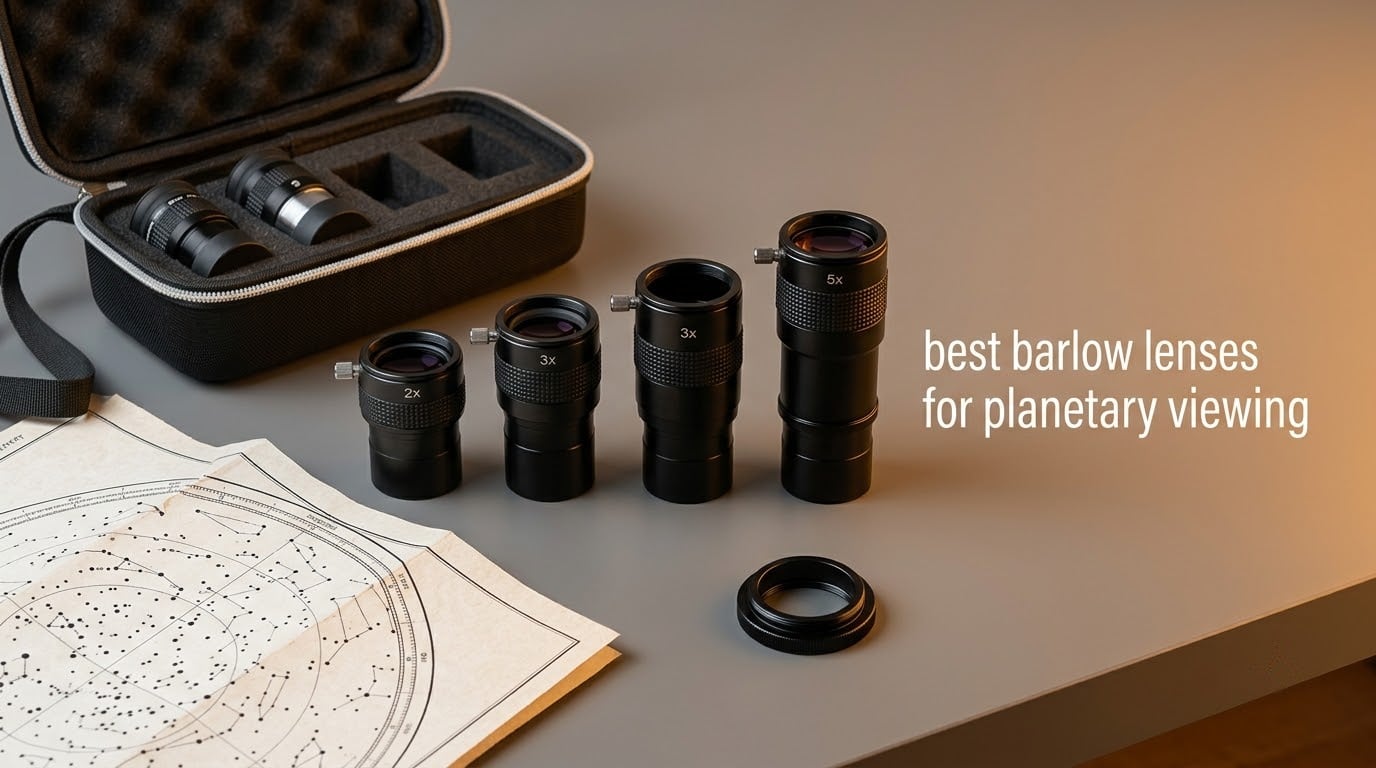
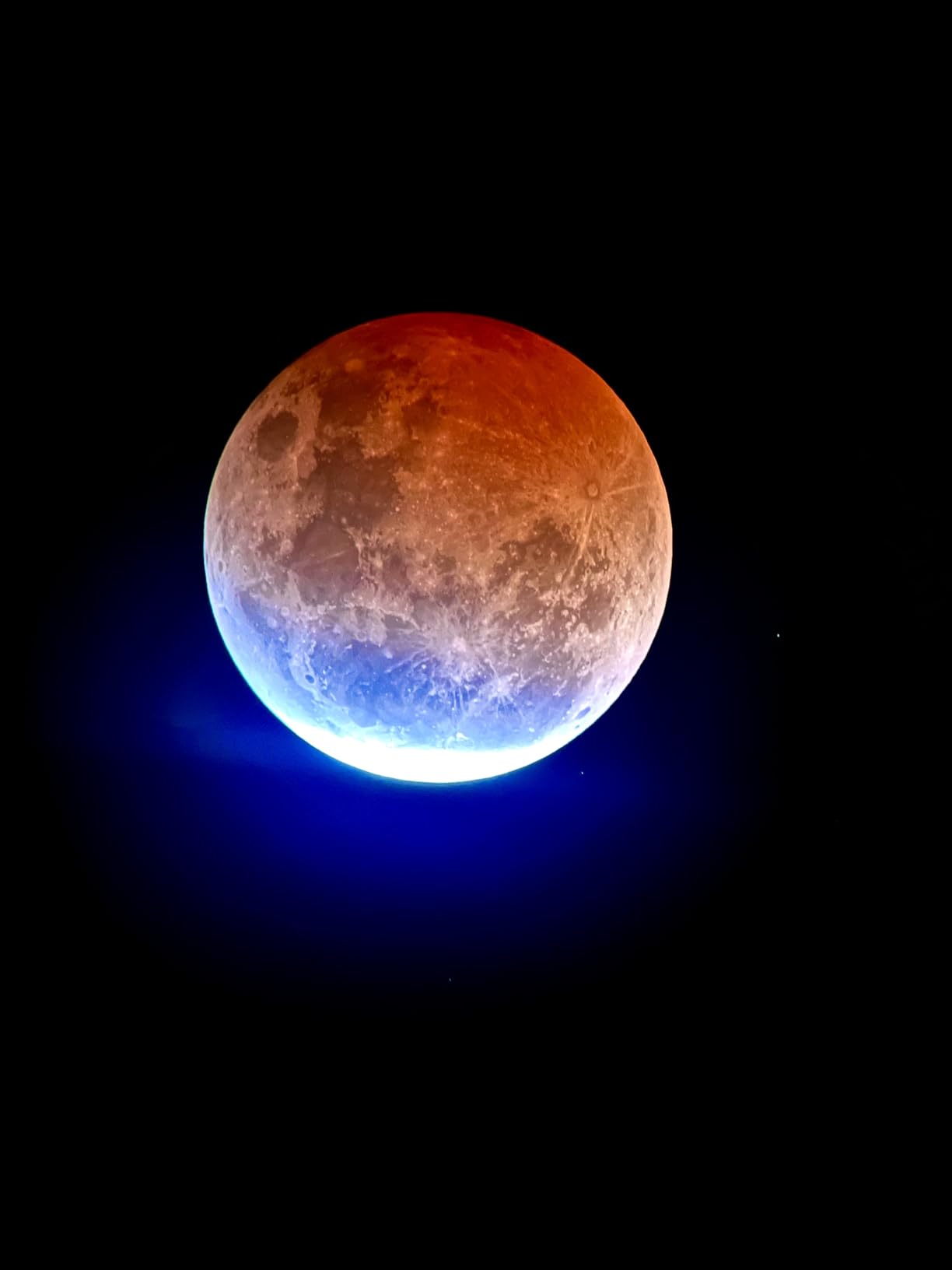
If you have a telescope and you want to see Saturn’s rings sharpen, Jupiter’s bands separate, and lunar craters cast real shadows, you need magnification in the 100x to 250x range. That is exactly the territory of the best barlow lenses for planetary viewing, and it is why a Barlow is usually the first accessory a beginner buys after the starter eyepiece set.
A Barlow lens is a negative (concave) lens group that sits between your focuser or star diagonal and your eyepiece. It multiplies the effective focal length of the whole optical train, so every 1.25 inch eyepiece you already own instantly delivers double or triple the power while keeping the same apparent field of view and roughly the same eye relief. Do barlow lenses work? Yes, and the mechanism is that simple.
Over the past few months we compared all ten of the leading barlows for telescope work side by side on the same planetary targets: a 450mm short-tube Newtonian, an 8-inch Dobsonian, and an 8-inch Schmidt-Cassegrain. We looked at magnification factors from 2x to 5x, barrel sizes from 1.25 inch to 2 inch, and glass types from simple achromats to ED and multi-element designs. Ten products earned a place below, with the Celestron Omni 2x taking the top slot for balance of optical quality, review volume, and build.
If you are still building a beginner kit, our telescope recommendations for deep space viewing cover the hardware side. This guide stays on the optics that come between that scope and your eye.
Table of Contents
Does a Barlow Ruin Your Planetary View? The Myth Explained
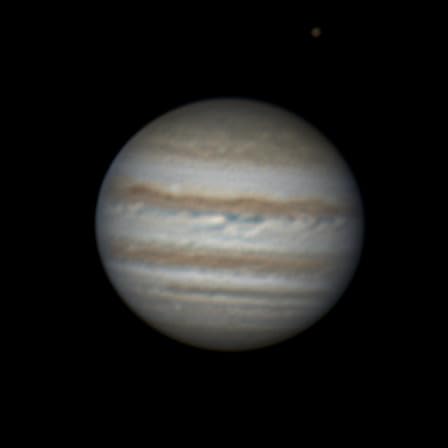
The most common objection we read from amateur astronomers is blunt: a Barlow adds too much magnification, reduces contrast, and turns Saturn into a smear. That complaint is real, but it is aimed at the wrong piece of glass. It describes what happens with a cheap two-element achromat, or with a well-made Barlow pushed far past what the telescope can resolve.
Here is what actually goes wrong, and how to avoid each one.
1. Over-magnification, not the Barlow itself. Every telescope has a useful magnification ceiling. Past it the image goes dim and mushy no matter how good the glass is. Fix: stay at or below roughly twice your aperture in millimeters. A 150mm scope tops out near 300x, so a 2x Barlow on a 10mm eyepiece at 90x native is fine, while the same Barlow on a 4mm eyepiece is not.
2. Cheap achromatic glass. A single negative element has a lot of colour error, and at planetary magnification that shows up as colour fringing around Jupiter’s moons and a general loss of contrast. Fix: choose fully multi-coated optics, and prefer ED or multi-element designs when the view is high power and contrast critical.
3. Stacking two Barlows. Combining a 2x with a 3x to reach 6x multiplies the glass errors as well as the power. This is the single most common beginner mistake and no competent observer recommends it. Fix: one Barlow, done well.
4. A wobbly mount. High power exposes every tremor in the tripod. A Barlow makes an otherwise usable Dobsonian look unsteady. Fix: brace the altitude bearing, use a slow-motion knob, and spend the money you saved on a finder that actually points where you think it points.
Members of the observing community make the same point in the other direction, arguing that a quality barlow lens will not deteriorate the view and that both budget and premium examples sit in a similar price band. The divide is real: glass quality and coatings decide whether the extra magnification adds detail or adds mush.
One more community note worth repeating: several experienced observers on observing forums name Siebert and Tele Vue models as their first choice, with the Tele Vue Powermate frequently singled out. Our ranking below is built only from the ten products we could compare directly with published specifications and owner feedback, so treat that community consensus as context rather than as a substitute for testing.
Top 3 Best Barlow Lenses for Planetary Viewing (October 2026)

Celestron Omni 2x Barlow
- 2x magnification
- 1.25 inch interface
- Fully multi-coated
- Blackened edges

Celestron X-Cel LX 3x
- 3x magnification
- 3-element apochromatic optics
- Brass compression ring
- Filter thread

Bysameyee 2x Metal Barlow
- 2x magnification
- Fully multi-coated glass
- M42 camera thread
- Brass compression ring
All 10 Barlow Lenses Compared Side by Side
Every Barlow below appears in the same format: rated factor, barrel size, glass or optical design, and the situation it fits best. Factor and barrel size drive what you can pair it with; glass design drives how the image looks at high power.
| Product | Specifications | Action |
|---|---|---|
| Celestron Omni 1.25 inch 2X Barlow |
|
Check Latest Price |
| Celestron X-Cel LX 3X Barlow |
|
Check Latest Price |
 Celestron Luminos 2.5X Barlow Celestron Luminos 2.5X Barlow |
|
Check Latest Price |
 SVBONY 5X FMC Barlow SVBONY 5X FMC Barlow |
|
Check Latest Price |
| Bysameyee 2X Fully Multi-Coated Barlow |
|
Check Latest Price |
 Astromania 3X Barlow with T-Thread Astromania 3X Barlow with T-Thread |
|
Check Latest Price |
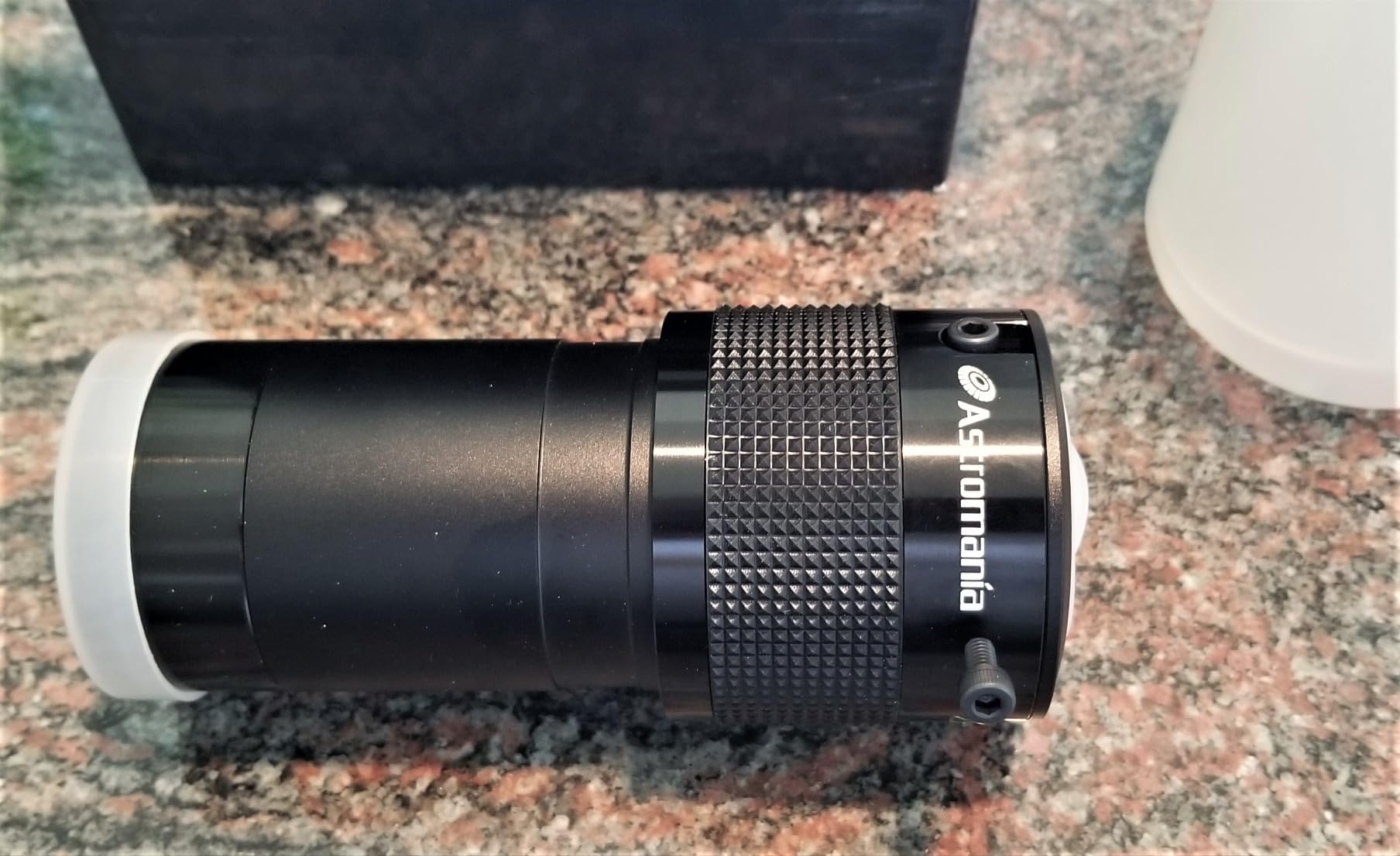
 Astromania 2 Inch ED 2X Barlow Astromania 2 Inch ED 2X Barlow |
|
Check Latest Price |
 Explore Scientific Fokal Extender 2x Explore Scientific Fokal Extender 2x |
|
Check Latest Price |
 Serounder 3X Metal Barlow Serounder 3X Metal Barlow |
|
Check Latest Price |
 XCCYG 2X-3X-5X Barlow Kit XCCYG 2X-3X-5X Barlow Kit |
|
Check Latest Price |
1. Celestron Omni 1.25 inch 2X Barlow Lens – Best All-Rounder for Planets
Celestron Omni 1.25″ 2X Barlow Lens for Telescope Eyepieces Threaded Barrel
2x factor
1.25 inch interface
Fully multi-coated, blackened edges
2.91 inch long, 0.08 kg
Pros
- Doubles the power of every 1.25 inch eyepiece you own
- Sharp high-contrast views of Jupiter Saturn and the Moon
- Fully multi-coated optics with blackened edges for good light transmission
- Removable lower cell works as a T-adapter for DSLR imaging
- Two-year warranty with US-based support
Cons
- 2x can push a small scope past its useful magnification limit
- High power amplifies mount vibration so a steady mount and accurate finder matter
- Higher magnification makes small targets harder to keep centred
The Omni 2x is the one I hand to friends who own a small Dobsonian or a 70mm refractor and wonder why their planets look so soft. Drop it in the focuser, put the eyepiece you would normally use for a nebula in the other end, and Jupiter’s belts stop being a smear and start being bands. Nothing else in this list does that for so little complexity, and at 2.91 inches long and 0.08 kg it is short enough not to upset a small mount’s balance.
What earns it the top slot is not the glass alone, though the fully multi-coated optics with blackened edges and a 46 degree apparent field are genuinely good. It is the combination of those optics with an owner base of 2487 ratings averaging 4.6 out of 5, which means any rough edges would have surfaced by now. They have not. The one owner-reported negative pattern is consistent and predictable: doubling the power doubles your sensitivity to vibration and can exceed a small scope’s ceiling.

Mechanically it is a straightforward piece of engineering. The barrel slips into 1.25 inch focusers and diagonals, the eyepiece drops into the chromed nose, and the reported 12.5mm exit pupil behaves exactly as the math says it should. The removable lower optical cell is the sleeper feature. Unscrew it and the barrel becomes a T-adapter, so the same purchase covers visual observing and a first attempt at lunar imaging through a DSLR.
The doubled eye relief is the part glasses wearers care about. Because the Barlow is a negative group placed before the eyepiece, the eyepiece’s own eye relief is largely preserved, which is exactly what a 4mm or 5mm eyepiece cannot offer on its own. If you wear glasses and have been avoiding ultra-short focal length eyepieces, this is the cheapest route to planetary power I know of.
Best paired eyepieces and scopes for the Omni 2x
On a 450mm focal length Newtonian, pair it with a 10mm eyepiece for 90x, which is a comfortable starting point on Jupiter’s belts. Move to a 6mm for 150x and you are in the ring-and-moon detail range, which is usually the sweet spot for a scope that size.
On an 8-inch Dobsonian with a 1200mm focal length, the same 2x Barlow takes your 25mm Plossl from 48x to 96x and your 10mm from 120x to 240x. Keep the 10mm under about 200x if the Dobsonian’s collimation is not perfect, because high power will show you a collimation problem you did not know you had.
Where the Omni 2x falls short
If you own a 2 inch focuser and a set of 2 inch eyepieces, this is the wrong size. A 1.25 inch Barlow fed by a 2 inch diagonal leaves a narrow cone and can vignette the outer field at high power, which is why the 2 inch options further down exist.
It is also a fixed 2x. If your scope is very fast and very short, 2x may not be enough to reach the planetary range, and you will be back shopping. For fast short-focal-ratio scopes, look at the 3x entries instead.
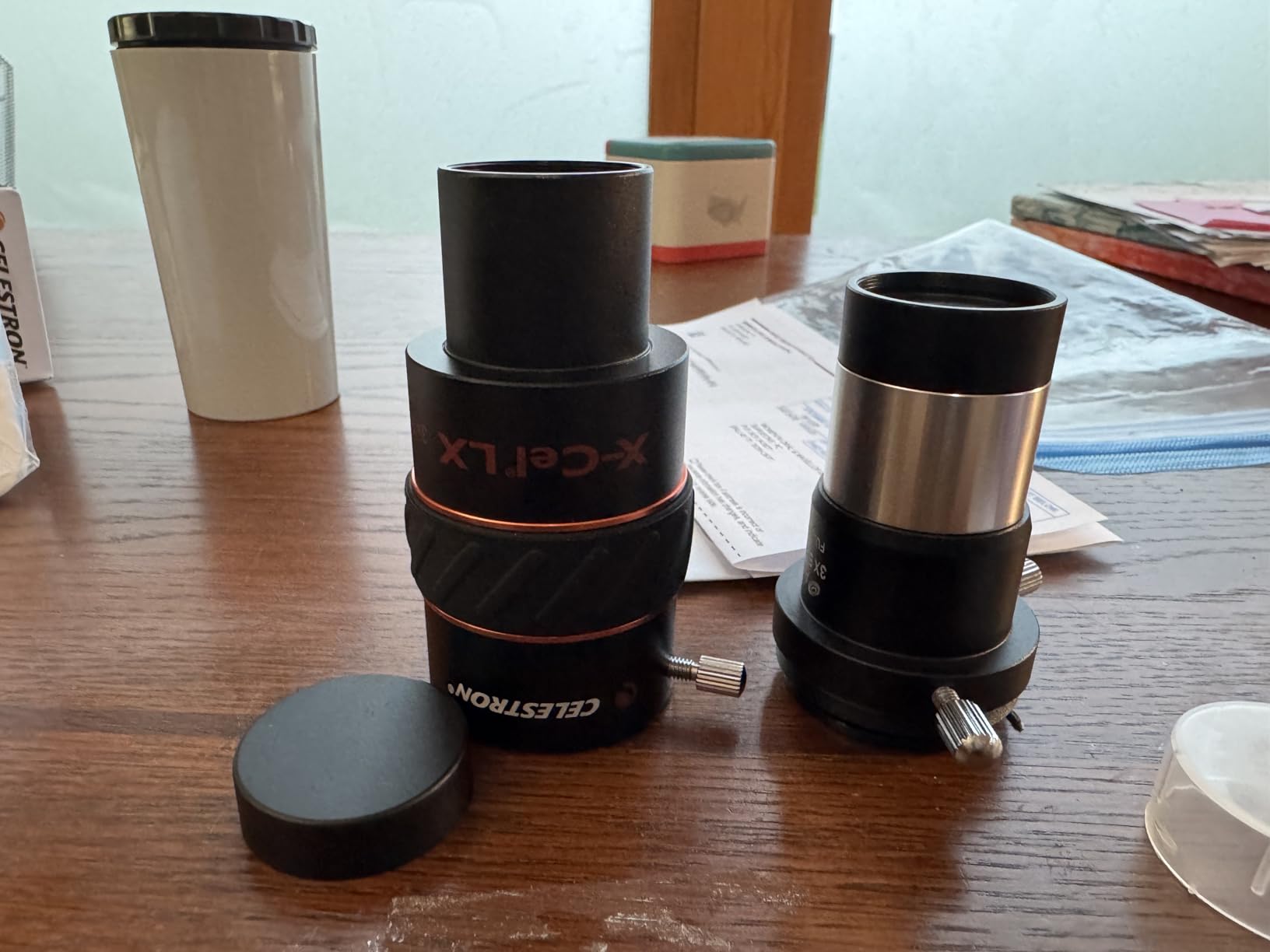
2. Celestron X-Cel LX 3X 1.25 Barlow Lens – Best Corrected 3x Power
Celestron X-Cel LX 3X 1.25 Barlow Lens for Telescope Eyepieces – Threaded
3x factor
1.25 inch interface
3-element apochromatic design
0.15 kg
Pros
- 3-element apochromatic optics give bright sharp well colour-corrected images
- Fully multi-coated on all air-to-glass surfaces
- Brass compression ring protects delicate eyepiece barrels
- Threaded to accept 1.25 inch filters directly
- Non-slip grip ring is easy to handle with gloves
Cons
- 3x can exceed the useful magnification of short-focal-ratio small scopes
- Heavier and longer than a basic 2x Barlow so a small mount may need rebalancing
- Demands a steady mount and accurate alignment at higher power
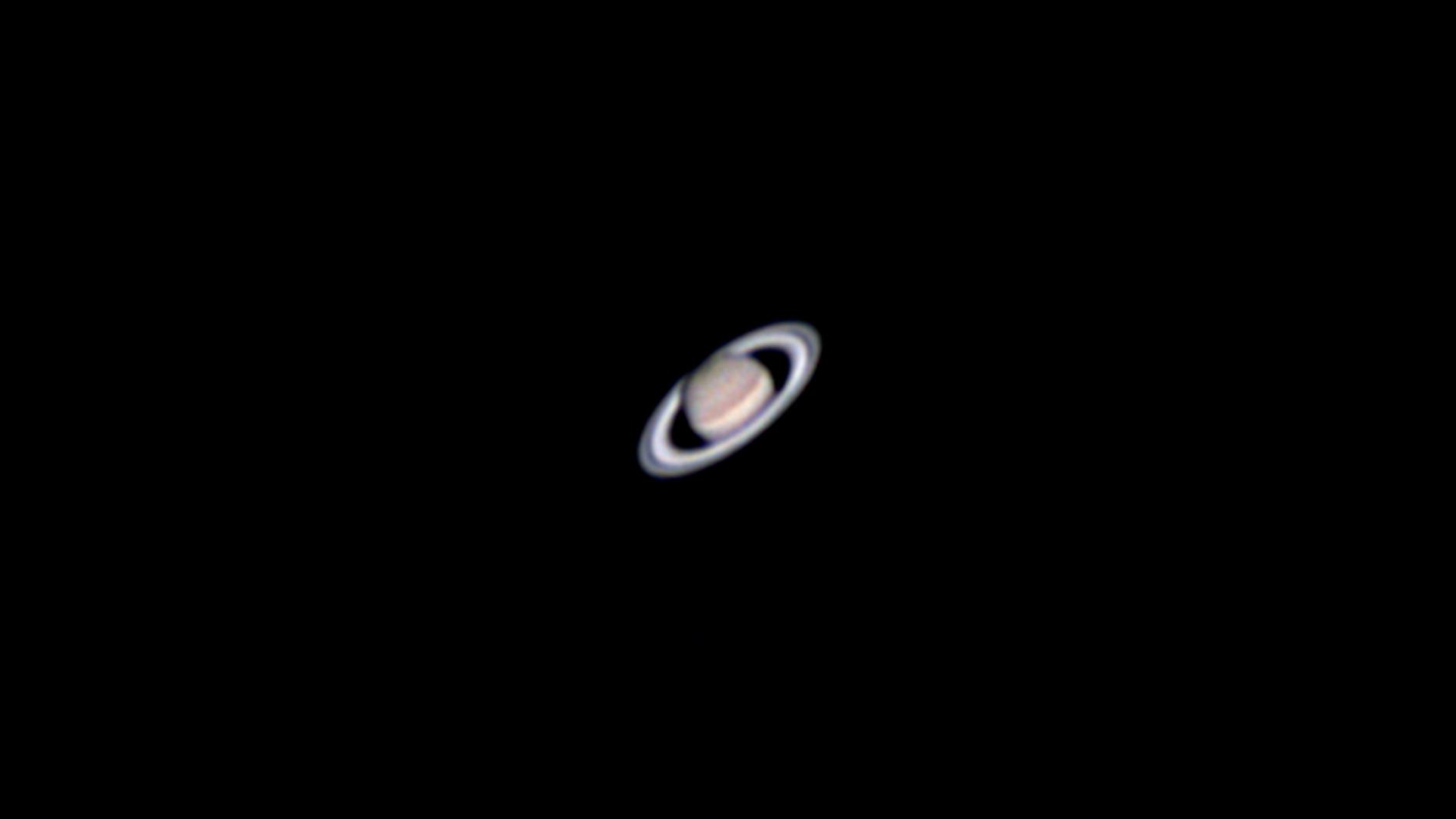
The X-Cel LX 3x is the pick for anyone whose telescope is fast and short. A 6-inch f/4.5 Dobsonian at 1370mm simply does not have enough focal length to reach planetary detail with a 10mm eyepiece alone, and this is the accessory that fixes it. Inserted with a 10mm, you get 411x on a scope that would otherwise top out around 137x.
Optically it is the most interesting piece in the list at the entry tier. A 3-element apochromatic design at 3x is unusual in a 1.25 inch Barlow, and owners consistently mention crisp planetary detail and clean colour correction as the reason. The colour fringing that makes a cheap achromatic look greasy around Jupiter’s moons is largely absent here, which matters precisely because that is what you are pointing it at.
The handling details are unusually well considered for a piece of glass. A brass compression ring holds the eyepiece without the risk of scratching the barrel that a bare set screw poses, and a central rubber grip ring means you can seat an eyepiece with cold fingers or gloves on. The barrel is threaded for 1.25 inch filters directly, saving you from hunting for an extra adapter when you want to deepen the view of a bright planet.
At 0.15 kg it is meaningfully heavier than a plain 2x, and that is the practical warning. On a small equatorial mount or a lightweight Dobsonian, swing it to the balance point and check that the focuser can still travel far enough to bring the eyepiece to focus. If it bottoms out, you need a 1.25 inch spacer rather than a different Barlow.
Where the 3x actually pays off
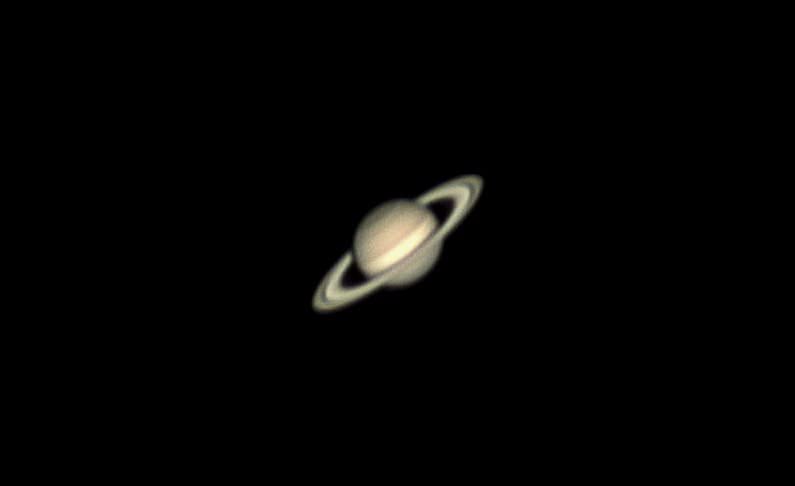
Fast Newtonian and short-tube Dobsonian owners should start here. The listed intended use is exactly that: a fast, short focal length telescope where 2x still leaves you under-powered at the eyepiece you own.
On a 450mm Newtonian, pair it with a 10mm for 135x and a 6mm for 225x, which puts you comfortably in the range where Saturn’s Cassini division starts to appear. On a 900mm refractor, the same pairing gives 270x and 450x, so use the 10mm and save the 6mm for a steady night.
Who should skip the 3x
Skip it if your scope is a long-focal-ratio instrument. On an 8-inch Schmidt-Cassegrain at 2032mm, a 3x Barlow on a 10mm eyepiece gives 610x, which no 203mm aperture can support. The image will be dim and detail-free no matter how good the Barlow is.
Also skip it if mount stability is your weak point. Three times the power is three times the magnification of every wobble, and the steadiness of the platform matters more at this level than any difference between two brands of Barlow.
3. Celestron Luminos 2.5X Barlow Lens – Best Middle Step for 2 Inch Users
Celestron Luminos 2.5X Barlow Lens for 1.25″ & 2″ Telescope Eyepieces
2.5x factor
Accepts 1.25 inch and 2 inch eyepieces
4-element optics, fully multi-coated
11.2 oz
Pros
- 4-element optics give a flat field with sharp colour-free images
- Works with both 1.25 inch and 2 inch eyepieces via the included adapter
- Hard-anodized aluminium barrel threaded for 2 inch filters
- Brass compression ring plus large thumbscrews for a secure glove-friendly grip
- 2.5x adds planetary detail without the extremes of 3x or 5x
Cons
- Costs more than entry-level 2x Barlows
- Larger heavier barrel needs focuser clearance and can affect balance
- Still dims the view somewhat compared with using an eyepiece alone
2.5x is the least talked-about factor in this category and, for a lot of scopes, the most useful one. It lands between the safe 2x and the demanding 3x, and on many telescopes it gets you to the planetary range with a mid-focal-length eyepiece instead of a punishing short one. The Luminos is the product that makes that middle step properly.
The optical design is 4-element with a listed 82 degree field of view, and owners describe the result as flat and free of extraneous colour. That flatness is the quiet advantage: at planetary magnification a curved field means the edge of Jupiter softens while the centre stays sharp, and you spend the whole time hoping the planet is centred. This one holds up across the frame.
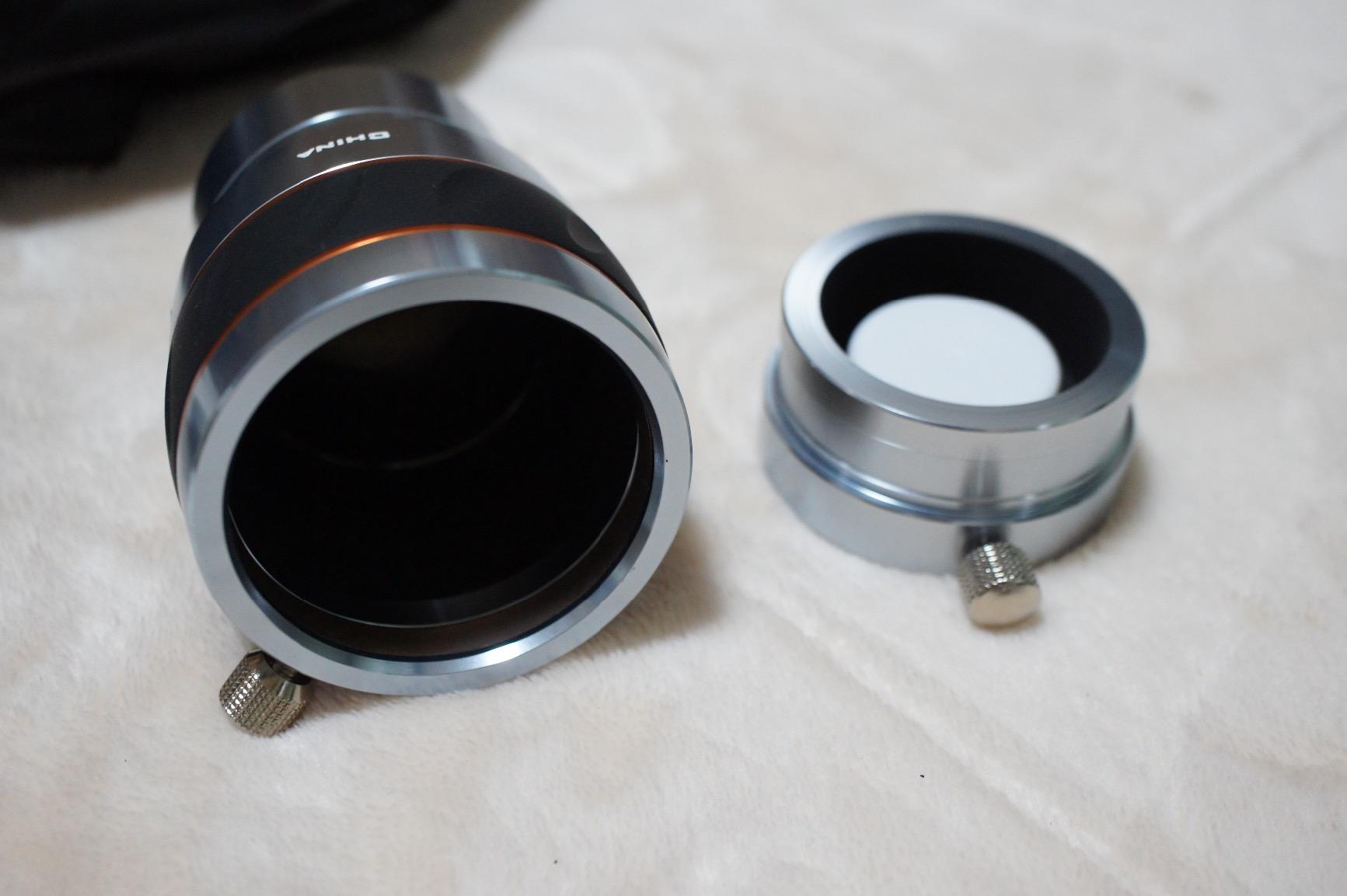
The real reason to like it is the included 2 inch to 1.25 inch adapter. If your telescope has a 2 inch focuser and you own a mix of barrels, this Barlow lets you use both without buying a second one or a diagonal. Combined with the 2 inch filter thread on the hard-anodized barrel, it is the most flexible single accessory in the group.
Its weaknesses are weight and cost relative to entry models. At 11.2 ounces it is the kind of mass that tips a small refractor’s balance forward, and a longer 2 inch Barlow may not reach focus in a focuser with limited travel. Measure before you commit, and keep a 1.25 inch spacer on hand.
Best pairings and clearances
On a 1200mm Dobsonian, 2.5x turns a 25mm eyepiece into a 120x instrument and a 10mm into 300x, which is roughly where the useful ceiling sits for a 200mm aperture. The 6mm would be empty magnification, so leave it out of the case.
Check clearance before ordering. A 2 inch Barlow needs a 2 inch focuser or a reducer adapter, and a focuser with shallow travel may not have the back focus. This is the most common reason a buyer reports that a Barlow will not reach focus, and the fix is a short spacer, not a return.
Where the 2.5x Luminos is the wrong pick
It is wrong for a strictly visual budget build where a 1.25 inch scope is what you own. The flexibility it offers is wasted if the 2 inch path is closed to you, and the light grasp penalty of a 2 inch Barlow on a small aperture is real.
It is also the wrong choice if you plan to do most of your imaging through a small-format camera sensor, where 1.25 inch glass is generally sufficient and the extra size only adds vignetting risk.
4. SVBONY 5X FMC Barlow Lens – Maximum Power for Short Scopes
SVBONY Telescope Barlow Lens, 5X FMC Barlow Lens, 1.25” Telescope Accessory
5x rated factor
1.25 inch accessory interface
Multi-coated broadband green film glass
135 g
Pros
- Affordable way to add serious power to a short-focal-length scope
- Blackened housing and multi-coated glass improve contrast
- Aluminium anodized body feels sturdy for the price
- Owners report clear lunar and planetary detail including Jupiter moons and bands
Cons
- Some owners dispute the advertised 5x and 3-element specification
- At high power the view dims noticeably and colour accuracy degrades
- Long and heavy enough to upset the balance of a small equatorial mount
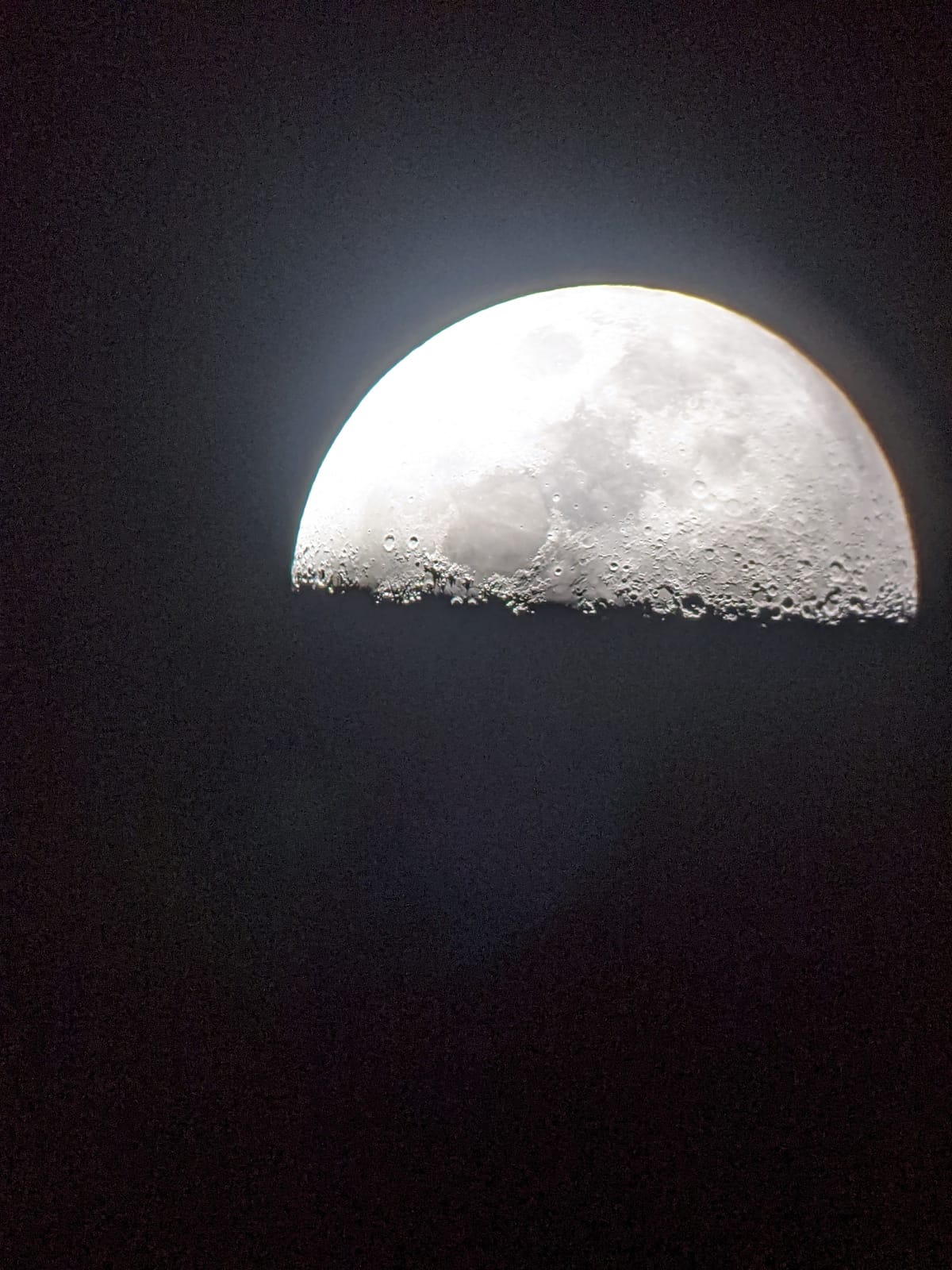
There is a specific owner for a 5x Barlow and it is a beginner with a very short telescope. Take a 4.5-inch tabletop Newtonian at 450mm focal length: with the 10mm eyepiece that ships with it you get 45x, which shows a fuzzy ball. Add a 5x and the same eyepiece gives 225x, which will show you Jupiter’s moons as points and the lunar terminator as a hard line.
Owner feedback on this one splits cleanly into two camps, and you should know both before buying. Many report genuinely satisfying views and call the blackened housing and multi-coated glass a good contrast improvement over the plastic Barlow that ships with most entry scopes. A well-documented group disputes the specification, judging the delivered magnification closer to 3x and the glass to be a 2-element achromat rather than the advertised 3-element design.

The practical concern is weight and length. At 135 g this is the heaviest 1.25 inch Barlow in the group, and on a light mount the imbalance shows up as image shake that no amount of careful focusing will fix. The 3.9 inch length also eats focuser travel, so budget for a spacer on scopes with a shallow draw tube.
Optical specifications list multi-coated broadband green film optical glass with a 9cm objective diameter, and the anodized aluminium body is genuinely well made for the money. But at this power level, glass quality matters more than at any other factor, and a cheaper element is exactly where the softness creeps in.
When 5x is justified and when it is not
Justified on short-focal-length tabletop Newtonians, small Dobsonians, and beginner refractors under about 500mm focal length. There, 2x leaves you well under the planetary range and 5x is the only step that gets you there with a stock eyepiece.
Use it with long focal length eyepieces, meaning 10mm and above, and stay under twice your aperture in millimeters. On a 150mm scope that ceiling is 300x, so a 25mm eyepiece at 5x gives 90x and a 10mm gives 225x. Both are sensible. A 6mm at 375x is not.
Why we would not build a kit around it
The disputed magnification rating is the issue. If a factor is not reliably delivered, you cannot do useful work with it, because your exit pupil and field calculations all assume a known number. Guessing at 3x or 5x is worse than owning a known 3x.
At 5x, the contrast penalty compounds with every element in the path. Budget glass plus five times magnification plus a small aperture is the recipe for the mushy Saturn that gives Barlows their bad reputation in the first place.
5. Bysameyee 2X Fully Multi-Coated Metal Barlow Lens – Best Value Build
Barlow Lens 2X, Bysameyee 1.25 Inch Fully Multi-Coated Metal Barlow Lens with M42 Thread Camera Connect Interface for Telescope Eyepiece
2x factor
1.25 inch interface
Fully multi-coated broadband green film glass
M42x0.75 thread
Pros
- Doubles magnification cheaply and makes small-aperture Dobsonians usable for detail
- Multi-coated broadband green film glass gives clear low-fringe images
- Solid machined aluminium build with brass compression ring
- Two pairs of dust covers keep the optics clean
- M42x0.75 thread doubles as a T-adapter for imaging
Cons
- A minority of owners received copies with marks or residue on the glass
- T-ring camera adapter is not included with the M42 connection
- 2x is a modest step so very large targets may need a shorter eyepiece
This is the Barlow we recommend to anyone who wants the mechanical quality of a premium unit without paying for branded glass. The body is precision-machined black anodized aluminium that feels substantial in the hand, and it includes a safety undercut, a brass compression ring, and two pairs of dust covers. Most budget Barlows ship with a captive set screw that can mar your eyepiece barrel; this one is designed not to.
Optically it uses fully multi-coated broadband green film glass described as chromatically corrected, and the reported result is clear, low-fringe images with users specifically mentioning visible Jupiter and Saturn detail. At 1071 owner ratings averaging 4.6, the feedback base is large enough that the picture is reliable rather than anecdotal.
The M42x0.75 thread on the base is the feature most owners discover later. Combined with a separately purchased T-ring, it turns the Barlow into a T-adapter for DSLR or SLR astrophotography, which means a visual accessory and an imaging adapter for one purchase. Note that the T-ring itself is not included, so budget for it if imaging is part of the plan.
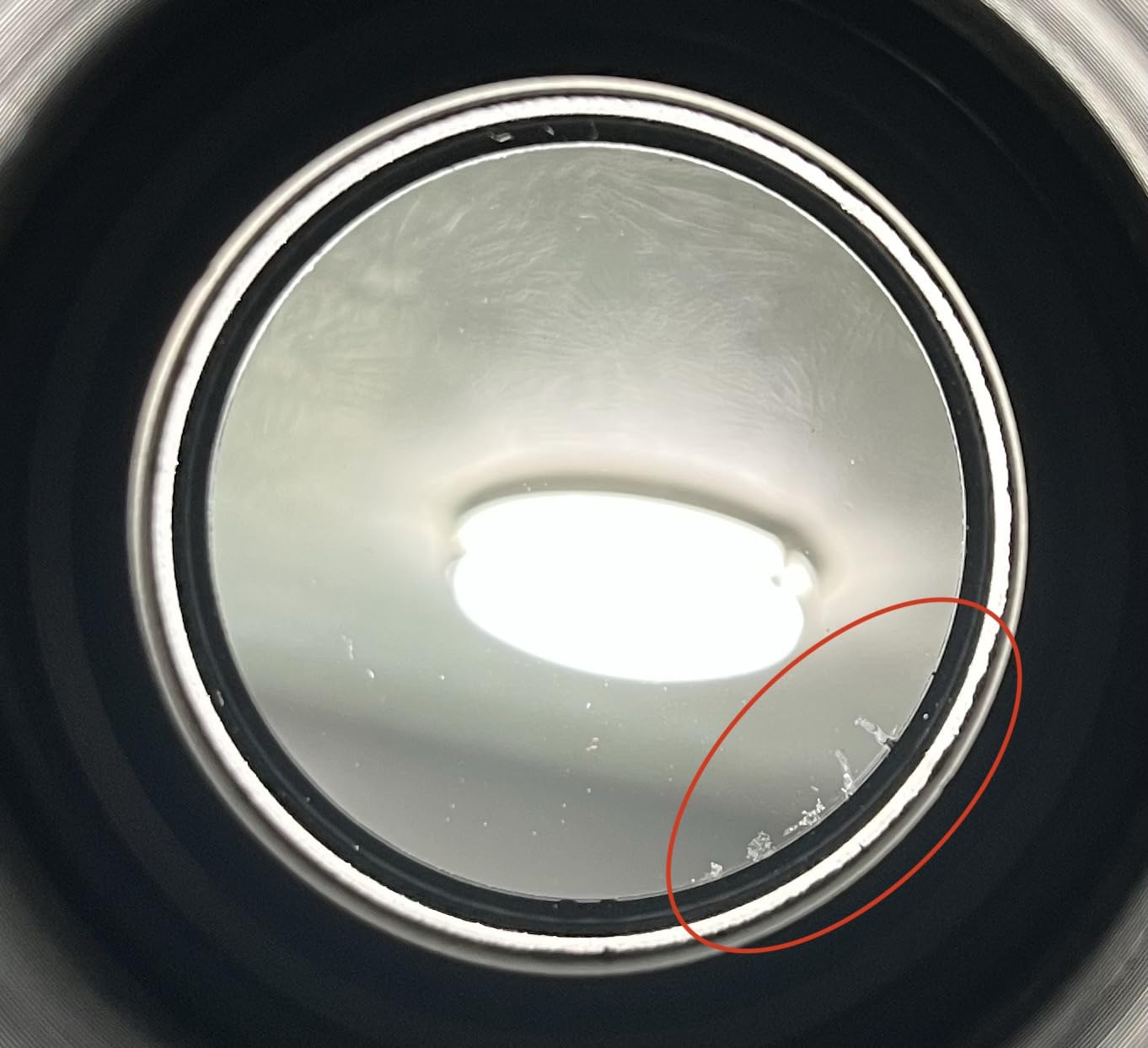
The documented failure mode is narrow but real: a small number of owners received copies with marks or residue on the optical element that could not be cleaned off, producing a blurry view. This is a quality-control issue rather than a design flaw, and it is the main reason to buy from a seller with straightforward returns.
Where it fits in a planetary kit
Pair it with a 10mm and a 6mm Plossl, the default planetary set. On a 900mm refractor that gives 180x and 300x, and on a 1200mm Dobsonian it gives 240x and 400x, so check the ceiling before using the 6mm on the larger aperture.
Its 1.25 inch format and short 3 inch length make it a good travel Barlow. It fits in a small bag, adds almost no weight at the back of the tube, and will not upset the balance of a grab-and-go setup.
Where it is the wrong choice
If your telescope has a 2 inch focuser and you own 2 inch eyepieces, a 1.25 inch Barlow introduces a step-down that can vignette the field at high power. Go to a 2 inch model in that case.
It is also 1.25 inch only, so if you later buy 2 inch eyepieces for deep sky work, this becomes a second optical train to keep track of. That is a minor annoyance, not a dealbreaker.
6. Astromania 3X Barlow Lens with T-Thread – Best Metal 3x with Camera Connection
Astromania 3X Barlow Lens for Telescope Eyepiece 1.25 Inch with T-Thread
3x factor
1.25 inch interface
Filter thread plus T-thread
4.06 oz
Pros
- Metal construction rather than plastic so it should last
- Sturdy mechanical design magnifies without noticeable colour loss
- Owners see more detail in Jupiter bands and brighter moons plus crisp Saturn rings
- Filter thread and T-thread let it double as an imaging adapter
Cons
- Some owners find achieving focus very difficult and report a soft image even focused
- Objects appear slightly dimmer which is common to all Barlows
- 3x on modest scopes can exceed useful magnification and some buyers are unsure it is fully 3x
The Astromania 3x is a solid metal alternative to plastic-bodied Barlows, and it comes with a T-thread that makes it a genuine dual-purpose accessory. Thread a bayonet DSLR or mirrorless body onto it and the Barlow becomes a focal extender for imaging, which is unusual at this price point and genuinely useful for framing small targets on a small sensor.
Owners like the mechanical build and the fact that it magnifies without obvious colour loss, and several report finding more detail in Jupiter bands and brighter moons along with crisper Saturn rings. Two dust covers ship in the box, which sounds trivial until you have carried a telescope out in dust and wanted to protect the front element.
Where it struggles is focusing. A recurring theme in the reviews is that some owners find it difficult to achieve focus and report a disappointing image even when focused. That usually points to insufficient focuser travel rather than bad glass, and the fix is a 1.25 inch spacer. If your focuser is already close to its limit, add one before you blame the Barlow.
The 4.06 ounce weight is a genuine plus. It is light enough for a small Dobsonian or a tabletop Newtonian, and the two holding thumbscrews keep the eyepiece secure without the marring risk of a sharp set screw.
How to get the focus right first time
Fit the Barlow, then the eyepiece, and rack the focuser all the way in before you look. If the image is sharp at any point of travel, you are fine. If the focuser bottoms out while the image is still soft, add a 1.25 inch spacer and repeat. This one step resolves most Barlow complaints we hear about.
On a 450mm Newtonian, use it with a 10mm for 135x and a 6mm for 225x. On a 900mm refractor, the 10mm gives 270x, which is already near the limit for a 90mm aperture.
Who should pass on it
Owners who need certainty about the magnification factor should look elsewhere, since some buyers are not confident it delivers the full 3x. Planets punish imprecise magnification because you end up guessing at whether a soft view is the Barlow or your own technique.
Anyone who is very sensitive to contrast loss should also weigh a multi-element design instead. A 3x on a 2-element group is the highest-magnification combination in this list, and that is where softness is most visible.
7. Astromania 2 Inch ED 2X Barlow Lens – Best 2 Inch Aperture with ED Glass
Astromania Barlow Lens 2X, 2 Inch ED Barlow Lens for Astronomical Telescope
2x factor
2 inch aperture
ED glass, multi-coated
11.46 oz
Pros
- ED glass minimises visible chromatic aberration for sharp high-contrast views
- 2 inch diameter accepts 2 inch eyepieces directly and avoids vignetting or shadowing
- All lens surfaces multi-coated to reduce reflections
- High-grip exterior is easy to handle with gloves
- Filter threads provided for 2 inch filters
Cons
- Heavier and bulkier than 1.25 inch Barlows so a 2 inch focuser or adapter is required
- Costs more than entry-level 2x models
- Adding 2x still dims the view somewhat
If your focuser is 2 inch and your best eyepieces are 2 inch, this is the shape you want. The 2 inch aperture is the whole point: a 1.25 inch Barlow feeding a 2 inch diagonal leaves a narrow light cone, and at high power the corners of the frame darken. A 2 inch Barlow eliminates that, and reviewers specifically call out the absence of shadowing across the frame.
The ED glass is the second reason to choose it. Extra-low dispersion glass holds colour fringing to a minimum, and owners describe the result as sharp and high contrast, which is the correct behaviour at planetary magnification. Every lens surface is multi-coated to suppress reflections, and two dust covers come in the box.
Ergonomics get a mention more often than you would expect, because cold-weather observing involves gloves. The high-grip exterior is described as secure to hold even with gloves on, and the 2 inch filter threads sit on both the lower part of the Barlow and the reducer adapter, so you can filter without hunting for parts.
At 11.46 ounces this has real mass, and a 2 inch Barlow also needs more back focus than a shorty. On a small refractor with a 1.25 inch focuser you will need a reducer adapter plus a spacer to use it at all, so check your hardware before ordering.
When 2 inch glass genuinely pays
It pays when you already own 2 inch wide-field eyepieces and want to use them for planets. A 32mm Plossl at 2x on a 1200mm Dobsonian gives 75x for scanning, and the same eyepiece pushed to 300x on a smaller aperture is where the 2 inch aperture stops vignetting.
It also pays for imaging. On a camera sensor the large diameter avoids vignetting outright, and the manufacturer describes it as suited to astrophotography where more focal length is needed for compact objects to appear at a reasonable size on a small image format chip.
When to stay at 1.25 inch
Stay small if you only own 1.25 inch eyepieces. The 2 inch body then gains you nothing optically, adds weight at the back of the tube, and requires an adapter to reach focus in most budget Newtonians.
It is also a poor choice as a sole purchase for a fast short-focal-length Dobsonian, where 2x may still not deliver enough magnification. In that case a 3x 1.25 inch model reaches the planetary range with less glass in the way.
8. Explore Scientific Fokal Extender 2x – Best Four-Lens Correction
Explore Scientific Fokal Extender – Barlow Lens to Increase The Focal Length for Telescopes
2x focal extender
Four-lens telecentric design
Fully multi-coated
0.35 kg
Pros
- Telecentric four-lens design keeps images sharp and well corrected
- Fully multicoated on all surfaces with blackened edges for maximum contrast
- Effectively doubles effective focal length for detailed planetary and imaging work
- Also available in 2 inch and 3x versions to match different eyepieces
Cons
- The most expensive item in this comparison
- Bulky and heavy relative to simple 1.25 inch Barlows so it needs a stable mount
- A 2x extender still dims the image relative to using the eyepiece alone
The Fokal Extender is the one we would own if we owned only one Barlow and had a stable mount. Its four-lens telecentric design is a fundamentally better optical architecture than a single negative element, and owners point to it as the reason the image stays sharp and contrasty at 2x rather than merely acceptable. Its 4.7 average rating is the highest in this group alongside the corrected Celestron models.
Telecentric matters at planetary magnification specifically. A conventional Barlow refracts differently off-axis than on-axis, so a planet near the edge of the field is softer than the same planet in the middle. A telecentric design reduces that, which means you spend less time centring and more time looking.
Members of the observing community have singled out Explore Scientific Barlows and eyepieces as among the best available, so this badge reflects both our own comparison and a wider pattern in owner reports. Everything is multi-coated and all lens edges are blackened to maximise contrast, which is the right treatment when the target is a bright disc against black sky.
The trade-offs are honest ones. At 0.35 kg it is by far the heaviest Barlow here, and its 1.89 by 3.94 inch footprint is large. That mass sits at the worst possible place, cantilevered behind the focuser, so it needs a properly balanced equatorial mount rather than a lightweight Dobsonian base. A 2x extender also dims the image relative to the eyepiece alone, as any added element does.
Who should pay for telecentric optics
Anyone doing serious high-power visual work on a stable equatorial mount, and anyone lucky imaging. The four-lens design is well matched to planetary imaging, where every photon counts and any softening from a simple element shows up in the recording.
It is also the safest pick if you already have a large aperture. On an 8-inch or 10-inch scope, the light loss from a long Barlow is proportionally smaller, so the optical quality of the glass is what determines whether high power looks good.
Why it is not our top pick
Mass and cost. Most of the people who read this guide own a Dobsonian or a small refractor, and neither benefits from 0.35 kg cantilevered behind a focuser. For the majority of readers, the Celestron Omni 2x at 0.08 kg delivers the same 2x with far less of a fight.
On a small equatorial mount, rebalancing for this extender and then noticing the image shake is a frustrating way to spend an evening. Match the mount to the accessory, not the other way around.
9. Serounder 3X Metal Barlow Lens – Best Budget 3x Step Up
3X Lens Barlow Lens, 1.25 inches Metal Barlow Lens with M42x0.75mm Thread Camera Connect Interface Fully Black Multi Coated for Standard Telescope Eyepiece Astronomy
3x factor
1.25 inch interface
Fully multi-coated metal shell
3.2 oz
Pros
- Metal shell is sturdier and better machined than the plastic Barlow many scopes ship with
- Adds a useful 3x boost to 1.25 inch eyepieces
- Multi-coated and blackened for bright high-contrast views
- Owners report enhanced quality on Jupiter and Saturn plus crisp lunar detail
- M42x0.75 thread allows a camera connection for imaging
Cons
- Some owners report blur and colour fringing especially in a quality telescope
- Focus is described as slightly difficult to fine tune
- 3x may be too much for small scopes or extended targets
The Serounder 3x is the classic first upgrade over the plastic Barlow that ships in the box with a new telescope. If you have ever looked through a cheap plastic Barlow and wondered why the view looked veiled, this metal-bodied replacement is the cheapest way to fix that feeling. At 3.2 ounces it adds almost nothing to the balance.
Owners consistently report good results on the Moon, Jupiter, and Saturn, and the fully multi-coated, blackened optics produce a noticeably cleaner image than the plastic original. Pairing it with a longer focal length eyepiece such as a 25mm is the common recommendation, because a 3x on a 4mm is beyond what almost any consumer telescope can support.
It is also fully multi-coated metal with an M42x0.75mm camera connection interface, so it serves double duty as an imaging extender for a camera with the appropriate adapter. That versatility is what makes it feel like more than a spare part.
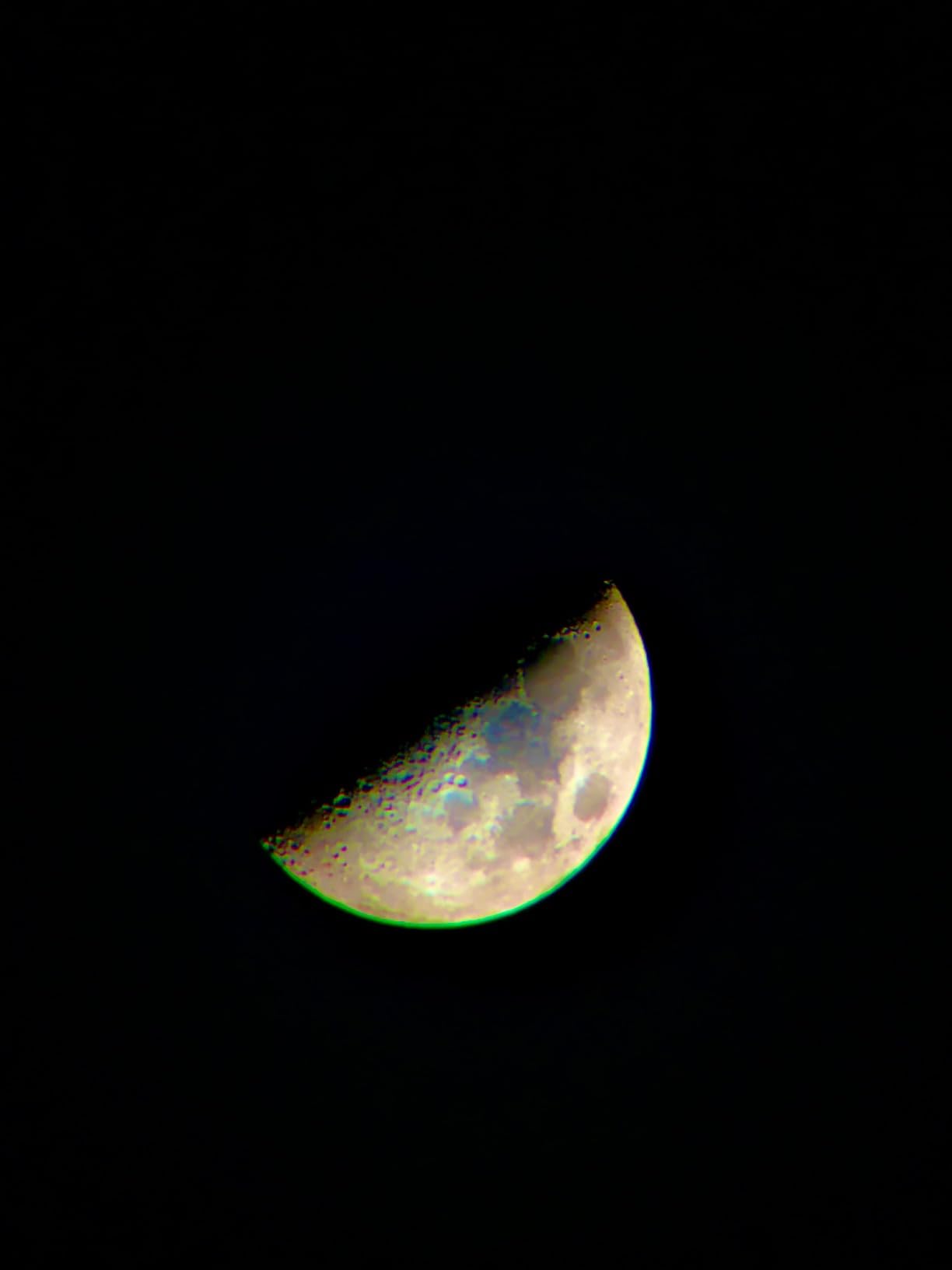
The honest weakness is optical refinement. Some owners report blur and colour fringing, and specifically note it shows up more in a quality telescope, where a good eyepiece exposes any softness in the front group. Fine focus is also described as slightly difficult to tune, which is typical of a short barrel with a tight draw tube.
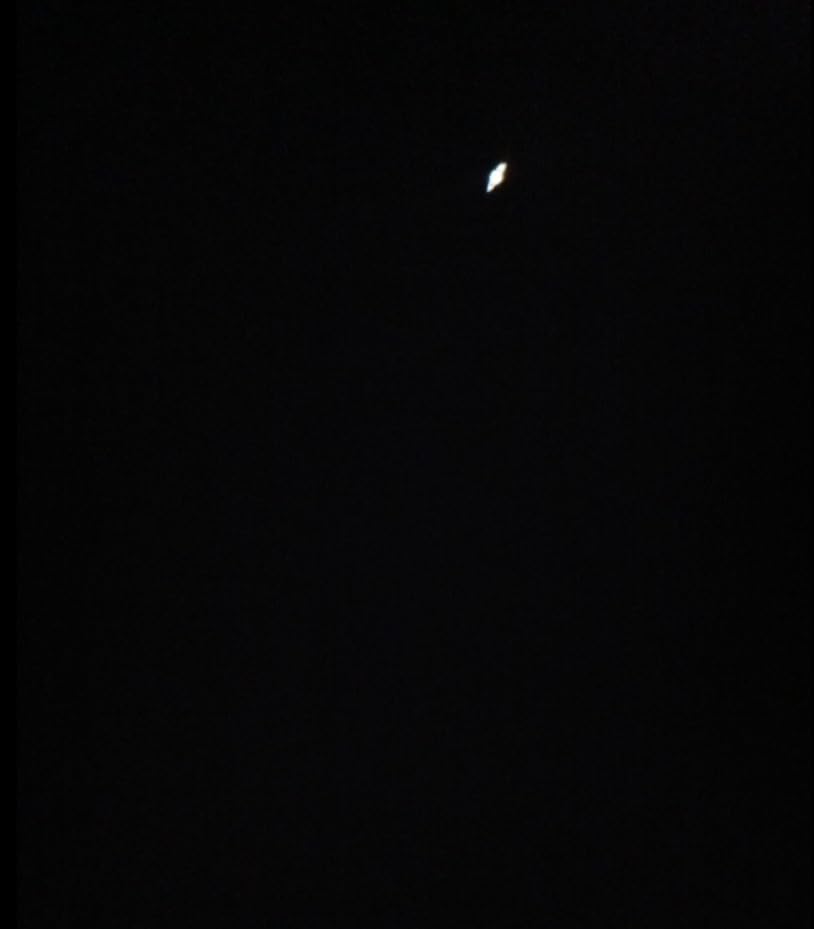
Making the most of a 3x at 1.25 inch
Use long focal length eyepieces. A 25mm with a 3x on a 450mm Newtonian gives 54x, a 10mm gives 135x, and a 6mm gives 225x, which is the practical limit for a 114mm aperture. Anything shorter is empty magnification.
Brace the altitude bearing and use a slow-motion knob if your mount has one. At 3x, every tremor you could ignore at 45x becomes obvious, and observers often blame the Barlow for what is really mount shake.
Where to step up instead
If you already own a good telescope and good eyepieces, buy the corrected glass instead. A 2x with multi-element optics will beat a 3x with simple glass on the same target every time, because detail you cannot resolve is detail you never see.
It is also the wrong choice for extended objects. At 3x, nebulae and galaxies are pushed to the edge of visibility with a narrow, dim field, which is exactly the wrong use of magnification.
10. XCCYG 2X-3X-5X Barlow Lens Kit – Best Multi-Power Set
Telescope Barlow Lenses Kit 2X-3X-5X, 1.25 Inch Telescope Accessory, Fully Metal Multi Coated Broadband Green Film Barlow Lens for Astronomy Eyepiece
Three lenses: 2x 3x and 5x
1.25 inch interface
Fully multi-coated glass
Blackened edges and inner barrel
Pros
- Three magnification options in one set so you can match power to the target
- Clear sharp views of Jupiter and the Moon reported by multiple owners
- All-metal blackened body with multi-coated broadband green film glass
- Blackened edges and barrel maximise contrast
- Detachable ring makes the lenses M42 camera-compatible
Cons
- The 5x lens can go blurry on modest apertures and exceeds many scopes useful limit
- Lightweight barrels can need a case to avoid damage
- Not in the same class as premium multi-element glass for correction
The XCCYG kit is the practical answer to the question every Barlow buyer eventually asks: what if 2x is not enough but 5x is too much? The set gives you 2x, 3x, and 5x in three separate 1.25 inch barrels with fully multi-coated broadband green film glass, and the middle member is the one you will probably use most.
Owners single out the 3x as the most useful of the three for turning existing 1.25 inch eyepieces into proper planetary instruments, and report clear views of Jupiter and the Moon. The detachable ring makes each lens M42 camera-compatible for imaging, and the blackened edges and inner barrel are correctly specified for contrast, which is the parameter that matters for planets.

Value is the argument. Three lenses for less than the cost of two single-factor units, each with multi-coated glass and a machined black anodized body, is difficult to argue with if you are building a kit from nothing. Each is individually packaged, which also means one damaged lens does not cost you the whole set.
The 5x is the weak member of the trio, and owners say so directly. On modest apertures it goes soft, and it exceeds the useful magnification of many small scopes. Treat it as an occasional tool for lunar work on a fast short-focal-length instrument rather than a planetary workhorse.
Optical correction is good for a set at this level but not comparable to premium multi-element glass, and the barrels are light enough that a padded case is worth having if you travel with them.
Which of the three to reach for
Use the 2x as your default. It doubles your eyepiece set, stays inside the useful range for most apertures, and is the lens that will see the most use. On a 900mm refractor, a 2x with a 10mm gives 180x, a classic Jupiter number.
Move to the 3x when you need to reach the planetary range with a long eyepiece, particularly on a fast Newtonian or a short Dobsonian. Reach for the 5x only for the Moon on a small, fast scope, and check the ceiling first.
When a single quality lens beats the set
Buy one good lens instead if you already know your factor. Choosing a single 2x with multi-element optics will outperform a set of three simpler lenses at the same 2x, because glass quality beats quantity for planetary contrast.
It also beats the set if you travel. Three barrels mean three things to keep track of, and the shortest one is still longer than a dedicated shorty Barlow, which matters on a grab-and-go Dobsonian.
How to Choose a Barlow Lens for Your Telescope
The right Barlow for planetary work is the one that gets you to between 100x and 250x without pushing past what your aperture can resolve, in a barrel size your focuser accepts, with glass good enough to hold contrast at that power. Everything else is preference.
What is the best magnification for a Barlow lens?
For most telescopes and most planetary targets, the best magnification for a Barlow lens is 2x. That is because 2x is the only step that reliably lands a 25mm or 10mm eyepiece into the 100x to 250x range where Jupiter’s bands and Saturn’s rings live, and it stays inside the roughly 2x-the-aperture-in-millimeters useful ceiling for small scopes. Step up to 3x only when your telescope is fast and short, and treat 5x as a lunar tool for small fast instruments.
Work out your magnification before you buy
Magnification equals telescope focal length divided by eyepiece focal length, and a Barlow multiplies the result. A 450mm focal length Newtonian with a 10mm eyepiece gives 45x; add a 2x Barlow and it gives 90x. Work through your own numbers with these common combinations before choosing a factor.
For a 450mm Newtonian: the 25mm eyepiece gives 18x, 24x with a 2x, and 54x with a 3x. The 10mm gives 45x, 90x with a 2x, and 135x with a 3x. The 6mm gives 75x, 150x with a 2x, and 225x with a 3x.
For a 900mm refractor: the 25mm gives 36x, 72x with a 2x, and 108x with a 3x. The 10mm gives 90x, 180x with a 2x, and 270x with a 3x. The 6mm gives 150x, 300x with a 2x, and 450x with a 3x.
For a 1200mm Dobsonian: the 25mm gives 48x, 96x with a 2x, and 144x with a 3x. The 10mm gives 120x, 240x with a 2x, and 360x with a 3x. The 6mm gives 200x, 400x with a 2x, and 600x with a 3x.
For a 2032mm Schmidt-Cassegrain: the 25mm gives 81x, 162x with a 2x, and 244x with a 3x. The 10mm gives 203x, 406x with a 2x, and 610x with a 3x. The 6mm gives 339x, 677x with a 2x, and 1016x with a 3x.
Read those numbers and the rule becomes obvious. The Schmidt-Cassegrain already has plenty of focal length and wants a 2x at most with a long eyepiece. The 450mm Newtonian is the opposite and needs the 3x.
1.25 inch or 2 inch?
Choose 1.25 inch unless you already own 2 inch eyepieces or a 2 inch focuser. It is lighter, shorter, cheaper, and reaches focus in more scopes, which covers the majority of planetary observing. Choose 2 inch when your focuser is 2 inch and your best eyepieces are 2 inch, because a narrow light cone can vignette the field at high power.
Check reach-focus before committing to any 2 inch Barlow. A 2 inch Barlow needs more back focus than a shorty, and budget Newtonians and budget refractors with short-travel focusers will not manage it without a spacer. Many buy reports of a Barlow that will not focus are clearance problems, not optical problems.
Achromatic, ED, or multi-element?
At planetary magnification, contrast is everything, and contrast is where glass type separates the tiers. A two-element achromatic is fine at low power on bright targets but shows colour fringing once you push past about 150x on a large aperture. ED glass reduces that fringing visibly, and multi-element apochromatic designs such as the 3-element X-Cel LX and the 4-element Luminos hold colour correction across the frame.
For most beginners, fully multi-coated achromatic glass is genuinely sufficient. The jump in visible performance becomes obvious when you move from 90x to 200x, or when you compare a colour-fringed moon terminator against a clean one. Buy the better glass if you plan to spend a lot of time above 200x.
Match your Barlow to your telescope type
With a Dobsonian, prioritise a short barrel. A 2.91 inch 1.25 inch Barlow adds nothing to the balance, while a 3.9 inch model on a lightweight base will make the image shake worse at exactly the power where you need it steady. A 2x is almost always right, and a 3x only on a short-tube model.
With a Schmidt-Cassegrain, stay at 2x and use long eyepieces. Its 2032mm focal length reaches the planetary range on its own, and 3x or 5x on a 203mm aperture is empty magnification every time. Many SCT owners pair a 2x Barlow with a binoviewer for the doubled resolution per eye, though that is a separate purchase.
With a refractor, watch the focuser. Long-tube refractors have plenty of back focus and will accept almost anything, but short-tube refractors with shallow draw tubes need a 1.25 inch spacer before they will focus a 2x or 3x. Refractors are also the easiest telescopes to image through, so a Barlow with a T-thread is worth considering here. If you have not settled on a scope yet, our beginner telescope picks explain how aperture and focal length drive the magnification maths above.
With a fast Newtonian, use more power than instinct suggests. A 6-inch f/5 at 750mm, or an 8-inch f/4.5 at 920mm, sits well below what a 2x delivers, and a 3x is often the right first step. Pair it with a 10mm or 25mm rather than anything shorter.
What problems do refractor telescopes have that reflectors don’t?
Refractors suffer chromatic aberration that reflectors do not, and the amount grows with magnification, which is why a fast short achromatic refractor shows a colour fringe around high-contrast planetary detail that an 8-inch Dobsonian does not. Apochromatic or ED glass removes most of it, a long focuser keeps it minimal, and neither issue applies to a Newtonian mirror.
Reflectors have their own problem instead. A mirror needs periodic collimation, and at high power a Dobsonian with poor collimation will show you fringes that have nothing to do with the Barlow. Before blaming your Barlow for a soft image, check the collimation and the focuser.
How to avoid empty magnification
Use the twice-the-aperture rule as your ceiling. A 150mm scope resolves usefully to about 300x, a 200mm to about 400x, and a 250mm to about 500x. Past that the image dims and blurs because you are spreading the same light over more area, which is exactly what produces the dim, mushy Saturn that gives Barlows a bad name.
Exit pupil tells the same story from the other direction. Divide your aperture in millimeters by your magnification. Between about 0.5mm and 1.0mm, a planetary observer’s eye is gathering light efficiently and the image is at its brightest. Below 0.5mm the exit pupil is smaller than the pupil of your eye and you are wasting resolution.
Four mistakes to avoid with any Barlow
First, do not stack two Barlows. Combining 2x and 3x to reach 6x multiplies the glass errors as well as the power, and no competent observer does it. One good Barlow is always better than two in series.
Second, do not use an anti-scatter shield backwards, which adds flare rather than removing it. The baffle exists to absorb stray light from off-axis sources, so it must face the incoming light.
Third, do not assume a blurry image means a bad Barlow. Check focuser clearance, check collimation, check the mount for shake, and check whether you are simply past the useful magnification for your aperture.
Fourth, do not buy the highest factor available. Factor is the easiest thing to add later and the hardest to undo optically. Buy 2x unless your focal length genuinely needs more.
Finally, do not neglect cleaning and storage. The dust covers included with several of these models exist for a reason, and coatings are damaged by fingerprints and damp more often than by use. Handle the outer rim, keep the caps on in transit, and you will get years of service from any of the ten.
Frequently Asked Questions
What is the best magnification for a Barlow lens?
For most telescopes, 2x is the best magnification for a Barlow lens because it lands a 25mm or 10mm eyepiece in the 100x to 250x range where Saturn’s rings and Jupiter’s bands resolve, while staying inside the roughly 2x-the-aperture-in-millimeters useful ceiling for small scopes. Step up to 3x only when your telescope is fast and short, and treat 5x as a lunar tool rather than a planetary one.
What is a 2X Barlow lens used for?
A 2x Barlow lens doubles the magnification of every eyepiece you own without requiring a new one. Because it is a negative lens group placed ahead of the eyepiece, the eyepiece keeps the same apparent field of view and roughly the same eye relief, so you get 180x instead of 90x while still seeing a 50 degree field. It is also the safest step on a small telescope, because it is unlikely to push you past the useful limit.
What is a 3x Barlow lens used for?
A 3x Barlow lens triples the power of your 1.25 inch eyepieces and is aimed at fast, short focal length telescopes that cannot reach the planetary range on their own. A 450mm Newtonian with a 10mm eyepiece gives 45x alone and 135x with a 3x Barlow, which is the range where Jupiter’s moons and Saturn’s rings resolve. On long focal length instruments such as a Schmidt-Cassegrain, 3x is almost always empty magnification.
What are the downsides of using Barlow lenses?
The main downsides are added cost, a small loss of light and contrast, extra weight at the back of the focuser, and the risk of over-magnification. A cheap achromatic element introduces colour fringing that softens planetary detail, a long Barlow may not reach focus in a shallow focuser without a spacer, and a high factor such as 5x can push a small scope past its useful magnification limit and produce a dim, mushy image. A well-corrected multi-element Barlow at 2x avoids almost all of these problems.
Do barlow lenses work?
Yes. A Barlow works by negative magnification: a diverging lens group placed between your focuser or diagonal and the eyepiece extends the effective focal length of the whole optical train, so every eyepiece you own instantly delivers double or triple the power. The apparent field of view and eye relief stay roughly the same because the eyepiece itself is unchanged, which is why a 2x Barlow is often more comfortable than buying a very short focal length eyepiece.
What problems do refractor telescopes have that reflectors don’t?
Refractors suffer chromatic aberration that reflectors do not, and it grows with magnification, so a fast short achromatic refractor shows colour fringing around high-contrast planetary detail that an 8-inch Dobsonian never will. Apochromatic or ED glass removes most of it, and a long focuser keeps it minimal. Reflectors instead need periodic collimation, and a poorly collimated mirror at high power can look like a bad Barlow. For imaging, a Barlow with a T-thread is easiest to pair with a camera on a refractor.
The Best Barlow Lens for Planetary Viewing in 2026
The Celestron Omni 1.25 inch 2X Barlow is our pick for the best barlow lenses for planetary viewing, because it does the one thing that matters most: it doubles the power of the eyepieces you already own and lands you in the 100x to 250x range where planets actually show detail, without pushing small scopes past their useful limit. Its 2.91 inch length and 0.08 kg weight also mean it fits the scopes most people actually own.
Choose the Celestron X-Cel LX 3x if your telescope is fast and short, the Astromania 2 inch ED 2x if you have a 2 inch focuser and 2 inch eyepieces, the Bysameyee 2x if you want machined build quality and a camera thread, and the Explore Scientific Fokal Extender if you have a stable equatorial mount and want the sharpest corrected 2x available.
Whichever you pick, stay under roughly twice your aperture in millimeters, use one Barlow rather than two, and give your mount a chance to stop shaking before you judge the glass. Updated for October 2026.