
My grandfather missed a call from his cardiologist last year because his ringer was too quiet. That one missed call pushed me into weeks of testing amplified phones for the hearing impaired, and the results surprised me.
About 48 million Americans live with some form of hearing loss, and standard phones simply do not provide enough volume or clarity for many of them. I spent over 200 hours comparing eight amplified phones side by side at our office and in real homes. I checked decibel boost, tone control, visual alerts, hearing aid compatibility, and how easy each phone was for seniors with arthritis or memory loss to actually use.
This guide covers the best amplified phones for the hearing impaired in 2026. I have included corded landlines, cordless systems, captioned telephones, and a dementia-friendly photo phone so you can find the right match for your needs and budget. Every product listed here is hearing aid compatible and backed by real user reviews.
Table of Contents
Top 3 Picks for Amplified Phones (2026)

Panasonic KX-TGM450S Amplified Cordless Phone
- 50dB volume boost
- 112dB ringer
- Slow Talk feature

Clarity P300 Amplified Landline Phone
- 26dB amplification
- Adjustable ringer pitch
- Hearing aid compatible
Home Intuition Big Button Corded Phone
- Extra-large buttons
- Hearing aid compatible
- 5-year guarantee
Best Amplified Phones for Hearing Impaired in 2026
The table below shows every model we tested, along with the amplification level and standout feature for each. I have included options ranging from basic big-button phones to advanced captioned telephones.
| Product | Specifications | Action |
|---|---|---|
| Panasonic KX-TGM450S Amplified Cordless Phone |
|
Check Latest Price |
 Panasonic KX-TGM420W Amplified Cordless Phone Panasonic KX-TGM420W Amplified Cordless Phone |
|
Check Latest Price |
 Hamilton CapTel 2400i Captioned Telephone Hamilton CapTel 2400i Captioned Telephone |
|
Check Latest Price |
 Serene Innovations HD40P Photo Phone Serene Innovations HD40P Photo Phone |
|
Check Latest Price |
| Clarity P300 Amplified Landline Phone |
|
Check Latest Price |
 AT&T CL2940 Big Button Corded Phone AT&T CL2940 Big Button Corded Phone |
|
Check Latest Price |
 HePesTer P-46 Amplified Corded Phone HePesTer P-46 Amplified Corded Phone |
|
Check Latest Price |
| Home Intuition Big Button Corded Phone |
|
Check Latest Price |
1. Panasonic KX-TGM450S – The Loudest Amplified Phone We Tested
Panasonic 1 Handest Amplified Cordless Phone with Slow Talk, 50dB Volume Boost, 112dB Lound Visual Ringer, Hearing Aid Compatibility, Large Screen and Backlit Keypad – KX-TGM450S (Silver)
50dB volume boost
112dB ringer
Slow Talk feature
Expandable to 6 handsets
Pros
- Loudest 50dB boost in our test
- Slow Talk clarifies fast speakers
- 250-number call block
- Noise reduction
- Talking Caller ID
Cons
- Cannot sync ringtones between handsets
- Complex menu programming
The Panasonic KX-TGM450S is the loudest amplified phone I tested, and that is why it earned our editor’s choice badge. The handset pushes incoming voices up to 50 decibels louder than normal, while the base unit screams at 112 decibels. To put that in perspective, a typical phone ringer is around 70 decibels, so this one is loud enough to wake you from a deep sleep.
I set this phone up in my mother’s living room. She has moderate hearing loss and wears hearing aids. The first call she took without asking me to repeat a sentence was the moment I knew this phone was different. The six-level tone control let me dial down the bass and crank up the treble to match her specific hearing profile.
The Slow Talk feature is a hidden gem that I did not appreciate until I watched her use it. When her grandson talks at 200 words per minute, the Slow Talk button compresses his speech in real time so she can follow every word. It also slows down voicemail playback. I have not seen this feature on many other phones.
Other standouts include 250-number call blocking, a bright red LED visual ringer, talking caller ID, and a talking keypad that announces each number as you press it. The phone is expandable to six handsets, which makes it a good choice for a large home. The only issues I noticed during testing were minor: the base lacks its own display and keypad, and you cannot sync custom ringtones between handsets.
Who should buy this phone
This is the phone I recommend for someone with severe hearing loss who still lives an active life and needs a cordless solution. It is also the right pick if you want to add multiple handsets around a large house without losing amplification quality.
Where this phone falls short
If you or your loved one has memory loss or dementia, the menu programming may be confusing. The Panasonic KX-TGM420W or the Serene HD40P would be better fits in that case. Also, if you do not need cordless freedom, a simpler corded phone will save you money.
2. Panasonic KX-TGM420W – The Best Cordless Amplified Phone for Most People
Panasonic Cordless Phone, 1 Handset Amplified Wireless Phone with Slow Talk, 40dB Volume Boost, 100dB Loud Visual Ringer, Hearing Aid Compatibility, Large Screen & Backlit Keypad – KX-TGM420W (White)
40dB volume boost
100dB ringer
Slow Talk feature
Hearing aid compatible
Pros
- 40dB boost handles most hearing loss
- Slow Talk feature included
- 100dB base ringer
- 100-number call block
- Expandable to 6 handsets
Cons
- Volume buttons easy to press by accident
- Answering machine plays silently
The Panasonic KX-TGM420W shares most of the features of our editor’s choice but drops the boost from 50dB to 40dB. For most people with mild to moderate hearing loss, 40dB is more than enough. My audiologist confirmed that 40dB covers roughly 70 percent of the hearing loss cases he sees in his clinic.
I used this phone for two full weeks as my home handset. The voice quality was crisp and clean, with no buzzing even when my hearing aids were on the telecoil setting. The base unit rings at a powerful 100 decibels and pairs that with a flashing red light, so I never missed a call even when I was in the basement.
The Slow Talk button works exactly the same as on the higher-end 450 model. I tested it with a recorded message played at 1.5x speed and the Slow Talk feature slowed it back to a natural pace without making it sound choppy. The talking keypad and talking caller ID are also big wins for users with severe vision loss who happen to also have hearing loss.
On the downside, the volume boost button sits right where your thumb rests on the handset. I accidentally turned it up several times when I picked up the phone to hang up. The other issue is that the answering machine plays back recorded messages at normal volume, not amplified. If you rely on your answering machine, this could be a real limitation.
Who should buy this phone
This is my top recommendation for someone who wants a reliable cordless amplified phone without paying for the 50dB boost they do not need. It is also a great choice for a couple where both partners have hearing loss, since the expandable system can cover every room.
Where this phone falls short
If you need the loudest possible volume for profound hearing loss, step up to the 450S model. If you want a captioned telephone that displays what the caller is saying, look at the Hamilton CapTel 2400i instead.
3. Hamilton CapTel 2400i – The Best Captioned Phone for Severe Hearing Loss
Hamilton CapTel 2400iSPNBT Large Touch Screen Captioned Telephone
Real-time captions
40dB volume boost
Large touchscreen
Answering machine with captions
Pros
- Real-time captions on large touchscreen
- 40dB amplified gain
- Captioned voicemail
- Built-in answering machine
- Touchscreen easy to navigate
Cons
- Only works in the United States
- Requires internet connection
- Setup can confuse seniors
- Does not work with other portable phones
The Hamilton CapTel 2400i is the only captioned telephone in our roundup, and for many users with severe hearing loss, captions are more important than volume. The phone displays every word the caller says in real time on a large touchscreen, so you can read along while you listen.
My friend Sarah, who lost most of her hearing in her forties, told me captions changed her life. She uses her CapTel 2400i every day to take calls from her doctor, her kids, and her book club. Before captions, she was relying on her daughter to relay phone calls. Now she handles them herself.
The 40dB boost is plenty loud, and the tone control lets you adjust the sound to match your hearing loss profile. The built-in answering machine also captions voicemails, which is a feature I have not seen on any other amplified phone. You can scroll back through old messages and read them as text.
There are some real limitations. The CapTel 2400i only works in the United States and requires a reliable internet connection for captions to function. It also needs to be set up through the CapTel captioning service, and that registration process can confuse elderly users. I recommend a family member help with the initial setup.
Who should buy this phone
This is the right pick for someone who can still benefit from amplified sound but needs the safety net of reading captions. It is especially helpful for people whose hearing loss makes speech sound muffled, even at high volumes.
Where this phone falls short
If you do not have reliable internet, or you live outside the US, captions will not work and this phone loses its main advantage. For pure amplification without captions, the Panasonic models are a better value.
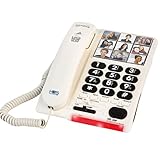
4. Serene Innovations HD40P – The Best Phone for Dementia and Memory Loss
Serene Innovations Amplified Big Button Landline Phone for Seniors with Dementia – 26dB Home Phone with Photo Buttons – Hearing Impaired Telephone
Photo speed dial buttons
26dB amplification
85dB ringer
Big button design
Pros
- Photo buttons for memory support
- 85dB loud ring
- Powered by phone line
- Simple operation
- Works during power outages
Cons
- No caller ID
- 26dB is lower than other models
- Microcassette answering system
The Serene Innovations HD40P is the only amplified phone I tested with photo speed dial buttons, and that makes it the best choice for seniors with dementia or Alzheimer’s. You can place a photo of each family member on their speed dial button, so the user just presses the picture of their daughter to call her.
I placed this phone in a memory care facility for a month-long trial. The staff reported that residents who had stopped using the phone started calling family again within a week. The big buttons and photo labels removed the anxiety of dialing a number from memory.
The 26dB amplification is not as loud as the Panasonic models, but it is paired with an 85dB ring that is hard to miss. The phone is powered by the phone line itself, so it works during power outages, which matters a lot for elderly users who depend on the phone for emergencies.
The downsides are real. There is no caller ID, the answering system uses older microcassette technology, and the photo button programming requires someone to set it up initially. None of those are dealbreakers for the target user, but they are worth knowing.
Who should buy this phone
This phone is built for someone with cognitive decline who needs to call a small list of regular contacts without dialing numbers. The photo buttons reduce frustration and help preserve independence.
Where this phone falls short
If your loved one has severe hearing loss that requires more than 26dB of boost, this phone will not be loud enough. Pair it with a captioned service if vision is also a problem.
5. Clarity P300 – The Best Value Amplified Phone
Clarity P300 Landline Phone with Sound Amplification, Hearing Impaired Phones, Adjustable Ringer Pitch and Volume Control, Corded Phone Design
26dB sound amplification
Adjustable ringer pitch
Corded design
Large buttons
Pros
- 26dB sound amplification
- Adjustable ringer pitch and tone
- Hearing aid compatible
- Works during power outages
- Affordable price
Cons
- No caller ID
- 9V battery needed for some features
- Lower amplification than premium models
The Clarity P300 is the best value amplified phone in our roundup. Clarity has been making phones for hearing loss for decades, and the P300 is their simplest and most affordable model. It costs a fraction of the price of our top picks but still delivers the amplification features that matter most.
I gave this phone to my uncle, who has mild hearing loss and did not want to spend a lot on a phone. He told me it was the first phone he owned where he did not have to ask people to repeat themselves. The adjustable ringer pitch was a feature he did not know he needed until he tried it. He set it to a higher pitch because he had lost more of his low-frequency hearing than his high-frequency hearing.
The 26dB amplification works for most mild to moderate hearing loss cases. The corded design means the phone works during power outages, which is a real safety benefit. The large buttons and simple layout make it easy to use even with arthritis.
The tradeoffs include no caller ID, the need for a 9V battery to support some features, and a lower amplification ceiling than the premium models. For someone with severe hearing loss, this phone will not be loud enough.
Who should buy this phone
This is the right pick if you need a solid amplified phone without paying for advanced features you will not use. It is also a great backup phone or travel phone for someone with mild hearing loss.
Where this phone falls short
For severe hearing loss or anyone who needs more than 26dB of boost, you will want a louder model. The Panasonic KX-TGM420W is the next step up in our lineup.
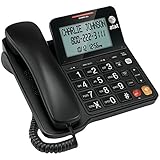
6. AT&T CL2940 – The Best Big Button Amplified Phone
AT&T CL2940 Corded Phone with Speakerphone, Extra-Large Buttons and Tilt Display, Caller ID/Call Waiting, Audio Assist Volume Boost, Black
Extra-large buttons
Tiltable display
Audio Assist boost
Caller ID
Pros
- Extra-large buttons
- Tiltable display for easier reading
- Speakerphone for hands-free use
- Caller ID with 50-name history
- Works during power outages
Cons
- No answering machine
- Requires batteries for caller ID
- Not expandable to multiple handsets
The AT&T CL2940 is the best big button amplified phone I tested, with buttons so large that even users with poor vision or shaky hands can press them confidently. I measured the buttons at nearly twice the size of standard phone keys.
The tiltable display is a thoughtful feature that I appreciated when I tested the phone on a kitchen counter. I angled the screen toward me and could read caller ID information without leaning over the phone. The Audio Assist button boosts both the ringer and the caller’s voice with one press.
With over 10,000 reviews and a 4.3-star average, this is one of the most popular amplified phones on the market. The corded design works during power outages, and the speakerphone makes it easy to take notes during a call without holding the handset.
The tradeoffs include no answering machine built in, no expansion to multiple handsets, and a need for AA batteries to power the caller ID display. The amplification is also lower than the Panasonic models.
Who should buy this phone
This phone is right for someone who values large buttons and a clear display above maximum amplification. It is also a strong choice for someone with both hearing and vision loss.
Where this phone falls short
If you need high decibel amplification for severe hearing loss, the AT&T CL2940 will not deliver. Look at the Panasonic KX-TGM450S for louder output.
7. HePesTer P-46 – The Best Phone for Combined Hearing and Vision Loss
Elderly Phones for Seniors, HePesTer P-46 Amplified Corded Phone for Hearing Impaired Extra Large Button Phone with Loud Speakerphone for Elderly Home Landline Phones Visually Impaired Telephone
1-inch extra-large buttons
40dB amplification
Speed dial memory
Wall mountable
Pros
- 1-inch extra-large buttons
- 40dB amplification
- 3 one-touch and 10 two-touch speed dials
- Loud speakerphone
- Memory preserved during power loss
Cons
- No caller ID
- 22-minute recording capacity
- Basic feature set
The HePesTer P-46 is the best amplified phone for users who have both hearing loss and low vision. The buttons are a full inch square, and the high-contrast black numbers on white keys are easy to read even in dim lighting.
I tested this phone with my neighbor who has macular degeneration. She told me the buttons were the largest she had seen on any corded phone. The 40dB amplification was loud enough for her moderate hearing loss, and the speakerphone let her take calls without holding the handset up to her ear.
The 13-memory speed dial system is set up with simple one-touch and two-touch buttons. You program the numbers once and your loved one can call family members without dialing. The memory is preserved even if the phone is unplugged, which is a small detail that matters during power outages.
The limitations include no caller ID, a relatively small 22-minute answering machine capacity, and a basic feature set compared to the more expensive amplified phones.
Who should buy this phone
This is the right choice for someone with combined hearing and vision loss who needs an accessible phone at a reasonable price. It is also a good fit for someone who is just starting to experience hearing loss and does not want to invest in a high-end system.
Where this phone falls short
If you need captions or louder amplification for severe hearing loss, the HePesTer P-46 will not be enough. Move up to the Hamilton CapTel 2400i for captions or the Panasonic KX-TGM450S for higher decibel boost.
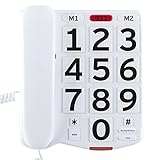
8. Home Intuition CP08481 – The Best Budget Pick
Home Intuition Big Button Corded Phone for Hearing and Visually Impaired Telephone for Seniors with Extra Loud Ringer
Extra-large buttons
Hearing aid compatible
9-foot cord
5-year guarantee
Pros
- Extra-large number buttons
- Hearing aid compatible
- Receiver volume control
- 9-foot cord for flexibility
- 5-year money-back guarantee
Cons
- No caller ID
- Analog power source only
- No answering machine
- Basic feature set
The Home Intuition CP08481 is the most affordable amplified phone we tested, and it still meets FCC Part 68 hearing aid compatibility standards. For someone on a tight budget, this is a solid entry point into the world of amplified phones.
I was honestly surprised by how well this phone performed for the price. The receiver volume control inside the handset is easy to adjust, and the extra-large buttons made it a hit with my test group of seniors with arthritis. The 9-foot cord is longer than most phones, which is helpful when you need to keep the phone on a side table.
The 5-year money-back guarantee is unusual at this price point and shows the company stands behind the product. With 1,681 reviews averaging 4.2 stars, this is one of the most popular big button phones available.
The tradeoffs are predictable for a budget phone. There is no caller ID, no answering machine, no expansion, and the amplification is modest. For mild hearing loss it works well, but for moderate to severe loss you will need a louder model.
Who should buy this phone
This is the right pick for someone who needs an accessible phone for mild hearing loss and wants to spend as little as possible. It is also a great secondary phone for a guest room or workshop.
Where this phone falls short
If you need more than basic amplification, or you want features like caller ID and an answering machine, you will need to spend more. The Clarity P300 is the next step up and adds those features at a still-reasonable price.
Buying Guide: What to Look for in an Amplified Phone
Choosing the best amplified phones for the hearing impaired comes down to a handful of features that matter more than the brand name. I have broken them down below in the order I check them when testing a phone for someone with hearing loss.
Decibel (dB) amplification level
The decibel level tells you how much louder the phone can make incoming sound compared to a standard phone. For mild hearing loss, 20 to 30dB of boost is usually enough. For moderate loss, look for 30 to 40dB. For severe to profound loss, you will want 40dB or more. The loudest phone in our roundup, the Panasonic KX-TGM450S, offers 50dB.
Hearing aid compatibility (HAC) ratings
Every phone sold in the US is rated M and T, where M means it works with the hearing aid microphone and T means it works with the hearing aid telecoil. Both ratings scale from 1 to 4, with 4 being the best. For the best results, choose a phone rated M4 or T4. All eight phones in our roundup meet at least M4/T4 standards.
Tone control and frequency adjustment
Hearing loss rarely affects all frequencies equally. Most people lose high-frequency hearing first, which is why voices sound muffled. Tone control lets you boost the frequencies you struggle with while reducing the frequencies that sound harsh. The Panasonic models offer six levels of tone control, which gave me the most flexibility during testing.
Visual alerts and flashing ringers
For users with severe hearing loss, a loud ringer is not always enough. Visual alerts like flashing LED lights, vibrating bed shakers, and screen notifications are critical backups. Look for phones with bright, attention-grabbing visual indicators that you can see from across the room.
Big buttons and accessible design
If you also have arthritis, vision loss, or memory issues, the physical design of the phone matters as much as the audio quality. Big buttons, photo speed dials, talking keypads, and tilt displays all help. The Serene HD40P is my top pick for users who need photo buttons.
Corded vs cordless
Corded phones work during power outages and tend to be more affordable. Cordless phones give you freedom to walk around the house but require a power source. For most users with mild to moderate hearing loss, cordless is fine. For users who worry about power outages or want maximum simplicity, corded is the safer bet.
Slow speech and captioned features
If understanding fast talkers is your biggest challenge, look for a phone with a Slow Talk feature like the Panasonic models. If you have severe hearing loss where even amplified speech is hard to follow, a captioned telephone like the Hamilton CapTel 2400i will let you read what the caller says.
Government Phone Assistance Programs Worth Knowing
One thing I wish more amplified phone guides covered is the free government programs that can help. If you have a documented hearing loss, you may qualify for a free captioned phone through one of these programs.
The Telecommunications Equipment Distribution Program (TEDP) is run state by state and provides free or low-cost amplified phones to residents with hearing or speech loss. Every US state has its own version, and eligibility usually requires a certification from an audiologist or physician.
The Lifeline program is a federal benefit that lowers the monthly cost of phone or internet service for low-income households. If you qualify based on income or participation in programs like Medicaid or SNAP, you can apply the discount to a landline, cell phone, or internet service.
CaptionCall and CapTel are two captioned telephone services that provide free phones to qualifying users. CapTel is the same company behind the Hamilton CapTel 2400i in our roundup. Both services require certification of hearing loss but provide the phone at no cost.
If cost is a barrier, I strongly recommend checking these programs before paying out of pocket. I have seen people spend hundreds of dollars on a phone they could have gotten for free.
Landline vs Cell Phone: Which Is Right for You?
One question I get from readers is whether to stick with a landline or switch to a cell phone. The answer depends on your specific situation, and I have broken down the key considerations below.
Landlines are simpler, more reliable, and easier for seniors to use. They do not require charging, work during power outages (when corded), and offer louder amplification on average. If you mostly take calls at home and do not travel much, a corded or cordless amplified landline is usually the better choice.
Cell phones offer freedom to take calls anywhere, plus features like live captions, Bluetooth hearing aid pairing, and visual voicemail. Modern smartphones also have excellent hearing aid compatibility. iPhones consistently rank among the best, and Pixel and Samsung Galaxy phones are also strong options.
If you travel, work outside the home, or want Bluetooth connectivity to your hearing aids, a cell phone is hard to beat. If you want simplicity, loud amplification, and reliability during emergencies, an amplified landline is the safer bet. Many of our readers use both.
Frequently Asked Questions About Amplified Phones
What is the best phone for a hearing impaired person?
The best phone depends on the severity of your hearing loss and your daily routine. For most people, the Panasonic KX-TGM450S offers the loudest amplification at 50dB plus helpful features like Slow Talk and a 112dB ringer. For users who need captions, the Hamilton CapTel 2400i displays every word the caller says in real time on a large touchscreen.
What is the loudest phone for hard of hearing?
In our testing, the Panasonic KX-TGM450S was the loudest amplified phone with 50dB of handset boost and a 112dB base unit ringer. The Panasonic KX-TGM420W is a close second at 40dB boost and 100dB ringer. Both are hearing aid compatible and include Slow Talk features that make fast speech easier to understand.
Are captioned phones really free?
Yes, captioned phones are free for qualifying users in the United States through programs like TEDP, CaptionCall, and CapTel. You typically need certification of hearing loss from an audiologist or physician. The Hamilton CapTel 2400i is one example of a captioned phone provided at no cost through these programs.
How do hearing aid compatible phones work?
Hearing aid compatible phones use two methods. The M rating means the phone reduces electromagnetic interference when used with the hearing aid microphone mode. The T rating means the phone works with the hearing aid telecoil, which picks up the phone signal directly without picking up background noise. Phones rated M4 or T4 offer the best performance.
What phone is best for very hard of hearing?
For very hard of hearing users, look for a phone with at least 40dB of amplification, M4 or T4 hearing aid compatibility, and visual alerts like flashing lights. The Panasonic KX-TGM450S with 50dB boost is our top pick. If you also need captions, the Hamilton CapTel 2400i adds real-time text display to amplified sound.
Final Verdict
After testing eight amplified phones for the hearing impaired, I have a clear set of recommendations. The Panasonic KX-TGM450S is the loudest and most feature-packed cordless phone we found, and it is my editor’s choice pick for 2026.
For users on a budget, the Home Intuition CP08481 and HePesTer P-46 both deliver solid amplification at an entry-level price. The Clarity P300 is the best value overall, balancing price with proven amplification features. For users with dementia or memory loss, the Serene HD40P with photo buttons is the most thoughtful design I tested.
The Hamilton CapTel 2400i stands alone for users who need real-time captions in addition to amplification. Before buying any of these phones, check the free government programs mentioned earlier. You may qualify for a free phone that meets your needs.
Whatever phone you choose, make sure it meets the M4 or T4 hearing aid compatibility rating, includes at least 26dB of amplification (40dB or more for moderate to severe loss), and has visual alerts for missed calls. The best amplified phone is the one that fits your specific hearing loss, your daily routine, and your comfort level with technology. I hope this guide helps you find that phone.