
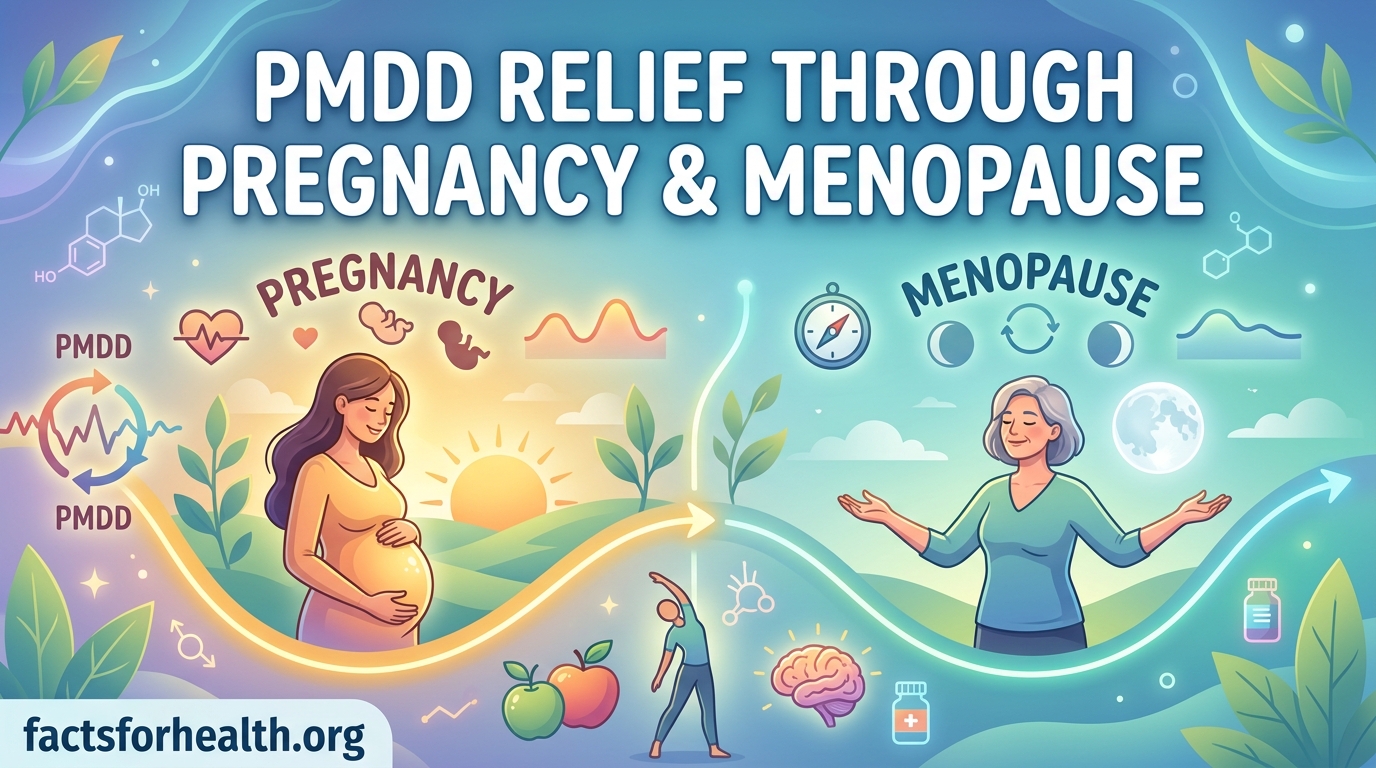
If you live with Premenstrual Dysphoric Disorder, you probably know the pattern by heart. Every month, like clockwork, the luteal phase arrives and brings a wave of emotional and physical symptoms that can feel impossible to escape. But many women notice something unexpected during pregnancy or after menopause. The symptoms vanish. This is not a coincidence or a fluke. PMDD pregnancy menopause relief is real, and it comes down to one biological fact: PMDD requires a menstrual cycle to exist.
The Massachusetts General Hospital Center for Women’s Mental Health puts it plainly. PMDD mood symptoms are not present in the absence of a menstrual cycle. That means when pregnancy pauses ovulation or menopause ends it entirely, the hormonal trigger for PMDD disappears along with it.
For women who have spent years cycling through despair, irritability, and exhaustion every few weeks, this relief can feel almost miraculous. Women in online support communities describe pregnancy as “such a relief” and report feeling “fantastic mentally” during those nine months. Others describe finally reaching menopause after decades of suffering and feeling like a completely different person.
In this article, we will walk through exactly why this happens. We will cover the biological mechanism behind PMDD, why pregnancy shuts it down, why perimenopause actually makes it worse before it gets better, and what happens after menopause. We will also share real experiences from women who have lived through these transitions.
Table of Contents
What Is PMDD and Why Does It Need a Menstrual Cycle?
PMDD, or premenstrual dysphoric disorder, is a severe cyclical mood and physical condition that affects an estimated 3 to 8 percent of women in their reproductive years. It is not just “bad PMS.” It is a recognized psychiatric and gynecological condition that can cause significant impairment in daily functioning, relationships, and work life.
The defining feature of PMDD is its timing. Symptoms appear during the luteal phase, which is the one to two weeks between ovulation and the start of your period. They resolve within a few days after menstruation begins. This cyclical pattern is what separates PMDD from other mood disorders like generalized anxiety or persistent depression.
Common symptoms of PMDD include:
- Severe mood swings and emotional reactivity
- Depressed mood, sometimes with feelings of hopelessness
- Intense irritability or anger that can affect relationships
- Anxiety and a sense of being on edge or out of control
- Fatigue and lethargy that interfere with daily tasks
- Sleep disturbances, either insomnia or oversleeping
- Appetite changes or intense food cravings
- Physical symptoms like bloating, breast tenderness, and headaches
- Difficulty concentrating or feeling mentally foggy
What makes PMDD unique among mood conditions is that it is completely dependent on the menstrual cycle. No cycle means no luteal phase. No luteal phase means no hormonal trigger. This is why understanding why pregnancy or menopause can feel like relief from PMDD starts with understanding what happens during that luteal phase.
The luteal phase begins after your ovary releases an egg. The remnants of the follicle form a structure called the corpus luteum, which produces large amounts of progesterone and moderate amounts of estrogen. These hormones are preparing your body for a potential pregnancy. When pregnancy does not occur, progesterone levels crash, your period starts, and the cycle begins again.
For women with PMDD, this hormonal shift is where the problem lies. Their brains do not tolerate the normal rise and fall of these hormones the way most women’s brains do. The result is a cascade of neurological changes that produce severe symptoms month after month.
Understanding the Hormone Mechanism Behind PMDD
What is the biological causation for PMDD? This is one of the most searched questions about the condition, and the answer is more nuanced than many people expect. PMDD is not caused by abnormal hormone levels. Women with PMDD typically have completely normal hormone levels. The problem lies in how their brains respond to those normal fluctuations.
Research published by the National Institutes of Health and cited by the MGH Center for Women’s Mental Health identifies the primary cause as an abnormal central nervous system response to normal hormonal fluctuations. In other words, the hormones are normal. The brain’s reaction to them is not.
The key player in this process is a compound called allopregnanolone. This is a metabolite of progesterone, meaning it is produced when your body breaks down progesterone. Allopregnanolone normally acts as a calming neurosteroid. It interacts with GABA receptors in your brain, which are the same receptors targeted by antianxiety medications like Valium and Xanax.
In most women, rising allopregnanolone during the luteal phase produces a mild calming effect. But in women with PMDD, something goes wrong. Research suggests that their GABA A receptors are unusually sensitive to fluctuations in allopregnanolone. When allopregnanolone levels rise and then fall, instead of feeling calm, their brains react with anxiety, irritability, and mood instability.
The serotonin system also plays a role. Studies using positron emission tomography (PET) scanning have shown differences in serotonergic neurotransmission in women with PMDD compared to those without it. This is why selective serotonin reuptake inhibitors, or SSRIs, are one of the most effective treatments for PMDD symptoms.
Understanding this mechanism is the key to understanding why pregnancy and menopause bring relief. If the trigger is the cyclical fluctuation of progesterone and allopregnanolone, then anything that stops that fluctuation should stop the symptoms. And that is exactly what happens.
Think of it this way. PMDD is like a severe allergic reaction to hormonal change. It is not the hormone itself that is the problem. It is the changing. When hormones stay steady and high during pregnancy, or when they drop to a stable low level after menopause, there is no fluctuation. And without the fluctuation, there is no reaction.
Why Pregnancy Can Feel Like Relief from PMDD
Does PMDD get better when pregnant? For the vast majority of women, the answer is a resounding yes. During pregnancy, the entire menstrual cycle shuts down. No ovulation occurs. No corpus luteum forms after the first few weeks. The hormonal pattern shifts from a cyclical rise-and-fall to a steady, continuous increase.
This means the luteal phase, the exact trigger for PMDD symptoms, simply does not exist during pregnancy. Progesterone levels rise dramatically in the first trimester and remain elevated throughout. Instead of the hormonal roller coaster that triggers PMDD, the brain experiences a stable hormonal environment for nine continuous months.
The results, for many women, are remarkable. In Reddit’s r/PMDD community, women who have been pregnant consistently describe the experience in terms of profound relief.
One user wrote, “I felt fantastic mentally during all three of my pregnancies.” Another shared, “I had complete relief from PMDD, obviously no periods, and I slept brilliantly for the first time in years.” Multiple women used the same word over and over: relief.
This is not just anecdotal. The biological explanation is straightforward. With no ovulation, there is no luteal phase. With no luteal phase, there is no progesterone withdrawal. And without the progesterone withdrawal and its effect on allopregnanolone and GABA receptors, the neurological cascade that produces PMDD symptoms never gets triggered.
However, there is an important caveat that many women discover the hard way. Early pregnancy does not always provide immediate relief. During the first few weeks after conception, hormone levels are still fluctuating in ways that can mimic PMDD symptoms. As one forum user noted, “The hormone cocktail in early pregnancy is pretty much the same as the luteal phase.” This means you might experience mood symptoms, fatigue, and irritability in those early weeks before the placenta takes over hormone production and levels stabilize.
There is also a more serious concern that every woman with PMDD should be aware of. Research has shown that women with a history of PMDD have an increased risk of developing postpartum depression. The dramatic drop in progesterone and allopregnanolone after delivery can trigger a severe mood episode in brains that are already sensitive to hormonal changes.
If you are planning a pregnancy and have PMDD, this does not mean you should be afraid. It means you should be prepared. Talk to your healthcare provider about postpartum monitoring and have a support plan in place before the baby arrives. Awareness and preparation can make a significant difference.
Why Perimenopause Makes PMDD Worse Before It Gets Better
If pregnancy brings relief and menopause brings resolution, you might assume the years leading up to menopause would be a gradual improvement. Unfortunately, the opposite is true for many women. Perimenopause, the transitional phase before menopause, can make PMDD significantly worse.
Perimenopause typically begins in a woman’s 40s, though it can start earlier. During this phase, the ovaries begin producing less estrogen and progesterone, but they do not do so in a smooth, steady decline. Instead, hormone levels swing wildly from month to month. Some cycles feature high estrogen. Others feature very low levels. Ovulation becomes irregular, which means progesterone production becomes unpredictable.
For a brain that is already sensitive to hormonal fluctuation, this is the worst possible scenario. Remember that PMDD is triggered by change, not by specific hormone levels. Perimenopause is essentially years of amplified, chaotic hormonal change. Many women find that their PMDD symptoms become more intense, more frequent, and harder to predict during this time.
In online support groups, this pattern comes through clearly. Women describe perimenopause as making PMDD “worse and more unpredictable.” Some report having symptoms every two weeks instead of monthly because their cycles have shortened. Others experience prolonged episodes because their luteal phases have become irregular.
One woman shared that she suffered from PMDD-related suicidal ideation for 30 years. It was only when her periods began spacing further apart during perimenopause that she finally started to feel some relief. A widely shared Chatelaine article describes a similar experience, with the author writing that perimenopause “radically improved my life” after decades of suffering under PMDD.
This is the paradox of the perimenopause transition. The overall trajectory is toward fewer cycles and eventual relief. But the journey there can involve some of the most difficult PMDD episodes a woman will ever experience. Understanding that this is temporary, and that real relief is coming on the other side of menopause, can provide an important sense of hope during a very challenging time.
The timeline varies from woman to woman. Perimenopause can last anywhere from 2 to 10 years, with the average being about 4 years. During this time, symptoms may come and go as cycles become more irregular. The key thing to remember is that as cycles become less frequent, PMDD episodes should become less frequent too. The worsening is temporary. The relief is permanent.
Why Menopause Brings PMDD Relief
Will PMDD go away with menopause? Yes. For women with true PMDD, symptoms resolve after menopause. This is one of the most definitive statements that can be made about the condition, and it is confirmed by major medical institutions including the Mayo Clinic and Massachusetts General Hospital.
Menopause is defined as the point when a woman has gone 12 consecutive months without a menstrual period. At this stage, the ovaries have essentially stopped producing the cyclical hormones that drive the menstrual cycle. Estrogen levels settle at a low, stable level. Progesterone production becomes minimal. Ovulation no longer occurs.
Without ovulation, there is no luteal phase. Without a luteal phase, there is no progesterone surge and no allopregnanolone fluctuation. The entire mechanism that triggers PMDD symptoms is shut down. As the Gennev health platform explains, PMS and PMDD generally resolve in menopause when hormones finally level out and the body adjusts to its new normal.
The impact on quality of life can be profound. Research cited by the MGH Center for Women’s Mental Health estimates that PMDD can cause the loss of nearly 3 quality-adjusted life years across a woman’s reproductive lifetime. That is years spent battling severe mood symptoms, damaged relationships, lost work days, and in the most severe cases, suicidal ideation.
When menopause finally puts an end to PMDD, many women describe feeling like they have gotten their lives back. The monthly cycle of dread, the two weeks of emotional turmoil, the slow recovery, and the brief respite before it starts again. All of it ends.
The Mayo Clinic notes that during pregnancy, you will not experience PMDD symptoms because you will not have a menstrual cycle. The same logic applies to menopause. No cycle means no PMDD. The condition is fundamentally cyclical, and when the cycle stops permanently, so do the symptoms.
It is worth noting that the relief may not be instant. The body needs time to adjust to its new hormonal baseline after menopause. Some women may continue to experience mood fluctuations for a period as their system recalibrates. But over time, as the hormonal environment stabilizes, PMDD symptoms fade and do not return.
The Critical Difference: PMDD vs Premenstrual Exacerbation (PME)
There is one important catch to everything we have discussed so far. Not every woman who feels worse before her period has PMDD. Some have what is called premenstrual exacerbation, or PME. This distinction matters enormously because it changes whether pregnancy and menopause will bring relief.
PMDD is a standalone condition. The mood symptoms exist only during the luteal phase and disappear completely after menstruation. There is a true symptom-free interval during the follicular phase, the first half of the cycle.
PME is different. In PME, a woman has an underlying mood disorder such as depression, anxiety, or bipolar disorder that exists all month long. But her symptoms get noticeably worse during the luteal phase. The premenstrual period amplifies her existing condition rather than creating a new one.
Why does this distinction matter? Because PME does not resolve with menopause. If a woman has underlying depression that worsens premenstrually, removing the menstrual cycle will stop the premenstrual worsening. But the underlying depression will remain. This is why some women reach menopause and are surprised to find that their mood symptoms persist, even though their periods have stopped.
This is also why accurate diagnosis is so important. The MGH Center for Women’s Mental Health emphasizes the need to distinguish PMDD from PME because the treatment approaches are different. PMDD often responds dramatically to SSRIs taken only during the luteal phase. PME requires treatment of the underlying condition on a continuous basis.
How can you tell the difference? The gold standard is prospective symptom charting. This means recording your mood and physical symptoms daily for at least two to three months using a validated tool like the Daily Record of Severity of Problems (DRSP). This documentation shows whether symptoms are truly confined to the luteal phase or whether they persist throughout the month.
If you have been diagnosed with PMDD but find that your symptoms do not improve after menopause, it is worth revisiting the diagnosis with your healthcare provider. You may have been dealing with PME all along, and a different treatment approach could make a significant difference.
When to Seek Professional Help
PMDD is a serious condition that deserves professional treatment. While this article explains why pregnancy and menopause can bring natural relief, waiting years or decades for that relief is not a realistic treatment strategy. There are effective options available right now.
The first step is getting an accurate diagnosis. If you suspect you have PMDD, start tracking your symptoms daily. Use a symptom diary or a validated charting tool for at least two full menstrual cycles. This documentation is invaluable for your healthcare provider and is often required for a formal diagnosis.
Treatment options for PMDD include SSRIs, which can be remarkably effective even when taken only during the luteal phase. Oral contraceptives containing drospirenone, such as Yaz, are FDA-approved for PMDD and work by suppressing ovulation. For severe cases that do not respond to other treatments, GnRH agonists can be used to temporarily induce a menopause-like state, confirming the diagnosis and providing relief.
There are also non-pharmacological approaches that can help. Cognitive behavioral therapy adapted for PMDD has shown promise. Regular exercise, adequate sleep, stress reduction, and dietary modifications can all contribute to symptom management.
Most importantly, if you experience suicidal thoughts or thoughts of self-harm during your luteal phase, seek help immediately. A 2021 analysis found that suicide risk is significantly elevated in women with PMDD compared to the general population. This is not a condition to minimize or try to push through alone. Contact a mental health professional, call a crisis line, or go to an emergency room. You do not have to wait for menopause to feel better. Help is available now.
Does PMDD get better during menopause?
Yes, PMDD symptoms resolve after menopause for most women. Because PMDD is triggered by the hormonal fluctuations of the menstrual cycle, the end of ovulation and the stabilization of hormone levels after menopause eliminates the biological trigger. The Mayo Clinic and Massachusetts General Hospital both confirm that PMDD symptoms typically go away once menopause is complete.
Does PMDD get better when pregnant?
Yes, most women experience significant or complete relief from PMDD symptoms during pregnancy. Pregnancy stops ovulation and the menstrual cycle, which eliminates the luteal phase hormonal fluctuations that trigger PMDD. However, early pregnancy may still cause mood symptoms because hormone levels are initially shifting, and women with PMDD have an increased risk of postpartum depression after delivery.
What is the biological causation for PMDD?
PMDD is caused by an abnormal central nervous system response to normal hormonal fluctuations during the menstrual cycle. Specifically, women with PMDD have heightened sensitivity to allopregnanolone, a progesterone metabolite that affects GABA receptors in the brain. Serotonin neurotransmission differences also play a role, which is why SSRIs are an effective treatment.
Will PMDD go away with menopause?
Yes, PMDD goes away after menopause for women with true PMDD. Once the menstrual cycle ends permanently and hormone levels stabilize at a low, steady state, the cyclical hormonal fluctuations that trigger PMDD symptoms no longer occur. However, women with premenstrual exacerbation (PME) of an underlying mood disorder may still experience symptoms after menopause.
Why is PMDD worse during perimenopause?
PMDD often worsens during perimenopause because hormone levels become more erratic and unpredictable. Estrogen and progesterone levels swing dramatically from month to month, and ovulation becomes irregular. Since PMDD is triggered by hormonal fluctuation rather than specific hormone levels, the chaotic hormone changes of perimenopause can intensify symptoms before they eventually resolve at menopause.
Conclusion
Understanding why pregnancy or menopause can feel like relief from PMDD comes down to a single biological principle. PMDD is triggered by the hormonal fluctuations of the menstrual cycle. Remove the cycle, and you remove the trigger. During pregnancy, the steady high hormone levels eliminate the cyclical changes that cause symptoms. After menopause, the permanently low and stable hormone environment does the same thing.
For women currently in the trenches of PMDD, this knowledge offers something powerful: hope. The monthly suffering is not permanent. It has an end date built into your biology. Whether that end comes through pregnancy, menopause, or effective medical treatment, relief is real and it is achievable.
If you are struggling with PMDD right now, do not wait for menopause to seek help. Track your symptoms, talk to a healthcare provider, and explore the treatment options that are available today. You deserve relief, and you do not have to suffer alone to get there.