
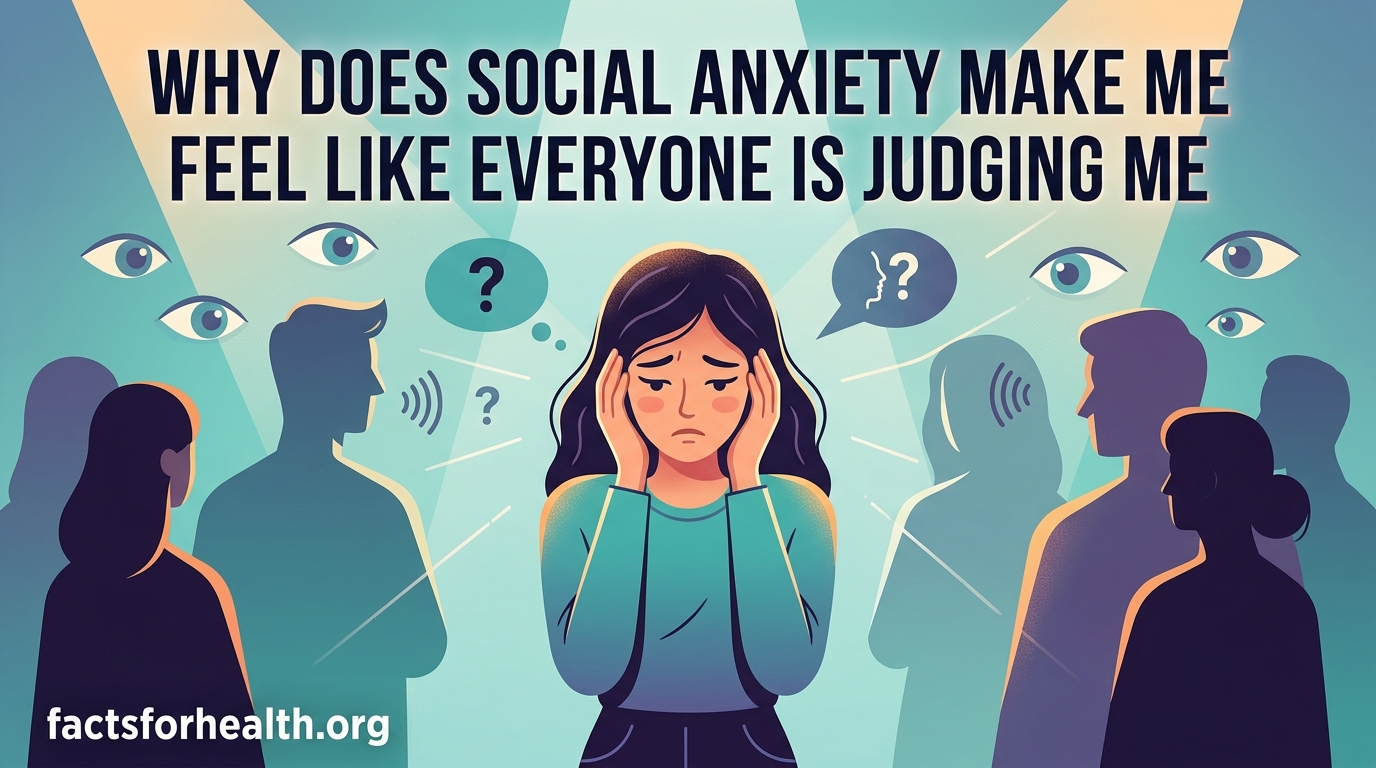
You walk into a room and feel it immediately. The sense that every pair of eyes is tracking you, cataloging your flaws, forming silent opinions. Your heart picks up speed. Your face feels warm. You rehearse what to say, then second-guess it before the words leave your mouth.
If this sounds familiar, you are far from alone. Roughly 12% of adults experience social anxiety disorder at some point in their lives, according to the National Institute of Mental Health. Many more deal with social nervousness that never reaches a clinical threshold but still makes daily life exhausting.
The question we hear more than any other is the one you probably typed into a search bar: why does social anxiety make me feel like everyone is judging me? The answer involves your brain’s threat detection system, a well-documented psychological bias called the spotlight effect, and a feedback loop that quietly reinforces itself over years.
Understanding the mechanism behind this experience is the first step toward loosening its grip. Once you know what your brain is doing and why, the feelings become less mysterious and more manageable. This article breaks down the neuroscience, the cognitive distortions, and the practical strategies that can help.
Table of Contents
The Short Answer
Social anxiety makes you feel like everyone is judging you because your brain’s threat detection system, centered on the amygdala, misinterprets social situations as dangerous. It treats the possibility of negative evaluation the same way it treats physical danger, triggering a full fight-or-flight response even when no actual threat exists.
This response is amplified by cognitive distortions like mind reading (assuming others think negatively of you) and the spotlight effect (overestimating how much people notice about you). Together, these mental habits create a convincing illusion of constant scrutiny that does not match reality.
What Social Anxiety Actually Is
Social anxiety disorder, also called social phobia, is a mental health condition where everyday social interactions cause intense fear, self-consciousness, and embarrassment because you believe others are scrutinizing, evaluating, and judging you negatively. The Cleveland Clinic describes it as one of the most common anxiety disorders, affecting millions of adults in the United States alone.
It is important to understand what social anxiety is not. It is not the same as shyness, introversion, or simply preferring quiet environments. Shyness is a personality trait that typically eases as you warm up to a situation. Social anxiety persists regardless of how long you are in a social setting and often intensifies over time.
Someone who is shy might feel awkward at a party for the first twenty minutes, then relax and enjoy themselves. Someone with social anxiety may spend days dreading the party, feel acute distress throughout the entire event, and replay every interaction for days afterward wondering what they did wrong.
Social Anxiety vs. Shyness vs. Everyday Nervousness
Many people confuse these three experiences, but they differ in important ways. Everyday nervousness is a normal human response to high-stakes situations like a job interview or a first date. It comes and goes. Shyness is a personality tendency toward reserved behavior in new situations but does not typically cause significant distress or avoidance.
Social anxiety disorder, by contrast, involves persistent, intense fear that interferes with daily functioning. It causes avoidance of situations, physical symptoms like sweating and trembling, and significant distress that can last for hours or days after a social event has ended. The fear is disproportionate to the actual threat, and the person usually recognizes this on some level but cannot simply turn it off.
The Mayo Clinic notes that social anxiety disorder often begins in the early to mid-teens and, without treatment, can persist for decades. It affects work performance, relationships, and overall quality of life. Recognizing the difference between normal social nervousness and social anxiety disorder matters because it determines whether professional treatment is warranted.
Why Your Brain Makes You Feel Judged: The Neuroscience
To understand why social anxiety creates such a visceral feeling of being watched and evaluated, you need to look at what happens in the brain. The central player is the amygdala, a small almond-shaped structure deep in the brain that functions as your internal alarm system.
The amygdala’s job is to detect threats and trigger the body’s fight-or-flight response. When it perceives danger, it floods your system with adrenaline and cortisol. Your heart rate spikes. Your muscles tense. Your breathing quickens. Blood rushes away from your digestive system and toward your limbs, preparing you to fight or run. This is an ancient survival mechanism designed to protect you from predators.
Here is where things go wrong in social anxiety. In people with this condition, the amygdala is hypersensitive. It misreads social cues as threats, activating the same fight-or-flight cascade that would normally be reserved for physical danger. Walking into a meeting, raising a hand in class, or making small talk at a gathering triggers the same biological response as encountering a predator.
Meanwhile, the prefrontal cortex, the part of the brain responsible for rational thinking and perspective, struggles to override the alarm. Research shows that in people with social anxiety, the connection between the prefrontal cortex and the amygdala is less effective at dampening the fear response. The alarm rings louder and longer than it should.
The Evolutionary Angle: Why Rejection Feels Like Death
Why would the brain treat social evaluation as a survival threat? The answer lies in our evolutionary history. For hundreds of thousands of years, humans lived in small tribal groups. Being accepted by the tribe meant access to food, shelter, protection, and mates. Being rejected or expelled from the group was effectively a death sentence.
Your brain evolved to treat social approval as a matter of survival, because for most of human history, it was. The fear of being judged negatively by others is not a flaw or a weakness. It is an ancient biological program running in modern software, firing in contexts where the actual stakes are far lower than your nervous system believes.
This is why a critical comment from a coworker can feel genuinely devastating. Your rational brain knows it is not life-threatening. Your amygdala does not make that distinction. It processes the experience through the same threat-response pathway that kept your ancestors alive, and it reacts accordingly.
The Spotlight Effect: Why You Feel Like Everyone Is Watching
One of the most powerful psychological forces behind the feeling of constant judgment is the spotlight effect. Coined by researchers Thomas Gilovich and colleagues at Cornell University in a landmark 2000 study, the spotlight effect describes the tendency to dramatically overestimate how much other people notice about your appearance, behavior, and mistakes.
In Gilovich’s experiments, students were asked to wear embarrassing t-shirts and then estimate how many of their peers noticed. Consistently, participants believed that far more people had noticed the shirt than actually had. The researchers found that people routinely doubled or tripled the actual level of attention they received.
The spotlight effect explains a huge part of why social anxiety makes you feel scrutinized. You are not imagining that people are watching. You are overestimating how closely. A stranger glances in your direction for two seconds, and your brain registers it as a prolonged stare of judgment. You stumble over a word in a meeting, and you are convinced everyone noticed and is thinking about it. In reality, most people are wrapped up in their own concerns.
As one Reddit user in the r/socialanxiety community put it: the thing that changed things for them was realizing that even when you do something noticeable, people forget about it almost immediately because everyone is occupied with their own stuff. This insight aligns perfectly with what the research on the spotlight effect demonstrates.
Cognitive Distortions That Fuel the Fear
The spotlight effect is just one of several mental shortcuts that feed the feeling of constant judgment. Cognitive distortions are habitual patterns of biased thinking that feel accurate in the moment but do not reflect reality. They are a core focus of cognitive behavioral therapy because identifying and challenging them is one of the most effective ways to reduce social anxiety.
Here are five cognitive distortions that most commonly contribute to the fear of being judged:
1. Mind Reading. This is the assumption that you know what other people are thinking, specifically that they are thinking negative thoughts about you. You catch someone yawning during your presentation and immediately conclude they find you boring. In reality, they might be tired, hungry, or simply stretching their jaw.
2. Catastrophic Thinking. This distortion amplifies the perceived consequences of a social misstep. You stumble over a word and your brain tells you that you have humiliated yourself, that everyone thinks you are incompetent, and that your career is over. The actual consequence was a momentary stumble that no one will remember tomorrow.
3. Personalization. This is the tendency to assume that other people’s behavior is about you. Someone is short with you at work and you assume they are angry at something you did. In truth, they might be dealing with a personal issue, a difficult phone call, or a headache that has nothing to do with you.
4. Emotional Reasoning. This distortion treats feelings as evidence. Because you feel embarrassed, you must have done something embarrassing. Because you feel judged, people must be judging you. The emotion creates a perception that feels like proof, even though the feeling itself was generated by anxiety, not by external reality.
5. Mental Filtering. This is the habit of focusing exclusively on negative information while filtering out anything positive. Ten people compliment your work and one person offers mild criticism. By the end of the day, all you can think about is the criticism. The filter magnifies perceived judgment and erases evidence that contradicts it.
Everyone uses cognitive distortions occasionally. What makes social anxiety different is that these distortions run on a constant loop, are concentrated on social evaluation, and feel so convincing that they are difficult to question without practice and support.
The Vicious Cycle: Three Factors That Keep Anxiety Alive
Understanding why social anxiety persists, even when you logically know people are not scrutinizing you as much as it feels, requires understanding the maintenance cycle. Three interacting factors keep the fear of judgment alive and often strengthen it over time: hypervigilance, self-focused attention, and post-event processing.
Hypervigilance to Threat means your brain is constantly scanning social environments for signs of danger. You are tuned to detect even subtle indicators of negative evaluation: a slight frown, a brief hesitation, an awkward silence. Because you are looking for threats, you find them everywhere, even where they do not exist. A neutral expression registers as disapproval. A glance in your direction becomes evidence of scrutiny.
Self-Focused Attention means that during social situations, your attention turns inward rather than outward. Instead of paying attention to the conversation, you are monitoring your own behavior. Did I say the right thing? Is my face red? Am I holding my hands weirdly? This internal focus makes it impossible to be present, which makes social interactions feel unnatural and strained, which in turn provides more material for the anxiety to latch onto.
Post-Event Processing is the mental replay that happens after a social interaction has ended. You lie in bed rehashing a conversation, analyzing what you said, cringing at perceived mistakes, and convincing yourself that you performed poorly. This rumination reinforces the belief that social situations are dangerous and that you are being judged, which feeds back into hypervigilance the next time you enter a social setting.
Together, these three factors create a self-reinforcing loop. You enter a situation hyperalert to threats. You focus on yourself instead of the interaction, making the experience feel awkward. Afterward, you replay everything and find evidence that confirms your worst fears. The cycle strengthens with each repetition, making the anxiety more entrenched over time.
Safety Behaviors: How Avoidance Makes Things Worse
Many people with social anxiety develop safety behaviors, subtle actions meant to prevent the feared outcome. These include avoiding eye contact, rehearsing every sentence before speaking, checking your phone to avoid interaction, standing near exits, wearing high collars to hide blushing, or leaving events early.
Safety behaviors feel protective in the moment, but they are deeply counterproductive. They prevent you from having the corrective experiences that would disprove your fears. If you avoid eye contact and leave a conversation quickly, you never get to see that the interaction would have gone fine. You never learn that people are not judging you as harshly as you imagine. The safety behavior keeps the fear alive by preventing the evidence that would dissolve it.
What Happens in Your Body: Physical Symptoms
Social anxiety is not just in your head. It produces a range of real, measurable physical symptoms that can be distressing in their own right. These symptoms are a direct result of the fight-or-flight response your amygdala triggers when it perceives social threat.
Common physical symptoms of social anxiety include:
- Racing heart or heart palpitations
- Blushing or flushed skin
- Sweating, particularly on the palms, face, and underarms
- Trembling or shaking hands
- Dry mouth or a lump in the throat
- Nausea or stomach discomfort
- Shortness of breath or shallow breathing
- Muscle tension, especially in the jaw, neck, and shoulders
- Dizziness or lightheadedness
- Mind going blank or difficulty concentrating
These symptoms create a secondary problem: they become things you worry about being noticed. You fear that people can see you blushing or sweating, which creates more anxiety, which intensifies the physical symptoms, which makes you more worried about being noticed. This is another feedback loop that keeps the cycle spinning.
How Social Media Amplifies the Fear of Judgment
Social media has introduced a new dimension to the fear of being judged that previous generations did not face. Platforms designed around public metrics like likes, comments, and follower counts create a constant, quantified measure of social approval. Every post becomes a small performance with visible, immediate feedback.
For someone with social anxiety, this environment can be particularly difficult. The curated nature of social media means you are comparing your real, unedited life to the highlight reels of everyone else. A post that receives fewer likes than expected can trigger a spiral of perceived judgment. The ability to see exactly who viewed your story but did not respond provides concrete material for the mind-reading distortion to feed on.
Research on social media and anxiety is still emerging, but early findings suggest that heavy social media use correlates with increased social comparison, fear of negative evaluation, and anxiety symptoms. The constant exposure to curated lives amplifies the perception that everyone else is confident, polished, and socially successful while you are the only one struggling.
If you notice that your social media use intensifies your fear of judgment, consider whether the platforms you use are serving you. Setting boundaries around when and how you engage, curating your feed to reduce comparison triggers, and remembering that what you see online is heavily edited can all help reduce the amplifying effect.
Practical Strategies: How to Stop Feeling Like Everyone Is Judging You
Understanding the mechanics of social anxiety is valuable, but knowing how to actually change the pattern is what makes the difference. The strategies below are grounded in cognitive behavioral therapy and exposure-based approaches, the two most evidence-based treatments for social anxiety. They are not a substitute for professional treatment, but they are powerful tools you can begin using on your own.
1. Challenge your automatic thoughts. When you notice yourself assuming that someone is judging you, pause and ask: What is the actual evidence? Is there another explanation? Would I draw this conclusion if a friend described the same situation? Writing down the thought and the evidence for and against it can help break the spell of cognitive distortions. Over time, this practice trains your brain to question its initial alarm signals rather than accepting them as fact.
2. Shift your attention outward. Since self-focused attention is one of the three maintaining factors, deliberately redirecting your attention to the external environment disrupts the cycle. During a conversation, focus on what the other person is saying rather than on how you look or sound. Notice details about the room, the sounds, the other person’s words. This is not avoidance. It is a deliberate rebalancing of attention that makes social interactions feel more natural.
3. Reduce safety behaviors gradually. Pick one small safety behavior and experiment with dropping it. If you usually avoid eye contact, try maintaining it for a few seconds longer than usual. If you rehearse every sentence, try speaking without planning ahead. The goal is to have the experience of not using the safety net and discovering that nothing catastrophic happens. Each successful experiment weakens the anxiety.
4. Build an exposure hierarchy. Make a list of social situations that trigger anxiety, ranked from least to most anxiety-provoking. Start with the easiest item and practice entering that situation regularly until the anxiety decreases. Then move to the next item on the list. This systematic approach, called graded exposure, is one of the most effective techniques in clinical treatment for social anxiety.
5. Practice the 5-4-3-2-1 grounding technique. When acute anxiety hits in a social situation, grounding techniques can help pull your attention out of the spiral. Name five things you can see, four things you can physically feel, three things you can hear, two things you can smell, and one thing you can taste. This sensory engagement brings your nervous system back to the present moment and interrupts the fight-or-flight cascade.
6. Use slow, deliberate breathing. When the fight-or-flight response activates, your breathing becomes shallow and rapid, which reinforces the feeling of panic. Deliberately slowing your breath to about five or six breaths per minute activates the parasympathetic nervous system, which counteracts the stress response. Inhale for four counts, hold briefly, exhale for six. This is a technique you can use discreetly in any social situation.
7. Limit post-event processing. When you catch yourself replaying a social interaction and spiraling into rumination, set a boundary. Give yourself a limited window to reflect, then deliberately redirect to another activity. Remind yourself that your post-event analysis is filtered through anxiety and is not an accurate record of what happened. Engaging in a absorbing task, physical activity, or conversation with someone you trust can help break the replay loop.
What to Try Right Now: An In-the-Moment Toolkit
If you are reading this in the middle of an anxiety spike, here is what to do in the next sixty seconds. Take three slow breaths, counting to four on the inhale and six on the exhale. Look around and name three objects you can see in the room. Remind yourself: my brain is sending a false alarm right now. This feeling is intense but it is not dangerous, and it will pass. Then, if you can, take one small action toward the situation you are avoiding rather than away from it.
When to Seek Professional Help
Self-help strategies can make a meaningful difference, especially for mild to moderate social anxiety. But some situations warrant professional support. If social anxiety is interfering with your work, relationships, education, or daily functioning, or if you have been dealing with it for months or years without significant improvement, it is time to talk to a mental health professional.
Other signs that professional help is appropriate include experiencing panic attacks in social situations, using alcohol or other substances to cope with social situations, or avoiding social interactions so frequently that it has led to isolation or depression.
Several highly effective treatments exist. Cognitive behavioral therapy is the most extensively researched and has the strongest evidence base for social anxiety disorder. It focuses on identifying and restructuring the thought patterns and behaviors that maintain the anxiety. Acceptance and commitment therapy takes a different approach, focusing on accepting anxious feelings rather than fighting them while committing to values-based action. For some individuals, medication such as SSRIs can be helpful, particularly when used in combination with therapy. A qualified mental health provider can help determine which approach is right for your situation.
FAQs
How does it feel to have social anxiety?
Social anxiety feels like a constant, buzzing awareness that you are being watched and evaluated. Physically, it can cause a racing heart, sweating, blushing, trembling, dry mouth, nausea, shortness of breath, and a mind going blank. Emotionally, it produces intense self-consciousness, dread before social events, and a compulsion to replay interactions afterward, searching for mistakes. The experience is exhausting because your nervous system is responding to ordinary social situations as if they were physically dangerous.
How to get over social anxiety and the fear that everyone is judging you?
The most effective approach combines several strategies: 1) Challenge automatic negative thoughts by examining the actual evidence for and against them. 2) Practice gradual exposure to feared social situations, starting small and building up. 3) Reduce safety behaviors like avoiding eye contact or rehearsing every word, which prevent corrective experiences. 4) Shift attention outward during conversations instead of monitoring yourself. 5) Seek cognitive behavioral therapy, which has the strongest evidence base for treating social anxiety. Progress takes time and consistency, but social anxiety is one of the most treatable anxiety disorders.
Will my social anxiety ever go away?
Social anxiety is highly treatable, and many people experience significant improvement or full remission with proper treatment, particularly cognitive behavioral therapy. However, it is not always a condition that disappears completely and permanently. For some, it becomes a managed condition where symptoms may resurface during periods of stress but are no longer disabling. The goal of treatment is not necessarily to eliminate all anxiety but to reduce it to a level where it no longer controls your choices or limits your life.
Are people with social anxiety disorder happier alone?
Not necessarily. While solitude may feel safer in the moment because it removes the source of anxiety, long-term isolation tends to reinforce and worsen social anxiety. Humans are socially wired, and meaningful connection is a fundamental psychological need. Avoidance reduces anxiety temporarily but prevents the positive social experiences that would challenge the fear. The treatment goal is not to avoid social situations but to develop the capacity to participate in them without overwhelming distress.
Moving Forward
The feeling that everyone is judging you is one of the most painful aspects of social anxiety, and it is also one of the most well-understood. We now know that it stems from a hypersensitive amygdala treating social evaluation as a survival threat, amplified by cognitive distortions like mind reading and the spotlight effect, and reinforced by a cycle of hypervigilance, self-focus, and post-event rumination.
None of this means the feelings are your fault or that you can simply think your way out of them. But it does mean there are specific, proven mechanisms behind what you are experiencing, and where there are mechanisms, there are interventions. Challenging distorted thoughts, gradually reducing safety behaviors, building exposure, and shifting attention outward are all skills that improve with practice.
If you take one thing from this article, let it be this: the feeling that everyone is judging you feels like fact, but it is a perception generated by an overactive threat detection system. Most people are not scrutinizing you. They are busy navigating their own anxieties, their own spotlight effects, their own mental replays. The judgment you feel is real as an experience, but it is not real as an accurate read of what others are thinking.
Social anxiety is one of the most treatable anxiety disorders. Whether you start with self-help strategies or reach out to a therapist, the path forward is real and well-traveled. The goal is not to never feel anxious again. The goal is to reach a point where the anxiety no longer makes your decisions for you.