
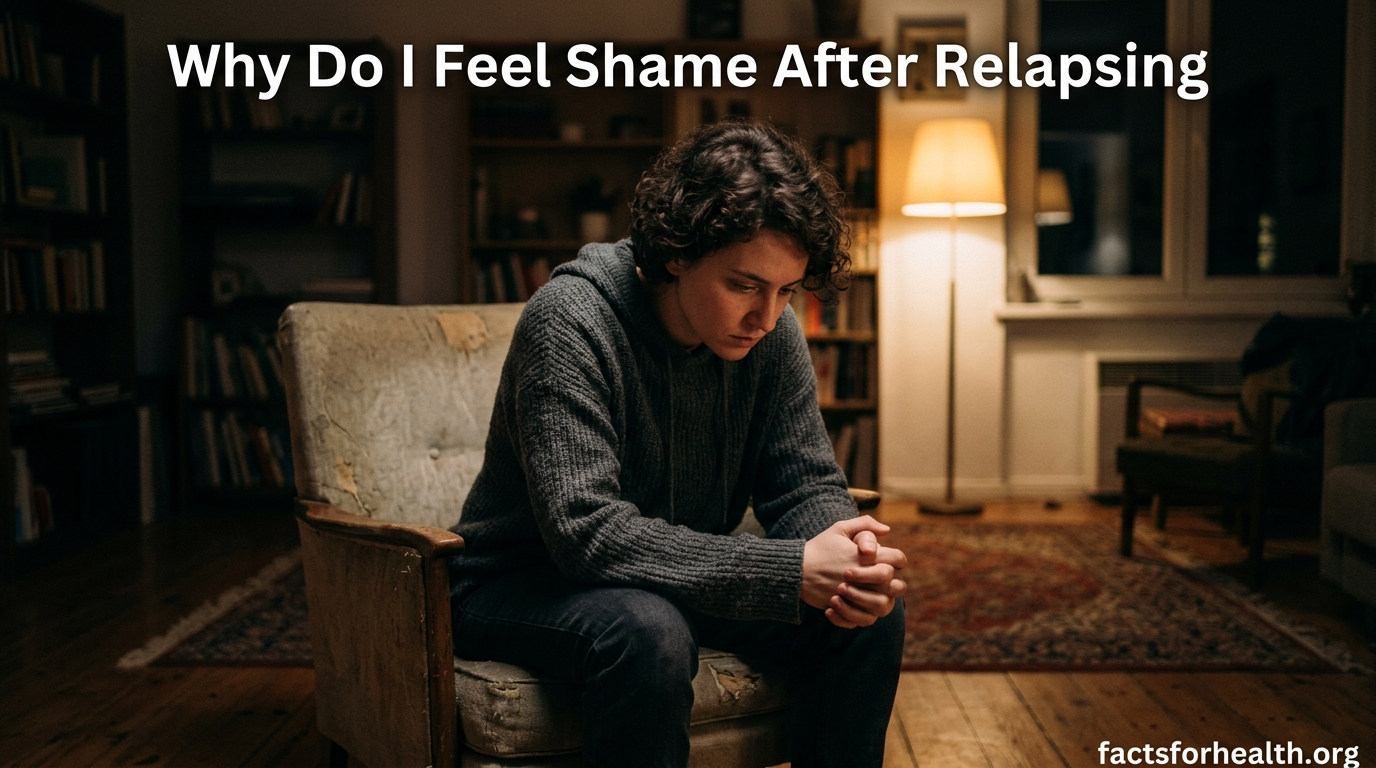
If you are reading this right now, you are probably in one of the most painful emotional places a person can be. That crushing weight in your chest, the voice telling you that you failed, the urge to hide from everyone who believed in you. That feeling has a name, and asking the question “why do I feel so much shame after relapsing?” is actually the first step toward understanding and moving through it.
You feel shame after relapsing because your brain interprets the return to substance use or addictive behavior as a deep personal failure rather than what it actually is: a recognized part of the recovery process for many people. According to the National Institute on Drug Abuse (NIDA), relapse rates for substance use disorders fall between 40 and 60 percent, which is comparable to relapse rates for other chronic conditions like hypertension and asthma. That does not make your pain any less real, but it does mean you are far from alone.
The shame you are experiencing is not a character flaw or a sign that you cannot recover. It is a powerful psychological and neurological response that happens when your identity, your values, and your recent actions suddenly collide. People in recovery forums describe post-relapse shame as physically painful. They compare it to wanting to crawl into a hole, feeling a heavy blanket of worthlessness pressing down on them, or being unable to look another person in the eye.
Here is what we want you to hear right now: your recovery is not erased. Your sober time still counts. The days, weeks, months, or years you spent in recovery taught your brain new patterns, built new neural pathways, and proved that you can live without the substance. A relapse does not undo all of that progress. It means you hit a bump, and bumps are part of the road.
In this article, we will walk through exactly why shame after relapse happens, what is going on in your brain, how to distinguish between helpful guilt and destructive shame, and the concrete steps you can take right now to start feeling better and get back on track.
Table of Contents
Why Shame After Relapse Hits So Hard: The Psychology Explained
Shame after relapse feels uniquely devastating because it attacks your identity at a level deeper than ordinary disappointment. When you commit to recovery, you begin building a new self-image. You start thinking of yourself as someone who is sober, someone who shows up, someone who can be trusted. A relapse threatens that new identity in a way that feels catastrophic.
Researcher Brene Brown, who has studied shame for over two decades, defines shame as “the intensely painful feeling or experience of believing that we are flawed and therefore unworthy of love and belonging.” That definition captures exactly why relapse shame hits different from other types of regret. You are not just thinking “I made a bad choice.” You are thinking “I am a bad person.”
This identity-level attack is what makes shame so much more destructive than guilt. Guilt says you did something bad. Shame says you are something bad. When you are in early recovery and someone asks why do I feel so much shame after relapsing, the answer often traces back to this identity crisis. The substance use contradicts the story you were telling yourself about who you are becoming.
Several psychological factors amplify shame after relapse:
Identity incongruence. You built a self-concept around sobriety. Relapsing creates a painful gap between who you believe you are and what you just did.
The comparison trap. You look at others in your recovery community who seem to have it together, and you wonder what is wrong with you that you could not do the same.
Broken promises. You may have made commitments to yourself, your family, your sponsor, or a higher power. The shame of breaking those commitments compounds with the shame of the substance use itself.
Fear of judgment. Anticipating the disappointment or criticism of others creates anxiety that feeds directly into shame. You imagine their reactions before they even happen, and the imagined judgment is often worse than reality.
Societal stigma. Society still treats addiction as a moral failing rather than a medical condition. Even if you intellectually understand addiction as a disease, the cultural messaging that substance use equals weakness gets internalized over a lifetime.
Understanding these psychological mechanisms does not make the shame disappear overnight. But it does something important: it shifts shame from an unnamed, overwhelming force into a recognizable pattern with known causes. And patterns can be interrupted.
The Neuroscience of Shame: Why It Feels Physically Painful
If you have ever noticed that shame does not just feel emotional but actually physically painful, you are not imagining it. Neuroscience research shows that emotional pain and physical pain activate some of the same brain regions, which is why shame after relapse can literally make your body hurt.
When you experience shame, your brain’s anterior cingulate cortex lights up. This is the same area that processes physical pain. A breakthrough 2003 study by Naomi Eisenberger at UCLA found that social rejection and emotional pain activate the dorsal anterior cingulate cortex in a way that closely mirrors the brain’s response to physical injury. That is why people describe shame as feeling like a punch to the gut or a crushing weight on the chest.
At the same time, shame triggers your amygdala, the brain’s threat detection system. Your amygdala cannot tell the difference between a physical threat to your survival and the emotional threat of being exposed as a failure. It responds to both with the same fight-or-flight cascade. Your heart rate increases, your muscles tense, your breathing gets shallow, and stress hormones like cortisol and adrenaline flood your system.
This stress hormone surge matters for recovery because cortisol is one of the strongest triggers for substance cravings. Here is the cruel irony of post-relapse shame: the very emotion you feel after relapsing produces the stress hormones that make you want to use again. Your brain is, in a sense, recommending the substance as a solution to the pain the substance caused.
The prefrontal cortex, your brain’s rational decision-making center, also takes a hit. Under intense shame and stress, prefrontal cortex activity decreases. This is the part of the brain responsible for impulse control, long-term planning, and weighing consequences. When it goes offline, you are left with raw emotion and diminished capacity to make good decisions. That is why shame-driven relapse spirals happen so quickly and feel so unstoppable.
Understanding the neuroscience helps in two ways. First, it validates that the pain is real and biological, not something you are making up or being dramatic about. Second, it explains why certain coping strategies work better than others. Techniques that calm the amygdala and reactivate the prefrontal cortex, like grounding exercises and slow breathing, directly counteract the shame response at a neurological level.
Guilt vs Shame After Relapse: Understanding the Critical Difference
One of the most important things you can do after a relapse is learn to distinguish between guilt and shame. They feel similar in the moment, but they have completely different effects on your recovery. Understanding this difference can literally change your trajectory.
Guilt focuses on behavior. Shame focuses on identity. Guilt says “I did something that goes against my values.” Shame says “I am a bad person because of what I did.” This distinction, first articulated by shame researchers Helen Block Lewis and later popularized by Brene Brown, is the single most important concept for navigating emotions after a relapse.
Guilt, when handled well, can be productive. It motivates you to make amends, learn from mistakes, and recommit to recovery. It is specific, time-limited, and action-oriented. You feel bad about what happened, and that feeling pushes you to do something differently next time. Guilt has an endpoint.
Shame, on the other hand, is paralyzing. When shame takes over after a relapse, it does not motivate change. It convinces you that change is impossible because the problem is not what you did but who you are. Shame tells you that relapsing proves you are fundamentally broken, that recovery is not possible for you, and that there is no point in trying again. Shame has no natural endpoint. It feeds on itself.
Here is a practical way to tell which one you are experiencing. Complete this sentence: “After relapsing, I feel bad because…”
If your answer sounds like “because I used a coping skill that I know does not serve me, and I want to understand what triggered it so I can do better next time,” that is guilt talking. It is uncomfortable but constructive. It points toward growth.
If your answer sounds like “because I am a failure who will never get this right, I have proven that I cannot be trusted, and everyone was right to give up on me,” that is shame. It is painful and destructive. It points toward giving up.
The goal is not to eliminate negative emotions after relapse entirely. Some guilt, some disappointment, some regret are normal and even helpful. The goal is to catch shame early, before it hijacks your recovery, and redirect it toward the more productive emotion of guilt. You do this by challenging identity-level statements about yourself and replacing them with behavior-specific observations.
Instead of “I am a failure,” try “I used a substance, and that is a setback I can learn from.” Instead of “I cannot be trusted,” try “I made a decision in a moment of vulnerability, and I need to understand what led to that moment.” These are not just word games. Language shapes how your brain processes the experience, and shifting from identity language to behavior language literally reduces the shame response.
The Shame-Relapse Cycle: How Shame Fuels More Relapses
If there is one concept that can save your recovery right now, it is understanding the shame-relapse cycle. This is the self-perpetuating loop that turns a single relapse into an extended return to active addiction. Many people who relapse do not spiral because the substance itself pulls them back in. They spiral because the shame of the relapse drives them to use again.
Here is how the cycle works. First, you experience a lapse or relapse after a period of recovery. Immediately, intense shame follows. The shame tells you that your recovery is over, that you are back at zero, that all your progress was meaningless. This creates overwhelming emotional pain and spikes your cortisol levels, which triggers substance cravings.
The craving, combined with the shame-driven belief that recovery has already failed, removes your motivation to resist. You think, “I already relapsed, so what does it matter anyway?” This cognitive distortion, known in psychology as the abstinence violation effect, makes a single lapse feel like total failure. And so you use again, not because you wanted to, but because shame convinced you there was no point in trying not to.
Each additional use deepens the shame, which intensifies the cravings, which leads to more use. This is how one night becomes a week, and a week becomes months. The substance is not the primary force keeping you in the cycle. Shame is.
Breaking the cycle requires interrupting it at the shame stage. The moment you catch yourself thinking “I already messed up, so I might as well keep going,” you have identified the cycle in action. That thought is not truth. It is shame trying to protect itself by pulling you deeper.
The most effective way to break the cycle is to reach out to another person immediately. Call your sponsor, a trusted friend, a helpline, or post in a recovery forum. The simple act of saying out loud “I relapsed and I am struggling with shame” begins to dissolve the shame’s power. Shame thrives in secrecy and isolation. The moment you speak it aloud to someone who responds without judgment, the cycle weakens.
Forum users in recovery communities consistently report that the turning point after a relapse was not when they stopped using. It was when they told someone. The act of sharing shattered the isolation that shame needed to survive, and from there, recovery could resume.
Why Shame After Relapse Is Normal (And What the Statistics Say)
Let’s address one of the most common questions people ask in the aftermath of a relapse: is this level of shame normal? The short answer is yes. The slightly longer answer is yes, and understanding why can help you stop fighting the feeling and start processing it.
Relapse is a recognized part of the recovery process, not a sign that treatment has failed. NIDA reports that 40 to 60 percent of people with substance use disorders experience at least one relapse. For context, relapse rates for type 1 diabetes are between 30 and 50 percent, and rates for hypertension and asthma are between 50 and 70 percent. Nobody tells a person with asthma who has a flare-up that they are a moral failure. Yet that is exactly the standard we apply to ourselves after an addiction relapse.
Multiple studies on recovery trajectories show that most people who eventually achieve long-term sobriety went through periods of relapse along the way. A landmark study published in the Journal of Studies on Alcohol found that people who experienced relapses and returned to recovery often developed stronger, more durable sobriety than those who never relapsed. The relapse forced them to confront vulnerabilities they had not addressed and to build a more comprehensive recovery plan.
The concept of “terminal uniqueness” is relevant here. In recovery circles, terminal uniqueness refers to the belief that you are the only person who has ever relapsed, the only one who could fall that far, the only one whose situation is this bad. Shame feeds on this belief. It tells you that your relapse proves you are uniquely broken. But the statistics tell a completely different story. You are part of a very large, very human pattern.
Another cognitive distortion to watch for is the “back to zero” mindset. This is the belief that a relapse erases all your sober time and returns you to the starting line of recovery. It is one of the most demoralizing thoughts a person can have after relapsing, and it is also completely false.
Every day you spent in recovery created real changes in your brain, your habits, your relationships, and your self-knowledge. Those changes do not vanish because of a relapse. You are not back at zero. You are someone with recovery experience who hit a setback, and that is a profoundly different starting position than someone who has never tried to get sober. Forum users who have been through multiple cycles of recovery and relapse consistently emphasize this point. The knowledge, tools, and connections from previous recovery periods made getting back on track faster each time.
Immediate Steps for the First 24-48 Hours After Relapsing
The first 24 to 48 hours after a relapse are the most critical period for your recovery. This is when the shame-relapse cycle is most active and when the decisions you make can either end the lapse quickly or extend it into a full spiral. Having a concrete plan removes the need to make good decisions while your prefrontal cortex is impaired by shame and stress.
Here are the steps to take in the immediate aftermath of a relapse:
Step 1: Stop and assess your physical safety. If you used substances, check whether you need medical attention. Do not drive. If you are in any physical danger or experiencing overdose symptoms, call emergency services immediately. Your physical safety comes before anything else, including shame.
Step 2: Get rid of remaining substances. If there is anything left, pour it out, flush it, or give it to someone you trust. Removing access reduces the likelihood of continued use while you are in the shame spiral’s most intense phase.
Step 3: Contact one person within the first hour. This is the single most important step. Call your sponsor, a recovery friend, a family member, or a helpline like SAMHSA’s National Helpline at 1-800-662-4357. Say the words out loud: “I relapsed and I need support.” The moment you break the silence, shame begins to lose its grip.
Step 4: Do not make any major decisions. Do not decide that recovery is impossible. Do not decide to leave your treatment program. Do not decide to tell everyone you know. The shame brain is not a reliable advisor. Give yourself at least 48 hours before making any significant decisions about your recovery.
Step 5: Practice the 5-4-3-2-1 grounding technique. This exercise calms your amygdala and brings your prefrontal cortex back online. Name five things you can see around you. Name four things you can physically feel. Name three things you can hear. Name two things you can smell. Name one thing you can taste. This sensory exercise anchors you in the present moment and interrupts the shame spiral’s momentum.
Step 6: Write down what happened, without judgment. Document the timeline of the relapse. What were you feeling beforehand? What triggered the craving? Where were you? Who were you with? This is not about self-punishment. It is data collection. Understanding the sequence helps you identify your specific relapse signature so you can catch it earlier next time.
Step 7: Reconnect with your recovery routine as soon as possible. Attend a meeting, call your therapist, go to your outpatient session. Do not wait until you feel ready, because shame will keep telling you that you are not ready indefinitely. Action precedes motivation. Showing up while you feel ashamed is one of the most powerful things you can do.
Practical Strategies to Work Through Post-Relapse Shame
Once the immediate crisis has passed and you have taken the first steps to stabilize, the longer work of processing shame begins. Overcoming shame after relapse is not about pretending you feel fine. It is about actively working to transform shame from a destructive force into information you can use.
Practice self-compassion as a deliberate skill. Self-compassion is not weakness or letting yourself off the hook. Research by Dr. Kristin Neff at the University of Texas shows that self-compassion is strongly associated with greater emotional resilience, lower anxiety, and higher rates of follow-through on personal goals. When you catch yourself in a spiral of self-criticism, ask yourself: “If a close friend came to me with this exact situation, what would I say to them?” Then say those words to yourself.
Challenge the cognitive distortions. Shame relies on distorted thinking. Write down the specific thoughts you are having and examine them. “I am a failure” becomes “I experienced a setback, and I have tools to address it.” “Everyone will judge me” becomes “I am assuming what others think without evidence, and my recovery community has shown they support people who relapse.” This technique, drawn from cognitive behavioral therapy (CBT), helps you separate facts from shame-driven interpretations.
Identify your relapse triggers with specificity. Relapses do not happen randomly. They follow patterns. Common triggers include emotional distress, social isolation, relationship conflicts, HALT states (hungry, angry, lonely, tired), overconfidence in recovery, and exposure to people or places associated with past use. Write out your personal trigger chain so you can recognize the early warning signs before the next crisis.
Reframe the relapse as data, not destiny. Every relapse contains information about what your recovery plan was missing. Maybe you need more structured support, a different therapy approach, medication-assisted treatment, or a change in environment. Treating the relapse as feedback rather than proof of failure keeps you in a problem-solving mindset.
Use dialectical behavior therapy (DBT) skills for emotional regulation. DBT teaches that two seemingly opposite things can be true at once. You can accept that the relapse happened without condemning yourself for it. You can feel disappointed in your behavior while still believing in your capacity for recovery. This “both-and” thinking counteracts the black-and-white, all-or-nothing thinking that shame thrives on.
Rebuild connection with your recovery community. Shame tells you to hide, to skip meetings, to avoid your sponsor. Every time you listen to that voice, shame gets stronger. Every time you show up anyway, shame gets weaker. People in recovery communities understand relapse because most of them have lived through it. The non-judgmental acceptance you find there is one of the most powerful shame antidotes that exists.
Consider trauma-informed care. Many people who experience intense shame after relapse have underlying trauma that has not been addressed. Trauma and addiction are deeply intertwined, and shame is often a trauma response rather than a purely addiction-related emotion. If your shame feels disproportionate to the event, or if it triggers flashbacks or dissociation, working with a trauma-informed therapist can address the root cause.
Develop a written relapse prevention plan. Include your triggers, your early warning signs, your coping strategies, and your emergency contacts. Having this plan in writing means that when shame tries to take over, you do not have to think clearly. You just have to follow the steps you already wrote down when you were thinking clearly.
How to Talk About Your Relapse: Scripts for Family, Sponsors, and Meetings
One of the most anxiety-producing parts of post-relapse shame is the prospect of telling other people. You may be dreading conversations with your sponsor, your family, your therapist, or your recovery group. Having words ready can reduce the dread and make these conversations more productive.
Talking to your sponsor or recovery mentor: “I need to be honest with you. I relapsed [timeframe]. I am committed to my recovery and I need your support right now. Can we talk about what happened and what I need to do differently?”
Talking to a partner or close family member: “I want to be transparent with you because honesty is part of my recovery. I had a relapse. I am okay physically, and I have already reached out to [sponsor/therapist/support person]. I know this is hard to hear, and I am committed to figuring out what went wrong and fixing it.”
Talking to children (if age-appropriate): “I am having a hard time with my health right now, and I am working with my doctors and support team to get back on track. You did not cause this, and it is not your responsibility to fix it. I love you, and I am going to keep working on getting healthy.”
Returning to a support group meeting: “I am coming back after a relapse. I do not want to share all the details yet, but I wanted to be here and be honest about where I am at. Thank you for being here.” You do not owe anyone the full story until you are ready to tell it.
Talking to an employer (if necessary): “I am dealing with a personal health matter that I am actively addressing with my treatment team. I may need to adjust my schedule temporarily to attend appointments. I am committed to maintaining my work responsibilities.” You are not obligated to disclose the specific nature of your health condition.
The fear of these conversations is almost always worse than the conversations themselves. People who care about you want to help, not punish you. And the people in your recovery community have likely been exactly where you are. Vulnerability in these conversations does not just reduce your shame. It gives other people permission to be honest about their own struggles.
Shame After Long-Term Sobriety: When Relapse Happens After Years
Relapse after months or years of sobriety carries a unique quality of shame that early-recovery relapses do not. When you have built years of recovery, the identity shift is deeper, the expectations are higher, and the fall feels longer. Forum users who have relapsed after extended sobriety describe a shame that is qualitatively different from what they experienced in early recovery.
If you are in this situation, the shame may be compounded by the feeling that you should have known better. You had the tools. You had the time. You understood your triggers. And you relapsed anyway. That narrative is shame talking, and it conveniently ignores several important realities about long-term recovery.
Recovery is not a linear process with a finish line. It is an ongoing practice that requires continuous maintenance. People who achieve long-term sobriety sometimes fall into the trap of complacency, believing that enough time has passed that they are no longer at risk. This overconfidence is itself a well-documented relapse trigger. The relapse is not proof that your recovery was fake. It is proof that recovery requires ongoing attention regardless of how much time has passed.
Life changes can also disrupt even the most solid recovery. Job loss, the death of a loved one, relationship endings, health crises, or major transitions like retirement can overwhelm coping systems that worked perfectly under normal conditions. A relapse during a period of significant life stress does not mean your recovery failed. It means the stress exceeded your current coping capacity, and that capacity can be rebuilt.
The shame of relapse after long-term sobriety is often amplified by the fear of how others will perceive you. You may worry that people looked up to you in the recovery community, and that your relapse will disappoint them or make them question their own recovery. This is another form of terminal uniqueness, the belief that your experience is exceptional in a negative direction. In reality, people in recovery communities respect honesty about relapse more than the appearance of perfect sobriety.
Do not let shame convince you that you have to start over from scratch. Your years of recovery gave you tools, insights, relationships, and neurological changes that are still with you. The path forward is not beginning again. It is integrating this experience into a more honest, more resilient version of your ongoing recovery.
When to Seek Professional Help for Shame After Relapse
Some level of shame after relapse is normal and can be processed with the support of your existing recovery network. But there are times when professional help is necessary, and recognizing those times can be life-saving.
Seek professional help immediately if you experience any of the following:
Thoughts of self-harm or suicide. Shame after relapse can become so overwhelming that it triggers suicidal ideation. If you are having thoughts of harming yourself, this is a medical emergency. Call the Suicide and Crisis Lifeline at 988, go to the nearest emergency room, or call 911. You do not have to be certain that you are in danger to call. If the thoughts are there, reach out.
Inability to stop using after 48 hours. If the relapse has extended beyond a single episode and you cannot return to abstinence on your own, you may need medical support. Withdrawal from certain substances, including alcohol and benzodiazepines, can be medically dangerous. A medically supervised detox may be necessary.
Shame that does not decrease after two weeks. While shame is intense in the first few days, it should gradually lessen as you re-engage with recovery activities. If the intensity is not decreasing after two weeks of active recovery participation, a therapist who specializes in addiction and shame can help you work through what is keeping the shame locked in place.
Isolation from all support systems. If shame has caused you to cut off contact with your sponsor, your recovery community, your therapist, and your loved ones, professional intervention can help you reconnect. Isolation is both a symptom and a perpetuator of shame.
Co-occurring mental health symptoms. If the shame is accompanied by symptoms of depression, severe anxiety, panic attacks, or symptoms of post-traumatic stress disorder, a mental health professional can assess whether you need treatment for conditions that may be contributing to both the shame and the relapse.
Types of professional help to consider include individual therapy with a licensed addiction counselor, intensive outpatient programs (IOPs), medication-assisted treatment if appropriate, and psychiatric evaluation for co-occurring disorders. The SAMHSA National Helpline at 1-800-662-4357 is a free, confidential, 24/7 service that can connect you with treatment options in your area.
Seeking professional help is not a sign that your recovery has failed more severely than someone who does not need it. It is a sign that you are taking your recovery seriously enough to use every available resource.
How to Support Someone Who Feels Ashamed After Relapsing
If you are reading this because someone you love has relapsed and is consumed by shame, your response in the hours and days that follow can significantly influence their recovery trajectory. The way family members, friends, and partners react to a relapse can either worsen or alleviate the shame the person is already feeling.
The most important thing you can do is respond without anger or disappointment, even if you feel those emotions. The person who relapsed is already punishing themselves more harshly than any external reaction could. Adding anger on top of their shame does not motivate recovery. It deepens the shame-relapse cycle that drives continued substance use.
Here is what to say: “Thank you for telling me. I know how hard that was. I believe in your recovery, and I am here to support you. What do you need right now?”
Here is what not to say: “How could you do this after everything we have been through?” or “I thought you were done with this” or “You promised.” These responses, while understandable from a place of hurt, reinforce the exact shame-based thinking that the person needs to escape.
Practical ways to support someone after a relapse include offering to attend a meeting with them, helping them research treatment options if they want to adjust their recovery plan, checking in regularly without being intrusive, and educating yourself about addiction as a chronic condition rather than a moral failing. The more you understand about the shame-relapse cycle, the better equipped you are to respond in ways that support recovery rather than inadvertently undermining it.
If you are a family member struggling with your own emotions about a loved one’s relapse, consider seeking support for yourself. Al-Anon, Nar-Anon, and individual therapy can help you process your feelings so they do not spill over into your interactions with the person in recovery. Taking care of your own mental health is not selfish. It makes you a more effective source of support.
Remember that your loved one’s relapse is not a reflection of your worth either. Family members often feel that they failed or that they were not enough to prevent the relapse. Addiction is a complex disease, and no one person can control another person’s recovery. Your role is to be a steady, non-judgmental presence, not to manage their sobriety.
FAQs
How to deal with shame after relapse?
To deal with shame after relapse, reach out to one person immediately, challenge identity-level thoughts like ‘I am a failure’ by replacing them with behavior-specific observations, practice the 5-4-3-2-1 grounding technique to calm your nervous system, reconnect with your recovery community even if you feel embarrassed, and reframe the relapse as data about what your recovery plan needs rather than proof that recovery is impossible.
How many times do people relapse before quitting successfully?
Research from NIDA shows relapse rates for substance use disorders are between 40 and 60 percent, comparable to other chronic conditions like hypertension and asthma. There is no universal number of relapses a person goes through before achieving lasting recovery. Many people who eventually reach long-term sobriety experienced one or more relapses along the way, and those experiences often strengthened their eventual recovery.
How to recover after a relapse?
To recover after a relapse, first ensure your physical safety and remove any remaining substances. Contact your sponsor, therapist, or a support person within the first hour. Do not make major decisions for 48 hours. Document what happened without judgment to identify your trigger patterns. Reconnect with your recovery routine as soon as possible, including meetings or therapy sessions. Consider adjusting your recovery plan based on what you learn from the relapse.
What are the stages of relapse in addiction?
Relapse typically occurs in three stages. Emotional relapse involves poor self-care, isolation, and not addressing emotions, even though the person is not thinking about using. Mental relapse involves an internal struggle where part of the person wants to use and part wants to stay sober, including craving, fantasizing about use, and planning how to use. Physical relapse is the actual act of using the substance. Catching relapse in the emotional or mental stage can prevent physical relapse entirely.
Is shame after relapse normal?
Yes, shame after relapse is completely normal. With relapse rates of 40 to 60 percent for substance use disorders, the vast majority of people in recovery experience at least one relapse, and the shame that follows is a well-documented psychological response tied to identity, brain chemistry, and societal stigma. Feeling ashamed does not mean something is uniquely wrong with you. It means you are human and your brain is responding exactly the way brains respond to perceived failure.
How long does shame after relapse last?
Shame after relapse is typically most intense in the first 24 to 72 hours and should gradually decrease as you re-engage with recovery activities, reach out to support people, and process the experience. If the shame remains at peak intensity beyond two weeks of active recovery participation, or if it worsens over time, it may indicate a need for professional support from a therapist who specializes in addiction and shame.
Conclusion: You Are Not Starting Over
If you came to this article searching for answers about why do I feel so much shame after relapsing, we hope you now have a clearer understanding of what is happening in your mind and your brain. The shame you feel is real, it is biologically based, and it is shared by countless others who have walked this same path. It is not evidence that you are broken. It is evidence that you care deeply about your recovery.
The most important thing to remember is this: a relapse is an event, not an identity. It is a moment in your recovery story, not the end of it. Every tool you learned, every relationship you built, every day you stayed sober is still part of who you are. The question is not whether you can recover from this. People do, every single day. The question is what your next step will be.
Take that step today. Call one person. Go to one meeting. Read one page of something that helps. You do not have to fix everything right now. You just have to take the next small action that moves you toward the life you want. Recovery is not a straight line, and it never has been. It is a practice of returning, again and again, to the choice to heal. You have not lost that choice. It is right here, waiting for you.