
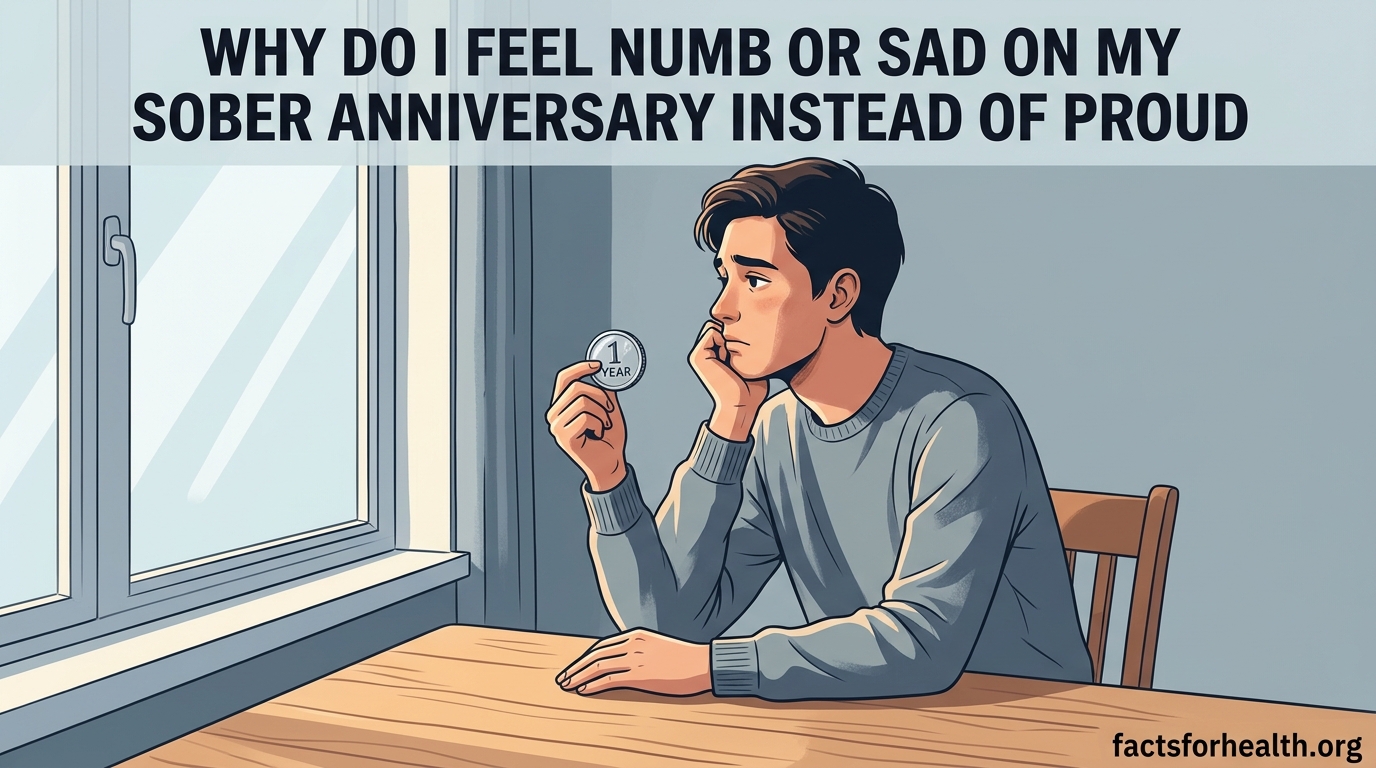
Feeling numb or sad on your sober anniversary instead of proud is incredibly common and happens because your brain is recalibrating dopamine after addiction, suppressed emotions are surfacing, and you may be grieving the loss of your old coping mechanism. This emotional flatness on meaningful milestones is a normal part of recovery, not a sign that something is wrong with you or your progress.
If you are reading this on or near a sobriety milestone, you might be wondering why the day does not feel the way you expected. You imagined fireworks, pride, maybe tears of joy. Instead, you feel hollow, disconnected, or even inexplicably sad. You are not alone in this experience.
Our team has looked at hundreds of recovery stories from forums like r/stopdrinking, r/alcoholism, and r/Sober, and this exact question comes up over and over. People one year, two years, even five years into recovery describe feeling desolate, flat, or numb on their soberversary when they expected to feel triumphant.
In this article, we will break down exactly why you feel numb or sad on your sober anniversary instead of proud, what is happening in your brain, when these feelings are normal versus when they might signal something more, and what you can actually do to move through this emotional season.
Table of Contents
Why You Feel Numb or Sad on Your Sober Anniversary Instead of Proud
The short answer is that recovery rewires your brain, and milestones tend to amplify whatever is happening beneath the surface. When you stop using substances, your brain has to relearn how to produce and process emotions without chemical assistance. That recalibration does not follow a calendar, and it rarely aligns with the dates we mark on our calendars.
On top of the neurobiology, anniversaries are inherently reflective. They ask you to look back at who you were, what you went through, and what you lost. That reflection can surface grief, regret, and sadness that you may not have fully processed yet. The combination of a healing brain and unresolved emotions creates the perfect conditions for feeling flat when you expected to feel alive.
What makes this especially confusing is the gap between expectation and reality. Society tells us milestones should feel celebratory. When yours feels like nothing, it is easy to interpret that emptiness as failure. It is not.
Your Brain Is Recalibrating Dopamine After Addiction
To understand why you might feel numb or sad on your sober anniversary, you need to understand what happened to your brain during active addiction. Alcohol and other substances hijack the brain’s reward system by flooding it with dopamine, the neurotransmitter responsible for motivation, pleasure, and feeling rewarded.
Over time, your brain adapted to these artificial dopamine floods by reducing its own production and dialing down receptor sensitivity. This is called neurobiological adaptation. The brain basically said, “We have too much dopamine, so let me turn down the volume.”
When you stop drinking or using, those dopamine levels drop dramatically. Your brain is now operating with fewer dopamine receptors and reduced natural production. This creates a condition called anhedonia, which is the inability to feel pleasure from things that used to bring joy, including achievements like a sobriety milestone.
The Dopamine Recovery Timeline
Dopamine receptor recovery does not happen overnight. Research suggests that it can take anywhere from 12 to 18 months for dopamine levels to return to near-normal ranges after stopping alcohol or drug use. During this window, emotional blunting is extremely common.
This means that if your sober anniversary falls within the first year or two of recovery, your brain may literally lack the neurochemical capacity to generate the pride and joy you expected to feel. You hit the milestone, but your brain’s reward system is still offline. The achievement is real even if the feeling has not arrived yet.
One person in recovery described it this way on r/stopdrinking: “I’m in my second year of sobriety and I just feel emotionally numb and going through the motions.” That numbness is the dopamine system still rebuilding itself, not a personal failing.
Emotional Suppression During Addiction Is Catching Up
Here is something that took me a long time to understand about recovery. During active addiction, substances do not just numb bad feelings. They numb all feelings. Years of drinking or using created an emotional backlog that you never had to process.
Think about it this way. Every time you felt bored, lonely, angry, scared, or sad, you reached for a substance to make that feeling go away. The feeling did not disappear. It got shelved. Now that you are sober, those shelves are collapsing and everything is coming down at once.
A member of r/alcoholism put it perfectly: “What’s killing me is actually having to feel everything I used to drown out. Boredom. Loneliness. Anger.” When you combine years of unprocessed emotions with a brain that is still learning how to regulate itself, the result can be emotional overload. And the brain’s response to overload is often to shut down and go numb.
This protective numbing, sometimes called emotional blunting, is your brain’s way of managing more emotional input than it can handle at once. On an anniversary date, when you are naturally reflecting on the past, that input multiplies. The numbness you feel on your soberversary may actually be your brain protecting you from a tidal wave of feelings all hitting at the same time.
The irony is that this numbness can feel worse than the emotions themselves. It can make you question whether you are actually healing or just going through the motions. You are healing. The flatness is part of the process.
You May Be Grieving Your Old Self
This is something almost no recovery resource talks about, and it might be the most important piece of the puzzle. When you hit a sober anniversary, you are not just celebrating. You are also mourning.
Substance use, for many people, was not just a habit. It was an identity, a coping mechanism, a social lubricant, a comfort blanket, and a companion. Getting sober meant saying goodbye to all of that. Anniversaries mark that loss just as much as they mark the achievement.
Grief experts have long recognized that recovery and grief are deeply intertwined. When you remove the substance, you also remove the rituals, the social circles, the stress relief, and the identity that came with it. On an anniversary, all of that loss becomes more visible because you are measuring the distance between who you were and who you are now.
This is what some people call the grief of the old self. You may find yourself missing the version of you that could just have a drink and let go, even though you know that version of you was struggling. That grief is valid. It does not mean you want to go back. It means you are human and loss is complicated.
One person shared on a recovery forum: “I’m one year sober today, but instead of feeling proud and happy, I feel absolutely desolate.” That word, desolate, captures the grief landscape perfectly. It is not depression. It is the emotional terrain of someone standing in the space between an old life they left behind and a new life they are still building.
Anniversary dates can intensify this grief because they force a before-and-after comparison. You cannot help but measure what you have gained against what you have lost. Both are real. Both deserve acknowledgment.
Post-Acute Withdrawal Syndrome (PAWS) and Milestone Sadness
Another factor that may explain why you feel numb or sad on your sober anniversary is Post-Acute Withdrawal Syndrome, or PAWS. While acute withdrawal refers to the intense physical symptoms that happen in the days and weeks after quitting, PAWS is the longer-term emotional and psychological phase that can follow.
PAWS symptoms include mood swings, anxiety, irritability, difficulty concentrating, and most relevantly, emotional flatness and periods of sadness. These symptoms come and go in waves rather than following a steady linear improvement. You might feel great for weeks and then suddenly hit a wall.
PAWS can last anywhere from several months to up to two years, depending on the substance, the duration of use, and individual factors. During this period, emotional waves can be triggered by stress, life changes, and yes, milestone dates that carry emotional weight.
What makes PAWS tricky on anniversaries is that it can masquerade as depression or as a sign that recovery is not working. You reach a milestone, expect to feel proud, and instead feel flat or sad. The temptation is to interpret that as a problem with your recovery rather than a symptom of your brain still healing.
If your anniversary triggers a wave of PAWS symptoms, remember that waves pass. The flatness will lift. Your brain is still doing the long, slow work of recalibration, and milestones are simply moments where that work becomes more visible.
Normal Milestone Melancholy vs. Depression: Knowing the Difference
One of the most common questions people ask is how to tell the difference between normal anniversary sadness and something that needs professional attention. This distinction matters because emotional numbness in recovery can sometimes be a relapse warning sign, not just a passing phase.
Normal milestone melancholy tends to come in waves. You feel flat or sad around the anniversary, but the feeling lifts after a few days or weeks. You can still function, still connect with people, still find moments of warmth even within the numbness. The sadness has a context, the milestone, and it makes sense even if it is uncomfortable.
Depression, by contrast, tends to be more persistent and pervasive. It does not lift after the anniversary passes. It affects every area of your life, not just your emotional response to milestones. If numbness lasts for weeks without any fluctuation, if you lose interest in everything, if you feel hopeless about recovery itself, or if you start having thoughts about using again, those are signs that professional support is warranted.
When Emotional Numbness Becomes a Relapse Warning
Emotional numbness becomes a concern when it starts eroding your motivation to stay sober. If the flatness makes you think, “What is the point of being sober if I feel worse than I did drinking,” pay attention. That thought pattern is a known relapse trigger.
Other warning signs include withdrawing from your support system, skipping meetings or therapy, romanticizing the substance use days, and convincing yourself that numbness means recovery is not working. None of these mean you have failed. They mean you need more support, and reaching out for it is a sign of strength.
If you are experiencing thoughts of self-harm, suicidal ideation, or an urge to use that feels unmanageable, please reach out immediately. You can call the SAMHSA National Helpline at 1-800-662-4357, available 24/7, or dial 988 for the Suicide and Crisis Lifeline. You do not have to navigate this alone.
What to Do When You Feel Numb on Your Soberversary
Knowing why you feel numb or sad on your sober anniversary is important, but knowing what to do about it is what actually helps you move through it. Here are practical strategies our team has gathered from recovery communities, mental health professionals, and people who have navigated this exact experience.
Acknowledge the Feeling Without Judging It
The first step is simple but powerful. Let yourself feel whatever you are feeling without labeling it as wrong. If you are numb, you are numb. If you are sad, you are sad. Fighting the feeling only adds shame to an already heavy emotional load.
Tell yourself, “This is my brain healing, and it is okay to feel this way today.” That single reframe can take the pressure off and stop the cycle of feeling bad about feeling bad.
Reframe the Milestone on Your Own Terms
Not every anniversary needs to look like a celebration. If a party or a big gathering feels wrong this year, scale it down. Some people mark their soberversary quietly with a journal entry, a walk, or a moment of silence. There is no wrong way to honor your milestone.
Consider reframing the day as a day of acknowledgment rather than celebration. You are acknowledging that you stayed sober for another stretch of time. That is enough. Pride does not have to look like joy. Sometimes pride looks like simply continuing.
Use Grounding Techniques to Reconnect With Your Body
Emotional numbness often comes with a sense of disconnection from your body. Grounding exercises can help bridge that gap. Try the 5-4-3-2-1 technique: name five things you can see, four things you can touch, three things you can hear, two things you can smell, and one thing you can taste.
Cold water on your face, a brisk walk outside, or holding an ice cube can also jolt your nervous system back into the present moment. These techniques do not fix the underlying recalibration, but they can help you feel more present in your body even when emotions feel distant.
Try Journaling Prompts for Self-Reflection
Writing can help you process emotions that feel too tangled to think through. Try these prompts on or around your anniversary:
- What did I lose when I stopped drinking or using, and what did I gain?
- What does the person I was one year ago need to hear from me today?
- If I could remove all expectations about how today should feel, what would I actually be feeling?
- What is one small thing I am grateful for in my recovery right now?
- How have I grown, even if I cannot feel it yet?
You do not need to write pages. Even a few sentences can surface emotions that numbness was hiding.
Reach Out to Your Support System
Isolation makes numbness worse. Even if you do not feel like talking, reaching out to one person can shift something. Call your sponsor, text a friend from a recovery group, or post on a forum like r/stopdrinking. You will likely find people who have felt exactly what you are feeling.
One of the most powerful trust signals in recovery communities is shared experience. Reading someone else describe the same melancholy you are feeling can dissolve the shame of thinking you are the only one. You are not, and your willingness to be honest about your experience might be exactly what someone else needs to hear today.
Consider Professional Support
If numbness persists well beyond the anniversary or if it starts interfering with your daily functioning, therapy can help. Cognitive Behavioral Therapy (CBT) has strong evidence for working with recovery-related emotional challenges. EMDR can help if trauma is part of your story. A therapist who specializes in addiction recovery will understand the intersection of brain chemistry, grief, and milestones in ways that a generalist might not.
There is no threshold you have to meet to be “worthy” of therapy. If you are struggling, that is enough of a reason to reach out.
FAQs
How to celebrate a sober anniversary?
You can celebrate a sober anniversary in any way that feels right to you. Some people host gatherings with supportive friends, others mark the day quietly with journaling, a nature walk, or attending a meeting. There is no one right way. The best celebration is one that honors your journey without forcing emotions you do not feel. If a traditional celebration feels wrong, try a small personal ritual instead.
Why am I always sad when I’m sober?
Persistent sadness in sobriety often stems from dopamine recalibration after addiction, unprocessed emotions that substances previously suppressed, or grief over losing your coping mechanism. It can also be a symptom of PAWS, which causes emotional waves for months after quitting. If sadness lasts beyond a few weeks or affects daily functioning, it may indicate co-occurring depression that a mental health professional can help address.
How long does emotional blunting last?
Emotional blunting after quitting alcohol or drugs typically lasts between 6 to 18 months as the brain’s dopamine system recalibrates. The timeline varies based on the substance used, duration of addiction, and individual brain chemistry. Most people notice gradual improvement over time with occasional waves. If blunting persists beyond two years or worsens, consult a recovery specialist or therapist.
What does emotional blunting feel like?
Emotional blunting feels like a flat, muted emotional landscape where things that should bring joy or sadness barely register. People describe it as feeling disconnected, going through the motions, or watching life from behind glass. You might recognize an event as good or bad intellectually but not feel the corresponding emotion physically. It is different from sadness because there is often an absence of feeling rather than a presence of negative feeling.
You Are Not Broken for Feeling This Way
Feeling numb or sad on your sober anniversary instead of proud is one of the most common, least talked about experiences in recovery. It happens because your brain is still healing, your emotions are still unthawing, and you are carrying grief that no one warned you about. None of that means your recovery is failing. All of it means your recovery is real.
The pride you expected may not arrive on the date you marked on your calendar. It might show up weeks later, on a random Tuesday, when you notice that a craving passed without a struggle. It might arrive when someone reaches out to you for help. It might come quietly, the way most important things do.
For now, give yourself permission to feel exactly what you feel. Your brain is doing the slow, invisible work of rebuilding itself, and your only job is to stay with it. If you are struggling, reach out to a friend, a sponsor, a therapist, or a support line. You deserve support, not just on the hard days, but especially on the days when you expected to feel proud and instead felt nothing at all.