
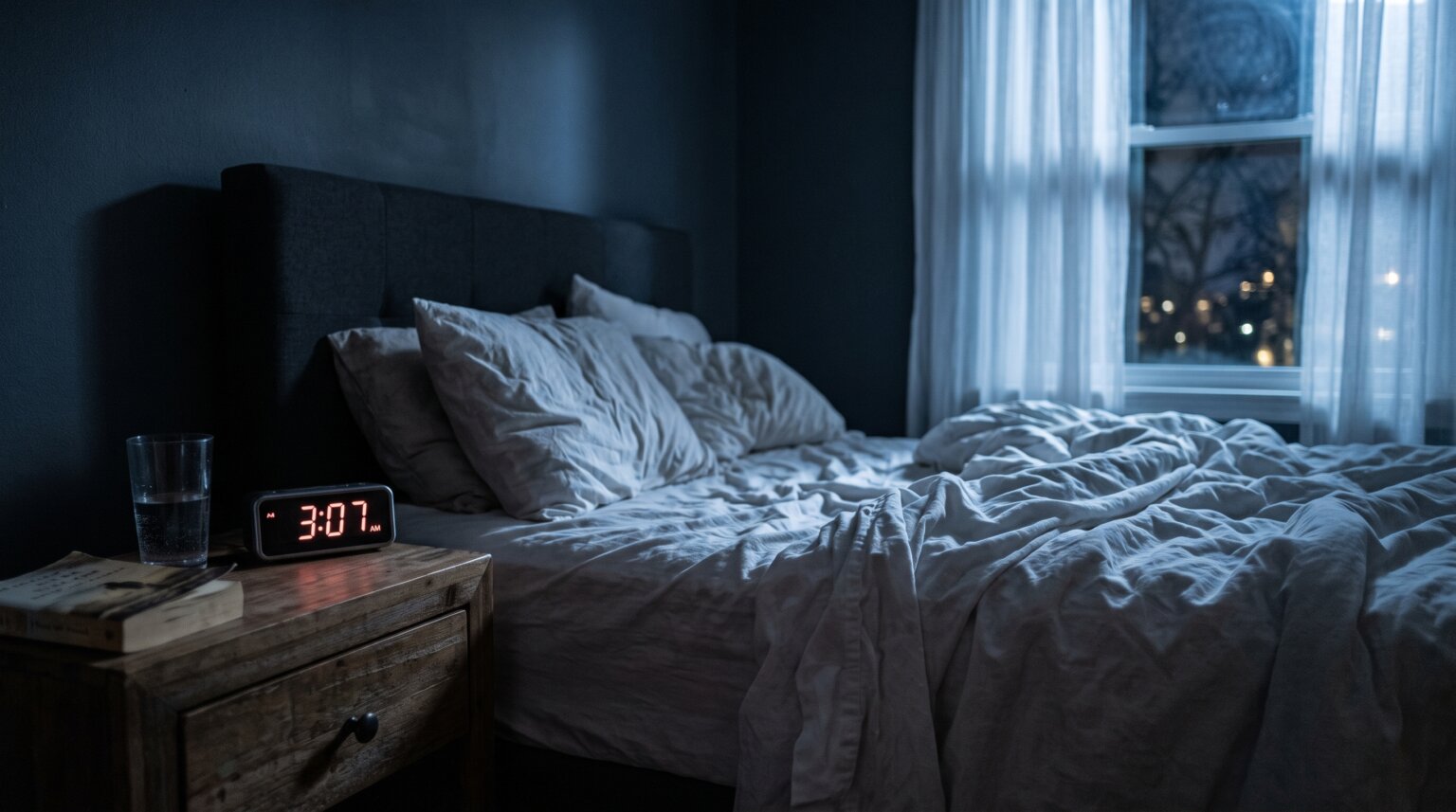
You wake up at 2 AM, glance at the ceiling, and your brain instantly flips on like a light switch. Your body feels exhausted, but your mind starts racing through tomorrow’s to-do list, a conversation from three days ago, and the growing panic that you only have four hours left to sleep. If you’re wondering why you can’t fall back asleep once you wake up at night, you’re dealing with one of the most common and frustrating sleep problems people face.
This experience has a medical name: sleep-maintenance insomnia. It affects up to one in five Americans, according to Johns Hopkins Medicine. Unlike sleep-onset insomnia (trouble falling asleep initially), sleep-maintenance insomnia means you wake during the night and then lie awake, unable to drift back off despite feeling tired.
The reason this happens comes down to a combination of brain chemistry, stress hormones, and learned behaviors. When you wake up and start worrying about being awake, your brain releases cortisol and activates your sympathetic nervous system, the same system responsible for fight-or-flight responses. This creates a vicious cycle where the harder you try to sleep, the more alert you become.
In this guide, our team breaks down exactly why your brain refuses to shut back down after a nighttime awakening. We’ll cover the neuroscience behind it, the most common triggers, and research-backed strategies you can use tonight to get back to sleep faster. Whether you wake up at 2 AM every night or just occasionally find yourself staring at the ceiling, these evidence-based techniques can help.
Table of Contents
What Is Sleep-Maintenance Insomnia?
Sleep-maintenance insomnia is the specific type of sleep disorder where a person wakes up during the night and cannot fall back asleep. It is distinct from sleep-onset insomnia, which involves difficulty falling asleep at the beginning of the night. Many people experience both, but sleep-maintenance insomnia on its own is incredibly common.
Here is something that might surprise you: waking up during the night is completely normal. Sleep researchers have found that healthy sleepers experience brief awakenings between sleep cycles multiple times per night. These mini-awakenings typically last just a few seconds, and most people never even remember them. The brain briefly shifts between sleep stages, and you naturally transition through lighter sleep phases.
The problem arises when a normal awakening turns into a full wake-up that lasts 20 minutes or longer. Instead of transitioning smoothly to the next sleep cycle, your brain crosses the threshold from light sleep into full wakefulness. At that point, getting back to sleep requires your brain to go through the entire sleep-onset process again, which is much harder the second time around.
According to the Mayo Clinic, mid-sleep awakenings often happen during periods of stress. They become clinically significant when they occur three or more times per week for three months or longer. If you occasionally wake up and take 30 minutes to fall back asleep, that is frustrating but normal. If it happens regularly and affects your daytime functioning, it may qualify as sleep-maintenance insomnia.
Understanding the difference between normal awakenings and problematic ones matters because the strategies for handling them are different. For a normal brief awakening, the best approach is to simply close your eyes and let sleep take over. For a full wake-up with cognitive arousal, you need active strategies to calm your nervous system before sleep becomes possible again.
Why Can’t I Fall Back Asleep Once I Wake Up at Night? The Science
No major health publication currently explains the actual neuroscience of why falling back asleep after waking is so difficult. This is a critical gap because understanding the mechanism makes the solutions make sense. Let me walk through what is happening in your brain when you wake up at 3 AM and find yourself wide awake.
Cortisol and Your Body’s Alarm System
Cortisol is often called the stress hormone, but it is also a natural part of your body’s daily rhythm. Under normal circumstances, cortisol levels drop to their lowest point around midnight and slowly rise in the early morning hours to help you wake up naturally. This is part of your circadian rhythm, the internal clock that regulates sleep and wakefulness.
When you wake up unexpectedly and feel alarmed, frustrated, or anxious about being awake, your body interprets this as a threat. Your adrenal glands release a burst of cortisol, which raises your heart rate, increases alertness, and suppresses melatonin production. Melatonin is the hormone that signals to your brain that it is time to sleep. When cortisol spikes and melatonin drops, your body is chemically primed for wakefulness, not sleep.
This cortisol response happens fast, often within seconds of waking. The mere act of realizing you are awake and feeling frustrated can trigger it. That is why the first few moments after waking are so important. If you can prevent the stress response from activating, you have a much better chance of drifting back to sleep quickly.
Cognitive Arousal: When Your Mind Won’t Stop Racing
Cognitive arousal is the mental equivalent of a car engine revving in neutral. Your thoughts start accelerating, jumping from topic to topic, and your brain becomes actively engaged in thinking rather than resting. This is one of the most common reasons people can’t fall back asleep after waking up at night.
The brain has two main modes for transitioning into sleep. The first is passive sleep onset, where your mind naturally slows down and drifts off. This is what happens at the beginning of the night when you are tired and your sleep drive is high. The second is active sleep onset, which requires conscious relaxation techniques to slow mental activity.
When you wake up in the middle of the night, your sleep drive is lower because you have already accumulated some sleep. This means passive sleep onset is harder to achieve. Your brain needs help shifting into a calmer state. Without that help, cognitive arousal keeps your brain in an active processing mode that blocks sleep entirely.
People with anxiety disorders, ADHD, or high baseline stress levels are especially prone to cognitive arousal after waking. The moment consciousness returns, the brain immediately picks up where it left off, processing worries, plans, and unresolved problems. Forum users on Reddit’s sleep communities frequently describe this exact experience: “My mind races the moment I wake up.”
The Bed-Wakefulness Conditioning Problem
Here is a psychological mechanism that almost no sleep article discusses but that plays a huge role in chronic sleep-maintenance insomnia. It is called conditioned arousal, and it is a core principle behind stimulus control therapy, one of the most effective behavioral treatments for insomnia.
Your brain forms associations based on experience. In an ideal world, your brain associates your bed exclusively with sleep. You lie down, and your brain recognizes the cue: time to shut down. But if you spend hours lying awake in bed night after night, your brain starts associating the bed with wakefulness, frustration, and anxiety instead of sleep.
This conditioned association becomes self-reinforcing. The more nights you spend lying awake in bed, the stronger the association between your bed and being awake becomes. Eventually, simply being in bed can trigger alertness. This is why lying in bed for hours “trying to sleep” is one of the worst things you can do, a point we will return to in the strategies section.
Stimulus control therapy breaks this cycle by having you leave the bed whenever you cannot sleep. The rule is simple: if you have been awake for roughly 20 minutes, get out of bed. Go to another room, do something low-stimulation, and only return when you feel genuinely drowsy. Over time, this rebuilds the association between your bed and sleep.
Common Causes of Nighttime Awakenings
Understanding why you wake up in the first place is half the battle. If you can identify the trigger, you can often address it directly. The causes fall into several categories, and many people have more than one factor working against them.
Environmental Triggers
Your sleep environment plays a bigger role in nighttime awakenings than most people realize. Noise is the most obvious culprit, and it does not have to be loud. A dog barking two houses down, a partner snoring, traffic noise, or a neighbor’s TV can pull you out of deep sleep. Even sounds you do not consciously remember hearing can trigger micro-awakenings.
Temperature is another major factor. Your body temperature naturally drops during sleep, and your bedroom needs to support this process. The ideal sleeping temperature is between 60 and 67 degrees Fahrenheit. If your room is too warm, you are more likely to wake up during the lighter sleep stages that occur in the second half of the night.
Light exposure matters enormously. Even small amounts of light, from a streetlamp through curtains or a glowing power button on an electronic device, can suppress melatonin production. Your brain relies on darkness as a signal to maintain sleep. When light enters your environment, melatonin production slows, making it harder to stay asleep.
Health Conditions That Disrupt Sleep
Several medical conditions are notorious for causing nighttime awakenings. Sleep apnea is one of the most common, affecting an estimated 25 million Americans. It causes repeated pauses in breathing throughout the night, each of which triggers a brief awakening. Many people with sleep apnea do not realize they have it, but they wake up feeling unrefreshed despite apparently sleeping for eight hours.
Restless legs syndrome causes an irresistible urge to move the legs, usually worse in the evening and at night. Periodic limb movement disorder, a related condition, causes involuntary leg movements during sleep that trigger awakenings. Both conditions fragment sleep severely and make falling back asleep difficult.
Nocturia, the need to urinate multiple times during the night, is another major contributor. While waking up to use the bathroom once may be normal, doing so two or more times per night disrupts sleep architecture. Once you are up and moving, your brain has to work harder to transition back into sleep mode.
Chronic pain conditions, acid reflux, and asthma can all trigger awakenings as well. If pain or discomfort wakes you up, the discomfort itself plus the cognitive arousal from being woken creates a double barrier to falling back asleep.
Lifestyle Factors
Caffeine is the most obvious lifestyle factor, but its timing is less intuitive than you might think. Caffeine has a half-life of roughly five to six hours. That means if you drink a cup of coffee at 4 PM, half the caffeine is still in your system at 10 PM. Even if you fall asleep fine, residual caffeine can make your sleep lighter and more fragmented, increasing the likelihood of nighttime awakenings.
Alcohol is the opposite of what most people expect. It helps you fall asleep faster initially, but as your body metabolizes it during the second half of the night, it causes what researchers call a rebound effect. Sleep becomes lighter and more fragmented, and awakenings become more frequent. This is why people often report waking up at 3 AM after a night of drinking.
Exercise timing matters too. Regular exercise improves sleep quality overall, but vigorous exercise within two to three hours of bedtime can raise your core body temperature and stimulate cortisol release, making it harder to stay asleep.
Screen use before bed deserves special attention. The blue light from phones, tablets, and computers suppresses melatonin production directly. But the content matters too. Scrolling through news, social media, or work emails creates cognitive arousal that can persist into the night and trigger awakenings.
Blood Sugar and the 3 AM Wake-Up
This is a cause that no top-ranking competitor discusses, yet it comes up repeatedly in user forums and sleep communities. Blood sugar fluctuations during the night can trigger awakenings, and the mechanism is well-documented in the research literature.
When you eat a meal high in refined carbohydrates or sugar close to bedtime, your blood sugar rises sharply and then drops as insulin responds. If blood sugar drops too low during the night, your body releases cortisol and adrenaline to raise it back up. These stress hormones wake you up, often around 2 or 3 AM, and they make falling back asleep nearly impossible because your body is in a mild fight-or-flight state.
Multiple Reddit users in sleep forums report that eating a small protein-and-fat snack before bed, such as a handful of almonds or a spoonful of peanut butter, reduces or eliminates their nighttime awakenings. While individual reports are not clinical evidence, the blood sugar mechanism is biologically sound and worth considering if your awakenings follow this pattern.
If you consistently wake up around the same time each night with a racing heart or feeling of alertness, blood sugar instability may be a contributing factor. Eating a balanced dinner with adequate protein, fat, and fiber, and avoiding sugary snacks before bed, can help stabilize overnight blood sugar levels.
Aging and Sleep Architecture Changes
Sleep naturally changes as we age, and this is one of the most under-discussed causes of sleep-maintenance insomnia. Starting in your 30s and accelerating through your 50s and beyond, sleep architecture shifts. You spend less time in deep sleep stages and more time in lighter sleep stages.
Lighter sleep means you wake up more easily and more often. Environmental noises, temperature changes, and internal sensations that you would have slept through at age 25 can jolt you awake at age 50. This is not a sign that something is wrong with your health; it is a normal part of how sleep changes with age.
For women, perimenopause adds another layer. Night sweats and hot flashes caused by hormonal fluctuations can cause repeated awakenings throughout the night. Johns Hopkins specifically addresses this in their sleep guidance, recommending temperature control strategies and breathable bedding for women in perimenopause.
Understanding that some sleep changes are age-related can reduce anxiety. If you are 55 and waking up twice a night, that does not necessarily mean you have a sleep disorder. It may mean you need to adjust your sleep habits and environment to accommodate lighter sleep architecture.
Immediate Strategies: What to Do Right Now
When you find yourself awake at 2, 3, or 4 AM and can’t fall back asleep, what you do in the first few minutes makes all the difference. These strategies are drawn from cognitive behavioral therapy for insomnia (CBT-I), which is considered the gold standard treatment for chronic sleep problems.
The most important principle is this: do not lie in bed forcing yourself to sleep. As we covered in the conditioning section, staying in bed while awake strengthens the association between your bed and wakefulness. The longer you stay, the worse the problem becomes.
Here is the step-by-step approach I recommend based on CBT-I principles and clinical guidelines from sleep specialists:
Step 1: Do not look at the clock. The moment you check the time, you start doing sleep math, calculating how many hours remain until your alarm. This triggers anxiety and spikes cortisol, which actively prevents sleep. Turn your clock around or move your phone out of reach. If you need an alarm, position it so you cannot see the time display.
Step 2: Assess how long you have been awake. You do not need the exact time, just a rough estimate. If it has been less than 15 to 20 minutes and you feel relatively calm, try a relaxation technique in bed. If it has been longer than 20 minutes, or if you feel agitated and frustrated, move to the next step.
Step 3: Get out of bed and leave the bedroom. This is the 15-20 minute rule, and it comes directly from stimulus control therapy. Go to another room with dim lighting. The goal is to break the association between your bed and being awake. Do not take your phone with you.
Step 4: Do something low-stimulation in dim light. Read a physical book (not a screen), listen to calming music or a podcast with your eyes closed, do a jigsaw puzzle, or practice gentle stretching. Avoid anything engaging, work-related, or emotionally stimulating. Many Reddit users swear by keeping a Kindle loaded with dense or boring material specifically for this purpose.
Step 5: Return to bed only when you feel drowsy. This is key. You should feel your eyelids getting heavy and your body genuinely ready for sleep. If you return to bed before this point, you will likely lie awake again and reinforce the negative association.
Step 6: Use a relaxation technique as you settle in. Once back in bed, use one of the breathing or meditation techniques described in the next section to ease the transition into sleep. This helps counter any residual cognitive arousal from being awake.
The specific approach should vary based on why you woke up. If you woke up to use the bathroom, keep lights as dim as possible and avoid looking at screens. If you woke up from a noise, try white noise or earplugs to prevent a recurrence. If you woke up with racing thoughts, a mental grounding technique will be more effective than trying to force sleep directly.
Relaxation Techniques That Actually Work
Relaxation techniques work by activating your parasympathetic nervous system, which is the body’s rest-and-digest mode. This counteracts the sympathetic nervous system activation that keeps you alert and awake. Research supports several specific techniques for improving sleep onset after nighttime awakenings.
4-7-8 Breathing Technique
The 4-7-8 breathing method was popularized by Dr. Andrew Weil and is one of the most frequently recommended sleep breathing exercises. It works by extending your exhalation, which triggers a parasympathetic response and slows your heart rate.
Here is how to do it: inhale through your nose for a count of four, hold your breath for a count of seven, and exhale slowly through your mouth for a count of eight. The exact count matters less than the ratio; the key is that your exhale is roughly twice as long as your inhale. Repeat this cycle four times to start.
Reddit users in sleep forums frequently mention 4-7-8 breathing as one of the techniques that actually helps them fall back asleep. It works best when your cognitive arousal is moderate, meaning your mind is busy but not in full panic mode. If anxiety is extremely high, combine this with a grounding technique first.
Progressive Muscle Relaxation
Progressive muscle relaxation (PMR) involves systematically tensing and releasing muscle groups throughout your body. It works because physical tension and mental tension are linked; when your body is physically tense, your brain interprets this as a sign that there is something to be alert about.
Start at your feet. Tense the muscles in your toes and feet for five seconds, then release completely and notice the contrast. Move up to your calves, tense for five seconds, release. Continue through your thighs, abdomen, hands, arms, shoulders, neck, and face. By the time you reach your head, your entire body should feel noticeably more relaxed.
Johns Hopkins sleep expert Dr. Luis F. Buenaver specifically recommends PMR for nighttime awakenings. The technique takes about 10 minutes to complete, and many people find they drift off to sleep before finishing the full sequence. PMR is particularly effective if you carry physical tension from stress in your shoulders, jaw, or neck.
Body Scan Meditation
A body scan is similar to PMR but without the tensing phase. Instead, you mentally move your attention slowly from your toes to your head, noticing sensations in each part of your body without trying to change them. This practice pulls your attention away from racing thoughts and anchors it in physical sensation.
Body scan meditation is especially helpful for cognitive arousal, where your mind is racing and you cannot stop thinking. By giving your brain a single, repetitive task to focus on, you interrupt the cycle of spiraling thoughts. Many sleep apps, including Calm and Headspace, offer guided body scan meditations designed specifically for falling asleep.
If you prefer not to use an app, you can guide yourself. Start at your feet and mentally say to yourself, “My toes feel warm and heavy.” Move to your feet, then ankles, then calves, repeating the phrase for each body part. The monotony of the repetition is part of what makes it effective for sleep.
Guided Imagery
Guided imagery involves visualizing a calm, peaceful scene in vivid detail. The scene can be real or imaginary: a quiet beach, a forest trail, a childhood memory of a safe place. The key is to engage multiple senses. What do you see? What do you hear? What do you smell? What does the ground feel like beneath you?
This technique works by occupying your brain’s visualization centers, leaving less capacity for anxious thoughts. It is essentially a form of controlled daydreaming that guides your mind in the direction of sleep rather than in the direction of worry.
If you find it hard to create your own imagery, try recalling a specific happy memory in extreme detail. Walking through every moment of a pleasant experience, noting what you saw, heard, and felt, can have a similar effect. The goal is the same: give your brain something neutral and absorbing to focus on.
Non-Sleep Deep Rest (NSDR)
Non-sleep deep rest, or NSDR, is a term popularized by neuroscientist Dr. Andrew Huberman. It encompasses practices like yoga nidra, a guided meditation technique that induces a state of deep relaxation while maintaining minimal awareness. You are not trying to fall asleep; you are trying to enter a deeply restful state that allows sleep to arrive naturally.
NSDR protocols typically last 10 to 30 minutes and are available free on YouTube and various podcast platforms. You listen to a guided audio track that leads you through body awareness, breath counting, and visualization exercises. The narrator’s voice provides a structure that makes it easier to let go of racing thoughts.
The Sleep Foundation highlights NSDR and yoga nidra as effective strategies for nighttime awakenings. The advantage of NSDR over other techniques is that it does not require you to create your own mental structure. You simply follow along, which is ideal when your cognitive resources are depleted from being awake in the middle of the night.
What NOT to Do When You Wake Up
Some behaviors that seem helpful actually make it much harder to fall back asleep. Avoiding these common traps is just as important as using the right techniques.
Do not look at your phone or any screen. The blue light from screens directly suppresses melatonin production, but the content is an even bigger problem. Checking messages, reading news, or scrolling social media all generate cognitive arousal. Even briefly checking the time can trigger anxiety. Keep your phone out of arm’s reach.
Do not watch the clock. Clock-watching is one of the most damaging behaviors for sleep-maintenance insomnia. Every time you check the time, you calculate how much sleep you have lost and how little remains. This creates a spike in anxiety and cortisol that makes sleep impossible. Turn clocks around and resist the urge to calculate.
Do not lie in bed for hours hoping sleep will return. As we discussed in the conditioning section, this actively worsens the problem over time. If you have been awake for more than 20 minutes, get up. The bed should be associated with sleep, not with hours of frustrated wakefulness.
Do not turn on bright lights. Even brief exposure to bright light can suppress melatonin and signal to your brain that it is morning. If you need light to navigate, use the dimmest possible source, ideally a warm-toned nightlight. Keep bathroom trips as dark as you safely can.
Do not use alcohol as a sleep aid. While a drink might make you drowsy initially, the metabolic rebound effect will worsen your awakenings. This creates a cycle where the “solution” is actually causing the problem.
Do not start problem-solving or planning. If your brain starts working on a real problem in the middle of the night, you will become engaged and alert. Keep a notepad by your bed. If a thought is truly important, write it down to deal with tomorrow, then return to a relaxation technique.
Long-Term Strategies to Prevent Nighttime Waking
Managing nighttime awakenings is not just about what you do at 3 AM. Your daytime habits, evening routine, and sleep environment all influence how well you stay asleep. Building better sleep hygiene creates a foundation that makes nighttime awakenings less frequent and easier to manage when they do occur.
Stabilize your circadian rhythm with morning light. Your body’s internal clock resets itself every day based on light exposure. Getting bright light, ideally sunlight, within 30 to 60 minutes of waking helps anchor your circadian rhythm. This makes your sleep-wake cycle more robust and reduces the likelihood of fragmented sleep. Aim for at least 10 to 15 minutes of outdoor light first thing in the morning.
Optimize your sleep environment. Keep your bedroom dark, quiet, and cool. Use blackout curtains or a sleep mask if ambient light is an issue. Consider a white noise machine or fan to mask disruptive sounds. Set your thermostat between 60 and 67 degrees Fahrenheit. If you live in a noisy environment, invest in quality earplugs designed for sleep.
Build a consistent wind-down routine. Your brain needs a transition period between daytime alertness and sleep. Start dimming lights one to two hours before bed. Avoid screens during this time, or use blue light blocking glasses if screen use is unavoidable. Engage in calming activities like reading, gentle stretching, or listening to quiet music.
Watch caffeine and alcohol timing. Stop consuming caffeine by early afternoon, keeping in mind its six-hour half-life. If you are sensitive to caffeine, your cutoff may need to be even earlier. Limit alcohol consumption, especially within three hours of bedtime, to avoid the rebound awakening effect.
Exercise regularly, but time it right. Regular physical activity improves sleep quality and reduces the time it takes to fall asleep. However, avoid vigorous exercise within two to three hours of bedtime. Morning or early afternoon exercise is ideal for sleep benefits.
Address stress during the day. If anxiety is driving your nighttime awakenings, the most effective long-term strategy is addressing the anxiety itself. Practices like journaling, talking with a therapist, meditation, or stress management techniques help reduce your baseline cognitive arousal so that waking up at night does not immediately trigger a spiral of racing thoughts.
Eat a balanced dinner with adequate protein and fiber. If blood sugar instability is contributing to your awakenings, focus on meals that provide steady energy. Avoid sugary desserts close to bedtime. A small snack containing protein and healthy fat about an hour before bed can help stabilize overnight blood sugar for some people.
The Next Day: Recovering From a Bad Night
After a rough night of fragmented sleep, how you handle the next day matters for breaking the cycle. Johns Hopkins specifically emphasizes maintaining your normal schedule, and this advice is backed by the science of sleep drive.
Sleep drive is the pressure to sleep that builds throughout your waking hours. It is driven by a chemical called adenosine, which accumulates in your brain the longer you are awake. When you have a bad night, your sleep drive is lower than usual the next morning, which means you will have less pressure to sleep the following night unless you build it back up.
To rebuild sleep drive: resist the urge to nap. If you absolutely must rest, keep it under 20 minutes and before 3 PM. Get sunlight exposure during the day. Maintain your normal bedtime rather than going to bed early, which can throw off your circadian rhythm. Avoid excessive caffeine, even though you will be tempted.
Most importantly, do not catastrophize. One bad night does not mean you are developing chronic insomnia. The anxiety about not sleeping is often more damaging than the sleep loss itself. Remind yourself that your body has an inherent drive to sleep, and if you maintain healthy habits, sleep will return.
When to See a Doctor
Occasional difficulty falling back asleep is normal and does not require medical attention. However, certain patterns warrant a conversation with your healthcare provider or a sleep specialist.
Talk to a doctor if your nighttime awakenings occur three or more times per week for a month or longer. This frequency and duration meets the clinical threshold for chronic insomnia, and a sleep specialist can help identify underlying causes and recommend targeted treatments.
Seek evaluation if you suspect sleep apnea. Key symptoms include loud snoring, gasping or choking during sleep, morning headaches, and excessive daytime sleepiness. Sleep apnea requires diagnosis through a sleep study and is typically treated with a CPAP machine or other therapies.
Consider seeing a behavioral sleep medicine specialist if anxiety about sleep has become a problem in itself. Sleep anxiety, where you dread going to bed because you fear not sleeping, is a common feature of chronic insomnia. CBT-I, delivered by a trained specialist, is highly effective for this pattern and is recommended as first-line treatment before medication.
Other red flags include awakening with chest pain, severe night sweats (especially if new or changing), symptoms of restless legs syndrome that interfere with sleep, or awakenings accompanied by panic attacks. These symptoms may indicate underlying medical conditions that require specific treatment beyond behavioral strategies.
If you are taking sleep medications and still experiencing awakenings, talk to your doctor. Medication adjustments, combined with behavioral approaches, are often more effective than medication alone for sleep-maintenance insomnia specifically.
FAQs
Frequently Asked Questions
What is the 3 3 3 rule for sleep?
The 3-3-3 rule is a grounding technique for quieting a racing mind when you can’t sleep. Name three things you can see, three things you can hear, and three things you can feel. This sensory exercise pulls your attention away from anxious thoughts and anchors it in the present moment, which helps reduce cognitive arousal and makes it easier to transition back into sleep.
What vitamin is lacking for insomnia?
Research suggests that deficiencies in magnesium, vitamin D, and B vitamins (particularly B6 and B12) may contribute to sleep problems. Magnesium plays a role in regulating melatonin and calming the nervous system. Vitamin D receptors are involved in sleep regulation, and B vitamins support neurotransmitter production. However, vitamin deficiency is rarely the sole cause of insomnia. If you suspect a deficiency, ask your doctor for a blood test before starting supplements.
What to do if I woke up and can’t go back to sleep?
If you wake up and can’t fall back asleep, follow these steps: 1) Do not look at the clock or your phone. 2) Try a relaxation technique like 4-7-8 breathing or progressive muscle relaxation. 3) If you have been awake for more than 20 minutes, get out of bed and go to another room. 4) Do something low-stimulation in dim light, like reading a physical book. 5) Return to bed only when you feel genuinely drowsy. This approach, based on stimulus control therapy, prevents your brain from associating your bed with wakefulness.
What if I wake up but can’t fall back asleep?
This is called sleep-maintenance insomnia, and it affects up to one in five Americans. It is usually caused by stress, anxiety, environmental disruptions, or underlying health conditions like sleep apnea. The key is not to force sleep. Get out of bed after 20 minutes of wakefulness, do a calming activity in dim light, and return when drowsy. If this happens regularly for a month or more, consider seeing a sleep specialist for evaluation.
Is it normal to wake up every hour at night?
Waking up briefly between sleep cycles is normal, and most people experience several micro-awakenings per night without remembering them. However, fully waking up every hour and struggling to fall back asleep is not typical and may indicate a sleep disorder, environmental disruption, or health issue. If you are waking every hour on a regular basis, talk to a doctor about possible causes such as sleep apnea, nocturia, or anxiety.
Why do I keep waking up at the same time every night?
Waking at the same time each night often relates to your sleep cycle structure. Your body cycles through sleep stages roughly every 90 minutes, and you naturally pass through lighter sleep stages at predictable intervals. If you wake at 3 AM every night, you may be hitting a light sleep stage amplified by a trigger like cortisol, blood sugar drops, noise, or temperature changes. Identifying and addressing the specific trigger can help break the pattern.
Conclusion
Struggling to fall back asleep once you wake up at night is one of the most common sleep complaints, and it can feel incredibly isolating when you are lying awake at 3 AM watching the minutes tick by. But understanding why it happens gives you the power to change the pattern.
The key takeaways: waking up at night is normal, but staying awake is often driven by cortisol spikes, cognitive arousal, and the counterproductive behaviors we turn to when sleep will not come. The harder you try to force sleep, the more your brain resists it. This is why the 15-20 minute rule and stimulus control therapy are so effective: they work with your brain’s natural mechanisms rather than against them.
If you take one thing from this guide, let it be this: stop lying in bed fighting to sleep. Get up after 20 minutes, do something calm in dim light, and return only when your body is genuinely ready. Combined with relaxation techniques like 4-7-8 breathing or progressive muscle relaxation, and supported by good daytime sleep hygiene habits, this approach can dramatically reduce the frequency and duration of your nighttime awakenings.
Remember that improving sleep-maintenance insomnia takes time. The conditioned associations between your bed and wakefulness took weeks or months to build, and they take time to unlearn. Be patient, be consistent, and if the problem persists despite your best efforts, do not hesitate to reach out to a sleep specialist. CBT-I and other professional treatments are available and highly effective for chronic sleep-maintenance insomnia.