
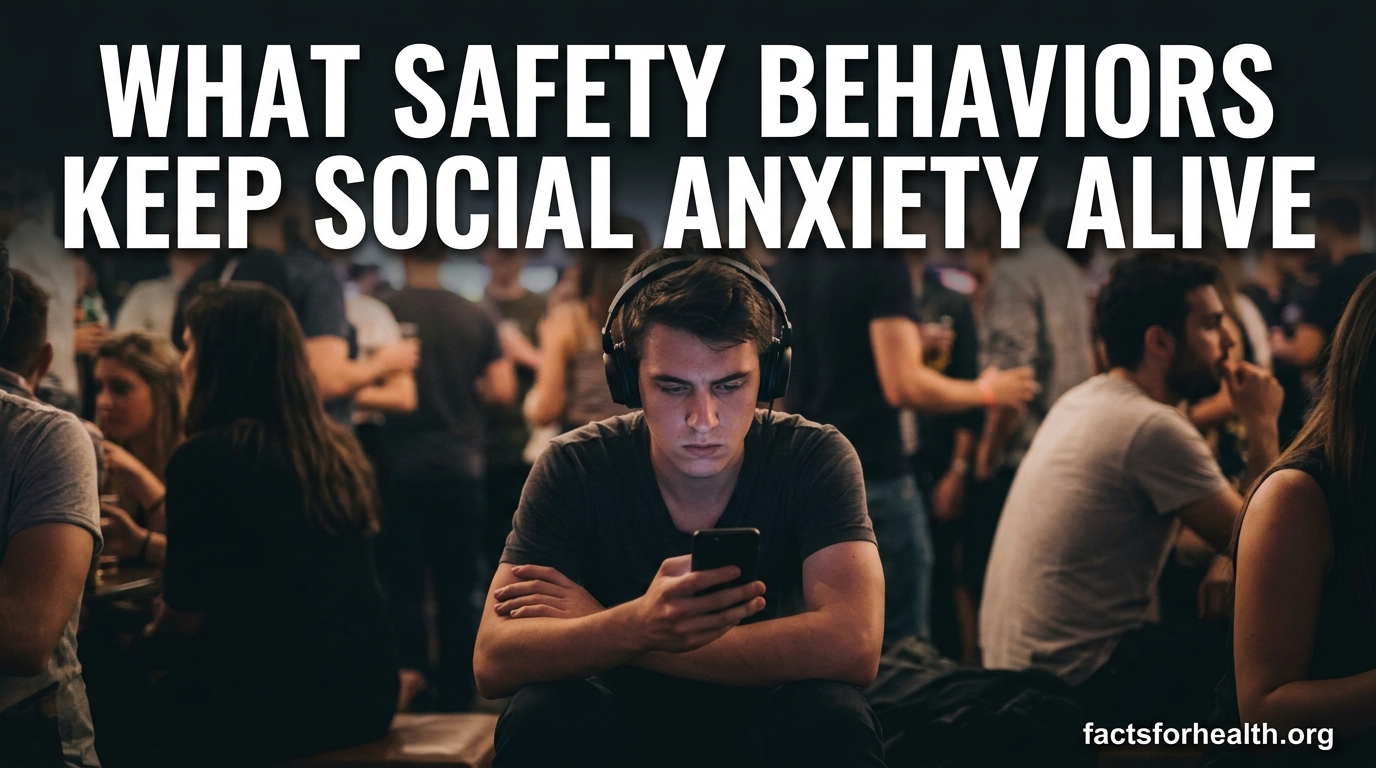
You rehearse what you’ll say before every conversation. You grab your phone the second there’s a lull. You position yourself near the exit at every gathering. These feel like smart coping strategies, the things that help you survive social situations without falling apart.
But what if those exact behaviors are the reason your anxiety never actually gets better?
If you’ve been wondering what safety behaviors are keeping your social anxiety alive, you’re in the right place. In this guide, we’ll unpack the subtle actions that feel protective but actually feed the anxiety cycle. You’ll learn how to spot your own safety behaviors, understand what’s happening in your brain when you use them, and take graduated steps toward letting them go.
Our team has spent months researching social anxiety maintenance patterns, reviewing clinical literature on cognitive behavioral therapy, and studying real experiences from anxiety support communities. The goal is simple: help you understand why your anxiety feels stuck and what you can actually do about it.
Table of Contents
What Are Safety Behaviors in Social Anxiety?
Safety behaviors, sometimes called safety-seeking behaviors, are actions people take to reduce anxiety in social situations they expect will go badly. These behaviors provide short-term relief but prevent the brain from learning that feared outcomes rarely happen, which keeps anxiety alive long-term. Common examples include avoiding eye contact, speaking softly, rehearsing conversations, and carrying a phone as a distraction.
That definition matters because the concept flips what most people assume about coping. We tend to think that anything that reduces anxiety is helping. But in cognitive behavioral therapy (CBT), researchers have identified a critical distinction: behaviors that reduce anxiety in the moment can actually maintain or worsen anxiety over time.
The key insight is that safety behaviors work through a trick. They make you feel like you narrowly escaped disaster, when in reality there was no disaster to escape. Think of it like carrying an umbrella every day because you’re terrified of rain. On the days it doesn’t rain, you tell yourself the umbrella worked. The umbrella becomes impossible to put down because you never get evidence that rain won’t destroy you.
That’s exactly what happens with social anxiety. You rehearse your introduction before a meeting and the meeting goes fine. Your brain credits the rehearsal. Next time, you rehearse even more. The preparation grows, the anxiety doesn’t shrink, and you’re left exhausted.
Common Safety Behaviors in Social Anxiety: The Complete List
Safety behaviors come in many forms, and some are so subtle you might not recognize them. People on anxiety support forums frequently describe an “aha moment” when they first realize behaviors they thought were helping were actually safety-seeking patterns. Here are the most common ones, grouped by category.
Conversation Safety Behaviors
These happen during social interactions and are designed to minimize your visibility or vulnerability:
- Avoiding eye contact: Looking away, looking down, or focusing on objects instead of people’s faces to reduce the intensity of interaction.
- Speaking softly or quietly: Lowering your volume so fewer people hear you, reducing perceived risk of saying something wrong.
- Talking too fast: Rushing through what you have to say to get it over with as quickly as possible.
- Deflecting questions: Quickly turning conversations back to the other person to avoid being the center of attention.
- Over-asking questions: Keeping the other person talking so you don’t have to share about yourself.
Preparation Safety Behaviors
These happen before social situations and involve extensive mental work to feel “ready”:
- Mental rehearsal: Scripting entire conversations in your head, sometimes for hours, before they happen.
- Over-preparing: Researching topics extensively before a casual gathering so you’ll have something to say.
- Pre-planning exits: Mapping out how you’ll leave early or planning excuses before you even arrive.
Physical and Environmental Safety Behaviors
These involve controlling your physical space or appearance to feel protected:
- Checking your phone: Using your phone as a shield during awkward moments, in lines, or when alone in a crowd.
- Sitting at the edge of a room: Choosing seats near exits or at the periphery so you can leave easily.
- Wearing neutral or specific clothing: Dressing to blend in, cover blushing, or avoid being noticed.
- Gripping objects: Holding a drink, bag, or notebook tightly to steady yourself and create a barrier.
Situational Safety Behaviors
These involve controlling who you’re with or what roles you play:
- Bringing a trusted companion: Only attending events with a specific friend or family member who acts as a buffer.
- Staying busy behind the scenes: Volunteering for tasks like serving food or taking photos to avoid unstructured socializing.
- Avoiding altogether: The ultimate safety behavior, skipping events entirely to prevent any possibility of judgment.
How many of these felt familiar? Most people with social anxiety use five to ten of these regularly without realizing they qualify as safety behaviors. That recognition isn’t cause for shame, it’s the first step toward real change.
How Safety Behaviors Keep Your Social Anxiety Alive
Safety behaviors keep social anxiety alive through a self-reinforcing cycle that feels logical but is built on a false premise. The cycle works in four stages, and understanding each one is the key to breaking free.
Stage 1: Anticipatory anxiety. Before a social event, your brain predicts something bad will happen. Maybe you’ll embarrass yourself, say something stupid, or be judged. This prediction triggers physical anxiety symptoms like a racing heart, tight chest, or nausea.
Stage 2: Safety behavior deployment. To manage that anxiety, you deploy a safety behavior. You rehearse what you’ll say. You decide to arrive late and leave early. You bring your most extroverted friend. The safety behavior reduces your anxiety slightly, giving you just enough relief to get through the door.
Stage 3: The situation ends without disaster. The event happens and nothing terrible occurs. Nobody laughed at you. You survived. But here’s the critical problem: your brain doesn’t credit the situation itself. It credits the safety behavior. “Thank goodness I rehearsed,” or “Good thing I had Sarah there,” or “If I hadn’t left early, it would have gone wrong.”
Stage 4: No learning occurs. This is the stage that keeps everything stuck. Because you used a safety behavior, your brain never got the chance to learn that you could handle the situation without it. The feared outcome was never tested, so the fear remains fully intact for next time.
In CBT, this concept is called the prevention of disconfirmation. Your brain needs direct evidence that feared outcomes don’t happen. Safety behaviors block that evidence from ever being collected. It’s like trying to overcome a fear of dogs while wearing a bite-proof suit. You’ll never feel safe around dogs because you’ll always wonder if the suit is what protected you.
This is why people on anxiety forums describe the same frustrating pattern: “I’ve been coping for years, but my anxiety hasn’t gotten any better.” Coping through safety behaviors isn’t the same as recovering. Coping manages symptoms. Recovery requires learning. Safety behaviors prevent the learning.
What’s Happening in Your Brain: The Neuroscience of Safety Behaviors
To understand why safety behaviors are so hard to drop, it helps to know what’s happening neurologically. Social anxiety isn’t a character flaw or a thinking problem. It’s a threat detection system that’s misfiring.
The amygdala is your brain’s alarm system. It’s a small, almond-shaped structure that scans your environment for threats and triggers the fight-or-flight response when it detects danger. In social anxiety, the amygdala is overactive, tagging ordinary social situations as potentially life-threatening.
When you walk into a party, your amygdala might react the same way it would to encountering a predator. Your heart races, your muscles tense, your breathing speeds up. This is not a rational response, and you can’t simply think your way out of it. The amygdala operates below conscious awareness.
The prefrontal cortex is your brain’s reasoning center. It can evaluate evidence, put things in perspective, and override the amygdala’s alarm signals. But here’s the catch: the prefrontal cortex can only calm the amygdala when it has direct, experiential evidence that a situation is safe.
This is where safety behaviors sabotage the process. When you use a safety behavior, the situation ends well. But the prefrontal cortex can’t use that as evidence of safety because it was never a clean test. The safety behavior contaminated the data. Your prefrontal cortex remains unable to tell the amygdala, “We’ve been in this situation before and nothing bad happened.”
The result is a neurological deadlock. The amygdala keeps firing the alarm, the safety behaviors keep dampening it temporarily, and the prefrontal cortex never gets the evidence it needs to intervene. Breaking the cycle requires removing the safety behavior so the brain can collect real data about what actually happens in social situations.
Post-Event Processing: The Stage Most People Miss
Most discussions of safety behaviors focus on what happens before and during social situations. But there’s a third stage that keeps anxiety alive after the event is over. It’s called post-event processing, and it’s one of the most exhausting aspects of social anxiety.
Post-event processing is the mental replay of a social event after it ends. Instead of moving on, your brain puts the interaction under a microscope. You replay what you said, how you said it, what your face looked like, and how other people reacted. You scan for evidence that you embarrassed yourself.
Here’s what makes post-event processing so destructive: it’s biased. Your brain doesn’t replay the conversation objectively. It highlights the most awkward moments, amplifies any pauses or stumbles, and filters out positive interactions. A five-minute conversation gets analyzed for hours, and the narrative that emerges is almost always more negative than what actually happened.
Forum users describe this vividly. They talk about lying awake at night replaying a comment they made, convinced it came across wrong. They describe reviewing text messages they sent, analyzing word choices, and worrying about how they were perceived. The event itself may have lasted 20 minutes, but the mental replay can go on for days.
Post-event processing functions as a safety behavior in slow motion. By obsessively reviewing what happened, your brain is trying to prevent future mistakes. It’s attempting to gather intelligence for next time. But because the review is biased toward negativity, it doesn’t produce useful information. It just reinforces the belief that social situations are dangerous and you handled them poorly.
This is why reducing safety behaviors means addressing the full cycle: anticipatory anxiety before, safety behaviors during, and post-event processing after. Working on one stage without the others is like patching one leak in a boat with three holes.
Self-Assessment: Identifying Your Own Safety Behaviors
No article or therapist can tell you exactly which safety behaviors are keeping your anxiety alive. Only you can identify them, because they’re highly personal. What feels protective to one person might never occur to another.
To help you identify your own patterns, work through these reflective questions honestly. There are no right or wrong answers, just information about how your anxiety operates.
Before social situations, do you:
- Spend significant time planning what you’ll say or how conversations will go?
- Research the event, the venue, or the people attending to feel more prepared?
- Plan your outfit specifically to avoid being noticed or to hide physical anxiety symptoms?
- Decide in advance how and when you’ll leave?
During social situations, do you:
- Use your phone, a drink, or another object as a physical shield or distraction?
- Position yourself near exits, corners, or the edges of rooms?
- Speak quietly, talk fast, or keep your contributions brief?
- Deflect attention away from yourself by asking questions or redirecting?
- Only attend with a specific person you consider your “safe” companion?
After social situations, do you:
- Replay conversations in your head, looking for things you said wrong?
- Check whether people responded positively (texts, social media, reactions)?
- Feel a wave of relief that it’s over, combined with dread about how you came across?
- Avoid thinking about it but find the memories surfacing involuntarily?
If you answered yes to several of these, you’ve just identified your personal safety behavior profile. Write them down. This list will be your roadmap for the gradual reduction process we’ll cover next.
Helpful Coping vs. Safety Behaviors: What’s the Difference?
Not every behavior that reduces anxiety is a problem. Some behaviors genuinely help you function and don’t interfere with learning. The distinction matters because you don’t want to eliminate everything that brings you comfort.
Adaptive behaviors help you engage more fully with the situation. They don’t prevent you from having the experience. Examples include taking three deep breaths before entering a room, reminding yourself that anxiety is a normal feeling, or using a grounding technique to stay present. These behaviors reduce distress without removing you from the situation or preventing you from gathering evidence.
Anxiety-driven safety behaviors reduce anxiety by reducing your exposure to the feared situation. They create a buffer between you and the social interaction. If you removed them, your anxiety would spike significantly. Examples include rehearsing every word, hiding behind a friend, or leaving before the event is over.
A good test: ask yourself, “If I couldn’t do this, would I still go?” If the answer is no, it’s likely a safety behavior. If you’d still attend but might feel somewhat more anxious, it’s probably an adaptive coping strategy. The goal isn’t to remove all comfort. It’s to identify and gradually reduce the behaviors that are blocking your brain from learning that social situations are survivable.
How to Reduce Safety Behaviors Without Overwhelming Yourself
The answer to safety behaviors isn’t to drop them all at once. That approach backfires because it floods your system with anxiety and makes you want to retreat further into avoidance. The approach that works, backed by CBT and exposure therapy research, is gradual reduction.
Step 1: Build your awareness. You’ve already started this by working through the self-assessment above. Awareness alone is powerful. Many people report that simply naming a behavior as a “safety behavior” changes their relationship to it. It goes from an invisible habit to a conscious choice.
Step 2: Rank your safety behaviors by difficulty. List every safety behavior you identified and rank them from easiest to hardest to give up. The easiest ones are your starting point. For example, if you always grip your drink tightly, that might be a level 1. If you always bring a specific friend to every event, that might be a level 8.
Step 3: Drop one behavior at a time. Choose your easiest safety behavior and commit to entering one social situation without it. Notice what happens. Your anxiety will likely spike, that’s expected and normal. The goal is to stay in the situation long enough to learn that the feared outcome doesn’t occur.
Step 4: Collect the evidence. After the situation, reflect on what actually happened. Did anyone laugh at you? Did the conversation fall apart? Did you survive? Write down what you observed. This is the data your prefrontal cortex needs to start calming your amygdala.
Step 5: Move to the next level. Once you’ve tested one safety behavior multiple times and your anxiety has decreased, move to the next item on your list. This graduated approach, called an anxiety hierarchy in CBT, is how lasting change happens.
Be patient with yourself throughout this process. Safety behaviors developed because they made sense at some point in your life. They were a logical response to feeling unsafe. Reducing them isn’t about judgment. It’s about giving your brain the chance to learn what it was never allowed to learn.
If your social anxiety is severe or you find this process too overwhelming to tackle alone, working with a therapist who specializes in CBT can make a significant difference. A trained professional can help you build your hierarchy, pace your progress, and provide support when the anxiety feels too intense to manage independently.
FAQs
What are safety behaviors in social anxiety?
Safety behaviors are actions people take to reduce anxiety in social situations they fear will go badly, such as avoiding eye contact, rehearsing conversations, or bringing a trusted friend. These behaviors provide short-term relief but prevent the brain from learning that feared outcomes rarely happen, which keeps anxiety alive long-term.
How to live with severe social anxiety?
Living with severe social anxiety involves a combination of professional support and self-management. Working with a CBT therapist helps you identify and gradually reduce safety behaviors through a structured exposure hierarchy. Daily practices like mindfulness, regular social engagement at a manageable pace, and self-compassion also help. Many people see significant improvement within 12 to 16 weeks of consistent CBT.
How to free your brain from social anxiety?
Freeing your brain from social anxiety requires teaching your amygdala that social situations are safe through direct experience. This means gradually reducing safety behaviors and entering feared situations without your usual protective strategies. When the brain collects evidence that feared outcomes don’t happen, the prefrontal cortex can begin calming the amygdala’s threat response. This process is called fear extinction and is the core mechanism of exposure therapy.
How do you manage social anxiety?
Effective social anxiety management combines awareness, gradual exposure, and cognitive restructuring. Start by identifying your safety behaviors and avoidance patterns. Then build a hierarchy from easiest to hardest social situations and practice entering them without safety behaviors. Challenge anxious thoughts by collecting real-world evidence. For moderate to severe anxiety, professional CBT provides structure and guidance that significantly improves outcomes.
Conclusion
Understanding what safety behaviors are keeping your social anxiety alive changes everything about how you approach recovery. These behaviors feel like they’re protecting you, but they’re the mechanism keeping your anxiety locked in place. By preventing your brain from learning that social situations are survivable, safety behaviors maintain the very fear they’re designed to manage.
The path forward is not about forcing yourself to stop everything at once. It’s about building awareness, ranking your behaviors from easiest to hardest, and gradually testing what happens when you let one go at a time. Each time you enter a social situation without a safety behavior and nothing terrible happens, you give your brain a piece of evidence it’s been waiting for.
Recovery from social anxiety is possible, and it doesn’t require perfection. It requires willingness to feel uncomfortable in the short term so your brain can learn what it needs to learn in the long term. Start small, be patient with yourself, and consider reaching out to a CBT therapist if the process feels too heavy to carry alone.