
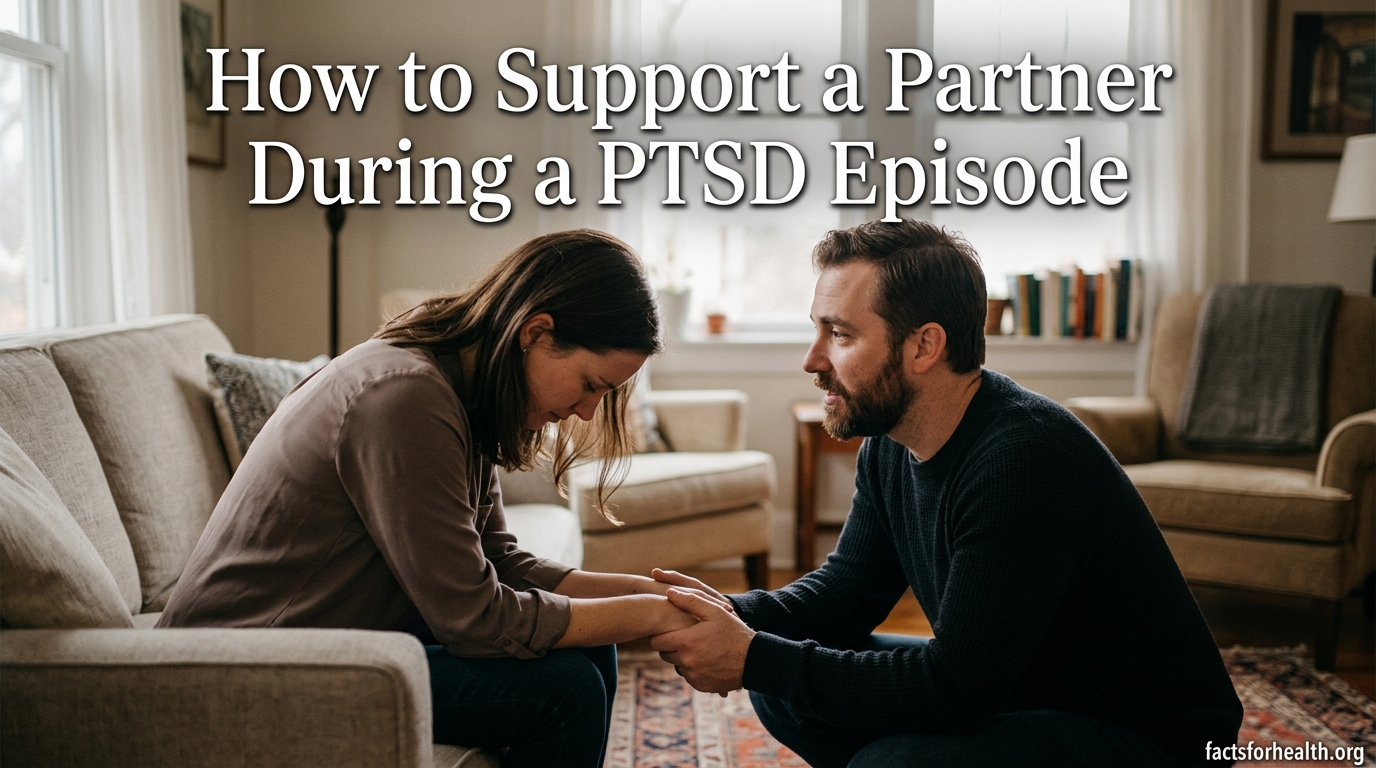
Watching someone you love go through a PTSD episode is one of the most frightening experiences a partner can face. One moment everything seems fine, and the next your partner is disoriented, trembling, or staring through you as if you are not there. If you have ever frozen in that moment, wondering whether to touch them, talk to them, or just back away, you are not alone.
Learning how to support a partner having a PTSD episode without making it worse comes down to a few specific principles: staying calm, using grounding techniques, respecting boundaries, and knowing what to avoid. The right response can shorten an episode significantly and help your partner feel safe. The wrong response, even with the best intentions, can intensify their distress and damage trust between you.
In this guide, we walk through exactly what happens during a PTSD episode, how to recognize the warning signs before one hits, what to do step by step while it is happening, and how to care for both your partner and yourself afterward. Whether your partner has been diagnosed recently or you have been navigating this together for years, you will find practical, field-tested strategies here.
Our team drew on clinical research, guidance from organizations like the VA National Center for PTSD and Mind, and real experiences shared by partners in trauma support communities. Every recommendation in this article reflects what both professionals and people who have lived through these moments recommend.
Table of Contents
Understanding PTSD Episodes and Trauma Responses
A PTSD episode is an intense psychological and physical response in which the brain reacts as if a past traumatic event is happening right now. The person is not just remembering what happened. Their nervous system fully activates the fight-or-flight response, flooding the body with adrenaline and stress hormones. To them, the threat feels immediate and real.
During an episode, the brain’s threat detection center, the amygdala, fires alarm signals. At the same time, the prefrontal cortex, which handles rational thinking and logic, largely goes offline. This is why telling someone to “just calm down” or “snap out of it” does not work. Their brain is physically unable to process that kind of rational instruction in that moment.
Episodes can take several forms. A flashback involves re-experiencing the trauma so vividly that the person feels transported back to the original event. Dissociation involves feeling disconnected from reality, from their body, or from their surroundings, as if watching everything from far away. Some episodes look more like a panic attack, with intense fear, rapid heartbeat, and hyperventilation but without the full re-experiencing of a flashback.
Complex PTSD, or C-PTSD, which develops from repeated or prolonged trauma, can produce episodes that last longer and involve deeper emotional dysregulation. Partners with C-PTSD may also experience emotional flashbacks, where they feel the emotions of the original trauma without necessarily having visual memories of it.
Understanding what is happening in your partner’s brain during an episode is the first step toward helping them. When you know that their reaction is neurological, not a choice, you can respond with patience instead of frustration.
Recognizing the Warning Signs Before an Episode
Most PTSD episodes do not come completely out of nowhere. Your partner will often show warning signs in the minutes or hours before a full episode hits. Learning to spot these signals gives you a window to intervene early and potentially reduce the severity of what follows.
Physical warning signs include restlessness, muscle tension, clenched jaws, rapid breathing, sweating, dilated pupils, and a heightened startle response. You might notice your partner suddenly going pale, developing a tremor, or complaining of a headache or chest tightness. Their body is already preparing for a perceived threat before their conscious mind catches up.
Behavioral changes are often the most noticeable. Your partner might become unusually quiet, withdraw from conversation, or suddenly seem distant. They might start scanning the environment, checking exits, or becoming hyperaware of sounds. Some people become irritable or snappy, while others become unusually compliant or people-pleasing.
Emotional warning signs can be subtle. Your partner may express sudden anxiety, seem on edge, or mention feeling unsafe without an obvious reason. You might notice mood swings, emotional numbness, or them shutting down emotionally. Pay attention if they say things like “I feel weird” or “something does not feel right.”
Every person’s warning signs are different. Over time, you will learn the specific patterns that signal an approaching episode for your partner. Keeping a mental note or even a shared log of what happened before each episode can help you identify their unique early warning system.
If you notice these signs, you can sometimes help your partner regulate before a full episode develops. Gently suggesting a grounding exercise, moving to a quieter space, or simply asking “Are you feeling okay right now?” can sometimes interrupt the escalation.
How to Support a Partner Having a PTSD Episode: Step-by-Step
When an episode is happening, your job is simple but not easy: be a calm, safe, grounding presence. Here is the step-by-step process that mental health professionals and experienced partners recommend.
Step 1: Regulate yourself first. Before you do anything else, take a deep breath and steady yourself. Your partner’s nervous system is highly attuned to the people around them. If you panic, their panic will intensify. If you stay calm and grounded, your steadiness can help co-regulate their nervous system. This is the single most important thing you can do.
Step 2: Assess the environment for safety. Quickly scan the area for any immediate danger or anything that might be triggering your partner. Is there a loud noise, a specific smell, a crowded space? If possible and safe, guide your partner to a quieter, more private location. Turn down lights, close doors, or step outside into fresh air.
Step 3: Get to their eye level and speak softly. Do not stand over them or loom. Sit down or crouch to their level if they are seated or lying down. Speak in a low, calm, slow voice. Keep your words simple and reassuring. Say things like “You are safe,” “I am right here with you,” and “This will pass.”
Step 4: Use grounding techniques. Help your partner reconnect with the present moment. The 5-4-3-2-1 method and the 3-3-3 rule are both highly effective. Walk them through it gently: “Can you tell me five things you can see right now?” Do not rush them. If they cannot respond, that is okay. Keep your voice as the anchor.
Step 5: Ask before touching. Never assume physical contact is comforting during an episode. For many trauma survivors, especially those with a history of physical or sexual abuse, unexpected touch can make things dramatically worse. Ask permission: “Can I hold your hand?” or “Would it help if I put my hand on your shoulder?” If they say no or pull away, respect that immediately and without taking it personally.
Step 6: Encourage slow, deep breathing. Without commanding or demanding, gently invite your partner to breathe with you. Say “Can you breathe with me?” and demonstrate slow, visible breaths. Inhale for four counts, hold briefly, exhale for six counts. Longer exhales activate the parasympathetic nervous system, which signals to the body that the danger has passed.
Step 7: Do not force conversation or explanations. Your partner may not be able to tell you what is wrong or what they need. That is normal. Their language processing is compromised during an episode. Do not press them for details about the flashback or what triggered it. Focus on the present moment and on safety.
Step 8: Stay until it passes. PTSD episodes can last anywhere from a few minutes to over an hour. Do not leave them alone unless they specifically ask for space and you are confident they are safe. Your continued, calm presence is one of the most powerful tools you have. Simply being there, breathing steadily, and occasionally offering soft reassurance is enough.
Many partners in support communities emphasize that staying calm yourself is the foundation of everything else. If you are panicking inside, your partner will sense it. Practice your own grounding exercises regularly so they become second nature when you need them.
Quick Reference: Dos and Don’ts During a PTSD Episode
Do: Stay calm, speak softly, use grounding techniques, ask before touching, respect their space, encourage slow breathing, and be patient.
Don’t: Tell them to calm down, touch them without asking, demand explanations, raise your voice, leave them alone abruptly, or try to logically argue them out of their feelings.
Grounding Techniques That Actually Work
Grounding techniques are specific exercises that help bring a person back to the present moment by engaging their senses and their rational brain. They work because they redirect neural activity away from the amygdala’s threat response and toward sensory processing areas of the brain. Here are the most effective grounding methods, with step-by-step instructions.
The 5-4-3-2-1 Method
This is the most widely recommended grounding technique for PTSD episodes. It engages all five senses and forces the brain to process current sensory input rather than reliving a traumatic memory.
Walk your partner through these steps slowly, pausing between each one. Do not rush. If they cannot answer one, move on to the next.
5 things you can see: Ask your partner to name five objects they can see in the room right now. Encourage detail: “Tell me five things you can see and describe one of them to me.”
4 things you can feel: Ask them to notice four things they can physically feel. This could be the chair beneath them, the fabric of their shirt, the floor under their feet, or the temperature of the air.
3 things you can hear: Ask them to identify three sounds in the environment. A clock ticking, traffic outside, birds, or your voice.
2 things you can smell: If they cannot identify two smells naturally, offer something. A piece of citrus fruit, a cup of coffee, essential oils, or even a scented lotion can work.
1 thing you can taste: Offer a mint, a piece of candy, or a sip of cold water. The strong sensory input of taste can be especially grounding.
The 3-3-3 Rule for PTSD
The 3-3-3 rule is a shorter, simpler grounding exercise that works well when your partner is too overwhelmed for the full 5-4-3-2-1 method. It is also easier to remember in a stressful moment.
Name 3 things you can see. Keep it simple. “The lamp, the window, the rug.”
Name 3 sounds you can hear. “Your voice, the fan, cars outside.”
Move 3 parts of your body. This is the physical component. Ask your partner to move their fingers, then their toes, then roll their shoulders. Physical movement reconnects the brain to the body and interrupts dissociation by forcing the motor cortex to engage.
The 3-3-3 rule works particularly well because the physical movement component actively brings the person back into their body. For partners who dissociate frequently, this technique can be a lifeline.
Physical Grounding Techniques
Beyond the structured exercises above, several simple physical techniques can help during an episode.
Cold water: Splash cold water on the face, hold an ice cube, or drink a glass of cold water. Cold stimulation activates the mammalian dive reflex, which slows the heart rate and signals safety to the nervous system.
Progressive muscle relaxation: Guide your partner to tense and then release each muscle group, starting from the feet and working up to the face. This releases stored tension and reconnects mind to body.
Barefoot grounding: If possible, have your partner take off their shoes and stand on the ground. The physical sensation of solid earth beneath their feet can provide a powerful sense of stability.
Counting backward: Ask your partner to count backward from 100 by sevens. This engages the prefrontal cortex and helps bring rational thinking back online.
Different techniques work for different people. Ask your partner during a calm moment which grounding exercises they find most helpful, and practice them together when they are not in distress. This builds muscle memory so the techniques are easier to use when it matters.
What NOT to Do During a PTSD Episode
Knowing what to avoid is just as important as knowing what to do. Well-meaning partners often accidentally escalate an episode by doing things they think are helpful but that actually make things worse. Here are the critical mistakes to avoid.
Phrases That Make Episodes Worse
Language matters enormously during an episode. Your partner’s brain is in survival mode, and certain phrases can feel dismissive, threatening, or confusing. Never say these things during an episode:
“Just calm down.” This is the most common mistake. Telling someone in a PTSD episode to calm down is like telling someone having an asthma attack to just breathe normally. It is physiologically impossible in that moment, and hearing it can make your partner feel like they are failing.
“You are overreacting.” Your partner’s brain is processing a real threat signal. Their reaction, however extreme it seems from the outside, is a genuine neurological response. Dismissing it deepens their distress and damages trust.
“It happened a long time ago, let it go.” PTSD is not a matter of holding onto the past. The brain has been physically changed by trauma, and the memories are stored differently. This phrase invalidates their experience and shows a misunderstanding of how PTSD works.
“What is wrong with you?” This can trigger shame and defensiveness. Nothing is wrong with your partner. Their brain is doing what trauma-trained brains do: trying to protect them from perceived danger.
“You are scaring me.” Even if this is true, sharing it during an episode adds guilt to their already overwhelming emotional load. Process your own feelings later, with a friend, therapist, or support system.
Behaviors That Escalate Episodes
Touching without permission. We covered this in the step-by-step section, but it bears repeating because it is the most common and most damaging mistake. A reassuring hug or hand on the shoulder can feel like an attack to someone whose body is reliving a trauma that may have involved physical violation.
Making sudden movements. Rapid gestures, standing up quickly, or moving toward your partner fast can be interpreted as a threat. Move slowly and deliberately, especially when you are close to them.
Raising your voice. Even if you are trying to be heard over their distress, a raised voice can intensify the fight-or-flight response. Keep your volume low and steady at all times.
Crowding them. Giving your partner physical space is important. Do not corner them or block their exit. Make sure they always have a clear path to leave the room if they need to.
Trying to reason them out of it. Logic does not work during an episode because the logical part of the brain is essentially offline. Do not try to explain why their fear is irrational or why they are safe. Focus on grounding, not arguing.
Taking their behavior personally. Your partner may push you away, say hurtful things, or become agitated with you. This is the episode talking, not your partner. Remind yourself that this is a trauma response, not a reflection of your relationship.
Partners in support communities consistently report that “snapping out of it” or telling someone to calm down makes episodes significantly worse. The partners who have the most success are the ones who have learned to simply be present without trying to fix anything in the moment.
After the Episode: Providing Ongoing Support
The moment an episode passes is not the end of the experience for your partner. The hours and days that follow are important for recovery, and how you handle them can affect how soon the next episode might come.
Immediately After
Your partner will likely feel exhausted, emotionally drained, and possibly embarrassed. PTSD episodes take an enormous physical and mental toll. Offer a quiet space, a blanket, and water. Do not ask them to debrief or explain what happened right away. Let them rest.
Some partners want to be held after an episode. Others want to be alone. Ask what they need without making them feel guilty either way. A simple “Do you want company or space right now?” gives them control without pressure.
Avoid bringing up stressful topics, making big decisions, or scheduling demanding activities for the rest of the day if possible. Treat the rest of the day as a recovery period.
The Days Following
In the days after an episode, your partner may experience heightened sensitivity, irritability, anxiety, or low mood. They might have trouble sleeping or experience more frequent nightmares. This post-episode vulnerability is normal and usually passes within a few days to a week.
Be extra gentle during this period. Reduce unnecessary stressors, maintain a calm home environment, and check in without hovering. Ask open-ended questions like “How are you feeling today?” rather than interrogating them about symptoms.
If your partner wants to talk about the episode, listen without judgment and without pressing for details they are not ready to share. Validate their experience: “That sounds incredibly difficult, and I am sorry you went through that.”
Understanding Recovery Timelines
PTSD episode recovery varies widely. Some people bounce back within hours. Others need several days to feel fully regulated again. Factors that affect recovery time include the severity of the episode, the person’s overall stress levels, their sleep quality, and whether they are in active treatment.
Do not impose a timeline on your partner’s recovery. Comparing their bounce-back rate to previous episodes or to other people’s experiences can create pressure and shame. Trust their process.
Tracking episodes together, when your partner is willing, can help identify patterns. Note the date, apparent trigger, duration, and what helped. Over time, this data can reveal trends that help both of you prepare for and potentially prevent future episodes.
Creating a Crisis Plan Together
One of the most effective things you can do as a partner is create a written crisis plan together before an episode happens. A crisis plan removes guesswork in the moment and gives both of you a clear roadmap to follow. Partners in support communities consistently report that having a pre-agreed plan dramatically reduces confusion and fear during episodes.
Create your plan during a calm, low-stress time. Sit down together when your partner is feeling stable and ask them to help you design a response that feels right for them. Every plan will be unique because every person’s needs are different.
What to Include in Your Crisis Plan
Early warning signs: List the specific signs that indicate an episode may be approaching for your partner. Include physical, behavioral, and emotional cues.
Preferred grounding techniques: Identify which grounding exercises work best for your partner and write them down in order of preference. This saves precious time during an episode.
Touch preferences: Document whether your partner wants physical contact during an episode and, if so, what kind. Be specific: hand-holding yes, hugging no, back rubbing only if offered first.
Safe spaces: Identify one or two locations in your home where your partner feels safest during an episode. This might be a specific room, a corner with a comfortable chair, or the bedroom.
Sensory preferences: Note whether lights should be dimmed, whether specific sounds are soothing or triggering, and whether certain smells help or hurt.
Code words: Establish a word or phrase your partner can use to signal that an episode is starting or that they need you to step in. Similarly, agree on a word you can use to gently check in without being intrusive.
When to Call Emergency Services
Most PTSD episodes can be managed at home with grounding and support. However, there are times when professional help is necessary. Call emergency services if your partner:
Expresses intent to harm themselves or someone else. This is always a reason to call immediately, even if you think they might not mean it.
Becomes completely unresponsive or disconnected from reality for an extended period without signs of returning.
Experiences physical symptoms beyond a typical episode, such as chest pain, difficulty breathing that does not improve, or loss of consciousness.
Shows signs of being a danger to themselves through reckless behavior, self-harm, or inability to care for their basic safety.
When in doubt, it is always okay to call a crisis line for guidance. The 988 Suicide and Crisis Lifeline is available 24/7 in the United States and can help you assess whether emergency intervention is needed.
Write the emergency numbers and criteria directly into your crisis plan so neither of you has to think about it during a stressful moment.
Learning Your Partner’s Triggers
Triggers are the sensory cues, situations, or reminders that activate a PTSD response. They can be obvious, like the sound of fireworks for a combat veteran, or incredibly subtle, like a specific brand of cologne, a particular time of day, or a certain tone of voice. Learning your partner’s triggers is an ongoing process, not a one-time conversation.
Common Triggers in Relationships
Relationship-specific triggers deserve special attention because they are often the most unexpected and the most confusing for partners. Intimate settings, physical affection, raised voices during arguments, feeling trapped or cornered, and certain sexual acts can all serve as triggers, especially for survivors of domestic abuse or sexual trauma.
Anniversaries of traumatic events, holidays, and family gatherings can also be triggering. Even positive experiences like a surprise party or an unexpected change of plans can activate a trauma response if the person feels a loss of control.
Sensory triggers are often the hardest to identify because they operate below conscious awareness. A specific smell, the quality of light at sunset, a song playing in a store, or the texture of a particular fabric can all transport someone back to a traumatic moment without warning.
How to Have the Trigger Conversation
Never try to map all of your partner’s triggers in one sitting. That approach can itself be triggering. Instead, make trigger identification an ongoing, low-pressure dialogue that unfolds naturally over time.
Ask open, gentle questions during calm moments. “Are there any topics that feel uncomfortable for you to talk about?” or “Is there anything I do that sometimes feels overwhelming?” Give your partner full permission to not answer or to defer the conversation.
When your partner shares a trigger, respond with validation, not defensiveness. If they tell you that a specific behavior of yours is triggering, do not argue or explain your intentions. Simply acknowledge it and commit to changing the behavior.
Create a shared trigger list that lives somewhere private and accessible, like a note on both your phones. Update it as you discover new triggers together. This shared document becomes a practical tool for both of you, helping you avoid known triggers and recognize them quickly when they occur.
Remember that triggers can change over time. As your partner processes trauma in therapy, some triggers may fade while new ones emerge. Keep the conversation open and revisit the topic periodically.
Encouraging Professional Help
While your support as a partner is incredibly valuable, it is not a substitute for professional treatment. PTSD is a clinical condition that responds well to evidence-based therapies. Helping your partner access professional care is one of the most meaningful things you can do for their recovery.
Evidence-Based Treatments for PTSD
Cognitive Behavioral Therapy (CBT): Trauma-focused CBT helps people identify and change the thought patterns that maintain PTSD symptoms. It is one of the most thoroughly researched treatments for PTSD and has strong evidence supporting its effectiveness.
Eye Movement Desensitization and Reprocessing (EMDR): EMDR uses bilateral stimulation, typically through guided eye movements, to help the brain reprocess traumatic memories so they no longer feel overwhelming. Partners in support communities frequently report that EMDR significantly reduced their loved one’s episode frequency and intensity.
Prolonged Exposure Therapy: This approach involves gradually and safely confronting trauma-related memories, feelings, and situations that have been avoided. While intense, it has strong evidence for reducing PTSD symptoms.
Medication: Some people benefit from medication, particularly SSRIs, to manage PTSD symptoms. Medication is often most effective when combined with therapy rather than used alone.
How to Suggest Therapy Without Pushing
Approach the topic during a calm, connected moment, not during or right after an episode. Use “I” statements focused on your care for them rather than framing it as a problem they need to fix. “I love you so much and I want you to have the best support possible. Have you ever thought about talking to someone about what you went through?”
Offer to help with the logistics. Finding a therapist, making the first call, and navigating insurance can be overwhelming for someone already struggling with PTSD. Offer to research therapists, make initial inquiries, or even attend the first appointment with them if they want.
Be patient if they are not ready. Resistance to therapy is common and often rooted in fear. Pressuring or guilting your partner into treatment usually backfires. Plant the seed, offer support, and let them move toward it at their own pace.
Couples therapy can also be valuable, especially if PTSD is creating patterns of miscommunication, emotional distance, or conflict in your relationship. A trauma-informed couples therapist can help both of you navigate the relationship dynamics that PTSD creates.
Taking Care of Yourself as a Supporter
Supporting a partner with PTSD takes a real toll. You cannot pour from an empty cup, and neglecting your own wellbeing ultimately harms both of you. Self-care is not selfish. It is a necessary part of being a capable, present support person.
Secondary Traumatic Stress in Partners
Secondary traumatic stress, sometimes called compassion fatigue or vicarious trauma, is a real condition that affects people who are close to someone with PTSD. You can develop symptoms that mirror PTSD itself: anxiety, intrusive thoughts about your partner’s trauma, sleep disturbances, hypervigilance, and emotional numbness.
Partners in support communities describe developing anxiety and PTSD-like symptoms themselves from the cumulative stress of supporting a traumatized loved one. If you notice yourself becoming chronically anxious, irritable, emotionally flat, or physically exhausted in ways that do not improve with rest, you may be experiencing secondary traumatic stress.
Recognizing these signs early is important. Secondary traumatic stress is treatable, and acknowledging it is not a betrayal of your partner. It is a sign that you are human and that the weight you are carrying is heavy.
Self-Care Strategies for Supporters
Get your own therapist. Having a professional space to process your experiences, frustrations, fears, and grief is one of the most important things you can do. A therapist who understands trauma can help you maintain perspective and develop coping strategies.
Maintain your own life. Keep up with your friends, hobbies, exercise routine, and interests outside of your role as a supporter. A full life outside the relationship gives you resilience and perspective.
Set boundaries without guilt. It is okay to need a break, to ask for quiet time, or to say “I cannot do this right now.” Boundaries protect the relationship from resentment and burnout. A burned-out partner cannot provide effective support.
Find a support community. Connecting with other partners of people with PTSD can be deeply validating. Knowing you are not alone, sharing strategies, and having a space where you can be honest about the hard parts can make a significant difference. Look for online support groups or local organizations for families and partners of trauma survivors.
Practice what you preach. Use the grounding techniques, breathing exercises, and self-regulation strategies you teach your partner. They work for you, too, especially in high-stress moments.
The “Walking on Eggshells” Problem
Many partners describe the experience of constantly monitoring their behavior to avoid triggering their loved one as “walking on eggshells.” This is an incredibly common experience, and it is not sustainable long-term.
Walking on eggshells often comes from a place of love, but it can create a tense, artificial dynamic that actually increases anxiety for both partners. The goal is not to eliminate all potential triggers from the environment, which is impossible. The goal is to communicate openly about triggers, manage the ones you can, and build your partner’s capacity to handle the ones you cannot.
If you find yourself constantly anxious about triggering your partner, bring it up directly during a calm moment. “I have been feeling like I need to be really careful all the time. Can we talk about this?” A good therapist can help both of you navigate this dynamic.
Remember that your needs matter too. A healthy relationship with someone who has PTSD is not one where you disappear. It is one where both partners support each other, communicate honestly, and grow together.
FAQs
How do I help my partner during a PTSD episode?
Stay calm, speak in a soft and steady voice, get to their eye level, and use grounding techniques like the 5-4-3-2-1 method or the 3-3-3 rule. Ask before touching them, never demand explanations, and simply be a safe, patient presence until the episode passes. Your calm demeanor helps co-regulate their nervous system.
What should I not do when someone has PTSD?
Never tell them to calm down, touch them without permission, make sudden movements, raise your voice, crowd their space, try to reason them out of their feelings, or take their behavior personally. Avoid phrases like ‘you are overreacting’ or ‘it happened a long time ago.’ These responses intensify the episode and damage trust.
What is the 3-3-3 rule for PTSD?
The 3-3-3 rule is a grounding technique where the person names 3 things they can see, names 3 sounds they can hear, and moves 3 parts of their body. It reconnects the brain to the present moment through sensory engagement and physical movement, which interrupts the trauma response.
How do I get someone out of a PTSD flashback?
Gently tell them they are having a flashback and that they are safe now. Guide them through grounding techniques by asking them to name objects they can see, feel, and hear in the present moment. Encourage slow breathing, offer cold water for sensory stimulation, and stay with them until the flashback passes. Do not touch them without asking first.
How long do PTSD episodes last?
PTSD episodes typically last anywhere from a few minutes to an hour, though some can persist longer. Recovery from the aftereffects, including emotional exhaustion and heightened sensitivity, can take hours to several days. The duration depends on the severity of the trigger, the person’s overall stress levels, and whether they are in active treatment.
What triggers PTSD in relationships?
Common relationship triggers include physical intimacy, raised voices during arguments, feeling trapped or cornered, unexpected changes of plans, anniversaries of traumatic events, specific smells or sounds, certain tones of voice, and situations that echo the original trauma. Triggers are unique to each person and can change over time.
Can you prevent PTSD episodes from happening?
PTSD episodes cannot always be prevented, but their frequency and severity can be reduced. Professional treatment like EMDR and trauma-focused CBT is the most effective way to decrease episodes over time. Identifying and avoiding known triggers, maintaining a crisis plan, practicing grounding techniques regularly, and managing overall stress also help reduce episode frequency.
When should I call emergency services for a PTSD episode?
Call emergency services if your partner expresses intent to harm themselves or others, becomes completely unresponsive for an extended period, experiences severe physical symptoms like chest pain or breathing difficulty that do not improve, or shows signs of being unable to maintain their basic safety. When in doubt, call the 988 Suicide and Crisis Lifeline for guidance.
Conclusion
Learning how to support a partner having a PTSD episode without making it worse takes time, patience, and practice. The core principles are simple: stay calm, ground them in the present, respect their boundaries, and know what to avoid. But mastering these skills under pressure is a process that unfolds over months and years.
You will not get it right every time, and that is okay. What matters most is your willingness to learn, your commitment to being present, and your ability to keep showing up even when it is hard. Your calm, informed presence is one of the most powerful tools your partner has in their recovery.
Take care of yourself along the way. Seek your own support, maintain your boundaries, and remember that your wellbeing matters just as much as your partner’s. Together, with patience and the right tools, you can navigate PTSD as a team and build a stronger, more connected relationship.
If you found this guide helpful, bookmark it for future reference and consider sharing it with others who may be supporting a partner through PTSD. The more people who understand how to respond to trauma with knowledge and compassion, the safer the world becomes for those who are healing.