
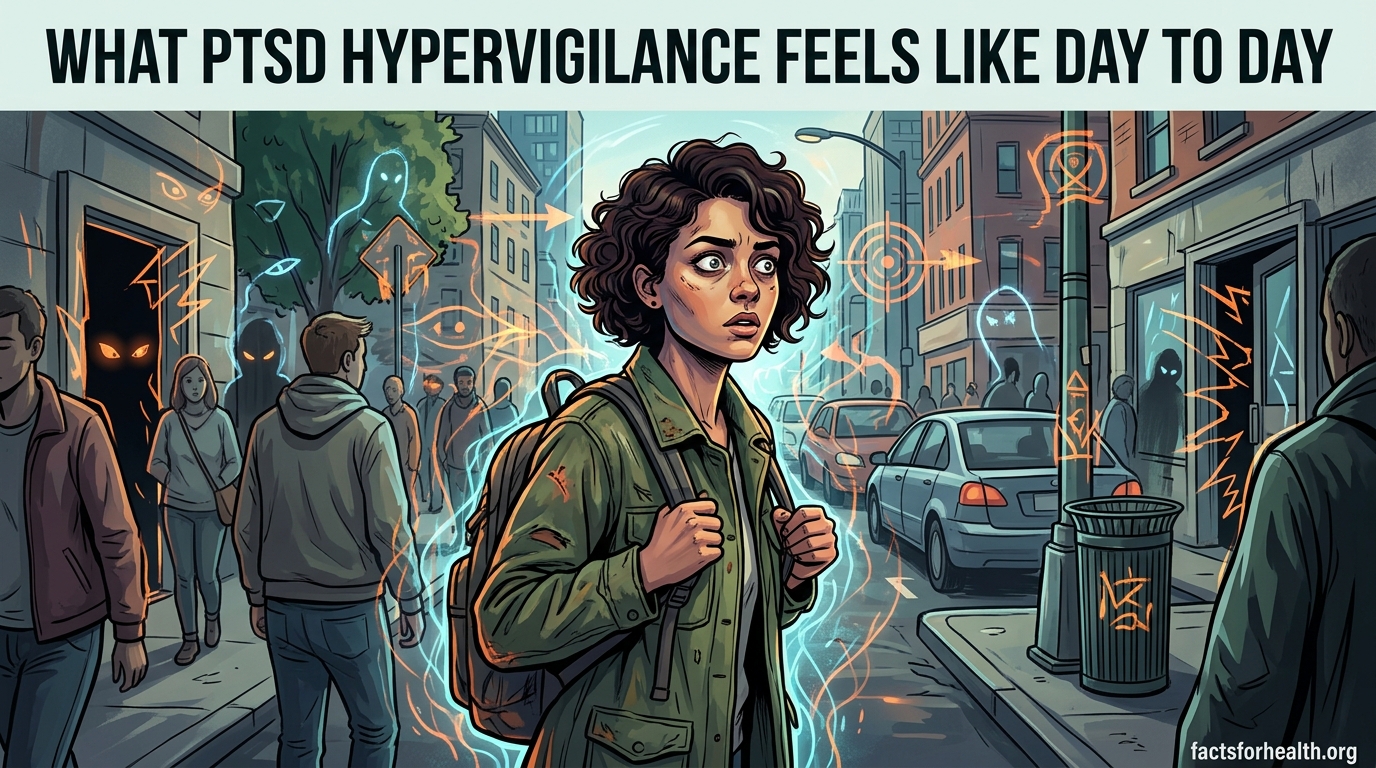
Imagine your brain has a security system that never turns off. It scans every room you enter, every person who walks past you, every unexpected sound. Even in your own living room, with the door locked and the lights on, part of you is waiting for something to go wrong. That is what PTSD hypervigilance feels like day to day, and for many trauma survivors, it is the most exhausting part of the condition.
Hypervigilance in PTSD is a constant state of heightened alertness where your nervous system remains stuck in fight-or-flight mode, scanning your environment continuously for potential threats even when no danger is present. It is one of the four core symptom clusters of PTSD, grouped under arousal and reactivity symptoms by the National Institute of Mental Health.
In this article, we walk through what hypervigilance actually feels like in daily life. We cover the physical sensations, the emotional toll, specific sensory triggers, an hour-by-hour look at a typical day, and what coping strategies genuinely help. If you live with hypervigilance or love someone who does, understanding the day-to-day experience is the first step toward managing it.
Table of Contents
What Hypervigilance in PTSD Actually Feels Like
People describe hypervigilance differently, but certain themes come up again and again. It feels like having a radar dish in your head, always rotating, always picking up signals. You notice things other people filter out automatically: the shift in someone’s tone of voice, a car slowing down outside, a door closing one floor away.
Your body reacts as though each of these signals might be a threat. The amygdala, the brain’s threat detection center, becomes overactive after trauma. It sends alarm signals to the rest of your nervous system even when you are sitting in a perfectly safe environment. This is not a conscious choice. It is not something you can reason your way out of in the moment. Your body has learned that the world is dangerous, and it is determined to keep you ready.
Hypervigilance Is Not the Same as Paranoia
One of the most common misunderstandings, especially from people who have never experienced trauma, is confusing hypervigilance with paranoia. The distinction matters. Paranoia involves fixed false beliefs, a conviction that someone is specifically out to get you. Hypervigilance, by contrast, is an overactive threat detection system. You do not necessarily believe a specific person is dangerous. You just cannot stop your body from scanning for danger everywhere.
It is also different from ordinary caution. Everyone checks the locks before bed sometimes. Hypervigilance is checking them three times, then lying awake listening for footsteps, then feeling your heart pound when the house settles. It is the intensity and persistence that sets it apart.
What sets it apart from generalized anxiety
Generalized anxiety and hypervigilance share symptoms like restlessness and tension. But hypervigilance is specifically rooted in trauma. It has a directional quality: you are scanning outward, monitoring the environment, tracking exits and other people. Anxiety tends to be more diffuse, a free-floating worry without a specific external focus.
Physical Symptoms of Hypervigilance
The body carries the weight of hypervigilance as much as the mind does. Because your nervous system is perpetually in fight-or-flight, you experience a cascade of physical reactions that never fully settle.
Racing heart and shallow breathing
Your heart rate may sit elevated even at rest. Adrenaline and cortisol, the stress hormones that prepare your body to respond to threats, circulate at levels higher than normal. Your breathing often becomes shallow and rapid, which feeds back into the feeling of anxiety.
Many people with PTSD hypervigilance report that their chest feels tight for no apparent reason. They may feel a constant low-grade buzzing sensation in their chest or stomach, as if they have had three cups of coffee on an empty stomach.
Muscle tension and chronic pain
When your body is bracing for impact around the clock, your muscles stay contracted. The shoulders, neck, and jaw are common areas of tension. Over weeks and months, this can lead to tension headaches, back pain, and jaw clenching. Many trauma survivors grind their teeth at night, compounding the physical toll.
The exaggerated startle response
One of the hallmark symptoms of PTSD hypervigilance is an exaggerated startle response. A book dropping, a car backfiring, someone tapping your shoulder from behind: these can trigger a full-body jolt. Your heart races, your muscles contract, and it can take minutes or longer for your nervous system to settle back down.
For some people, the startle response is embarrassing. You might jump at a sound that barely registers for anyone else, and people look at you strangely. This is one of the most validating things to understand: an exaggerated startle response is a recognized PTSD symptom, not an overreaction.
Exhaustion from constant physical arousal
Perhaps the most universal complaint among people living with hypervigilance is exhaustion. Running your body’s alarm system 24 hours a day takes an enormous amount of energy. Even if you have not done anything physically demanding, you feel drained by mid-afternoon. The body simply is not designed to stay in a state of high alert indefinitely.
Emotional and Mental Symptoms
Beyond the physical experience, hypervigilance reshapes how you process emotions and interact with the world around you.
Emotional hypervigilance: scanning people’s moods
Hypervigilance does not only apply to physical threats. Many trauma survivors develop emotional hypervigilance, a constant monitoring of other people’s moods, facial expressions, tone of voice, and body language. You might walk into a room and immediately sense whether the energy feels off.
This often develops in people who experienced trauma in relationships, including childhood trauma or domestic abuse. The nervous system learned that detecting subtle shifts in another person’s mood was essential for survival. Now, even in safe relationships, you cannot turn it off.
The toll is significant. You might find yourself constantly adjusting your behavior based on what you read from others. You become hyperaware of any sign of irritation, disappointment, or conflict. This is exhausting, and it can make it hard to just relax and be yourself around people you care about.
Irritability and difficulty concentrating
When your brain is allocating a large portion of its processing power to threat detection, less capacity remains for everything else. Concentration suffers. You might find yourself reading the same paragraph three times, or losing track of conversations because part of your attention is monitoring the room.
Irritability is another common symptom. When your nervous system is already at capacity, minor frustrations feel overwhelming. Someone cutting you off in traffic, a coworker interrupting you, a plan changing unexpectedly: these can trigger a disproportionate emotional reaction that you know is too much but cannot seem to control.
The mental radar that will not power down
In online trauma communities, one description comes up again and again: the feeling that your brain has a radar always switched on. It sweeps continuously, processing every stimulus, assigning threat levels, checking for the pattern that matches the original trauma. Even when you are exhausted and want nothing more than to relax, the radar keeps running.
This is why well-meaning advice like just calm down or stop overthinking does not work. The threat detection system is operating below the level of conscious thought. Telling someone to stop being hypervigilant is like telling their heart to stop beating faster. It is a physiological response, not a mindset.
Common Sensory Triggers for Hypervigilance
Hypervigilance does not activate randomly. It responds to sensory input, and certain types of stimuli are particularly likely to trigger the alarm system. Understanding your specific triggers is one of the most practically useful things you can do.
Sounds that set off the alarm
Sudden or unexpected sounds are among the most common triggers. A door slamming, a phone ringing at night, fireworks, a dog barking, someone raising their voice. Even sounds that are not inherently threatening, like a coworker dropping a stack of papers, can send a jolt through the nervous system.
Background noise can also be a problem. Many hypervigilant people find open-plan offices or crowded restaurants overwhelming because the brain is trying to process and threat-assess every sound simultaneously. This sensory overload leads to irritability, fatigue, and a strong urge to escape.
Visual triggers and environmental scanning
Visual stimuli play a major role. Movement in peripheral vision, especially sudden movement, can trigger the alarm. Crowds are particularly challenging because there is too much movement to track. Many people with hypervigilance instinctively position themselves with their back to a wall so they can see the entire room.
Confined spaces and environments with limited exits can also trigger intense discomfort. Elevators, packed subway cars, windowless meeting rooms: these settings make it impossible to maintain the environmental scanning that hypervigilance demands, which paradoxically increases anxiety.
Touch and spatial triggers
Unexpected touch is a powerful trigger for many trauma survivors. Someone patting your shoulder from behind, brushing past you in a tight space, or standing too close can activate the fight-or-flight response instantly. This is particularly common in people whose trauma involved physical contact.
People approaching from behind is a near-universal trigger. Even when you logically know the person is a friend or partner, your body reacts before your conscious mind can catch up. Many people describe an instinctive flinch, a spike of adrenaline, or a sudden urge to turn around and face the person.
A Day in the Life: PTSD Hypervigilance Day to Day
To really understand what PTSD hypervigilance feels like day to day, it helps to walk through a typical 24-hour period. This composite scenario draws on common experiences shared in trauma recovery communities and clinical literature. Your specific experience may differ, but the overall pattern is widely recognized.
Morning: waking already on alert
For many people with hypervigilance, sleep is the first casualty. You may have trouble falling asleep because your brain refuses to power down, or you may wake multiple times during the night at the slightest sound. When morning comes, you do not feel rested. You wake already in a state of low-grade alertness, sometimes with a racing heart before you have even gotten out of bed.
The morning routine itself involves a series of environmental checks. A scan of the room before getting up. A listen for sounds in the house. Checking the locks, even if you know you locked them the night before. These behaviors are not paranoid delusions. They are the nervous system’s attempt to confirm safety before it will allow you to proceed with the day.
Commute and arrival: scanning every environment
Stepping outside amplifies the scanning. On public transit, you notice everyone who boards. You track who is standing where, who looks agitated, where the exits are. In the car, you are hyper-aware of every vehicle around you. Driving can be particularly stressful because you cannot control the behavior of other drivers, and your threat detection system treats every unpredictable movement as a potential danger.
Arriving at work or school brings a new environment to assess. You note the layout, the exits, the people present. You may choose a specific seat, one that gives you a view of the room and the door. This is not a conscious strategy so much as an instinct, but it happens every time you enter a new space.
Workplace challenges: the hidden struggle
The workplace presents some of the most difficult hypervigilance challenges, and it is an area where competitor resources are notably thin. Open-plan offices are a nightmare for the hypervigilant brain. The constant movement, overlapping conversations, and people approaching from behind create a state of continuous sensory overload.
Meetings can be difficult for a different reason. You are expected to sit still, focus on the discussion, and contribute. But part of your attention is tracking the room: who shifted in their seat, whose tone changed, what that sideways glance meant. Emotional hypervigilance kicks into high gear in group settings, and you may find yourself replaying interactions afterward, wondering if you said something wrong.
Concentration difficulties can affect job performance. Tasks that require sustained focus take longer because your brain keeps interrupting with environmental checks. By the end of the workday, you feel mentally and physically depleted, even if your job is not physically demanding.
Public spaces and social situations
After work, simple errands can feel like expeditions. Grocery stores, shopping malls, restaurants: these environments combine crowds, noise, and unpredictability in ways that overwhelm the hypervigilant nervous system. You may rush through tasks, avoid peak hours, or do as much as possible online to minimize exposure.
Social gatherings are a mixed experience. You may want to connect with people, but the sensory and emotional demands of group settings are draining. You find yourself monitoring the mood of the room, tracking who is talking to whom, reading between the lines of every conversation. By the time you get home, you need significant time alone to decompress.
Evening: the body that will not wind down
The evening should be a time of rest, but for someone with hypervigilance, the nervous system resists relaxation. Even in a familiar, safe environment, your body maintains a low level of arousal. You may feel restless, unable to settle into the couch, checking the windows or listening for sounds outside.
This is the cruel irony of hypervigilance: the exhaustion is real, but the body will not let you rest. Sleep becomes a nightly battle. You lie in bed listening to the house, replaying the day’s interactions, mentally preparing for tomorrow. When sleep finally comes, it is often light and easily broken.
How Hypervigilance Affects Relationships and Work
The impact of hypervigilance extends beyond the individual. It shapes how you connect with others and how you function in structured environments.
Relationship strain and emotional scanning
In close relationships, emotional hypervigilance can create a persistent undercurrent of tension. You read your partner’s mood constantly, looking for signs of irritation or withdrawal. A delayed text response, a slightly flat tone, a sigh: these signals that others might overlook can trigger a cascade of anxiety.
Over time, this constant monitoring can strain the relationship. Partners may feel they are walking on eggshells, unable to have a bad day without triggering concern. And the person with hypervigilance feels guilty for not being able to just relax and trust. Both people end up exhausted by a dynamic that neither one chose.
When others do not understand
One of the most frustrating aspects of hypervigilance is how invisible it is to others. Friends, family, and colleagues may dismiss it as being overly anxious or too sensitive. They might say things like you just need to relax or you are overthinking it, genuinely not understanding that the response is physiological, not psychological in the everyday sense.
This misunderstanding is isolating. It adds a layer of shame to an experience that is already difficult. Understanding that hypervigilance is a recognized symptom of PTSD, rooted in measurable changes to the nervous system, can help counteract that shame. You are not too sensitive. Your threat detection system is calibrated differently because of what you have been through.
Workplace functioning and accommodations
In professional settings, hypervigilance can affect performance reviews, workplace relationships, and career trajectory. Difficulty concentrating in open-plan offices, irritability under stress, and the energy cost of masking symptoms all take a toll. Many people with PTSD do not disclose their condition at work, which means they struggle without accommodations that could genuinely help.
Simple adjustments can make a significant difference. Seating with a view of the room, noise-canceling headphones, the ability to take short breaks, and remote work options are all accommodations that reduce the sensory load on the hypervigilant nervous system.
Coping With Hypervigilance: What Actually Helps
While hypervigilance cannot be simply switched off, there are evidence-based approaches that help reduce its intensity and impact over time. The goal is not to eliminate the response entirely but to help the nervous system learn that safety is possible.
Grounding techniques for the moment
When hypervigilance spikes, grounding techniques help bring the nervous system back to the present. The 5-4-3-2-1 technique, where you name five things you see, four you hear, three you can touch, two you smell, and one you taste, engages the senses in a structured way that interrupts the threat detection loop.
Box breathing, where you inhale for four counts, hold for four, exhale for four, and hold for four, directly activates the parasympathetic nervous system. This is the body’s rest-and-digest network, the physiological opposite of fight-or-flight. Regular practice can help lower baseline arousal over time.
Therapy approaches that target the root
Trauma-focused therapies address the underlying mechanisms driving hypervigilance. Cognitive Behavioral Therapy helps identify and reframe the threat appraisals that keep the alarm system activated. Eye Movement Desensitization and Reprocessing, or EMDR, helps the brain reprocess traumatic memories so they no longer trigger such intense nervous system responses.
Somatic therapies, which work directly with the body and nervous system, can be particularly helpful for hypervigilance. Approaches like Somatic Experiencing focus on helping the body complete the fight-or-flight responses that got interrupted during the original trauma, allowing the nervous system to finally stand down.
Validation as a starting point
Perhaps the most important thing to understand about coping is that validation matters. Recognizing that hypervigilance is a trauma response, not a personal failing, is itself therapeutic. When you stop fighting the experience and start working with it, the path forward becomes clearer.
Recovery is not linear. There will be days when the radar is louder and days when it quiets down. Progress is measured not in eliminating hypervigilance but in reclaiming more moments of presence, connection, and rest.
FAQs
What is hypervigilance in PTSD symptoms?
Hypervigilance in PTSD is a constant state of heightened alertness where the nervous system remains stuck in fight-or-flight mode, scanning the environment continuously for threats even when no danger is present. It is one of the four core symptom clusters of PTSD, classified under arousal and reactivity symptoms.
What does PTSD look like day to day?
Day to day, PTSD often looks like waking already on alert, scanning every room for exits, struggling to concentrate in busy environments, reading other people’s moods constantly, experiencing exhaustion by mid-afternoon, and having difficulty winding down at night. Physical symptoms include elevated heart rate, muscle tension, exaggerated startle responses, and chronic fatigue from the body never fully standing down.
Can you cure hypervigilance?
Hypervigilance cannot be instantly cured, but it can be significantly reduced through trauma-focused therapies such as CBT, EMDR, and somatic therapy. Grounding techniques like box breathing and the 5-4-3-2-1 method help manage symptoms in the moment. Over time, with consistent treatment and self-awareness, the nervous system can learn to recalibrate and recognize safety more effectively.
Conclusion
Living with PTSD hypervigilance day to day means carrying a security system that never powers down. It affects your body through elevated heart rate, muscle tension, and chronic exhaustion. It shapes your emotions through constant mood scanning, irritability, and difficulty relaxing. And it changes how you move through the world, from choosing your seat in a restaurant to avoiding crowded grocery stores at peak hours.
The key takeaways are these: hypervigilance is a physiological trauma response, not a personal weakness or a mindset problem. It is different from paranoia and different from ordinary anxiety. And while it cannot be switched off instantly, it can be reduced through trauma-focused therapy, grounding techniques, and the slow process of helping your nervous system learn that safety is real.
If you recognize yourself in these descriptions, the most important next step is seeking support from a trauma-informed mental health professional. Recovery is not about eliminating the alarm system entirely. It is about recalibrating it so that you can live more fully in the present, connect more deeply with the people around you, and finally get the rest your body has been craving.