
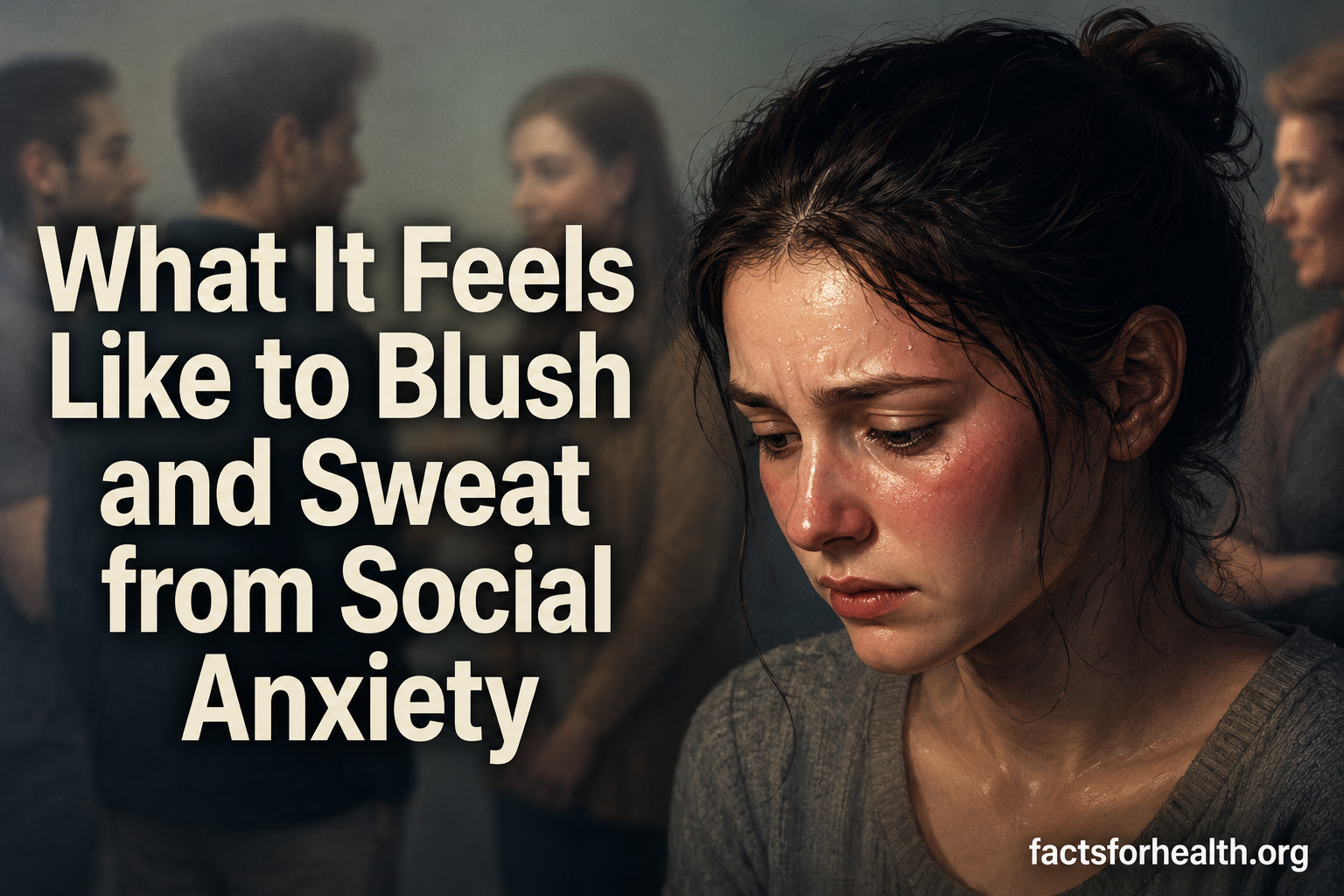
It starts as a warmth. A prickling heat that creeps up your neck, spreads across your cheeks, and settles somewhere between your ears and your collarbone. Your face feels like it is radiating. You can almost see the redness in your peripheral vision, even though you are staring straight ahead, trying desperately to act normal.
Then comes the sweat. A thin sheen on your forehead. Dampness blooming under your arms. Your palms turn slick and clammy against whatever you are holding. Your heart pounds against your ribs, and you become hyperaware of every drop of perspiration, every degree of heat, every person who might be looking at you.
If you have ever experienced this, you already know what it feels like to blush and sweat from social anxiety. It is a visceral, full-body experience that goes far beyond simple embarrassment. It is your nervous system reacting as though a conversation, a presentation, or a room full of people is an actual physical threat.
You are not alone in this. Thousands of people search for answers about social anxiety blushing and anxiety sweating every month. The good news is that understanding what is happening in your body is the first step toward feeling more in control. In this article, we will walk through the physical sensations, the science behind them, the vicious cycle that keeps them going, and practical strategies that can help.
Table of Contents
What It Feels Like to Blush and Sweat from Social Anxiety
Describing this experience requires more than a list of symptoms. It is a wave that builds and crashes, sometimes over several minutes and sometimes in a single heartbeat. Here is what many people describe when they talk about what it feels like to blush and sweat from social anxiety.
It often begins with a trigger. Someone calls your name in a meeting. You make eye contact with a stranger. You are asked to introduce yourself to a group. In that split second, your brain registers the situation as a social threat.
The heat comes first. It rises from your chest and floods upward into your neck and face. You feel your skin grow warm, then hot, then almost burning. The redness spreads across your cheeks, up to your ears, sometimes down to your chest. You can feel it the way you feel sunburn. It is not imagined. Your skin is genuinely several degrees warmer because blood is rushing to the surface.
Then the sweating follows. For some people, it starts on the forehead. A fine mist that makes your skin glisten under lights. For others, it is the palms first. Your hands turn cold and wet at the same time, making handshakes feel like a nightmare. Some people feel sweat bead along their hairline, drip behind their ears, or soak through their shirt under their arms.
Your heart races. Your breathing gets shallow. Your voice might waver or crack when you try to speak. You might feel your hands or legs trembling. Every one of these sensations feeds into your awareness, and that awareness is the cruelest part.
One Reddit user in the r/socialanxiety community described it this way: “I immediately feel my body temp raising and my heart racing, I get SO red and start feeling sweat in my forehead and neck. Sometimes it’s so bad I have to leave.”
Emotionally, the experience is overwhelming. There is a deep sense of shame. A feeling of being exposed, of everyone in the room seeing your body betray you. There is an urgent desire to escape, to find a bathroom, to splash cold water on your face, to disappear. And underneath all of it, there is frustration that your own body is doing this to you without your permission.
This is the reality of social anxiety blushing and sweating. It is not a minor inconvenience. For many people, it shapes their entire social life.
Why Does Social Anxiety Cause Blushing and Sweating?
To understand why your body does this, we need to look at the physiology. The short answer is your fight-or-flight response. But the longer answer reveals a fascinating chain reaction.
When you enter a social situation that your brain perceives as threatening, it activates your sympathetic nervous system. This is the same system that kicks in if you encounter a physical danger. Your brain does not distinguish between a bear in the woods and a room full of coworkers staring at you during a presentation. It sends the same alarm signal.
That signal triggers the release of adrenaline and noradrenaline. These stress hormones flood your body and set off a cascade of physical changes. Your heart rate increases. Your breathing speeds up. Your muscles tense. And critically for this discussion, your blood vessels change.
Blushing happens through a process called vasodilation. The blood vessels near the surface of your skin, particularly in your face and neck, widen and allow more blood to flow through. This increased blood flow is what causes the visible redness and the sensation of intense heat. Your face has an unusually high concentration of blood vessels close to the surface, which is why blushing is so visible there.
Doctors sometimes distinguish between two types. Dry flushing is redness and heat without sweating. Wet blushing combines the redness with perspiration. Social anxiety typically triggers the wet type, which is why blushing and sweating so often go hand in hand.
Sweating itself is a separate but related response. Your sympathetic nervous system activates your eccrine sweat glands, which are concentrated on your palms, soles, forehead, and underarms. The body produces sweat as a cooling mechanism during stress, but in social situations, it feels like a betrayal. Your body is preparing for a physical threat that does not exist, and the result is visible, uncomfortable, and often embarrassing.
So when you ask whether social anxiety can cause blushing, the answer is a definitive yes. It is a textbook physiological response to perceived social threat, not a character flaw or a sign of weakness.
The Vicious Cycle: How Fear of Blushing Makes It Worse
Here is where things get truly difficult. The most challenging aspect of social anxiety blushing is not the blushing itself. It is the fear of blushing.
The cycle works like this. You enter a social situation. Maybe you are about to speak in a meeting or walk into a party. Your anticipatory anxiety starts building. You begin worrying about whether you will blush. You think about the last time it happened. You imagine people noticing, staring, judging.
That worry itself is a form of anxiety. And anxiety triggers the fight-or-flight response. So by fearing the blush, you are actually making it more likely to happen. You sit down for the meeting already in a heightened state, your nervous system primed and ready.
Then you feel the first hint of warmth on your face. Maybe it is just the room being warm. Maybe it is nothing. But you notice it. And the moment you notice it, panic sets in. Your internal monologue accelerates: It is happening. I am blushing. Everyone can see. They are watching me turn red.
That spike of anxiety sends another wave of adrenaline through your body. More vasodilation. More redness. More sweat. The cycle feeds itself in real time, right there in the middle of the conversation.
One Reddit user captured this perfectly: “I can blush when people are staring at me or when I think they are, and then I blush more because I believe they see my blushing and are judging me.”
This cycle has a name in the clinical literature. When the fear of blushing becomes a condition on its own, it is called erythrophobia. Erythrophobia is the fear of blushing, and it can become so intense that people begin avoiding social situations entirely. They turn down invitations. They stay quiet in meetings. They structure their entire lives around avoiding the possibility of blushing in front of others.
People with social anxiety may hyperfocus on how others view their blushing, creating a loop where the fear of the symptom becomes more disabling than the symptom itself. Breaking this cycle is one of the most important steps toward managing social anxiety blushing and sweating.
Common Triggers: When Blushing and Sweating Strike Hardest
Certain situations are more likely to trigger the blushing-sweating response. If you experience social anxiety, you probably recognize several of these:
- Being put on the spot: Getting called on unexpectedly in a class or meeting, or being asked a question you were not prepared to answer.
- Public speaking: Presentations, speeches, or any situation where all eyes are on you and you are the center of attention.
- Meeting new people: Introductions, networking events, or walking into a room full of strangers.
- Authority figures: One-on-one conversations with a boss, professor, or anyone you perceive as having power over you.
- Being judged or evaluated: Job interviews, performance reviews, or any setting where you know you are being assessed.
- Being the center of attention: Birthdays, toasts, or any moment where the focus of a group shifts to you.
- Unexpected social encounters: Running into someone you know in public when you are not prepared for interaction.
What all these triggers share is a sense of being observed. The common thread is the feeling that others are watching, evaluating, or forming opinions about you. For someone with social anxiety, that perceived scrutiny is enough to set off the full physiological cascade.
Hyperhidrosis: When Anxiety Sweating Becomes a Condition
While blushing gets a lot of attention in discussions about social anxiety, sweating deserves equal focus. For some people, the sweating component becomes so severe that it qualifies as a separate medical condition.
Hyperhidrosis is the medical term for excessive sweating beyond what is needed for normal temperature regulation. It affects an estimated 15 million people in the United States alone. When hyperhidrosis is triggered or worsened by social anxiety, the two conditions feed each other in a particularly cruel way.
The sweating associated with social anxiety tends to hit specific areas. Palmar hyperhidrosis affects the hands, making handshakes and high-fives feel agonizing. Axillary hyperhidrosis causes excessive underarm sweating that can soak through clothing. Craniofacial hyperhidrosis causes sweating on the forehead, scalp, and face, which pairs directly with blushing to create the full visible anxiety package.
What does anxiety sweating feel like compared to normal perspiration? It feels sudden and disproportionate. You are not exercising. The room is not hot. But your body is producing sweat as though you are running a sprint. The sweat often feels cold and clammy rather than warm. It can appear in seconds and take much longer to subside.
One person shared on Reddit: “I’ve suffered from severe facial blushing from my anxiety where my face turns bright red. It occurs unprovoked usually from social or professional situations.” This combination of facial blushing and sweating is one of the most distressing visible anxiety symptoms because it is nearly impossible to hide.
The difference between normal anxiety sweating and hyperhidrosis comes down to frequency and severity. Everyone sweats when they are nervous. But if you find yourself sweating excessively in situations that should not cause significant stress, or if the sweating is severe enough to interfere with your daily life, it may be worth discussing with a healthcare provider. Hyperhidrosis is a recognized medical condition with treatment options ranging from clinical-strength antiperspirants to medications to procedures.
Do People Actually Notice When You Blush?
This is one of the most common questions people ask about social anxiety blushing. And the answer is both reassuring and surprising.
In psychology, there is a well-documented phenomenon called the spotlight effect. It describes our tendency to overestimate how much other people notice about us. We feel like everyone is watching our every move, remembering every awkward moment, cataloging every blush. In reality, most people are far too focused on themselves to pay close attention to what we are doing.
Research supports this. Studies on social anxiety have found that people significantly overestimate how visible their anxiety symptoms are to others. You might feel like your face is glowing like a stoplight, but the person across from you might not register any redness at all. They might be too busy worrying about their own performance in the conversation.
Even when someone does notice a blush, they rarely react the way you fear. Most people do not judge blushing harshly. Some studies suggest that people who blush are actually perceived as more trustworthy and relatable. Blushing signals that you care about social norms, which is a positive trait in the eyes of most observers.
The problem is not that everyone is watching. The problem is that you are watching yourself. Self-focused attention amplifies every sensation. When you direct your attention inward, monitoring your face for heat and your skin for sweat, you magnify the experience. You become your own worst audience.
This is why one of the most effective strategies for managing social anxiety blushing involves shifting your attention outward. We will cover that in the next section.
How to Break the Cycle: Coping Strategies That Help
There is no instant cure for social anxiety blushing and sweating. But there are proven strategies that can reduce the intensity, break the vicious cycle, and help you regain a sense of control. Here are the approaches that research and real-world experience support.
Challenge Your Automatic Negative Thoughts
Social anxiety is fueled by automatic negative thoughts, or ANTs. These are the split-second interpretations your brain generates in social situations: Everyone is looking at me. They can see I am blushing. They think I am weak. This is humiliating.
Cognitive behavioral therapy teaches you to catch these thoughts and challenge them. Ask yourself: Is there actual evidence that everyone is staring? Have you ever judged someone else for blushing? Would you think less of a friend who turned red during a conversation? Most of the time, when you examine these thoughts objectively, they fall apart.
Try the Paradoxical Approach: Accept the Blush
It sounds counterintuitive, but one of the most effective things you can do is stop fighting the blush. The harder you try to suppress it, the more anxiety you create, and the worse the blushing gets. This is the paradox at the heart of social anxiety blushing.
Instead, try accepting it. Say to yourself: I am blushing. That is okay. It is a normal physiological response and it will pass. Some therapists even use paradoxical intention, where you actively try to blush more. By removing the fear, you remove the fuel for the anxiety cycle. Many people find that when they stop dreading the blush, it happens less frequently and less intensely.
Shift Your Attention Outward
As we discussed earlier, self-focused attention amplifies anxiety symptoms. The antidote is to redirect your attention outward. Focus on the person you are talking to. Listen actively to their words. Notice details about the room. Count the colors you can see. Engage your senses with your environment rather than monitoring your own body.
This is not distraction in the sense of avoiding the situation. It is recalibrating your attention to match reality. When you stop monitoring your face for heat, the heat often subsides on its own because you have removed the anxiety that was feeding it.
Use Breathing Techniques
Slow, deep breathing activates your parasympathetic nervous system, which is the counterbalance to the fight-or-flight response. When you feel the anxiety building, try breathing in for four counts, holding for four, and exhaling for six. The longer exhale is key because it signals to your body that the threat has passed.
Practice this technique when you are calm so it becomes automatic. Then, when you feel the first signs of social anxiety blushing, you can deploy it without thinking.
Consider Gradual Exposure
Avoidance is the enemy of progress with social anxiety. Every time you skip a social event because you are afraid of blushing, you reinforce the fear. Exposure therapy, whether done with a therapist or on your own, involves gradually putting yourself in situations that trigger anxiety and staying long enough for the anxiety to decrease naturally.
Start small. Maybe it is saying hello to one new person per day. Build up to harder situations over weeks and months. The goal is not to never blush again. The goal is to prove to yourself that you can handle the situation even if you do.
Know When to Seek Professional Help
If social anxiety blushing and sweating are interfering with your work, relationships, or quality of life, professional help can make a significant difference. Cognitive behavioral therapy is the gold standard treatment for social anxiety disorder, and it has strong research backing for addressing the fear of visible symptoms.
In some cases, medication may be appropriate. Beta-blockers can help manage the physical symptoms of performance anxiety. Certain antidepressants are also effective for social anxiety disorder. A mental health professional can help you explore these options and find what works for you.
FAQs
Do people with social anxiety blush?
Yes, blushing is one of the most common physical symptoms of social anxiety. When someone with social anxiety perceives a social situation as threatening, their sympathetic nervous system triggers vasodilation, causing blood vessels in the face to widen and create visible redness and heat. This is a recognized symptom of social anxiety disorder.
Can you sweat from social anxiety?
Yes, social anxiety can trigger excessive sweating. When your brain perceives a social threat, it activates your fight-or-flight response, which stimulates your eccrine sweat glands. This can cause sweating on your palms, forehead, underarms, and face, even when the room is cool and you are not physically exerting yourself.
What do anxiety sweats feel like?
Anxiety sweats feel sudden, cold, and clammy. Unlike exercise sweat, which builds gradually and feels warm, anxiety sweating can appear in seconds and often feels disproportionate to the situation. You might notice dampness on your palms, a sheen on your forehead, or wetness under your arms that soaks through clothing.
What are signs of extreme social anxiety?
Signs of extreme social anxiety include frequent and intense blushing, excessive sweating in social situations, racing heart, trembling, difficulty speaking, intense fear of being judged, avoidance of social events, and the symptoms interfering with work or relationships. When these symptoms cause significant distress or lead to avoiding situations, it may indicate social anxiety disorder that would benefit from professional treatment.
Can social anxiety cause blushing?
Yes, social anxiety is one of the leading psychological causes of chronic blushing. The anxiety triggers your body’s fight-or-flight response, which causes blood vessels in your face to dilate. This process, called vasodilation, results in the redness and heat characteristic of blushing. Social anxiety blushing can occur in meetings, conversations, presentations, or any situation where you feel observed.
Why does social anxiety make me sweat?
Social anxiety makes you sweat because it activates your sympathetic nervous system, the same system responsible for the fight-or-flight response. When your brain perceives a social situation as a threat, it releases stress hormones like adrenaline that stimulate your sweat glands. Your body is essentially preparing for a physical emergency that does not exist, and the result is sweating in social situations.
You Are Not Your Blush
Understanding what it feels like to blush and sweat from social anxiety is the first step toward loosening its grip. The heat, the redness, the sweating, the racing heart, the spiral of self-consciousness. All of it is real. All of it is valid. And none of it means there is something wrong with you.
Your nervous system is doing exactly what it evolved to do. It is just responding to the wrong kind of threat. The strategies we covered, from challenging automatic negative thoughts to shifting your attention outward to considering professional support, are proven ways to gradually retrain that response.
If social anxiety blushing and sweating are affecting your daily life, reach out to a therapist who specializes in cognitive behavioral therapy. You do not have to white-knuckle your way through this alone. The cycle can be broken, and life on the other side is worth the work.