
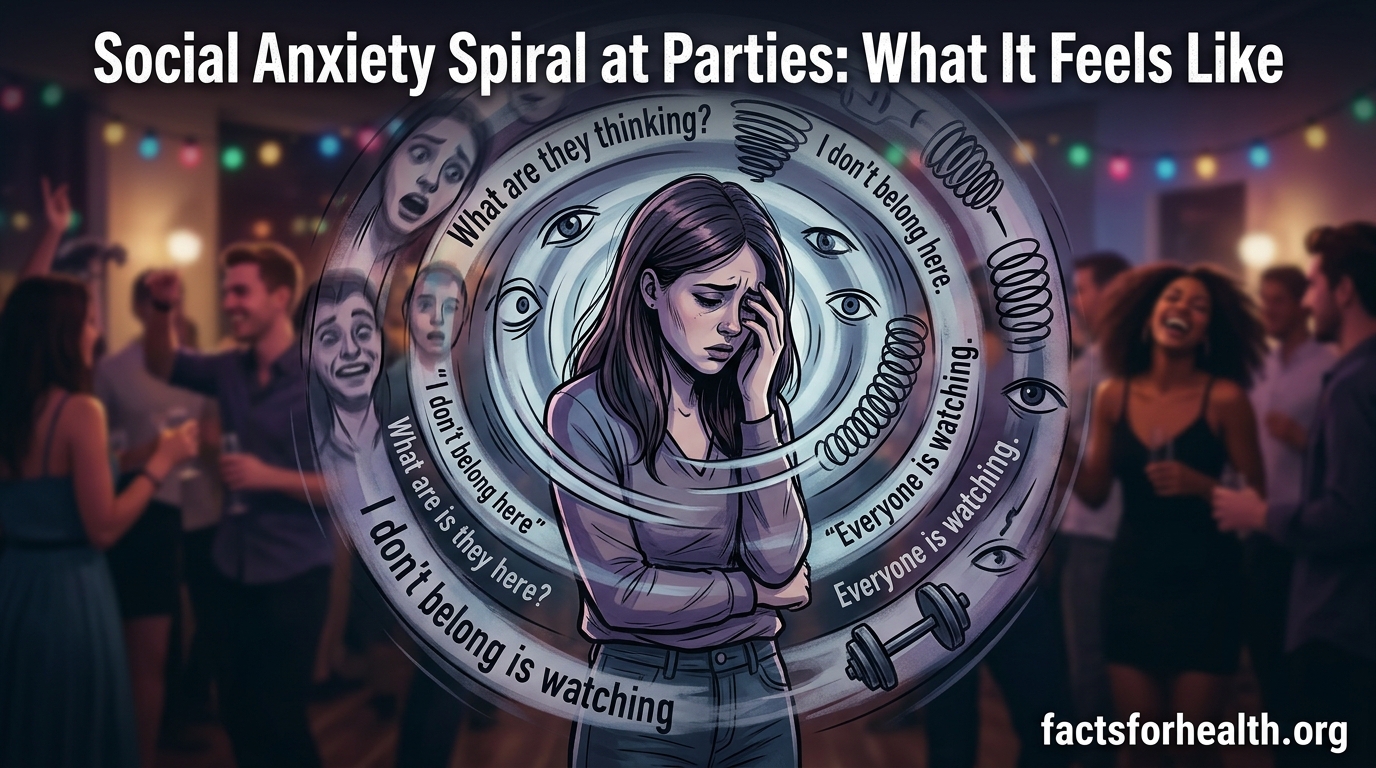
You are standing in the doorway of a party you were looking forward to all week. The music is loud, people are laughing, and someone waves at you from across the room. And instead of waving back, your chest tightens. Your mouth goes dry. A voice in your head says everyone is looking at you, and none of them want you here.
That is what a social anxiety spiral feels like at a party. It is not just shyness or nervousness. It is a cascade of physical tension, racing thoughts, and mounting fear that builds on itself until leaving feels like the only option. And the worst part is that the spiral often continues long after the party ends.
If you have experienced this, you are far from alone. Roughly 7 percent of U.S. adults deal with social anxiety disorder in any given year, and parties are one of the most common triggers. Many more people experience social anxiety spirals without ever receiving a formal diagnosis.
Our team has talked with readers, therapists, and community members who describe this experience in strikingly similar terms, and the pattern is remarkably consistent. In this article, we are going to walk through what a social anxiety spiral feels like at a party, step by step. You will learn how the spiral builds from the moment you hear about the event through the days of rumination afterward. We will cover the physical symptoms, the internal monologue, why parties trigger spirals so intensely, and most importantly, how to interrupt the cycle.
Whether you are trying to understand your own experience or make sense of what someone you love goes through, this guide will give you a clear picture of what is happening inside the spiral and what you can do about it.
Table of Contents
What a Social Anxiety Spiral Feels Like at a Party: The Definition
A social anxiety spiral at a party is a self-reinforcing cycle where a trigger, such as arriving at a social event, sets off physical symptoms like a racing heart or sweating, which then fuel anxious thoughts like “everyone is staring at me,” which intensify the physical symptoms further, creating an escalating loop of fear, bodily tension, and catastrophic thinking that can feel impossible to escape while it is happening.
Think of it like a feedback loop. Your body reacts to a perceived social threat, your brain interprets that physical reaction as proof that something is wrong, and your thoughts ramp up the fear, which sends your body into an even higher state of alert. Each layer feeds the next, and the spiral tightens.
The key word here is “perceived.” The threat is rarely real in the way your brain tells you it is. Most people at a party are not scrutinizing you. They are worrying about their own conversations, their own appearances, their own social performance. But during a social anxiety spiral, your brain treats social situations as genuine danger, and your body responds accordingly.
This is what separates a social anxiety spiral from ordinary party nerves. The spiral does not pass after a few minutes of settling in. It compounds. And for many people, it starts days before the event even happens.
Normal Party Nerves vs. a Social Anxiety Spiral
Almost everyone feels a little nervous before walking into a party where they do not know many people. That is a normal human response to an unfamiliar social situation. A social anxiety spiral is something different entirely, and understanding the distinction matters.
The table below breaks down the key differences between typical party nervousness and a true social anxiety spiral:
Normal Party Nerves: Fades within 10 to 15 minutes of arriving. You feel a flutter of butterflies, maybe some mild self-consciousness, but you settle in. You start talking to people, your body relaxes, and by the end of the night you are glad you came.
Social Anxiety Spiral: Intensifies over time rather than fading. Physical symptoms escalate throughout the event. Your mind becomes consumed with monitoring your own behavior, scanning for judgment, and planning escape routes. The anxiety does not decrease as you acclimate; it builds.
Duration: Party nerves last minutes. A social anxiety spiral can last for the entire event and then continue for hours or days afterward through post-party rumination.
Physical Intensity: Nerves might mean slightly sweaty palms or a quickened pulse. A spiral involves a full-body response: racing heartbeat, shortness of breath, trembling, nausea, dizziness, hot flashes, chest tightness, and sometimes panic attack symptoms.
Cognitive Pattern: With nerves, you might think “I hope I make a good impression.” With a spiral, the thoughts become absolute and catastrophic: “Everyone here thinks I am weird. I should not have come. I am going to embarrass myself and everyone will remember.”
After the Event: Party nerves fade once you leave. A social anxiety spiral transitions into a post-event rumination loop where you replay every conversation, dissect every word you said, and find fault in interactions that probably went fine.
Behavioral Impact: Nerves do not usually change your behavior significantly. A spiral drives avoidance behaviors: hovering near the exit, hiding in the bathroom, overusing your phone as a shield, drinking too much to cope, or leaving early without saying goodbye.
If you recognize yourself in the spiral column, what you are experiencing is real and valid. It is not a character flaw or a lack of willpower. It is a recognized psychological pattern that responds well to specific strategies and treatment approaches.
Phase 1: Anticipatory Anxiety Before You Even Arrive
For many people, the social anxiety spiral begins the moment the invitation arrives. Not at the party. Days or sometimes weeks before.
You get a text from a friend: “Hey, having people over Saturday, you should come!” A small knot forms in your stomach. You type back “Sounds great!” and immediately start dreading it. The anticipatory anxiety has begun.
Anticipatory anxiety is the fear and worry you experience leading up to a social event. It is one of the most exhausting parts of social anxiety because it stretches the suffering across days rather than confining it to the event itself. The party is on Saturday, but the anxiety starts on Monday.
Here is what anticipatory anxiety typically looks like in the days before a party:
Days before: You think about the party constantly, often without meaning to. Your mind generates scenarios: What if I do not know anyone? What if I say something stupid? What if everyone is in groups and I am standing alone? Each imagined scenario feels like a real threat your body needs to prepare for.
The day before: Sleep becomes difficult. You lie awake rehearsing potential conversations or trying to come up with reasons to cancel. You might text a friend asking who else will be there, not out of curiosity but out of a need to assess the threat level.
Getting ready: This is where the physical symptoms kick in for many people. Changing outfits multiple times because nothing feels right. Checking the mirror repeatedly. Feeling like you look wrong no matter what you wear. Your stomach might be in knots, and eating could feel impossible.
The drive over: This is the tipping point. Many people in online social anxiety communities describe driving all the way to the party location and not being able to go inside. One Reddit user shared that they drove to their best friend’s birthday party, sat in the parking lot for 20 minutes, and then drove home crying. That is how powerful anticipatory anxiety can be.
Your heart rate is elevated before you even knock on the door. Your palms are damp. Your breathing is shallow. And you have not even entered the party yet. The spiral is already building momentum, and the event has not started.
Phase 2: Walking Through the Door
The moment you step inside, the spiral accelerates. This is where the experience shifts from internal worry to full sensory confrontation.
You walk in and immediately do what many people with social anxiety describe as “the scan.” Your eyes sweep the room in a fraction of a second, cataloging threats: How many people are here? Do I know anyone? Where are the exits? Is there a spot where I can be less visible? Who is already in conversation and therefore unavailable to talk to me?
The scan happens automatically. You are not choosing to assess the room for danger. Your amygdala, the threat-detection center of your brain, is doing it for you. It is treating this party the way it would treat any potentially dangerous situation, and it is priming your body to respond.
Within seconds of entering, the physical symptoms spike. Your heart is pounding. Not beating fast from walking. Pounding, in a way you can feel in your throat and your temples. You become acutely aware of your own body, which only makes you more self-conscious.
You notice the noise level immediately. Music, overlapping conversations, laughter. For someone entering a social anxiety spiral, the sensory input can feel overwhelming. People who also experience sensory sensitivities, including many neurodivergent individuals, describe this as sensory overload on top of social anxiety, a double hit that can make the spiral feel inescapable.
Someone approaches to greet you. This should be a positive moment, but inside the spiral, it feels like an exam you did not study for. You say hello, and you are immediately monitoring everything: Is my voice shaking? Did I make enough eye contact? Too much? Was my handshake weird? Was that smile convincing?
Every interaction, no matter how brief, becomes a performance you are simultaneously executing and evaluating in real time. The mental energy required is staggering, and the party has barely begun.
Phase 3: The Middle of the Party
Twenty minutes in. The initial wave of arrival anxiety has passed, but instead of feeling relief, the spiral has shifted into a sustained, grinding state of hyper-vigilance. This is the phase that wears people down.
You are in a conversation, and your mind goes blank. This is one of the most commonly reported experiences in social anxiety communities. You were listening, you were engaged, and suddenly there is nothing. No question to ask, no comment to add, no witty response. Just empty static where your thoughts should be.
The blankness is not a sign that you are boring or unintelligent. It is a documented cognitive effect of anxiety. When your brain perceives threat, it allocates resources to survival processing rather than creative or social cognition. Your prefrontal cortex, responsible for conversation and social reasoning, goes partially offline while your threat-detection system runs at full capacity. You literally cannot think of what to say because your brain is busy looking for danger.
While your mind is blank, your inner monologue is anything but quiet. It fills the silence with a running commentary that is almost entirely negative:
“They think I am boring.”
“Why did I say that earlier? That was so awkward.”
“They are going to excuse themselves any second. I can tell they want to leave.”
“Everyone else here is so much better at this than I am.”
This negative self-talk operates like background noise that you cannot turn off. It runs underneath every interaction, coloring your perception of everything that happens. A conversational partner glances at their phone? They are bored with you. Someone laughs across the room? They are probably laughing at you.
During this middle phase, hiding behaviors become common. People describe gravitating toward the kitchen to help with dishes, volunteering to refill drinks, or finding a pet to focus on. These are not random choices. They are coping strategies that give anxious people a task and a reason to be in a particular spot without having to sustain unstructured social interaction.
Many people also describe the phone shield: pulling out your phone and pretending to text or scroll so that you look busy and no one approaches you. The tragic irony is that the phone shield protects you from social interaction in the moment while reinforcing the belief that you cannot handle it. The avoidance feels like relief but feeds the spiral.
Time slows down. A two-hour party feels like it lasts six. You start counting down to an acceptable time to leave. Every minute feels like effort, like you are holding a heavy weight that gets heavier the longer you carry it.
Phase 4: The Full Spiral Cascade
At some point, the components of the spiral lock together into a self-reinforcing loop. Physical symptoms, cognitive distortions, and behavioral changes feed each other in a cycle that can feel like it is spinning out of control. This is the full cascade.
Here is how the loop works in real time:
Step 1: You notice a physical symptom. Your heart is racing. Your face feels hot. Your hands are trembling slightly.
Step 2: Your brain interprets that symptom as evidence that something is wrong. “My heart is racing. People can probably see I am anxious. They can tell something is off.”
Step 3: The thought increases your anxiety. If people can see you are anxious, they will judge you for it. Being visibly anxious is embarrassing. Now you are anxious about being anxious.
Step 4: The increased anxiety intensifies the physical symptoms. Your heart beats faster. Your face gets hotter. Your trembling increases.
Step 5: You notice the worsening symptoms. The loop repeats, each cycle tighter and more intense than the last.
This is the heart of the spiral. It is not a linear progression from calm to anxious. It is a circular feedback loop where each element amplifies the others. The physical symptoms are real, but it is the interpretation of those symptoms as threatening that transforms normal physiological arousal into a full spiral.
For some people, this cascade culminates in a panic attack. Chest tightness that feels like you cannot get enough air. A sense of unreality, like you are watching yourself from outside your body. An overwhelming urge to flee. Panic attacks during a social anxiety spiral are terrifying precisely because they happen in public, which is the last place someone with social anxiety wants to lose control.
Even without a full panic attack, the cascade reaches a point where the only thing your brain can focus on is escape. How do I leave without drawing attention? What excuse can I make? Is there a bathroom I can hide in until I can slip out? The party that other people are enjoying has become a situation you are surviving, not experiencing.
Phase 5: The Post-Party Rumination Loop
You made it home. You changed into comfortable clothes. The party is over. But for many people with social anxiety, the hardest part is just beginning.
The post-party rumination loop is the phase that clinical experts and community resources consistently under-cover. It is also the phase that our community discussions identify as one of the most painful parts of the entire experience. You survived the party, but now your brain is going to replay every moment of it.
Rumination is the repetitive, unwanted replaying of social interactions after they occur. It is different from productive reflection. Productive reflection helps you learn and grow. Rumination keeps you stuck in a loop of self-criticism and regret.
Here is what the post-party rumination loop typically looks like:
The replay starts immediately. On the drive home, or lying in bed that night, your brain pulls up specific moments from the party. Not all of them. The worst ones. The joke that landed flat. The moment you stumbled over your words. The conversation that felt awkward. Each one is examined under a microscope.
You find fault everywhere. A Reddit user described it this way: “I replayed an entire three-minute conversation in my head for two days, convinced the other person thought I was weird. I finally asked a mutual friend about it, and they said the person thought I was really nice.” The rumination had created a narrative that was completely disconnected from reality.
The shame compounds. The more you replay, the more you find to be ashamed of. And the shame does not just cover the party itself. It extends to the fact that you were anxious at all. “Why can I not just be normal? Why is this so hard for me? What is wrong with me?” This is the social anxiety shame spiral, a secondary loop that layers self-judgment on top of the original anxiety.
The rumination affects your sleep. Many people describe lying awake for hours after a party, unable to stop the replay. The brain treats the social interactions as unresolved threats that need to be processed, and sleep becomes impossible until the rumination exhausts itself, which can take days.
It influences future behavior. The rumination from one party feeds the anticipatory anxiety for the next one. You remember how bad it felt last time, and your brain uses that memory to argue against going out again. Over time, this cycle can lead to increasing social avoidance, declining invitations, and shrinking your social world to avoid triggering the spiral.
This is why addressing the post-party phase is just as important as managing anxiety during the event. The rumination loop is where social anxiety does some of its deepest damage, eroding self-confidence and reinforcing avoidance patterns.
The Physical Symptoms: What Your Body Does During the Spiral
One of the most disorienting aspects of a social anxiety spiral is how physical it is. This is not just in your head. Your entire body is involved, and understanding what is happening physically can help you feel less out of control when symptoms hit.
The physical symptoms of a social anxiety spiral are driven by the fight-or-flight response. When your brain perceives a social threat, it activates the sympathetic nervous system, flooding your body with adrenaline and cortisol. This is the same system that would activate if you were facing a physical threat. Your body cannot tell the difference between a predator and a party.
Here are the most common physical symptoms during a social anxiety spiral at a party:
Cardiovascular: Racing heartbeat, heart palpitations, feeling your pulse in your throat or temples, chest tightness. Your heart is pumping blood to your muscles to prepare for fight or flight, even though neither is an appropriate response to a social situation.
Sweating and temperature: Excessive sweating, particularly on the palms, underarms, and face. Hot flashes and sudden feelings of overheating. Blushing, which is uniquely distressing for people with social anxiety because it is visible to others and therefore feels like evidence of your anxiety being on display.
Digestive: Nausea, upset stomach, feeling like you might be sick. Loss of appetite. Some people experience diarrhea or the urgent need to use the bathroom. The digestive system is highly sensitive to adrenaline, which is why gut symptoms are so common during anxiety spirals.
Respiratory: Shortness of breath, feeling like you cannot get enough air, shallow and rapid breathing, a lump in the throat or difficulty swallowing. These symptoms can be frightening because they mimic the feeling of suffocation, which only increases anxiety and worsens the spiral.
Muscular: Muscle tension, particularly in the jaw, shoulders, and neck. Trembling or shaking hands. Feeling physically rigid or unable to relax. Clenched fists you did not notice clenching.
Neurological: Dizziness, lightheadedness, feeling faint. A tingling sensation in the hands or around the mouth, which is caused by hyperventilation changing the carbon dioxide levels in your blood. A sense of unreality or feeling disconnected from your surroundings.
Cognitive: Mind going blank, difficulty concentrating, trouble following conversations. Your working memory is compromised because your cognitive resources are allocated to threat monitoring rather than social processing.
These symptoms are not dangerous, even when they feel like it. They are uncomfortable and distressing, but they are your body’s evolutionary alarm system going off in a situation where there is no actual physical threat. Knowing this does not make the symptoms disappear, but it can reduce the secondary anxiety of “something is physically wrong with me” that makes the spiral worse.
The Internal Monologue: What Your Mind Says During the Spiral
If the physical symptoms are the body of the spiral, the internal monologue is the engine. The thoughts that run through your mind during a social anxiety spiral are what turn normal nervousness into a full cascade. They are repetitive, automatic, and almost entirely negative.
Clinical psychologists call these cognitive distortions. They are patterns of thinking that feel like facts but are actually distorted interpretations of reality. During a social anxiety spiral, several specific distortions tend to dominate.
Mind reading: The belief that you know what other people are thinking, and it is negative. “They think I am boring.” “She does not actually want to talk to me.” “He is looking for a way to end this conversation.” You have no evidence for these thoughts, but inside the spiral, they feel like certainties.
Catastrophic thinking: Assuming the worst possible outcome from any social situation. “If I say the wrong thing, everyone will think I am weird and no one will invite me anywhere again.” The consequences are massively inflated, but the fear is real.
Personalization: Treating everything as if it relates to you. Someone yawns? They are bored with you. Someone checks their phone? They are looking for an escape from this conversation. Two people whisper and laugh? They are definitely talking about you.
All-or-nothing thinking: There is no middle ground. Either you were charming and witty or you were a complete failure. Either everyone liked you or everyone thought you were awful. The vast grey area of normal, fine, perfectly acceptable social interaction does not exist inside the spiral.
Emotional reasoning: “I feel anxious, so there must be something to be anxious about. I feel like I embarrassed myself, so I must have.” You treat your feelings as evidence of objective reality, even when the evidence contradicts you.
The spotlight effect: The belief that everyone is paying close attention to you, noticing every mistake, and remembering everything you do wrong. In reality, most people at a party are focused on themselves, their own conversations, and their own self-presentation. They are not scrutinizing you. But the spotlight effect makes it feel like they are.
What makes these thought patterns so powerful is that they feel like observations rather than interpretations. You do not think “I am having a distorted thought that they find me boring.” You think “They find me boring,” as though you are simply reporting a fact you observed. Learning to recognize these thoughts as distortions rather than truths is one of the core skills taught in cognitive behavioral therapy, and it is one of the most effective tools for interrupting the spiral.
Why Parties Trigger Spirals So Intensely
You might wonder why parties, of all social situations, trigger spirals so powerfully. After all, parties are supposed to be fun. The answer lies in the specific combination of factors that parties bring together, factors that happen to align almost perfectly with what the socially anxious brain perceives as threatening.
Unpredictability: You cannot control who will be there, what conversations you will have, or what situations will arise. For a brain that is already on high alert, unpredictability is interpreted as danger. You cannot prepare for every possible scenario, and that lack of preparation feels like vulnerability.
Groups and crowds: Parties usually involve multiple people, often strangers or acquaintances. More people means more potential observers, more potential judges, and more opportunities for social mishaps. The sheer number of social variables is overwhelming for someone whose threat-detection system is already running hot.
Performance pressure: Parties expect a certain type of social performance: being engaging, being fun, being able to make small talk with strangers. If you do not feel naturally skilled at these things, the expectation feels like a test you are going to fail in front of an audience.
Lack of structure: Unlike a work meeting or a class, a party has no defined agenda. You are expected to navigate the social landscape on your own, figure out who to talk to, and sustain unstructured conversation. For someone with social anxiety, the ambiguity of “what am I supposed to be doing?” is itself a trigger.
Visibility: At a party, you are visible. You cannot hide behind a desk or a screen. Your appearance, your body language, your behavior, and your social performance are all on display, at least in your own perception. This visibility is exactly what the socially anxious brain finds most threatening.
Sensory intensity: Loud music, crowded spaces, alcohol-fueled energy, and competing conversations create a high-stimulation environment. For many people, particularly those who are neurodivergent, this sensory intensity compounds the social anxiety and can push the spiral into overload territory.
Understanding why parties are so triggering does not make them less triggering. But it does help explain why your reaction feels so intense and so disproportionate to what is objectively happening. Your brain is responding to a combination of factors that, from an evolutionary perspective, genuinely look like a threatening situation. The response is real even if the threat is not.
How to Stop a Social Anxiety Spiral at a Party
Knowing what the spiral looks like is important. Knowing how to interrupt it is what actually changes your experience. The strategies below are organized into three phases: before the party, during the party, and after the party. This framework comes from clinical recommendations and community-tested strategies that our readers and community contributors have found genuinely helpful.
Before the Party: Preparation Strategies
Do a worry dump. Several hours before the party, write down every anxious thought you are having. Get them out of your head and onto paper. This reduces the cognitive load of carrying those thoughts and gives you a chance to look at them objectively. Many of them will look less threatening when you read them back.
Challenge your catastrophic thoughts. For each worry, ask: What is the evidence for this? What is the evidence against it? What is the most realistic outcome? You are not trying to eliminate the anxious thought but to introduce a more balanced perspective alongside it.
Arrive early or on time. Arriving when there are fewer people gives you time to acclimate gradually as the party fills up, rather than walking into a full room. Alternatively, arrive with a trusted friend who knows about your anxiety so you have a built-in social anchor.
Set a realistic exit plan. Decide in advance how long you will stay. Give yourself permission to leave at that point without guilt. Knowing you have an exit reduces the trapped feeling that fuels the spiral. You can always choose to stay longer if you are feeling good.
Limit caffeine and alcohol. Caffeine mimics anxiety symptoms, including racing heart and jitteriness, which can trigger the spiral before you even arrive. Alcohol may reduce anxiety in the moment, but relying on it creates its own problems and the rebound anxiety afterward can be worse. Community members consistently report that limiting both leads to more manageable party experiences.
During the Party: Grounding and Coping Techniques
The 5-4-3-2-1 grounding technique. This is one of the most recommended strategies for interrupting a social anxiety spiral in real time, and you can do it at a party without anyone noticing. Name silently: 5 things you can see (the drinks table, a painting, someone’s blue shirt, the window, a lamp). 4 things you can physically feel (your feet on the floor, the glass in your hand, the fabric of your shirt, the air on your skin). 3 things you can hear (music, someone laughing, ice clinking). 2 things you can smell (food, perfume). 1 thing you can taste (your drink). This exercise pulls your attention out of the spiral and back into your physical environment.
4-4-6 breathing. Inhale through your nose for 4 counts, hold for 4 counts, exhale slowly through your mouth for 6 counts. The longer exhale activates your parasympathetic nervous system, which is the body’s natural calming mechanism. You can do this in a corner, in the bathroom, or even mid-conversation. Three to five rounds can noticeably reduce the physical intensity of the spiral.
Take micro breaks. Excuse yourself to the bathroom or step outside for two minutes. These small breaks give your nervous system a chance to reset. You do not have to explain or justify them. Everyone steps away at parties.
Have a role or task. Offer to help with food, drinks, or music. Having a task gives you a natural reason to move around, interact briefly with people without sustained conversation, and feel useful rather than exposed. Many community members say this is the single most effective strategy for getting through a party.
Focus outward, not inward. The spiral pulls your attention inward, toward monitoring your own body and behavior. Deliberately shift your attention outward. Ask the person you are talking to questions about themselves. Listen actively. The more you focus on someone else, the less bandwidth your brain has for self-monitoring.
Use the buddy system. If you came with a trusted friend, let them know you might need a check-in during the party. A simple look or text that says “I need a minute” can prompt them to come find you, give you a conversational lifeline, or help you exit gracefully.
After the Party: Managing the Rumination Loop
Set a rumination boundary. Give yourself a specific, limited time to reflect on the party, say 10 or 15 minutes, and then stop. Write down anything that is bothering you during that window. When the time is up, close the notebook and do something absorbing: watch a show, call a friend about something else, play a game. This prevents the rumination from running unchecked for hours.
Reinforce what went well. Your brain will want to highlight everything that went wrong. Deliberately counter that by identifying things that went right, even small ones. You showed up. You had a conversation. You stayed longer than you thought you could. These are wins, and acknowledging them matters.
Practice self-compassion. Treat yourself the way you would treat a friend who told you they struggled at a party. You would not call them a failure. You would not dissect every mistake they made. You would be kind. Extend that same kindness to yourself. Self-compassion is repeatedly identified in community discussions as one of the most important factors in recovery from social anxiety spirals.
Plan downtime. Social anxiety is exhausting. Give yourself time to recover. Do not schedule back-to-back social events. A quiet day after a party is not avoidance. It is reasonable self-care.
How to Support Someone Experiencing a Spiral
If someone you care about experiences social anxiety spirals at parties, your support can make a meaningful difference. Here is what people with social anxiety consistently say helps the most.
Do not say “just relax” or “you will be fine.” These phrases, while well-intentioned, dismiss the experience and make the person feel more alone. Social anxiety is not a choice, and it cannot be reasoned away in the moment.
Offer to be their party buddy. Let them know you will stick with them, check in periodically, and help them exit if needed. Having a trusted person nearby is one of the most cited effective strategies.
Do not force interactions. If they are quiet or standing alone, do not drag them into large group conversations without warning. Introduce them to one person at a time in a low-pressure way.
Respect their exit. If they need to leave early, do not make them feel guilty. Thank them for coming, tell them you are glad they made it, and let them go. Making someone feel bad for leaving early guarantees they will be more anxious about the next invitation.
Follow up kindly. The day after the party, send a simple text: “It was great seeing you last night.” Do not ask probing questions about whether they had a good time. Just let them know their presence was valued.
When to Seek Professional Help
Social anxiety is highly treatable, but many people suffer for years before seeking help. If social anxiety is interfering with your relationships, your career, or your quality of life, professional support can make a significant difference.
Signs it may be time to seek help:
You avoid social situations regularly, including ones you want to attend. You experience significant distress before, during, or after social events. Your social world is shrinking because of anxiety. You rely on alcohol or other substances to get through social situations. You experience panic attacks in social settings. The anxiety is affecting your work, school, or relationships.
Cognitive behavioral therapy (CBT) is the most extensively researched and effective treatment for social anxiety disorder. CBT helps you identify and challenge the cognitive distortions that drive the spiral, gradually face feared social situations through exposure exercises, and develop coping skills for managing physical symptoms. Many people see significant improvement within 12 to 16 sessions.
Exposure therapy, a specific component of CBT, involves gradually facing social situations in a structured, supported way. You might start with a one-on-one coffee with a friend, then work up to a small dinner party, and eventually a larger gathering. Each step builds confidence and reduces the power of the spiral.
Medication can also be helpful for some people. SSRIs (selective serotonin reuptake inhibitors) and SNRIs (serotonin-norepinephrine reuptake inhibitors) are commonly prescribed for social anxiety disorder and can reduce the intensity of symptoms. Beta-blockers are sometimes used to manage physical symptoms like racing heartbeat during specific social events. Medication is typically most effective when combined with therapy.
If cost is a concern, many community mental health centers offer sliding-scale therapy, and online therapy platforms have made CBT more accessible than ever. The most important step is reaching out. Social anxiety thrives in isolation, and the act of seeking help is itself a form of exposure that builds confidence.
FAQs
How does it feel to have social anxiety?
Social anxiety feels like a constant, exhausting self-monitoring system running in the background of every social interaction. You are simultaneously trying to participate in a conversation while evaluating your own performance, scanning for signs of judgment, and managing physical symptoms like a racing heart and tense muscles. It feels like being on stage without a script, except the audience is everyone around you and you are convinced they are noticing every mistake.
How to cope with social anxiety at a party?
Effective coping strategies include arriving with a trusted friend, using the 5-4-3-2-1 grounding technique to pull your attention out of the spiral, practicing 4-4-6 breathing to calm your nervous system, taking micro breaks in the bathroom or outside, and giving yourself a role or task at the party to reduce unstructured social pressure. Setting a realistic exit time in advance also reduces the trapped feeling that fuels anxiety.
Is social anxiety permanent?
No, social anxiety is not permanent. It is one of the most treatable anxiety disorders. Cognitive behavioral therapy (CBT) has strong research support, and many people see significant improvement within a few months of treatment. Some people use medication alongside therapy. While social anxiety may not disappear completely, most people learn to manage it effectively and participate in social situations that once felt impossible.
What antidepressants are good for social anxiety?
SSRIs (selective serotonin reuptake inhibitors) such as sertraline, paroxetine, and escitalopram are commonly prescribed and FDA-approved for social anxiety disorder. SNRIs like venlafaxine are also used. Beta-blockers such as propranolol may be prescribed for situational physical symptoms like racing heartbeat. A psychiatrist or primary care doctor can help determine the best option based on your specific symptoms and medical history.
You Are Not Broken, and This Can Get Better
Understanding what a social anxiety spiral feels like at a party is the first step toward changing the experience. The spiral is real, it is physical, and it is painful. But it is also a pattern, and patterns can be interrupted. A social anxiety spiral does not have to define your social life.
The strategies in this article, from grounding techniques to cognitive reframing to professional therapy, are not quick fixes. They are tools that, with practice, reduce the intensity and frequency of spirals over time. Every person who has learned to manage their social anxiety started exactly where you are now: trying to understand what was happening to them and looking for a way through it.
If you recognize yourself in this article, consider reaching out to a therapist who specializes in anxiety disorders. Social anxiety responds well to treatment, and you do not have to navigate this alone. Parties may never be your favorite thing, and that is perfectly fine. But they do not have to feel like a threat to survive. They can become something you can handle, on your own terms, at your own pace.