
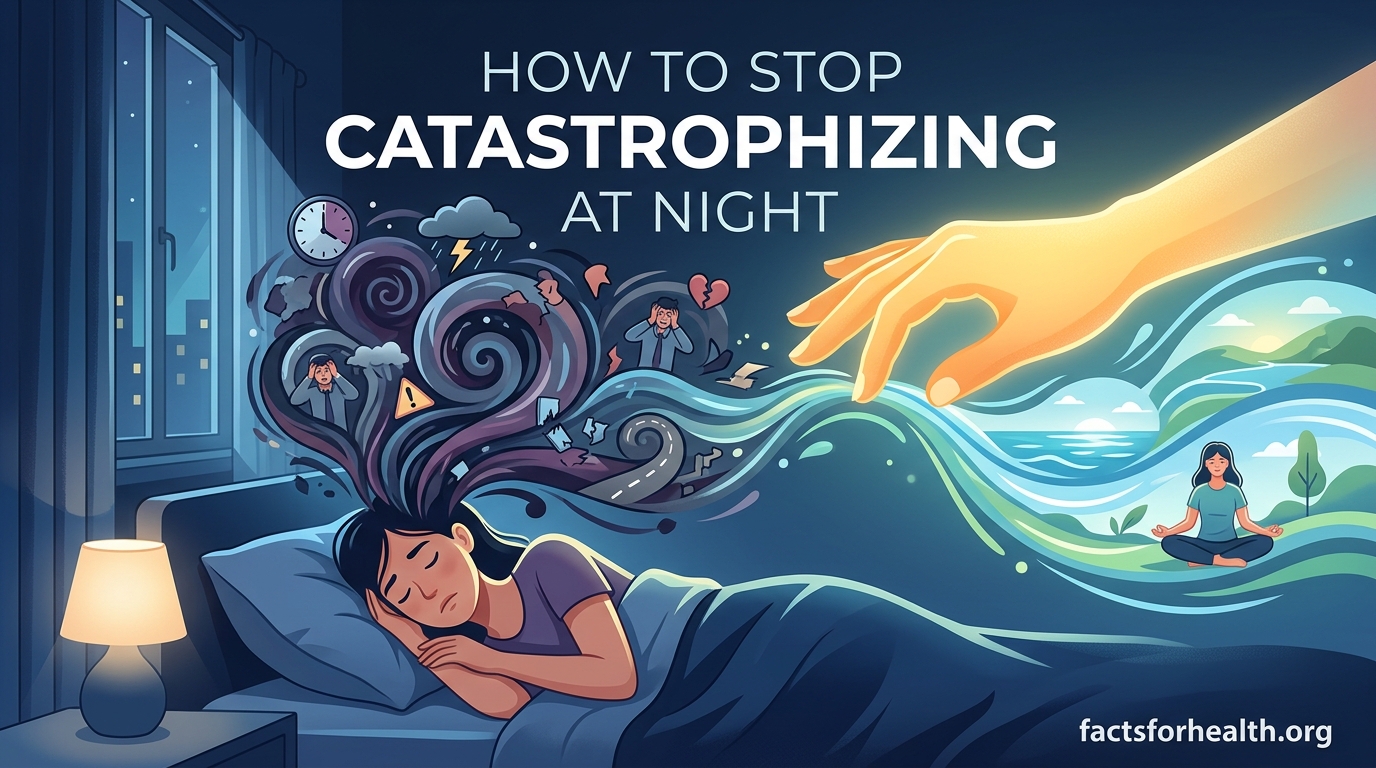
It is 3:12 a.m. You woke up for no clear reason, and within seconds your brain has already imagined three worst-case scenarios, replayed an embarrassing moment from 2019, and convinced you that a mild headache is something far worse. If this sounds familiar, you are dealing with nighttime catastrophizing, and you are far from alone.
Learning how to stop catastrophizing in the middle of the night can feel impossible when you are in the grip of it. Your thoughts race, your heart pounds, and the quiet darkness seems to amplify every worry. But there are proven techniques that can calm your racing mind right now, in bed, without needing your phone or any special tools.
I have spent years researching sleep psychology and anxiety management, and our team has compiled the most effective, evidence-based strategies for breaking the 3 a.m. thought spiral. Whether you deal with occasional nighttime worry or chronic catastrophizing that disrupts your sleep several times a week, this guide walks you through what is happening in your brain and exactly what to do about it.
Table of Contents
Key Takeaways
- Catastrophizing at night is a cognitive distortion where your mind fixates on worst-case scenarios, and it feels worse at night because your brain has fewer cognitive resources to challenge irrational thoughts.
- At 3 a.m., your circadian biology creates a perfect storm: cortisol begins rising, melatonin has peaked, and your sleep drive is at its lowest, making worries feel overwhelming.
- Immediate techniques like 4-7-8 breathing, dark-room grounding, cognitive restructuring, and stimulus control can stop a catastrophizing episode in minutes.
- People with ADHD or OCD are especially prone to nighttime catastrophizing and may need tailored approaches.
- If nighttime catastrophizing happens several times per week for a month or more, cognitive behavioral therapy for insomnia (CBT-I) can break the cycle effectively.
What Is Catastrophizing (and Why Does It Hit at Night?)
Catastrophizing is a cognitive distortion where your brain jumps to the worst possible conclusion and treats it as fact. Instead of thinking “I made a mistake at work, I will fix it tomorrow,” your mind says “I am going to get fired, lose my home, and ruin my life.” The leap from a minor concern to a catastrophic outcome happens automatically, and at night, it feels completely real.
Researchers sometimes call catastrophizing “problem-solving’s evil twin.” During the day, when something bothers you, your brain engages in actual problem-solving: identifying the issue, brainstorming solutions, and taking action. At night, that same problem-solving machinery runs with no brake system. Your brain cycles through worst-case scenarios without reaching any resolution.
Nighttime catastrophizing feels different from daytime worry for a simple reason. During the day, you have constant cognitive resources available to challenge irrational thoughts. You can text a friend, look at the evidence, or distract yourself with tasks. At 3 a.m., those resources are depleted. Your prefrontal cortex, the part of your brain responsible for logical reasoning and emotional regulation, is running on fumes. Every catastrophic thought gets a free pass because the mental filter that would normally reject it is essentially offline.
This is why worries that feel manageable at 2 p.m. feel devastating at 2 a.m. The problem itself has not changed. Your brain’s ability to put it in perspective has.
The quiet environment makes it worse. During the day, conversations, notifications, tasks, and sounds compete for your attention and naturally interrupt worry cycles. At night, there is nothing competing for your mind. The catastrophic thought has the entire stage to itself, and it takes full advantage.
Why Your Brain Turns Against You at 3am
You catastrophize in the middle of the night because your circadian biology creates a window where anxiety thrives. Around 3 a.m., several biological shifts converge: cortisol (your stress hormone) begins its daily climb to prepare you for waking, melatonin has already peaked and is starting to decline, and your sleep drive, the pressure that builds throughout the day to make you sleepy, is at its lowest point after hours of rest. Together, these changes create a biological environment where your body is slightly more alert and your stress response is slightly more sensitive, even though you are still in bed.
Professor Greg Murray, Director of the Centre for Mental Health at Swinburne University, has studied this phenomenon extensively. He explains that at 3 a.m., your brain is in a uniquely vulnerable state. You have enough alertness to think but not enough cognitive bandwidth to think clearly. Worries that your waking brain would easily dismiss feel urgent and real.
One Reddit user in the r/Anxiety community described this experience perfectly, calling their 3 a.m. thoughts “barbed-wire thinking.” The phrase captures how nighttime catastrophizing works: each thought catches you, and the more you struggle, the more tangled you become.
Here is something every nighttime catastrophizer needs to hear: those worries will almost certainly look different in the morning. Countless people report that their 3 a.m. fears “vaporize in the daylight.” This is not a coincidence. Your brain processes the same information differently at 8 a.m. than it does at 3 a.m. because your cognitive resources, your stress hormones, and your ability to think rationally have all shifted back to their daytime settings.
Understanding this biological reality can be its own form of relief. When you wake up catastrophizing, reminding yourself that “this is my 3 a.m. brain, not my real brain” can create just enough distance to keep the thoughts from spiraling further.
Immediate Techniques to Stop Catastrophizing in the Middle of the Night
When you are in the middle of a catastrophizing episode, you need techniques that work right now, in the dark, without getting out your phone. Here are seven evidence-based strategies you can use immediately.
1. Try 4-7-8 Breathing
This technique slows your heart rate and activates your parasympathetic nervous system, which counteracts the fight-or-flight response driving your anxiety. Inhale through your nose for 4 seconds, hold your breath for 7 seconds, and exhale slowly through your mouth for 8 seconds. Repeat this cycle four times. The extended exhale signals to your nervous system that you are safe, which helps quiet the catastrophic thoughts at their biological source.
The beauty of 4-7-8 breathing is that you can do it without opening your eyes, moving, or turning on a light. It is completely invisible to anyone sleeping next to you.
2. Use Dark-Room Grounding (5-4-3-2-1 Adapted)
The standard 5-4-3-2-1 grounding technique asks you to name things you can see, hear, feel, smell, and taste. In a dark bedroom, you need a modified version. Instead of relying on sight, shift your focus to your other senses.
Name five things you can feel: the sheets against your skin, the pillow under your head, the temperature of the air, your breath moving in and out, the weight of the blanket. Then name four things you can hear: the hum of a fan, distant traffic, your heartbeat, the sound of your breathing. Continue with three things you can feel internally, two slow breaths, and one calming word or phrase.
This technique works because it forces your brain to process sensory information instead of generating catastrophic scenarios. You cannot fully spiral into a worry cycle while your attention is occupied with identifying physical sensations.
3. Challenge the Catastrophic Thought (Cognitive Restructuring)
Cognitive restructuring is a core technique from cognitive behavioral therapy, and it directly targets the mechanism of catastrophizing. When a catastrophic thought arises, do not try to suppress it. Instead, question it.
Ask yourself: What is the actual evidence for this thought? What is the evidence against it? What would I tell a friend who had this exact thought at 3 a.m.? If the worst case happened, what would I do to cope? Is there a more realistic way to see this situation?
You do not need to fully resolve the worry. The goal is simply to introduce doubt into the catastrophic narrative. Even a small crack of skepticism, like recognizing “I have had this worry before and it never came true,” can begin to slow the spiral.
4. Get Out of Bed (Stimulus Control Therapy)
If you have been catastrophizing in bed for more than 20 minutes, get up. This advice comes from stimulus control therapy, one of the most effective treatments for insomnia and sleep-related anxiety developed in behavioral sleep medicine.
The principle is simple but powerful: your brain has started to associate your bed with worry and wakefulness rather than sleep and rest. Every minute you lie there catastrophizing, you strengthen that association. By getting out of bed, you break the cycle.
Go to a dimly lit room and do something calm and non-stimulating. Read a physical book, stretch gently, or sit quietly. Do not check your phone, do not turn on bright lights, and do not do anything work-related. When you feel sleepy, return to bed. If the catastrophizing starts again, get up again. This technique feels difficult at first, but it retrains your brain to associate your bed with sleep over time.
5. Do a Body Scan
A body scan is a mindfulness technique that shifts your attention away from racing thoughts and into physical sensations. Starting at the top of your head, slowly move your attention down through your body, noticing any tension, warmth, tingling, or relaxation in each area.
Spend a few breaths on each body part: your forehead, jaw, shoulders, arms, chest, stomach, hips, legs, and feet. When you notice tension, do not try to force it away. Just acknowledge it and continue scanning. This technique works because your brain has limited attention bandwidth. The more you direct toward physical sensations, the less is available for catastrophic thinking.
6. Visualize a Safe Place
Mental imagery can counteract catastrophizing by giving your brain an alternative scenario to focus on. Picture a place where you feel completely calm and safe. It could be a beach, a cabin in the woods, a childhood memory, or any setting that brings you peace.
Engage all your senses in the visualization. What do you see? What sounds are present? What does the air feel like? What can you smell? The more detailed your imagery, the more cognitive resources it requires, and the fewer resources are available for catastrophic thoughts.
7. Use Thought Blocking
Thought blocking is a technique where you actively interrupt a catastrophic thought and replace it with something neutral or positive. When you notice a worry spiral beginning, say “stop” silently in your mind. Then immediately shift to a neutral mental task, like counting backward from 100 by 7s, reciting the alphabet backward, or listing animals in alphabetical order.
This is not about suppressing emotions permanently. It is about breaking the immediate thought loop so you can calm your nervous system and eventually return to sleep. Thought blocking works best when combined with breathing techniques.
Technique Comparison: What Works Best for Nighttime Catastrophizing
Different techniques serve different needs during a nighttime catastrophizing episode. Here is how the main approaches compare so you can choose what fits your situation.
4-7-8 Breathing is best for calming physical anxiety symptoms like a racing heart or shallow breathing. It takes about 2 minutes, requires no movement, and is easy enough for anyone to do. Use this first when your body feels activated.
Dark-Room Grounding is best for when your thoughts are spiraling rapidly and you feel disconnected from reality. It takes 3 to 5 minutes, requires no movement, and is moderately easy. Use this when the thoughts are coming too fast to challenge individually.
Cognitive Restructuring is best for a specific, repeating catastrophic thought that you can identify clearly. It takes 5 to 10 minutes, can be done mentally or on paper if you get up, and requires more cognitive effort. Use this when you can name the specific fear you are catastrophizing about.
Stimulus Control (Get Out of Bed) is best for episodes lasting more than 20 minutes or when you feel fully awake. It requires leaving your bed and takes 15 to 30 minutes, but it is the most effective long-term strategy for breaking the bed-worry association. Use this as a last resort within a single episode.
Body Scan is best for general, unfocused anxiety without a single clear thought. It takes 5 to 10 minutes, requires no movement, and is easy to moderate in difficulty. Use this when you feel physically tense but cannot pinpoint a specific worry.
The 3-3-3 Rule and 3-2-1 Method Explained
Two popular anxiety frameworks come up frequently in searches about nighttime worry. Here is exactly what they are and how to use them.
The 3-3-3 Rule for Anxiety
The 3-3-3 rule is a grounding technique designed to interrupt anxiety spirals by engaging your senses and redirecting your attention. The standard version asks you to name three things you can see, three things you can hear, and three things you can feel (or three ways you can move your body).
For nighttime use in a dark room, adapt the seeing component. Instead of visual objects, name three things you can feel against your body right now. Then identify three sounds in your environment, from the most obvious to the most subtle. Finally, move three parts of your body slowly: wiggle your toes, roll your shoulders, flex your fingers. This adapted version works in complete darkness and follows the same principle of pulling your attention out of your thoughts and into your senses.
The 3-2-1 Bedtime Rule
The 3-2-1 bedtime rule is a prevention strategy rather than an in-the-moment technique. It involves three time-based restrictions before sleep. Stop using screens (phones, tablets, computers, TV) 3 hours before bed. Stop eating and drinking 2 hours before bed to prevent digestion-related sleep disruption and nighttime awakenings. Stop working 1 hour before bed to give your brain time to transition out of problem-solving mode.
This rule addresses one of the root causes of nighttime catastrophizing: going to bed with your brain still in high-alert, work-oriented mode. When you have been answering emails or scrolling through news right up until you close your eyes, your nervous system is still activated. The 3-2-1 rule creates a buffer zone that allows your cognitive activity to wind down naturally, making middle-of-the-night catastrophizing less likely.
ADHD and Racing Thoughts at Night
If you have ADHD, nighttime catastrophizing can be especially intense. Many people with ADHD describe their experience as their brain “won’t stop talking to itself” the moment external stimulation disappears. During the day, tasks, conversations, and activity provide the constant input that an ADHD brain craves. At night, when everything goes quiet, the brain generates its own stimulation in the form of racing thoughts, rapid topic-switching, and catastrophic scenarios.
This happens because ADHD brains have differences in dopamine regulation and attention control. When external stimulation drops, the brain compensates by creating internal stimulation. Unfortunately, at 3 a.m., that internal stimulation often takes the form of worry spirals and catastrophizing.
Standard advice like “just relax and clear your mind” rarely works for ADHD brains because stillness is the problem, not the solution. Instead, techniques that occupy your attention without overstimulating your system tend to work better.
Audio-based interventions can be especially helpful. Listening to a familiar podcast, audiobook, or guided meditation gives your brain something to process without requiring screen light or active engagement. Choose content you have heard before so your brain does not stay alert trying to follow a new plot. The familiarity lets your attention latch on without staying fully awake.
Fidget-based grounding also helps. Keeping a textured object, like a piece of fabric or a smooth stone, on your nightstand gives you a tactile focus point. Running your fingers over the texture engages your sense of touch and occupies the part of your brain that would otherwise be generating racing thoughts.
For people with OCD, catastrophizing at night often takes a specific form: intrusive thoughts that feel urgent and demand a response. The compulsive need to “solve” or neutralize the thought keeps you awake. If this pattern sounds familiar, techniques like cognitive restructuring and thought blocking can help, but working with a therapist trained in exposure and response prevention (ERP) is often the most effective long-term approach.
How to Break the Cycle of Nighttime Catastrophizing
Immediate techniques help in the moment, but the most powerful changes come from breaking the cycle before it starts. Here are the prevention strategies that have the strongest evidence behind them.
Schedule Worry Time
Worry time is a technique recommended by anxiety specialists at the OCD and Anxiety Center and other behavioral health institutions. Set aside 15 to 20 minutes earlier in the day, ideally in the late afternoon or early evening, to process your worries. Write down every concern, fear, and catastrophic thought that comes to mind. Then for each one, write a brief realistic assessment.
This technique works because it gives your brain a designated time and place to worry, rather than letting worries ambush you at 3 a.m. When a catastrophic thought arises in bed, you can remind yourself: “I already processed this during worry time. I will address it again tomorrow.”
Keep a Worry Journal at Your Bedside
If a catastrophic thought arises that you did not address during worry time, write it down. Keep a notebook and pen on your nightstand. When a worry hits, jot it down in one or two sentences. The act of externalizing the thought, moving it from your mind onto paper, reduces its intensity. Your brain no longer feels the need to keep cycling through it because it has been safely captured.
Do not try to solve the worry at 3 a.m. Just write it down and tell yourself you will revisit it in the morning. Many people find that reading their 3 a.m. worries the next day reveals how irrational they were, which reinforces the understanding that nighttime catastrophizing is not reality.
Maintain a Consistent Sleep Schedule
Your circadian rhythm thrives on consistency. Going to bed and waking up at the same time every day, including weekends, helps regulate your cortisol and melatonin cycles. When your biological clock is stable, you are less likely to experience the middle-of-the-night cortisol fluctuations that trigger catastrophizing episodes.
Inconsistent sleep schedules create what sleep researchers call “social jetlag,” where your body is confused about when it should be awake and when it should be asleep. This confusion makes nighttime awakenings more frequent and more prone to anxious thinking.
Create a Bedtime Buffer Zone
A bedtime buffer zone is the 30 to 60 minutes before sleep when you transition from active daytime mode to rest mode. During this time, avoid work, intense conversations, emotionally charged media, and stressful news. Instead, engage in calming activities like reading, gentle stretching, listening to soft music, or taking a warm shower.
The buffer zone gives your nervous system time to shift from sympathetic (fight-or-flight) to parasympathetic (rest-and-digest) mode. When you go to bed in a calm state, you are far less likely to wake up catastrophizing.
Reduce Screen Time Before Bed
Screens are doubly problematic for nighttime catastrophizing. The blue light suppresses melatonin production, making it harder to fall asleep and stay asleep. And the content itself, whether it is work emails, social media, or news, often plants the seeds of worry that bloom at 3 a.m.
Following the 3-2-1 rule or at minimum avoiding screens for 30 to 60 minutes before bed gives your brain a chance to process the day’s input before you try to sleep.
The 4-Word Sleep Trick
The 4-word sleep trick is a simple self-suggestion technique that went viral on social media. The idea is to repeat a calming four-word phrase silently as you breathe, such as “I am ready for sleep” or “My body is calm.” Some variations use “I am safe, I am calm” or simply “Let go, let sleep.”
The mechanism behind this trick is similar to a mantra in meditation. By occupying your verbal processing with a repetitive, calming phrase, you leave less cognitive space for catastrophic thoughts to take hold. It is not magic, but it gives your brain a simple, neutral task that is incompatible with spiraling into worry. Combine it with slow breathing for the best results.
When to Seek Professional Help
Nighttime catastrophizing is common and usually manageable with self-help techniques. But there are times when professional support is the right call.
Consider reaching out to a healthcare provider if nighttime catastrophizing happens three or more times per week for a month or longer. If it is significantly affecting your daytime functioning, causing chronic sleep deprivation, or interfering with your work, relationships, or mood, those are clear signals that additional support is needed.
If your catastrophizing involves intrusive thoughts about harm, death, or safety that feel impossible to dismiss, or if you experience nighttime panic attacks with physical symptoms like chest pain, shortness of breath, or a feeling of impending doom, talk to a professional promptly.
The gold standard treatment for nighttime catastrophizing and sleep anxiety is cognitive behavioral therapy for insomnia (CBT-I). This structured, short-term therapy, typically 6 to 8 sessions, directly addresses the thought patterns and behaviors that maintain sleep-related anxiety. Research consistently shows CBT-I is more effective than sleep medication for chronic insomnia, and its benefits last long after treatment ends.
For underlying anxiety disorders, generalized anxiety, OCD, or ADHD, working with a therapist who specializes in cognitive behavioral therapy or acceptance and commitment therapy can address the root causes of catastrophizing. In some cases, medication such as SSRIs may be recommended by a psychiatrist or primary care provider. Medication is not a sign of failure. For many people, it provides the biological support needed to engage fully with therapy and self-help techniques.
Start with your primary care provider, who can refer you to a sleep specialist, psychologist, or psychiatrist. Many providers now offer telehealth appointments, making access easier than ever.
FAQs
Why do I catastrophize in the middle of the night?
You catastrophize at night because your circadian biology creates a vulnerability window around 3 a.m. Your cortisol levels begin rising, melatonin has peaked and is declining, and your sleep drive is at its lowest. At the same time, your prefrontal cortex, responsible for rational thinking and emotional regulation, is running on reduced resources. This combination makes catastrophic thoughts feel more intense and real than they do during the day, even though the actual problems have not changed.
What is the 3/2/1 bedtime rule?
The 3-2-1 bedtime rule is a sleep preparation strategy: stop using screens 3 hours before bed, stop eating and drinking 2 hours before bed, and stop working 1 hour before bed. This creates a buffer zone that lets your brain wind down naturally, reducing the likelihood of nighttime catastrophizing.
What is the 4 word sleep trick?
The 4-word sleep trick involves repeating a calming four-word phrase silently as you breathe, such as “I am ready for sleep” or “My body is calm.” It works like a meditation mantra, occupying your verbal processing so there is less cognitive space for catastrophic thoughts. Combine it with slow breathing for the best results.
What is the 3-3-3 rule for anxiety sleep?
The 3-3-3 rule asks you to name three things you can see, three things you can hear, and three things you can feel. For nighttime use in a dark room, adapt it by focusing on three physical sensations (sheets, pillow, breath), three sounds (fan, heartbeat, breathing), and three slow body movements (toes, shoulders, fingers). This redirects attention from racing thoughts to sensory input.
Is catastrophizing at night a sign of an anxiety disorder?
Occasional nighttime catastrophizing is normal and does not necessarily indicate an anxiety disorder. However, if it happens three or more times per week for a month or longer, causes significant sleep loss, or interferes with your daily life, it may be a symptom of generalized anxiety disorder, OCD, ADHD-related overstimulation, or chronic insomnia. A mental health professional can help assess whether treatment is needed.
How long does it take for CBT-I to help with nighttime catastrophizing?
Cognitive behavioral therapy for insomnia (CBT-I) typically runs 6 to 8 sessions over several weeks. Many people notice improvement within the first 2 to 3 sessions. CBT-I addresses both the thought patterns that drive catastrophizing and the sleep behaviors that maintain it. Research shows it is more effective long-term than sleep medication for chronic insomnia and nighttime anxiety.
You Are Not Your 3am Thoughts
Nighttime catastrophizing can make you feel like your own mind is working against you. But understanding why it happens, your biology, your depleted cognitive resources, your conditioned associations, gives you the power to respond differently when it strikes.
Learning how to stop catastrophizing in the middle of the night is not about eliminating worry entirely. It is about building a toolkit of techniques you can reach for at 3 a.m., when the dark room feels overwhelming and your thoughts feel like facts. Start with breathing. Add grounding or cognitive restructuring. Get out of bed if you need to. Build prevention habits over time so the episodes become less frequent and less intense.
And remember the words of countless people who have been exactly where you are: those 3 a.m. thoughts will look different in the morning. They always do. Give yourself the compassion to wait for the daylight.