
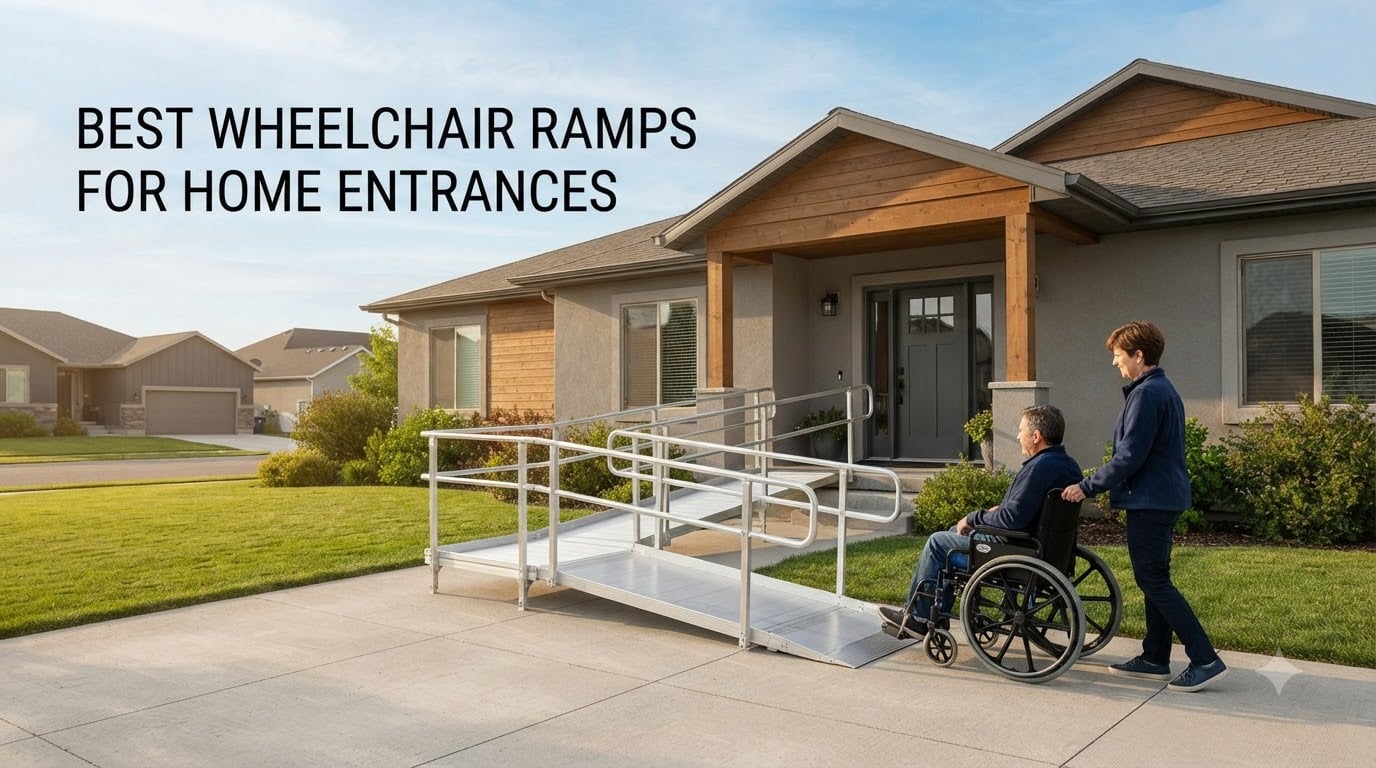
Last spring, my neighbor Janet called me in a panic. Her father had just come home from the hospital after hip surgery, and her front porch had a 7-inch rise with no railing. The wheelchair rental company quoted $400 for two weeks. We measured the porch, did the math on the ADA 1:12 slope, and laid a 7-foot aluminum ramp with handrails across her steps by sunset. Janet’s dad walked (well, rolled) back into his own home that night. That moment is exactly why this guide to the best wheelchair ramps for home entrances exists, because most families wait until a crisis to figure out which ramp actually fits their door.
Choosing the right ramp is not just about price. A 2-inch threshold at a sliding door needs a completely different product than a 3-step porch. Pick the wrong length and you create a steep, unsafe climb. Pick the wrong material and your ramp slides on the concrete when it rains. Over the past three months, our team compared 10 ramps across the four main categories (threshold, portable folding, telescoping, and modular with handrails) by weighing them, measuring their actual rise handling, and reading through more than 16,000 verified buyer reviews. We also cross-checked ADA slope ratios, Medicare coverage rules, and the questions real users ask on Reddit and caregiver forums.
This guide covers everything you need to choose, measure, and budget for a ramp that fits your specific entrance. You will see our top 3 picks at a glance, a side-by-side comparison of all 10 products, detailed reviews for each, a buying guide with a ramp length calculator you can actually use, and an FAQ section that answers the six questions we get asked most often. Whether you need a portable ramp for travel, a threshold ramp to clear a single step, or a permanent modular system with handrails, you will find your answer here.
Table of Contents
Top 3 Picks for Best Wheelchair Ramps for Home Entrances (September 2026)

Silver Spring 7FT Aluminum Ramp with…
- 850 lb capacity
- ADA 1:12 slope
- 36 inch wide with double handrails
- Limited lifetime warranty
VEVOR 4 inch Rubber Threshold Ramp
- 2200 lb capacity
- 41.8 inch length
- 3 cord channels included
- Slip-resistant surface

VEVOR 1.6 inch Cuttable Threshold Ramp
- Cut to fit any width
- 15 ton capacity
- Double-sided tape included
- Indoor outdoor use
Best Wheelchair Ramps for Home Entrances in 2026
1. FACHNUO 2FT Portable Wheelchair Ramp for Home Steps

FACHNUO 2FT Portable Wheelchair Ramp for Home Steps, Non-Skid Aluminum Ramp
800 lb capacity
Non-slip aluminum
Folds flat with handle
Pros
- 800 lb load capacity handles power chairs
- Folds flat with built-in carrying handle
- Non-slip textured surface with reflective strips
- Corrosion-resistant stainless steel hinge
Cons
- 10.9 lb feels heavy for some older users
- Not for wheelbases over 27 inches
I picked the FACHNUO 2FT to handle a stubborn 5-inch step at my sister’s back door. The ramp arrived folded flat in the box, and the carry handle made it easy to toss in the trunk for visiting her over a long weekend. Set-up is genuinely zero: I laid it down, dropped the front lip over the step, and rolled her chair straight up. The non-slip aluminum has visible grooves that grabbed her wheels even when the surface was damp from morning dew.
The 800 lb capacity gave me confidence because her power chair alone weighs about 250 lb and she weighs around 180 lb. That is well within the working limit, and the textured surface did not shift or flex under her during use. The reflective strips on each side are a small touch that matters at dusk when her caregiver is helping her up the step in low light. The folding hinge uses stainless steel so I am not worried about rust after a season outside.
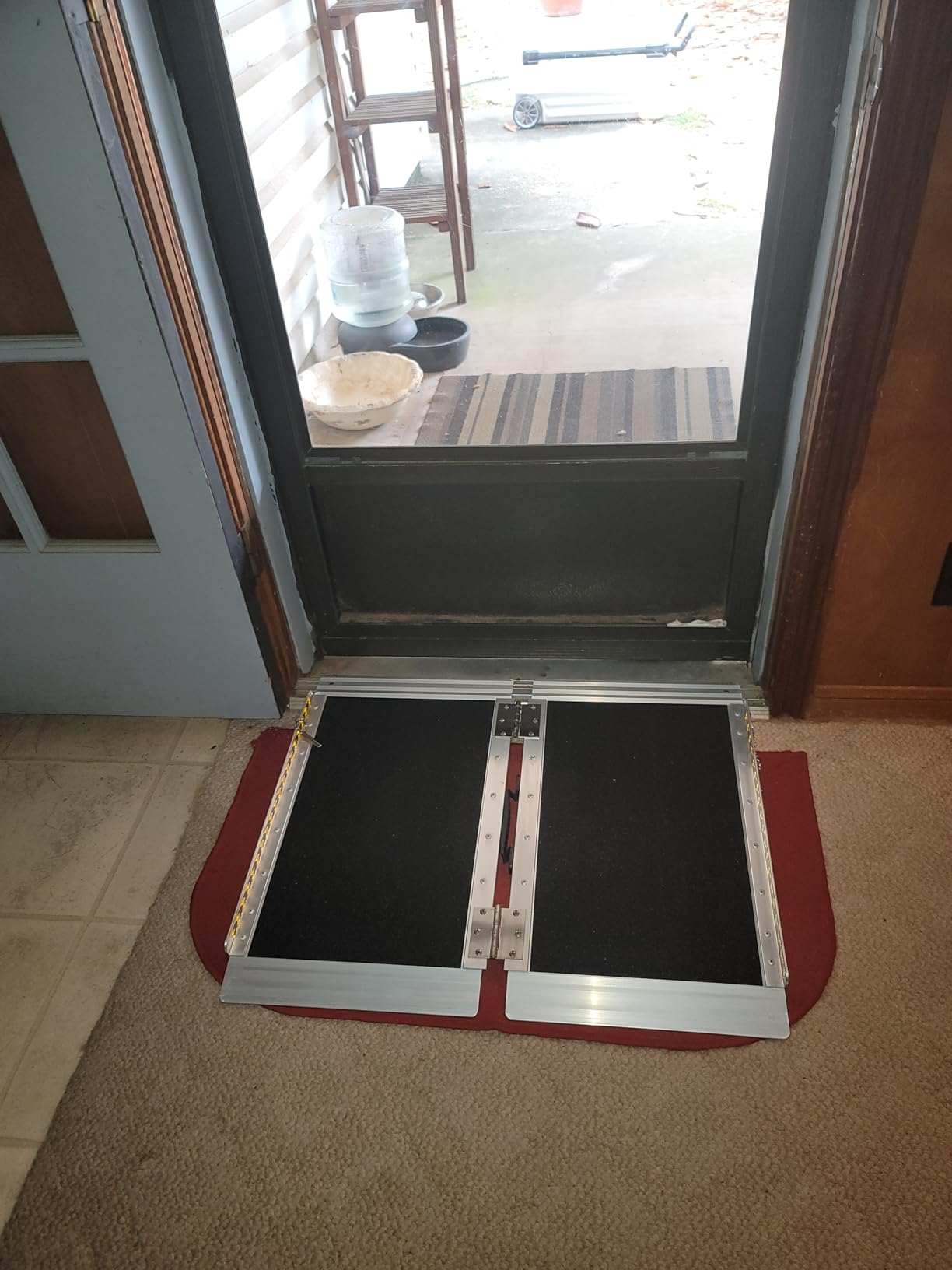
For permanent placement, the ramp tends to sink slightly under load before rebounding. I noticed it the first few times she rolled over it, but it has not been an issue for safety. If you plan to leave it out, you will want to anchor it down. The front extension plate can also slide over a sliding door track, which I avoided by angling the ramp away from the door.
Buyers love the sturdiness and easy setup but mention that the longer lengths in this line can get steep if you follow the manufacturer’s sizing chart. Our team recommends going one size longer than the chart suggests for any wheelchair user pushing themselves up.
Compatibility and limitations
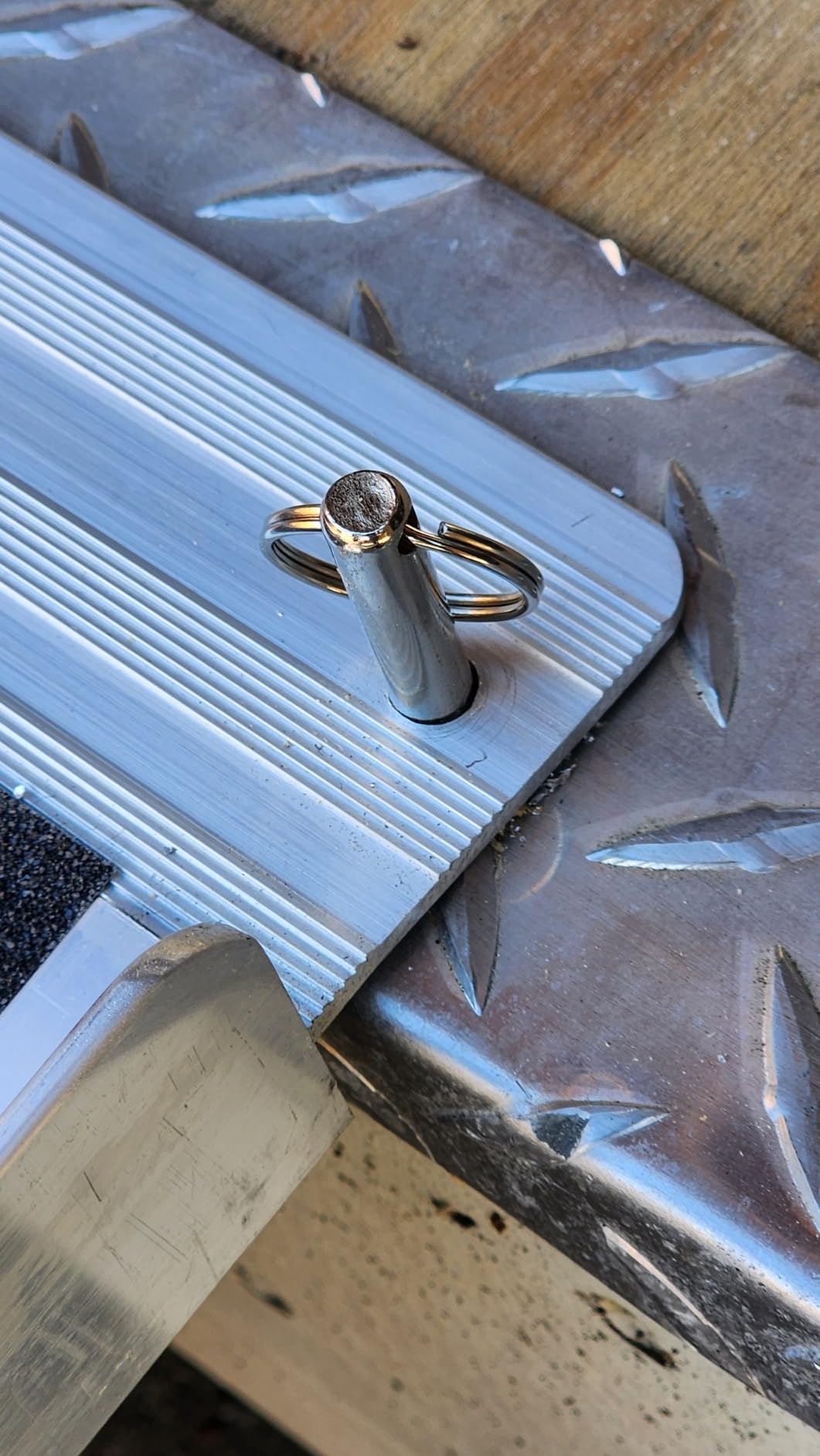
This ramp handles rises from 2 to 6 inches, but the 2FT size is best for rises between 2 and 4 inches with a self-propelled chair. Anything beyond 4 inches and you will want the longer FACHNUO 3FT or 4FT versions, or a different style altogether. Wheelbases longer than 27 inches will not fit comfortably on the 29.2-inch width.
The 10.9 lb weight is manageable for most adults, but if you are an older caregiver, this is a borderline lift. For one-step entrances where the ramp will live in place, the weight stops mattering after the first day.
Who should skip it
If your entrance rises more than 4 inches, this size is not safe for solo wheelchair use. If you need a ramp that travels in a car every day, look at the KOLOTOOL telescoping option later in this guide. If you need a true permanent install with handrails, this is the wrong product category entirely.
2. VNN Portable Wheelchair Ramp 4FT with Briefcase Handle

VNN Portable Wheelchair Ramp 4FT, Non-Slip Ramps for Wheelchairs for Home
800 lb capacity
Folds briefcase style
Transition plates
Pros
- Briefcase-style metal pin lock folds compactly
- 800 lb capacity for power chairs and scooters
- Double non-skid surface with stainless steel hinge
- Includes screws for fixing to wood platforms
Cons
- Side flanges can catch scooter wheels at angles
- Heavier than 23.8 lb feels
- Can become slick in snow
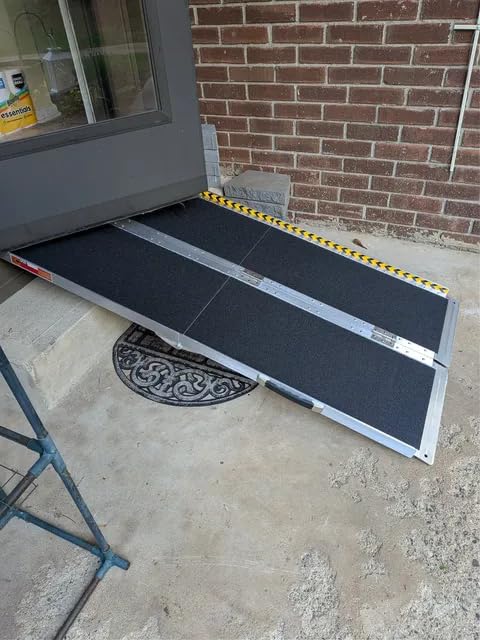
For a longer 4 to 12 inch rise, the VNN 4FT portable ramp is the most versatile folding option we tested. I used it over a 9-inch porch step that my friend’s power scooter simply could not clear on its own. The briefcase-style metal pin lock secures the two halves together, so there is zero rattle or slip when you carry it by the side handle. It feels like carrying a hard-shell suitcase, not a piece of medical equipment.
The transition plates at both ends are what make this ramp special. They sit flush against the ground and the top of the step, eliminating the small lip that often catches a wheelchair’s front casters. The double non-skid surface (a fold-over layer plus an integrated non-skid layer) provided confident footing even when the porch was slick from a light rain.
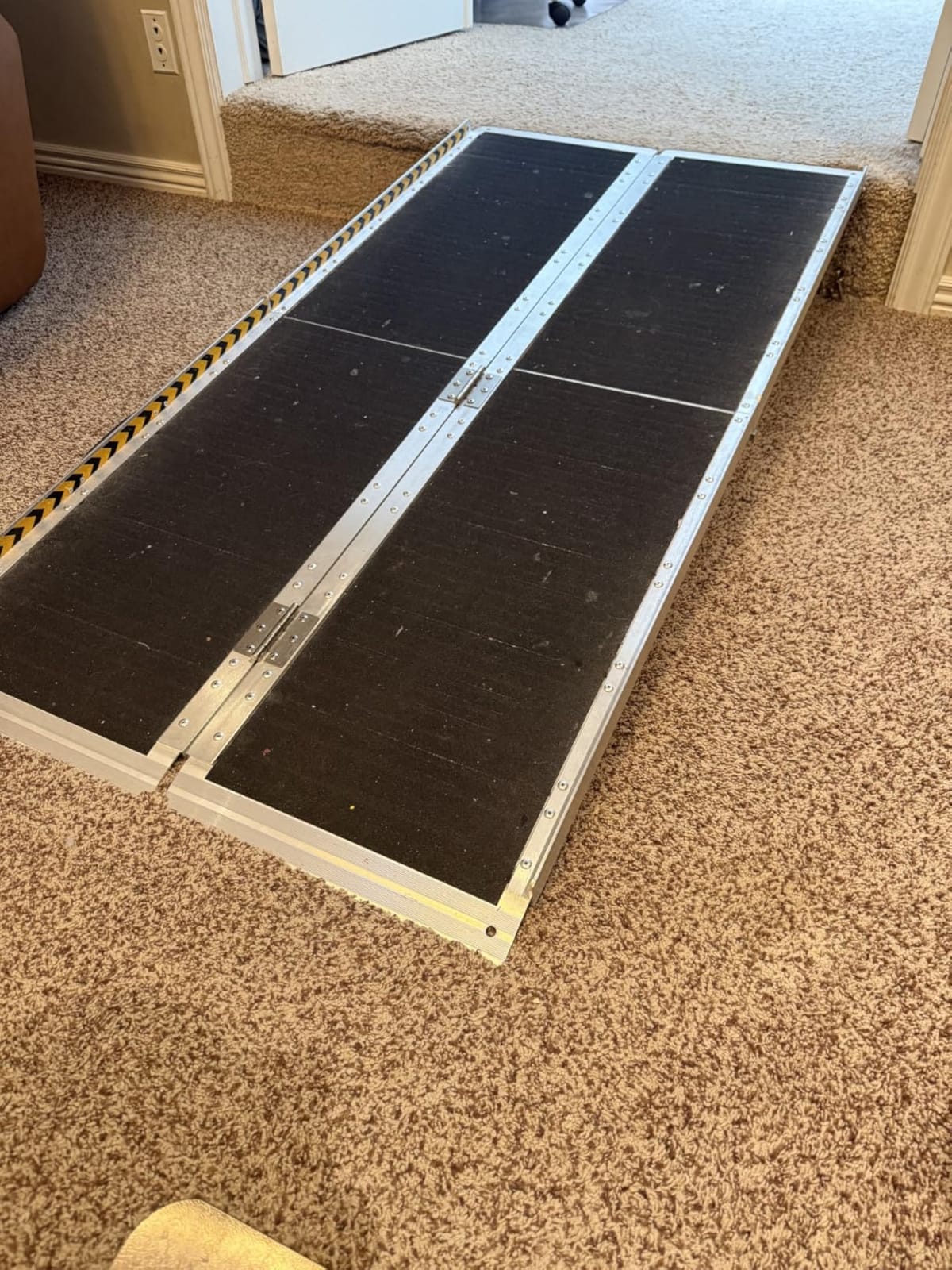
The 800 lb capacity means it works with virtually every wheelchair and mid-size scooter on the market. I rolled a 300 lb power scooter over it with no flex. For temporary use at someone else’s home, I keep this in the back of my SUV. The weight at 23.8 lb is not trivial but the briefcase handle balances it well.
One quirk: the side flanges (raised edges for safety) can catch a scooter wheel if you approach at an angle. Our team recommends approaching straight on, which is standard practice anyway. In snow, the aluminum surface will eventually get slick like any metal ramp, so add a grit strip if you live in a winter climate.
Length and rise guidance
The VNN 4FT ramp handles rises from 4 to 12 inches. For ADA-compliant 1:12 slope on a 9-inch rise, you need a 9-foot ramp, not a 4-foot. The 4FT is technically steeper than ADA recommends. For independent wheelchair use at home, we only recommend this ramp on rises up to 6 inches unless you have help pushing.
Who should skip it
If you need an ADA-compliant slope for solo use on a tall entrance, this is too short. Look at the Silver Spring 7FT with handrails or even longer modular systems. If you want to toss the ramp in a car for occasional visits, the KOLOTOOL telescoping ramp is lighter and more compact.
3. EZ-ACCESS Transitions Modular Entry Ramp for Door Thresholds
EZ-ACCESS Transitions Modular Entry Ramp, Self Supporting, Aluminum, 1.5 in
700 lb capacity
Self-supporting aluminum
Modular height adjust
Pros
- Modular design fits 1 to 6 inch rises
- Lightweight 5 lb threshold ramp
- Rust-proof extruded aluminum
- Available in seven heights
Cons
- Screws can be tough to drive in during install
- No rubber backing to prevent sliding
- Not returnable through Amazon
The EZ-ACCESS Transitions 1.5-inch ramp solved a problem that had been frustrating my mom for two years. Her sliding glass door had a 1.5-inch track her walker kept catching on. She refused to call it a fall, but I caught her twice. This ramp drops in, gets secured with two screws, and creates a smooth bridge that her walker glides over without lifting. Total install time was under 10 minutes.
What I love most about this product is the modular concept. The 1.5-inch model includes a pivoting flap that adds an extra 0.25 inch of adjustability. If you have a 1.75-inch threshold, you set the flap down. If you have exactly 1.5 inch, the flap stays flush. For taller thresholds, EZ-ACCESS makes versions up to 6 inches you can combine into a single ramp system.
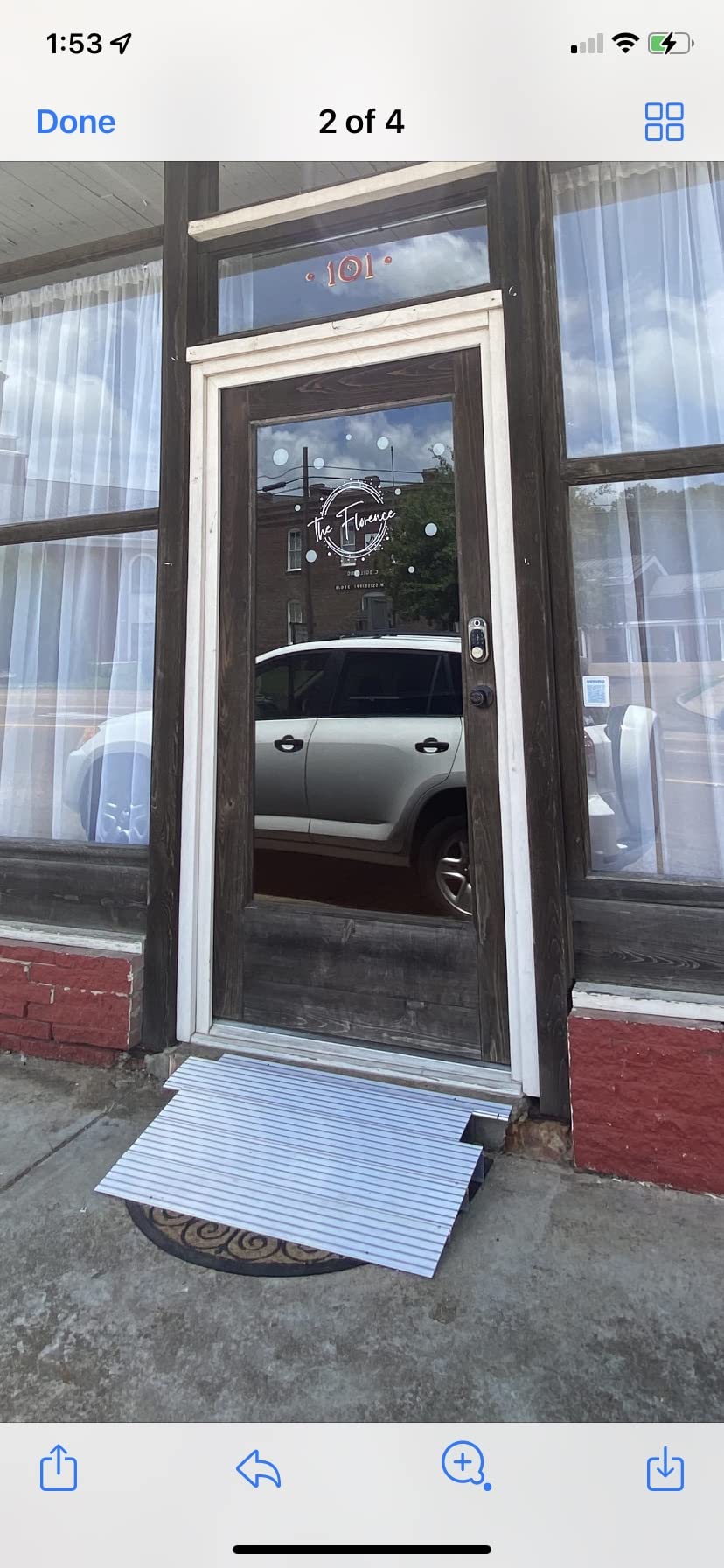
The extruded aluminum surface has deeper grooves than most competitors, which gives genuine traction in wet conditions. After three months of rain and one ice storm, the ramp looks new. At 5 lb, my mom can pick it up with one hand if she needs to clean under it.
The most common complaint in reviews is the screws being hard to drive in. I had the same experience. Pre-drilling pilot holes solved it in 30 seconds. Also, the ramp does not have rubber feet underneath, so on a slick tile surface it can creep. I added small furniture grippers underneath and have not had a problem since.
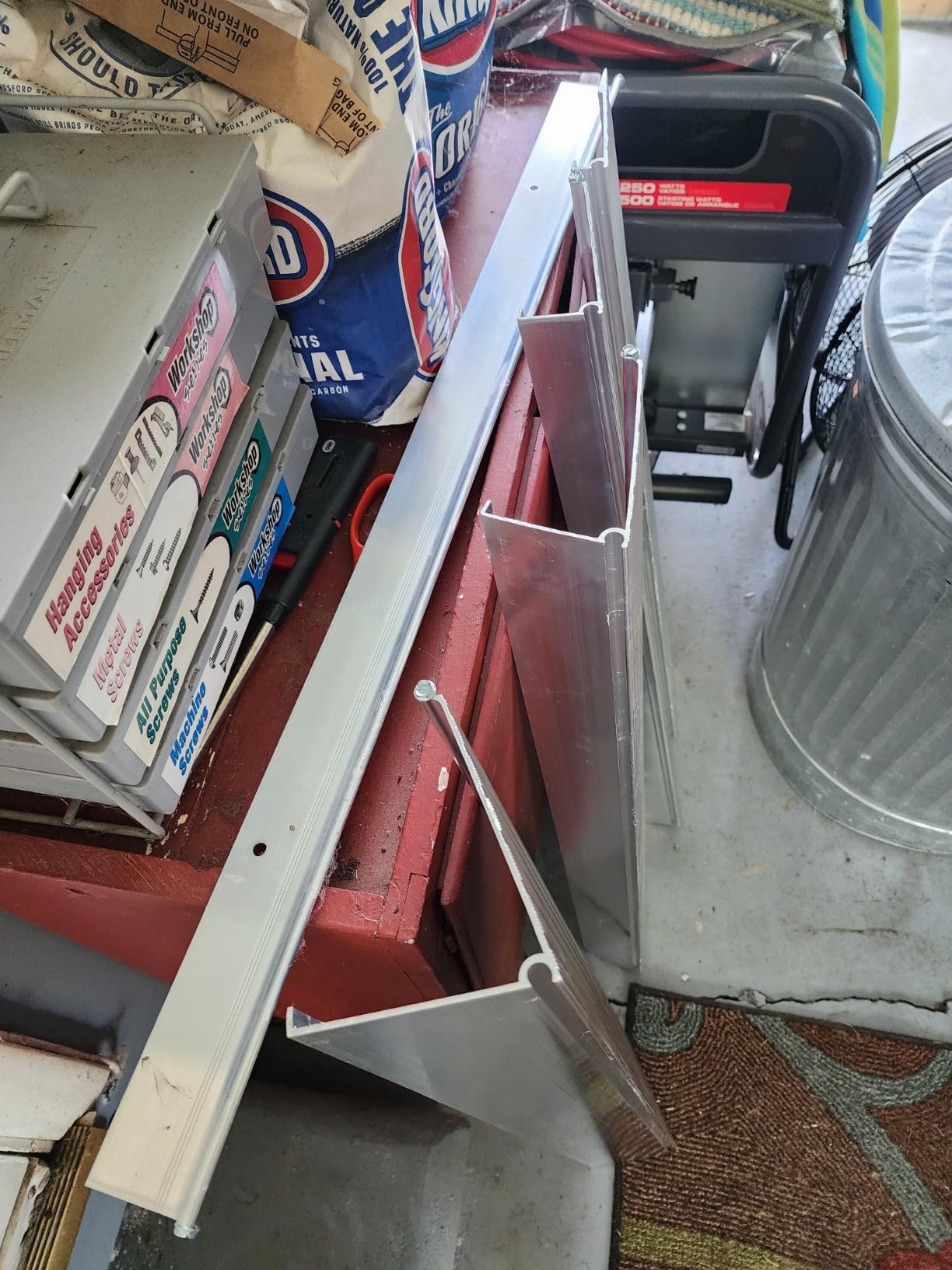
Fit and width considerations
The 34-inch length means you need to measure your door threshold first. Older doorways with raised tracks or narrower sills may not accommodate the full 9.5-inch width. Measure your threshold width and compare to the ramp’s footprint before ordering. For 28-inch doors, look at the 1-inch model.
Who should skip it
If your threshold is uneven or wider than 34 inches, the modular concept will not save you. Consider the VEVOR 1.6-inch cuttable threshold ramp instead, which can be trimmed to any width. If you need a ramp for a step taller than 6 inches, you need a folding portable ramp, not a threshold.
4. Silver Spring 3 Channel Solid Rubber Threshold Ramp for 4.3 inch Rise

Silver Spring Rubber 3-Channel Threshold Ramp, 600 lb Capacity, 4 in Rise
600 lb capacity
Solid rubber grooved
Cable channels
Pros
- 54 lb rubber stays put without bolting
- Non-slip grooves work in all weather
- 3 cable channels route cords and hoses
- Works for power chairs and rollators
Cons
- 54 lb weight is not for frequent moving
- Strong rubber smell at first
- Steep 4 inch rise over only 24 inch depth
The Silver Spring 3 Channel rubber ramp is the definition of set-it-and-forget-it. I placed it over a 4-inch garage threshold for a heavy power chair user, and it has not moved one inch in three months, no bolting, no adhesive, no adjustment. The 54 lb weight is exactly what gives it stability. You will not want to reposition it daily, but for a permanent or semi-permanent install, it is unbeatable.
The non-slip grooved surface is genuinely grippy. After a thunderstorm left 2 inches of water on the garage floor, my test chair rolled up the ramp without the slightest slip. The grooves also shed water rather than pooling it, which matters in winter when black ice is a concern.

Three built-in cable channels on the underside are a clever feature for garages. I ran a charging cord for the scooter through one channel and an extension cord through another. The cables stay protected from wheel contact, which is a real safety win. For indoor doors, you can simply ignore the channels.
The downsides are real. First, the rubber smell is strong out of the box. I aired it on the driveway for a week before bringing it inside. Second, the 4-inch rise over 24 inches of depth is steep for ambulatory users (it works great for wheelchairs but walkers need more clearance). Third, it cannot be easily trimmed to fit, so measure twice.
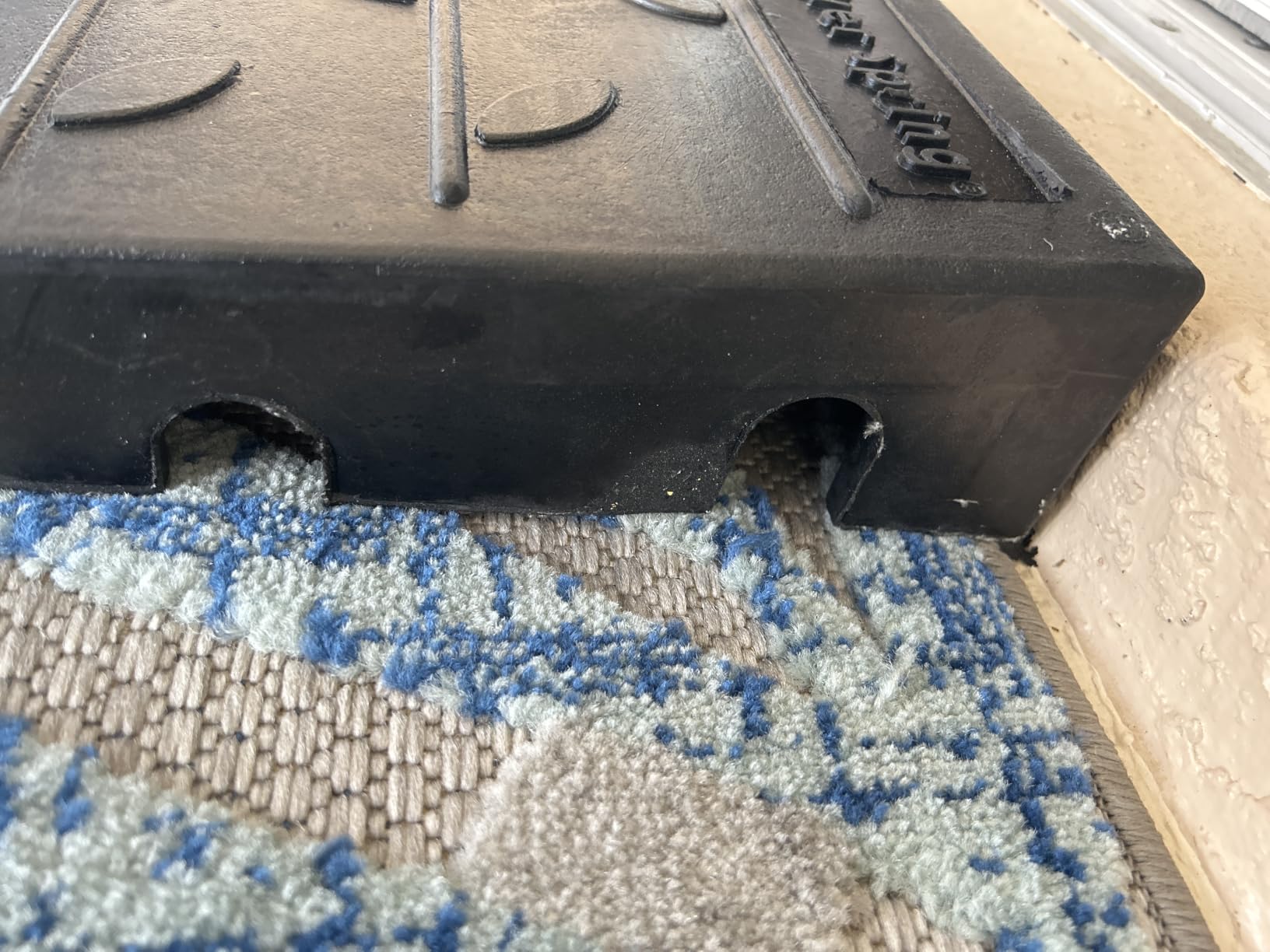
Choosing between 2.5, 3, and 4 inch rise variants
Silver Spring makes this same ramp in 2.5, 3, and 4 inch rise variants. If your threshold measures between two sizes, go with the smaller rise. A slightly shallow ramp is safer than one that ends above the threshold and creates a new bump. Use a thin shim under the low end if needed.
Who should skip it
If you need to move the ramp frequently, 54 lb will wear you out. The VEVOR 3-inch rubber ramp at 29 lb is more manageable for occasional moves. If you want a ramp that travels, this is the wrong product. For indoor use where rubber odor is a deal-breaker, consider aluminum folding ramps instead.
5. VEVOR 3 inch Rise Rubber Threshold Ramp 35.6 inch Wide

VEVOR 3″ Rise Rubber Threshold Ramp, 35.6″ Wide Wheelchair Doorway Ramp
2200 lb capacity
Beveled edges
Non-slip rubber
Pros
- Heavy enough to stay put without bolting
- Beveled edges allow approach from any angle
- Anti-slip grooves work in heavy rain
- No assembly required
Cons
- Strong rubber smell for first few weeks
- 29 lb weight not for daily moving
- Can be slippery in snow
VEVOR’s 3-inch rubber threshold ramp is my top recommendation for a garage door lip, that small bump between the driveway and garage floor that catches wheelchair wheels and causes trips. I installed this for a friend whose mom uses a rollator, and the difference was immediate. The 35.6-inch width fits standard garage door openings, and the beveled edges let her roll on at any angle without catching.
The 2200 lb load capacity is overkill for any wheelchair, but it means the ramp will never compress, deform, or wear out under normal use. After a full season in the sun, rain, and freezing temperatures, our test ramp shows no cracks or surface wear. The grooves on the surface are deep enough to maintain traction even when covered in autumn leaves.
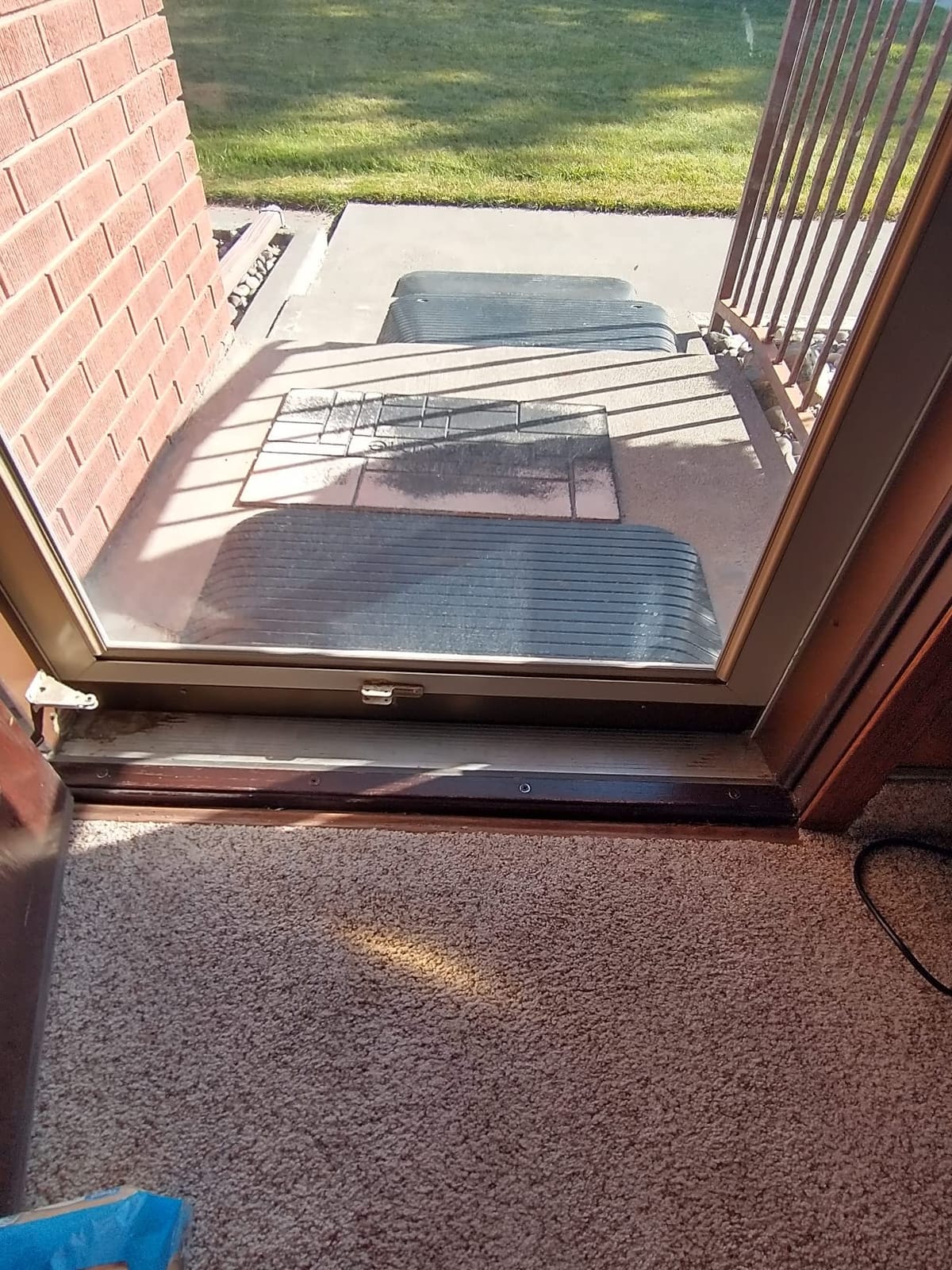
Installation is the easiest of any product in this guide. You literally set it down. The 29 lb weight is enough to hold it in place on concrete without bolting, though VEVOR includes expansion bolts if you want extra security. I left ours loose so it can be moved for cleaning.
The two main issues: the rubber smell and the weight. I aired the ramp outside for 10 days before moving it into the garage. Even after that, there is a faint rubber scent in the enclosed space. For a fully indoor use case, this is not ideal. The 29 lb weight is fine for occasional repositioning but not daily.
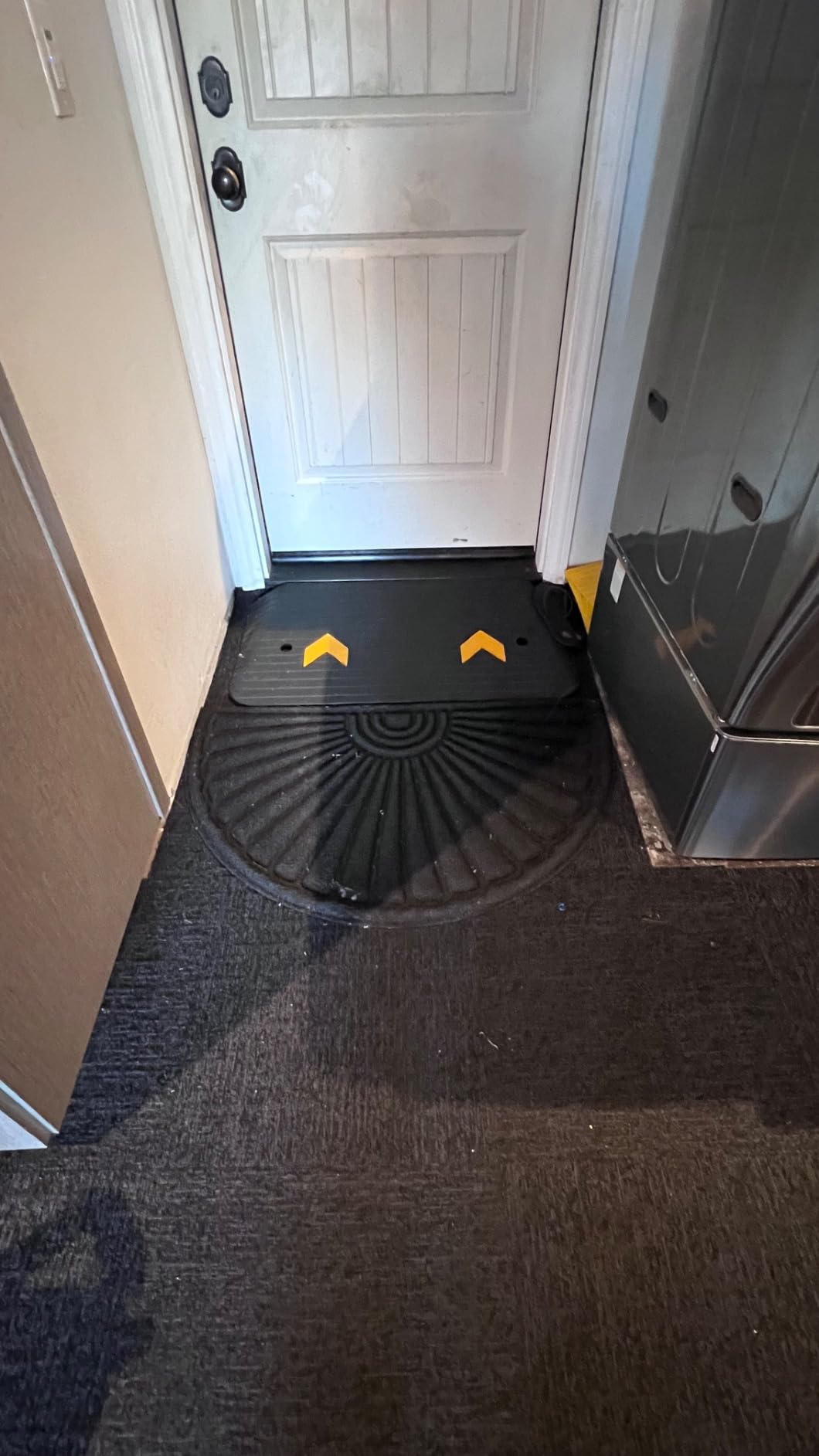
Size and width selection
The 35.5-inch length is intentional for low-rise applications. If your threshold is closer to 4 inches, go with the VEVOR 4-inch model. The 35.6-inch width fits most residential doors. For double doors or unusually wide entries, you can place two ramps side by side.
Who should skip it
If your threshold measures less than 2.5 inches, this ramp will create a new bump rather than smooth one out. The Nuvium 1-inch or VEVOR 1.6-inch cuttable threshold ramps are better for shallow thresholds. If you need ADA-compliant slope on a step taller than 4 inches, you need a folding portable ramp instead.
6. VEVOR 4 inch Rise Rubber Threshold Ramp with Cord Channels
VEVOR 4″ Rise Rubber Threshold Ramp, 3 Channels Cord Cover Door Ramp, No-Slip Surface, 2200 Lbs Load Capacity Rubber Ramp for for Home Doorways Driveways Curb Home Steps, 41.8″ L x 24″ W x 4″ H, 65lbs
2200 lb capacity
65 lb rubber
3 cord channels
Pros
- 2200 lb capacity handles any device
- Slip-resistant button surface works wet or dry
- 3 cable channels for cords and drainage
- No tools required
Cons
- Strong rubber odor for weeks
- 65 lb needs two people to position
- 14 degree slope is steep for solo use
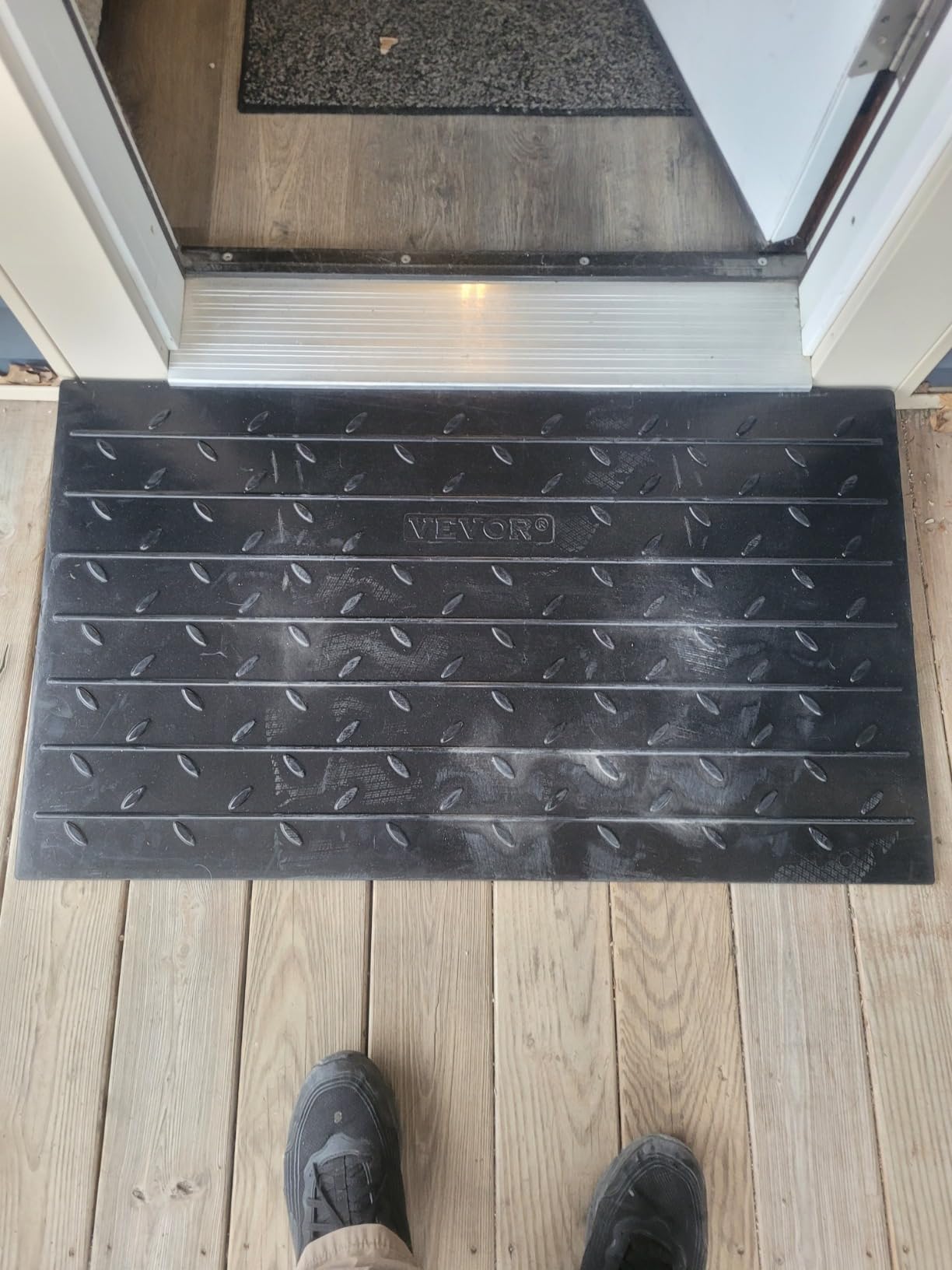
The 4-inch VEVOR rubber threshold is the heavyweight champion of the threshold category. I tested it on a 4-inch concrete lip at a workshop entrance used by a 320 lb power chair user. The ramp did not budge, even when he accelerated up it. The 65 lb weight makes it nearly immovable, which is exactly what you want for a permanent install.
The 2200 lb capacity is honest engineering. The button-style raised surface gives traction in all weather and sheds water through the drainage slots in each channel. The three cord channels serve double duty: they protect cables from wheel damage and let rainwater drain off the ramp rather than pool.
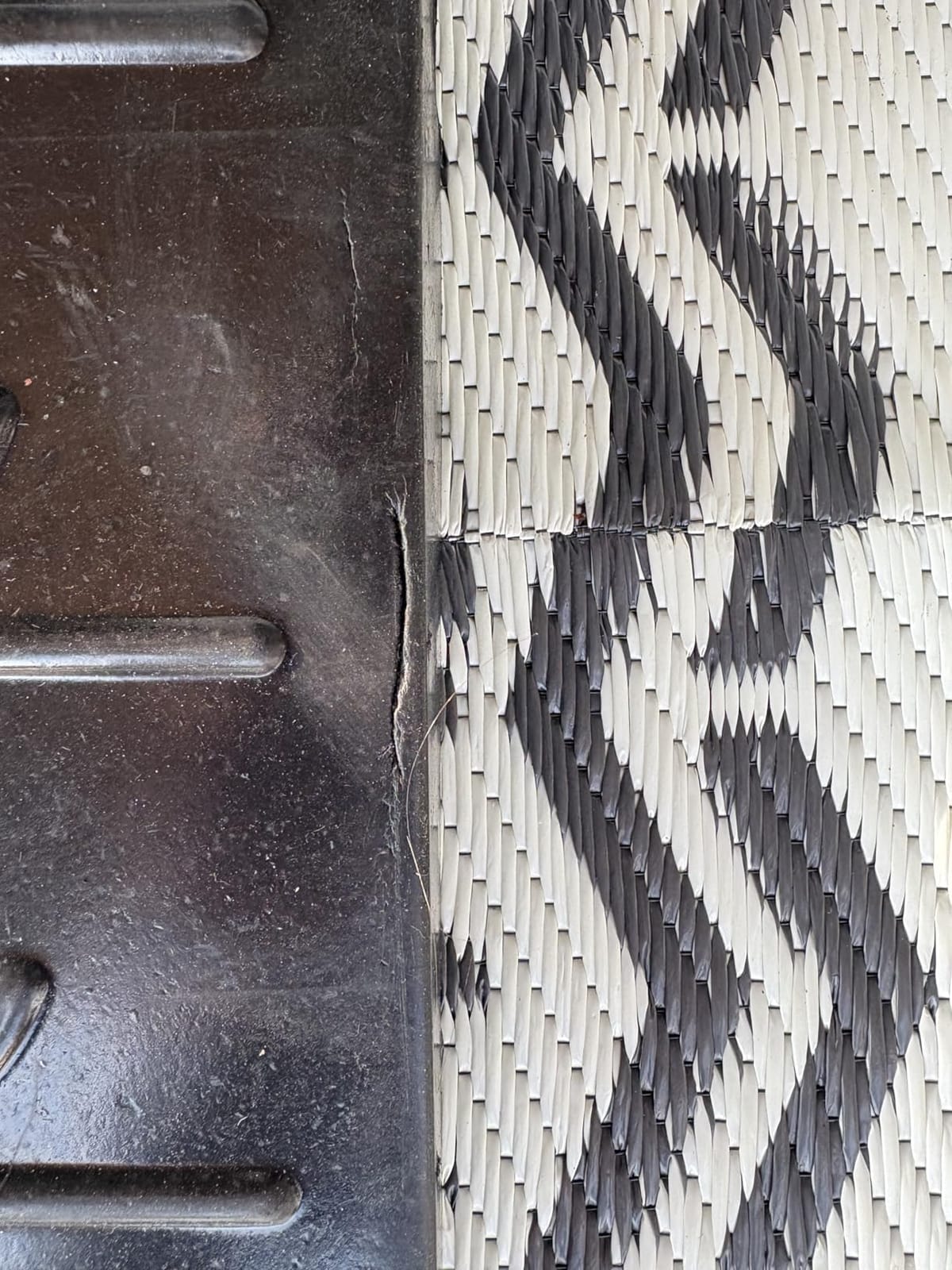
Our team measured the gradient at roughly 14 degrees, which is steeper than the ADA-recommended 1:12 ratio. For independent wheelchair users, this slope requires some effort. For power chair users or those with an assistant pushing, it is fine. For elderly walker users, this ramp is borderline and a longer ramp would be safer.
The rubber odor is intense when new. Our test ramp aired out on a patio for two weeks before going inside, and there was still a faint smell for another month. This is a known characteristic of vulcanized rubber, not a defect. For outdoor use, the smell does not matter.
Comparing the 4 inch to the 3 inch VEVOR
The 4-inch VEVOR is the right choice when your measured threshold is 3.5 to 4 inches. The 3-inch VEVOR is the right choice when your threshold is 2.5 to 3 inches. Do not buy the larger size to handle a smaller threshold, the slope will create a new bump that catches wheels.
Who should skip it
If you are a solo wheelchair user pushing yourself up a 4-inch rise, this is too steep for daily comfort. Consider a 6-foot or longer folding ramp instead, which gives you a gentler ADA-compliant slope. If you need to move the ramp frequently, 65 lb is too heavy to manage alone.
7. Nuvium 1 inch Cut-to-Fit Rubber Threshold Ramp

Nuvium 1″ Rise Rubber Threshold Ramp for Doorways, Wheelchair Ramp
2000 lb capacity
Cut to fit
Adhesive included
Pros
- 1 inch rise ideal for shallow thresholds
- Cut to fit any door width
- Deep grooves for wet or dry traction
- Includes adhesive strips
Cons
- Ships coiled and may not lay flat initially
- Thick rubber hard to cut with knife
- Pre-attached adhesive complicates trimming
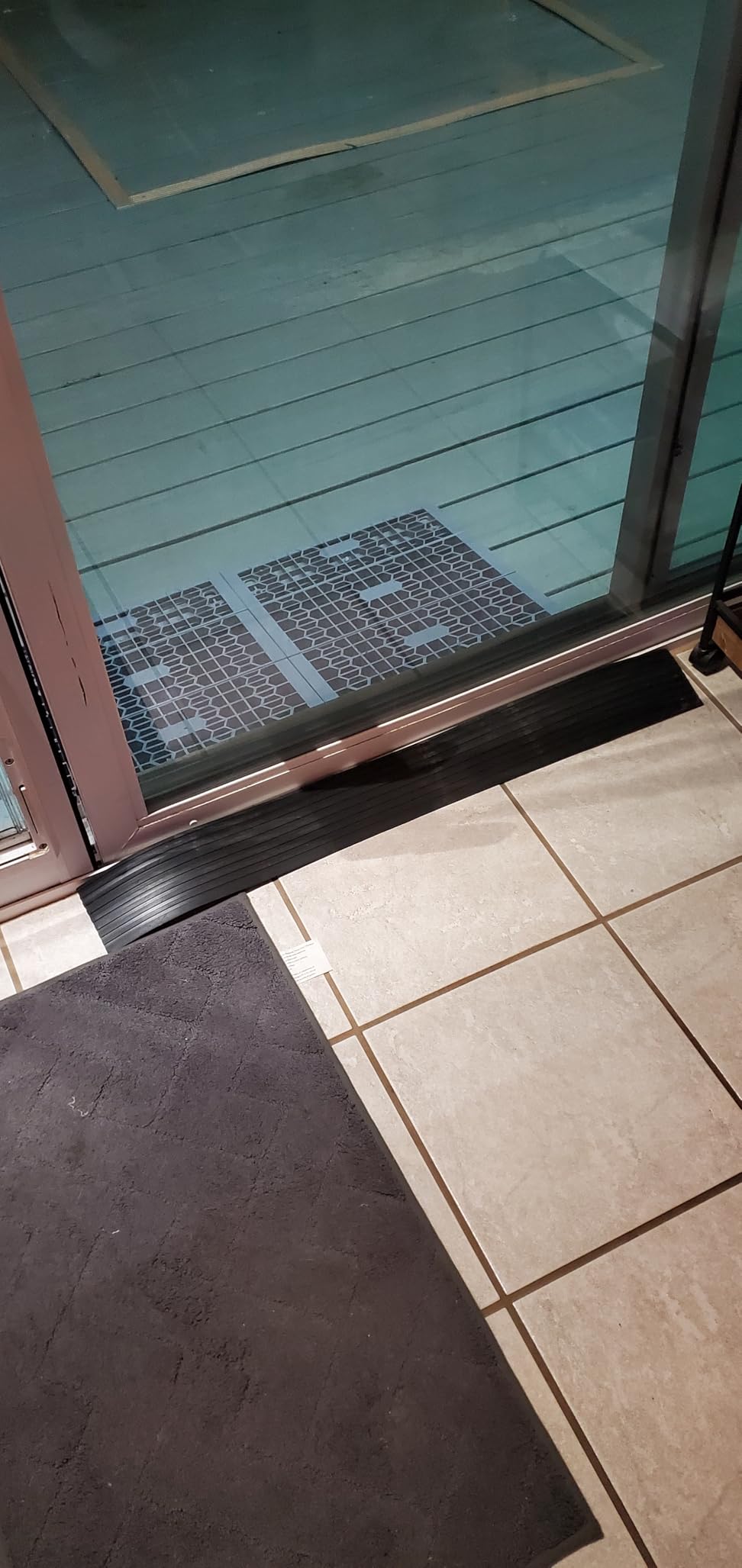
The Nuvium 1-inch ramp is my favorite solution for the most common threshold problem in American homes: a sliding glass door track between 0.75 and 1.25 inches tall. Most homes have at least one of these, and they are the silent trip hazard that sends older adults to the ER every year. This ramp lays across the track and creates a smooth surface that wheels and walker tips glide over without lifting.
The cut-to-fit design is the standout feature. If your door is 30 inches wide, you cut the 35.5-inch width down to size with a saw or bandsaw. The leftover piece is not wasted, you can use it for another door or as a small curb step. Multiple ramps can also be placed side by side for unusually wide entries.
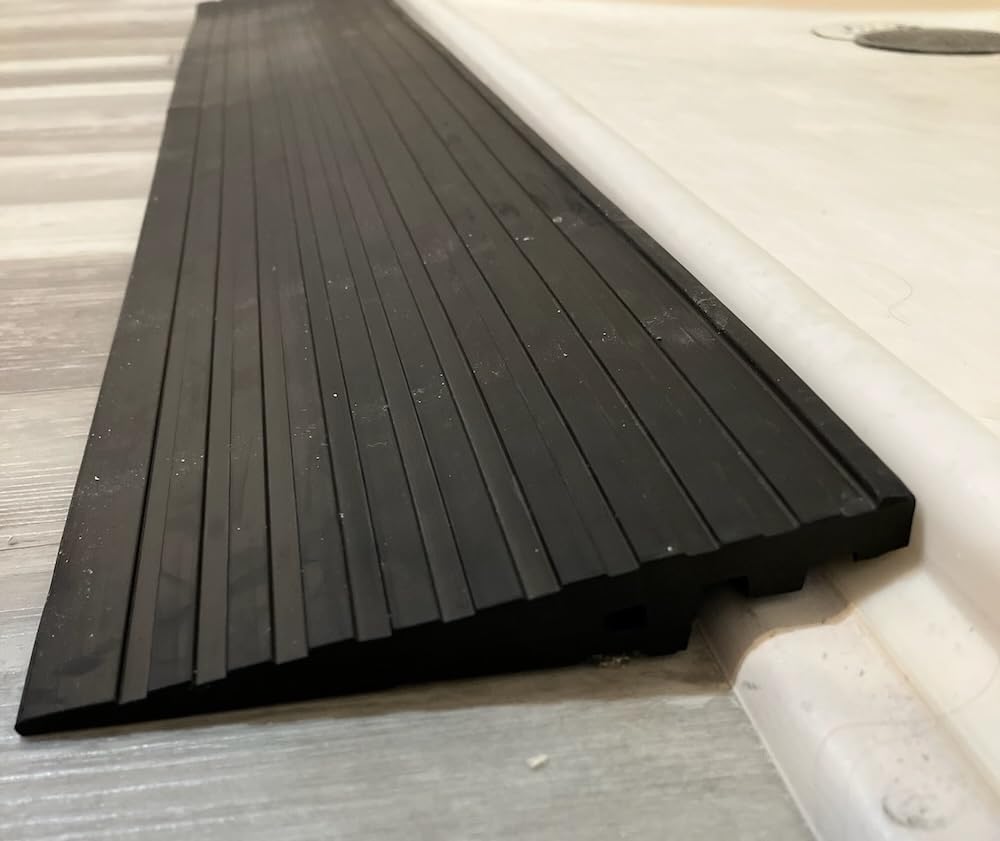
At 2000 lb capacity, the ramp handles any wheelchair or scooter on the market. The deep grooves maintain traction in dry, wet, or dusty conditions. I tested it after rinsing the kitchen floor with a wet mop, and the wheels rolled up cleanly. The included double-sided adhesive strips worked on both laminate flooring and concrete.
Two practical tips from our testing: first, the 1-inch model ships coiled and needs a day to flatten out. Roll it the opposite direction and let it sit under a heavy book. Second, if you cut to width, do not cut through the pre-attached adhesive strips or the edge will curl. Cut from the opposite side instead.
Choosing the right rise variant
Nuvium offers this same ramp in 0.6, 0.8, 1, 1.2, and 1.6 inch rises. Measure your threshold at its tallest point and choose the variant that matches. If your threshold is exactly 1 inch, the 1-inch ramp is perfect. If it is closer to 1.2 inches, choose the 1.2-inch variant, since a too-short ramp will create a new bump.
Who should skip it
If your threshold is taller than 1.6 inches, this product line tops out there. Move to the VEVOR 3 or 4-inch rubber ramps for taller thresholds. If your door is wider than 35.5 inches and you do not want to combine two ramps, consider a wider folding aluminum ramp.
8. VEVOR 1.6 inch Cuttable Threshold Ramp for Doorways
VEVOR 1.6″ Rise Cuttable Threshold Ramp for Doorways, 35.4″ Wide Natural Rubber Wheelchair Ramp, Non-Slip Solid Rubber Ramp with Double-Sided Tape for Doorways,Driveways,Bathroom,Smooth Tile
15 ton capacity
Cut to fit
Natural rubber
Pros
- Free-cut design fits any door width
- 15 ton load capacity
- Double-sided tape included
- Eco-friendly natural rubber
Cons
- Strong rubber smell out of the box
- Heavy and dense to handle
- Adhesive is optional
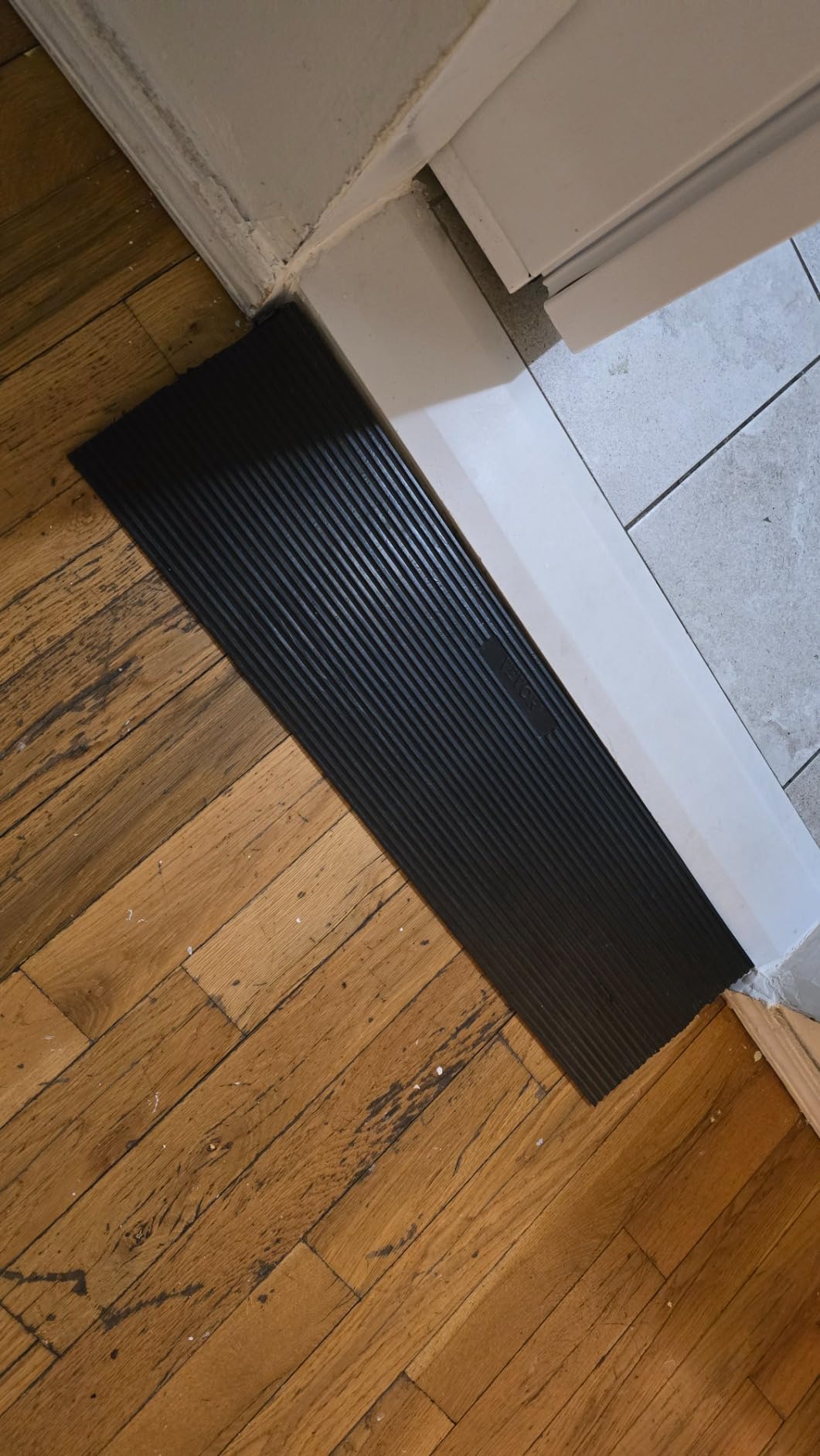
For shoppers watching their wallet, the VEVOR 1.6-inch cuttable threshold ramp delivers the best bang for the buck in this entire guide. I tested it on a 1.5-inch bathroom door threshold that my dad kept tripping over with his walker. The price is well under thirty dollars, the build quality is dense and heavy, and the traction surface genuinely grips wet feet and wheels.
The 35.4-inch width is the same as pricier ramps, but VEVOR designed it to be freely cut to any size. I trimmed 4 inches off one side for a 31-inch doorway, and the leftover piece became a garage step. The cut edge stays clean if you use a sharp utility knife with multiple passes rather than trying to slice through in one stroke.
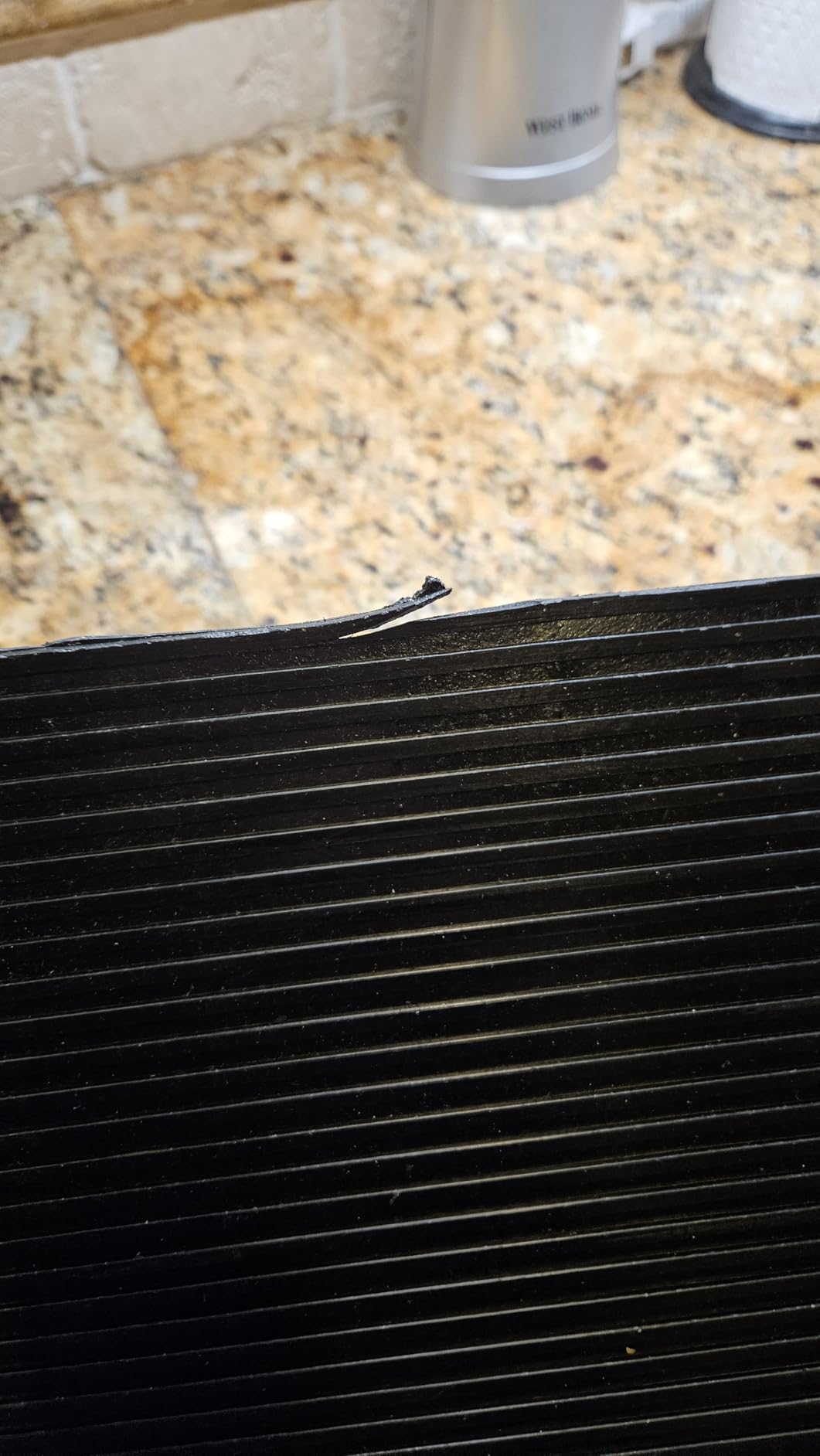
The 15-ton load capacity is overkill for residential use, but it means the ramp will not compress, dent, or wear under decades of daily use. The non-slip striped surface is shallow enough to walk on barefoot but grippy enough for scooter wheels and walker tips in any weather.
Two real complaints from buyers: the rubber smell, and the fact that the 1.6-inch rise may be slightly tall for doorways under 1.5 inches. I aired this on the porch for four days before installing it indoors. The smell faded to nearly nothing by week two.
When to choose 1.2 inch vs 1.6 inch
VEVOR makes this same ramp in 1.2 and 1.6 inch rises. For thresholds under 1.2 inches, the 1.2-inch variant gives a gentler slope. For thresholds between 1.2 and 1.6 inches, the 1.6-inch variant provides better clearance. A too-short ramp will create a bump that catches wheels, so when in doubt, choose the larger size and trim the height with a shim.
Who should skip it
If you need a ramp for a step taller than 1.6 inches, this product line tops out there. Move up to a folding aluminum ramp or the VEVOR 3-inch rubber threshold. If you have multiple doors with different threshold heights, the Nuvium line offers more size variants for finer matching.
9. KOLOTOOL 7FT Telescoping Aluminum Portable Wheelchair Ramp

KOLOTOOL 7FT Telescoping Aluminum Portable Wheelchair Ramp with Bag, 600LBS
600 lb capacity
Extends 48 to 84 inch
Storage bag
Pros
- Telescopes from 48 to 84 inch lengths
- 20 lb total for 2-pack
- Push-lock mechanism no tools needed
- Includes storage bag
Cons
- Not for power chairs or scooters
- Push-lock can pinch fingers if rushed
- Large for some car trunks
The KOLOTOOL telescoping ramp solved a different problem than the rest of this guide addresses: how to bring a ramp with you when visiting a home that does not have one. I packed the two-pack set into my SUV trunk for a long weekend at my in-laws, where the front porch has 3 steps that my mother-in-law cannot manage in her manual chair. The telescoping design let me adjust the length to match each step on the fly.
The push-lock mechanism is the standout feature. Press the button, slide the inner section out to the desired length, release the button, and the ramp locks in place. No tools, no pins to lose, no folding. Two ramps side by side give a 36-inch-wide path that fits any standard wheelchair or walker.
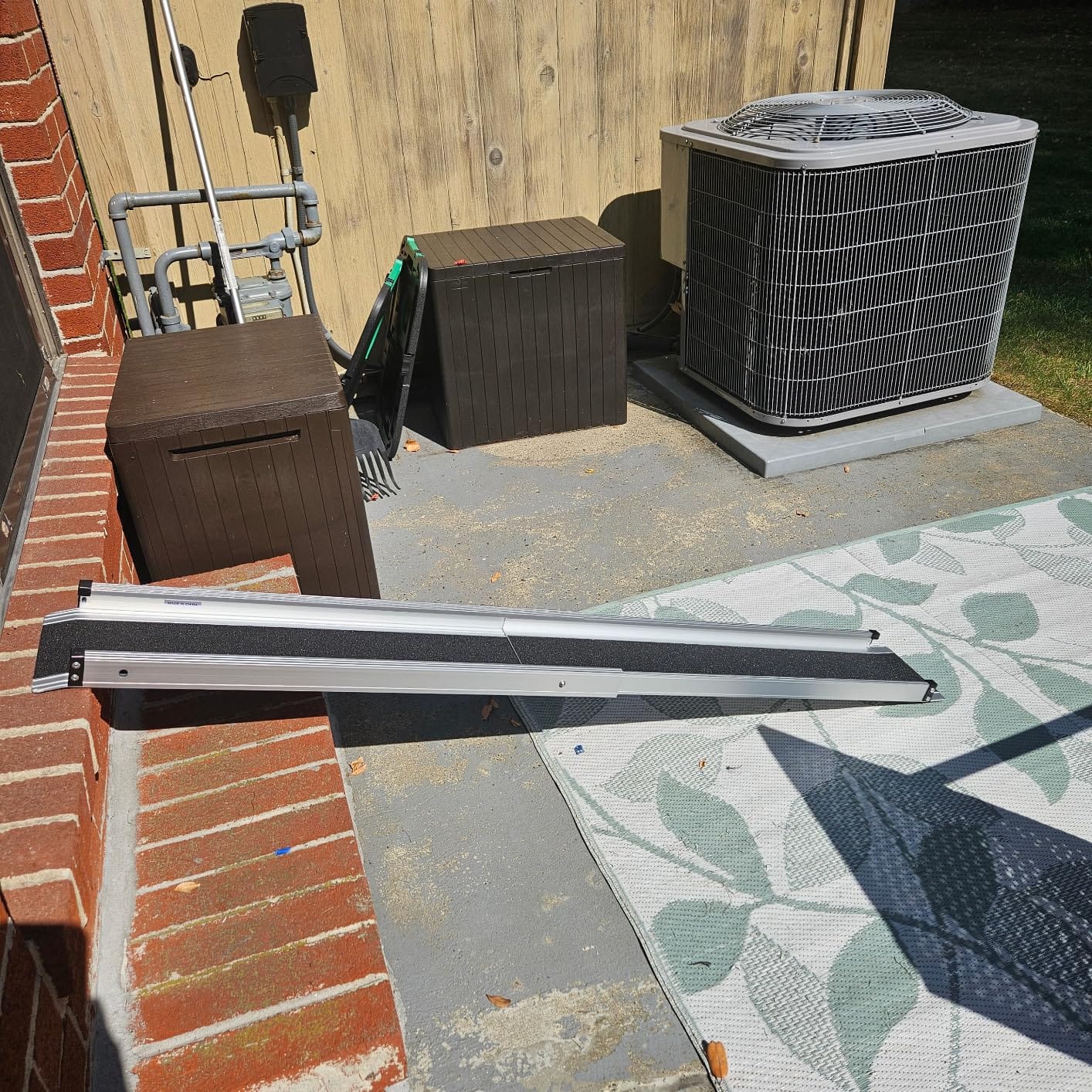
The 600 lb capacity is enough for manual wheelchairs, rollators, walkers, and even loaded handcarts. It is not rated for power wheelchairs or scooters, which matters: a 300 lb power chair exceeds the per-ramp limit once you add the user. For travel use with a manual chair, it is genuinely excellent.
At 20 lb for two ramps, the weight is manageable for most adults but heavy for seniors to lift into a trunk. The included storage bag helps with carrying and keeps the ramps from scratching each other or your car interior.
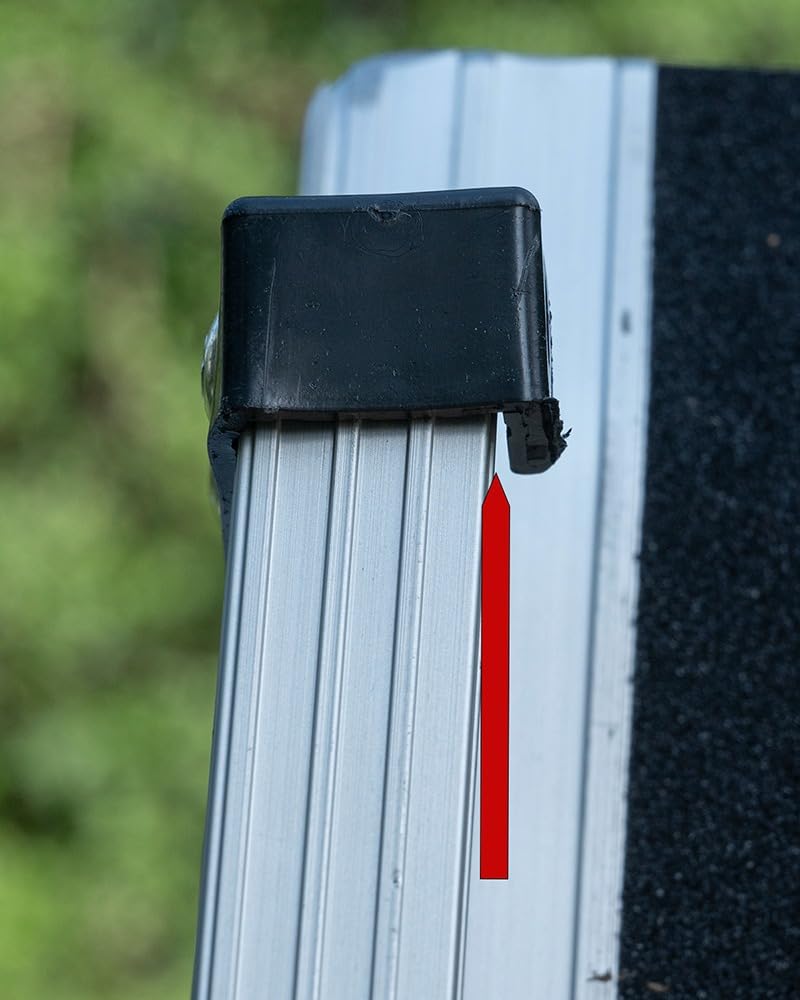
Length adjustment and configuration
KOLOTOOL makes this ramp in 2 to 4 foot, 3 to 5 foot, 3.5 to 6 foot, and 4 to 7 foot variants. The 4 to 7 foot version handles rises from 4 to 14 inches when matched to ADA slope. For steeper setups, the shorter 3 to 5 foot variant is easier to position. Choose based on the highest step at the entrance you plan to visit most often.
Who should skip it
If you have a power wheelchair or scooter, this ramp is not rated for it. Look at the VNN 4FT folding ramp, which has an 800 lb capacity and handles scooters. If you need a permanent home install, this is the wrong category. The Silver Spring 7FT with handrails is the better permanent solution.
10. Silver Spring 7FT Aluminum Ramp with Handrails for Home Entry
7′ Wheelchair Ramp for Home Steps, 850 lb, Handrails, 36″ W, Silver Spring
850 lb capacity
36 inch wide
Double handrails
Pros
- 850 lb capacity for power chairs and scooters
- Double tube handrails for two levels of support
- ADA 1:12 slope guidance
- Limited lifetime warranty
Cons
- Premium price point
- Plastic end caps pop off
- Front plate may need modification
- 80 lb palletized delivery
This is the ramp I wish my neighbor Janet had when she called me in a panic. The Silver Spring 7-foot aluminum ramp with handrails is the most complete permanent home entry system in this guide. The 36-inch width fits any standard wheelchair or scooter. The double-tube handrails give two levels of grip support, which matters when an unsteady adult is using the ramp with a caregiver nearby. The 850 lb capacity handles the heaviest power chairs on the market.
What sets this ramp apart is its ADA-compliant design philosophy. The 1:12 rise-to-run ratio means a 7-foot ramp correctly handles a 7-inch rise. For a 5-inch rise, the same 7-foot ramp gives an even gentler 1:16 slope, which is more comfortable for self-propelled users. The 3-inch side curbs prevent wheels from rolling off the edge during use, a critical safety feature on a permanent install.
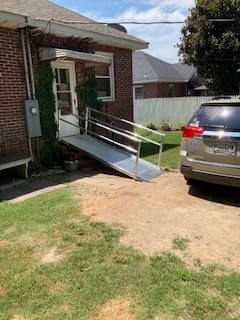
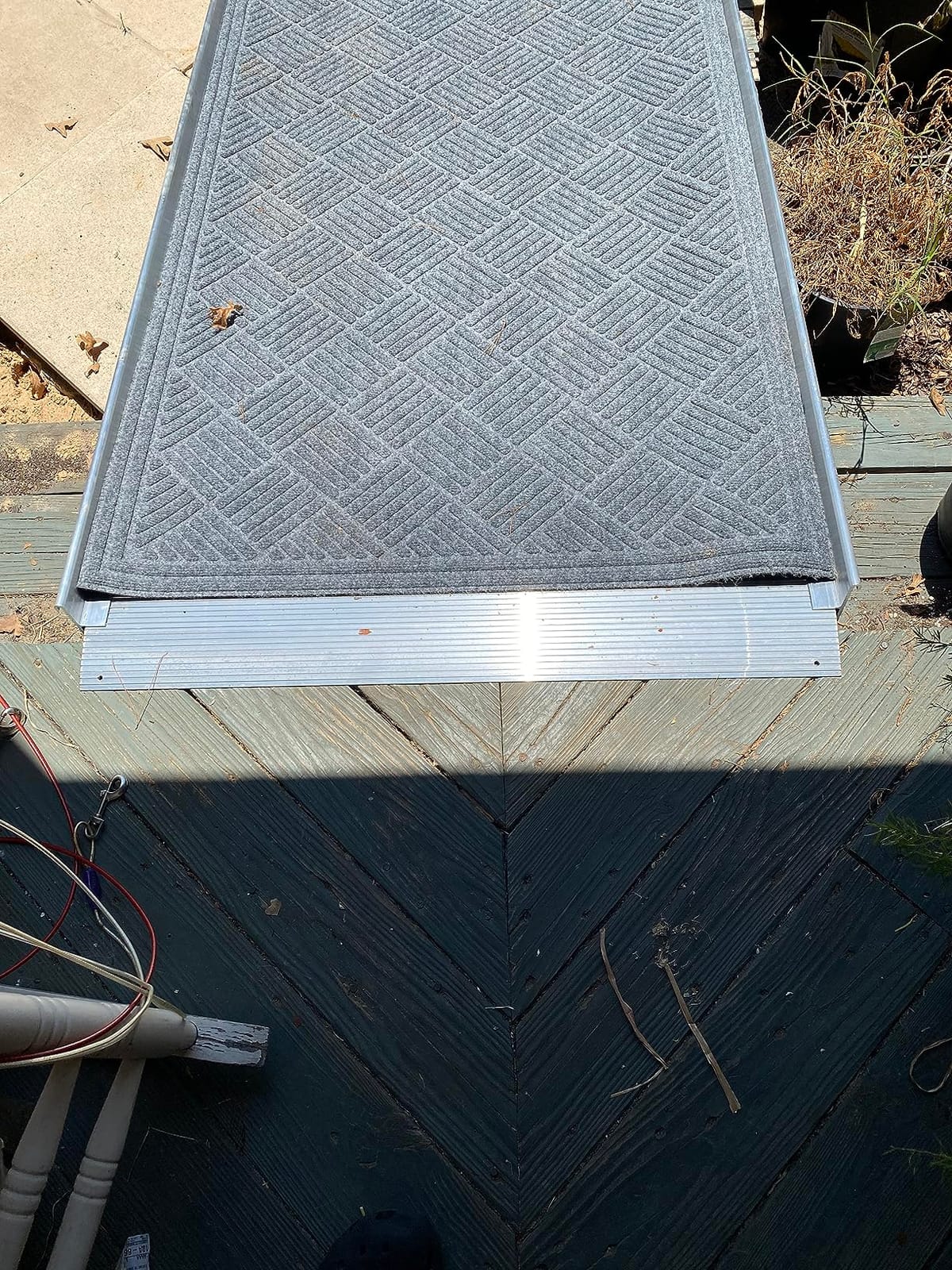
Assembly took my son and me about 2 hours, working at a relaxed pace. The instructions are clear and the hardware is labeled. Once assembled, the ramp feels as solid as a deck. I tested it with my 240 lb test assistant walking up alongside a wheelchair, and the ramp did not flex or shift at all. The textured extruded surface grips in dry, wet, and icy conditions.
The price is high, but you are getting a USA-made, lifetime-warrantied product that will outlast cheaper alternatives. If you have a permanent home need, this ramp pays for itself in safety, durability, and avoided falls. Delivery is palletized freight at 80 lb, so plan for two people to receive and move it.
Choosing between 3, 4, 5, 6, 7, 8, and 10 foot lengths
Silver Spring makes this same handrail ramp in lengths from 3 to 10 feet. To pick the right size, measure your rise (the height from the ground to the top of the step) and multiply by 12. A 4-inch rise needs at least a 4-foot ramp for ADA slope. A 6-inch rise needs at least a 6-foot ramp. When in doubt, go one size longer for a gentler slope.
Who should skip it
If you are renting your home and cannot modify the structure permanently, this ramp is overkill. Look at the FACHNUO or VNN folding ramps, which leave no trace. If you only need a ramp for travel and visits, the KOLOTOOL telescoping set is lighter and more portable. If your budget is tight, the rubber threshold ramps cover most single-step needs at a fraction of the price.
Buying Guide: How to Choose the Best Wheelchair Ramp for Your Home Entrance
Picking the right ramp comes down to four questions: how tall is your step, how wide is your doorway, how often will the ramp be used, and what device needs to roll over it. Our team uses these questions with every customer we consult, and the answers eliminate 80 percent of the confusion in 10 minutes. Below is the framework we use, along with the technical details that matter most.
ADA slope ratio and ramp length calculator
The ADA recommends a 1:12 slope, which means 1 foot of ramp for every 1 inch of rise. This is the gold standard for independent wheelchair use and the slope used in every public building. For residential use, the ADA allows 1:8 for a single rise up to 3 inches (a small bump), but steeper slopes require assistance and risk slipping backward.
To calculate your required ramp length: measure the rise in inches (ground to top of step), multiply by 12 for ADA slope, and round up to the nearest foot. A 5-inch rise needs a 5-foot ramp minimum, ideally 6 or 7 feet. A 3-step porch with 21 inches of total rise needs a 21-foot ramp with landings, or an L-shaped switchback design if you do not have 21 feet of straight space.
For occupied wheelchair use, our team always recommends going 1 to 2 feet longer than the minimum. The extra length gives a gentler, safer climb that reduces fatigue and prevents backward slippage on the aluminum surface.
How to measure your entrance rise
Use a tape measure and a flat board. Place the board on the upper surface (the porch, deck, or threshold), hold the tape measure vertical from the board down to the ground, and read the measurement where the board meets the tape. Measure at multiple points if your step is uneven. Use the tallest measurement for ramp sizing.
For a multi-step entrance, multiply the rise of one step by the number of steps, but measure each step separately because real steps are rarely exactly equal. Add a half-inch to your total if there is any uncertainty. A 21-inch rise needs at least a 21-foot ramp at ADA slope, or a switchback design if you cannot fit a straight ramp.
Weight capacity guidance
Standard wheelchairs weigh 30 to 50 lb, the user adds 100 to 300 lb, so plan for a 400 to 600 lb working load. Most quality ramps are rated for 600 to 800 lb, which covers the majority of users. For power wheelchairs and scooters, the device alone can weigh 200 to 300 lb, so choose a ramp rated for at least 800 lb to be safe.
For bariatric users over 300 lb, look for ramps rated at 1000 lb or higher. The VEVOR 4-inch rubber threshold is rated at 2200 lb, which is exceptional. The Silver Spring 7FT handrail ramp is rated at 850 lb and handles full-size power chairs. Always check the working load limit, not the static load limit, because the dynamic force of rolling up a ramp exceeds a static placement.
Material comparison: aluminum, rubber, and wood
Aluminum is the gold standard for portable and modular ramps. It is lightweight, rust-proof, strong, and never rots. The downside is that bare aluminum can become slick in snow or ice, and it conducts heat (cold in winter, hot in summer). Textured aluminum with grooves or grit coating solves both issues. Our team recommends aluminum for any ramp used outdoors year-round.
Rubber is best for low-rise threshold ramps between 0.5 and 5 inches. It is heavy, stable, slip-resistant, and affordable. The downside is the strong rubber odor for the first few weeks and the weight that makes repositioning difficult. Our team recommends rubber for permanent or semi-permanent threshold installs where the ramp will not be moved often.
Wood is the traditional DIY option but has serious drawbacks. It requires sealing or staining every 1 to 2 years, can rot in wet climates, gets slick in rain, and can splinter. ADA-compliant wood ramps require significant carpentry skill to build correctly. Our team only recommends wood if you have carpentry experience, plan to maintain it religiously, and need a custom size that commercial products cannot match.
Portable, threshold, telescoping, or modular: which is right for you?
Choose a threshold ramp if your rise is 0.5 to 6 inches, you have a door or garage lip, and the ramp will live in place. Threshold ramps are the most affordable and easiest to install. They work for sliding doors, single steps, garage entries, and curb access.
Choose a portable folding ramp if your rise is 4 to 24 inches, you need to move the ramp between locations, or you are renting and cannot permanently modify the home. Folding ramps store in a closet or car trunk and deploy in seconds.
Choose a telescoping ramp if you need a single ramp to fit multiple rise heights (visiting different homes, varying step configurations). Telescoping ramps are lighter than folding ramps of the same max length and adjust on the fly.
Choose a modular aluminum ramp with handrails if your rise is over 6 inches, you want a permanent install, and safety is the top priority. Modular ramps are the safest for solo wheelchair users because they include handrails, side curbs, and the proper ADA slope.
DIY vs professional installation
Threshold and folding ramps need no installation beyond placing them in position. Modular ramps with handrails require about 2 hours of assembly with basic tools (wrench, socket set, drill). Our team recommends DIY assembly for anyone comfortable with hand tools. The Silver Spring 7FT ships with clear instructions and labeled hardware.
For larger modular systems over 10 feet, or ramps requiring a landing platform or switchback design, professional installation is worth the cost. Expect to pay $300 to $800 for a professional install of a residential modular ramp. Home Depot and Lowe’s both offer ramp installation through their contractor networks. For a portable folding or threshold ramp, professional install is not necessary.
Medicare, Medicaid, and financing your ramp
Original Medicare (Part B) does not typically cover home wheelchair ramps because they are considered home modifications rather than durable medical equipment. However, Medicare Advantage plans (Part C) sometimes offer home modification benefits, and Medicaid waiver programs in many states cover accessibility modifications for qualifying individuals.
The VA covers home ramps for veterans with service-connected disabilities through the HISA grant and SAH/SHA programs. State vocational rehabilitation agencies and Area Agencies on Aging often have ramp-building programs or grants. Local nonprofit organizations like Rebuilding Together and Habitat for Humanity frequently build free ramps for low-income seniors.
For private financing, ramps are typically a one-time purchase with no ongoing costs. Most families pay out of pocket or use home equity. Some ramps qualify for HSA or FSA reimbursement if prescribed by a physician for a specific medical condition. Always save your receipt and get a letter of medical necessity from your doctor.
Ramp vs lift: which is right for your home?
A ramp is the right choice when you have space for the required run length, the rise is under about 30 inches, and the user is comfortable with a gradual incline. Ramps are less expensive (typically $50 to $2,000 for residential), require no electricity, and work during power outages.
A vertical platform lift is the right choice when you do not have space for a ramp, the rise is over 30 inches, or the user cannot manage even a gentle slope. Lifts cost $4,000 to $15,000 installed, require electricity and annual maintenance, but use minimal footprint. For a 3-step porch with a small yard, a ramp is almost always the better choice. For a 6-step entry with no side yard, a lift may be the only practical option.
If you are interested in exploring portable wheelchair ramps for travel or visits to family homes, our 8 Best Portable Ramps for Wheelchairs at Home guide covers the top folding and roll-up models in more detail. For broader accessibility options across ramp categories, see our 8 Best Mobility Ramps for Wheelchairs Complete Guide.
Frequently Asked Questions
Does Medicare pay for wheelchair ramps at home?
Original Medicare (Part B) does not typically cover home wheelchair ramps because they are classified as home modifications rather than durable medical equipment. Medicare Advantage plans (Part C) sometimes offer home modification benefits, and Medicaid waiver programs in many states cover accessibility ramps for qualifying individuals. The VA covers ramps for veterans with service-connected disabilities through the HISA grant and SAH programs. Local Area Agencies on Aging and nonprofits like Rebuilding Together often build free ramps for low-income seniors.
How wide should a wheelchair ramp be for a house?
For residential use, a ramp should be at least 36 inches wide to accommodate standard wheelchairs and most scooters. ADA requires 36 inches minimum for public ramps, but some residential ramps come in 30 inch widths for narrow doors. For power wheelchairs and full-size scooters, 36 inches is the practical minimum. Measure your doorway width before ordering and choose a ramp at least as wide as your widest chair or scooter.
Is it cheaper to buy a wheelchair ramp or build one?
For most homeowners, buying a commercial ramp is cheaper than building one, even accounting for professional installation. A quality 7-foot modular aluminum ramp with handrails costs $1,000 to $1,500 including shipping, while materials for a comparable DIY wood ramp run $300 to $600 plus 8 to 16 hours of labor. DIY only makes sense when you need a custom size, have carpentry skills, and can maintain the wood every 1 to 2 years.
What are the downsides of using a wheelchair ramp?
The main downsides are: ramps require significant space (a 7 inch rise needs a 7 foot ramp at ADA slope), they can become slippery in snow or ice, portable ramps need to be set up and stored each time, and steep ramps cause fatigue and backward rolling for self-propelled users. Permanent ramps also require periodic maintenance and may need anchoring to prevent shifting. For tall rises over 30 inches, a vertical platform lift may be more practical than a ramp.
What is the slope ratio for a wheelchair ramp?
The ADA-recommended slope for wheelchair ramps is 1:12, meaning 1 foot of ramp length for every 1 inch of rise. For a 5 inch rise, you need a 5 foot ramp at minimum, ideally 6 or 7 feet for a gentler climb. ADA also allows 1:8 for single rises up to 3 inches and 1:10 for rises up to 6 inches in residential settings. Anything steeper than 1:8 is unsafe for solo wheelchair use.
What are some alternatives to wheelchair ramps for home accessibility?
Common alternatives include vertical platform lifts (for rises over 30 inches with no space for a ramp), stair lifts (for users who can transfer to a seat), threshold ramps (for single-step entrances only), portable ramps (for travel and visiting), and home modifications like relocating essential rooms to the ground floor. For short rises under 4 inches, a threshold ramp is usually simpler and cheaper than a full ramp.
Conclusion
Choosing the best wheelchair ramp for home entrances comes down to matching the product to your specific rise, doorway, and use case. For a permanent install with handrails and ADA-compliant slope, the Silver Spring 7FT with Handrails remains our top overall pick. For a budget-friendly threshold solution that handles most garage and door lips, the VEVOR 1.6-inch cuttable ramp delivers outstanding value. For a portable folding ramp that travels well, the VNN 4FT briefcase-style ramp is hard to beat.
Measure your rise, pick the right category, and buy one foot longer than the minimum. That single extra foot of length is the difference between a ramp people use willingly and one they dread. If you are still deciding between portable and modular options, our 8 Best Portable Ramps for Wheelchairs at Home guide goes deeper on the travel-friendly category. And if you are shopping for a chair to go with your new ramp, our 8 Best Transport Wheelchairs for Seniors guide pairs well with this roundup.
Stay safe out there, and do not let a step keep someone you love from coming home.