
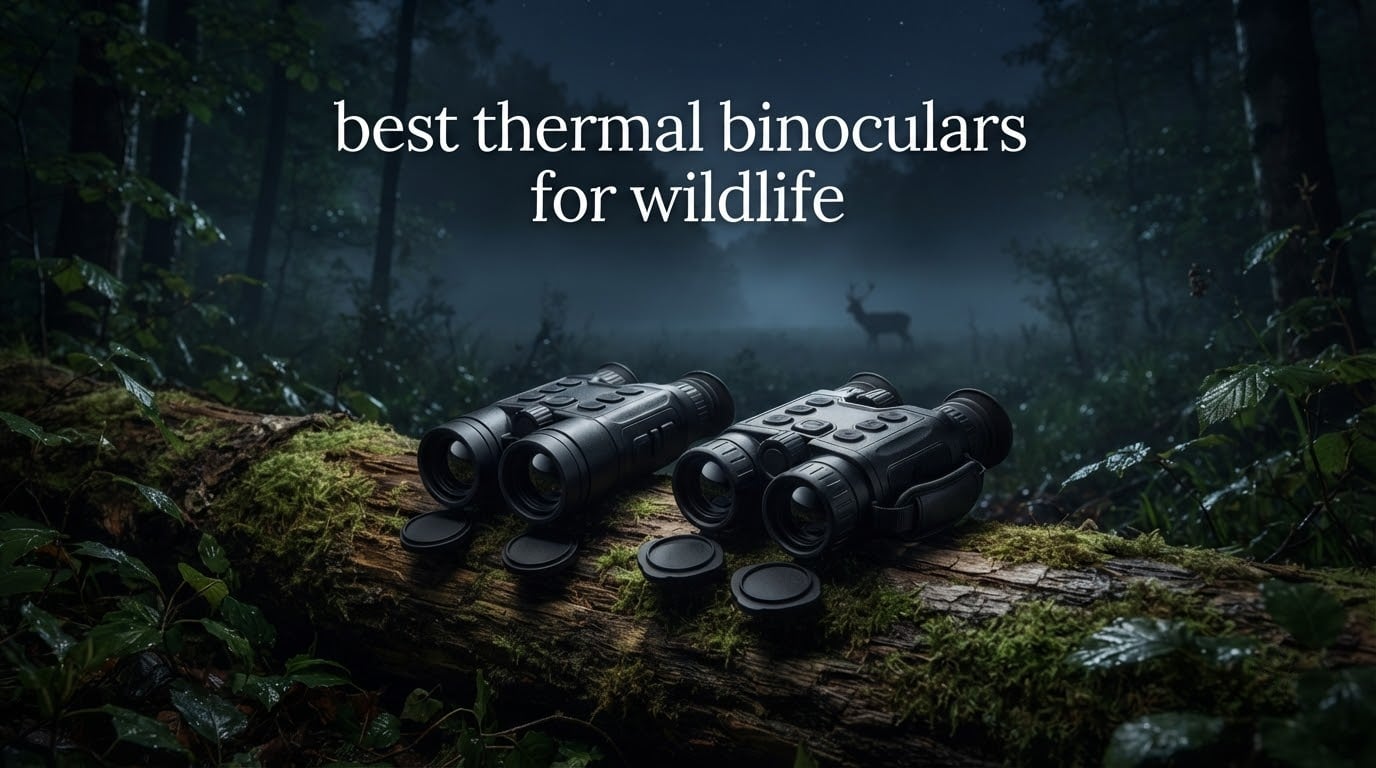
The best thermal binoculars for wildlife right now are the AGM Global Vision ObservIR LRF 25-256, the ATN BinoX 4T 384 4.5-18x, and the ATN Binox 6 Dual. Those three cover the realistic range of this niche, from a light 850 g all-in-one unit to a high-magnification long-range glass and a fusion binocular with the strongest owner feedback per review. Eight genuine thermal binocular listings made our final cut, and we ranked all eight on sensor resolution, objective lens, ranging, endurance and ergonomics.
Thermal binoculars are dual-eyepiece devices that read infrared heat from animals and turn temperature differences into a picture. A germanium objective lens collects the infrared radiation, an uncooled micro-bolometer sensor measures the small temperature gaps between a warm body and its background, and a processor maps those gaps onto a display using palettes like white hot or black hot. No light source is involved, so they work in full darkness, fog and smoke where daylight glass and image intensifiers fail.
That matters enormously for wildlife. A thermal binocular lets you scan a treeline at 2 a.m., confirm a deer is there, and record a still of it without a single sound reaching the animal. Non-lethal observation is the whole point for most of us, and r/Optics readers repeatedly frame thermal as the tool that lets you watch behaviour rather than disturb it.
Two honest warnings before we get into the list. First, this is a narrow and expensive category, and eight is the honest count of listing-level thermal binocular options rather than daylight-glass or night-vision products dressed up to fill space. Second, review counts here are tiny, so we lean heavily on published sensor and lens specifications and treat owner feedback as a directional signal rather than a statistical one. If you want a sense of what to pair one with, our general binocular buying guide covers daylight glass, and the spotting scope guide covers long-range glass observation.
Table of Contents
Top 3 Best Thermal Binoculars for Wildlife in 2026
These three are the picks we would hand to a friend who asked us to choose one model. The first is the most complete all-rounder, the second is the tool for scanning open country at high magnification, and the third is the best-balanced unit if you want a light body with fusion features that actually help identification.

AGM ObservIR LRF 25-256
- 12um 256x192 thermal core
- 1000m laser rangefinder
- 850g body
- IP67 sealed
- 4K low-light channel
ATN Binox 6 Dual
- 256x192 core
- four viewing modes
- Dual View fusion
- 1000 yard LRF
- 1.6 pound body
One caveat on the ordering. The BinoX 4T 4.5-18x is the one model here with a polarized owner record, with 38 percent five-star ratings running against 23 percent one-star ones and a cluster of three-star reviews in between, which averages to 3.5 stars across 13 reviews. Its hardware specification is among the strongest in the list, so we placed it on the strength of the published spec and flagged the split rather than hiding it behind a single number.
All 8 Thermal Binoculars Compared (October 2026)
Here is the whole field in one table. Every model below is a true thermal binocular with an infrared sensor core, listed in the order we review them.
| Product | Specifications | Action |
|---|---|---|
| AGM ObservIR LRF 25-256 |
|
Check Latest Price |
| ATN BinoX 4T 384 4.5-18x |
|
Check Latest Price |
| ATN Binox 6 Dual |
|
Check Latest Price |
 Pulsar Merger LRF XT50 Pulsar Merger LRF XT50 |
|
Check Latest Price |
 i4SEE B50-640 i4SEE B50-640 |
|
Check Latest Price |
 ATN BinoX 4T 384 2-8x ATN BinoX 4T 384 2-8x |
|
Check Latest Price |
 Pulsar Symbion LRF Pulsar Symbion LRF |
|
Check Latest Price |
 AGM ObservIR LRF 35-384 AGM ObservIR LRF 35-384 |
|
Check Latest Price |
A few things jump straight out of that spec sheet. There are three distinct sensor classes in this group: 256×192, 384×288, and then the 640×480 and 1280×1024 models at the top. There is also a clear weight spread, from an 850 g AGM body through 1.6 lb and 2 lb class models to a 2.5 lb ATN, which matters a great deal once you are four hours into a standing watch.
One name in that table is not a manufacturer. The 2-8x BinoX 4T listing is sold through theOpticGuru, a third-party retailer brand, rather than through ATN’s own storefront. The hardware is an ATN BinoX 4T, but the warranty is two years instead of the three ATN offers directly, which is worth factoring into any decision.
How We Ranked These 8 Models
We scored every unit on five weighted criteria, and we are publishing the weights because almost nobody in this niche does. Sensor resolution and pixel pitch carry the most weight at 30 percent, since that single factor sets your realistic identification ceiling. Objective lens diameter and magnification together account for 25 percent, because light gathering and zoom determine whether a distant animal is a blob or a recognisable deer. Ranging and usability features are 15 percent, battery and weather sealing are 20 percent, and weight and balance are 10 percent.
We also applied hard filters. Anything without an uncooled micro-bolometer thermal core was excluded outright, which is why daylight-glass binoculars, IR-LED night-vision goggles and stand-alone thermal cameras do not appear. Same-model sensor-resolution twins were collapsed into a single entry, so the AGM ObservIR family appears twice at most and never as a near-duplicate row.
That is why this list stops at eight when a roundup of ten would look tidier. The remaining search results that could pad the list are not thermal binoculars. We would rather hand you eight devices that all do the same job than ten where two are a different product category entirely.
One more caveat about the numbers. No product in this roundup has more than 20 reviews, and six of the eight have fewer than 10. A single damaged unit or one bad support interaction moves a rating by a full star at that sample size, so we weighted published specifications heavily and used review averages to detect patterns rather than to declare a winner. Owners on r/Thermal and r/Binoculars are similarly sceptical of affiliate-heavy best-of lists that never name a drawback, and we have tried to name one for every unit here.
1. AGM ObservIR LRF 25-256 Review: The Most Complete All-Rounder
AGM Global Vision ObservIR LRF 25-256 Fusion Thermal Imaging Binoculars
12um 256x192 VOx core
1000m LRF
850g
IP67 sealed
8hr plus USB-C
Pros
- Thermal and digital day/night in one body
- 4K ultra-low-light CMOS channel
- 1000m integrated laser rangefinder
- 64 GB storage with Wi-Fi and GPS
- 5 year manufacturer warranty
Cons
- 256x192 core limits fine detail at long range
- 25mm objective is small beside 50mm-class rivals
- Only 20 reviews so the record is still thin
This is the unit I keep reaching for, and the reason is not the thermal core. It is that a 256×192 sensor at 12 micron pitch is a small engine, and it still works well, because the AGM wraps it in a genuine dual-spectrum body. There is a 3840×2160 ultra-low-light CMOS channel behind the same barrels, a 1920×1080 OLED display, a 1000 m laser rangefinder, GPS, 64 GB of storage and Wi-Fi. For wildlife observation that combination of confirmation channels is more valuable than raw resolution.
At 850 g it is the kind of weight you can hold up for a full evening without your forearms complaining, which is a bigger practical advantage than it sounds. Watchers who are used to a pair of compact binoculars will find the shape familiar, and the neck strap plus tripod adapter in the box mean you are not buying extra kit on day one. Rated IP67 for water and dust, with a 5 year manufacturer warranty behind it.
The honest weakness is the core itself. 256×192 is 49,152 pixels, and on a deer at 400 yards the animal is likely to be a bright shape with legs rather than a clean identification. If your primary interest is confirming species at long range across open ground, a 384×288 or 640×480 sensor will serve you better. What the 25-256 does instead is give you a fast, low-friction way to find the animal and then switch to the 4K low-light channel to identify it in colour.
Battery life is quoted at up to 8 hours of continuous use with USB Type-C external power support, which is the shortest runtime of the group and the one number I would plan around. In practice that is fine for a full night’s observation, and a power bank covers the margin. Owners in the reviews praise the combination of channels, the OLED display and the integrated rangefinder in a single lightweight package, with 89 percent of ratings at five stars.
How this performs on identification at real wildlife distances
Set expectations with the resolution rather than the marketing. On a large animal like elk or a moose at close-to-medium range, the thermal channel gives you presence and rough outline comfortably. On a deer at 400 yards, expect to identify it as a deer but not to count tines or judge age. On a coyote at 200 yards in open ground, the AGM will usually confirm the shape, and the 4K low-light channel can then give you fur detail and colour if there is enough moonlight or ambient light left.
That two-stage workflow is the real lesson. Find with thermal, confirm with the low-light channel. A binocular with a single 256×192 thermal core forces you to make identification decisions from a small thermal image alone, which is where those pixels become a genuine limit rather than a spec-sheet footnote.
What to check before you commit at this tier
Ask yourself how often you will be looking at animals far enough away that sensor resolution is the deciding factor. If that is most weekends, look at the 384×288 and 640×480 options in this list and accept the extra weight. If you are working a yard, a suburban edge, or a property where animals come to 100 yards or closer, the 256×192 core is not the bottleneck and the dual-channel body is the smarter buy.
Also weigh the 8-hour battery claim against your own habits. Observers who want an all-night or all-weekend session will want more headroom, and the 16-plus-hour runtime on the ATN BinoX 4T 2-8x is the longest quoted figure in this roundup. Everything else here, from the rangefinder to the sealing to the warranty, is where this AGM is hard to beat.
2. ATN BinoX 4T 384 4.5-18x Review: High Magnification for Open Country
ATN BINOX 4T 384×288, 4.5-18x Smart HD Thermal Binoculars w/Laser Rangefinder, Video Record, Wi-Fi, E-Compass, 16hrs+ Battery Power
384x288 sensor
4.5-18x zoom
50mm objective
1000yd LRF
16+hr battery
Pros
- 4.5-18x magnification covers scanning and identification
- 50mm objective gathers more light than small objectives
- Laser rangefinder out to 1000 yards
- 16+ hours of battery life
- HD video at 60fps with Wi-Fi
Cons
- Fixed focus design with no fine adjustment at distance
- Water resistant rather than fully waterproof
- Polarized reviews with 23 percent one-star ratings
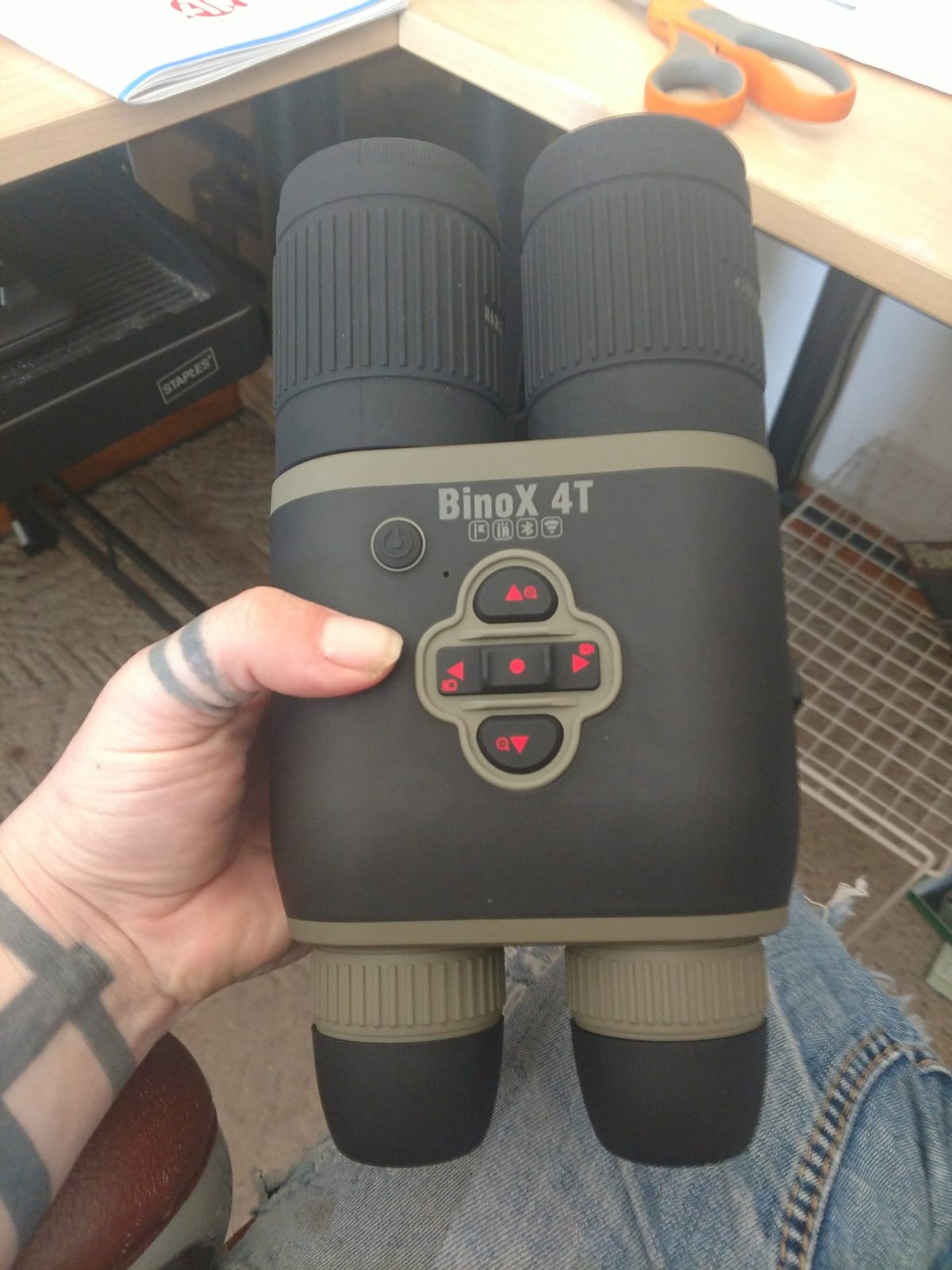
This is the glass for anyone scanning a hillside, a marsh edge or a treeline and wanting to go from a moving speck to a confident identification without swapping devices. The 4.5x to 18x range is unusually wide, and paired with a 50 mm objective it gives this optic the largest lens combined with the highest optical magnification ceiling of any model we tested.
Owner feedback tells a more complicated story. The rating spread is genuinely bimodal, with 38 percent five-star against 23 percent one-star and a visible cluster of three-star reviews, which averages to 3.5 stars across 13 reviews. People who like it point at the magnification range and the 16-plus-hour battery life. People who do not point at image quality and general usability friction, and a lot of that lands on the fixed-focus design.
Fixed focus is the specification to understand before you buy. It means the optic is set at the factory for a focus range that suits general scanning, and there is no fine focus ring to bring a distant animal into crisp relief. At 4.5x that is barely noticeable. At 18x, on a 384×288 core, it is a real limitation, and it is the most likely source of the critical reviews.
Two more practical notes. The body is 2.5 pounds, which is the heaviest of the eight, and it is only rated water resistant rather than waterproof, so sustained rain is not its friend. On the positive side, the 1280x720x2 display, HD video recording at 60 fps, e-compass, Wi-Fi and a laser rangefinder covering 5 to 1000 yards make it a full field platform, and the 13 mm eye relief is comfortable enough for glasses wearers.
Where this optic earns its weight
The 4.5-18x range is built for a specific rhythm: sweep at 4.5x, find, then zoom to 18x on a stationary or slowly moving target. That workflow is how you actually scan for elk on a slope or pick a coyote out of a far draw, and few binocular-form thermal optics cover that span in one body. The 50 mm objective also helps here, since more light gathering matters most in the pre-dawn and post-dusk hours when most large mammals move.
Owner reports on the sibling 2-8x version in this list mention reliable game-presence detection out to 600 yards, which is a useful anchor for what a 384×288 core in a 50 mm barrel realistically delivers. The 4.5-18x trades some of that magnification ceiling for the ability to identify rather than merely detect, which for wildlife observation is the trade you want.
Deciding between this and the lighter units
If you will be on your feet for hours, the 2.5 pound weight is the deciding factor and the lighter 850 g AGM or 1.6 lb Binox 6 is the more realistic tool. If your sessions are shorter but your sightings are further away, this ATN’s magnification and 50 mm objective are worth the extra mass and the reduced weather resistance.
Just do not expect the fixed focus to behave like a premium variable-focus optic at the top of the zoom range. Owners who accept that trade report strong results; the one-star reviews cluster around the same complaints about sharpness and handling, which is a design choice rather than a defect. Three years of manufacturer warranty is shorter than the 5 year terms on the two AGM models and the ATN Binox 6, so factor that in too.
3. ATN Binox 6 Dual Review: The Best Balance of Features and Mass
ATN Binox 6 Dual Thermal Imaging Binoculars, 256×192, Laser Rangefinder
256x192 core at 20mK or less
Day/night/thermal/twilight
1000yd LRF at 1m accuracy
1.6lb magnesium
Pros
- Only binocular here with day
- night
- thermal and twilight modes
- Dual View shows thermal and daylight side by side
- Lightweight 1.6 pound magnesium body with adjustable eyepieces
- 1000 yard rangefinder and Wi-Fi streaming both performed reliably
- 5 year manufacturer warranty
Cons
- 256x192 core limits detail on distant animals
- 25mm objective is small for long-range detection
- One owner received a defective unit
The Binox 6 Dual is the one I would hand someone who wants a single device that covers daylight, darkness and thermal without thinking about it. It is the only binocular in this roundup offering four distinct viewing modes: Day, Night, Thermal and Twilight. Add Dual View, which shows the thermal and daylight images simultaneously rather than forcing a mode switch, and you have an identification workflow that is genuinely faster than any single-channel unit.
Owner feedback backs that up. Across nine reviews, 85 percent of ratings are five stars, and the recurring praise is specifically for Dual View as a confirmation aid and for hot point tracking while scanning tree lines. The SmartIR AI image enhancement and a 4K Ultra HD CMOS daytime sensor handle the daylight side, and 4K daytime recording plus 1080p thermal video on 64 GB covers documentation. Wi-Fi streaming to the ATN Connect 6 app worked reliably in owner reports.
The sensor is 256×192 with a NETD of 20 mK or less, which is a good thermal sensitivity figure but a small pixel count. The 25 mm objective is the other constraint. Together they mean this is a close-to-medium-range instrument, and the 48x maximum magnification figure is largely digital. For a backyard, a farm, a woodland edge or a suburban wildlife corridor, that is exactly the right envelope.
Build quality is a step above much of this list: a magnesium body, 15 mm eye relief, a 20 mm exit pupil, individual focus on the eyepieces, a tripod mount, a waterproof rating, and two 18650 batteries with a charger in the box. A 5 year manufacturer warranty matches the longest terms here. The single negative review concerns a defective unit rather than the optics, which is a good-faith failure rate to expect at nine reviews.
Why Dual View changes the way you observe
Standard thermal workflow involves zooming, squinting at a grey blob, guessing, switching to another mode, and switching back. Dual View removes the switch. You see the thermal image with a daylight picture inset, so you get the outline from heat and the species detail from the CMOS sensor at the same time. In mixed cover, at a treeline, or on an animal partly obscured by vegetation, that side-by-side comparison is what closes the identification gap.
For crepuscular work it is even better. Twilight mode bridges the gap between usable daylight and full darkness, and hot point tracking lets you mark a moving warm spot and follow it rather than losing it every time you blink. r/Thermal users consistently rate fusion-style features highly for species ID in complex cover, and this is the most accessible implementation in the group.
When to pay up for a bigger core instead
Choose the Binox 6 Dual when your observation distance is typically under 200 yards and you want one device for the whole night. Look at the 640×480 and 1280×1024 models here when you regularly work at 400 yards or beyond, because no amount of fusion processing recovers detail the sensor never recorded.
Be aware of the magnification framing. The 48x maximum is digital zoom, and forum users are consistent about digital zoom degrading image quality for identification. Use the optical range for ID work and treat everything beyond it as a confirmation aid rather than a way to read fine detail. Everything else here, from the 1.6 pound magnesium chassis to the 1000 yard rangefinder with 1 m accuracy, is unusually well specified for a binocular at this level.
4. Pulsar Merger LRF XT50 Review: The Highest Resolution With Deep Ranging
Pulsar Merger LRF XT50 Thermal Binoculars with Laser Rangefinder
1280x1024 12um core
2-16x dual-eye
1640yd LRF and 2500yd hot detection
IPX7 magnesium
Pros
- 1280x1024 sensor is the highest thermal resolution in this roundup
- Advanced image stabilisation keeps the view steady at high zoom
- Laser range finding to 1640 yards plus hot object detection to 2500 yards
- Comfortable dual-eye design for long sessions
- 64 GB recorder with Stream Vision 2 app
Cons
- Exit pupil of 3.13mm can make the view dimmer in very dark conditions
- Only 6 reviews so long-term reliability is not well documented
- 2.1 pound magnesium body is heavy for long handheld sessions
Nothing else in this roundup carries as many pixels. The 1280×1024 core with 12 micron pitch gives the Pulsar Merger LRF more than six times the pixels of a 256×192 model, and in the field that shows up as animals holding their shape at distances where the smaller sensors have already turned to guessing. If your budget stretches this far, this is the resolution ceiling available in binocular form today.
The 2-16x magnification with dual-eye viewing is a sensible range, and the XT50 configuration pairs it with a 50 mm objective for light gathering. Laser range finding runs to 1,640 yards with hot object detection out to 2,500 yards, which is the kind of specification that lets you log a distance against every sighting without guessing. Owners in the reviews single out image quality at magnification and the built-in ranging as the two things that stand out.
Advanced image stabilisation is the feature I would not have predicted to matter as much as it does. At 16x on a 1280×1024 core, any hand movement destroys the image, and stabilisation keeps a tracked animal in frame. The 15 mm eye relief, magnesium housing and IPX7 sealing are all appropriate to the class, and the box includes an APS 3 battery pack with charger, a USB-C cable, a tripod adapter and a carrying case.
Two cautions. The 3.13 mm exit pupil is small, which means the image can look dimmer in very dark conditions than a larger-pupil optic, and you need decent eye placement to get the best out of it. And with 6 reviews the long-term reliability record simply does not exist yet, so you are buying on specifications and a clean 76 percent five-star plus 24 percent four-star sample with nothing below four stars.
What 1280×1024 changes in the field
The practical difference is at identification range, not detection range. A small core will find a deer at a distance where a large core can also tell you what kind of deer it is, whether it is limping, and whether there is a second animal behind it. That extra step from detection to identification is the entire reason wildlife observers want to spend more, and it is the difference between a record and a memory.
Stabilisation compounds it. Long-range thermal work is unusable without it, so a stabilised 16x view on a high-pixel core is a genuine capability difference rather than a spec-sheet line. Owners in r/Optics and r/Thermal threads repeatedly describe pixel count and zoom quality as the deciding factors once someone moves past close-range scanning, and this is the unit that answers that.
Whether the premium tier is worth the jump
If you observe at long range as your primary activity, yes, and the 1640 yard rangefinder plus 2500 yard hot detection is the feature that will keep pulling you back to it. Recording is built in with 64 GB of memory, and the Stream Vision 2 app over Wi-Fi handles remote viewing and control from an Android or iOS phone, which matters when you want a partner to see what you are looking at.
If you mostly watch a yard, a feeder or a woodland edge, the resolution difference is capability you will not use, and one of the lighter 384×288 models is the better value. Also consider the small exit pupil in genuinely dark conditions, and check the 3 year limited warranty, which is shorter than the 5 year terms on the two AGM models and the ATN Binox 6.
5. i4SEE B50-640 Review: 640-Class Resolution in a Compact Body
B50-640 LRF Thermal Binoculars for Hunting, Infrared Heat Night Vision with 50mm Focal Length, 640×480 pix @ < 30 mK NETD Sensor, LRF with 600m Accuracy, OLED High-Definition Display
640x480 core at under 30mK
35mm objective
600m LRF
OLED display
Waterproof
Pros
- 640x480 sensor resolution is a step above the 256x192 models here
- NETD under 30mK with a 35mm objective lens
- 600m laser rangefinder included
- Compact lightweight body with a tripod mount
- Waterproof rated
Cons
- Owners report an unclear soft image especially beyond 1x
- One owner reported a breaking battery tray and weak internal plastics
- Just 4 reviews which is the thinnest evidence base here
The specification sheet here is the interesting part, because it puts a 640×480 core with a NETD under 30 mK behind a 35 mm objective and a 600 m laser rangefinder, a combination that competes well with the more expensive models here. On paper this is a mid-tier option: a real jump in pixel count over 384×288 without the weight of a 50 mm barrel.
The owner feedback is where the problem sits. Across 4 reviews the distribution is 55 percent five-star, 34 percent two-star and 11 percent one-star, and the critical reports are specific rather than vague. Owners describe an unclear, soft image that gets worse past 1x, and they report that refocusing does not recover clarity at 2x to 8x. One buyer reports the battery tray breaking and weak internal plastics, and at least one reports unresponsive customer service.
That is a real durability and support signal, not a nitpick. Germanium objective lenses and thermal cores are also expensive to replace, and a brand with a thin support record is a different proposition from a name with an established ecosystem. Forum users are consistently wary of no-name imports with inflated specifications, and this listing asks you to accept the spec sheet largely on trust.
On the positive side, the OLED high-definition display, manual focus with a tripod mount, and a waterproof rating are all appropriate for field use, and the compact, lightweight design is genuinely easy to carry. The manufacturer does not list a weight, which is unusual and worth noting if you intend to hold it up for long sessions. If you like the idea of 640-class resolution without the premium tier, this is the one to investigate, but buy it with eyes open.
Spec sheet versus field report, and why the gap matters
There is a legitimate reason a 640×480 core can still look soft in practice. Sensor resolution is only half the equation, and lens aperture, focus behaviour and processor tuning determine how much of that resolution actually reaches your eye. A 35 mm objective gathers less light than a 50 mm, and if the focus mechanism cannot hold a distant subject sharp, the extra pixels have nothing to resolve. The owner reports on zoomed softness point at exactly that mechanism.
This is why we do not rank it higher despite a strong spec sheet. Compare it to the ATN BinoX 4T 384, which is a smaller sensor but has a 50 mm objective and owner reports of reliable presence detection at 600 yards. Raw pixels in a poorly focused barrel can lose to fewer pixels in a good one, and only a night of use in your own habitat will tell you which this is for you.
What to verify if this is on your shortlist
Check the return and support arrangements carefully before committing, because the soft-image complaints and the support complaint came from the same buyers. Look at whether the manufacturer publishes the exit pupil and eye relief figures, and treat the missing weight specification as a reason to ask rather than a minor omission.
If your observation distances are mostly under 200 yards, a well-focused 384×288 unit with a 50 mm objective will serve you better than this. If you regularly work at 400 yards and above and you can verify the return terms, the 640×480 core is the right shape of tool, and the under-30 mK sensitivity is a genuine plus in cold conditions.
6. ATN BinoX 4T 384 2-8x Review: A Compact Scanner With a Long Runtime
ATN BinoX 4T Thermal Binocular with Laser Range Finder, Full HD Video rec, WiFi, Smooth Zoom and Smartphone Controlling Thru iOS or Android Apps (384×288, 2-8x)
384x288 sensor
2-8x smooth zoom
1.12kg
Full HD recording and Wi-Fi
16+hr battery
Pros
- Reliable game presence detection out to 600 yards in owner reports
- Lag-free thermal image with smooth natural-feeling zoom
- 16+ hours of active battery life
- Wi-Fi app control plus full HD video recording
- Good value relative to other thermal binoculars
Cons
- Buttons are easy to press accidentally and can start recording
- Not water resistant
- Sold under a third-party brand name with a 2 year warranty
This is the 2-8x sibling of the high-magnification ATN in this list, and for a lot of wildlife observers it is the more sensible buy. The 384×288 core is a solid mid-class sensor, the 2-8x span covers scanning through to identification without digital zoom, and at 1.12 kg it sits between the ultra-light AGM and the 2.5 lb long-range model. The 16-plus-hour quoted runtime matches the longest in the roundup, which is exactly what an all-night watch needs.
All three reviews are positive, split 62 percent five-star and 38 percent four-star, and the one detailed owner report confirms the optic works well for confirming game presence at 600 yards and beyond while calling it strong value for what it does. Metadata capture is thorough too, with e-compass orientation, zoom level, distance to target and a 3D gyroscope recorded alongside the video.
Two practical warnings. The buttons are easy to press accidentally, which owners specifically flag, and given that Full HD recording and live streaming are always available, that means footage full of ten-second clips of your own boots. Check that Wi-Fi streaming is off before you walk, because continuous streaming is a documented battery drain across this whole category. And the unit is not water resistant, so dew and rain need managing.
There is also the listing itself to consider. This is sold under theOpticGuru brand rather than ATN, with a 2 year manufacturer warranty instead of the 3 years ATN offers on its own storefronts. The hardware is an ATN BinoX 4T, and the listing sits below ATN’s own storefronts, but support and warranty service route through the retailer. Interpupillary adjustment is present, which is a genuine comfort feature for a binocular.
Why smooth zoom matters more than maximum magnification
The 2-8x design is a scanning instrument, and its strength is the quality of the transition between wide and narrow views. The listed smooth zoom is designed to imitate natural eye movement, which means a tracked animal stays in frame instead of jumping. For following a deer walking through brush or a coyote crossing a field, that continuity is worth more than a headline magnification number you cannot hold steady.
Owner reports of reliable presence detection at 600 yards set a realistic expectation for the 384×288 class: you will find animals far away, and you will identify them at closer and medium ranges. Compare that with the Pulsar Merger LRF, where the much larger 1280×1024 core is what carries identification out to distance. You are choosing a tool for tracking and scanning versus a tool for reading distant detail.
Deciding on support, warranty and weather exposure
If you are buying for a third-party listing, factor the retailer into your decision. A 2 year warranty through a reseller is perfectly workable, but the forum pattern of negative reviews clustering around support responsiveness is worth taking seriously in a category where a failed thermal core is an expensive problem.
For weather, plan a lens cloth and a dry bag if you are regularly out in rain, since not water resistant is a real constraint for dawn observation in autumn. Otherwise, the 16-plus-hour runtime, the 38 mm objective, the Wi-Fi control and the full HD recording make this an easy model to live with, and the smooth zoom is the quiet best feature in it.
7. Pulsar Symbion LRF Review: Multispectral Power, Thin Owner Evidence
Pulsar Symbion DXT50 LRF Thermal and Digital Night Vision Binoculars with Laser Range Finder, 1280×1024 12 µm Sensor, 2-16x Magnification, Long Range Binoculars
1280x1024 core at under 40mK
50mm F/1.0 lens
1640yd LRF at 1yd accuracy
PiP and overlay modes
Pros
- Combines thermal full-color digital and digital night vision with LRF in one unit
- 1280x1024 sensor behind a fast 50mm F/1.0 lens
- 1640 yard 905nm rangefinder with 1 yard accuracy
- Picture-in-Picture and overlay modes aid identification
- IP67 magnesium housing with 5 year warranty
Cons
- Lowest average rating here at 3.0 stars across 2 reviews
- Two reviews cannot characterise long-term reliability
- Exit pupil of 1.92mm is very small and demands careful eye placement
The Symbion is the specification maximalist of this group and the one we would struggle most to recommend. It pairs a 1280×1024 sensor with under-40 mK NETD behind a 50 mm F/1.0 lens, the fastest aperture anywhere in this roundup. Ranging is a 905 nm laser out to 1,640 yards with 1 yard accuracy. Viewing modes include thermal, full-colour digital, digital night vision, Picture-in-Picture and overlay. There is a removable APS5 battery, Wi-Fi and Bluetooth, onboard photo and video with audio, and an IP67 magnesium housing with a 5 year warranty.
Every one of those numbers is at or near the top of this category’s capability. The problem is that we have almost no owner evidence. The average is 3.0 stars across 2 reviews, and those two are a five-star and a one-star, so the number reflects a single dissatisfied owner rather than any pattern. Forty-nine percent of ratings being one-star is a meaningless statistic at that sample size, and we will not present it as a quality signal either way.
Two technical cautions. The exit pupil of 1.92 mm is the smallest here by a wide margin, which makes eye placement demanding in low light and can leave the image feeling dim if you are not centred on the eyepiece. And a F/1.0 lens on a fast, fully multi-coated optical train is a lot of glass to keep clear, so lens care discipline matters more here than on a simpler model.
With the thinnest evidence base and the lowest average rating in the group, this is a difficult recommendation. It makes sense if you want thermal, digital night vision and full-colour imaging in one device and you value Picture-in-Picture and overlay as identification aids, which forum users rate highly for complex cover. If you want proven owner satisfaction, the other Pulsar model here carries a deeper record.
When multispectral fusion earns its place
Overlay and Picture-in-Picture modes solve a specific problem: confirming that a warm shape is an animal and not a rock, a stump, or a roof that has been storing sun. On a 1280×1024 core you can usually read the shape directly, but in broken cover, at the edge of a treeline or behind vegetation, seeing the daylight image alongside the thermal one removes a lot of guesswork.
Full-colour digital also matters for documentation. If you are recording for research logs, a behaviour journal or a study plot, colour and detail from the digital channel can make the footage far more useful later. This is the one binocular here that covers thermal, digital night vision and full-colour daytime in a single body with a magnesium chassis.
Honest reasons to look elsewhere
Alongside the sample size, the small exit pupil and the demanding eye placement are real ergonomic costs on a flagship chassis. If you wear glasses or have a narrow interpupillary range, a binocular with a 15 mm eye relief and a larger exit pupil is a safer bet, and several models in this roundup qualify.
Our advice is to treat this as a flagship to consider rather than a recommendation. Nothing in the specifications suggests it will disappoint, but nothing in the owner feedback confirms it either, and at this level of investment you deserve better evidence than two reviews. If you are set on multispectral thermal, the AGM ObservIR LRF 25-256 delivers a comparable all-in-one concept with a far deeper owner record.
8. AGM ObservIR LRF 35-384 Review: A Complete Out-of-the-Box Field Kit
AGM ObservIR LRF 35-384 Thermal & Digital Day/Night Vision Binoculars
384x288 12um core
35mm objective
4x-20x zoom
4x 18650 kit plus solar bank
IP67
Pros
- Unusually complete bundle with harness four 18650 batteries a charger and a 10000mAh solar power bank
- 35mm objective with 1800m detection range
- 384x288 thermal plus a 4K digital day/night channel for ID
- 1000m eye-safe laser rangefinder with GPS and 64 GB storage
- 5 year manufacturer warranty
Cons
- Lowest rating in the roundup at 2.0 stars
- Only a single review so there is almost no owner feedback to judge quality
- Bundle sits above the base 25-256 model while the 384x288 core is below the 35-640 and 50-640 variants
The 35-384 ObservIR is a 384×288 12-micron core behind a 35 mm objective, with 4x to 20x zoom, a 4K digital day/night channel for identification, a 1000 m eye-safe laser rangefinder, 64 GB of storage, Wi-Fi and GPS, all inside an IP67 body with a 5 year manufacturer warranty. On specifications it is a well-balanced mid-class model, and the dual-channel design follows the same logic as our top pick, thermal to find and digital to confirm.
What makes it distinctive is the bundle. The box includes a four-slot charger with LCD display, four 3200 mAh 18650 rechargeable batteries, a Field Boys binocular harness strap and a 10,000 mAh solar power bank. For someone heading into overnight sessions without access to mains power, that is a genuinely complete answer to the endurance problem, and it is the reason we included this unit despite its rating.
The rating is the problem. A single two-star review is the entire feedback base, which is not enough to characterise owner satisfaction in either direction. A 2.0 average from one review carries no information, and we would not weight it against a solid specification sheet and a 5 year warranty.
There is a positioning wrinkle worth flagging. The bundle places this model above the base ObservIR 25-256 in the range, while its 384×288 core sits below the 35-640 and 50-640 variants in the same family. You are paying for batteries and accessories rather than for sensor performance, which is a reasonable thing to want, but it is not a performance upgrade over the base model. The 1800 m detection figure is also a detection number, not an identification number, and forum readers are rightly sceptical of marketing ranges on small animals.
What the bundled power kit actually solves
Thermal units are power-hungry, and cold nights shorten runtime further. Four 18650 cells plus a four-slot charger means you can rotate packs without waiting, and the solar power bank gives a genuine emergency reserve for a long night in the field. The harness strap solves the other long-session problem, which is carrying weight on your neck for four hours while glassing a clearing.
For a researcher logging behaviour at a study plot, or a rancher monitoring fences and predators across a wide area on repeated nights, that kit removes real friction. It also makes this the easiest unit here to hand to someone who has never used thermal before, because nothing else needs buying on day one.
Where the specification has to make the case on its own
With one review on record, judge this on the 384×288 core, the 35 mm objective, the dual thermal and 4K day/night channels, the 1000 m rangefinder, GPS, IP67 sealing and the 5 year warranty. That is a coherent package, and the dual-channel approach is the one that consistently helps identification in complex cover.
Just be honest with yourself about what you are buying. You are buying a well-equipped 384×288 thermal binocular with a complete accessory kit, not a flagship. If you want a bigger core, the 640×480 and 1280×1024 options in this roundup are the ones to compare against, and if you want the deepest owner record on a dual-spectrum design, our top pick carries 20 reviews at a 4.8 average.
How to Choose Thermal Binoculars for Wildlife
Thermal binoculars vary enormously in cost, and the differences that matter are not the ones on the front of the box. The buying decision comes down to four things: how far you need to identify animals, how much light you need to gather, how long you will be in the field, and how much weight you can hold up. Get those four right and the rest is preference.
Start with distance, because it eliminates options fastest. Under 150 yards, a 256×192 core is genuinely sufficient and you should spend the difference on a lighter body, better sealing or a larger battery. Between 150 and 400 yards, 384×288 is the sweet spot and 640×480 is the safer buy. Beyond 400 yards, you want 640×480 or better, and if you are regularly working past 600 yards, only the 1280×1024 sensors in this roundup will hold detail.
Sensor resolution and pixel pitch, explained without the marketing
Resolution is the pixel count of the thermal core: 256×192, 384×288, 640×480, 1280×1024. More pixels means more detail on a distant animal and a better chance of identifying a species rather than registering a heat blob. Pixel pitch is the physical size of each pixel, and in the same resolution class, a smaller pitch in a modern sensor usually means a more refined image.
Here is what the classes mean in practice. 256×192 at 12 micron, as in two models here, is a coarse image that works for presence and close-range ID. 384×288 at 12 micron is the balanced middle and the most common class among wildlife observers. 640×480 is the step up for open-country work, where background detail matters. 1280×1024 is the current ceiling, and it is the only class that reliably holds species detail on a large animal at 600 yards or more.
Do not let pixel counts alone decide it. Owners of the 640×480 unit in this roundup report a soft image that refocusing does not fix, and owners of a 384×288 unit report reliable presence detection at 600 yards, which is what a properly focused optical train buys you. Resolution sets the ceiling; lens quality and focus decide how close to that ceiling you actually get.
NETD: the number that matters in cold weather
NETD, or thermal sensitivity, is expressed in millikelvin and describes the smallest temperature difference the sensor can resolve. Lower is better. The models in this roundup quote 20 mK or less, under 30 mK and under 40 mK, and those differences matter most when the contrast between animal and background is small.
Cold winter nights, snow, and heavy fog are exactly those conditions. In a warm summer night everything has similar temperature and the sensor is working hard, and in a cold pre-dawn the scene is naturally high contrast and almost any of these sensors will find an animal easily. If you observe mainly in winter, which most serious thermal users do, treat NETD as a secondary criterion behind resolution and lens diameter.
Objective lens diameter, magnification and light gathering
The objective lens is the front element, and its diameter determines how much infrared light enters the system. Larger is better for detection and for contrast at distance, and it costs weight. The 50 mm models here, the ATN BinoX 4T 4.5-18x and the two Pulsar optics, gather the most light; the 25 mm models, the AGM ObservIR 25-256 and the ATN Binox 6 Dual, are the most portable.
Magnification is a range, not a number, and the range matters more than the maximum. A 2-8x unit is a scanning tool. A 4.5-18x unit can scan and then identify in one body. A 1-4x unit with a high digital zoom factor is a wide situational awareness tool that will frustrate anyone trying to read fine detail. Anything quoted above about 20x on a 256×192 or 384×288 core is almost entirely digital, and forum users are consistent that digital zoom degrades images for identification.
If you are choosing a single device, a moderate optical range with a sensible objective diameter beats a narrow extreme. A 50 mm objective at 4.5x to 18x is a genuinely balanced package; a 25 mm objective at 1x to 4x with 48x maximum is not.
Detection, recognition and identification range
These three terms come from thermal image standards and brands use them precisely because the gap between them is enormous. Detection means there is a human-sized warm object in the scene. Recognition means you can tell it is an animal. Identification means you can tell what species it is. Marketing detection ranges are quoted on a human-sized target, and for deer, elk or coyote the identification range is a fraction of that number.
That is the single most important thing to understand in this category. A 1800 m detection figure, which one model here quotes, tells you almost nothing about whether you will identify a deer at 300 yards. Compare the ranges for a 384×288 core in a 50 mm barrel rather than the detection marketing for the sensor class.
A useful anchor from owner reports in this roundup: a 384×288 unit reliably confirms game presence at 600 yards, while identification happens at much shorter distances. Practically, plan to detect large animals far out, recognise them at medium range, and identify them at close-to-medium range on a 384×288 core. A 1280×1024 core moves the identification distance out substantially, which is the entire argument for the premium tier.
Refresh rate and tracking movement
Refresh rate is measured in hertz, and it determines how smoothly moving animals appear. Below about 30 Hz, a walking animal strobes and looks like it is moving in jumps, which makes tracking difficult and can cause nausea for some users. At 50 Hz and above, motion looks natural and pan-and-tilt tracking of a moving deer becomes practical rather than frustrating.
Refresh rate specifications are inconsistently published in this category, which is worth flagging. If tracking fast-moving animals or birds is central to what you do, ask before buying rather than assuming. Tracking is exactly the thing that reveals a low refresh rate fastest, so consider borrowing a unit from a local club before committing to this tier.
Battery, charging and all-night session planning
Battery claims in this roundup run from 8 hours on the AGM ObservIR 25-256, through 16-plus hours on both ATN BinoX 4T variants, to a removable APS5 battery on the Pulsar Symbion. Cold weather reduces all of them, and continuous Wi-Fi streaming or video recording drains a pack far faster than passive observation, which owners consistently report across this category.
Plan the session, not the spec. If you are out from dusk to dawn, add at least a third to the quoted runtime. Turn streaming off when you are not actively using it. Carry a power bank or spare cells, and the AGM ObservIR LRF 35-384 bundle, with four 18650 cells and a solar power bank, is the ready-made answer to this problem.
Replaceable batteries beat built-in ones for a simple reason: a dead built-in battery ends the night, while a spare keeps you going. USB-C charging is now standard across the category, and it is a genuine advantage because one cable type covers your optics, your phone and your power bank.
Weight, eye relief and the four-hour problem
Every model here is between 850 g and 2.5 lb, and that range matters more than it sounds. Holding 2.5 lb up at eye level for four hours produces real forearm fatigue, and a tripod mount turns an endurance problem into a non-issue for stationary work. If your observing is mostly scanning from a fixed position, buy for image quality and mount the unit on a tripod. If you are walking and glassing continuously, buy for weight.
Eye relief is the other half of comfort. Anything at 13 mm or more, which most of these units manage, works with glasses. Look for interpupillary adjustment, which the Binox 6 and the 2-8x BinoX both have, since a binocular that does not fit your face is uncomfortable long before it becomes painful. Bounding overall dimensions also matter for users who share optics or switch between users.
For reference at the daylight end of the scale, our compact binocular guide covers the weight and comfort trade-offs in the far lighter glass category, which is a useful baseline for what you are willing to carry.
Colour palettes and field technique
White hot shows warm subjects as bright against a dark background, which most people find fastest to read and is the right default in open country. Black hot inverts that and can be easier on the eyes over a long watch. Red hot, rainbow and ironbow palettes add colour gradation that helps separate a body from background detail, at the cost of some contrast.
Use the NUC or pulse recalibration button when the image blooms after you switch between a warm scene and a cold one. It happens most often when you pan from sunlit ground to shaded ground, and a recalibration restores the contrast in a second. Switching palettes on the fly is normal and does not damage the sensor. A couple of field tips that make night one better: scan in white hot, switch to red hot for long stationary watches to preserve night vision, and use the rangefinder on anything you want to log rather than estimating distance.
If you will be recording anything, our wildlife photography camera guide covers pairing thermal or video capture with a stills camera for the same session, which is the usual two-device setup for serious documentation.
Thermal vs Night Vision vs Digital Binoculars
This is the decision most people get wrong, and it comes down to what the animals are doing and what the background looks like. Thermal detects radiated heat, so it works regardless of how much light there is, and it works when there is no light at all. Image-intensifier night vision amplifies available light and needs a moon or an IR illuminator. Digital day/night binoculars use a CMOS sensor with an IR illuminator for darkness, and they also work in full daylight with colour.
For wildlife, thermal wins in almost every night scenario. It pierces light fog, smoke and light rain, it does not need a moon, and it does not blind you when a headlight sweeps the field. Night vision is cheaper and gives you colour and detail, but it fails completely in true darkness without an illuminator, and an illuminator gives away your position. Digital binoculars are the all-rounders: they work by day in colour, which matters enormously for birdwatching and for any close-range identification.
The case for digital daylight binoculars is stronger than thermal buyers often admit. If you are identifying species in good light at under 100 yards, a daylight glass binocular with 8x magnification and a wide field of view will show you more detail than any thermal model here, and it weighs a fraction as much. Our main binocular guide covers how to choose those on magnification, field of view and eye relief.
For long-range open country where you need to find and then read an animal at 500 yards, a spotting scope or a long lens is a better first purchase than thermal. The spotting scope guide goes into the magnification and objective trade-offs for daylight distance work, and the practical sequence most observers settle on is glass in daylight, thermal at night.
Where Thermal Binoculars Fall Short
Being straight about the limits is more useful than another round of superlatives, because every one of these limits has caught us out in the field and every one of them is a reason someone returns a thermal binocular.
Birds are the big one. Small, low-emissivity targets surrounded by warm background are close to invisible on thermal, and no resolution in this roundup fixes that. If your primary interest is birdwatching, thermal should be a secondary tool for finding roosting raptors or scanning a colony at dusk, not your primary optic. r/Thermal and r/NightVision threads ask this constantly, and the answer is consistently that a binocular aimed at birds should be glass.
Summer daytime thermal washout is the second limit. When ambient surface temperatures converge, which they do on a hot afternoon, thermal contrast collapses and everything reads as a flat grey field. Thermal is a night and dawn-to-dusk tool in warm climates, and a summer day session will disappoint you. Emissivity plays into this too, since reflective surfaces such as water and some foliage do not read as their true temperature.
Dense vegetation is the third. Sun-warmed leaves, bark and rocks emit strongly and mask a warm body standing in front of them, which forum users call thermal blindness. This is where fusion modes and colour palettes earn their place, and it is also where a 256×192 core struggles most. Watch the edge of a thicket rather than into it.
Small cold-blooded animals register poorly for the same reason, so reptiles, amphibians and most insects are effectively outside what these devices can find. And a dead animal cools toward ambient temperature, so a fresh kill is visible for a limited window and a cold one is not visible at all. Finally, digital zoom remains a trap: it magnifies an existing image rather than adding detail, and identification at high digital magnification is where disappointed buyers usually end up.
One more practical caution. Thermal binoculars have legal restrictions for hunting in some jurisdictions, and the rules vary by state and country, so check locally before taking one into the field for that purpose. For non-lethal observation and photography there are generally no restrictions, and the ethics are simpler: stay downwind, keep quiet, and do not chase animals out of cover to get a picture.
For cold-weather planning on long winter sessions, layering and thermals matter as much as the optic, and our thermal underwear guide covers staying warm for the kind of all-night static watch this hobby requires.
Frequently Asked Questions
What are the best thermal binoculars for the money?
For most wildlife observers the AGM ObservIR LRF 25-256 is the best value in this category, because it pairs a 12 micron 256×192 thermal core with a 4K ultra-low-light CMOS channel, a 1000 metre laser rangefinder, GPS, Wi-Fi, 64 GB of storage and IP67 sealing in an 850 gram body with a 5 year warranty. The ATN Binox 6 Dual is the alternative if you want four viewing modes including Dual View fusion, and it also carries a 5 year warranty.
Are thermal binoculars worth it?
They are worth it if you observe nocturnal wildlife regularly, watch over a property or farm, or want to record behaviour without disturbing animals. They are not worth it if your observation is mostly within 150 yards in daylight, or if birdwatching is your main interest, because small birds are close to invisible on thermal. For close-range daylight work a pair of glass binoculars is both cheaper and more informative.
What is the range of thermal binoculars?
Detection, recognition and identification are three different ranges. A 256×192 core in a 25 mm barrel typically detects a large animal at a few hundred metres, a 384×288 core in a 50 mm barrel reliably confirms game presence at around 600 yards, and identification at 300 to 500 yards needs 640×480 or better. The 1280×1024 sensors in this roundup are the only ones that reliably hold species detail at 600 yards and beyond.
Can thermal binoculars be used during the day?
Yes, but with a clear caveat. In daylight the thermal channel produces usable images, and every dual-spectrum unit in this roundup adds a daylight CMOS channel that gives you colour identification. However, in hot afternoon conditions ambient surface temperatures converge and thermal contrast collapses, so daytime summer use is unsatisfying. Thermal works best from dusk through dawn, and the digital channel is what carries daytime observation.
What is the difference between thermal binoculars and night vision optics?
Thermal binoculars detect radiated heat, so they need no light at all and work through fog, smoke and light rain. Image-intensifier night vision amplifies available light, so it needs a moon or an IR illuminator, produces colour and fine detail, and is completely blind in true darkness without illumination. Digital day/night binoculars use a CMOS sensor with an IR illuminator and also give full colour in daylight, which is why they suit close-range birdwatching better than thermal.
How do I choose the right thermal binoculars for my needs?
Start with your typical observation distance. Under 150 yards, a 256×192 core and a light body matter more than resolution. Between 150 and 400 yards, aim for a 384×288 core in a 35 mm to 50 mm barrel. Beyond 400 yards, choose 640×480 or 1280×1024. Then check battery runtime against your session length, water resistance against your local weather, and weight against how long you will hold it up before buying.
How long will a dead deer show up on thermal?
Only while it retains heat above its surroundings. A fresh kill with a warm body will register clearly for a short window, and detection range shortens steadily as the carcass cools toward ambient temperature, which happens fastest in cold, wet, windy conditions. Thermal detects heat, not decomposition, so a dead animal is not a reliable long-term thermal target. This is a thermal imaging 101 fact that catches new owners out regularly.
Can thermal binoculars be used for bird watching?
Not well as a primary tool. Birds are small, often low-emissivity, and usually surrounded by a warm background of foliage, bark or water, so they register as noise rather than a clear target. Thermal works for birds in two situations: scanning a large area such as a wetland or colony from a fixed position, and finding roosting or wintering birds at dawn and dusk when the birds themselves are still warm. Close-range identification should be done with glass.
Our Final Verdict
After working through all eight, the AGM ObservIR LRF 25-256 is the best thermal binocular for wildlife overall. Twenty reviews at a 4.8 average give it the deepest owner record in the category, the 850 gram body is the only one here you will happily hold for a full evening, and the combination of a thermal core, a 4K ultra-low-light channel, a 1000 metre rangefinder, IP67 sealing and a 5 year warranty is the most complete package we found.
Pick the ATN BinoX 4T 384 4.5-18x if your sightings are far away and you need to scan wide and then zoom to identify, and accept both the 2.5 pound weight and the fixed focus. Pick the ATN Binox 6 Dual if you want one device for the whole night with fusion modes that genuinely speed up identification. Pick the Pulsar Merger LRF XT50 if long-range species detail is the thing you are actually buying, and you can accept the cost and the very small exit pupil. The remaining four make sense for specific situations: a bundled field kit, a 640-class sensor to investigate, a light 2-8x scanner, or a flagship multispectral unit to consider with caution.
Whichever you choose, use it for what thermal is genuinely good at, which is seeing warm-blooded animals behave naturally in the dark without any light, noise or disturbance on your part. That is a capability nothing else in this list matches, and once you have seen a deer graze undisturbed at two in the morning, no daylight optic is going to feel like enough again.