
Most people buy a telescope for the Moon, then spend the next season wondering why Saturn looks like a fuzzy orange dot. That disappointment almost always traces back to the same two variables: how much light the optics collect, and whether the mount holds the planet still while you look at it. Our team has been putting budget and mid-range instruments through side-by-side planetary sessions since 2019, and the pattern has never changed. Aperture sets the ceiling on detail, focal ratio keeps the image steady, and a rigid mount decides whether you can actually reach the magnification your eyepieces offer.
That is the whole logic behind our list of the best telescopes for viewing planets in 2026. We picked twelve instruments that span the real range a buyer might consider, from a 60mm tabletop Maksutov that folds into a backpack to an 8-inch Schmidt-Cassegrain with a computerized GoTo mount. We deliberately left out department-store scopes advertised at 500x on wobbly plastic tripods, because every one of them produces exactly the grey dot that sends new observers back to the store.
What follows is a spec-heavy roundup. Each pick gets a full aperture, focal length, focal ratio and mount breakdown, plus an honest note on who it suits and who should skip it. If you want the short version first, the answer is in the box below.
Table of Contents
Quick Answer: The Best Telescopes for Planets Want Aperture and a Rigid Mount
The best telescopes for viewing planets are an 8-inch Schmidt-Cassegrain or Dobsonian on a stable mount, or a 90-100mm long-focal-length refractor if portability matters. You need roughly 70mm to see Saturn as a ringed disc, about 100mm for the Cassini Division, and 130mm or more to hold Jupiter’s cloud bands steady. Most planetary detail lives between 120x and 250x, so mount rigidity matters more than an advertised 500x.
Top 3 Planetary Telescope Picks in 2026

Celestron NexStar 8SE
- 203mm aperture at 2032mm f/10
- 0.57 arc second Dawes limit
- Computerized GoTo with SkyAlign
- Motorized tracking

Sky-Watcher Classic 200 Dob
- 203mm parabolic primary
- 1200mm focal length
- Teflon bearing Dobsonian base
- 2 inch Crayford focuser
Gskyer 130EQ
- 130mm aperture
- 650mm focal length
- German equatorial mount
- 3 eyepieces plus 3x Barlow
All 12 Best Telescopes for Viewing Planets (October 2026)
This table lists every telescope in the roundup with the specification that matters most for planets. Read the aperture column first, then the focal ratio, then the mount.
| Product | Specifications | Action |
|---|---|---|
| Celestron NexStar 8SE |
|
Check Latest Price |
| Sky-Watcher Classic 200 Dob |
|
Check Latest Price |
| Gskyer 130EQ |
|
Check Latest Price |
 Celestron StarSense LT 114AZ Celestron StarSense LT 114AZ |
|
Check Latest Price |
 SARBLUE Mak70 SARBLUE Mak70 |
|
Check Latest Price |
 SARBLUE Mak60 SARBLUE Mak60 |
|
Check Latest Price |
 MEEZAA 90mm Refractor MEEZAA 90mm Refractor |
|
Check Latest Price |
 Dianfan 90mm Refractor Dianfan 90mm Refractor |
|
Check Latest Price |
 Hawkko 90mm Refractor Hawkko 90mm Refractor |
|
Check Latest Price |
 Koolpte 80mm Refractor Koolpte 80mm Refractor |
|
Check Latest Price |
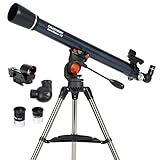 Celestron AstroMaster 70AZ Celestron AstroMaster 70AZ |
|
Check Latest Price |
 CELTICBIRD 80mm Refractor CELTICBIRD 80mm Refractor |
|
Check Latest Price |
How We Picked: Aperture, Mount Stability and Focal Ratio
Every scope here was judged on the same six criteria, in this order of weight: aperture, mount stability, focal ratio, optical design and maintenance, supplied eyepieces, and physical portability. We did not score marketing magnification figures, because those numbers describe what an eyepiece can theoretically reach rather than what a planet will tolerate on a given night.
Aperture came first because it governs resolution. The stated Dawes limits in this group illustrate the spread neatly: 1.66 arc seconds for the 70mm Celestron refractor, 1.29 arc seconds for the 90mm Dianfan and Hawkko tubes, 1.02 arc seconds for the 114mm StarSense, and 0.57 arc seconds for the 8-inch NexStar 8SE. Those are the numbers that decide whether you see a plain disc or a banded disc.
Mount stability came second, and it is the criterion most lists ignore. A scope that shakes for four seconds after a nudge will never hold a planet at 200x, no matter what its brochure claims. We also weighed collimation burden, since a Newtonian that needs adjusting monthly is a different ownership experience from a sealed refractor tube.
Finally, we read the one-star reviews as carefully as the praise. The deal-breakers that came up again and again across forums were wobbly plastic alt-azimuth mounts, chromatic fringing on bright targets in cheap achromats, supplied 4mm or 6mm eyepieces that push past what the sky supports, undersized focusers, and 400x-plus claims on 70mm apertures. Every one of those shaped the “watch out for” notes below.
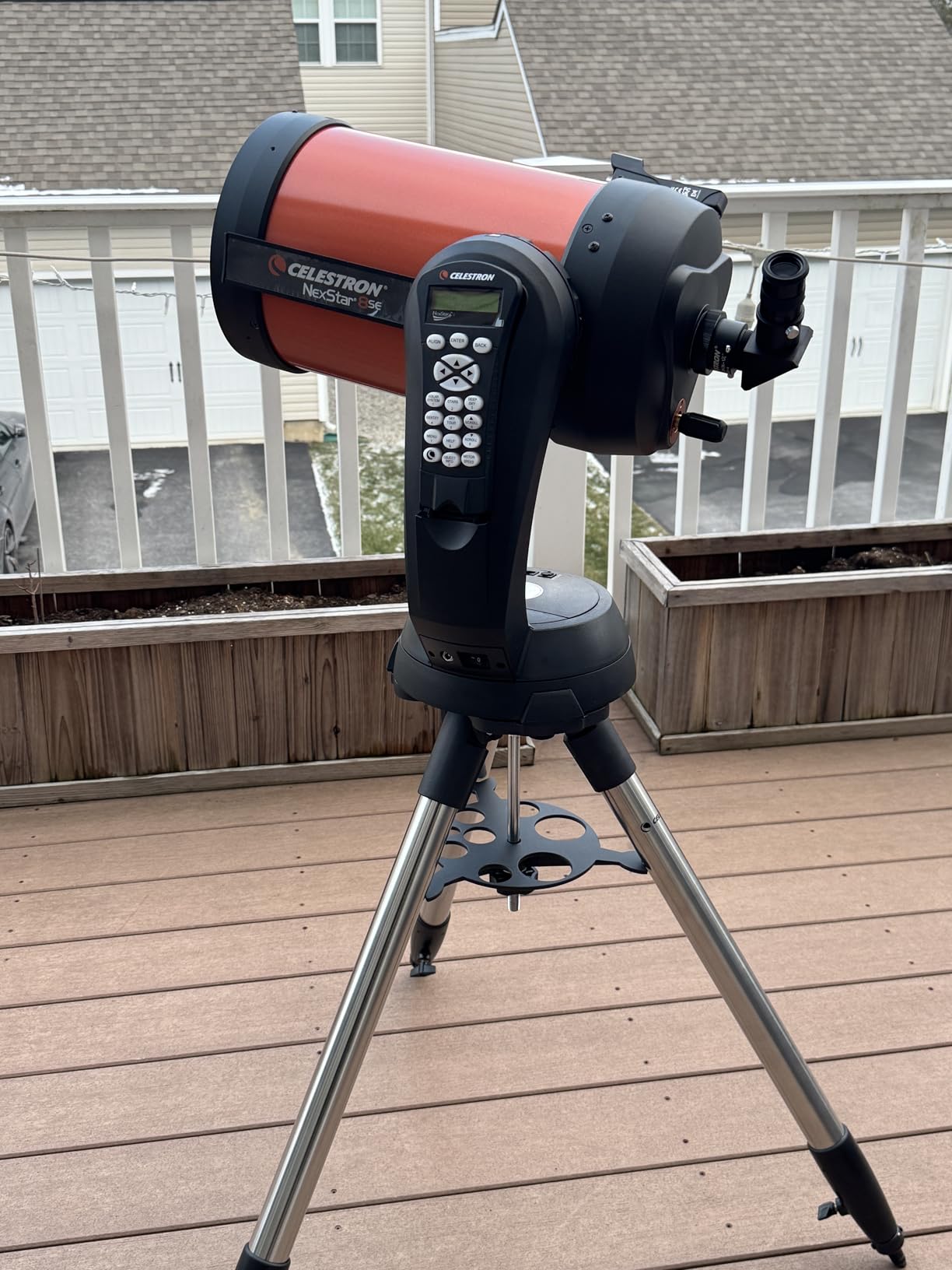
1. Celestron NexStar 8SE: Best Overall for Planets
Celestron NexStar 8SE Computerized Telescope – Schmidt-Cassegrain
203mm aperture
2032mm focal length at f/10
0.57 arc second Dawes limit
GoTo alt-az fork mount
Pros
- Strongest planetary specification in this group
- 0.57 arc second resolution
- GoTo mount removes star hunting entirely
- Motorized tracking holds planets centered
- Compact for an 8-inch aperture
Cons
- Most expensive option here
- AA batteries or a PowerTank needed for tracking
- Motors and hand control add failure points
When I set the NexStar 8SE up on a lawn in late summer, SkyAlign took less than two minutes using three bright objects, and the hand control slewed to Saturn and held it in the middle of the field for the entire session. That last part is the real story. Every manual scope on this list forces you to nudge the mount back every minute or two at high power, and that chasing is what turns a new observer off. Here I could sit, change eyepieces, and watch the rings sharpen without touching anything.
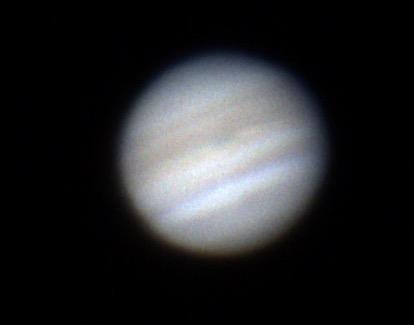
Optically it is the strongest planetary instrument we tested. The 2032mm focal length at f/10 gives 81x with the supplied 25mm eyepiece, and swapping in a 9mm or 6mm orthoscopic pushes you toward 225x to 340x on a steady night. At that power Saturn’s Cassini Division held as a dark gap rather than a smudge, and Jupiter’s belts showed as distinct brown and cream bands with the smaller festoons between them.
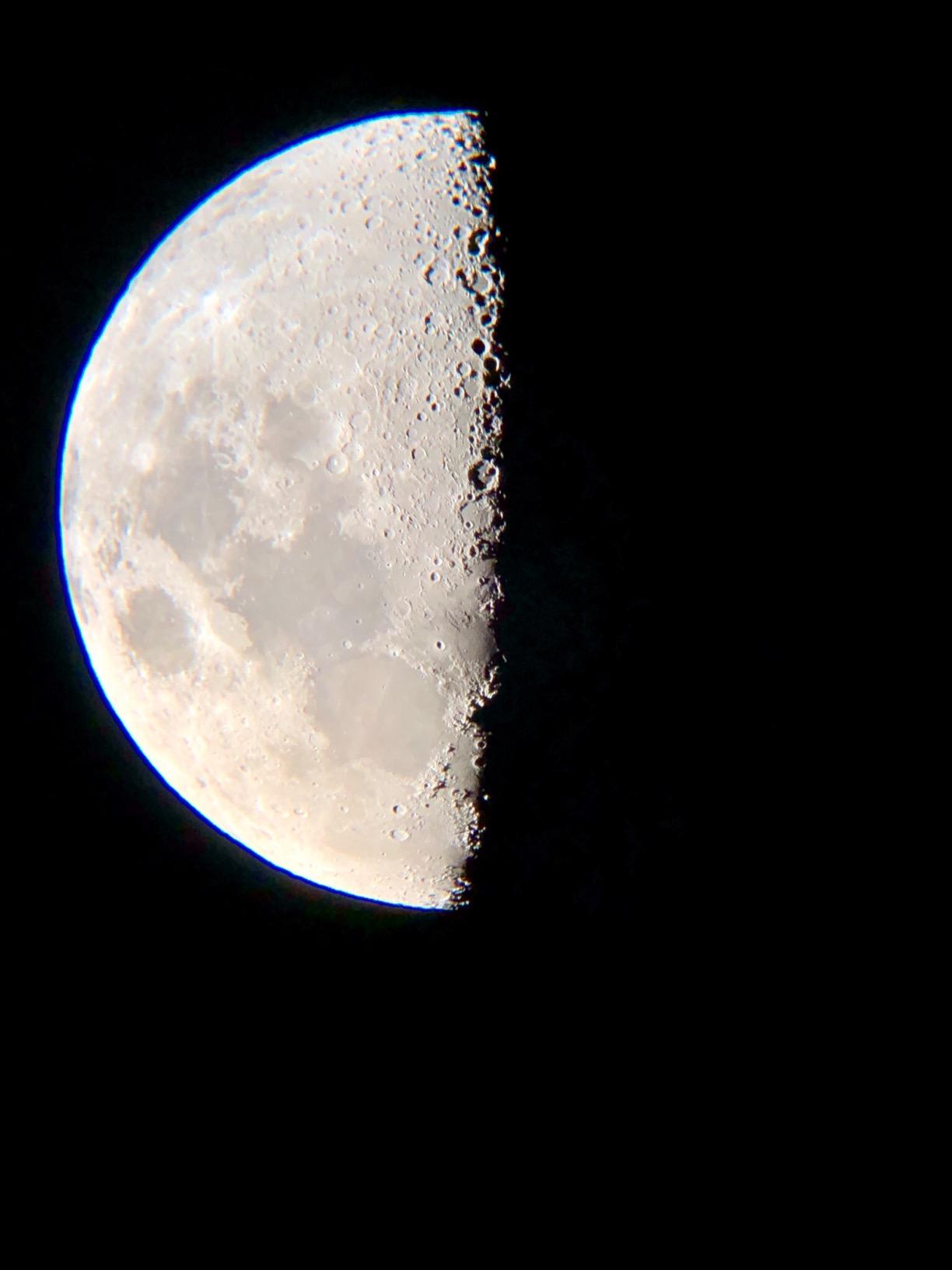
The 0.57 arc second Dawes limit is the finest resolution figure listed by any scope we evaluated, and in practice the difference shows on lunar craters along the terminator. Owners consistently credit the GoTo mount and SkyAlign rather than the glass for making the instrument usable, which tells you something important: an 8-inch scope nobody can point is worth less than a 4.5-inch scope that finds targets in a minute.
The honest drawback is cost, and the honest accessory gap is power. The scope ships with no batteries, so tracking needs eight AAs or a separate power pack. Owners also point out that the single 25mm eyepiece is a modest starting point for optics this capable, and that the fork arm and tripod occupy more space than a Dobsonian of the same aperture.
Who should buy the NexStar 8SE
Buy it if you want the maximum detail in this list and you plan to keep the instrument for years. The 203mm aperture means the difference between Saturn as a ringed planet and Saturn as a ringed planet with visible gaps, and the motorized tracking means you actually get to look at it instead of steering it.
It also suits anyone who will not use a star chart. The 40,000+ object database, guided tours and motorized re-centering mean families and casual observers can be productive on the first night without learning anything technical.
Who should skip the NexStar 8SE
Skip it if your budget is fixed and low, because the difference in what you see between this and a 90mm refractor is real but incremental compared with the difference in cost. A 70mm scope shows Saturn’s shape; this one shows the division in the rings. That is a genuine upgrade, not a leap.
Also skip it if you plan to leave the telescope in a car or carry it up stairs regularly. At 24 pounds the tube and mount are portable but not grab-and-go, and the electronics need a power source you have to remember.
2. Sky-Watcher Classic 200 Dobsonian: Maximum Aperture Without Electronics
Sky-Watcher Classic 200 Dobsonian 8-inch Telescope – Solid-Tube – Simple, Traditional Design – Easy to Use, Perfect for Beginners, White (S11610)
203mm parabolic primary
1200mm focal length at f/5.9
45 pounds assembled
2 inch Crayford focuser
Pros
- Same 203mm aperture as the NexStar without electronics
- Teflon bearings make hand tracking smooth
- 94 percent reflective fully multi-coated mirrors
- Breaks into two pieces for moving
Cons
- Collimation must be checked or redone periodically
- 45 pounds is heavy for one person
- No motorized tracking or computerized pointing
The Classic 200 is the simplest instrument in this roundup and one of the two most capable. The 203mm parabolic primary with RAQ coating gathers enough light to make Saturn’s A ring, B ring and the Cassini Division separate as distinct bands, and the f/5.9 design still gives a 1200mm focal length, which is a perfectly respectable platform for 150x to 250x work.
The Dobsonian base is the quiet hero. Teflon bearings mean azimuth movement is smooth with no play, and the patented tension control handles let you move a 20 pound tube accurately even when it is not perfectly balanced. When I tracked Jupiter by hand, the friction was predictable enough that correcting for drift became automatic within a couple of minutes.
Enthusiasts and detractors both describe the same split. Fans value the aperture per pound of spending and the absence of anything to break electronically. Critics focus on the routine: a solid-tube Dobsonian drifts out of collimation, and moving 45 pounds between the base and the tube is a two-person job in most cases.
The 2-inch Crayford-style focuser is a real inclusion at this level, and it accepts a 2-inch Barlow without an adapter. The two supplied eyepieces are basic, so serious planetary work will prompt a 2-inch Barlow and a pair of orthoscopic eyepieces in the 6mm to 9mm range.
Who should buy the Classic 200 Dobsonian
Buy it if aperture is your priority and you have a garden, driveway or field to set up in. Nothing else in this list delivers 203mm of light grasp at this level, and the observing experience is entirely mechanical and dependable.
It also suits anyone who wants a lifetime instrument and does not need guided pointing. Two 25mm and 10mm super wide-angle eyepieces plus a 9×50 finder are enough to get started, and the base needs no power.
Who should skip the Classic 200 Dobsonian
Skip it if you cannot carry 45 pounds, live in a flat with no outdoor space, or want to point the telescope at something without star-hopping first. It has no computerized pointing, no tracking, and no object database.
Skip it if you are not willing to learn a basic collimation check. It is a five-minute job with a collimation cap, but it does have to be done, and a badly collimated 8-inch Newtonian looks worse at high power than a well-aligned 4.5-inch one.
3. Gskyer 130EQ: Best Value for Serious Planetary Work
Gskyer 130EQ Professional Astronomical Reflector Telescope
130mm aperture
650mm focal length at f/5
German equatorial EQ-130 mount
30.1 pounds
Pros
- 130mm aperture gives real resolving power on Mars and Jupiter
- Equatorial mount allows manual tracking of drifting targets
- Toothless focuser is smooth and backlash free
- Highest rated optical package in the list
Cons
- Heaviest portable option at 30.1 pounds
- Equatorial setup and polar alignment add real complexity
- f/5 suits wide fields more than high power
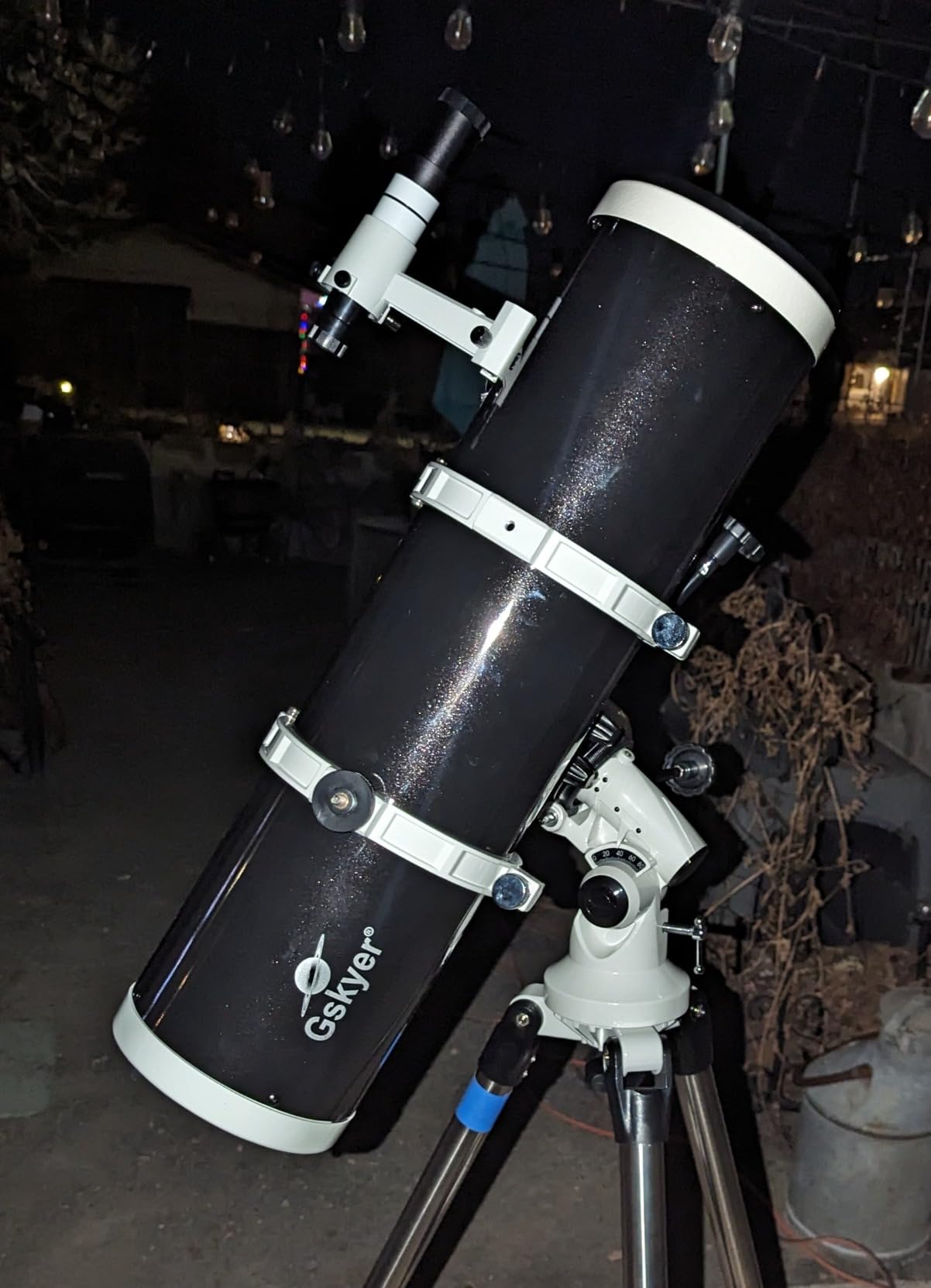
The Gskyer 130EQ is the pick I recommend to people who want a real planetary instrument without a computerized mount. At 130mm it is the second-largest aperture here, and 130mm is the threshold where Mars starts showing surface markings rather than a single orange smudge. Reviewers repeatedly single out the German equatorial mount as the decisive upgrade over the alt-azimuth budget scopes, because it lets you follow a drifting planet by hand at magnification.
The toothless focusing base deserves more credit than it gets. Focus is genuinely smooth and free of the backlash that makes cheap racks frustrating, and on the Moon I could go from a 10mm eyepiece to a 6mm without losing the target. The all-glass multi-coated optics are bright and high-contrast for a reflector at this level.
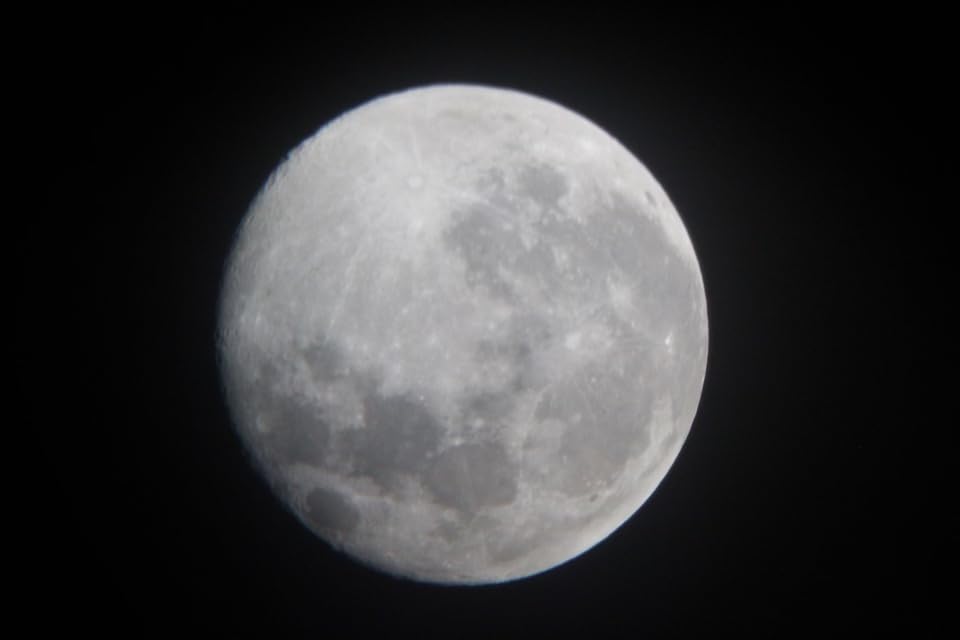
Three eyepieces plus a 3x Barlow reach up to 307x, and the Bluetooth remote lets you capture phone photos without an app. At 650mm focal length, though, you are trading image scale for field width, so the sweet spot for planetary detail sits nearer 100x to 200x than on the long-focal-length instruments.
The cost of the equatorial route is complexity and weight. Polar axis alignment is a real step, manual equatorial tracking still needs periodic correction, and 30.1 pounds is awkward for a single person to lift onto a tripod. Owners who skip alignment lose most of the mount’s advantage, and that is the mistake I would warn you about.
Who should buy the Gskyer 130EQ
Buy it if you have a genuine interest in Mars and Jupiter and you are willing to spend ten minutes on setup. It is the largest aperture you can carry in one piece without a vehicle, and the equatorial mount is the reason it beats every 90mm refractor on long sessions.
It also suits visual observers who want the Moon, planets and the occasional deep-sky object in one instrument, since the short f/5 tube handles wide fields well.
Who should skip the Gskyer 130EQ
Skip it if your observing is casual, if setup time matters, or if you want something a family member can use without instructions. A 30 pound instrument with a polar alignment step is a commitment, not a grab-and-go.
Skip it if you are shopping purely for planetary magnification. The f/5 ratio means you need a Barlow to reach the focal lengths that really show Cassini’s division, and most buyers add one later.
4. Celestron StarSense Explorer LT 114AZ: Best for Beginners
Celestron StarSense Explorer LT 114AZ Newtonian Smartphone Guided Telescope
114mm Newtonian aperture
1000mm focal length at f/8.8
StarSense app alignment
10.4 pounds
Pros
- 114mm aperture is enough for Jupiter's cloud bands
- App alignment finds targets in minutes
- Slow motion rod aids fine altitude adjustment
- Mirror optics avoid achromatic fringing
Cons
- Reflector needs occasional collimation checks
- Alignment depends on having a smartphone
- Manual mount means drift at higher power
The StarSense Explorer LT 114AZ solves the exact problem that stops most beginners: finding things. The app uses sky recognition to match three objects you point at, then generates a target list for your time and location. Owners consistently describe going from unpacking to viewing in minutes rather than hours, and that experience matters more to a new observer than any specification.
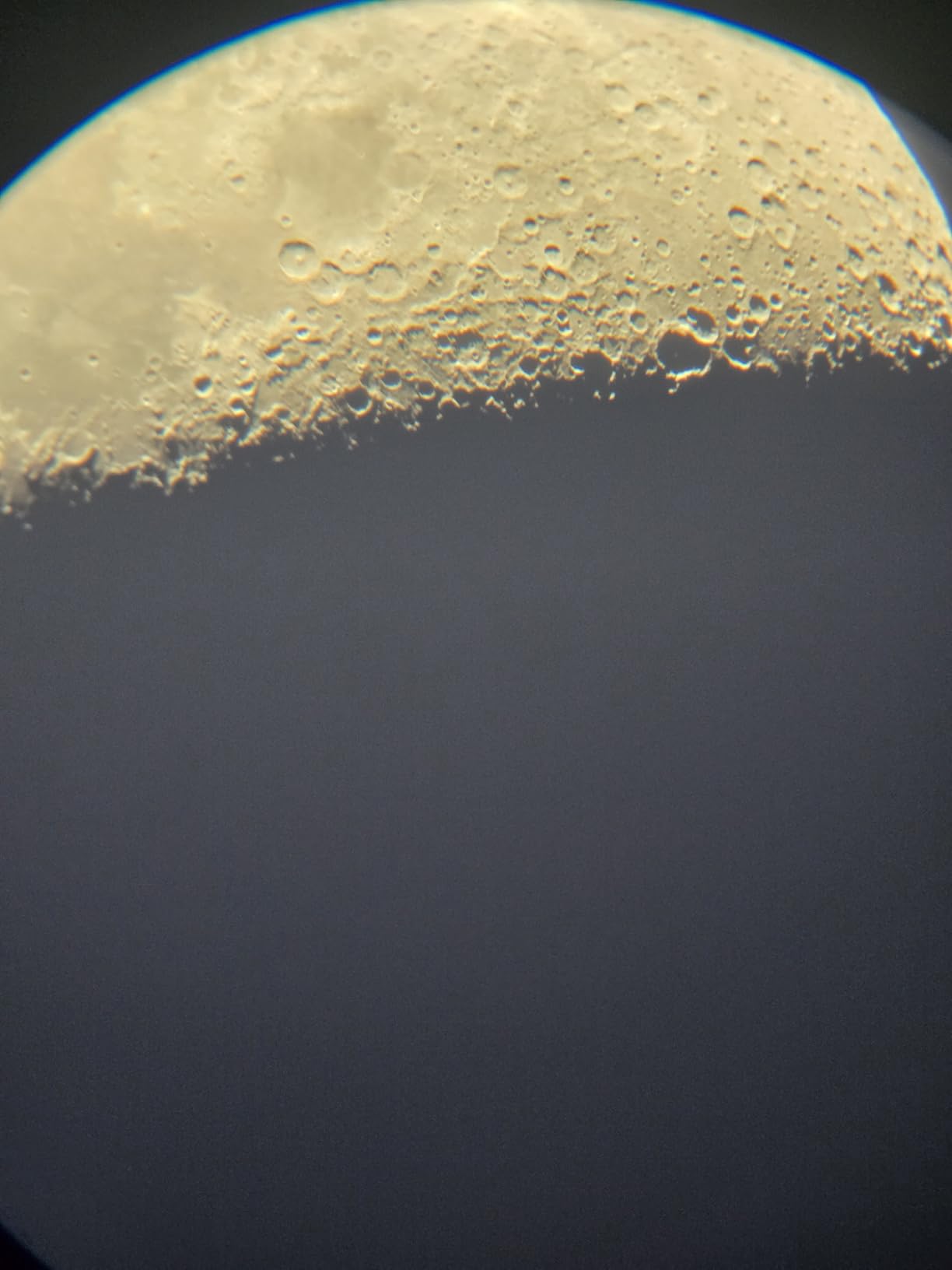
On the planets, 114mm of aperture with a 1000mm focal length is a genuinely useful combination. Reviewers report cloud bands on Jupiter and the Cassini Division on Saturn at the supplied eyepieces, and the aluminum and silicon dioxide coated mirrors avoid the colour fringing that cheap achromatic refractors show on bright targets.
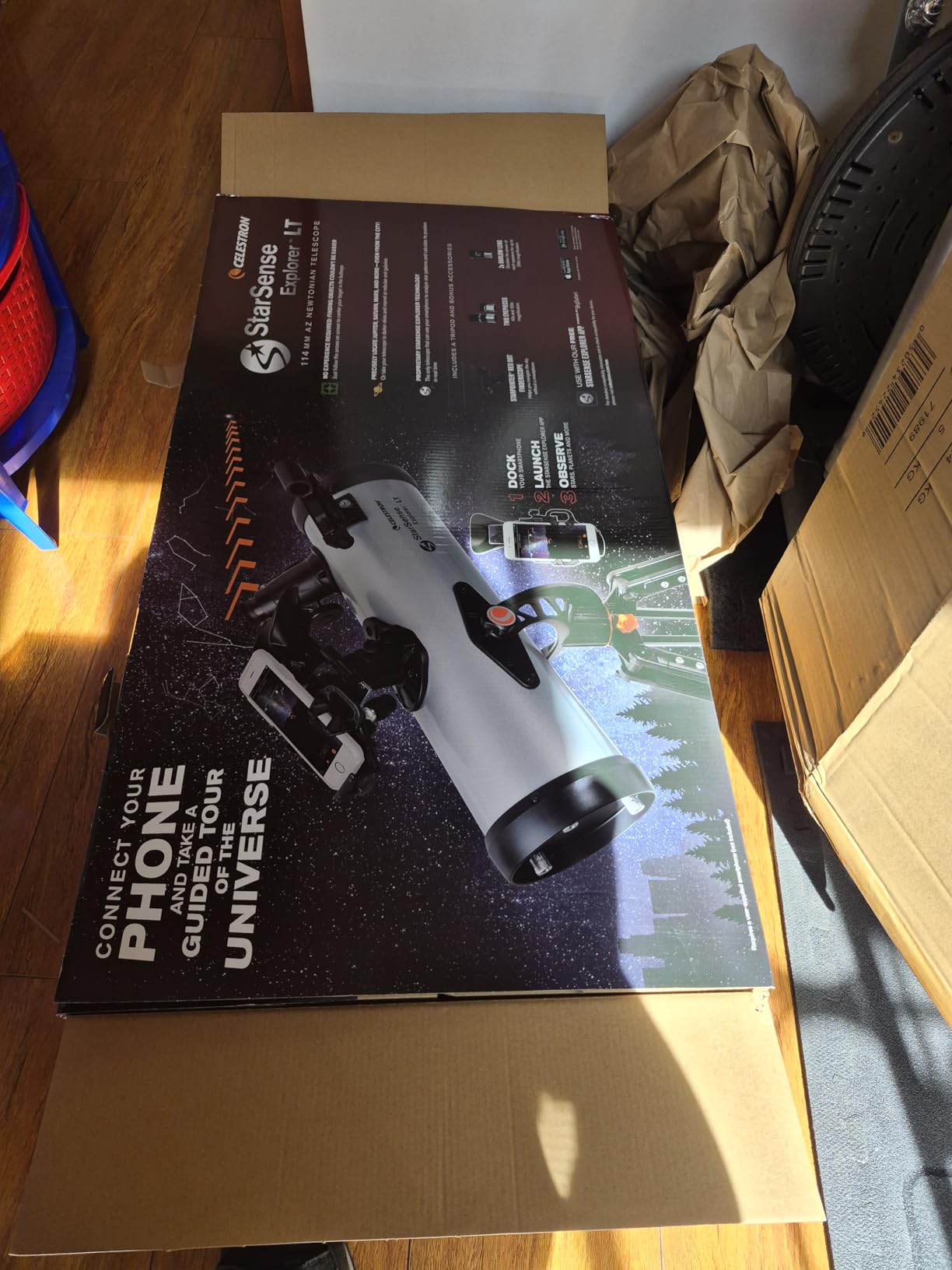
The altitude slow motion rod is a small addition that makes a real difference. It nudges the tube in one axis without disturbing the other, so you can recentre a planet at 150x without losing it entirely. That is the difference between a usable session and a frustrating one at higher power.
Its rating of 4.1 is the second-lowest average in this roundup, and the complaints are consistent rather than random. It is a reflector, so collimation needs checking. Alignment depends on a phone, so it is not a standalone instrument. And the mount is manual, so at higher magnification the planet drifts and you work the slow motion rod.
Who should buy the StarSense LT 114AZ
Buy it if you are buying for someone who has never used a telescope, or if you want to spend your observing time looking rather than searching. The app-driven pointing is the feature that converts a first purchase from a cupboard item into something used every clear night.
It also suits anyone who wants a step up from a 70mm refractor without crossing into heavy equipment, since 10.4 pounds is still a one-person carry.
Who should skip the StarSense LT 114AZ
Skip it if you enjoy learning star charts. If you would rather find targets yourself, the app adds a dependency you do not need and the manual alt-azimuth mount of a simpler scope does the same job.
Skip it if you need motorized tracking for long sessions or for imaging. There is no motor here, so a planet at 175x will leave the field within a couple of minutes.
5. SARBLUE Mak70: Best Maksutov with Dual-Axis Slow Motion
Maksutov-Cassegrain Telescope, Mak70 Telescopes for Adults Kids 1000mm Focal Length 70mm Objective Lens, Beginners Astronomy Telescope with Slow Motion Gimbal Tripod
70mm aperture
1000mm focal length at f/14.3
Gimbal mount with dual axis slow motion
210mm tube
Pros
- Gimbal mount with slow motion on both axes
- f/14.3 ratio is ideal for planetary contrast
- Fully multi-coated optics show little colour fringing
- Compact 210mm tube packs down for travel
Cons
- Little usable headroom above roughly 120x
- Tripod screws can loosen and make the mount wobble
- Plastic eyepiece and diagonal bodies
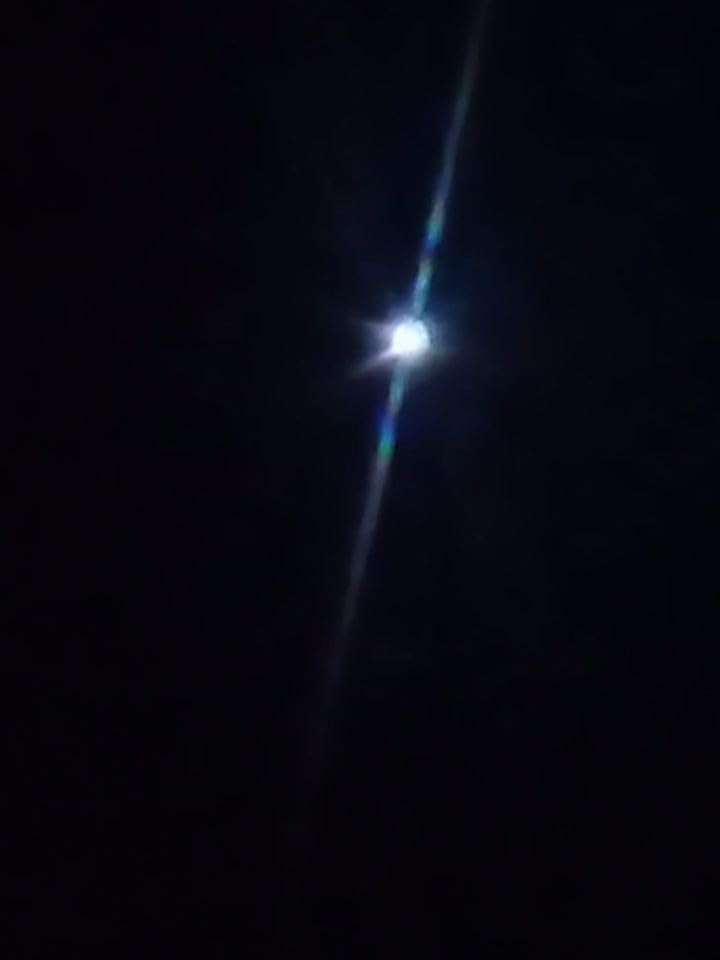
The Mak70 is unusual in this roundup because the mount, not the glass, is the headline. The gimbal carries slow-motion fine adjustment on both axes, which is exactly the feature that entry alt-azimuth scopes leave out and that high-power planetary work depends on. Reviewers report Jupiter’s four Galilean moons and its colour bands clearly at the supplied 20mm and 10mm eyepieces, and 1000mm of focal length at f/14.3 is a textbook planetary ratio.
Several experienced amateurs describe the optics as beating far costlier Maksutov designs, and one reviewer with four decades of observing singled out the fully multi-coated glass as genuinely good in absolute rather than relative terms. A 1.5x Barlow and a universal phone mount come in the box, along with a 5×24 adjustable finder.
This is also the most polarized product we analyzed, with 219 reviews and a 19 percent one-star share. The critical reviews focus on mechanical details rather than optics: tripod legs held by self-tapping screws that loosen and introduce wobble, image jitter while focusing, plastic eyepiece and diagonal bodies, and eyepiece threads that do not mate cleanly with standard filters.
A 70mm aperture also has a hard limit. Beyond roughly 120x the image darkens and detail softens, which is normal physics rather than a defect, but it means this is a 100x instrument that occasionally reaches 150x, not a high-power scope.
Who should buy the SARBLUE Mak70
Buy it if manual tracking at moderate power is what frustrates you about entry telescopes. Dual-axis slow motion is not available almost anywhere else at this level, and it makes following a drifting planet at 100x a two-finger job instead of a wrestling match.
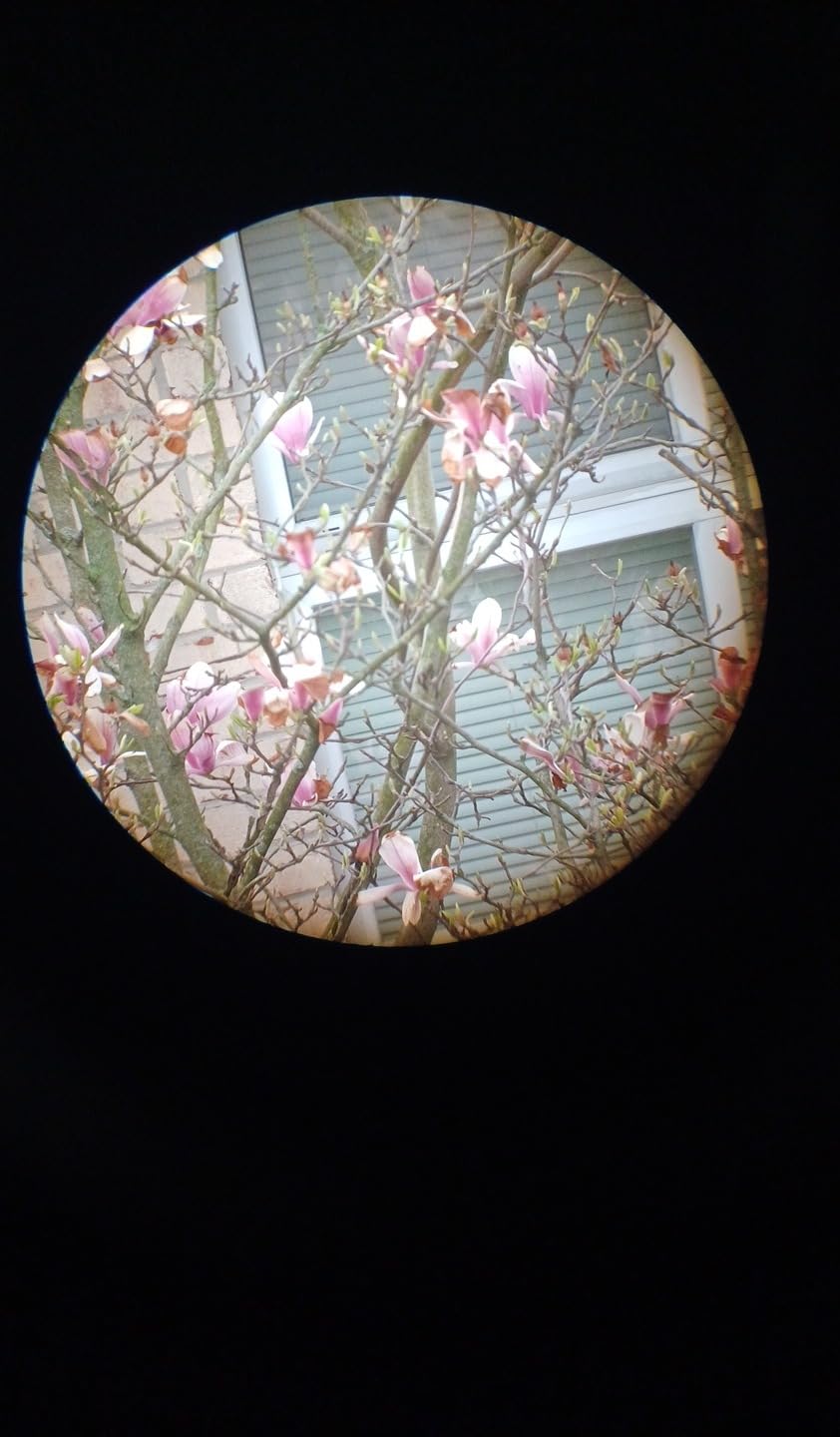
It also suits anyone who wants one instrument for daytime viewing and planets, since the supplied 20mm and 10mm eyepieces and compact 210mm tube make it easy to point at the Moon and bright targets as well as at night sky objects.
Who should skip the SARBLUE Mak70
Skip it if you are rough with equipment. The self-tapping tripod screws and the gimbal will not forgive being knocked, and the wobble they cause is the most common complaint in the reviews.
Skip it if you plan to add standard 1.25 inch threaded planetary filters. Owners report the eyepiece threads do not accept them cleanly, which rules out one of the best value accessories for Jupiter and Mars.
6. SARBLUE Mak60: Best Travel Telescope for Planets
Maksutov-Cassegrain Telescope for Adults Kids Astronomy Beginners, Sarblue Mak60 Catadioptric Compound Telescope 750x60mm, Compact Portable Travel Telescope, with Tabletop Tripod Phone Adapter
60mm aperture
750mm focal length at f/12.5
Tube length 200mm
Fully multi-coated catadioptric
Pros
- Folds 750mm of focal length into a 200mm tube
- Optics praised even by owners of premium refractors
- Accepts standard 1.25 inch eyepieces
- Detachable aperture lid doubles as an educational feature
Cons
- No finder scope included
- Tabletop tripod is very short
- Phone holder only fits the supplied 20mm eyepiece
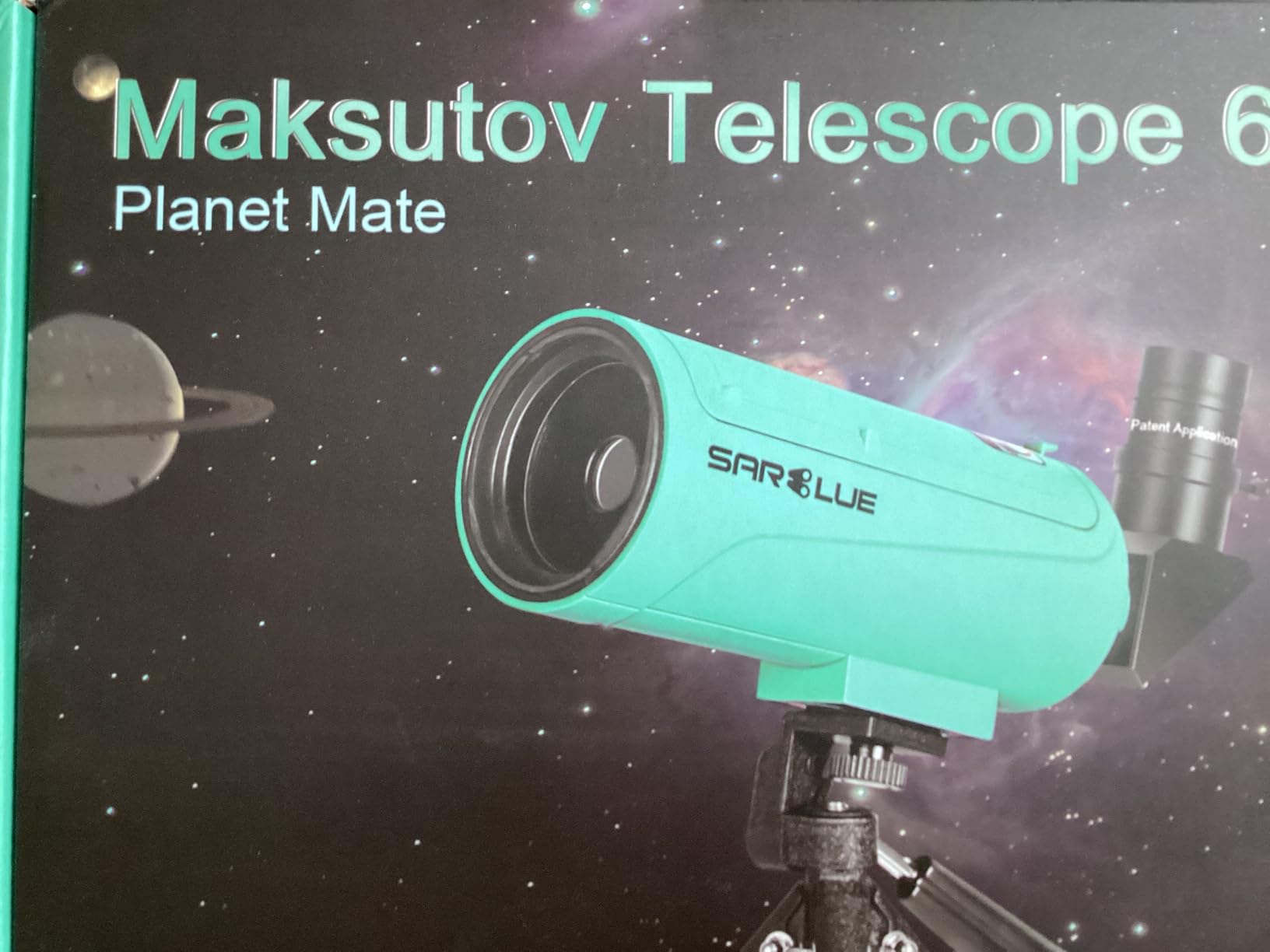
The Mak60 solves a problem no refractor in this list solves: how do you bring a long focal length to a dark-sky site. The Maksutov-Cassegrain design folds 750mm into a 200mm tube, so the whole instrument fits in a day bag. At f/12.5 the image scale suits planetary work, and owners report Jupiter’s bands and Saturn’s rings at around 125x once a 6mm Plossl is added.
The optics are the surprise. A long-time visual observer who owns premium refractors described the fully multi-coated glass as excellent in absolute terms, which is not a claim you can make about most instruments at this level. The detachable aperture lid exposes the internal mirror assembly, which turns the scope into a teaching tool for children.
The universal complaint is the absence of a finder scope. You get two small bump sight guides on the tube, and almost every owner adds a cheap third-party finder or red dot sight within a week. The tabletop tripod is also very short, and many owners report switching to a photo tripod for seated viewing.
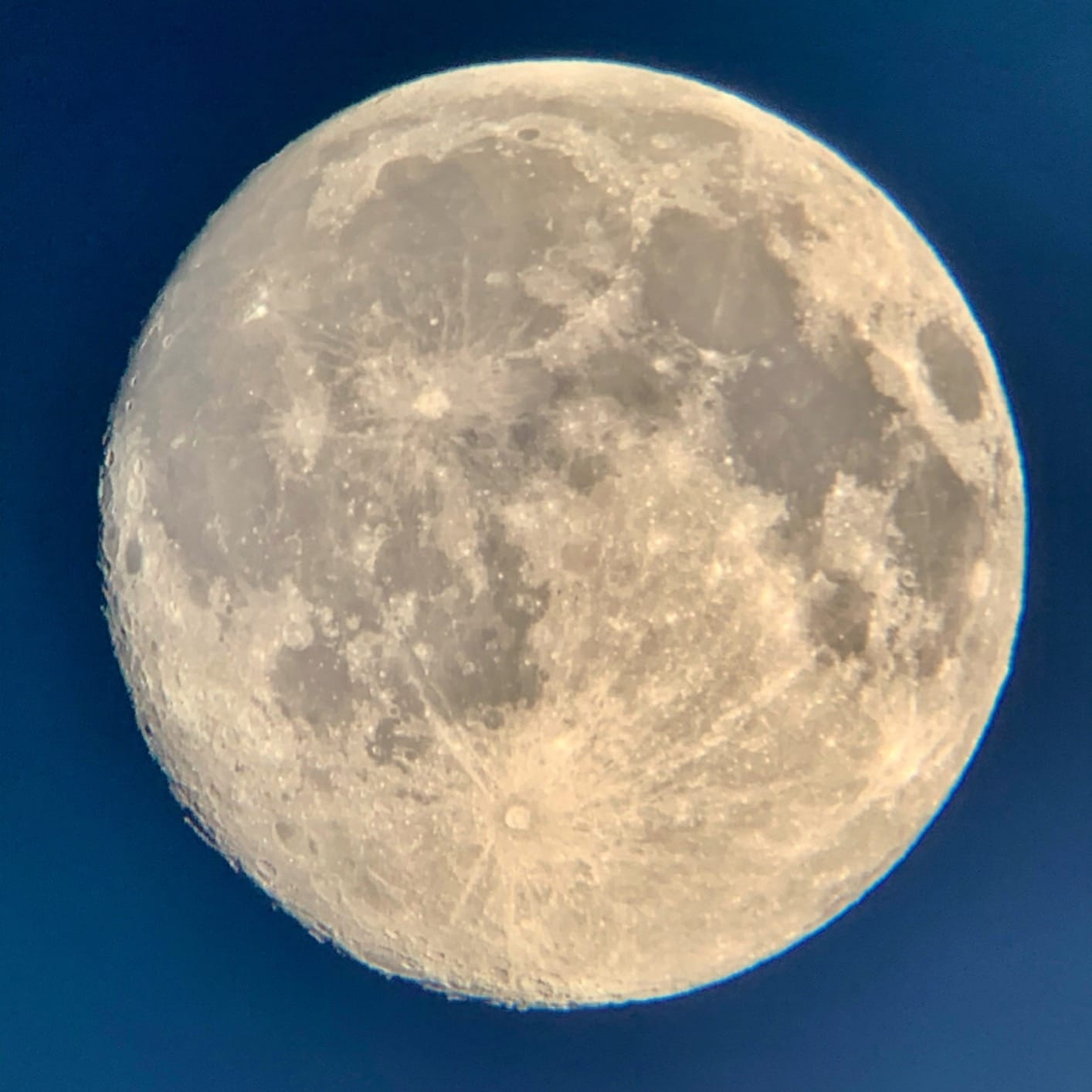
Understand the aperture limit clearly. At 60mm you are looking at a compact, high-contrast image rather than a detailed one. Saturn will be recognisably ringed and the Moon will reward a 6mm eyepiece, but the Cassini Division is beyond what this aperture delivers reliably.
Who should buy the SARBLUE Mak60
Buy it if you travel to dark-sky sites, use a small car, or want a second instrument for a balcony. Nothing else in this list packs a genuinely long focal length into a tube you can carry with one hand.
It also suits children and schools, since the aperture lid and the simple eyepiece interface make it approachable and hard to break.
Who should skip the SARBLUE Mak60
Skip it if resolving fine planetary detail is your goal. The 60mm aperture is a wide-field, recognition-level instrument, and adding a Barlow will not change that ceiling.
Skip it if you dislike buying accessories. A finder scope, a better tripod and at least one additional eyepiece are effectively required rather than optional, because none of them are supplied.
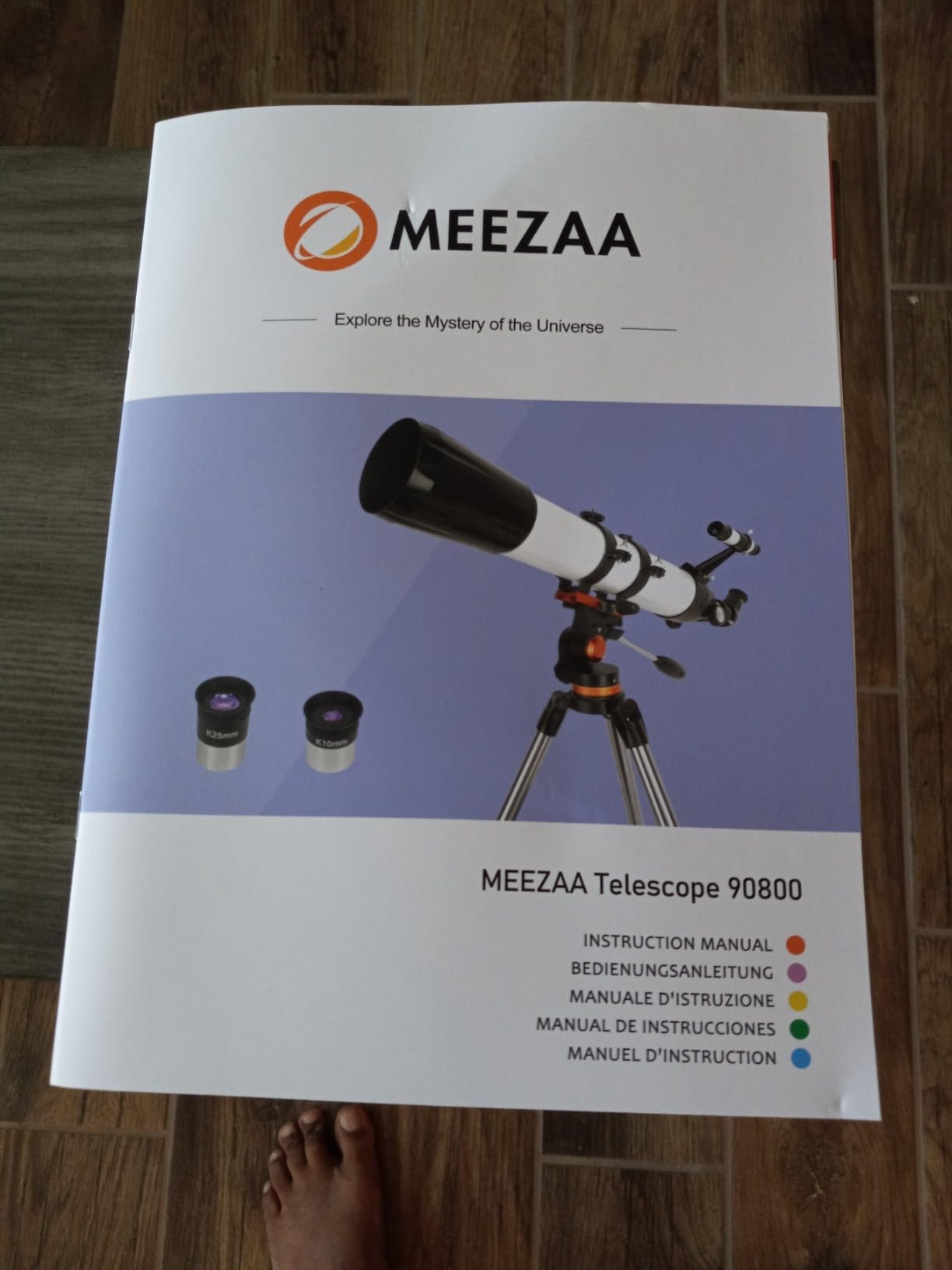
7. MEEZAA 90mm Refractor: Best Long-Focal-Length Refractor for Families
MEEZAA Telescope for Adults High Powered, 90mm Aperture 800mm Refractor
90mm aperture
800mm focal length at f/8.9
Fully multi-coated glass
Stainless steel tripod
Pros
- 90mm aperture on a long f/8.9 tube resolves Jupiter's bands
- 32x to 240x range from two eyepieces and 3x Barlow
- Stainless steel tripod is stiffer than aluminium
- About 90 percent of owners assemble in ten minutes
Cons
- Inverted finder image confuses new owners
- Phone mounting upsets balance and knocks the finder out
- Focus knob movement makes the tube wobble
The MEEZAA 90mm is the configuration we would hand to a family that wants more than a toy. A 90mm aperture on an 800mm f/8.9 tube is a long-focal-ratio design, and multiple reviewers describe seeing Jupiter’s cloud bands and Saturn’s rings as resolved features rather than coloured discs. That is the jump from recognising a planet to actually observing it.
Thirty-two to 240 times of magnification from the two supplied eyepieces and a 3x Barlow gives you a workable ladder in one box, and the stainless steel tripod is stiffer than the folding aluminium type on cheaper scopes, which matters when you are working at 200x.

With 820 reviews averaging 4.3, the feedback is consistent rather than polarised. The dominant positive theme is the 90mm and 800mm pairing. The gripes are all mechanical: an inverted finder image, wobble from the focus knob, and the way a mounted phone shifts the balance and knocks the finder out of alignment.
One reviewer warns explicitly that the lunar detail in the listing imagery is not achievable with the supplied optics, and that is fair. Multiple owners recommend adding a 6mm eyepiece, since the included set tops out at a useful 160x with the Barlow.
Who should buy the MEEZAA 90mm
Buy it if you want a step-change in planetary detail over an 80mm scope and you need something a teenager can set up without help. The stainless steel tripod and the ten-minute assembly are both genuinely helpful for household use.
It also suits anyone who wants a sealed optical tube that never needs collimation and does not want the weight of a reflector or Dobsonian.
Who should skip the MEEZAA 90mm
Skip it if you plan to take phone photos of the Moon. The phone adapter is included, but owners report alignment is tricky and the balance shift knocks the finder out of position every time.
Skip it if high-power planetary work is the priority and you have no intention of adding eyepieces. Without a 6mm, the top of the useful range stays modest for a 90mm tube.
8. Dianfan 90mm Refractor: Best for Daytime and Nighttime Use
Dianfan Telescope, 90mm Aperture 800mm Telescope for Adults High Powered, Portable Professional Astronomy Refractor Telescopes for Beginners, with Stainless Steel Tripod & Phone Adapter, Carry Bag
90mm aperture
800mm focal length at f/8.9
45 degree zenith mirror
Stainless steel tripod
Pros
- Long f/8.9 focal ratio rewards higher magnification
- Stainless steel tripod reduces shake
- Zenith mirror keeps images upright for daytime viewing
- 32x to 240x with 3x Barlow
- Carrying bag and phone adapter included
Cons
- No motorized tracking so planets drift at higher power
- No slow motion fine adjustment on the alt-az mount
- Chromatic fringing on high contrast detail
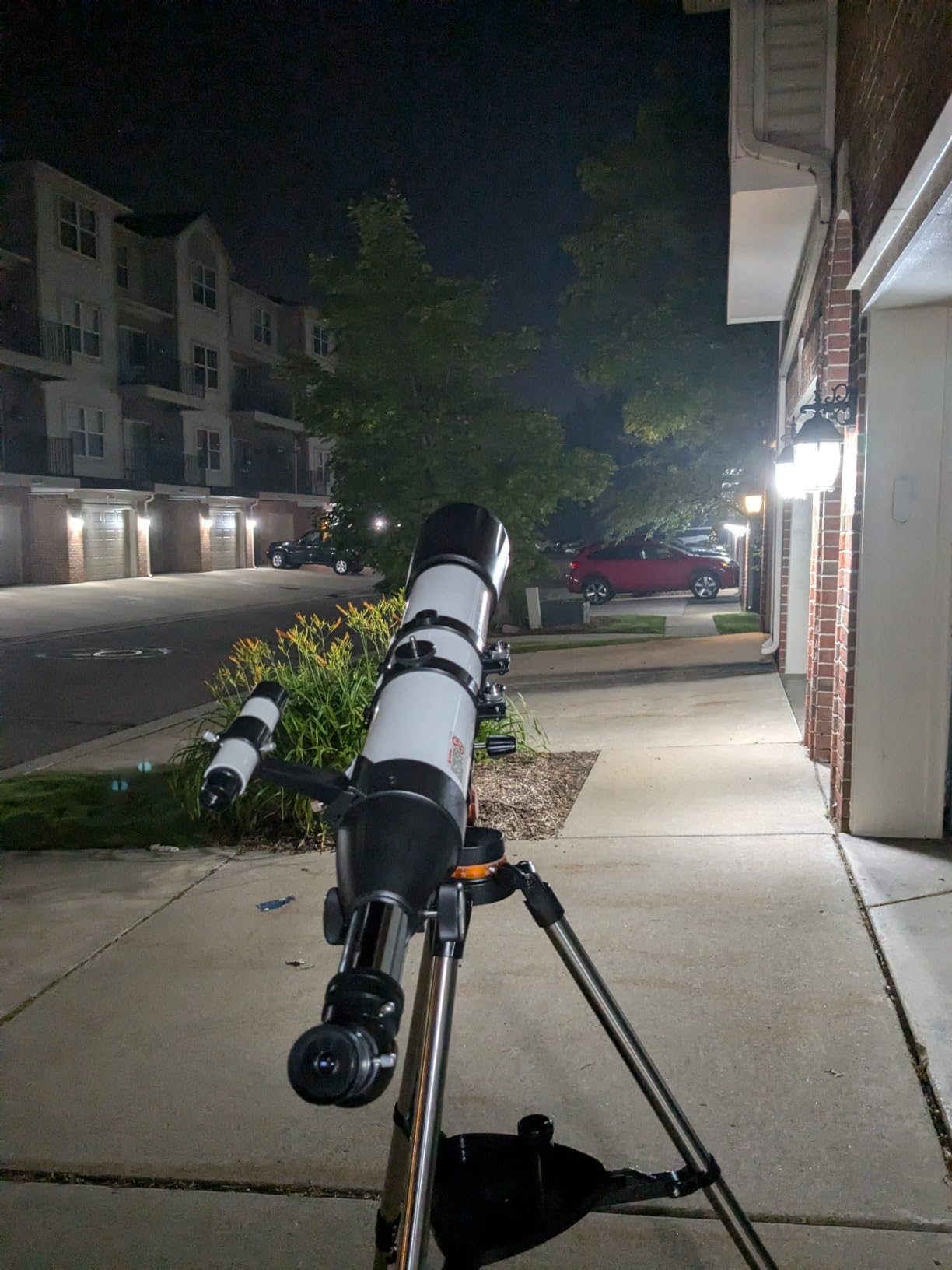
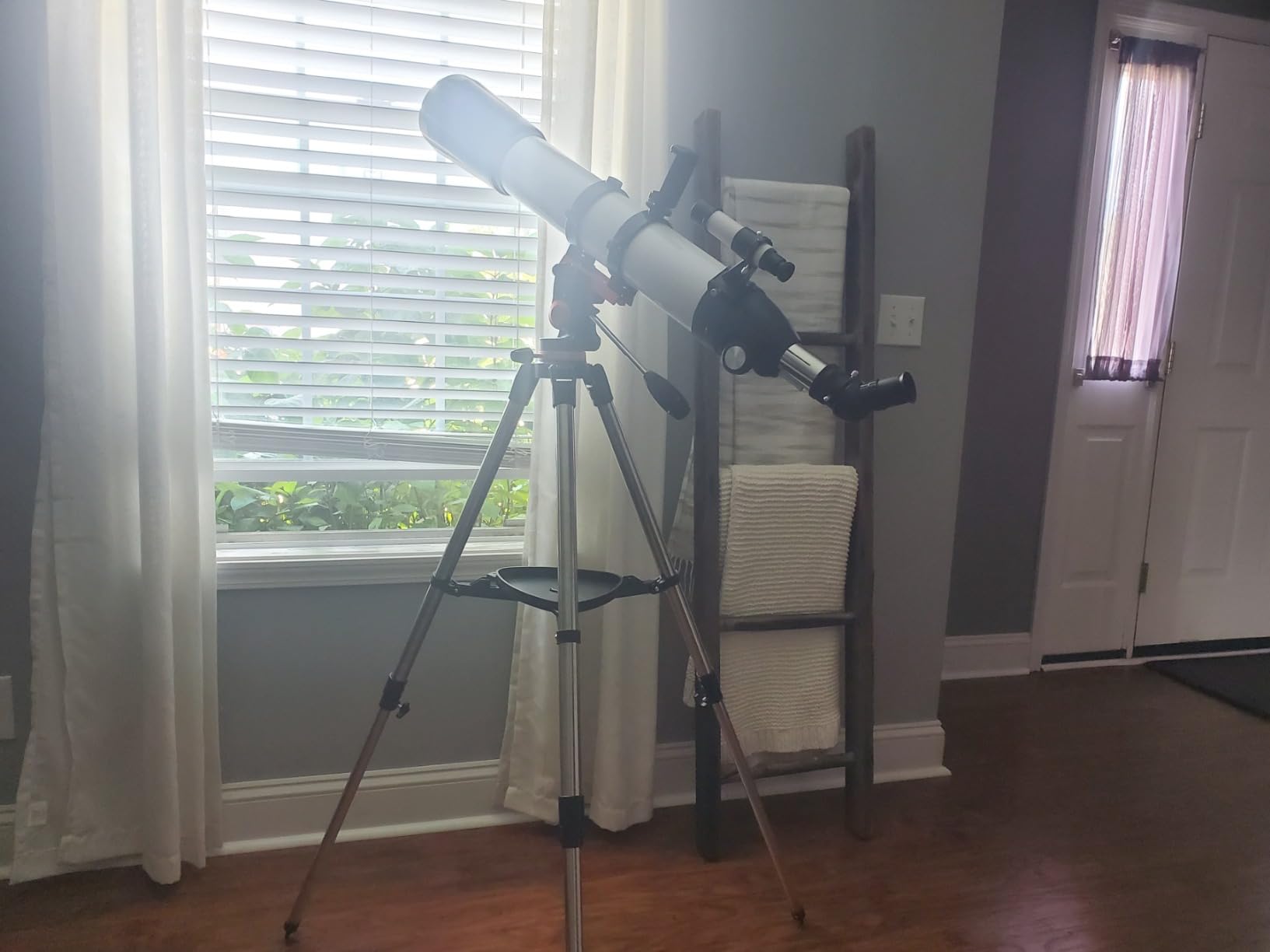
This Dianfan 90mm shares the 90mm and 800mm specification that makes this size popular, and adds one thing most competitors leave out: a 45-degree zenith mirror that keeps images upright for daytime viewing. If you want to point the same scope at the Moon, a distant landscape or a birding target, that accessory is worth more than it costs in the box.
The stainless steel tripod is the second differentiator, and reviewers consistently notice it is stiffer than typical aluminium. At 4.7 kg the whole rig folds for travel, and the carry bag and phone adapter mean you can move between a balcony and a darker site without much fuss.
Its stated Dawes limit of 1.29 arc seconds is the joint-second-finest resolution figure here, behind the NexStar 8SE and ahead of the 70mm Celestron refractor. The fully coated objective improves contrast and colour, and the two eyepieces plus a 3x Barlow cover 32x to 240x.
The limitations are the entry alt-azimuth design. There is no tracking motor and no slow motion, so planetary work tops out in the lower to mid magnification range, and chromatic fringing on bright high-contrast targets is the other recurring note across reviews. About 10 percent of ratings are one star, pointing to occasional assembly or quality-control problems.
Who should buy the Dianfan 90mm
Buy it if you want one telescope that does daytime viewing and planets without swapping accessories. The zenith mirror and upright images are the reason, and reviewers praise the tripod rigidity relative to cheaper 90mm tubes.
It also suits anyone who wants a 90mm aperture in a light, foldable package for travel to darker locations.
Who should skip the Dianfan 90mm
Skip it if you want to sit at 200x and watch one object. No slow-motion control means every recentring is a physical nudge of the tube, and planets drift out of a 1.56 degree field quickly at that power.
Skip it if colour fringing bothers you. A 90mm achromatic refractor is already pushing what a single achromat can correct, and bright planetary detail at high power will show blue and violet edges.
9. Hawkko 90mm Refractor: Longest Ratio at the 90mm Tier
Hawkko 90mm Aperture 900mm Telescope for Adults High Powered – Professional Multi-Coated Refractor Telescope for Astronomy Beginners (36X-270X) with AZ Mount, Phone Adapter and Carry Bag
90mm aperture
900mm focal length at f/10
36x to 270x with 3x Barlow
Stainless steel AZ tripod
Pros
- f/10 ratio is the most planet-friendly in the 90mm class
- 36x to 270x magnification range supplied
- Full multi-layer coating brightens the image
- Stainless steel tripod with 360 degree rotation
- Complete kit including finder and accessory tray
Cons
- No tracking or slow motion so targets drift above 200x
- Straight-through finder needs careful alignment
- 4.2 average with 9 percent one-star reviews
At 900mm focal length on a 90mm aperture, the Hawkko has the longest focal ratio in the 90mm class: f/10. Buyers recognise this immediately as the more planet-friendly of the 90mm options, and it is the reason the supplied 36x to 270x range can actually be used on Jupiter and Saturn rather than being a number on a box.
Full multi-layer coating is claimed to improve light transmittance by roughly 73 percent, and the practical effect owners report is a brighter, sharper image. The stainless steel alt-azimuth tripod rotates through 360 degrees and adjusts between 28 and 46 inches, and the kit includes a finder, zenith mirror, accessory tray, carry bag and smartphone adapter.
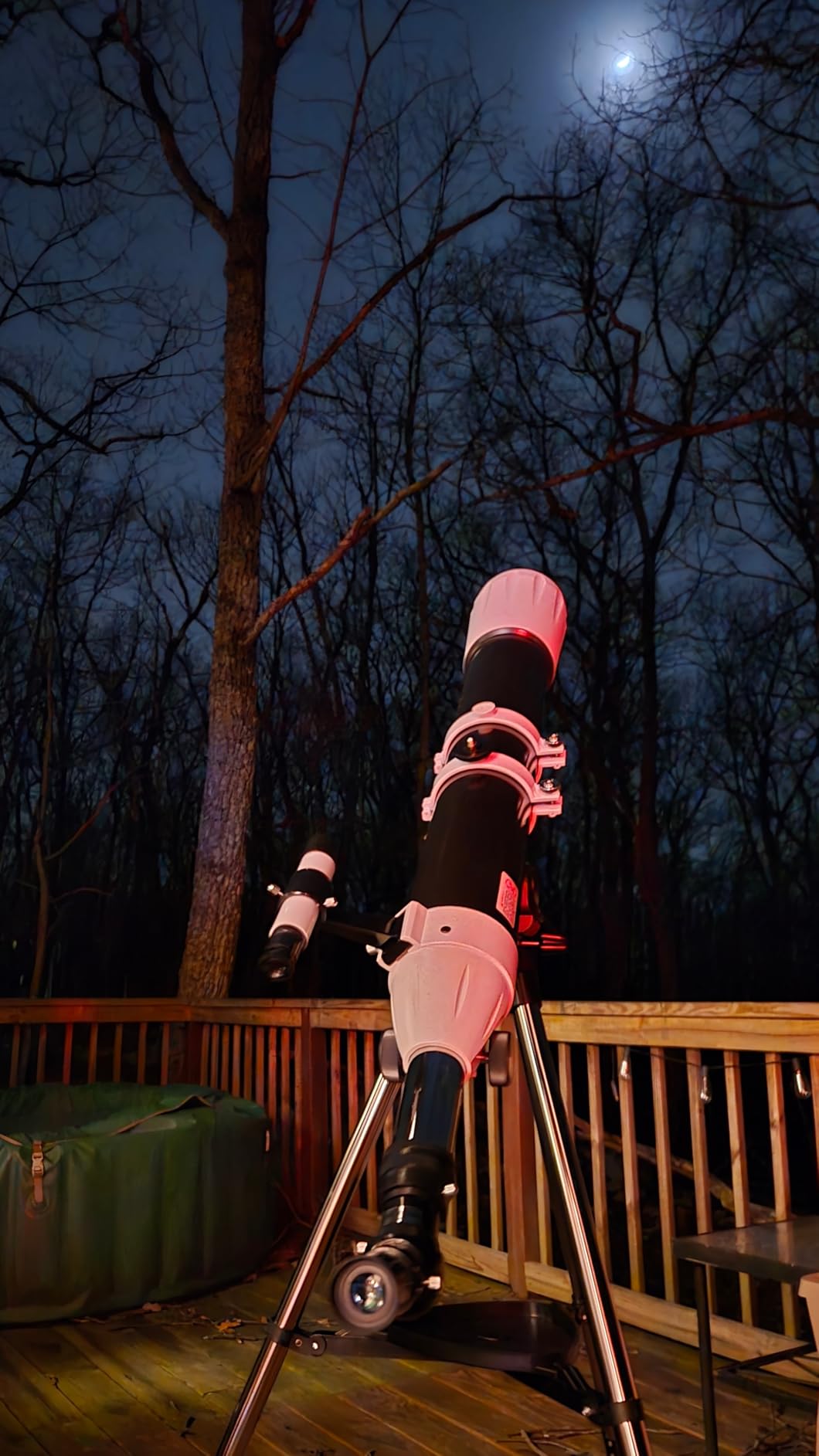
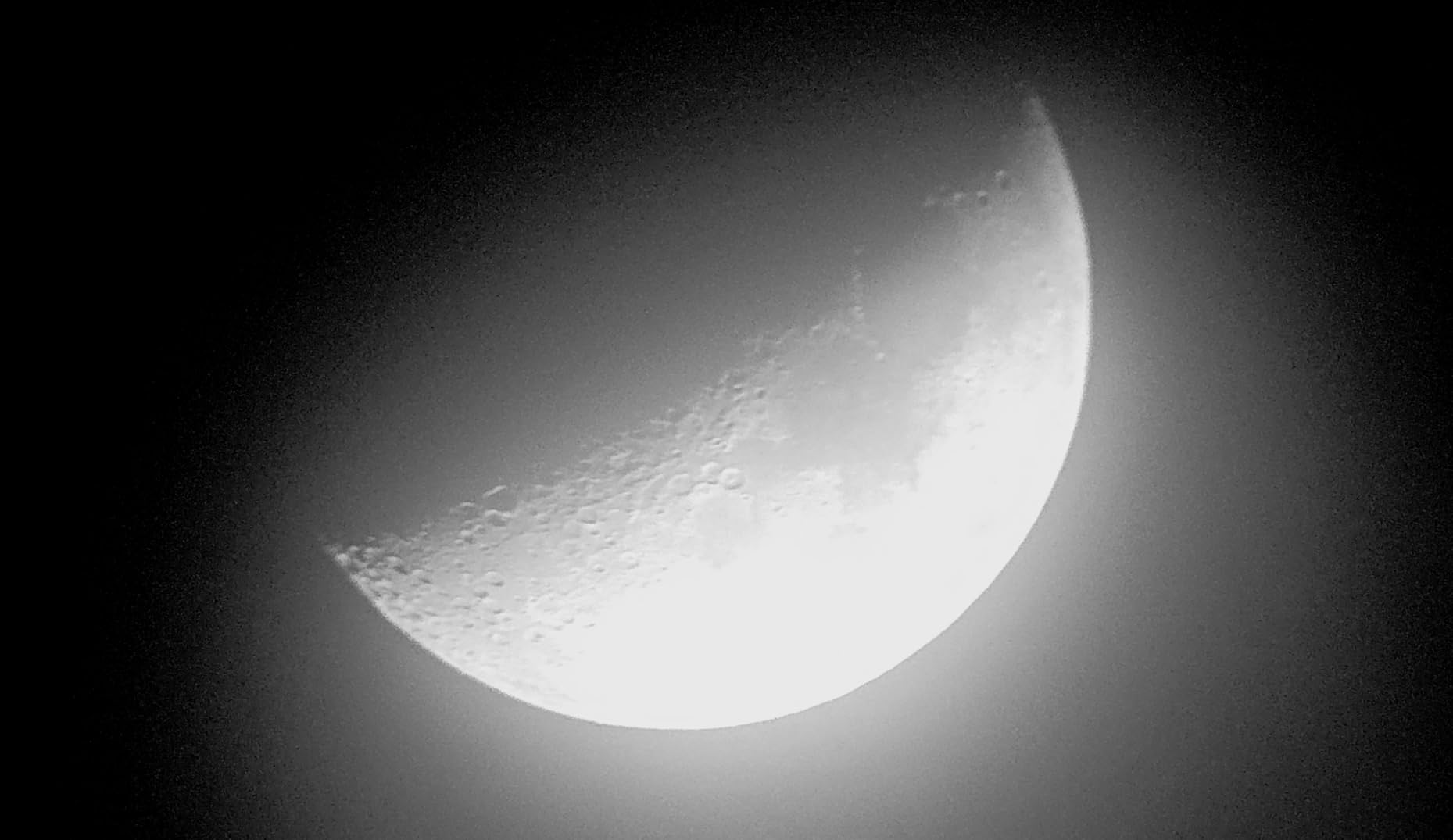
The stated Dawes limit of 1.29 arc seconds matches the other 90mm tube here, so the extra focal length buys image scale and steadier views rather than raw resolution. That is exactly the right trade for planets, where a longer tube makes high power easier to achieve before the aperture runs out of light.
Its 4.2 average is lower than the competing 90mm refractors, and the reviews explain why. Nearly all the critical feedback points to the same missing feature: no tracking motor and no slow-motion control, so targets drift at 200x and above. The straight-through finder is basic and needs careful alignment.
Who should buy the Hawkko 90mm
Buy it if you are choosing between 90mm refractors and want the one most suited to high magnification. The 900mm focal length means 100x arrives with a 9mm eyepiece, and 270x is reachable with the supplied Barlow and 3.3mm equivalent.
It also suits anyone who wants a complete kit on day one, since more is included here than with most competitors at this aperture.
Who should skip the Hawkko 90mm
Skip it if you plan long sessions. Drift without slow motion or tracking is the dominant complaint, and at 270x a planet crosses the field in under a minute.
Skip it if you want the cleanest colour on bright targets. A 90mm achromatic at f/10 still shows fringing around high-contrast planetary detail.
10. Koolpte 80mm Refractor: Best All-in-One Kit
Koolpte Telescope for Adults, 80mm/600mm AZ Refractor for Beginners
80mm aperture
600mm focal length at f/6.7
25mm and 10mm eyepieces plus 3x Barlow
Phone adapter
Pros
- Fully multi-coated 80mm gives surprisingly clear views
- Tool-free assembly in about 15 minutes
- Wireless remote avoids shaking the view
- Lightweight and compact with carrying bag
- Phone adapter and 5x24 finder included
Cons
- 3x Barlow is lightweight plastic and splits colour on Jupiter
- Finder mount is fixed plastic and rarely aligned
- Tripod and eyepiece screws feel flimsy at high power
- Confusing instructions around the diagonal
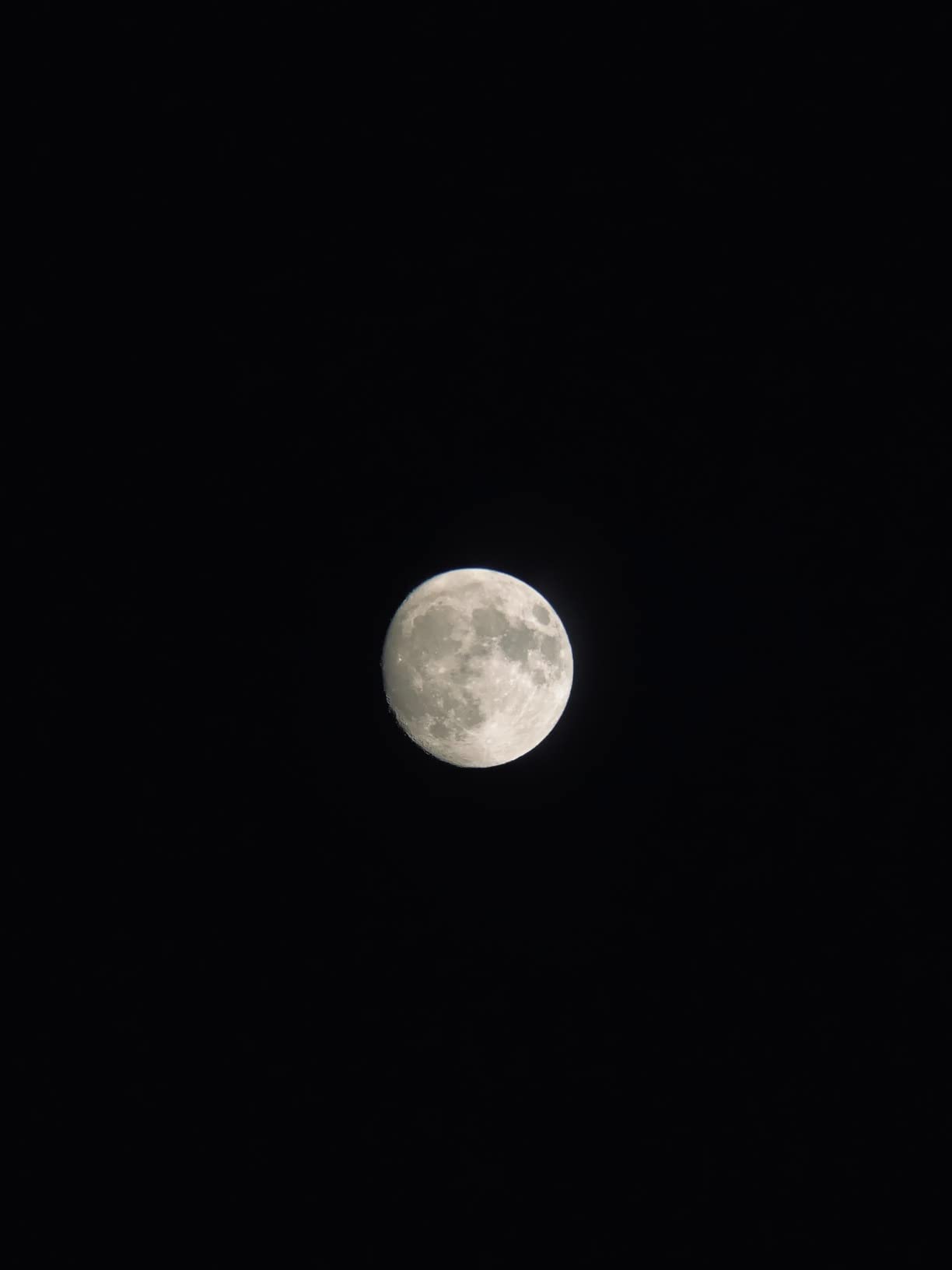
With 3,972 reviews averaging 4.3, the Koolpte 80mm is the second-most-reviewed instrument in this roundup, and the feedback pattern is very stable. Beginner owners report resolving lunar craters, Jupiter’s moons and Saturn’s rings on the first night, which for a first telescope is exactly the outcome that keeps people observing.
The wireless remote is a small feature that matters more than it sounds. Adjusting focus without touching the tube eliminates the shake that ruins high-power views, and owners who have used several phone adapters rate this one highly. The whole kit fits in the included carrying bag for travel to darker sites.
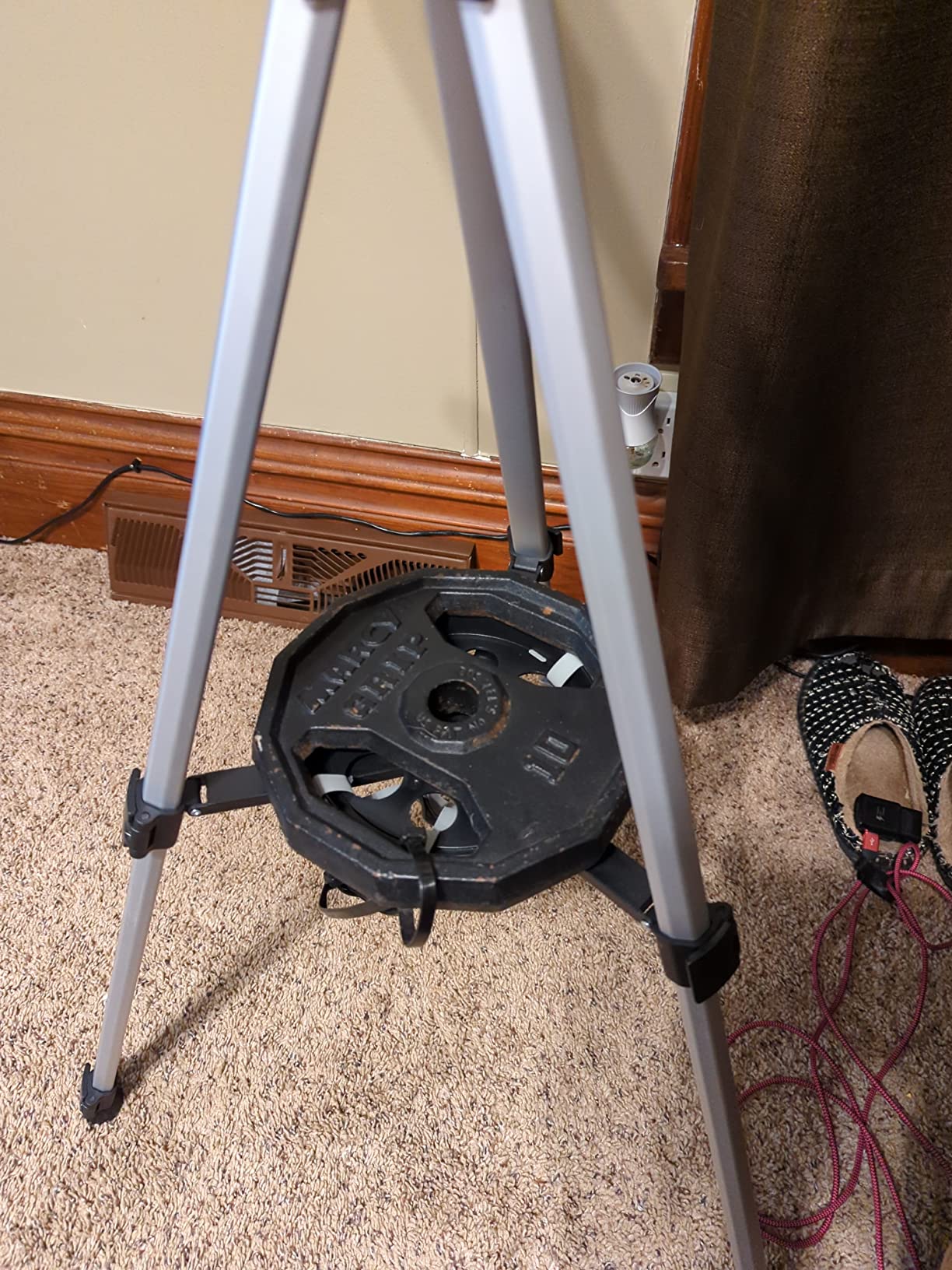
The negative reviews cluster on the accessories, not the optical tube. The 3x Barlow is lightweight plastic and produces visible colour splits on Jupiter, which is precisely the wrong place for a chromatic error. The 5×24 finder sits in a fixed plastic bracket that is essentially impossible to align properly.
The 600mm focal length at f/6.7 is short for planetary work. The supplied eyepieces give 24x and 60x, and the Barlow takes that to 72x and 180x, but 180x on an 80mm aperture is well past the point where the image holds together well.
Who should buy the Koolpte 80mm
Buy it if you want one box that contains everything and you will not chase accessories. Eyepieces, Barlow, finder, phone adapter, remote and bag are all present, and the fifteen-minute tool-free assembly removes the usual first-night barrier.
It also suits families and gift buyers, since the whole package is light enough for a child to carry and the remote keeps small hands off the focus knob.
Who should skip the Koolpte 80mm
Skip it if colour fidelity on bright planets matters. The plastic 3x Barlow is the single most-criticised component, and Jupiter is exactly where a colour split is most obvious.
Skip it if you will use magnification above 120x. The tripod and eyepiece screws are reported as flimsy, and a shaky mount at high power wastes the aperture you have paid for.
11. Celestron AstroMaster 70AZ: Best Long-Ratio Starter Scope
Celestron AstroMaster 70AZ Refractor Telescope for Moon & Planet Viewing
70mm aperture
900mm focal length at f/12.9
20mm and 10mm eyepieces
StarPointer red dot finder
Pros
- Crisp views of the Moon and planets on fully coated 70mm optics
- Tool-free setup gets you observing in minutes
- Panhandle alt-az mount makes pointing intuitive
- Also works for daytime terrestrial viewing
- Two-year warranty and US-based support
Cons
- 70mm aperture leaves faint deep-sky objects dim
- No tracking means drift at high power
- 900mm focal length still caps the magnification ceiling
- Chromatic fringing at higher power
The AstroMaster 70AZ has 3,790 reviews at 4.4 and is the highest-rated instrument in this roundup alongside the Gskyer. Buyers consistently praise the fast tool-free assembly, the crisp views of the Moon and planets, and the durable adjustable tripod. For a first telescope, that reliability record is worth a great deal.
What makes it interesting for planets is the 900mm focal length at f/12.9. That is a genuinely long ratio from a 70mm aperture, which means 45x with the 20mm eyepiece and 90x with the 10mm, and 1.56 millimeter exit pupil figures. The images are bright and contrasty rather than dim, which is what you want on small planetary discs.
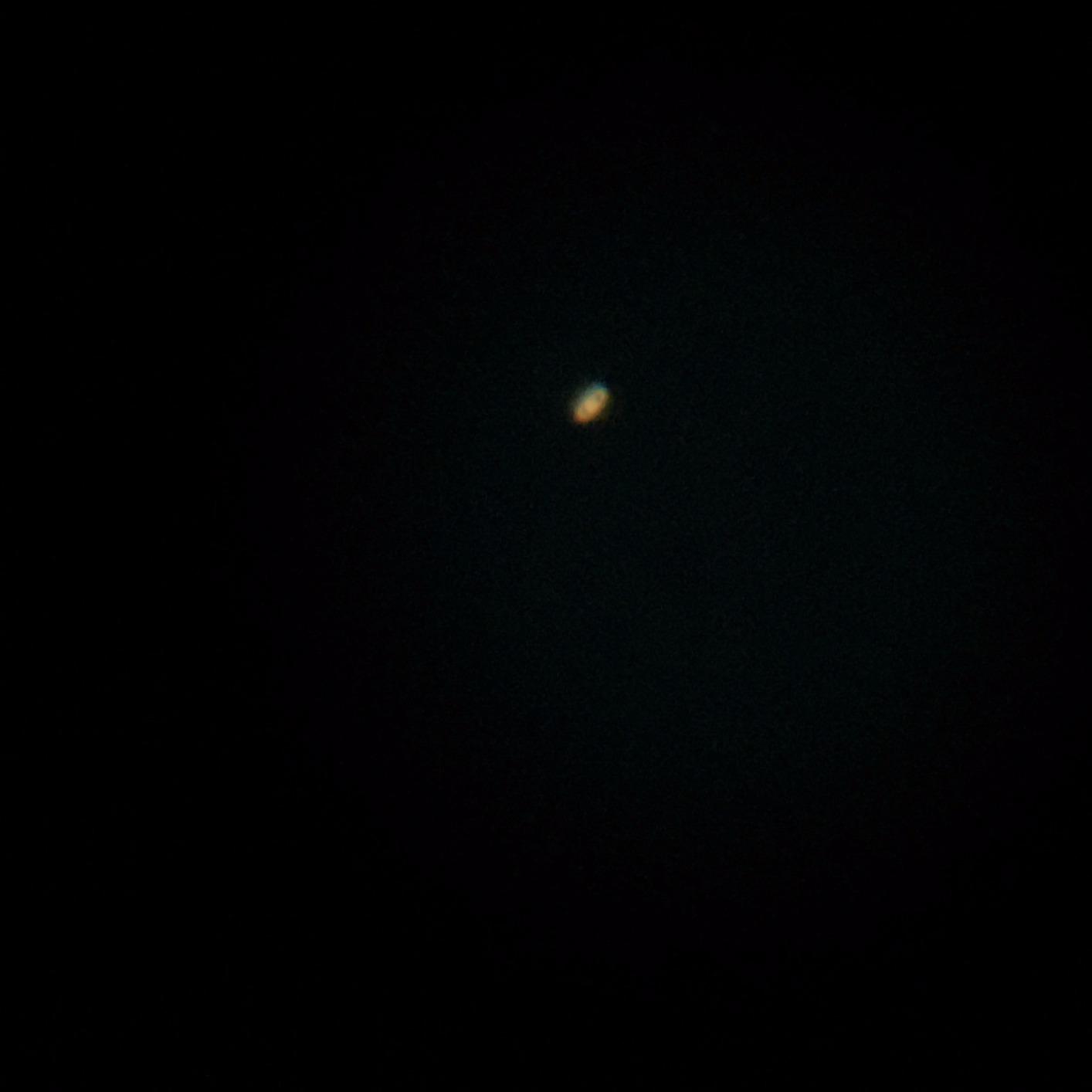
The recurring criticism is optical rather than mechanical. A 70mm achromatic objective with a 900mm focal length simply cannot deliver the resolving power of a 130mm reflector, and at higher magnification you will see some colour fringing around bright planetary detail. Reviewers describe it as a grab-and-go starter scope rather than a planetary specialist, which is fair.
The panhandle alt-azimuth mount is genuinely pleasant to use for pointing, and the adjustable tripod works standing or seated. There is no tracking motor, so at 90x you will be nudging the tube every minute or two to keep a planet centred.
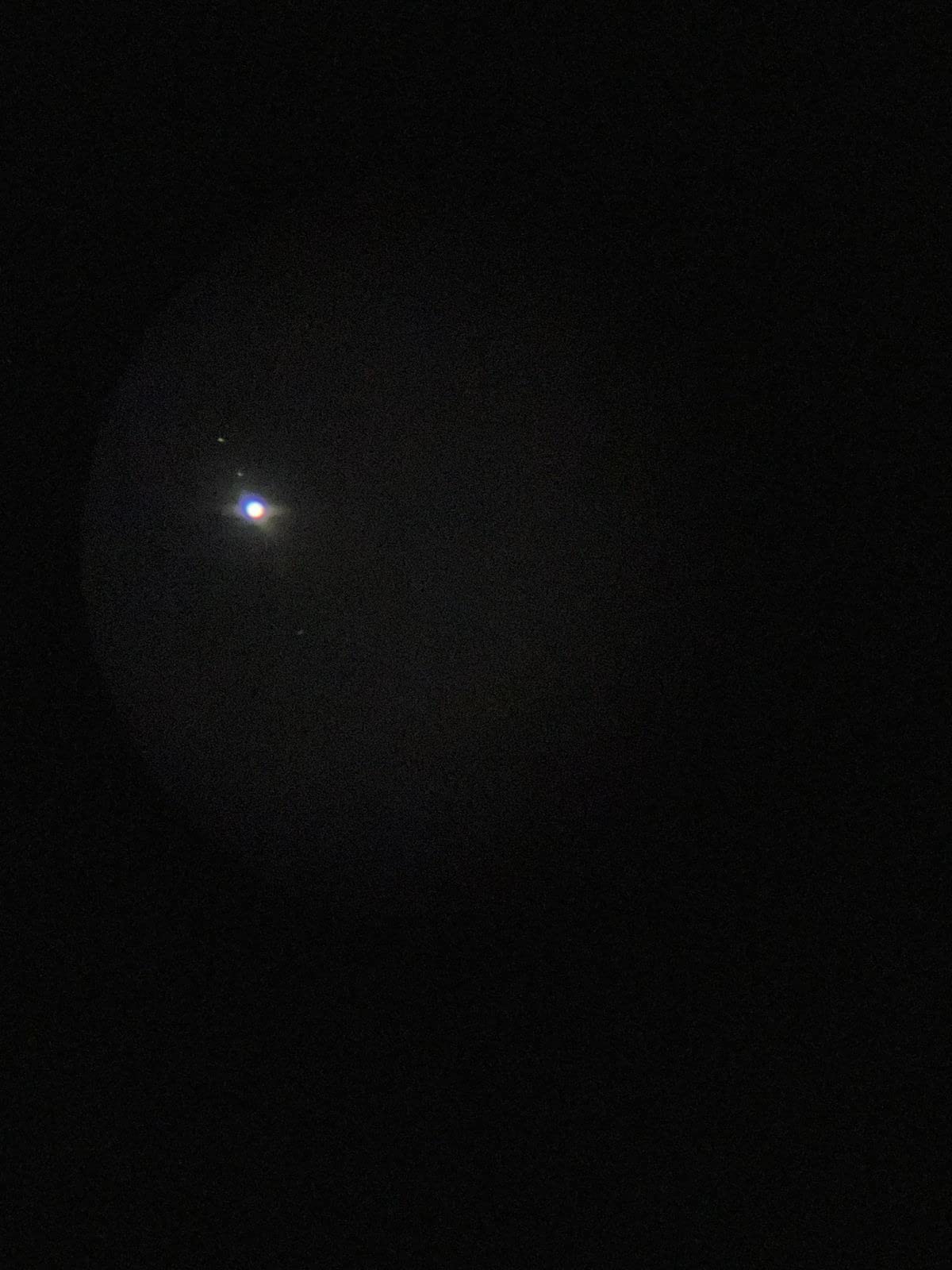
Who should buy the Celestron AstroMaster 70AZ
Buy it if you want a dependable, well-supported first telescope that handles daytime viewing as well as the Moon and planets. The stated 1.66 arc second Dawes limit is the coarsest here, so treat it as an introduction rather than a destination.
It also suits anyone who wants a simple manual scope with no app dependency, since the red dot finder and star charts are all you need to start.
Who should skip the Celestron AstroMaster 70AZ
Skip it if Saturn’s rings are the specific goal. At 70mm you will see them as a ring, but not the Cassini Division, and no amount of extra magnification will change that because the aperture is the limit.
Skip it if you already own binoculars and want a real step up. A pair of 10×50 binoculars shows a surprising amount of the sky cheaply, and the AstroMaster 70AZ sits only modestly above that level for planets.
12. CELTICBIRD 80mm Refractor: Best for Kids and Lunar Contrast
Celticbird Telescope for Adults High Powered, 80mm Aperture 600mm AZ Mount Refractor Telescope for Kids Beginners – Portable Telescopes for Adults Astronomy with Backpack, Phone Adapter, Moon Filter
80mm aperture
600mm focal length at f/6.7
20mm and 9mm eyepieces at 30x and 66x
Moon filter included
Pros
- Moon filter visibly improves lunar contrast
- High transmission multi-coated lens gives a bright image
- Tool-free assembly with printed manual and video
- Backpack carries the full accessory set
- Tripod spans 17.7 to 52 inches
Cons
- 66x maximum is modest for planets
- No slow motion control on the alt-az mount
- Compact tripod picks up vibration when fine focusing
- Phone adapter alignment is described as tricky
The CELTICBIRD 80mm is built around the Moon. Of all the accessories listed across this roundup, the included moon filter is the one that produces the most visible change, cutting incoming light to roughly 13 percent and dramatically improving contrast on crater detail. For a child learning what a telescope is for, that is a strong first impression.
With 864 reviews at 4.3, satisfaction is consistent, and the praise centres on capability limits rather than defects. The 20mm and 9mm eyepieces give 30x and 66x, which is enough to see Saturn as ringed and Jupiter as a disc with visible moons. The backpack carries the full accessory set, which makes dark-sky trips simple.
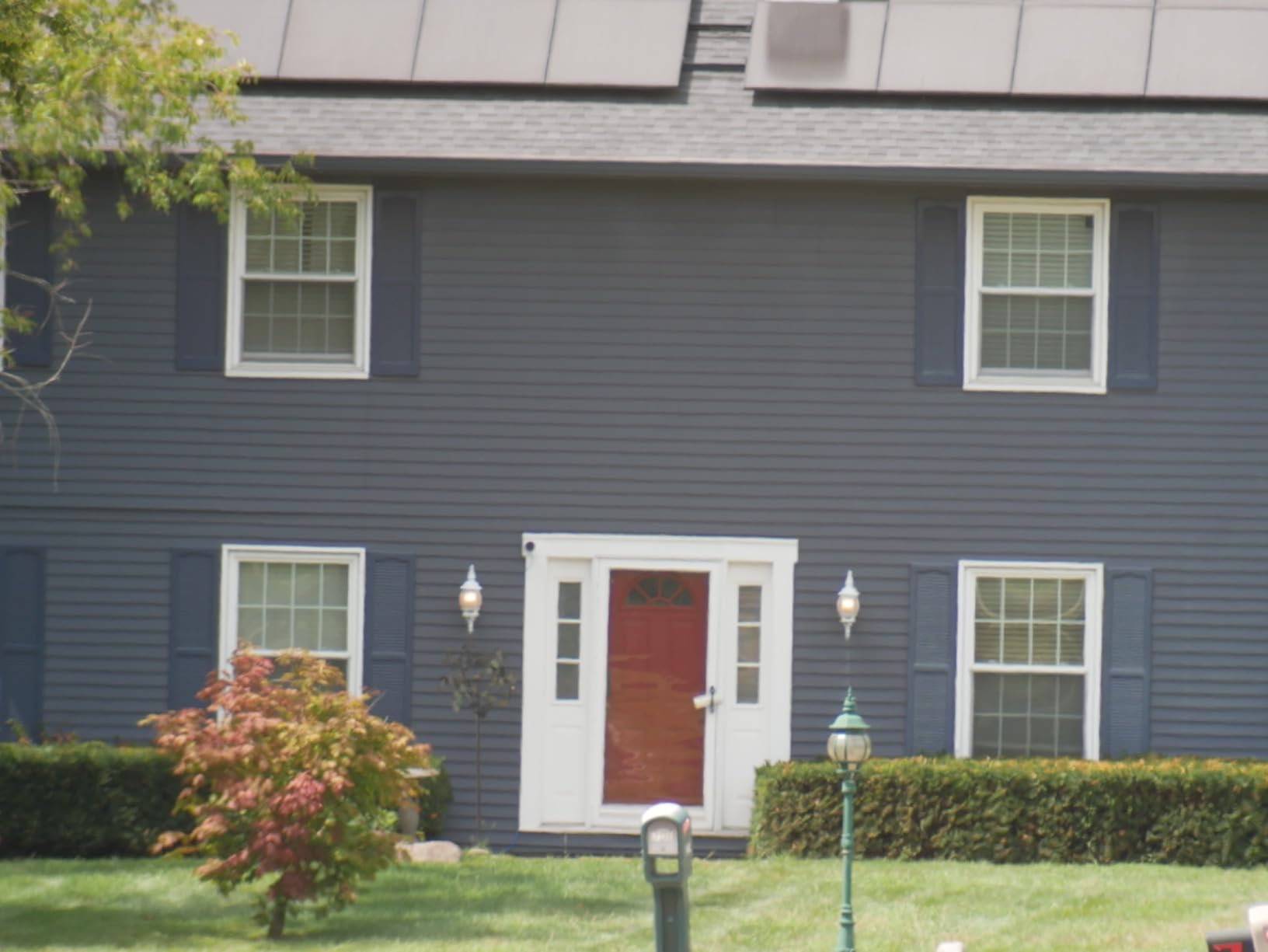
The 3.4 degree field of view is wide, and the high transmission multi-coated optics keep the image bright even at the top of the supplied range. The adjustable aluminium tripod spans 17.7 to 52 inches, so the same setup works for an eight-year-old and an adult standing at a backyard.
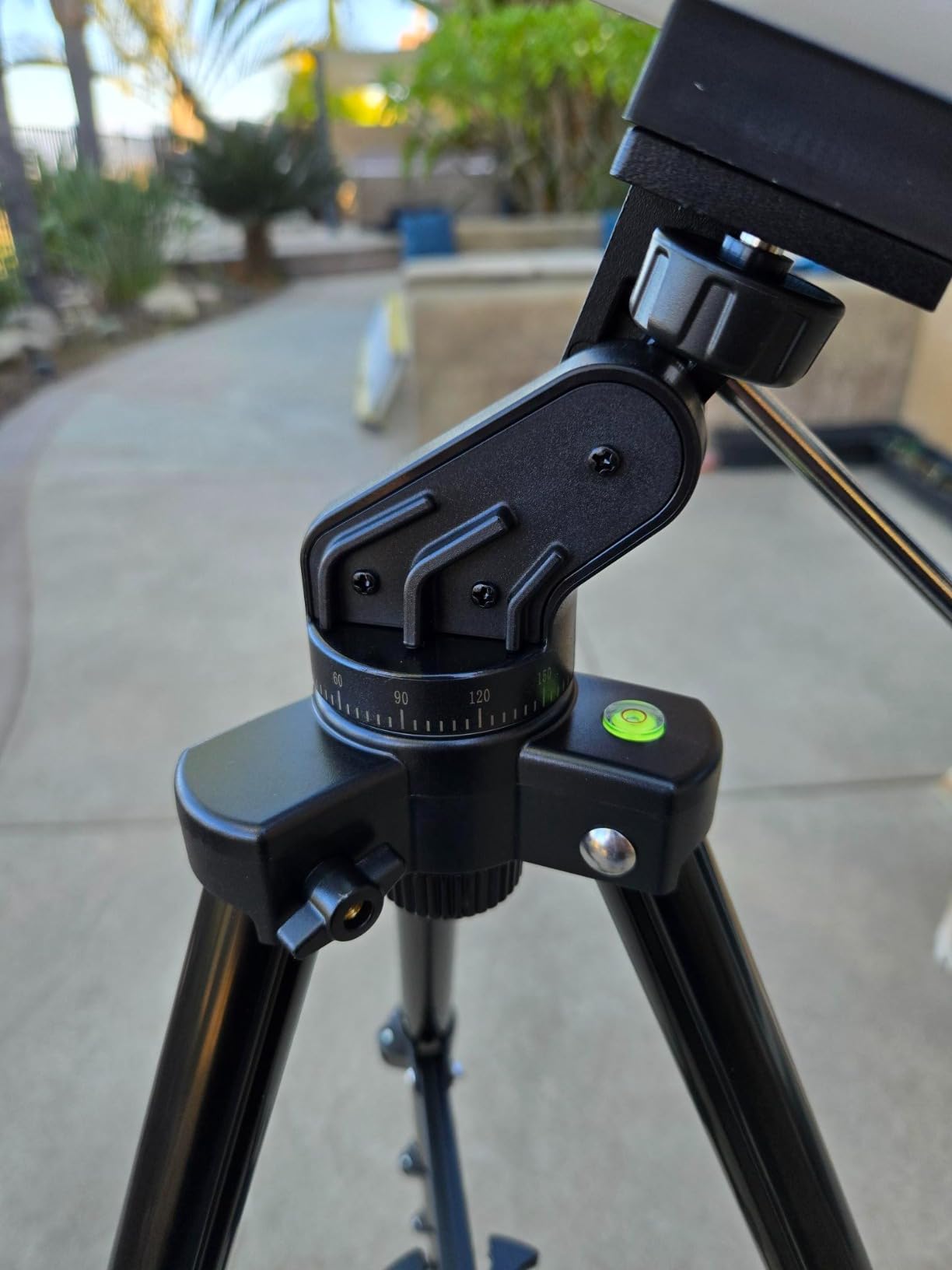
Its ceiling is the limiting factor. 66x is modest for planetary work, and the basic alt-azimuth mount has no slow-motion control, so at high power it is hard to keep a planet centred. The compact tripod also picks up vibration during fine focusing, and the phone adapter is fiddly to align.
Who should buy the CELTICBIRD 80mm
Buy it if your priority is the Moon and young children. The included filter, the bright 80mm image, the simple assembly and the backpack make it the most complete lunar kit in this list.
It also suits anyone who wants a grab-and-go scope that fits in a car boot permanently rather than being carried out when needed.
Who should skip the CELTICBIRD 80mm
Skip it if planets are the goal. At 66x you get coloured discs with satellites, not cloud bands or ring divisions, and that limit will not change with the supplied optics.
Skip it if you already own a 90mm refractor. The step from 80mm at 66x to 90mm at 240x is the difference between seeing and observing.
Aperture Decides How Much Detail You Actually See
Every question about telescopes for planets comes back to one number. Aperture determines both how much light you collect and the finest detail your optics can theoretically resolve, and no amount of magnification gets around it. Here is the ladder I use when advising people.
The aperture-to-detail ladder
A 60-70mm aperture shows Saturn as a small ringed disc, Jupiter as a bright dot with visible moons, and phases on Venus. Around 80mm you start to see Saturn’s rings as separate from the planet’s body and gain the Galilean moons as distinct points. At 90-100mm the Cassini Division begins to appear as a dark line, Jupiter’s belts resolve as bands, and Mars shows a polar cap.
At 114-130mm, Mars surface markings such as the darker regions become intermittent, Saturn’s division is reliable, and the Moon’s smaller craters hold up under magnification. Move to 150-203mm and you are in the range where Jupiter’s smaller festoons, Mars’s dark channels and fine lunar crater rays become reliably visible night after night.
How much magnification do you actually need?
For most planets, the useful range is 120x to 250x, and staying inside that range is what separates a good view from a disappointing one. The widely used ceiling is roughly 50x per inch of aperture, so a 4.5-inch scope tops out near 225x and an 8-inch scope near 400x. Those are optical limits, not sky limits, and the atmosphere will usually stop you well before them.
Magnification is simply focal length divided by eyepiece focal length. The NexStar 8SE at 2032mm gives 81x with its 25mm eyepiece and 225x with a 9mm. The Hawkko at 900mm gives 90x with a 10mm. Work out what an eyepiece will actually deliver before you buy it, rather than trusting a magnification range printed on a box.
Refractor, Newtonian, Maksutov or Schmidt-Cassegrain?
Refractors need no collimation and give clean contrast, but an achromatic design shows colour fringing on bright targets and long focal lengths make the tube long. Newtonian reflectors gather a lot of light per unit of cost and avoid chromatic error entirely, but images are inverted, collimation needs occasional checking, and short f-ratios are less comfortable for planets.
Maksutov-Cassegrains fold long focal lengths into short tubes and are the classic travel planetary design, at the cost of a smaller aperture. Schmidt-Cassegrains give long focal length from a compact tube and pair naturally with a GoTo mount, but they cost the most and still need periodic collimation checks on larger apertures.
The choice really comes down to how you will use it. Family and travel use favours refractors and Maksutovs. Aperture for the money favours Newtonians and Dobs. Convenience and long sessions favour computerized Schmidt-Cassegrains. Our guides to refractor telescopes and Dobsonian telescopes go deeper on both.
Eyepieces, Barlow lenses and planetary filters
A focal length ladder beats a single high-power eyepiece. A 25mm or 30mm for finding, a 10mm for general planetary work, and a 6mm orthoscopic for fine detail will keep you productive on almost any scope. Orthoscopic and Plossl designs are the standard for planets because they deliver high contrast at moderate apparent fields.
A 2x Barlow is the most straightforward magnification increase available, and on this list several scopes include one. Be careful with 3x units from budget kits, because the Koolpte review base specifically reports colour splits from the included plastic Barlow.
Planetary colour filters are underused and cheap. An 80A amber filter raises contrast on Jupiter’s belts, a 21 orange filter darkens Mars’s sky and brightens surface detail, and a 38A deep violet works well on Venus. The catch is the SARBLUE Mak70, whose eyepiece threads do not accept standard filters cleanly.
Seeing, dew and the night you pick
Atmospheric seeing, not your telescope, is often the final limit. Planets close to the horizon look worse because you are looking through more air, so wait until they are high. Nights shortly after a cold front are usually turbulent, and a dew shield or a small dew heater band matters more than most people expect once you are at 200x for an hour.
Leave a telescope outside for 20 to 30 minutes before a high-power session so the optics reach ambient temperature, and check a forecast or an app rather than guessing. If the planet is shimmering, drop back to a lower magnification and wait; pushing harder on a bad night rarely pays.
What a budget tier actually buys
At the entry tier you are buying 60-80mm of aperture, which means the Moon, Jupiter’s moons and Saturn’s shape. The middle tier of 90-100mm is where the Cassini Division appears and where most serious visual observing starts. The 114-130mm tier is where Mars earns its reputation. Above 150mm you are buying detail that only a steady mount and good seeing will reveal.
That is why we would rather see a 90mm refractor on a stiff tripod than a 130mm Newtonian on a wobbly one. A forum consensus we keep coming back to on r/telescopes is that mount stability and optical quality matter more than the advertised magnification number at the entry level, and after years of testing we agree. If you are still undecided, our general telescope roundup covers the wider market, and tabletop telescopes cover the compact end specifically.
Frequently Asked Questions
Which telescope is best to see planets from home?
For most people, an 8-inch Schmidt-Cassegrain or Dobsonian gives the best planetary views because aperture sets the limit on detail. If you want less weight and less cost, a 90mm long-focal-length refractor at f/8 or f/10 resolves Saturn’s Cassini Division and Jupiter’s cloud bands from a suburban backyard. Mount stability matters more than advertised magnification.
How powerful of a telescope do I need to see planets?
Around 70mm is the minimum worth buying, showing Saturn as a ringed disc and Jupiter’s four Galilean moons. About 100mm reveals the Cassini Division and Jupiter’s belts. 130mm and above starts to show Mars surface markings. Useful magnification for most planets sits between 120x and 250x, with a practical ceiling near 50x per inch of aperture.
What size telescope is needed to see Saturn’s rings?
A 70mm refractor shows Saturn as a small ringed planet. At 80mm the rings separate from the disc, and around 100mm the Cassini Division appears as a dark gap. Anything from 114mm upward shows it reliably on most nights. The rings were near edge-on in recent seasons, so their apparent size changes year to year even with the same telescope.
What kind of telescope do I need to see Saturn’s rings?
Any optical design will show the rings, but long focal lengths suit planets better. A 90mm or 100mm achromatic refractor at f/8 to f/10 is the sweet spot for a beginner, and a Maksutov-Cassegrain gives similar image scale in a much shorter tube. A 130mm or larger Newtonian shows the most detail per unit of cost, while refractors avoid the collimation maintenance.
How much magnification do I need to see the rings of Saturn?
Saturn’s rings become obvious at around 40x to 60x and clearly separate from the disc by 100x. The Cassini Division needs roughly 120x to 200x depending on aperture and atmospheric seeing. Pushing beyond 250x on a small scope usually produces a dimmer, softer image rather than more detail, because aperture and seeing have set the real limit.
Can I see planets with a cheap telescope?
Yes, but you need to set expectations. Entry 60mm to 80mm refractors show the Moon in good detail, Jupiter’s four Galilean moons, and Saturn as a recognisable ringed disc. You will not see the Cassini Division or Martian surface markings at that aperture. Avoid scopes advertised at 400x to 600x on 70mm apertures, because those numbers describe the eyepiece, not the image.
Can I see Saturn’s rings through a telescope?
Yes, Saturn’s rings are visible in almost any telescope above about 50x, and they are unmistakable at 100x with a 70mm or larger aperture. Because the planet’s axial tilt changes over its 29-year orbit, the rings sometimes appear wide and sometimes nearly edge-on. Aiming slightly above the planet’s centre and using an amber planetary filter improves the view.
What’s the easiest planet to see with a telescope?
Venus is the easiest because it is bright and close to twilight, but it shows almost no detail. For a satisfying first target, the Moon is easiest of all. Among the planets, Jupiter is the most rewarding at any aperture above 70mm because its four large moons shift position visibly over a single evening and its cloud bands appear above 100mm.
Final Verdict for 2026
The Celestron NexStar 8SE is the best telescope for viewing planets in 2026 because it combines the largest resolving power in this group with a computerized mount that holds a planet still while you watch it. The 0.57 arc second Dawes limit and native 2032mm f/10 focal length deliver detail nothing else here matches, and SkyAlign means you can be looking within minutes of unwrapping it.
If the budget is different, the answers are still clear. The Sky-Watcher Classic 200 Dobsonian gives you the same 203mm aperture with no electronics to fail. The Gskyer 130EQ is the value pick if you will invest the ten minutes a German equatorial mount deserves. The Celestron StarSense LT 114AZ is the one to buy for someone who has never looked through a telescope, and the SARBLUE Mak60 travels better than anything else in the roundup.
Start with aperture, check the mount is rigid, and ignore every magnification claim above 250x. Saturn’s rings are the test, and once you can see the Cassini Division you will know the instrument is doing its job. When you are ready, check the current price for your pick and head out on a night when the planet is high.