
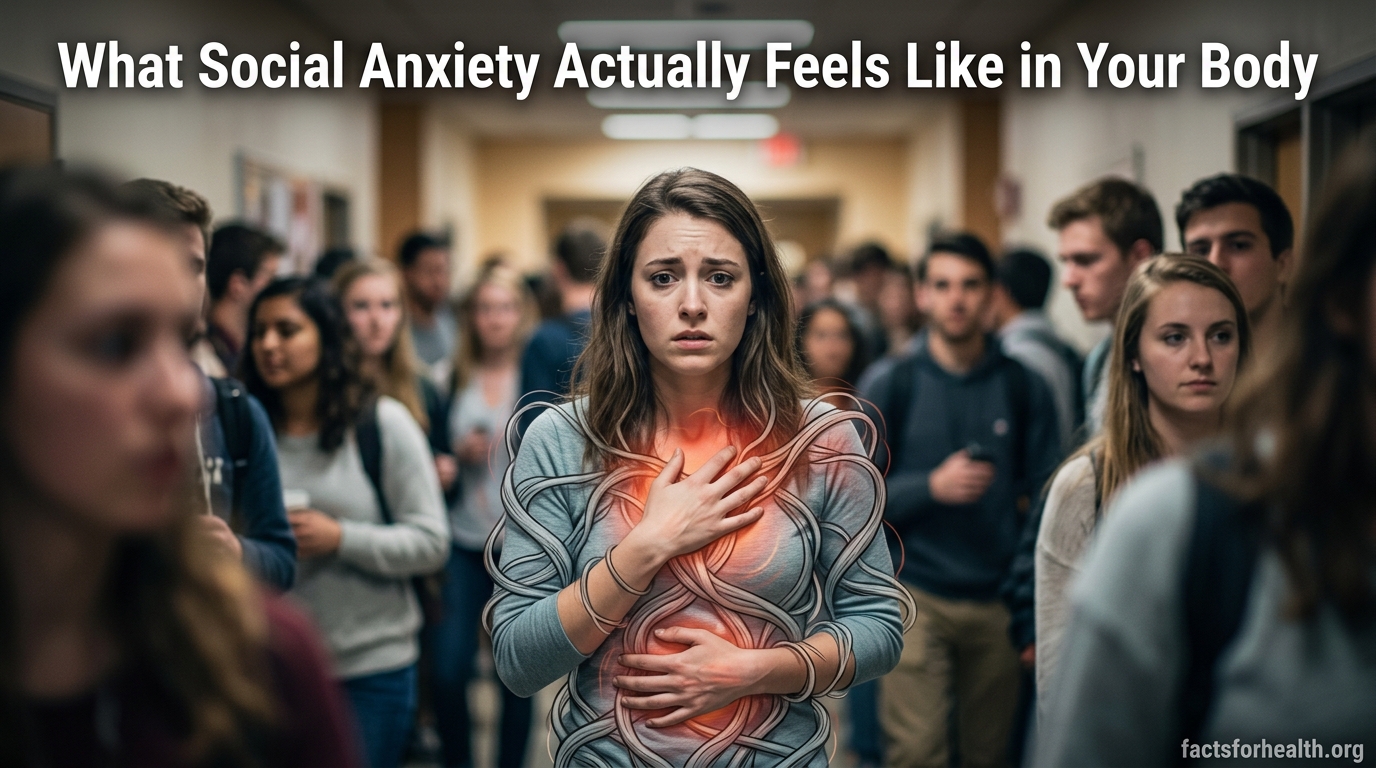
Your heart slams against your ribs. Your face burns. Your hands won’t stay still. You are not in danger, but your body does not know that. If you have ever felt your body revolt in a social situation, you already know part of what social anxiety actually feels like in your body. What most people do not know is how far these sensations go beyond a simple case of nerves.
Social anxiety disorder is not just shyness. It is a full-body stress response triggered by everyday social situations. When your brain perceives social judgment as a threat, your nervous system reacts the same way it would to a physical predator. Your heart races, your stomach churns, your face flushes, your muscles lock up. Every system in your body participates.
Our team has spent months researching the lived experience of social anxiety. We analyzed medical literature from the NIMH, Mayo Clinic, and Harvard Health. We read hundreds of firsthand accounts from anxiety forums and support communities. What we found is that most resources list symptoms clinically but never describe what they actually feel like from the inside.
This article changes that. We are going to walk you through exactly what social anxiety feels like in your body, system by system, sensation by sensation. We cover the common symptoms everyone talks about and the unusual ones almost no one mentions. By the end, you will either recognize your own experience or understand what someone you love is going through.
Table of Contents
Key Takeaways
- Social anxiety triggers a fight-or-flight response that affects your cardiovascular, digestive, neurological, muscular, respiratory, and thermoregulatory systems simultaneously.
- Physical symptoms can appear days or weeks before a social event, not just during it.
- Unusual sensations like tingling, skin crawling, and electric feelings are real and common, even though most resources never mention them.
- Your body can feel anxious even when your mind knows you are safe. This is called the mind-body disconnect.
- Physical symptoms exist on a spectrum from mild discomfort to full-body responses that mimic medical emergencies.
What Does Social Anxiety Feel Like in Your Body?
Social anxiety feels like your body sounding an alarm in a situation where no alarm is needed. Your heart pounds as if you are running from danger. Your face heats up and turns red. Your stomach knots and turns. Your hands shake, your voice wavers, your breathing goes shallow, and your mind goes completely blank. Every part of you prepares to fight or flee from a threat that is, in reality, just a conversation.
The physical symptoms of social anxiety fall into six major body systems:
- Cardiovascular: Racing heart, heart palpitations, chest tightness, chest pain
- Gastrointestinal: Nausea, stomach cramps, butterflies, digestive upset
- Neurological: Mind going blank, dizziness, brain fog, headaches, dissociation
- Thermoregulatory: Blushing, hot flashes, sweating, facial flushing
- Muscular: Trembling, muscle tension, rigid posture, freezing, voice changes
- Respiratory: Shortness of breath, rapid breathing, feeling like you cannot get enough air
What makes social anxiety different from normal nervousness is the intensity and duration of these symptoms. Someone with social anxiety might feel their body react this way for hours, days, or even weeks before a social event. The sensations can be so powerful that they mimic serious medical conditions, sending people to emergency rooms convinced they are having a heart attack when they are actually experiencing a surge of anxiety.
Let us look at each body system in detail and describe what social anxiety actually feels like, not just what the clinical name for it is.
Your Heart and Chest: The Cardiovascular Experience
The cardiovascular system is often where social anxiety makes itself known first. Your heart is the drum that sets the rhythm for every other symptom, and when it starts racing, everything else follows.
Racing heart is the signature sensation. It feels like your heart is trying to punch its way out of your chest. You can feel it in your throat, in your temples, in your fingertips. A normal resting heart rate sits between 60 and 100 beats per minute. During a social anxiety surge, your heart can jump to 120, 140, or higher. You feel every beat. The sensation is impossible to ignore because your body wants your full attention on the perceived threat.
Heart palpitations take this a step further. These feel like your heart skips a beat, then overcompensates with a hard thump. Some people describe it as a fluttering sensation. Others say it feels like their heart does a flip. Palpitations can happen even when you are sitting still, just thinking about an upcoming social situation. They are frightening because they feel like something is wrong with your heart, even though they are a normal part of the adrenaline response.
Chest tightness wraps around your ribcage like a band being squeezed. It feels difficult to take a full breath. Some people describe it as a weight sitting on their chest. Others say it feels like their chest muscles are locked in a permanent state of flex. This tightness is caused by muscle tension in the chest wall and diaphragm, driven by the same stress hormones that make your heart race.
Chest pain from social anxiety can be sharp and stabbing or dull and aching. It is one of the most alarming symptoms because it mimics the signs of a heart attack. The pain is real. Your muscles are in spasm, your breathing is shallow, and your body is flooded with adrenaline. But unlike cardiac chest pain, anxiety-related chest pain usually eases when the anxiety passes.
What others see: Usually nothing. Unless you grab your chest or mention it, no one knows your heart is pounding at 130 beats per minute while you smile and make small talk. This gap between what you feel internally and what others observe is one of the most isolating aspects of social anxiety.
Your Stomach and Gut: The Digestive Response
The gut and the brain are deeply connected through the gut-brain axis, which means social anxiety does not just live in your head. It lives in your stomach too. The digestive system is packed with neurons, and when your brain signals danger, your gut responds immediately.
Butterflies in the stomach is the mildest version. It feels like a fluttering, nervous energy in your lower abdomen. Some people describe it as a tickling sensation from the inside. It is uncomfortable but manageable. You might feel it before a date, a presentation, or walking into a room full of people you do not know well.
Nausea is where things escalate. This is not just feeling a little queasy. Social anxiety nausea can be intense enough to make you gag. Some people vomit before presentations or social events. The nausea comes from your digestive system essentially shutting down during the fight-or-flight response. Your body diverts blood away from your gut and toward your muscles, and your stomach reacts by rebelling.
Stomach pain and cramping can mimic gastrointestinal illness. People with social anxiety frequently report sharp, cramping pain in their abdomen before social situations. The pain can be severe enough to send people to the bathroom repeatedly, leading to a cycle of anxiety about having stomach problems in public, which triggers more stomach problems.
One Reddit user in the r/socialanxiety community described it this way: they feel physical symptoms like shivering, nausea, sweating, a racing heartbeat, and breathing difficulties that haunt them in social settings. The nausea is not psychosomatic. It is a genuine physiological response that can last for hours.
Digestive disruption is the downstream effect. Social anxiety can trigger diarrhea, constipation, or alternating between both. The connection between anxiety and irritable bowel syndrome is well documented. For some people, the gut symptoms are the primary way social anxiety shows up in their body, while the mental worry is secondary.
Your Brain and Nerves: The Neurological Experience
The neurological symptoms of social anxiety are among the most disorienting because they affect your ability to think, speak, and perceive the world around you.
Mind going blank is the classic social anxiety experience. You are in a conversation, and suddenly the words evaporate. It feels like someone pulled the plug on your brain. You know you should say something, but your mental word bank is completely empty. This happens because the stress response redirects cognitive resources away from the prefrontal cortex, the part of your brain responsible for language and social reasoning, and toward survival functions.
The sensation is deeply embarrassing. You are mid-conversation, someone asks you a simple question, and you stare at them with nothing. Your mouth opens, but no words come out. The longer the silence stretches, the harder it becomes to think, because now you are anxious about the silence itself.
Brain fog is a persistent version of the blank mind. It feels like trying to think through wet cement. Your thoughts move slowly. You struggle to follow conversations. You forget what someone said moments after they said it. This fog can last for the duration of a social event and sometimes for hours afterward as your nervous system slowly calms down.
Dizziness and lightheadedness occur when your breathing changes. Shallow, rapid breathing reduces carbon dioxide levels in your blood, which constricts blood flow to your brain. The result is a spinning, woozy sensation. You might feel like the room is tilting. Some people describe it as feeling like they are about to faint, even though anxiety-related fainting is extremely rare.
Headaches from social anxiety are usually tension headaches. They feel like a tight band squeezing your skull. The pain builds gradually as your neck, jaw, and scalp muscles tense throughout a social interaction. By the time you get home, the headache is fully established, and it can take hours to resolve.
Dissociation is one of the strangest neurological symptoms. It feels like you are watching yourself from outside your body. The room seems slightly unreal, like you are looking through glass. Sounds might feel muffled. People with social anxiety often describe feeling disconnected from the conversation, as if they are floating above it rather than participating in it. This is your brain’s way of protecting you from overwhelming stress by numbing your experience.
Heat and Sweat: The Thermoregulatory Response
Social anxiety literally changes your body temperature. The thermoregulatory symptoms are some of the most distressing because they are visible to others, creating a cycle of anxiety about the symptoms themselves.
Blushing is the symptom people fear most. It starts as a warm sensation in your cheeks, then spreads to your ears, your neck, and sometimes your chest. The heat is immediate and intense. You can feel the blood rushing to the surface of your skin. From the inside, it feels like your face is on fire. From the outside, it looks like a red flush that is impossible to hide.
The cruel irony of blushing is that the more you think about it, the worse it gets. You feel the heat, you know you are turning red, and that awareness triggers more anxiety, which triggers more blushing. People have quit jobs, dropped out of classes, and avoided entire social categories because of fear of blushing.
Sweating accompanies the heat. It is not the light perspiration of a warm room. It is stress sweat, which is chemically different from exercise sweat. Stress sweat comes from apocrine glands and contains proteins and lipids that bacteria break down quickly, producing a stronger odor. You might sweat from your palms, your underarms, your face, your back, or all of them simultaneously.
Sweaty palms make shaking hands agonizing. Sweaty underarms create visible wet patches on shirts. Sweaty faces look shiny and flushed on camera. The fear of visible sweating drives avoidance behavior, as people plan their clothing, their seating position, and even their attendance around sweat management.
Hot flashes and flushing can extend beyond the face. Some people experience full-body heat waves during social anxiety episodes. Your skin prickles with heat. You feel like you need to tear off layers of clothing. These flashes come on suddenly and can last anywhere from a few seconds to several minutes.
Tension and Trembling: The Muscular Experience
Your muscles are the front line of the fight-or-flight response. They prepare for action by tensing, and when that tension has nowhere to go, it produces a range of physical sensations.
Muscle tension is the baseline. It feels like every muscle in your body is flexed at 50 percent capacity. Your shoulders creep toward your ears. Your jaw clenches. Your fists ball up. Over hours, this tension becomes painful. Your neck aches. Your back aches. Your jaw aches from clenching your teeth. The tension does not release until the perceived social threat has passed, which for someone with generalized social anxiety might be never.
Trembling and shaking occur when the muscle tension becomes unsustainable. Your body is flooded with adrenaline, and your muscles cannot maintain their state of high alert without oscillating. The shaking can be subtle, a slight tremor in your hands that you try to hide by shoving them in your pockets. Or it can be dramatic, with full-body tremors that you cannot control.
One person in an anxiety forum described it as feeling like a constant nervous wreck, super stiff and tense all the time, with shaking in their neck, head, and full-body tremors that looked like they had Parkinson’s. This level of trembling is terrifying to experience and impossible to hide from others.
Voice changes happen when tension reaches your vocal cords. Your voice might shake, crack, go high-pitched, or become barely audible. Speaking feels physically difficult, like pushing words through a constricted throat. Some people develop a stutter that only appears in social situations. Others lose their voice entirely.
Awkward movements and freezing are the motor expression of social anxiety. When every movement feels self-conscious, walking becomes mechanical. You become hyper-aware of how your arms swing, where your feet land, how you hold your body. Some people freeze entirely, locked in place like a deer in headlights. This freeze response is an ancient survival mechanism that your body deploys when neither fight nor flight seems possible.
A Reddit user in r/socialanxiety described it beautifully: you feel self-conscious even in the tiniest movements you make. You start to move around awkwardly, shuffling your feet. It is like being restrained and skewered by the presence and looks of others. There is a tension inside of you that you cannot release.
Breathing Changes: The Respiratory Response
Breathing is automatic until anxiety makes it manual. The moment you become aware of your breathing, it changes, and rarely for the better.
Shortness of breath during social anxiety feels like you cannot get enough air into your lungs. You take a breath, but it feels incomplete, like your lungs refuse to fully expand. This sensation drives panic, which makes breathing even harder. The chest tightness compounds the problem, making each breath feel like work.
Rapid, shallow breathing is what typically happens. Instead of slow, deep breaths from the diaphragm, you take quick, shallow breaths from your chest. This pattern, called hyperventilation, reduces carbon dioxide in your blood. The result is a cascade of symptoms: dizziness, tingling in your hands and feet, lightheadedness, and a feeling of unreality.
The breathing-anxiety cycle is self-perpetuating. Anxiety makes you breathe shallowly. Shallow breathing produces physical symptoms. Those symptoms create more anxiety. Breaking this cycle is one of the most effective ways to reduce acute social anxiety symptoms, which is why breathing exercises are a cornerstone of anxiety management.
What others see: Rapid breathing is sometimes visible. Your shoulders might rise and fall quickly. Your chest might heave. But much of the time, the breathing changes are internal. You feel like you are suffocating while the person across from you sees someone who just looks slightly tense.
The Sensations No One Talks About
This is where this article diverges from every medical resource on the first page of search results. The clinical symptom lists cover blushing, sweating, and trembling. They do not cover the strange, unsettling sensations that people with social anxiety experience but rarely talk about because they are afraid no one will believe them.
Pins and needles in your hands, feet, or face. This tingling sensation, medically called paresthesia, occurs when hyperventilation changes your blood chemistry. It feels like tiny needles pressing into your skin. Some people describe it as their hands going numb or feeling like they are wearing invisible gloves.
Skin crawling is even stranger. It feels like insects are walking across your skin, or like your skin itself is vibrating at a frequency you cannot control. This sensation, called formication, is a known but rarely discussed symptom of intense anxiety. It can occur anywhere on your body, but people most commonly report it on their arms, legs, and scalp.
The electric feeling is how many people describe the overall bodily sensation of social anxiety. One Reddit user in r/Anxiety described it as a tingly, electric feeling, like pins and needles, where tension and electricity cover the whole body, most intensely in the hands. This electrical sensation is your nervous system firing at full capacity. Your nerves are saturated with stress signals, and you can feel that saturation physically.
The skipping-a-stair sensation is one of the most vivid descriptions we found. Someone on Reddit described social anxiety as the feeling of accidentally skipping a stair while going down the stairs, but that feeling does not go away. It is that sudden jolt in your chest and gut, that lurching drop, that split-second of falling. Except for someone with social anxiety, that sensation persists for minutes or hours instead of fractions of a second.
The lump in your throat is a sensation that makes swallowing feel difficult. Medically called globus sensation, it feels like something is stuck in your throat. It is caused by tension in the throat muscles, not an actual physical obstruction. The sensation can persist throughout a social event and makes eating or drinking in front of others feel impossible.
Body anxious but mind calm might be the most confusing sensation of all. This is the mind-body disconnect. Your conscious mind knows you are safe. You know there is no real threat. But your body does not agree. Your heart races, your stomach churns, your hands shake, and there is nothing your rational mind can do to stop it. This disconnect is incredibly frustrating because it feels like your body has a mind of its own.
One person on the BeyondBlue forum captured this perfectly: they felt they had some form of social anxiety for years, but because they did not have severe physical symptoms like panic attacks, they never sought help. The absence of full-blown panic does not mean the absence of social anxiety. The body can express anxiety in dozens of quieter, equally disruptive ways.
Why Your Body Reacts This Way: The Fight-or-Flight Response
Every physical symptom described above has a biological explanation. Understanding the mechanism does not make the sensations less intense, but it does make them less frightening. When you know why your body is doing something, the mystery recedes, and with it, some of the fear.
Here is what happens, step by step:
Step 1: The amygdala detects a threat. Your amygdala is a small, almond-shaped cluster of neurons deep in your brain. It is your threat detection system. In social anxiety, the amygdala is oversensitive. It interprets social situations, eye contact, judgment, or the possibility of embarrassment as threats on par with physical danger. This misinterpretation is not a choice. It is a neurological pattern.
Step 2: The sympathetic nervous system activates. Once the amygdala sounds the alarm, it sends a signal to your sympathetic nervous system. This is the network responsible for the fight-or-flight response. It runs from your spinal cord to nearly every organ in your body, and it responds in milliseconds.
Step 3: Adrenaline floods your system. Your adrenal glands release a surge of adrenaline. This hormone is the main driver of the physical symptoms. Adrenaline makes your heart race, your breathing quicken, your muscles tense, and your blood vessels constrict. It is the chemical that makes you feel like you could run through a wall or sprint a mile, even though you are just standing in a meeting.
Step 4: Cortisol sustains the response. While adrenaline acts fast, cortisol acts slow. Released minutes after the initial alarm, cortisol keeps your body on high alert for extended periods. This is why social anxiety symptoms can last for hours, not seconds. Cortisol also suppresses your digestive and immune systems, which is why chronic social anxiety leads to stomach problems and frequent illness.
Step 5: The body cannot complete the response. In a genuine physical threat, you would fight or flee, burning off the adrenaline and cortisol through physical action. In a social situation, you cannot fight and you cannot run. You stand there, smiling, while your body vibrates with unspent stress hormones. This is why social anxiety feels so physically exhausting. Your body prepares for action that never happens.
Understanding this sequence is powerful. Your body is not broken. It is responding exactly as it was designed to respond to a threat. The problem is not the response itself but the fact that it is triggered by social situations rather than actual danger.
Before the Event: What Anticipatory Anxiety Feels Like
Anticipatory anxiety is the physical experience of dreading a future social event. For many people, this phase is worse than the event itself. Your body starts reacting days, weeks, or even months ahead of time.
You might know about a presentation three weeks away. The moment you think about it, your stomach tightens. As the date approaches, the physical symptoms intensify. The night before, you cannot sleep. Your heart races when you lie down. Your mind replays worst-case scenarios on a loop. Your body is essentially experiencing the social threat in advance, flooding your system with stress hormones for an event that has not happened yet.
The physical toll of anticipatory anxiety is real and cumulative. Days of elevated cortisol lead to fatigue, headaches, digestive disruption, and muscle pain. Some people spend entire weekends physically ill because of a Monday morning meeting. The social event itself might last an hour, but the bodily experience of it spans days.
Anticipatory anxiety also feeds on itself. The physical symptoms become proof that the event will be terrible. Your racing heart and nauseous stomach are interpreted as evidence that something catastrophic will happen. This creates a feedback loop where the bodily sensations amplify the mental fear, which amplifies the bodily sensations.
Mild to Severe: The Intensity Spectrum
Social anxiety is not a binary experience. The bodily sensations exist on a spectrum, and where you fall on that spectrum can vary by situation, day, and overall stress level.
Mild social anxiety feels like background noise. There is a slight tension in your shoulders. Your stomach has a mild flutter. You are aware of yourself in the social space but can function normally. You might feel a little warm, a little self-conscious, but you can push through. Many people live in this range for years without recognizing it as anxiety. They just think they are a bit shy or introverted.
Moderate social anxiety is impossible to ignore. Your heart rate is visibly elevated. Your palms are damp. Your face feels warm. You are acutely aware of how you are standing, where you are looking, what your hands are doing. Conversation requires effort. You rehearse responses before saying them. After the social event, you replay every interaction, physically cringing at moments you perceived as awkward. The bodily symptoms persist for hours after the event ends.
Severe social anxiety is a full-body experience that can mimic a medical emergency. Your heart pounds at 140 beats per minute. Your breathing is rapid and shallow. You are trembling visibly. Your face is deep red. Your stomach is cramping. You might feel like you are going to faint, vomit, or both. Your mind is either racing or completely blank. This is the level at which social anxiety becomes disabling, as people begin avoiding social situations entirely to prevent the physical experience.
Normal nervousness versus social anxiety: Everyone feels nervous before social events sometimes. The difference is in the intensity, duration, and impact. Normal nervousness is a brief wave of butterflies that passes once you settle in. Social anxiety is a sustained bodily response that may not pass even after the event ends. Normal nervousness does not make you avoid events. Social anxiety does.
Grounding Techniques for Acute Physical Symptoms
When your body is mid-response and you need relief, grounding techniques can help bring your nervous system back to baseline. These are not cures for social anxiety, but they are practical tools for managing the physical intensity in the moment.
1. The 4-7-8 breathing technique. Inhale through your nose for 4 seconds. Hold the breath for 7 seconds. Exhale through your mouth for 8 seconds. This pattern activates your parasympathetic nervous system, which is the brake to the sympathetic nervous system’s gas pedal. Four cycles of this breathing pattern can measurably reduce your heart rate and ease chest tightness.
2. The 5-4-3-2-1 grounding exercise. Name 5 things you can see, 4 things you can touch, 3 things you can hear, 2 things you can smell, and 1 thing you can taste. This exercise forces your brain to process sensory information from your environment rather than spinning in anxiety loops. It is particularly effective for breaking the dissociation and brain fog symptoms.
3. Progressive muscle relaxation. Starting from your toes, tense each muscle group for 5 seconds, then release. Work your way up through your calves, thighs, abdomen, shoulders, arms, and face. This technique directly addresses the muscle tension that drives trembling, headaches, and chest tightness. Releasing the tension manually helps your body understand that the threat has passed.
4. Temperature change. Splash cold water on your face or hold an ice cube. Cold triggers the mammalian dive reflex, which automatically slows your heart rate. It also provides a strong sensory input that interrupts anxiety spirals. This is a fast, accessible tool for acute moments when breathing exercises are not enough.
5. Name what is happening. Silently say to yourself: my body is having a stress response. My heart is racing because adrenaline is being released. I am not in danger. This is social anxiety. Naming the mechanism engages your prefrontal cortex, which helps regulate the amygdala’s alarm signal. It reduces the secondary anxiety, which is the fear of the symptoms themselves.
When Physical Symptoms Signal Something More
Social anxiety symptoms are real and valid, but they can also overlap with medical conditions that need different treatment. Knowing when to seek medical evaluation is important.
If you experience chest pain for the first time, especially with shortness of breath and pain radiating to your arm or jaw, seek immediate medical attention. It is better to visit an emergency room and learn it was anxiety than to assume it is anxiety and miss a cardiac event.
Persistent gastrointestinal symptoms, chronic headaches, or ongoing dizziness should be evaluated by a healthcare provider. These symptoms can be caused by social anxiety, but they can also indicate thyroid disorders, inner ear problems, inflammatory bowel disease, or other conditions. A thorough medical evaluation can rule out other causes and give you confidence that what you are experiencing is anxiety.
If social anxiety symptoms interfere with your daily life, preventing you from attending school, work, social events, or maintaining relationships, it is time to seek professional help. Cognitive behavioral therapy (CBT) is the most evidence-based treatment for social anxiety disorder. CBT helps you identify and restructure the thought patterns that trigger the physical response. For some people, medication such as SSRIs or beta-blockers provides additional relief from physical symptoms.
FAQs
What does social anxiety feel like physically?
Social anxiety feels like a full-body alarm response in a non-dangerous situation. Your heart races, your face flushes and turns red, your hands tremble, your stomach churns with nausea or butterflies, your breathing goes shallow, and your mind goes blank. Some people also experience dizziness, sweating, muscle tension, voice changes, and unusual sensations like tingling or skin crawling. These symptoms are driven by adrenaline and cortisol released during the fight-or-flight response.
How to free your brain from social anxiety?
Freeing your brain from social anxiety is a gradual process. The most effective approach combines cognitive behavioral therapy (CBT), which helps you identify and restructure threat-detecting thought patterns, with practical grounding techniques like 4-7-8 breathing and the 5-4-3-2-1 sensory exercise. Gradual exposure to social situations, starting small and building tolerance, retrains your amygdala to stop treating social interactions as threats. Mindfulness meditation and regular exercise also help regulate your nervous system over time.
How to stop being socially anxious?
You cannot instantly stop social anxiety, but you can significantly reduce it over time. The most evidence-based treatment is cognitive behavioral therapy (CBT), which addresses the thought patterns driving the physical response. Some people benefit from medication such as SSRIs for long-term management or beta-blockers for acute physical symptoms like trembling and racing heart. Lifestyle changes including regular exercise, adequate sleep, limiting caffeine, and practicing relaxation techniques all contribute to reducing baseline anxiety levels.
How do I know if I actually have social anxiety?
Social anxiety disorder is characterized by a persistent, intense fear of social situations where you might be judged, embarrassed, or rejected. Key signs include physical symptoms like racing heart, blushing, trembling, and nausea in social settings; avoidance of social events; intense anticipatory anxiety days or weeks before social situations; and post-event rumination where you replay interactions and cringe. If these symptoms have persisted for six months or more and interfere with your daily life, work, or relationships, a mental health professional can provide a formal assessment using DSM-5 criteria.
Can you have physical anxiety symptoms without feeling mentally anxious?
Yes. This is a common and confusing experience called somatic anxiety. Your body produces physical symptoms like a racing heart, stomach upset, or trembling even when your conscious mind does not feel worried. This happens because the amygdala, your brain’s threat detection system, can trigger the fight-or-flight response before your conscious mind registers a threat. The body reacts to subconscious cues like social context, eye contact, or environmental triggers without your awareness.
Why does my body feel anxious but my mind is calm?
This mind-body disconnect occurs because your sympathetic nervous system responds faster than your conscious thought processes. When your amygdala detects a social threat, it releases adrenaline in milliseconds. Your conscious mind, operating more slowly, may not register any fear. The result is a body flooded with stress hormones while your rational mind knows you are safe. Adrenaline also takes time to metabolize, so physical symptoms can persist even after the mental anxiety has passed. This is normal and does not mean anything is wrong with you.
You Are Not Broken, and You Are Not Alone
Understanding what social anxiety actually feels like in your body is the first step toward managing it. Your racing heart, your burning face, your trembling hands, your churning stomach, your blank mind, and yes, even those strange electric tingling sensations are all real. They are not in your head. They are your body doing exactly what it evolved to do in the presence of a perceived threat.
The problem is not your body. The problem is that your threat detection system is calibrated for a different kind of danger. Social situations are not predators, but your amygdala does not know that yet. The good news is that this calibration can be adjusted through therapy, practice, and patience.
If you recognized yourself in these descriptions, talk to a mental health professional. CBT has decades of evidence behind it for social anxiety disorder. You do not have to live with your body sounding alarms in every social situation. Relief is possible, and it starts with understanding what is happening inside you.