
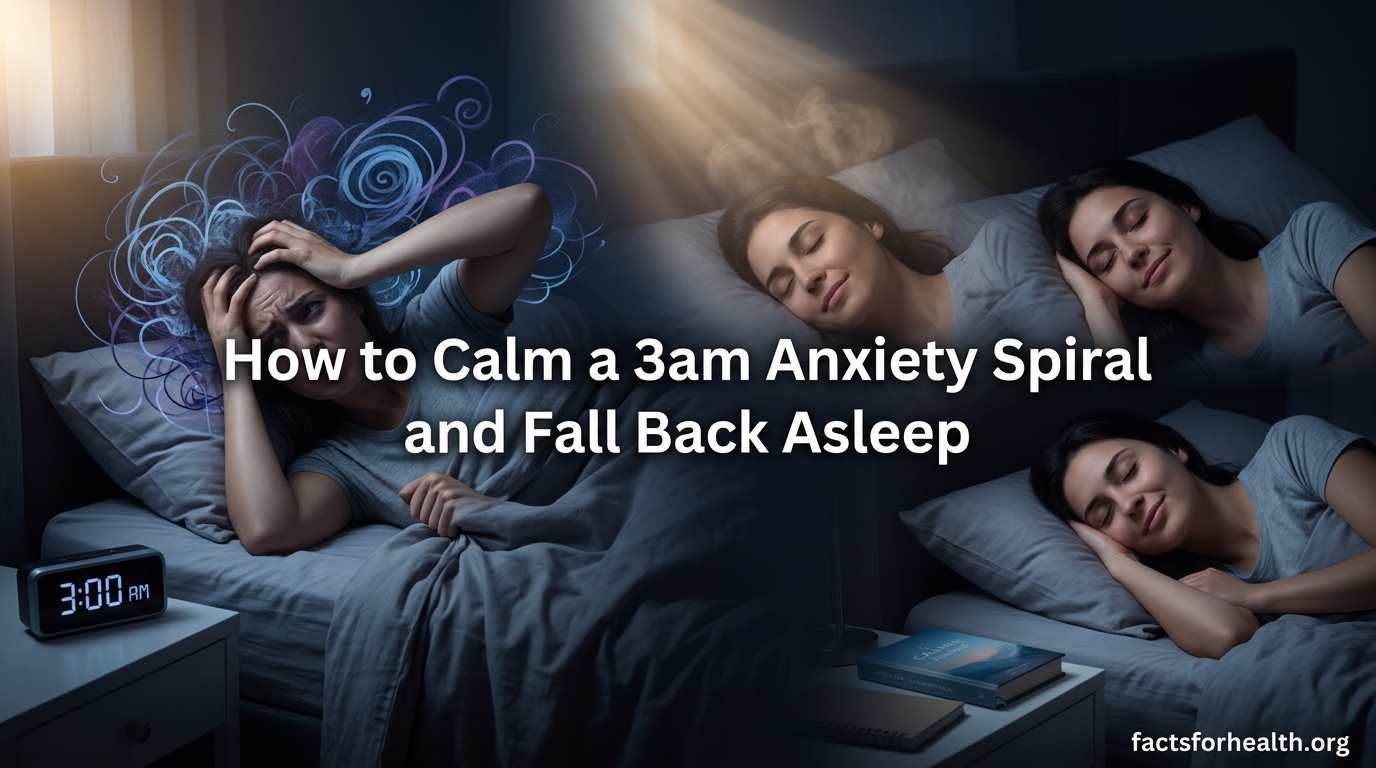
It is 3:07 in the morning. Your eyes snap open and within seconds, your brain is replaying that awkward thing you said in a meeting last Tuesday. Then it jumps to your credit card balance. Then to the strange symptom you noticed three days ago. Within five minutes, your heart is pounding, your chest feels tight, and sleep feels like a distant memory. If this sounds familiar, you are far from alone. Millions of people experience this exact scenario every single night, and learning how to calm a 3am anxiety spiral and fall back asleep can transform your nights and your days.
I have spent years researching sleep psychology, interviewing people who struggle with nighttime anxiety, and poring over forum threads where thousands of people describe this exact experience. The most common thing I hear is relief: relief that they are not the only one, relief that there is a name for what is happening, and relief that there are proven techniques that actually work.
This guide breaks down exactly why your brain does this to you at 3am, what makes anxiety feel so overwhelming in the middle of the night, and the specific steps you can take right now to break the spiral and get back to sleep. We will cover immediate techniques you can use at 3am, daytime habits that prevent these wake-ups from happening in the first place, and when it makes sense to talk to a professional.
No fluff, no generic advice about deep breathing that leaves you wondering what to actually do. Just real, actionable strategies grounded in sleep science and tested by people who have been exactly where you are right now.
Table of Contents
Quick Answer: What to Do Right Now
If you are reading this at 3am and want the short version before you try anything else, here is the summary. These five steps are your fastest path back to sleep:
- Acknowledge what is happening. Tell yourself: my cortisol is spiking, my brain is in a lighter sleep stage, and this is a physiological event, not a personal failure.
- Do not look at the clock. Calculating how many hours of sleep you have left will only increase anxiety and reinforce the spiral.
- Get out of bed if you have been awake for more than 20 minutes. Staying in bed awake trains your brain to associate your mattress with stress and wakefulness.
- Do something boring in dim light. Read a dull book, listen to a calm podcast, or do a repetitive task. No screens.
- Return to bed only when you feel genuinely sleepy. Your eyelids should feel heavy and your thoughts should be drifting.
The rest of this article explains why these steps work and gives you a deeper toolkit so you can handle the next 3am wake-up with confidence instead of dread.
Why Does 3am Anxiety Happen? The Biology Explained
To understand how to calm a 3am anxiety spiral and fall back asleep, you first need to understand what your body and brain are doing at this hour. The answer involves a combination of sleep architecture, hormone cycles, and the unique way your brain processes information when it is sleep-deprived.
The Cortisol Awakening Response Starts Earlier Than You Think
Cortisol is often called the stress hormone, but it is also your body’s natural wake-up signal. Your cortisol levels begin rising in the hours before dawn as part of a process called the cortisol awakening response. For most people, this rise starts between 2 and 4 in the morning, gradually building to help you feel alert when it is time to get up.
If you have anxiety, your stress response system is already dialed up higher than it should be. Your baseline cortisol may be elevated, and your body may be more sensitive to cortisol’s effects. So when that natural early morning cortisol rise begins, your body interprets it as a threat signal rather than a gentle alarm clock. Your sympathetic nervous system kicks into gear, your heart rate increases, and you go from deep sleep to wide awake in a matter of seconds.
This is why 3am anxiety feels different from daytime anxiety. During the day, you have distractions, social interactions, and tasks that keep your mind occupied. At 3am, the cortisol spike hits a brain that has nothing to focus on except itself.
Sleep Architecture: Why You Wake Up at 3am Specifically
Your sleep is not a flat line of unconsciousness. It cycles through stages roughly every 90 minutes, moving from light sleep to deep sleep to REM (rapid eye movement) sleep and back again. The first half of your night is dominated by deep sleep, which is hard to wake from. The second half, starting around 2 or 3 in the morning depending on when you went to bed, shifts toward more REM sleep and lighter sleep stages.
Lighter sleep stages are easier to wake from. Small triggers, a noise, a temperature change, a full bladder, or an internal stress signal can pull you out of sleep more easily during these stages. Once you are awake, the cortisol rise and the absence of distractions do the rest.
The 2am, 3am, and 4am Difference
People often wonder why they wake at a specific time. The timing of your wake-up can tell you something about what is driving it. At 2am, you are often transitioning out of your last deep sleep cycle. This is when blood sugar drops, alcohol rebound, or a warm room are most likely to jolt you awake.
At 3am, you are squarely in the cortisol rise window. Your body is starting its natural preparation for morning, and if your stress system is sensitized, this is when anxiety hits hardest. At 4am, you are often in REM-rich sleep, which means your dreams are vivid and emotional. Waking from an anxiety-provoking dream at 4am can leave you with a lingering sense of dread that feels hard to shake.
Understanding these differences helps you target the right solution. A 2am wake-up might respond to a small snack and a cooler room. A 3am wake-up needs nervous system regulation. A 4am wake-up may benefit from grounding techniques that help you separate dream emotions from reality.
Why Thoughts Feel Catastrophic at Night
Have you ever noticed that a problem that feels unmanageable at 3am seems completely solvable at 9am? This is not your imagination. Your prefrontal cortex, the part of your brain responsible for rational thinking, perspective-taking, and emotional regulation, is significantly less active during the night and when you are sleep-deprived.
Meanwhile, your amygdala, the brain’s threat detection center, remains highly active. This means at 3am, you are literally thinking with the part of your brain that sees danger everywhere and without the part that can talk it down. Every worry feels 10 times more urgent. Every problem feels unsolvable. Every embarrassment feels catastrophic.
Research on nighttime cognition has shown that people who try to solve problems during nighttime wake-ups take an average of 47 minutes longer to fall back asleep compared to those who do not engage in problem-solving. Your brain at 3am is simply not equipped to resolve complex issues, and attempting to do so keeps your nervous system activated and your sleep further away.
Blood Sugar Drops: The Hidden Trigger
One trigger that gets almost no attention is blood sugar. If you ate dinner early, consumed something sugary before bed, or had alcohol in the evening, your blood sugar can crash in the middle of the night. When blood sugar drops, your body releases adrenaline and cortisol to bring it back up. These are the same hormones involved in the fight-or-flight response.
If you have ruled out other causes and still wake up jittery and anxious around 2 or 3am, a blood sugar crash might be the culprit. A small protein-and-fat snack before bed, like a handful of almonds or a spoonful of peanut butter, can stabilize blood sugar through the night and prevent the adrenaline surge that wakes you up.
The Problem-Solving Trap: Why Trying to Fix Things at 3am Backfires
One of the biggest mistakes people make during a 3am anxiety spiral is trying to solve the problems their brain is throwing at them. It feels productive. You think that if you can just figure out the answer to whatever worry is circulating, you will be able to relax and sleep.
This almost never works. Your nighttime brain is running on an impaired prefrontal cortex and an overactive amygdala. The solutions you generate at 3am are typically worse, more anxious, and more extreme than the solutions you would generate during the day. People make decisions at 3am that they deeply regret in the morning: sending emotional texts, quitting jobs in their heads, catastrophizing minor issues into emergencies.
Research published in sleep medicine journals has found that cognitive activity during nighttime awakenings, specifically worry and problem-solving, is one of the strongest predictors of difficulty returning to sleep. The same study showed that people who engaged in active problem-solving took significantly longer to fall back asleep than those who used acceptance or distraction strategies.
The key insight is this: at 3am, your job is not to solve your problems. Your job is to keep your nervous system calm enough that sleep can return. Problem-solving can wait for daylight, when your brain is actually equipped to handle it. Write down the worry if you need to, tell yourself you will address it in the morning, and then redirect your attention to something neutral and boring.
What NOT to Do When You Wake Up Anxious
Before we get to what you should do, let us cover the behaviors that are probably making your 3am anxiety worse. Many of these feel helpful in the moment but are actively sabotaging your ability to fall back asleep. I see these patterns come up again and again in forums, and sleep researchers have confirmed that each one disrupts the conditions your brain needs to return to sleep.
Do Not Look at the Clock
This is the number one mistake. The moment you check the time, you start calculating. You count how many hours are left before your alarm. You estimate how much sleep you have already gotten. You compare tonight to last night. Each calculation sends a fresh spike of anxiety through your system.
Sleep researchers call this sleep math, and it is one of the most destructive habits for people with nighttime anxiety. Turn your clock around, put your phone out of reach, and commit to not knowing what time it is. The time does not matter. What matters is keeping your nervous system calm.
Do Not Reach for Your Phone
Your phone is a double threat. First, the blue light from the screen suppresses melatonin, the hormone that signals to your brain that it is time to sleep. Even a few minutes of scrolling can delay melatonin production by 30 minutes or more. Second, phone content, whether it is news, social media, or email, is designed to grab your attention and trigger emotional responses. This is the exact opposite of what your brain needs at 3am.
People on anxiety forums repeatedly report that phone scrolling is the habit they know makes things worse but struggle to resist. If you cannot trust yourself not to grab your phone, put it in another room or across the bedroom before you go to sleep.
Do Not Stay in Bed Awake
This sounds counterintuitive. Shouldn’t you stay in bed so you can fall asleep? The answer is no, not if you have been lying there anxious for more than 15 to 20 minutes. Every minute you spend in bed wide awake and stressed, you are training your brain to associate your bed with anxiety and wakefulness rather than rest.
Sleep psychologists call this conditioned arousal, and it is one of the core mechanisms that transforms occasional 3am wake-ups into chronic insomnia. The more you lie in bed fighting anxiety, the more your brain learns that bed is a place for fighting anxiety. Get up, go to another room, and only return when you feel genuinely sleepy.
Do Not Try to Force Sleep
Sleep is not something you can achieve through effort. In fact, trying harder to sleep makes sleep less likely. This paradox is well-documented in sleep research: performance anxiety around sleep creates hyperarousal, which directly blocks sleep onset.
Forum users describe this experience vividly. They talk about lying in bed, furious at themselves for being awake, desperately running through sleep techniques, and feeling like failures when the techniques do not immediately work. This frustration feeds the anxiety spiral and keeps sleep at bay.
The fix is to shift your goal. Instead of trying to sleep, aim for rest. Tell yourself: I am going to rest my body and my mind, and if sleep comes, great. If it does not, I am still getting some rest. This removes the pressure and, paradoxically, makes sleep more likely to arrive.
Do Not Drink Alcohol to Fall Back Asleep
A glass of wine or a shot of whiskey might make you drowsy, but alcohol is terrible for sleep quality. It fragments your sleep, suppresses REM sleep, and causes rebound wakefulness as it metabolizes. If you regularly drink in the evening and wake at 3am, the alcohol itself may be causing the wake-up.
Do Not Count Sleep Hours
Similar to clock-watching, counting how many hours of sleep you have left creates a countdown pressure that makes sleep impossible. Your brain treats it like a deadline, which triggers stress hormones, which keep you awake. Let go of the arithmetic entirely.
Immediate Techniques: How to Calm a 3am Anxiety Spiral and Fall Back Asleep
Now for the part you came here for. When you are in the middle of a 3am anxiety spiral, you need techniques that work quickly, require no equipment, and can be done in the dark. I have organized these into what I call the CALM protocol, a four-step framework you can remember even when your brain is spinning.
The CALM Protocol: Your 3am Emergency Response
Step 1: Change Your Location
If you have been awake for more than 15 to 20 minutes, get out of bed. Go to a comfortable chair, the couch, or another quiet room. Keep the lights very dim, just enough to see. This breaks the association between your bed and anxiety and signals to your brain that the bed is not where the worrying happens.
Step 2: Activate Your Breath
Your breath is the most direct lever you have over your nervous system. When anxiety hits, your breathing becomes shallow and fast, which reinforces the fight-or-flight state. Slow, deep breathing activates your parasympathetic nervous system, the rest-and-digest mode that counters the stress response.
The most well-researched technique for this is the 4-7-8 breathing method. Breathe in through your nose for 4 counts, hold your breath for 7 counts, and exhale slowly through your mouth for 8 counts. The long exhale is what triggers the parasympathetic response. Do 4 to 8 cycles. If holding for 7 counts feels uncomfortable, modify the ratio but keep the exhale longer than the inhale.
Another effective option is box breathing: inhale for 4 counts, hold for 4, exhale for 4, hold for 4. This is used by military personnel and first responders to regulate their nervous system under stress. It works at 3am too.
Step 3: Lower Your Stimulation
Everything in your environment should signal to your brain that it is still nighttime. Keep lights as dim as possible. No screens, no TV, no bright kitchen lights. If you need to use the bathroom, use a nightlight instead of overhead lights. Keep the room cool, ideally between 60 and 67 degrees Fahrenheit, because your body temperature needs to drop for sleep to return.
Step 4: Manage Your Thoughts
This is the hardest step, but also the most important. Your goal is not to eliminate anxious thoughts, which is nearly impossible, but to redirect your attention away from them. Here are the most effective techniques for doing this:
Progressive Muscle Relaxation
Progressive muscle relaxation involves systematically tensing and then releasing each muscle group in your body. Start at your feet. Tense the muscles in your toes and feet for 5 seconds, then release and notice the contrast. Move up to your calves, tense for 5 seconds, release. Continue through your thighs, glutes, abdomen, hands, arms, shoulders, neck, and face.
This technique works on two levels. First, anxiety creates physical tension that you may not even be aware of. Releasing that tension sends a signal to your brain that the threat has passed. Second, focusing on your body gives your mind something to do besides spiral into worried thoughts. Many people are asleep before they finish the full body scan.
The Body Scan Technique
Similar to progressive muscle relaxation but without the tensing phase, a body scan involves slowly moving your attention through your body from toes to head. Notice each area without judgment. Feel the weight of your legs on the surface beneath you. Notice the temperature of the air on your skin. Feel the rise and fall of your chest.
This is a form of mindfulness meditation adapted for sleep. It works because your brain can only fully focus on one thing at a time. When you fill your attention with physical sensations, there is less bandwidth available for anxious thoughts. It does not need to be perfect. If your mind wanders back to a worry, gently redirect your attention to the body part you were focusing on.
Grounding With the 5-4-3-2-1 Technique
If your anxiety is intense and you feel disconnected from your body, the 5-4-3-2-1 grounding technique can pull you back to the present moment. Name 5 things you can see in the room (even in dim light), 4 things you can physically feel (the blanket, the chair, your feet on the floor), 3 things you can hear, 2 things you can smell, and 1 thing you can taste.
This technique is borrowed from trauma therapy and is particularly effective for people whose anxiety feels like it is spiraling into panic territory. It forces your brain to process sensory information instead of running thought loops, which interrupts the anxiety cycle.
Cognitive Shuffling: The Random Word Technique
This is one of the most effective techniques for racing thoughts specifically. Your brain produces sleep by generating random, nonsensical imagery and thoughts. You can mimic this process to trick your brain into falling asleep. Pick a random word, ideally at least 5 letters long. Then think of as many words as you can that start with the first letter. When you run out, move to the next letter.
For example, if your word is SLEEP, start with S: sun, sandwich, snake, symphony, socks. Then L: lemon, ladder, lake, lantern. The words do not need to be connected. The randomness is the point. This technique mimics the cognitive state of falling asleep and can short-circuit the anxious thought loops that keep you awake.
Calming Visualization
Instead of letting your brain generate anxious scenarios, give it a calm scenario to focus on. Picture a place where you feel safe and relaxed. It could be a beach, a cabin in the woods, a garden, or anywhere else that feels peaceful. Engage all your senses in the visualization. What do you see? What do you hear? What does the air feel like?
The key is to choose a place that has no real-life emotional significance. Do not visualize your workplace or your childhood home if there are complicated feelings attached. Choose something neutral and pleasant.
Non-Screen Distractions That Actually Help
Sometimes the best approach is to give your brain a gentle distraction that does not involve screens. Many forum users swear by audiobooks, particularly ones they have already read so there is no suspense. Podcastcasts about boring topics, sleep stories, and guided sleep meditations can also work well. The goal is something engaging enough to hold your attention but not so exciting that it wakes you up further.
One popular technique from anxiety forums is listening to a podcast at low volume with a sleep timer. The voices provide company, which addresses the isolation many people feel at 3am, and the content provides a replacement for the worried thoughts without requiring screen time. Set the volume low enough that you have to focus a little to hear it, but not so low that straining to listen keeps you alert.
Breaking the Bed-Anxiety Connection: Understanding Stimulus Control
If your 3am anxiety has been happening for weeks or months, you may have developed what sleep psychologists call conditioned arousal. This is a Pavlovian response where your brain has learned to associate your bed with anxiety and wakefulness instead of sleep and rest.
Think about it this way: every time you lie in bed at 3am with your heart pounding and your mind racing, you are training your brain that this is what your bed is for. The more nights this happens, the stronger the association becomes. Eventually, just getting into bed can trigger anxiety, even at the beginning of the night.
Stimulus control therapy is one of the core components of CBT-I (Cognitive Behavioral Therapy for Insomnia), and it is designed to break this association. The rules are simple but require consistency:
- Use your bed only for sleep and intimacy. No reading, no scrolling, no worrying in bed.
- If you cannot fall asleep within about 20 minutes, get up and go to another room. Do something calm and non-stimulating until you feel sleepy, then return to bed.
- Repeat this process as many times as necessary. You may need to get up multiple times in one night at first.
- Keep a consistent wake-up time every day, regardless of how much sleep you got. This is non-negotiable.
- Avoid napping during the day, as it weakens your sleep drive for that night.
The first few nights of stimulus control can be challenging. You may feel like you are spending more time out of bed than in it. But within a week or two, most people see significant improvement because their brain is relearning the association between bed and sleep.
Daytime Habits That Prevent 3am Wake-Ups
The techniques above are for handling a 3am anxiety spiral in the moment. But the most effective long-term strategy is to prevent these wake-ups from happening in the first place. What you do during the day has a direct impact on what happens at 3am. Here are the daytime habits that make the biggest difference.
Get Morning Sunlight Within 30 Minutes of Waking
Morning sunlight is the single most powerful signal for your circadian rhythm. When light hits your eyes in the morning, it sets off a cascade of hormonal events that regulate your sleep-wake cycle for the next 16 hours. Getting bright light exposure early in the day helps your body produce melatonin at the right time that evening.
Aim for 10 to 20 minutes of outdoor light within 30 minutes of waking. If it is still dark when you wake up, turn on bright indoor lights or consider a light therapy lamp. This simple habit does more for your sleep than any supplement or gadget.
Set a Caffeine Cutoff
Caffeine has a half-life of about 5 to 6 hours, which means if you have a cup of coffee at 3pm, half of that caffeine is still in your system at 9pm. Caffeine blocks adenosine, the chemical that builds up during the day and makes you feel sleepy at night. Even if you fall asleep fine after afternoon caffeine, it can increase the number of nighttime awakenings and make your sleep lighter.
For most people, a caffeine cutoff of noon or 1pm significantly improves nighttime sleep quality. If you are sensitive to caffeine, you may need to cut it off even earlier. Pay attention to how your sleep changes when you adjust your caffeine timing.
Schedule Daily Worry Time
One of the most effective techniques for preventing nighttime anxiety is to give your brain a designated time to worry during the day. Set aside 15 to 20 minutes, ideally in the late afternoon or early evening, to write down every worry, concern, and anxious thought that is circulating in your mind.
This practice, called scheduled worry time or a brain dump, works because it signals to your brain that there is a time and place for processing these thoughts. When a worry surfaces at 3am, you can remind yourself that you have already addressed it or will address it during your next worry session. It sounds simple, but research on worry scheduling has shown significant reductions in nighttime anxiety for people who practice it consistently.
Keep the worry session at least 3 hours before bed. You want to process the worries, not carry them directly into sleep. Write them down, brainstorm any actions you can take, and then close the notebook. The physical act of closing the notebook is a symbolic signal to your brain that worry time is over.
Exercise at the Right Time
Regular exercise improves sleep quality, reduces anxiety, and helps regulate your circadian rhythm. But timing matters. Vigorous exercise raises your body temperature, heart rate, and cortisol levels, all of need to come back down for sleep. For most people, exercising in the morning or early afternoon is ideal.
If you exercise in the evening, keep it moderate and finish at least 3 hours before bed. Gentle activities like walking, stretching, or restorative yoga can actually help with sleep if done close to bedtime, but avoid high-intensity workouts late in the day.
Be Strategic About Alcohol
Alcohol is a sedative, which means it can help you fall asleep. But as your body metabolizes it, it causes what researchers call rebound wakefulness. This typically happens 4 to 6 hours after drinking, which for many people lands right in the 2 to 4am window. If you regularly have a drink or two in the evening and wake up at 3am, the alcohol is likely a major contributor.
Try eliminating alcohol for two weeks and see if your nighttime wake-ups decrease. You do not need to quit permanently, but understanding how alcohol affects your sleep can help you make more informed choices about when and how much to drink.
Build a Wind-Down Routine That Signals Safety
Your nervous system needs a clear signal that the day is over and it is safe to let go. A consistent wind-down routine provides that signal. Start 60 to 90 minutes before bed and include activities that are calm, predictable, and screen-free.
Reading a physical book, taking a warm bath or shower (the subsequent drop in body temperature helps trigger sleep), gentle stretching, listening to calming music, or doing a short meditation are all good options. The specific activities matter less than the consistency. Your brain learns through repetition, and doing the same routine every night teaches it that this sequence of events means sleep is coming.
Avoid the news, intense conversations, and work-related tasks during your wind-down. These activate your stress response at exactly the wrong time. If you must deal with stressful matters in the evening, do it before your wind-down routine begins.
Optimize Your Bedroom Environment
Your bedroom should be a cave: cool, dark, and quiet. The ideal sleeping temperature is between 60 and 67 degrees Fahrenheit. Use blackout curtains or a sleep mask if light pollution is an issue. If noise is a problem, a white noise machine or fan can mask disruptive sounds.
Some people find that a weighted blanket helps with nighttime anxiety by providing deep pressure stimulation, which activates the parasympathetic nervous system. Others prefer earplugs and an eye mask. Experiment to find what combination works for your body and your environment.
Types of Insomnia: Understanding Where Yours Fits
Not all insomnia is the same, and understanding your specific type helps you choose the right strategies. Sleep specialists generally categorize insomnia into three types based on when the sleep disruption occurs.
Sleep onset insomnia is difficulty falling asleep at the beginning of the night. You lie in bed for 30 minutes or more, unable to transition from wakefulness to sleep. This type often responds well to sleep compression therapy (restricting time in bed to build sleep drive) and wind-down routine optimization.
Sleep maintenance insomnia is difficulty staying asleep. You fall asleep fine but wake up during the night and have trouble getting back to sleep. This is the type most relevant to 3am anxiety, and it responds best to stimulus control therapy, nervous system regulation, and addressing underlying triggers like caffeine and alcohol.
Early morning awakening insomnia involves waking up earlier than desired, typically between 4 and 5am, and being unable to fall back asleep. This pattern is sometimes associated with depression and can benefit from bright light therapy in the morning and professional evaluation if it persists.
Many people have a mixed pattern, experiencing elements of more than one type. Tracking your sleep patterns for two weeks, when you go to bed, when you wake up, how long it takes to fall asleep, and how many times you wake during the night, can help you identify your pattern and choose the right interventions.
When to Seek Professional Help
Occasional nighttime anxiety is normal, especially during periods of stress. But if 3am wake-ups are happening three or more times per week for a month or longer, it is time to consider professional support. Chronic sleep problems are easier to address early, before conditioned arousal and sleep anxiety become deeply entrenched patterns.
CBT-I: The Gold Standard Treatment
Cognitive Behavioral Therapy for Insomnia (CBT-I) is the most effective treatment for chronic insomnia, and research consistently shows it outperforms sleep medication in both short-term and long-term outcomes. CBT-I combines several techniques, including stimulus control, sleep compression, cognitive restructuring, and sleep hygiene education.
A typical CBT-I program runs 6 to 8 sessions with a trained therapist. Many therapists now offer CBT-I online, and there are evidence-based CBT-I apps that can guide you through the process. If you have been struggling with 3am anxiety for months, CBT-I is the single most effective step you can take.
Signs You Should Talk to a Professional
Consider reaching out to a healthcare provider or sleep specialist if you experience any of the following: nighttime anxiety that happens three or more times per week for a month or longer; anxiety that is affecting your daytime functioning, concentration, or mood; panic attacks at night that include chest pain, difficulty breathing, or a feeling of impending doom; sleep problems that do not improve despite trying the techniques in this article; or nighttime anxiety accompanied by symptoms of depression, such as loss of interest in activities, persistent sadness, or changes in appetite.
Also talk to your doctor if your nighttime awakenings are accompanied by physical symptoms like snoring, gasping, or choking, which could indicate sleep apnea. Sleep apnea can cause frequent nighttime awakenings that mimic anxiety, and it requires different treatment.
There is no virtue in suffering through chronic sleep problems alone. Sleep medicine has effective, evidence-based treatments, and asking for help is a sign of self-awareness, not weakness.
FAQs
Why does my anxiety spike when I try to sleep?
Anxiety spikes when trying to sleep because your brain has fewer external distractions at night, allowing unresolved worries to surface. Additionally, cortisol begins its natural morning rise between 2 and 4am, which can trigger or amplify anxiety. This combination of internal focus and hormonal shifts creates a perfect storm for nighttime anxiety.
How do I stop a 3am cortisol spike?
You cannot fully stop a natural cortisol spike, but you can reduce its impact. Leave the bed after 15 to 20 minutes to break the anxiety-bed association. Practice slow breathing like the 4-7-8 technique to activate your calming nervous system. Keep lights very dim to preserve melatonin, and do something boring and non-stimulating until you feel sleepy again.
How do I deal with anxiety at night?
To deal with anxiety at night, try progressive muscle relaxation by tensing and releasing each muscle group. Use the 4-7-8 breathing technique to activate your parasympathetic nervous system. Keep a worry journal during the day to process anxious thoughts before bed. Avoid screens for at least an hour before bed since blue light suppresses melatonin. Get morning sunlight exposure to regulate your circadian rhythm.
Why is my anxiety so bad at 3am?
Anxiety is often worse at 3am because of three factors. Your brain naturally transitions to lighter REM sleep in the second half of the night, making wake-ups more likely. Your cortisol levels begin their natural morning rise around 2 to 4am. And with no external distractions, your mind has nothing to focus on except worried thoughts. For people with anxiety, this combination can feel overwhelming.
Is waking up at 3am with anxiety normal?
Yes, waking up at 3am with anxiety is very common and is experienced by millions of people. It becomes a concern when it happens three or more times per week for a month or longer, at which point it may indicate sleep maintenance insomnia and warrants professional evaluation.
How long should I stay in bed before getting up?
Sleep researchers recommend getting out of bed after about 20 minutes of being awake and unable to sleep. Staying in bed longer than that trains your brain to associate your bed with wakefulness and anxiety. Go to another room, do something calm in dim light, and return to bed only when you feel genuinely sleepy.
Does CBT-I work for 3am wake-ups?
Yes, CBT-I is highly effective for sleep maintenance insomnia and 3am wake-ups. It is considered the gold standard treatment for chronic insomnia and consistently outperforms sleep medication in clinical studies. A typical program runs 6 to 8 sessions and combines stimulus control, sleep compression, and cognitive restructuring techniques.
What helps with racing thoughts at 3am besides breathing exercises?
Besides breathing exercises, cognitive shuffling (thinking of random words starting with each letter of a word) mimics the cognitive state of falling asleep. Calming visualization, listening to a familiar audiobook or podcast at low volume, and progressive muscle relaxation can also interrupt racing thoughts. The key is redirecting attention away from worries without engaging in problem-solving.
Conclusion: You Can Break the Cycle
Learning how to calm a 3am anxiety spiral and fall back asleep is not about finding one magic technique that works instantly. It is about understanding what your brain is doing, avoiding the behaviors that make things worse, and building a toolkit of strategies you can rely on. The CALM protocol gives you a framework for those 3am wake-ups, and the daytime habits in this guide address the root causes over time.
Start with the basics tonight: turn your clock around, put your phone across the room, and commit to getting out of bed if you have been awake for 20 minutes. Add one or two breathing or relaxation techniques. Then work on the daytime habits, beginning with morning sunlight and scheduled worry time. Small, consistent changes compound into better nights and better days. You do not have to live with 3am anxiety forever, and the first step is tonight.