
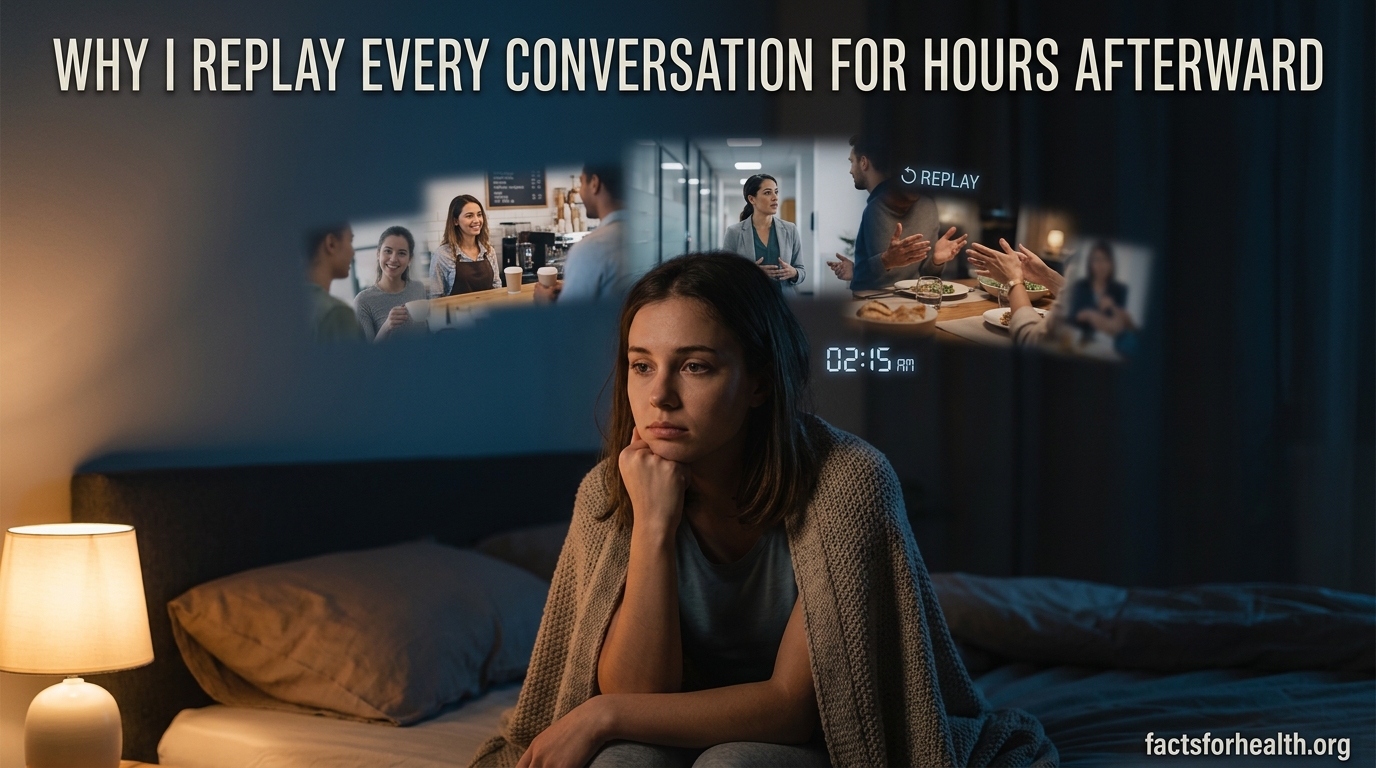
If you have ever found yourself lying in bed replaying a five-minute chat with a coworker for the next three hours, you are far from alone. The question “why I replay every conversation for hours afterward” is one of the most searched mental health queries online, and it points to something psychologists have studied for decades. You are not broken, and you are definitely not the only person doing this.
The short answer is that your brain is doing something called rumination or post-event processing. It is a repetitive thinking pattern where your mind reviews social interactions over and over, searching for threats, mistakes, or lessons. For most people this is occasional and harmless. For others it becomes a draining cycle that eats up hours and feeds anxiety.
Yes, it is normal to replay conversations in your head to some degree. Research shows nearly everyone does this after socially meaningful or awkward interactions. The line between normal reflection and problematic rumination comes down to duration, distress, and how much control you feel over the loop.
In this guide, our team breaks down exactly why this happens, what your brain is trying to accomplish, when it crosses into something worth addressing, and what you can do tonight to quiet the loop. We pulled from clinical research, forum discussions across Reddit communities, and the latest psychological findings published in 2026.
Table of Contents
Quick Answer: What Is Conversation Replay?
Replaying conversations in your head is a psychological phenomenon called rumination or post-event processing. It happens when your brain repetitively reviews a social interaction to analyze what was said, how it was received, and whether you made a mistake. The behavior is common and often normal, but it can become problematic when it causes significant distress, interferes with sleep, or consumes large portions of your day.
Think of it as your brain running a security scan on a past event. It pulls up the conversation, examines it for threats (did I say something wrong?), and loops back to check again. The problem is that unlike a real security scan, this one rarely reaches a satisfying conclusion.
Why I Replay Every Conversation for Hours Afterward: 5 Main Reasons
There is no single cause behind conversation replaying. Researchers have identified several overlapping drivers, and most people relate to more than one. Here are the five most common reasons, backed by clinical research and reflected across thousands of forum posts.
1. Negativity Bias and Threat Detection
Your brain is wired to prioritize negative information over positive information. This is called negativity bias, and it served our ancestors well when survival depended on remembering which berries were poisonous or which tribe members were dangerous.
A 2024 neuroimaging study published in Cognitive, Affective, and Behavioral Neuroscience found that negative social feedback activates the brain’s threat-detection circuits far more intensely than positive feedback activates reward circuits. The same study showed that these neural responses directly predicted how much participants ruminated afterward.
In modern life, this means your brain treats an awkward comment at lunch like a survival-level event. It flags the interaction, marks it as unresolved, and keeps pulling it back into your awareness because the threat system thinks there is still work to do.
This is why a single mildly embarrassing moment can dominate your thoughts for the rest of the day while a dozen positive interactions barely register. Your brain is not being cruel. It is being overly cautious with outdated software.
2. Social Anxiety and Fear of Negative Evaluation
If you live with social anxiety, conversation replaying is practically a built-in feature. Social anxiety disorder involves an intense fear of being judged negatively by others, and replaying conversations is the brain’s attempt to figure out whether that judgment happened.
People with social anxiety engage in what researchers call post-event rumination, a specific type of replaying that focuses heavily on perceived mistakes and signs of rejection. A 2024 meta-analysis in the Journal of Psychiatric Research confirmed that post-event rumination is one of the strongest maintaining factors in social anxiety, creating a self-reinforcing cycle.
The cycle works like this: you have a conversation, you replay it looking for evidence that you messed up, the replaying generates more anxiety, and the anxiety makes future conversations feel more threatening. Each loop strengthens the pattern.
Forum users on r/socialanxiety describe this perfectly. They talk about dissecting a coworker’s tone of voice, rereading text messages dozens of times, and mentally rehearsing what they should have said. The common thread is a desperate need for certainty about how they were perceived, which is something no amount of replaying can actually provide.
3. Perfectionism and the Drive to Communicate Flawlessly
Perfectionism is one of the most overlooked drivers of conversation replaying. If you hold yourself to an impossibly high standard for how you should communicate, then every real conversation will inevitably fall short.
People with maladaptive perfectionism set unrealistic expectations for their social performance. When a conversation inevitably includes a stumble, a pause, or a less-than-perfect joke, the perfectionist brain flags it as a failure that needs to be analyzed and corrected for next time.
Psychology Today’s coverage of this topic highlights how internalized perfectionism around communication drives the replay loop. The thinking goes: if I can just figure out what I did wrong, I can make sure I never do it again. But this logic traps you in an endless review process because no conversation will ever be flawless.
This connects to what researchers call self-referential processing, where you interpret every social cue as a direct reflection of your worth. A neutral facial expression becomes evidence that you are boring. A delayed text reply becomes proof that you said something wrong.
4. The Illusion of Emotional Regulation
Here is one of the most counterintuitive findings: many people replay conversations because they believe it helps them process emotions. It feels productive, like you are doing important psychological work.
Researchers call this the false sense of emotional regulation. The replay loop feels like problem-solving, so your brain keeps running it. But studies consistently show that rumination does not resolve emotions. It amplifies them.
A 2024 meta-analysis found that rumination is strongly correlated with worsening mood over time, not improvement. The act of replaying keeps the emotional content active in your working memory, preventing the natural fading process that would let the interaction lose its charge.
This is why the more you replay a conversation, the worse you tend to feel about it. You are not processing. You are reopening the wound every time.
5. ADHD and Hyperfocus on Social Uncertainty
People with ADHD often experience conversation replaying through a different mechanism: hyperfocus. The ADHD brain tends to latch onto interesting or unresolved problems and pursue them with intense, sustained attention.
Social uncertainty is inherently unresolved. Did they mean it that way? Was that sarcastic? Should I have responded differently? For an ADHD brain, these open questions become a puzzle that demands solving, and the hyperfocus engine locks on.
Reddit users on r/ADHD frequently describe replaying conversations to make sure they did not miss anything important. They worry about having interrupted, talked too much, or failed to pick up on social cues due to attention gaps. The replaying becomes a compensatory strategy to catch what they feel they missed in real time.
This differs from social anxiety-driven replaying. The ADHD version is often more about completeness and accuracy than about fear of judgment, though the two frequently overlap.
Nighttime Replay: Why Conversations Linger at Bedtime
If you have ever wondered why replaying conversations hits hardest the moment your head touches the pillow, there is a neurological reason. Nighttime rumination is one of the most common complaints in forum discussions, yet almost no resource addresses it directly.
During the day, your brain is occupied with tasks, decisions, and sensory input. These act as natural distractions that keep intrusive thoughts at bay. At night, those distractions disappear, and the default mode network takes over. This is the brain system responsible for self-referential thinking, mind-wandering, and yes, rumination.
The default mode network becomes more active when external stimulation drops. So the very act of lying still in a quiet room gives your brain the perfect conditions to replay conversations. Combine this with mental fatigue from the day, which weakens your ability to redirect attention, and you have a recipe for hours of looping thoughts.
Additionally, cortisol and stress hormones can spike in the evening for people with chronic anxiety, making bedtime replaying feel more urgent and distressing. Your tired brain lacks the resources to challenge the thoughts effectively, so they run unchecked.
The most effective approach to nighttime replaying involves redirecting attention before the loop gains momentum. This is not about forcing yourself to stop thinking, which backfires due to ironic process theory. Instead, it involves giving your brain a different task that is absorbing enough to override the default mode network without being stimulating enough to keep you awake.
Healthy Reflection vs. Unhealthy Rumination
One of the most common questions in forums is some version of: how do I know if this is normal or if something is wrong? The honest answer is that the line is not about whether you replay conversations. Nearly everyone does. The line is about how it functions in your life.
Healthy reflection is time-limited, problem-oriented, and leads to a resolution. You think about a conversation, identify something useful, and move on. It might last a few minutes or come back a couple of times during the day, but it does not dominate your mental space.
Unhealthy rumination is repetitive, distress-driven, and circular. You revisit the same material without reaching new conclusions. It lasts for hours, interferes with sleep or concentration, and focuses heavily on perceived flaws, mistakes, and worst-case interpretations.
Here is a practical way to tell the difference. After you finish thinking about the conversation, do you feel like you resolved something, or do you feel worse than when you started? Reflection leaves you with clarity or at least neutral acceptance. Rumination leaves you more anxious, more self-critical, and more convinced you did something wrong.
Duration matters too. Thinking about a conversation for ten minutes is normal. Losing an entire evening to it on a regular basis is a sign the pattern has become maladaptive. If friends have noticed you seem distracted or if you regularly lose sleep to replaying, those are clear signals worth paying attention to.
Connected Conditions: When Replaying Points to Something Deeper
Conversation replaying is a behavior, not a diagnosis. But it shows up alongside several mental health conditions, and understanding which pattern fits your experience can help you find the right strategies.
Social Anxiety Disorder
Social anxiety is the condition most strongly linked to conversation replaying. The replaying is driven by fear of negative evaluation and tends to focus on perceived social failures. People with social anxiety often replay conversations looking for evidence of rejection or embarrassment, and they rarely find reassurance no matter how many times they review.
OCD and Relationship OCD
OCD can drive conversation replaying through a different mechanism. Instead of anxiety about social judgment, OCD-driven replaying often involves compulsive re-checking. The brain demands certainty: did I say something offensive? Did I lie without realizing it? Did I agree to something I do not remember?
Relationship OCD (ROCD) specifically can drive replaying of conversations with romantic partners, searching for evidence about whether the relationship is right or whether feelings are genuine. The replaying functions as a compulsion, a mental checking behavior that temporarily reduces anxiety but ultimately strengthens the obsessive loop.
ADHD
As covered earlier, ADHD-related replaying is often tied to hyperfocus and concerns about missed social cues. People with ADHD may also replay conversations because of rejection sensitive dysphoria, a pattern of intense emotional sensitivity to perceived rejection or criticism.
Depression
Depression and rumination are deeply intertwined. Depressive rumination tends to be more global and self-critical than social-anxiety-driven replaying. Instead of analyzing one conversation, the depressed brain might use a conversation as evidence for broader negative beliefs: I am unlikable, I always say the wrong thing, nothing will ever change.
Autism Spectrum
People on the autism spectrum may replay conversations as part of processing social interactions that did not come intuitively. This differs from anxiety-driven replaying because the goal is often genuine understanding rather than fear reduction. Autistic individuals may review conversations to decode social cues, learn patterns, or make sense of interactions that felt confusing in real time.
How to Stop Replaying Conversations in Your Head
Knowing why you replay conversations is helpful, but the real question everyone asks is how to make it stop. The strategies below are drawn from cognitive behavioral therapy, mindfulness-based interventions, and techniques that forum users report actually working.
Step 1: Name the Pattern
The moment you notice yourself replaying, label it. Say to yourself, internally or out loud: I am ruminating. This is post-event processing. My brain is running its security scan again. Naming the pattern activates the prefrontal cortex, which helps create distance between you and the thought loop.
This is not about stopping the thought. It is about changing your relationship to it. Instead of being inside the replay, you step outside and observe it. That shift alone can reduce the emotional intensity significantly.
Step 2: Challenge Cognitive Distortions
Replaying conversations is fueled by thinking errors. The most common ones include mind reading (assuming you know what someone else was thinking), catastrophizing (assuming the worst possible outcome), and personalizing (assuming someone’s behavior was about you).
When you catch yourself replaying, ask: what is the actual evidence for my interpretation? Would a neutral observer reach the same conclusion? Am I holding myself to a standard I would never apply to a friend? These questions come from CBT and they work because they force the analytical brain to evaluate what the anxious brain assumed.
Step 3: Use Grounding Techniques
When the replay loop is intense, grounding pulls your attention back to the present moment. Try the 5-4-3-2-1 technique: name five things you can see, four things you can physically feel, three things you can hear, two things you can smell, and one thing you can taste.
Sensory grounding works because rumination lives entirely in your mental simulation of the past. Physical sensations exist only in the present. By flooding your sensory channels with real-time input, you crowd out the replay and give your brain a different task.
Step 4: Set a Rumination Time Limit
Counterintuitively, trying to banish replaying entirely can make it worse due to ironic process theory. Instead, give yourself a structured window. Set a timer for ten minutes. During that time, think about the conversation as much as you want. When the timer ends, redirect.
This technique, sometimes called worry scheduling, gives the rumination a place to exist without letting it expand to fill your entire evening. Many people find that once they have permission to think about it for a bounded period, the urgency drops.
Step 5: Write It Down and Close the Loop
Journaling about the conversation can help because writing forces structure. Thoughts that loop endlessly in your head become linear on paper. Write what happened, what you are worried about, and what you would tell a friend in the same situation.
Often the act of writing reveals that the concern is smaller than it felt. Even when it does not, the process of externalizing the thoughts reduces their grip. Once written, many people feel a sense of completion that the mental looping never provided.
Step 6: Practice Self-Compassion
Self-criticism fuels rumination. The harsher you are about replaying, the more material you give the loop to work with. Self-compassion is not letting yourself off the hook. It is treating yourself the way you would treat a friend who came to you with the same struggle.
Research consistently shows that self-compassion reduces rumination frequency and intensity. Try this: replace I cannot believe I said that, what is wrong with me with that was a hard conversation and I am being too hard on myself. Small shifts in self-talk compound over time.
Step 7: Redirect at Nighttime
For nighttime-specific replaying, the key is intervention before the loop builds momentum. Keep a notebook by your bed and do a brain dump before sleep. If the replaying starts anyway, try an absorbing but low-stakes mental task: counting backwards from 1000 by sevens, reconstructing the layout of your childhood home, or listening to a familiar audiobook at low volume.
The goal is not to force sleep but to give your default mode network competition. A mildly engaging task occupies the same mental resources that rumination wants to use.
FAQs
What is replaying conversations a symptom of?
Replaying conversations is a symptom of rumination or post-event processing. It commonly appears alongside social anxiety, OCD, ADHD, depression, and perfectionism. Occasional replaying is normal, but persistent looping that causes distress or disrupts daily life may point to an underlying condition worth discussing with a mental health professional.
Do people with ADHD replay conversations?
Yes, many people with ADHD replay conversations. This often relates to hyperfocus on unresolved social questions, concerns about missing social cues during the interaction, and rejection sensitive dysphoria. The ADHD brain can lock onto social uncertainty as a problem to solve, leading to extended replay sessions focused on accuracy and completeness.
Does OCD make you replay conversations?
OCD can drive conversation replaying through compulsive mental checking. The brain demands certainty about what was said, whether offense was caused, or whether something was agreed to. Relationship OCD can specifically trigger replaying of conversations with partners. The replaying functions as a compulsion that temporarily reduces anxiety but reinforces the obsessive cycle.
Why do I overanalyze every social interaction?
Overanalyzing social interactions is driven by negativity bias, fear of negative evaluation, perfectionism, or social anxiety. Your brain treats social uncertainty as a threat and keeps reviewing the interaction searching for mistakes or signs of rejection. This pattern intensifies when you hold yourself to unrealistic communication standards or have a strong need for social approval.
Is it normal to replay conversations in your head constantly?
Replaying conversations in your head is normal in moderation. Most people review socially meaningful or awkward interactions for a short time afterward. It becomes a concern when it happens constantly, lasts for hours, interferes with sleep, feels uncontrollable, or causes significant distress. If replaying consumes large portions of your day on a regular basis, it may have crossed from normal reflection into problematic rumination.
How do I stop replaying conversations in my head?
To stop replaying conversations, try naming the pattern when it starts, challenging cognitive distortions, using grounding techniques, setting a time limit for rumination, journaling to externalize the thoughts, and practicing self-compassion. For nighttime replaying, try a brain dump before bed and redirect with a low-stakes mental task. If the pattern persists and disrupts your life, consider speaking with a therapist trained in CBT.
Conclusion
Understanding why I replay every conversation for hours afterward starts with recognizing that your brain is not malfunctioning. It is running an outdated threat-detection program with good intentions and poor execution. Rumination and post-event processing are deeply human patterns shaped by negativity bias, social anxiety, perfectionism, and the drive for emotional resolution.
The good news is that this cycle is breakable. Naming the pattern, challenging distorted thoughts, using grounding techniques, and practicing self-compassion are all proven strategies that reduce replaying over time. If the pattern is severe, persistent, or interfering with your sleep and daily life, a therapist trained in CBT can help you build a personalized toolkit. You do not have to live with the loop running indefinitely.