
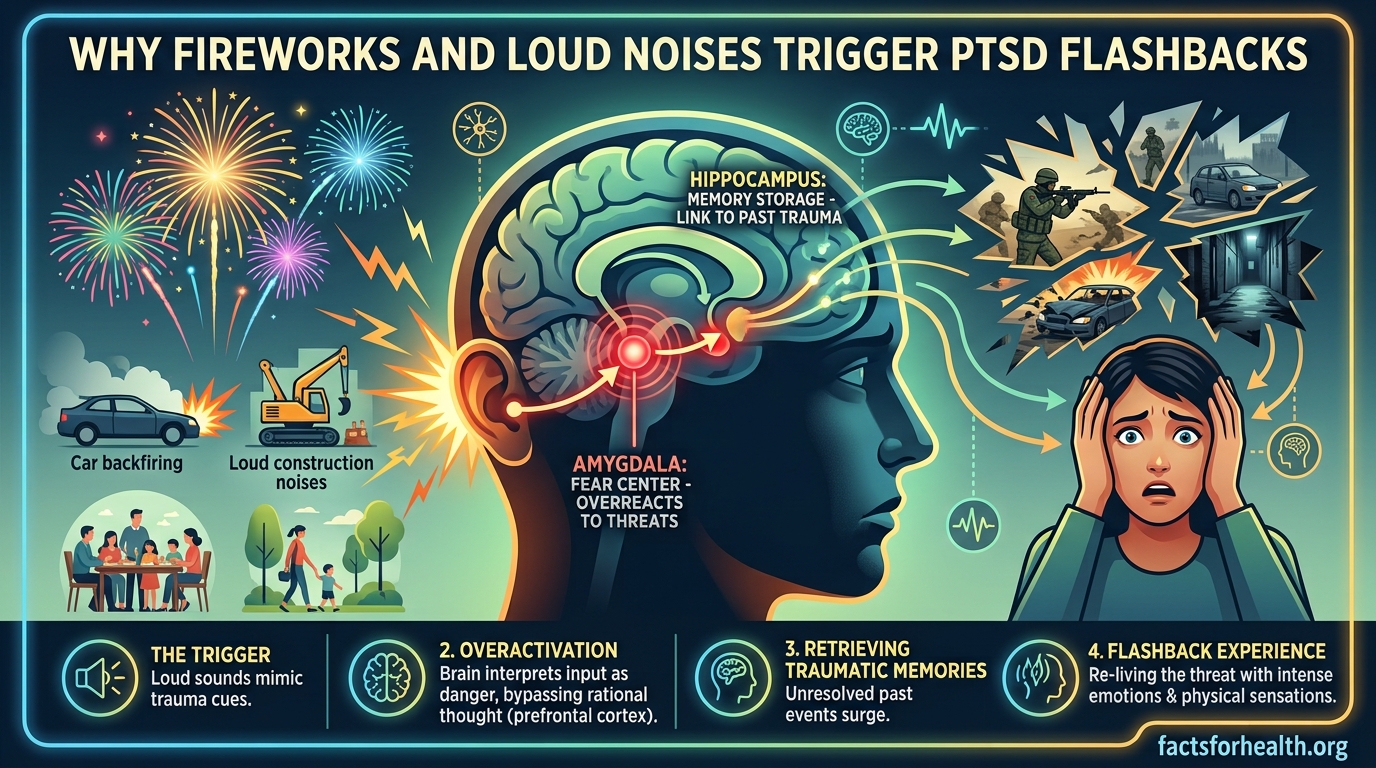
Fireworks and loud noises trigger PTSD flashbacks because the brain’s threat-detection system misidentifies these sudden, intense sensory inputs as signs of danger, reactivating the same fear response that occurred during the original trauma. For someone with Post-Traumatic Stress Disorder, a firework is not just a loud sound. It is a neurological event that can transport them back to a combat zone, a violent attack, or a devastating accident in a matter of seconds.
Our team has spent months researching the intersection of sensory triggers and trauma response, reviewing clinical literature, VA resources, and firsthand accounts from veterans, survivors, and mental health professionals. What we found is that the vast majority of people, even those who love someone with PTSD, do not fully understand what happens inside the brain when a firework goes off.
This guide breaks down exactly why fireworks and loud noises trigger PTSD flashbacks, what happens in the brain on a neurological level, who is most affected, and what you can do to cope or help someone you care about. Whether you are a combat veteran dreading the Fourth of July, a survivor of gun violence, or a family member trying to understand what your loved one is going through, the information here can help you navigate fireworks season with greater confidence.
One combat veteran shared on Reddit something that captures the experience with raw clarity: “The consistency and loudness mimics gunshots and bomb drops. I want my family to enjoy but I can’t be there.” That sentiment is echoed by thousands of people every year. If you have ever wondered why fireworks and loud noises trigger PTSD flashbacks, the answer lies at the intersection of brain chemistry, sensory memory, and the devastating power of unpredictability.
Table of Contents
Quick Summary: The Short Answer
PTSD flashbacks from fireworks occur when loud, sudden noises and sensory cues from fireworks activate the brain’s trauma response, causing a person to mentally and physically re-experience a past traumatic event as if it is happening again. The amygdala, the brain’s threat detector, flags the sound as dangerous. The prefrontal cortex, which normally regulates fear, shuts down. The hippocampus floods with stress hormones, making traumatic memories feel present and real.
Several factors make fireworks especially potent triggers:
- Sensory similarity to trauma: Fireworks sounds mimic explosions and gunfire almost exactly, and the flash of light and smell of gunpowder compound the effect.
- Unpredictability: You cannot predict when the next bang will happen, which prevents the brain from calming down between explosions.
- Multi-sensory overload: Fireworks attack the brain through sound, sight, and smell simultaneously, creating a more immersive trauma reminder than a single-sense trigger.
- Duration: Fireworks displays and neighborhood celebrations can last for hours or even days around holidays, keeping the nervous system in a prolonged state of alarm.
People most at risk include combat veterans, survivors of gun violence, first responders, survivors of domestic abuse, and anyone whose trauma involved explosions, loud noises, or sudden violence. Roughly 12 million adults in the United States have PTSD in any given year, and for many of them, fireworks season is the most difficult time of the entire calendar. If you or someone you know is struggling with anxiety symptoms, our guide on anxiety symptoms and management provides additional strategies for understanding and coping with stress responses.
What Is PTSD and What Are Triggers?
Post-Traumatic Stress Disorder (PTSD) is a psychiatric condition that develops in some people after they experience or witness a life-threatening or deeply distressing event. The brain, overwhelmed by the trauma, fails to properly process and file the memory. Instead of becoming a normal, distant recollection, the traumatic memory stays raw, vivid, and easily activated.
A trauma reminder, also called a trauma cue, is anything that the brain associates with the original traumatic event. Reminders can be obvious, like the sound of an explosion, or subtle, like a specific smell, a time of day, or even a weather pattern. The Department of Veterans Affairs defines trauma reminders as “sights, sounds, smells, or other sensory cues that remind the person of the traumatic event.”
A trigger is a specific type of trauma reminder that actually activates PTSD symptoms. Not every reminder causes a reaction. Triggers are the reminders that cross a threshold and set off the brain’s alarm system. For someone whose trauma involved explosions or gunfire, a firework is one of the most powerful triggers that exists because it recreates the sensory experience of the original trauma with startling accuracy.
What makes PTSD triggers so challenging is that they operate below the level of conscious thought. A person does not choose to be triggered. The brain’s survival circuitry detects what it interprets as a threat and reacts before the rational mind has a chance to intervene. This is why simply knowing that “it is just fireworks” does not stop a flashback. The thinking brain is not in charge during that moment.
The Neuroscience: What Happens in Your Brain During a Fireworks Trigger
Understanding why fireworks and loud noises trigger PTSD flashbacks requires looking at what happens inside the brain when a trigger hits. Three key brain structures play central roles: the amygdala, the prefrontal cortex, and the hippocampus. Together, they form what neuroscientists call the brain’s fear circuitry, and in PTSD, this circuitry is altered in ways that make it hyper-responsive to threats.
The Amygdala: Your Brain’s Threat Detector
The amygdala is a small, almond-shaped structure deep inside the brain that acts as a constant threat scanner. Its job is to detect danger and trigger the body’s alarm system before you even consciously register what is happening. In a healthy brain, the amygdala reacts to real threats and calms down when the danger passes.
In a brain with PTSD, the amygdala becomes hyperactive. It is always on high alert, scanning the environment for anything that resembles the original trauma. When a firework explodes, the amygdala does not process it as a celebration. It processes it as an incoming mortar round, a gunshot, or a car bomb. Within milliseconds, the amygdala sends an emergency signal that activates the fight-or-flight response.
This is what researchers call an “amygdala hijack.” The emotional, survival-oriented part of the brain takes over before the rational part can assess the situation. The person has no control over this initial reaction because it happens at a neural level faster than conscious thought.
The Prefrontal Cortex Goes Offline
The prefrontal cortex is the part of the brain responsible for rational thinking, decision-making, and emotional regulation. Under normal conditions, it acts as the brain’s brake system, assessing threats and telling the amygdala when a danger is not real.
During a PTSD trigger, the prefrontal cortex becomes suppressed. Brain imaging studies show reduced activity in this region among people with PTSD, especially during flashbacks. This is why someone having a flashback cannot simply reason their way out of it. The part of the brain that would say “that is just a firework, you are safe at a barbecue” is essentially offline.
The suppression of the prefrontal cortex also explains why flashbacks feel so vivid and real. Without the rational brain providing context and grounding, the sensory input from the trigger floods the system unchecked. The person’s brain is reliving the trauma because there is no logical counterbalance to stop it.
The Hippocampus and Memory Flooding
The hippocampus is the brain structure responsible for processing and organizing memories. It helps distinguish between past and present, telling you that a memory is something that happened before, not something happening right now.
In PTSD, the hippocampus functions differently. Traumatic memories are stored in a fragmented, disorganized way rather than being properly filed as past events. When a trigger like a firework activates these memories, the hippocampus floods with stress hormones like cortisol and adrenaline. This chemical flood disrupts the brain’s ability to distinguish past from present.
The result is that the traumatic memory does not feel like a memory at all. It feels like it is happening again, right now, in this moment. A veteran may see flashes of a battlefield. A shooting survivor may feel the physical sensation of being hit. The brain has lost its ability to label the experience as “something that happened before.”
The Neurological Timeline of a Flashback (Seconds to Minutes)
Here is what happens during a fireworks-triggered flashback, broken down by the neurological timeline:
0 to 50 milliseconds: The sound of the firework reaches the auditory cortex. The amygdala begins processing the sound as a potential threat before the conscious brain even registers it.
50 to 200 milliseconds: The amygdala sends an emergency distress signal. The hypothalamus activates the sympathetic nervous system, releasing adrenaline. Heart rate spikes. Breathing becomes rapid and shallow. Muscles tense.
200 milliseconds to 2 seconds: The fight-or-flight response is in full activation. The prefrontal cortex begins to shut down. Cortisol floods the bloodstream, suppressing the hippocampus’s ability to contextualize the experience. The person may feel a surge of terror, an urge to run, or an urge to fight.
2 to 10 seconds: If the trigger continues or the person cannot self-regulate, a full flashback may develop. The brain begins re-experiencing the traumatic memory. Sensory details from the original event, sounds, smells, visual images, flood the person’s awareness. They may lose connection to their current surroundings.
10 seconds to several minutes: The flashback peaks. The person may be partially or fully detached from present reality. Physical symptoms peak: shaking, sweating, rapid heartbeat, nausea. The duration depends on the severity of the PTSD, the intensity of the trigger, and whether the person has coping tools available.
Minutes to hours after: Even after the flashback subsides, the nervous system remains elevated. The person may feel exhausted, emotionally drained, irritable, or numb for hours or even days afterward.
Why Fireworks Are Uniquely Triggering
Plenty of loud noises exist in daily life. Sirens, construction, thunder, and traffic all produce significant sound. Yet fireworks stand apart as one of the most universally cited triggers among people with PTSD. Understanding why requires looking at the specific sensory qualities of fireworks and how they interact with the traumatized brain.
Multi-Sensory Overload: Sound, Light, and Smell
Fireworks are a full-sensory experience. They do not just produce sound. They produce a blinding flash of light, the acrid smell of gunpowder and smoke, concussive pressure waves that you can feel in your chest, and sometimes even heat. For a brain that is already on high alert, this multi-sensory assault is far more potent than any single-sense trigger.
Consider how this maps onto combat trauma. A veteran who survived an IED explosion experienced the blast as sound, light, pressure, smell, and heat all at once. A firework recreates nearly all of these sensory channels simultaneously. The brain does not just hear a loud noise. It hears a loud noise, sees a flash, smells smoke, and feels a pressure wave, and all of these inputs together form a pattern that the amygdala recognizes as the original trauma.
Even for non-combat trauma survivors, the sensory intensity of fireworks can be triggering. A survivor of a house fire may be triggered by the smell of smoke. A survivor of a car accident involving an explosion may be triggered by the concussive feeling. The multi-sensory nature of fireworks makes them a nearly universal trigger for trauma involving sudden, violent sensory events.
The Unpredictability Factor: Why Not Knowing Makes It Worse
Of all the factors that make fireworks triggering, unpredictability may be the most important. Yet it is one of the least discussed aspects in popular coverage of this topic. The Department of Veterans Affairs is one of the few authoritative sources that specifically highlights unpredictability as a key amplifier of PTSD triggers.
Here is why unpredictability matters so much. The brain’s threat detection system is designed to assess danger and then return to baseline once the danger passes. But when threats are unpredictable, the brain can never return to baseline. It stays locked in a state of hypervigilance, constantly scanning for the next explosion that could come at any moment.
Reddit users with PTSD describe this vividly. One person wrote: “The unpredictability is worse than the actual noise. Knowing it’s coming makes it manageable.” Another noted: “Some people can tolerate loud noises if they know they’re coming.” This is why a scheduled fireworks show with a known start and end time is often more manageable than random neighborhood fireworks that go off without warning.
This is also why unannounced fireworks set off by neighbors are particularly devastating. There is no schedule, no warning, no end time in sight. The person with PTSD cannot prepare, cannot brace themselves, and cannot relax because the next bang could come in five seconds or five hours. This extended state of uncertainty keeps the nervous system in fight-or-flight mode far longer than the actual noise would.
From a clinical perspective, unpredictability amplifies the startle reflex. Each unexpected bang triggers a fresh amygdala activation. The brain never gets the signal that it is safe to stand down. Over the course of a fireworks-heavy evening, this can lead to cumulative nervous system overload, where each successive bang produces a stronger reaction than the one before.
Fireworks vs. Other Loud Noises: What Sets Them Apart
Thunder is loud, but it is a natural phenomenon that the brain does not typically associate with personal trauma. Construction noise is loud, but it is continuous and predictable. A car backfire is sudden, but it is brief and singular.
Fireworks combine all the worst qualities for someone with PTSD. They are extremely loud, often exceeding 150 decibels (louder than a jet engine at close range). They are sudden and percussive, mimicking the staccato rhythm of gunfire or mortar impacts. They are unpredictable when set off casually by individuals. And they are multi-sensory, attacking through sound, sight, and smell simultaneously.
Physical and Emotional Symptoms of a Fireworks Trigger
When a firework triggers a PTSD response, the symptoms can range from mild hyperarousal to a full dissociative flashback. The specific symptoms a person experiences depend on their trauma history, the severity of their PTSD, and whether they have developed coping mechanisms. But the general pattern follows a predictable arc of physical, emotional, and cognitive reactions.
What Does a PTSD Flashback Feel Like?
A PTSD flashback is not simply remembering a traumatic event. It is re-experiencing it. During a flashback, the brain processes the traumatic memory as if it is happening in the present moment. The person may see, hear, smell, and physically feel things that are not actually occurring in their current environment.
One trauma survivor described it this way: “Everything you see is altered, the smells, you feel things on your skin that aren’t there. You taste the air as if you were there. The sounds, everything comes flooding back.” This multi-sensory re-experiencing is what makes flashbacks so disorienting and terrifying.
Flashbacks can vary in intensity. Some people experience full visual flashbacks where they literally see the traumatic event playing out in front of them. Others experience emotional flashbacks, where they are flooded with the emotions of the original trauma, terror, helplessness, rage, without visual components. Auditory flashbacks involve hearing sounds from the trauma, such as gunfire, screaming, or explosions, layered over the present environment.
Do PTSD flashbacks feel real? Yes. During a flashback, the brain’s fear circuitry activates exactly as it did during the original trauma. The physiological response, racing heart, sweating, shaking, is identical to what the body would produce in actual danger. This is why flashbacks are so exhausting and why they can leave a person debilitated for hours or days afterward. Understanding the connection between mental health awareness and breaking the stigma around PTSD is an important step toward better support for those affected.
Hyperarousal and Hypervigilance Explained
Hyperarousal is a core symptom of PTSD in which the nervous system is perpetually stuck in a state of heightened alertness. It is as if the body’s alarm system is broken and cannot be turned off. People with hyperarousal may have an exaggerated startle reflex, difficulty sleeping, irritability, and constant scanning of their environment for threats.
Hypervigilance is a related symptom that specifically refers to the mental state of constantly monitoring for danger. A hypervigilant person at a fireworks display is not just reacting to each explosion. They are tracking every movement, every person nearby, every exit route, and every potential source of the next bang. This mental surveillance is exhausting and makes it impossible to relax or enjoy the event.
During fireworks season, hyperarousal and hypervigilance intensify dramatically. Many people with PTSD report difficulty sleeping during this period because their brain will not let them lower their guard. Every noise becomes a potential threat. A car door slamming, a trash can being rolled to the curb, a child popping a balloon, all trigger a spike of adrenaline.
Over time, chronic hyperarousal can worsen. Several Reddit users in PTSD communities report that their startle reflex has intensified over the years, not diminished. This suggests that repeated triggering without adequate treatment or recovery can sensitize the nervous system further, making each subsequent fireworks season potentially worse than the last.
Neurogenic Tremors: When Your Body Shakes Uncontrollably
One symptom that almost no competitor resource covers is neurogenic tremors. These are involuntary shaking or trembling episodes that occur when the nervous system is overwhelmed by stress or trauma. They are not voluntary, not a panic attack, and not a seizure. They are the body’s way of discharging excess nervous energy that has built up during a threat response.
Neurogenic tremors are a natural mechanism. Animals in the wild literally shake after escaping a predator to release the stress hormones and return their nervous system to baseline. Humans have the same mechanism, but in PTSD, it can become activated at overwhelming intensity during triggers.
For someone triggered by fireworks, neurogenic tremors may begin during or after a flashback. The shaking can affect the hands, legs, or the entire body. Some people describe it as shivering that they cannot control, even though they are not cold. Others describe a vibrating sensation that moves through their body in waves.
While neurogenic tremors can be frightening, especially the first time they happen, they are generally not dangerous. They represent the nervous system attempting to self-regulate. Understanding that these tremors are a normal physiological response can help reduce the secondary anxiety they cause.
Who Is Most Affected by Fireworks and Loud Noises
PTSD does not discriminate. It can affect anyone who has experienced trauma, regardless of age, gender, or background. However, certain populations are disproportionately affected by fireworks triggers because their specific trauma histories share strong sensory overlap with the experience of fireworks.
Combat Veterans and Military Personnel
Combat veterans are the population most commonly associated with fireworks-related PTSD triggers, and for good reason. Modern warfare often involves exposure to explosions, gunfire, mortar attacks, and IED detonations. The sensory experience of combat, the sounds, the flashes, the smells, is closely mirrored by fireworks.
For a veteran who served in Iraq or Afghanistan, a fireworks display can recreate the sensory landscape of a combat zone with startling accuracy. The staccato pop of firecrackers mimics gunfire. The deep boom of a large shell mimics a mortar impact. The flash and smoke mimic an explosion. The brain, trained by months or years of combat to treat these sensory inputs as mortal threats, reacts accordingly.
The Fourth of July is widely recognized as the most challenging holiday for combat veterans with PTSD. Organizations like the VA and veteran support groups issue annual reminders asking the public to be mindful of fireworks, particularly in residential areas near veteran communities. Some veterans post signs in their yards asking neighbors to be courteous with fireworks.
Survivors of Gun Violence and Accidents
Survivors of gun violence represent a growing and frequently overlooked population affected by fireworks triggers. With mass shootings and gun violence affecting communities across the country, the number of people with trauma related to gunfire is significant and increasing.
For a survivor of a shooting, the sound of fireworks can mimic the sound of gunfire with disturbing precision. The brain, which encoded the sound of gunshots as a mortal threat during the attack, responds to fireworks the same way it would respond to actual gunfire. The startle reflex, the urge to flee or take cover, and the flood of fear are automatic.
Survivors of industrial accidents, car crashes involving explosions, and natural disasters involving loud concussive events can also be triggered. Any trauma that involved sudden, loud, percussive sounds creates a neural pathway that fireworks can activate.
First Responders
First responders, including police officers, firefighters, and emergency medical personnel, are repeatedly exposed to traumatic events as part of their profession. Sirens, explosions, gunfire, and the chaos of emergency scenes are routine elements of their work.
Over time, cumulative trauma exposure can lead to PTSD. Fireworks can trigger this PTSD by recreating the sensory environment of emergency scenes. A firefighter who responded to a devastating explosion may be triggered by the concussive force of a large firework. A paramedic who worked a mass casualty event involving gunfire may react to the rapid popping of firecrackers.
First responder PTSD is gaining more recognition, but fireworks-specific triggers in this population remain under-discussed. Many first responders suffer in silence because of the stigma surrounding mental health in emergency services professions. If you are interested in learning more about how stress affects everyday health, our article on stress management techniques for everyday life covers practical approaches to managing chronic stress responses.
Survivors of Abuse and Childhood Trauma
People who experienced childhood abuse or domestic violence can also be triggered by fireworks and loud noises, though the connection is less obvious than with combat or gun violence. Loud, sudden noises are often associated with abusive environments, a slamming door, breaking glass, a raised voice, physical impact.
For survivors of abuse, the unpredictability of fireworks may be the most triggering element. Living in an abusive environment often involves chronic unpredictability, never knowing when the next incident will occur. Fireworks recreate that psychological state of waiting for the next explosion, unable to predict when or how bad it will be.
Complex PTSD (C-PTSD), which develops from repeated or prolonged trauma rather than a single event, often involves heightened sensory sensitivity. People with C-PTSD may find that their reaction to loud noises intensifies over time, making each fireworks season progressively harder without treatment.
Coping Strategies for Fireworks Season
If you or someone you love has PTSD, fireworks season does not have to mean total isolation and suffering. While there is no way to eliminate triggers entirely, there are proven strategies that can reduce their intensity, shorten recovery time, and help you regain a sense of control. The key is preparation. People who plan ahead consistently report better outcomes than those who try to wing it.
Grounding Techniques: The 5-4-3-2-1 Method
Grounding is the practice of using your senses to anchor yourself in the present moment during a flashback or dissociative episode. It works by giving the brain concrete, real-time sensory input that competes with the trauma memory flooding the system.
The 5-4-3-2-1 method is one of the most widely recommended and effective grounding techniques. It is simple enough to remember even when distressed and can be done anywhere:
- Name 5 things you can see. Look around and identify five specific objects in your environment. A lamp, a book, a tree outside the window, a clock on the wall, a glass of water. Describe them in detail, including color, shape, and texture.
- Name 4 things you can physically feel. The chair beneath you, the fabric of your shirt, the floor under your feet, the temperature of the air on your skin. Focus on the physical sensation of each.
- Name 3 things you can hear. A fan humming, traffic in the distance, a clock ticking. Identify sounds that are present in your current environment, not sounds from the memory.
- Name 2 things you can smell. Coffee, soap, fresh air, a scented candle. If you cannot smell anything, think of two smells you enjoy.
- Name 1 thing you can taste. A mint, a sip of water, the lingering taste of your last meal.
The 5-4-3-2-1 method forces the brain to process current sensory information, which helps the prefrontal cortex come back online and reminds the hippocampus that you are in the present, not in the past. With practice, this technique can reduce the intensity and duration of flashbacks.
Creating a Preparation Plan for July 4th
The single most effective thing you can do is create a written plan before fireworks season begins. Having a plan reduces anxiety because it removes the uncertainty of not knowing what to do when a trigger hits. Here is what a solid preparation plan should include:
Know the schedule. Find out when official fireworks displays are scheduled in your area. Mark the dates and times on your calendar. If possible, find out about neighborhood traditions, when people typically set off personal fireworks, so you can anticipate peak trigger times.
Create a safe space. Identify a room in your home that is the most soundproof and away from windows. A basement, an interior bathroom, or a bedroom with heavy curtains works well. Stock this space with comforting items: blankets, headphones, a tablet with movies or shows, stress balls, and snacks.
Arrange a support buddy. Choose someone you trust who understands your PTSD and can be available, in person or by phone, during peak fireworks hours. Brief them on what to do if you have a flashback and what not to do.
Plan an exit strategy. If you attend an event, know how you will leave if needed. Park where you can exit easily. Have a code word or signal with your companion that means you need to go. Having permission to leave reduces the pressure that can amplify anxiety.
Inform your neighbors. If you feel comfortable, let your neighbors know that fireworks are difficult for you. You do not need to disclose your trauma. A simple note explaining that loud sudden noises cause you distress and asking for a heads-up before any fireworks can make a significant difference.
Practical Tools: Ear Plugs, Headphones, and Safe Spaces
Physical noise reduction can dramatically reduce the intensity of fireworks triggers. While no tool eliminates the sound entirely, reducing the decibel level that reaches your auditory system gives your brain less sensory data to process as a threat.
Ear plugs are the simplest and most affordable option. High-fidelity ear plugs reduce volume without distorting sound, allowing you to remain aware of your environment at a safer level. Foam ear plugs, while less precise, are inexpensive and widely available.
Noise-canceling headphones are more effective for intense situations. Over-ear models with active noise cancellation can significantly reduce the percussive impact of fireworks. Many people combine noise-canceling headphones with white noise, music, or audiobooks to further mask the sound of explosions.
Beyond noise reduction, physical comfort tools matter. Weighted blankets provide deep pressure stimulation that calms the nervous system. A weighted blanket in your safe space can help ground you during and after a trigger. Some people also find that holding something cold, an ice pack, a frozen water bottle, provides an intense sensory input that interrupts the flashback cycle. For additional support, see our guide on managing panic attacks and response strategies for techniques that complement grounding practices.
Building Your Support Network
Isolation amplifies PTSD symptoms. Connection reduces them. Having people who understand what you are going through and can support you during fireworks season is not a luxury. It is a clinical necessity for recovery.
Your support network should include people at multiple levels. A therapist or counselor who specializes in trauma treatment provides professional guidance. A support group, whether in person or online, connects you with people who have lived experience of what you are facing. Friends and family members who are willing to learn about PTSD and accommodate your needs provide day-to-day support.
Online communities can be particularly valuable. Reddit communities like r/ptsd and r/Veterans provide spaces where people share coping strategies, vent about difficult moments, and support each other through fireworks season. Knowing that thousands of other people are going through the same experience can reduce the isolation that makes everything worse.
How to Help Someone Having a PTSD Flashback
If someone you love has PTSD, knowing how to respond during a flashback is one of the most valuable skills you can develop. The right response can shorten the flashback and help the person recover faster. The wrong response can prolong it or make it worse.
First, recognize the signs. A person entering a flashback may suddenly go quiet, stare blankly, begin sweating or shaking, breathe rapidly, or seem detached from their surroundings. They may physically flinch or duck at sounds. They may become agitated or, conversely, completely frozen.
Here is what to do:
Step 1: Ensure safety. Gently guide the person away from the source of the trigger if possible. Move to a quieter, darker space. Do not grab them or force them to move, as sudden physical contact can intensify the flashback.
Step 2: Speak calmly and identify yourself. Say their name. Tell them where they are. Say something like: “You are safe. You are at home. It is [date]. I am here with you.” Use simple, repetitive, grounding statements.
Step 3: Use grounding prompts. Ask them to name things they can see in the room. Offer a physical sensation: “Can you feel this blanket? Is it soft?” Hand them something cold to hold. The goal is to engage their present-moment senses.
Step 4: Do not rush them. Flashbacks take time to pass. Do not demand that they snap out of it or tell them to calm down. Be patient. Your calm presence is doing more than you realize.
Here is what NOT to do:
Do not tell them it is just fireworks. Their brain cannot process that information during a flashback, and it may feel dismissive. Do not touch them unexpectedly, especially from behind. Do not raise your voice or show frustration. Do not ask them to talk about the traumatic event while they are in a flashback state.
After the flashback passes, offer continued support. The person may feel exhausted, embarrassed, or emotionally raw. Let them know there is no judgment. Offer water, a quiet space, and time to recover. Check in on them over the following days, as the nervous system can take time to return to baseline.
When to Seek Professional Help
If fireworks triggers are significantly impacting your quality of life, causing you to avoid social events, disrupting your sleep, or producing flashbacks that you cannot manage on your own, it may be time to seek professional help. PTSD is a treatable condition, and effective therapies exist that can reduce trigger intensity and improve your ability to cope.
Several evidence-based treatments have shown strong results for PTSD. Cognitive Behavioral Therapy (CBT) helps reframe the thought patterns that maintain fear responses. Eye Movement Desensitization and Reprocessing (EMDR) uses bilateral stimulation to help the brain reprocess traumatic memories so they no longer trigger intense reactions. Prolonged Exposure Therapy gradually helps the brain learn that trauma reminders are not dangerous.
Medication can also play a role. SSRIs (selective serotonin reuptake inhibitors) are FDA-approved for PTSD and can help reduce symptoms including hyperarousal and anxiety. A psychiatrist or primary care physician can help determine whether medication is appropriate for your situation.
If you are in crisis, resources are available. The Veterans Crisis Line connects veterans and their loved ones with trained responders at 988, then press 1. The Crisis Text Line provides free 24/7 support by texting HOME to 741741. The SAMHSA National Helpline at 1-800-662-4357 provides referrals to treatment facilities and support services nationwide.
Frequently Asked Questions
What are CPTSD flashbacks like?
CPTSD (Complex PTSD) flashbacks are often emotional rather than visual. Instead of seeing the traumatic event, a person may be suddenly flooded with the emotions they felt during the original trauma, such as terror, shame, worthlessness, or helplessness. These emotional flashbacks can last much longer than typical PTSD flashbacks, sometimes hours or days. People with CPTSD often describe feeling as if they have regressed to a younger, helpless version of themselves. Loud noises like fireworks can trigger these emotional flashbacks because the brain associates sudden, unpredictable sounds with the chronic threat that characterized the original abuse or trauma.
Do fireworks bother people with PTSD?
Yes, fireworks are one of the most common and potent triggers for people with PTSD, especially veterans and survivors of gun violence or explosions. The loud bangs, bright flashes, smell of gunpowder, and concussive pressure can all serve as trauma reminders that activate the brain’s fear circuitry. Even people whose PTSD is not related to combat or explosions can be triggered by the unpredictability and intensity of fireworks sounds.
How to stop auditory flashbacks?
To stop auditory flashbacks, use grounding techniques like the 5-4-3-2-1 method: name 5 things you see, 4 you can touch, 3 you hear, 2 you smell, and 1 you taste. Remind yourself aloud that you are having a flashback and that the traumatic event is over. Use noise-canceling headphones or ear plugs to reduce the incoming sound. Hold something cold or textured to engage your sense of touch. Practice slow, deep breathing to signal your nervous system that the threat has passed. Having a safety plan with a trusted support person can also help you manage auditory flashbacks more effectively.
Do PTSD flashbacks feel real?
Yes, PTSD flashbacks can feel completely real. During a flashback, the brain’s fear response activates as if the trauma is happening again in the present moment. The person may see, hear, smell, and physically feel things that are not actually present in their current environment. The body responds with the same physiological reactions it would during actual danger: racing heart, sweating, shaking, and intense fear. This is because the prefrontal cortex, the brain region responsible for rational assessment, is suppressed during a flashback, making it difficult to distinguish past memory from present reality.
Conclusion
Understanding why fireworks and loud noises trigger PTSD flashbacks comes down to a fundamental truth about the traumatized brain: it cannot always distinguish between past danger and present safety. When a firework explodes, the amygdala sounds the alarm, the prefrontal cortex goes offline, and the hippocampus floods with stress hormones, creating a moment where the past and present collapse into a single terrifying experience.
But this is not the whole story. The brain that learned to fear can also learn to feel safe again. With grounding techniques, preparation plans, support networks, and professional treatment, people with PTSD can reduce the power that fireworks hold over their lives. The unpredictability that makes fireworks so triggering can be partially managed through community awareness, advance notification, and neighborly consideration.
If you have PTSD and dread fireworks season, know that you are not alone and your reactions are not a weakness. They are the result of a brain that did exactly what it was supposed to do during trauma: it learned to survive. If you love someone with PTSD, your understanding and patience can make a measurable difference in their ability to cope. Together, with awareness, preparation, and compassion, we can make fireworks season safer for everyone navigating the challenges of PTSD and sensory triggers.