
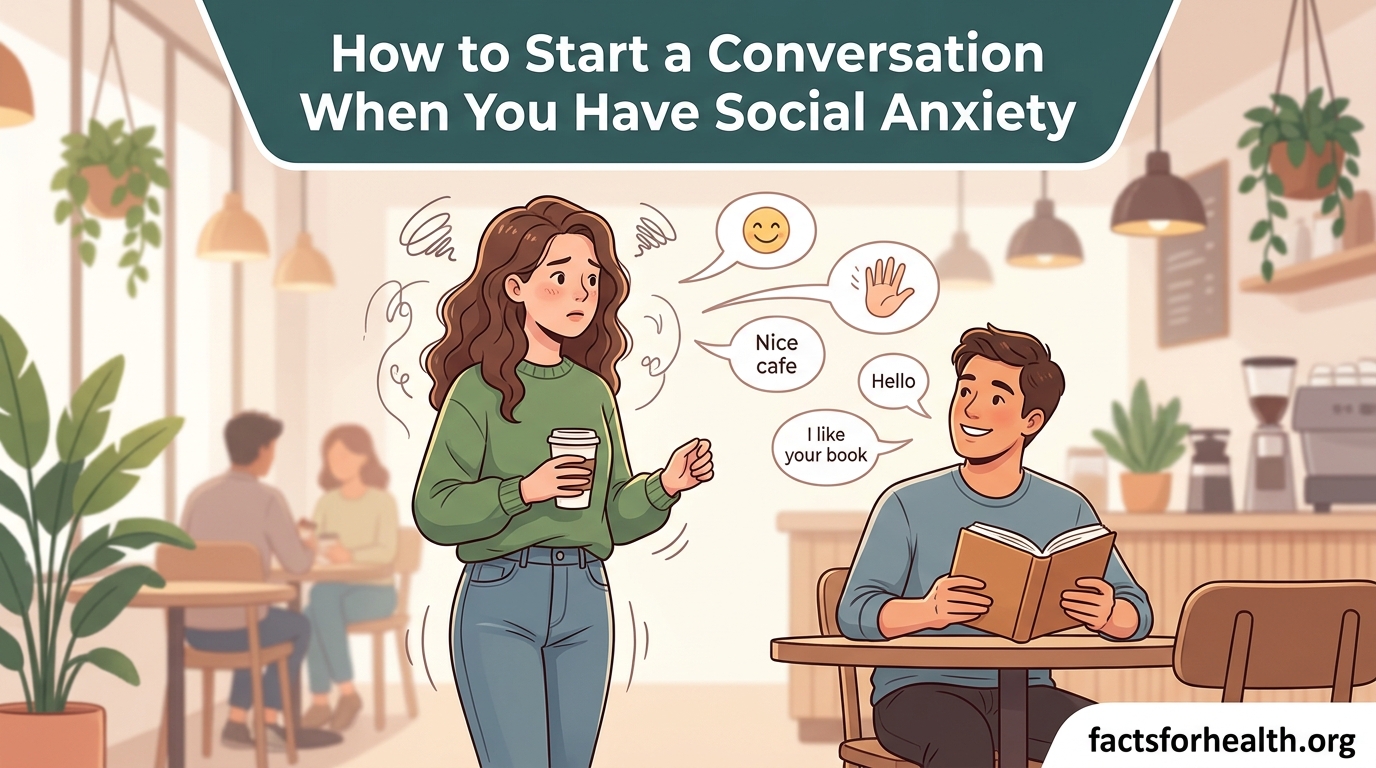
You are standing at the edge of a room. Someone nearby smiles in your direction. Your heart pounds, your palms sweat, and your mind races through a dozen possible opening lines only to reject each one. If this sounds familiar, you are far from alone. Roughly 7 percent of adults in the U.S. deal with social anxiety disorder, and millions more experience significant conversation nervousness without a formal diagnosis.
Here is the thing that took me years to learn: the struggle to start conversations is not a personality flaw. It is a predictable response from a brain that has learned to treat social situations as threats. Understanding that mechanism is the first step toward working with your mind instead of fighting it every step of the way.
This guide breaks down exactly how to start a conversation when you have social anxiety. You will find ready-to-use scripts, techniques for keeping the flow going, strategies for when your mind goes blank, and a step-by-step practice plan that builds real confidence over time. Everything here is designed for people who know the theory but need help translating it into action in the moment.
Table of Contents
Quick Start: 5 Conversation Openers You Can Use Right Now
Sometimes you just need something to say right now, before reading a 3,000-word guide. Here are five low-pressure openers that work in almost any setting:
- “How is your day going so far?” — Simple, warm, and universally appropriate. It invites the other person to share as much or as little as they want.
- “I really like your [specific item]. Where did you get it?” — Compliments create instant goodwill and give the other person a topic they are comfortable discussing.
- “Is this your first time at one of these?” — Perfect for events, classes, or meetings. It establishes shared context and opens the door to comparing experiences.
- “I am trying to get better at meeting new people, so I wanted to come say hi. I’m [your name].” — Vulnerability is disarming. Many people find this approach refreshing and relatable.
- “What are you working on these days?” — Broad enough for professional or casual settings, and it lets the other person steer the conversation toward their interests.
Print these out, screenshot them, or write them on your phone. Having a small set of go-to phrases removes the pressure of inventing something on the spot when anxiety spikes.
Understanding What Happens in Your Mind and Body
To understand why starting a conversation feels so hard, it helps to know what is happening beneath the surface. Social anxiety is not just shyness. It is a stress response that activates your body’s fight-or-flight system in social situations.
When you approach someone or think about initiating a conversation, your amygdala (the threat-detection center of your brain) sends alarm signals. Your nervous system responds as though you are facing physical danger. Your heart rate increases, your breathing becomes shallow, and blood flows away from your prefrontal cortex (the part of your brain responsible for creative thinking and word retrieval). This is why your mind goes blank. You literally lose access to the cognitive resources needed for smooth conversation.
This response feeds a cycle. You feel anxious, so you avoid conversations. Avoidance provides temporary relief, which reinforces the idea that conversations are dangerous. The next time, the anxiety is stronger. Breaking this cycle does not happen through willpower alone. It requires understanding the pattern and deliberately practicing new responses.
There is also a phenomenon called the liking gap. Research from the Journal of Personality and Social Psychology found that people consistently underestimate how much their conversation partners like them. You walk away from a conversation convinced you were awkward and unlikable, while the other person walks away thinking you were perfectly pleasant. The gap between your self-assessment and reality is often enormous.
Understanding this matters because it means your brain is feeding you inaccurate information. The fear of judgment you feel is louder than the judgment itself, which is usually minimal or nonexistent.
10 Practical Conversation Starters You Can Use Today
Having a mental library of conversation starters means you do not have to invent something under pressure. Here are ten openers organized by approach, with notes on when each works best.
1. The observation opener. Comment on something happening around you both. “This line is moving so slowly today” or “That presentation was really interesting.” Shared experiences create an instant point of connection and require no personal disclosure.
2. The compliment opener. “I love those shoes, where are they from?” People rarely receive genuine compliments and almost always respond warmly. Keep it specific and sincere rather than generic.
3. The help-request opener. “Do you know if there is coffee anywhere around here?” Asking for small favors makes people feel helpful and valued, and it naturally transitions into further conversation.
4. The opinion opener. “What did you think of that meeting?” or “Have you tried the food here?” People enjoy being asked for their perspective, and it shifts the conversational load to them.
5. The situational opener. “Are you here for the workshop too?” or “Do you come to this coffee shop often?” This works because it references your shared environment and establishes common ground immediately.
6. The honest opener. “I am not great at small talk, but I wanted to introduce myself. I’m [your name].” Many people find this approach endearing. It removes the pressure to perform and sets an authentic tone.
7. The current-events opener. “Did you see that [recent event in your industry or community]?” Keep it positive or neutral. Avoid controversial topics unless you know the person well.
8. The follow-up opener. “Last time we talked, you mentioned you were working on [project]. How is that going?” This shows you were listening and care, which deepens the connection beyond surface-level chat.
9. The curiosity opener. “That looks really interesting, what are you reading?” or “I have been meaning to try that restaurant. Have you been?” Curiosity signals genuine interest, which is one of the most attractive qualities in conversation.
10. The transition opener. If you are already in a group but want to start a one-on-one exchange: “I meant to ask you earlier, how do you know [mutual connection]?” This creates a private channel within a larger social setting.
The key with all of these is delivery. Speak slowly enough that your words are clear, maintain brief but present eye contact, and keep your tone warm. If you stumble over a word, just keep going. Most people will not notice, and those who do will not care.
Essential Techniques to Keep the Conversation Going
Starting a conversation is only half the battle. For people with social anxiety, the real challenge often comes a minute or two in, when the opening exchange runs dry and panic sets in. These techniques will help you maintain flow without feeling like you are carrying the entire conversation.
Ask Open-Ended Questions
Closed questions (those that can be answered with yes or no) kill conversations quickly. “Did you have a good weekend?” gets you a one-word answer and a dead end. Open-ended questions keep things flowing: “What did you get up to this weekend?” or “What was the highlight of your week?” These invite the other person to share, which takes the pressure off you.
A useful formula: start questions with “what,” “how,” or “tell me about.” These openings make it nearly impossible for the other person to give a dead-end answer.
Use the Echo Technique
The echo technique is simple but powerful. When someone says something, repeat the last few words back to them as a question, with genuine curiosity. If they say, “I just moved here from Chicago,” you respond, “From Chicago? What brought you here?”
This technique does two things. First, it shows you are listening, which makes people feel valued. Second, it encourages them to elaborate, which means they do more of the talking while you listen. For someone with social anxiety, listening is often far more comfortable than speaking.
Practice Active Listening
Active listening means engaging with what someone is saying rather than planning your next sentence. Nod occasionally. Say brief acknowledgment phrases like “that makes sense” or “I can see that.” Ask follow-up questions that dig deeper into what they just shared.
People remember how you made them feel, not the specific words you used. When you listen well, people walk away thinking you are a great conversationalist, even if you did not say much.
Shift From Small Talk to Meaningful Talk
Small talk feels draining precisely because it is surface-level. You can deepen a conversation by asking one layer of depth beyond the initial topic. If someone mentions they were tired this morning, instead of moving on, ask, “Have you been busy lately, or just not sleeping well?” This invites them to share something real, which makes the conversation feel more genuine for both of you.
The Role of Body Language in Conversation
Your words matter less than you think. Research suggests that a significant portion of communication is nonverbal. For people with social anxiety, body language can either reinforce anxious feelings or help ground you in the present moment.
Here are the body language fundamentals that make the biggest difference, along with what to avoid:
Do: Maintain eye contact in brief, natural intervals (2 to 3 seconds at a time, then glance away). Keep your shoulders relaxed and slightly back. Angle your body toward the person you are talking to. Nod occasionally to show you are engaged. Keep your hands visible and relatively still.
Don’t: Stare intensely without breaking eye contact. Cross your arms (it signals defensiveness even when you do not mean it that way). Hunch forward or make yourself physically smaller. Fidget with your phone, keys, or clothing repeatedly. Stand rigidly stiff like you are frozen.
If maintaining eye contact feels overwhelming, a helpful tip: look at the bridge of the person’s nose or the space between their eyebrows. It looks like eye contact to them but feels less intense for you.
Body language also works in the other direction. Research on embodied cognition shows that adopting open, confident body language can actually reduce anxiety. Standing up straight with your shoulders back sends a signal to your brain that you are safe, which helps calm the fight-or-flight response.
What to Do When Your Mind Goes Blank
This is the moment every person with social anxiety dreads. You are mid-conversation, the other person finishes their thought, and your mind is suddenly empty. No follow-up question surfaces. No clever response appears. You feel the silence stretching and panic rising.
First, know this: silence is not as bad as it feels. The pause that seems agonizing to you is often just a natural conversational breath. Most people do not perceive short silences as awkward. They are usually using the moment to think of what to say themselves.
When your mind goes blank, try these specific strategies:
Repeat their last point as a statement. “So you have been working on that project for three months now.” This buys your brain time to form a follow-up while keeping the conversation moving.
Name the experience honestly. “Sorry, I lost my train of thought for a second. What were we talking about?” This is disarming and human. People relate to it because it happens to everyone.
Redirect to a backup topic. Keep two or three universal topics in your back pocket: weekend plans, something in the news, food, travel, or media. “Completely changing topics, but have you seen [popular show/movie]?” It is not smooth, but it works.
Use the FORD method. FORD stands for Family, Occupation, Recreation, Dreams. When stuck, pick one: “So what do you do for work?” or “Do you have any trips planned?” These categories cover the most reliable conversation territory.
If-Then Planning for Awkward Moments
If-then planning is a technique from cognitive psychology that helps you respond automatically under pressure. You create simple contingency plans in advance: “If X happens, then I will do Y.”
Here are several ready-to-use if-then scripts:
- If the conversation stalls, then I will ask, “So what has been the most interesting part of your week?”
- If I say something awkward, then I will smile and say, “Well, that came out wrong. What I meant was…” and move on.
- If someone asks me a question and I freeze, then I will say, “That is a great question, let me think about that for a second.”
- If I need to exit, then I will say, “It was really nice talking with you. I am going to grab a drink/head to my next meeting/catch up with a friend.”
- If I accidentally interrupt someone, then I will say, “Oh, I am sorry, go ahead, you were saying?”
The beauty of if-then planning is that it removes the need for split-second creative thinking when your anxious brain is least equipped to handle it. You pre-make the decisions so you do not have to decide under pressure.
How to Manage Anxious Thoughts During Conversations
Even with great techniques, anxious thoughts will still arise during conversations. The goal is not to eliminate anxiety entirely (that is unrealistic and even counterproductive). The goal is to manage your relationship with those thoughts so they do not hijack the interaction.
Catch and Label Anxious Thoughts
When an anxious thought appears (“They think I am boring” or “I sound stupid”), do not try to suppress it. Suppression tends to make thoughts stronger. Instead, acknowledge it silently: “There is the anxiety again.” Labeling a thought creates distance between you and the thought. You are not the thought. You are the person observing the thought.
This technique, drawn from cognitive behavioral therapy, is called cognitive defusion or thought defusion. It helps you see anxious thoughts as mental events rather than facts. “I am boring” becomes “I am having the thought that I am boring.” That small shift changes everything.
Use the 333 Rule
The 333 rule is a grounding technique you can use mid-conversation without anyone noticing. Silently name three things you can see, three things you can hear, and three things you can feel (like your feet on the floor or the texture of your sleeve). This sensory check pulls your attention out of the anxious thought spiral and back into the present moment.
It takes about ten seconds, and it works because your brain cannot fully engage in anxious rumination while also processing sensory input. The 333 rule essentially forces a mental reset.
Practice Self-Compassion in Real Time
When you notice self-critical thoughts during a conversation, try offering yourself the same understanding you would give a friend. Instead of “I am so awkward, they definitely noticed,” try “This is hard for me and I am doing my best.” Self-compassion is not self-pity. It is acknowledging difficulty without adding a layer of harsh judgment on top.
Research by Dr. Kristin Neff shows that self-compassion reduces anxiety more effectively than self-criticism. People who practice self-compassion actually perform better socially because they are not draining mental energy on internal punishment.
Reframe the Conversation’s Purpose
Anxiety often comes from treating conversation as a performance. You feel like you are on stage, being evaluated. Reframe it as connection instead. The goal is not to impress. The goal is to learn something about another person and share something about yourself.
This shift reduces pressure significantly. When you approach conversation with curiosity rather than performance anxiety, the interaction becomes about discovery rather than evaluation.
Conversation Scripts for Specific Situations
Different settings call for different approaches. Here are specific scripts and strategies for the most common anxiety-provoking situations, addressing the content gap that no major competitor covers in depth.
At Work or Professional Events
Work settings add layers of complexity because professional dynamics are involved. The good news is that work conversations have built-in topics that make starting easier.
Starting a conversation with a coworker you barely know: “Hey, I don’t think we’ve officially met. I’m [your name], I work on the [team] side. What do you do here?”
At a networking event: “This is my first time at one of these, so I’m still figuring out how it works. Have you been before?” Honesty about being new is endearing and invites the other person to share their experience.
In a meeting before it starts: “Did anyone catch the [relevant project update] that went out yesterday?” or simply “How is everyone’s week going?” Brief, low-stakes, and time-boxed.
At the coffee machine or break room: “Is it just me, or has this week been especially long?” Commiserating about shared experiences builds instant rapport.
Avoid oversharing personal details too early in work conversations. Keep topics to work projects, industry news, benign interests, and light personal topics like weekend plans or hobbies.
At Social Gatherings and Parties
Parties are often the hardest setting because of the noise, the crowd, and the expectation to be social and fun. Here is how to navigate them.
Arriving at a party: Find the host first. “Thanks so much for having me, this place looks great.” This gives you an immediate task and a built-in person to talk to while you settle in.
Approaching a group: Stand at the edge of the group, make eye contact with someone, and wait for a natural opening. When one appears: “Mind if I join you? I’m [your name].” Most groups will welcome you without hesitation.
When you do not know anyone: Look for someone else who is alone. “Hi, I don’t know anyone here either. I’m [your name].” Shared isolation creates instant camaraderie.
Have an exit strategy. Before you arrive, decide how long you will stay and how you will leave. “I can only stay for about an hour” gives you permission to leave when your social battery runs out. Knowing you have an exit reduces the pressure of feeling trapped.
One-on-One Conversations
One-on-one conversations can feel more intense because all the attention is on you. But they are also where the deepest connections form.
With an acquaintance you want to know better: “I feel like we’ve only ever talked in passing. I’d love to actually get to know you. How did you end up [at this company / in this city / in this friend group]?”
When the conversation goes quiet: “So, what’s been the most surprising thing about [recent life event they mentioned]?” Deepening questions show you care and open new conversational territory.
With someone you have not seen in a while: “It’s been so long. What’s new in your world?” This broad question lets them choose what to share, from surface updates to meaningful life changes.
Joining a Group Conversation Already in Progress
This is one of the most common and most feared scenarios from forum discussions. The key is to listen first, then contribute when you have something relevant to add.
Approach the group and stand at the periphery. Listen for a minute. When someone makes a point you can respond to, jump in naturally: “Oh, that reminds me…” or “I had a similar experience with that.” If the topic is unfamiliar, you can ask a question: “Wait, I missed the beginning of this. What happened?”
If the group seems closed off (bodies turned inward, no one making eye contact), it is okay to move on. Not every group is open to newcomers, and that is about them, not you.
Building Conversation Confidence Gradually
No article will instantly make you a confident conversationalist. Confidence comes from repeated experience. The key is to build that experience gradually, in settings where the stakes feel manageable. This approach mirrors the principles of exposure therapy, the most evidence-based treatment for social anxiety.
Think of it like a ladder. You start on the lowest rung and climb one step at a time. Here is a sample graded exposure hierarchy for conversation practice:
Level 1 (very low stakes): Say hello to a cashier. Ask a barista how their day is going. Smile and nod at a stranger on the street. These interactions last seconds and carry almost zero risk.
Level 2 (low stakes): Make small talk with a neighbor or building staff member. Comment on the weather or a shared observation with someone in an elevator. These last under a minute with people you see regularly.
Level 3 (moderate stakes): Ask a coworker a work-related question in person rather than by email. Compliment a stranger on something specific. Join a brief group conversation in a casual setting.
Level 4 (moderate-high stakes): Initiate a one-on-one conversation with an acquaintance. Attend a social event where you know at least one person. Volunteer to speak up once in a meeting.
Level 5 (higher stakes): Attend an event where you know no one. Start a conversation with a stranger at a party. Invite an acquaintance to coffee or lunch.
Spend a week or two at each level before moving up. The goal is not speed. The goal is giving your nervous system enough positive experiences to start rewriting the learned association between social situations and danger.
Track your experiences. After each practice interaction, note three things: what you did, how anxious you felt (1 to 10), and what actually happened. Over time, you will see a pattern: your anxiety predictions are almost always worse than the reality.
What to Do After a Conversation: Self-Care and Self-Compassion
The conversation does not end when you walk away. For many people with social anxiety, the hardest part begins afterward, when the rumination starts.
You replay every word. You cringe at that one comment you made. You become convinced the other person thought you were strange. This post-conversation overthinking, or rumination, is a hallmark of social anxiety, and it can drain hours of mental energy.
Here is how to handle the post-conversation period:
Set a rumination time limit. Give yourself ten minutes to replay and process, then deliberately shift to another activity. Go for a walk, call a friend, watch something engaging. The thoughts will still arise, but you do not have to follow every one down its path.
Challenge your self-criticism. When you catch yourself thinking “That was terrible, they hated me,” ask for evidence. What did they actually say or do that suggests they disliked the conversation? Usually, the answer is nothing. The dislike exists only in your anxious interpretation.
Remember the liking gap. Studies show people consistently like us more than we think. The person you just talked to is probably not replaying the conversation at all. They have moved on with their day.
Practice self-compassion. Talk to yourself the way you would talk to a friend who just had the same conversation. You would not say, “That was a disaster, you are so awkward.” You would say, “Hey, that took courage. You did your best and that is enough.” Extend yourself the same grace.
Do something restorative. Social interaction depletes energy, especially for anxious people. After a challenging conversation or event, allow yourself quiet recovery time. Read a book, take a bath, listen to music. Restoring your social battery is not avoidance. It is necessary maintenance.
When to Seek Professional Help
If social anxiety is significantly interfering with your daily life, relationships, or career, professional support can make a transformative difference. You do not need to wait until things become unbearable to reach out.
Cognitive behavioral therapy (CBT) is considered the gold-standard psychological treatment for social anxiety disorder. CBT helps you identify and restructure the negative thought patterns that fuel anxiety, and it includes exposure exercises that help you gradually face feared social situations in a controlled, supportive way.
For some people, medication is also helpful. Selective serotonin reuptake inhibitors (SSRIs) such as sertraline (Zoloft) and paroxetine (Paxil) are FDA-approved for social anxiety disorder. The best medication varies by individual, and medication decisions should always be made in consultation with a psychiatrist or primary care doctor.
Signs that professional help may be warranted include: avoiding most social situations, experiencing panic attacks in social settings, having difficulty functioning at work or school due to anxiety, or feeling that anxiety is limiting your life in meaningful ways. A licensed therapist can provide an assessment and recommend a treatment plan tailored to your specific needs.
Frequently Asked Questions
What is the 333 rule for social anxiety?
The 333 rule is a simple grounding technique: name 3 things you can see, 3 things you can hear, and 3 things you can feel or move. This mindfulness exercise redirects your brain away from anxious thought spirals and back into the present moment, making it easier to engage in conversation. You can do it silently in about 10 seconds without anyone noticing.
How do I deal with social anxiety in conversations?
Dealing with social anxiety in conversations involves a combination of strategies: prepare a few go-to conversation starters in advance, use grounding techniques like the 333 rule or deep breathing, ask open-ended questions so the other person does more of the talking, challenge negative thoughts using cognitive defusion, and practice in low-stakes settings to build confidence over time. Cognitive behavioral therapy (CBT) is the most evidence-backed approach for long-term improvement.
How can I be socially at ease when I have anxiety?
To be more socially at ease: focus outward on the other person rather than inward on your anxiety, ask open-ended questions, prepare a few go-to phrases, practice relaxed body language, allow pauses without rushing to fill them, and practice self-compassion when things feel awkward. Social ease comes from repeated positive experiences, so start with low-stakes interactions and work your way up gradually.
What SSRI is best for social anxiety?
SSRIs commonly prescribed for social anxiety disorder include sertraline (Zoloft) and paroxetine (Paxil), both of which have FDA approval for this condition. However, the best SSRI varies by individual and should be determined by a psychiatrist or doctor. CBT is considered the most effective first-line treatment overall, and medication is often used alongside therapy for best results. Always consult a medical professional for medication decisions.
Why is it so hard to start conversations with social anxiety?
Social anxiety activates your body’s fight-or-flight response during social situations, which pulls cognitive resources away from the prefrontal cortex (responsible for word retrieval and creative thinking) and redirects them toward threat detection. This is why your mind goes blank. The fear of being judged or rejected amplifies the effect, creating a cycle where anxiety impairs conversation skills, which reinforces the fear.
Can social anxiety be cured?
Social anxiety is highly treatable, though the word cure is not typically used. With evidence-based treatment like CBT and exposure therapy, many people experience significant reduction in symptoms and are able to engage in conversations and social situations with far less distress. Some people recover to the point where anxiety no longer limits their daily life. Progress is gradual and requires consistent practice, but long-term improvement is very achievable.
Conclusion
Learning how to start a conversation when you have social anxiety is not about becoming a charismatic extrovert overnight. It is about building a toolkit of practical techniques, scripts, and mental strategies that you can use when anxiety shows up. Start small with the quick openers, practice the echo technique and open-ended questions, use if-then planning for the moments that scare you most, and climb the exposure ladder one rung at a time.
Your anxiety will not disappear completely, and that is okay. The goal is to act despite it, to let curiosity outweigh fear, and to keep showing up. Every conversation you have is evidence that you can do this, even when your anxious brain tells you that you cannot. Keep going. The confidence will follow.