
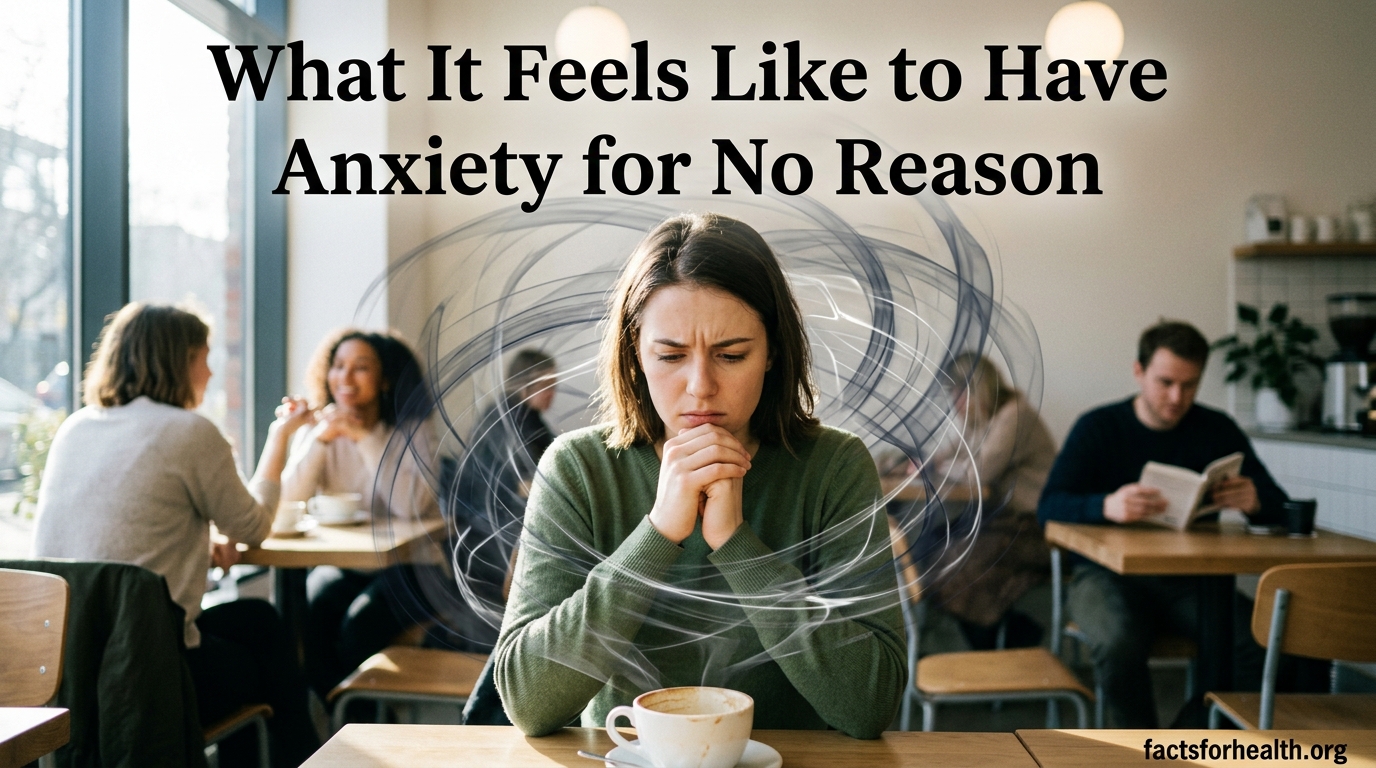
You are sitting at your desk, coffee in hand, scrolling through your morning emails. Nothing is wrong. No deadline is looming, no argument is brewing, no crisis is unfolding. And then it hits you. Your chest tightens. Your heart starts thudding faster than it should. A wave of dread washes over you for absolutely no identifiable reason. You scan your mind for the threat, but there is none. You are just anxious.
If you have ever experienced this, you already know what it feels like to have anxiety for no reason. It is one of the most confusing and isolating experiences a person can go through. Your body is screaming that something is wrong while your logical brain insists everything is fine. You might even wonder if you are losing your grip on reality.
You are not. You are not broken, you are not going crazy, and you are absolutely not alone. Millions of people experience this exact sensation every single day. Mental health professionals even have a name for it: free-floating anxiety. In this article, we are going to break down exactly what this experience feels like from the inside, why your brain and body do this, and what you can do about it.
Table of Contents
What Does Anxiety “For No Reason” Actually Feel Like?
Understanding what it feels like to have anxiety for no reason starts with recognizing the experience itself. The best way to describe it is through a scenario that many people with unexplained anxiety will instantly recognize.
Imagine waking up on a Saturday morning. You slept reasonably well. The weather is pleasant. You have no pressing obligations. You reach for your phone and feel a sudden, crushing sense of unease settle over you like a weighted blanket made of dread. Your stomach drops. Your mind starts racing through possibilities: Did I forget something? Is someone upset with me? Is something bad about to happen? You check your messages. Nothing. You scan your calendar. Clear. But the feeling does not leave.
That is what anxiety for no reason feels like. It is your body’s alarm system going off in an empty building.
The experience is fundamentally different from anxiety with a clear cause. When you are anxious about a job interview, a medical test, or a difficult conversation, you know what the threat is. You can name it, prepare for it, and eventually face it. That kind of anxiety makes sense. It has a beginning, a middle, and an end that you can see coming.
Unexplained anxiety is different. It arrives without an invitation, lingers without a purpose, and leaves without an explanation. Many people describe it as waves that come and go without any pattern or warning. One Reddit user described it perfectly: “I was just eating breakfast and suddenly I’m deep breathing and dizzy. Why?” Another said, “It’s like my body knows something my brain doesn’t.”
The frustration of not being able to pinpoint a cause is one of the hardest parts. When someone asks you what is wrong and you genuinely cannot answer, it can make you feel like you are imagining the whole thing. You are not. The physical sensations are real. The emotional distress is real. The only thing missing is a reason you can point to.
The Physical Sensations: What Anxiety Does to Your Body
When people ask what anxiety feels like physically, the honest answer is that it can feel like almost anything. Your nervous system connects to every organ and muscle in your body, which means anxiety can show up anywhere. Here is what that often looks like, broken down by area.
Your Chest and Heart
This is where most people feel anxiety first and most intensely. A racing heart is one of the most common physical symptoms, and it can be terrifying when it happens out of nowhere. Your heart might pound so hard you can feel it in your throat or ears. Chest tightness is another frequent complaint, often described as a squeezing sensation or a feeling that someone is sitting on your sternum.
Heart palpitations, where your heartbeat feels irregular, fluttery, or like it skips a beat, are also incredibly common. These sensations can send anxious people into a spiral of health anxiety, convinced something is wrong with their heart. In most cases, it is simply your nervous system flooding your body with adrenaline.
Your Stomach and Gut
The gut and the brain are deeply connected through what scientists call the gut-brain axis. This is why anxiety so often shows up as nausea, butterflies, cramping, or a sudden loss of appetite. Some people experience diarrhea or constipation during anxious episodes. Others describe a hollow, sinking feeling in their stomach, as if they are bracing for bad news that never comes.
Your Head and Throat
Dizziness and lightheadedness are frequent companions of unexplained anxiety. You might feel unsteady on your feet, foggy, or detached from your surroundings. Tension headaches are common too, especially a tight band of pressure wrapping around your forehead or the base of your skull.
Many people also describe a lump in their throat, medically known as globus sensation. It feels like something is stuck, making it uncomfortable to swallow. This is caused by muscle tension in the throat and is completely harmless, though it can be deeply unsettling when you do not know what it is.
Your Whole Body
Muscle tension is one of the most overlooked anxiety symptoms. Your shoulders might creep up toward your ears without you noticing. Your jaw might clench. Your hands might tremble slightly. You might feel restless, like you need to move but do not know where to go. Sweating, hot flashes, and cold chills can cycle through your body as your nervous system ramps up and winds down.
Fatigue is also a major factor. Anxiety is exhausting. Your body is burning energy as if you are preparing to run from a predator, even when you are just sitting on the couch. After a prolonged anxious episode, you might feel completely drained, even if you did nothing physically demanding.
Sleep disturbances tie everything together. Anxiety makes it harder to fall asleep, harder to stay asleep, and harder to wake up feeling rested. Poor sleep then lowers your threshold for anxiety the next day, creating a feedback loop that can be hard to break.
The Emotional and Mental Experience
The physical symptoms of unexplained anxiety are only half the story. The emotional and cognitive experience can be just as intense, and in some ways more difficult to manage.
Dread is the word many people use. It is not fear of something specific. It is a generalized sense that something terrible is about to happen, even though you cannot identify what that something might be. This feeling of impending doom can settle over you like a dark cloud, coloring everything you do with a sense of unease and apprehension.
Restlessness goes hand in hand with dread. You cannot settle. You cannot focus. You start a task, abandon it, start another, abandon that too. Your mind jumps from thought to thought like a startled bird, never landing long enough to accomplish anything. This racing mind can make simple decisions feel overwhelming and turn routine activities into endurance tests.
Intrusive thoughts are another common experience. These are unwanted ideas or images that pop into your head uninvited. They might be about your health, your relationships, your safety, or completely irrational worst-case scenarios. The harder you try to push them away, the louder they tend to get.
Irritability often surprises people. When your nervous system is constantly activated, your patience wears thin. Small annoyances feel like major offenses. You might snap at loved ones, feel frustrated by minor inconveniences, or find yourself on the verge of tears over something trivial. This can lead to guilt, which feeds the anxiety cycle.
Then there is the fear of going crazy. This is one of the most common and least talked about aspects of unexplained anxiety. When your body is reacting to a threat that does not exist, it is natural to question your own perception of reality. Many people silently worry that they are losing their minds, that something is fundamentally wrong with them, or that no one else experiences this.
None of those fears are true. Experiencing anxiety without a clear trigger does not mean you are unstable. It means your nervous system is doing exactly what it evolved to do, just with the sensitivity turned up too high.
Why Does This Happen? The Science Behind Free-Floating Anxiety
So why does your body launch a full stress response when there is nothing to stress about? The answer lies in a small, almond-shaped structure deep in your brain called the amygdala.
Your amygdala is your internal threat detector. Its job is to constantly scan your environment for danger and, when it detects a threat, trigger your fight-or-flight response. This response floods your body with adrenaline and cortisol, increases your heart rate, sharpens your senses, and prepares your muscles to either fight or run. It is an incredibly effective survival system that has kept humans alive for hundreds of thousands of years.
The problem is that the amygdala is not always accurate. It can misfire. It can react to subtle cues that your conscious mind does not even register: a faint smell that reminds your brain of a past stressful event, a slight change in your hormone levels, a dip in your blood sugar, or the accumulated weight of chronic stress that has been building for weeks or months. Any of these can set off the alarm.
This is what psychologists call free-floating anxiety. The anxiety is not actually baseless. There is a reason. It is just that the reason is happening at a level your conscious mind has not identified. Your amygdala detected something it interpreted as a threat and hit the panic button before your logical brain had a chance to weigh in.
Think of it like a smoke detector. A smoke detector is a good thing. It saves lives. But sometimes it goes off when you burn toast. The alarm is real, the sound is loud, and your body reacts. But there is no actual fire. Your nervous system is the same. It is working. It is just a little too sensitive and reacting to signals that are not actual emergencies.
This understanding matters because it reframes the experience. You are not malfunctioning. You are not broken. Your brain is doing its job with slightly miscalibrated settings. And like any system with miscalibrated settings, it can be adjusted.
Common Hidden Triggers You Might Be Missing
When people say they have anxiety for no reason, what they usually mean is they have anxiety for no reason they can identify. There is almost always a trigger. It is just hiding below the surface. Here are some of the most common hidden triggers that can spark unexplained anxiety.
Hormone fluctuations are one of the biggest culprits. Cortisol naturally peaks in the morning, which is why many people experience waking up anxious. Estrogen and progesterone shifts throughout the menstrual cycle can also dramatically affect anxiety levels. Thyroid hormones, when out of balance, can mimic or worsen anxiety symptoms.
Sleep deprivation is another major factor. Even one night of poor sleep can significantly increase your amygdala’s reactivity the next day. Chronic sleep debt builds this effect over time, making your nervous system increasingly hair-trigger.
Chronic stress accumulation is like filling a glass with water. Each individual stressor might seem small, but they add up. Eventually, one more drop, even a tiny one, causes the glass to overflow. You might feel fine all week and then suddenly experience a wave of anxiety on a quiet Sunday afternoon because your stress threshold has been crossed.
Caffeine deserves a special mention because it is one of the most overlooked anxiety triggers. Caffeine stimulates the central nervous system and can mimic anxiety symptoms: racing heart, jitters, restlessness. For some people, a single cup of coffee can trigger a full anxiety episode. Energy drinks are even worse due to their high caffeine and sugar content.
Blood sugar drops can also trigger anxiety. When you skip a meal or eat something high in sugar, your blood glucose spikes and then crashes. That crash releases stress hormones to help stabilize your energy, which can feel exactly like a wave of anxiety.
Subconscious trauma triggers are perhaps the most confusing. Your brain stores emotional memories that your conscious mind may not connect to the present moment. A tone of voice, a smell, a time of year, or even a physical sensation can activate a memory network associated with a past difficult experience. You feel the anxiety without knowing why because the trigger was processed by your emotional brain, not your thinking brain.
Physical health issues can also masquerade as anxiety. An overactive thyroid, vitamin deficiencies (especially B12 and vitamin D), iron deficiency, certain medications, and even dehydration can produce symptoms that feel identical to anxiety. This is why a check-up with your doctor is always a good idea if unexplained anxiety is a new or persistent problem.
How to Tell If This Is Normal or Something More
One of the most common questions people have is whether their anxiety is normal or whether it has crossed the line into something that needs attention. The answer is more nuanced than a simple yes or no.
Normal anxiety is something everyone experiences. It is the nervous feeling before a big presentation, the worry about a loved one who is sick, the apprehension before a major life change. This kind of anxiety is proportional to the situation, comes and goes with the circumstance, and does not significantly interfere with your daily life.
Free-floating anxiety, or unexplained anxiety, exists in a middle zone. It is not tied to a specific event, but it may not be severe enough or frequent enough to qualify as a disorder. Many people experience occasional waves of unexplained anxiety that pass on their own without significantly disrupting their lives.
Generalized anxiety disorder, or GAD, is when anxiety becomes a persistent, disruptive presence. Mental health professionals typically look for excessive worry and anxiety occurring more days than not for at least six months, difficulty controlling the worry, and at least three physical or cognitive symptoms such as restlessness, fatigue, difficulty concentrating, irritability, muscle tension, or sleep disturbance.
Here are some questions to help you assess where you fall on this spectrum. Is your anxiety present more days than not? Does it interfere with your work, relationships, or daily activities? Do you find it difficult to control or stop the worry? Has it been going on for months rather than days or weeks? Do you experience physical symptoms like muscle tension, sleep problems, or fatigue on a regular basis?
If you answered yes to several of these questions, it may be time to talk to a professional. That does not necessarily mean something is wrong with you. It means you deserve support, and there are effective treatments that can help.
It is also worth noting the anxiety-about-anxiety cycle. When you feel anxious for no reason, you might start feeling anxious about being anxious. You worry that it will happen again, which creates a state of hypervigilance that makes it more likely to happen again. Breaking this cycle often requires understanding it first.
High-functioning anxiety is another pattern worth mentioning. Some people appear perfectly fine on the outside, excelling at work, maintaining relationships, and handling responsibilities, while internally they are in a constant state of worry and unease. This form of anxiety can be especially insidious because others do not see the struggle, making it harder to get validation and support.
Practical Steps to Manage Unexplained Anxiety
Whether you experience occasional free-floating anxiety or deal with it daily, there are concrete steps you can take to manage it. These range from techniques you can use in the moment to habits that lower your baseline anxiety over time.
Immediate Techniques for Anxiety in the Moment
When a wave of anxiety hits, the goal is not to eliminate it completely but to bring your nervous system back from high alert. Box breathing is one of the most effective techniques. Inhale for four counts, hold for four counts, exhale for four counts, hold for four counts. Repeat this cycle four or five times. This pattern directly stimulates your vagus nerve, which signals your body to calm down.
The 5-4-3-2-1 grounding technique pulls your attention out of your racing mind and into your physical environment. Name five things you can see, four things you can physically feel, three things you can hear, two things you can smell, and one thing you can taste. This exercise engages your senses and interrupts the anxiety spiral.
Cold water on your face or wrists activates what is called the mammalian dive reflex, which slows your heart rate and redirects blood flow. Splashing cold water on your face or holding an ice cube can provide surprisingly fast relief during an intense anxiety spike.
Short-Term Strategies
Journaling helps you externalize the anxious thoughts instead of letting them circle in your head. Write down what you are feeling, when it started, and what was happening before it started. Over time, this can help you identify hidden patterns and triggers you might otherwise miss.
Physical movement is one of the fastest ways to metabolize stress hormones. You do not need to run a marathon. A brisk ten-minute walk, some gentle stretching, or even dancing to a favorite song can help your body process and release the adrenaline and cortisol that are fueling the anxiety.
Limiting caffeine can make a dramatic difference. If you are prone to unexplained anxiety, try cutting back on coffee, tea, energy drinks, and caffeinated sodas. Pay attention to whether your anxiety decreases. For some people, this single change is transformative.
Long-Term Habits
Mindfulness meditation trains your brain to observe anxious thoughts without getting swept away by them. Even ten minutes a day can gradually lower your baseline anxiety reactivity. Apps like Headspace, Calm, and Insight Timer offer guided sessions specifically designed for anxiety.
Progressive muscle relaxation involves systematically tensing and then releasing each muscle group in your body, from your toes to your head. This practice helps you become aware of where you hold tension and teaches your body what relaxation feels like. It is especially helpful before bed.
Sleep hygiene is non-negotiable for anxiety management. Aim for seven to nine hours of quality sleep. Keep a consistent sleep schedule, limit screens before bed, and create a calm bedtime routine. If anxiety is keeping you awake, try writing down your worries before lights out to get them out of your head and onto paper.
Social connection is one of the most powerful anxiety buffers we have. Talking to someone you trust about what you are experiencing can reduce the intensity and isolation of unexplained anxiety. You do not need them to fix it. You just need to feel heard and understood.
Perhaps the most important long-term strategy is acceptance. Fighting anxiety, trying to force it away, or getting angry at yourself for feeling it tends to make it stronger. Acceptance means acknowledging that the anxiety is present, that it is uncomfortable but not dangerous, and that it will pass. This stance, while counterintuitive, is one of the core principles of approaches like Acceptance and Commitment Therapy (ACT) and has strong research support.
When to Seek Professional Help
There is no magic threshold for when anxiety becomes serious enough to warrant professional help. A good general rule is this: if anxiety is affecting your quality of life, it is worth talking to someone about it. You do not need to wait until things become unbearable.
Specific signs that it may be time to reach out include anxiety that occurs most days and has lasted for several months, panic attacks that happen without warning, anxiety that is interfering with your sleep, work, relationships, or ability to enjoy life, physical symptoms that are causing you significant distress or health anxiety, and feelings of hopelessness, depression, or thoughts of self-harm.
Start with your primary care physician. They can rule out physical health issues that might be causing or worsening your symptoms, such as thyroid problems or vitamin deficiencies. They can also refer you to a mental health professional.
Therapists who specialize in cognitive behavioral therapy, or CBT, are particularly well-equipped to help with unexplained anxiety. CBT teaches you to identify and challenge the thought patterns that fuel anxiety and develop practical coping skills. It is one of the most thoroughly researched forms of therapy for anxiety, and it works.
In some cases, medication may be recommended. Selective serotonin reuptake inhibitors, or SSRIs, are commonly prescribed for anxiety disorders and can be highly effective, especially when combined with therapy. Other options include serotonin-norepinephrine reuptake inhibitors (SNRIs) and, for short-term use, anti-anxiety medications. A psychiatrist or your doctor can help you weigh the benefits and risks.
Seeking help is not a sign of weakness. It is the opposite. It takes courage to acknowledge that something is affecting you and to ask for support. The right treatment can be genuinely life-changing.
FAQs
How much anxiety is normal?
Some anxiety is completely normal and can even be helpful, like the nervous energy before a big presentation. Occasional worry about real stressors is part of being human. However, anxiety becomes a concern when it is constant, feels uncontrollable, or interferes with your daily activities, sleep, work, or relationships. If your anxiety has been present more days than not for several months, it may be time to seek professional support.
How to calm down anxiety?
To calm anxiety in the moment, try box breathing: inhale for 4 counts, hold for 4, exhale for 4, hold for 4, and repeat. Grounding exercises like naming 5 things you see, 4 you feel, 3 you hear, 2 you smell, and 1 you taste can pull you out of an anxiety spiral. Cold water on your face activates a calming reflex. Brief physical activity like a brisk walk helps metabolize stress hormones. Accepting the feeling rather than fighting it can also reduce its intensity.
Why does it feel like I have anxiety for no reason?
Anxiety that seems to come from nowhere is usually triggered by factors your conscious mind has not registered. Your amygdala, the brain’s threat detector, can react to subtle cues like hormone shifts, accumulated stress, a faint memory trigger, low blood sugar, or a poor night of sleep. It activates the fight-or-flight response even when there is no actual danger. This false alarm is common and means your nervous system is working, just with the sensitivity turned up too high.
How do you overcome anxiety?
Overcoming anxiety involves both immediate and long-term strategies. In the moment, use deep breathing and grounding techniques. Over time, identify your triggers through journaling, maintain good sleep and exercise habits, limit caffeine, and practice mindfulness meditation. If anxiety persists or interferes with your life, evidence-based treatments like cognitive behavioral therapy (CBT) and, when appropriate, medication can be highly effective. The goal is not to eliminate anxiety entirely but to manage it so it does not control your life.
If you have read this far, you already know what it feels like to have anxiety for no reason. You know the sudden chest tightness, the wave of dread, the racing mind, and the frustration of not being able to explain what is happening to you. You also know now that you are not imagining it, you are not alone, and there is nothing fundamentally wrong with you.
Your brain evolved an incredibly sophisticated system to keep you safe. Sometimes that system misfires, sounding the alarm when there is no real fire. That is uncomfortable and sometimes scary, but it is also understandable, explainable, and manageable. The anxiety you feel is real. The reason it happens is real, even if you cannot see it. And the tools to manage it are real too.
Start where you are. Try one breathing technique the next time a wave hits. Pay attention to your caffeine intake and sleep quality. Consider journaling to uncover hidden patterns. And if this experience is affecting your life in ways that feel too big to handle alone, reach out to a professional. You deserve support.
Anxiety for no reason does not have to define your days. With understanding, practice, and the right support, it becomes something you can live with rather than something that controls you. You are not broken. You are not going crazy. You are a person whose alarm system is a little too sensitive, and that is something you can work with.