
You notice a strange sensation in your chest at 2:47 in the afternoon. It is probably nothing. But your mind does not stop there. Within seconds, you are mentally cataloging every ache, twitch, and heartbeat you have felt this week. By 3:15, you have opened a new browser tab and typed your symptoms into a search engine. By 3:40, you are convinced something is seriously wrong.
If this sounds familiar, you are not alone. Health anxiety affects an estimated 4 to 6 percent of adults, and some research suggests the true number may be closer to 10 percent when undiagnosed cases are included. Understanding what health anxiety feels like and how it spirals is the first step toward breaking the cycle.
I have spent years researching anxiety disorders, talking with mental health professionals, and listening to hundreds of people share their personal experiences in support forums. What I have learned is that health anxiety is not just “worrying too much.” It is a complex psychological pattern with real physical symptoms, a predictable escalation pattern, and proven strategies for recovery.
This guide walks you through exactly what the spiral feels like, why it happens, and how to stop it.
Table of Contents
What Health Anxiety Feels Like: The First Moments
Health anxiety begins with a trigger. That trigger can be a physical sensation, a news story, a conversation about someone who got sick, or even a random thought that pops into your head. The sensation itself is often completely normal. A skipped heartbeat, a muscle twitch, a mild headache, a slightly upset stomach. These are things every human body experiences daily.
But for someone with health anxiety, that normal bodily noise is immediately flagged as dangerous. The first feeling is usually a jolt of adrenaline, a sudden tightness in the chest, or a lurch in the stomach. Your attention narrows. You become acutely aware of that one spot in your body where the sensation originated.
Then the scanning begins. You start checking your pulse, monitoring your breathing, pressing on the area to see if it hurts, and mentally replaying every twinge you have felt recently. This is called hypervigilance, and it is one of the hallmark signs that what you are experiencing has crossed the line from normal concern into health anxiety.
What health anxiety feels like in those early moments is a combination of hyper-awareness, a rising sense of dread, and an urgent need to figure out what is happening inside your body. The rational part of your brain knows the odds are low. But the anxious part has already decided the worst case is the most likely case.
Normal Worry vs. Health Anxiety vs. Illness Anxiety Disorder
People often confuse normal health worry with health anxiety, and even mental health professionals sometimes use overlapping terms. Here is how to tell them apart.
Normal health concern is temporary and proportional. You feel a symptom, you pay attention for a day or two, and when it resolves or a doctor says you are fine, the worry fades. You move on with your life.
Health anxiety is persistent and disproportionate. The worry lasts weeks or months, continues after negative test results, and interferes with your daily activities. You might spend hours each day thinking about your health, checking your body, or researching symptoms.
Illness anxiety disorder is the formal DSM-5 diagnosis. It refers specifically to a preoccupation with having or acquiring a serious illness, with minimal or no actual somatic symptoms. Somatic symptom disorder, by contrast, involves significant distress about actual physical symptoms that may or may not have a clear medical explanation.
The table below breaks down the key differences:
| Characteristic | Normal Health Worry | Health Anxiety | Illness Anxiety Disorder (DSM-5) |
|---|---|---|---|
| Duration | Days to a week | Weeks to months | 6 months or more |
| Response to Negative Tests | Relief, worry ends | Temporary relief, worry returns | Persistent preoccupation despite reassurance |
| Impact on Daily Life | Minimal | Moderate to significant | Significant impairment |
| Body Monitoring | Occasional | Frequent checking and scanning | Constant preoccupation with health status |
| Reassurance Seeking | Rarely needed | Frequent doctor visits, Googling | Excessive or avoidance of doctors entirely |
How the Health Anxiety Spiral Works: Step by Step
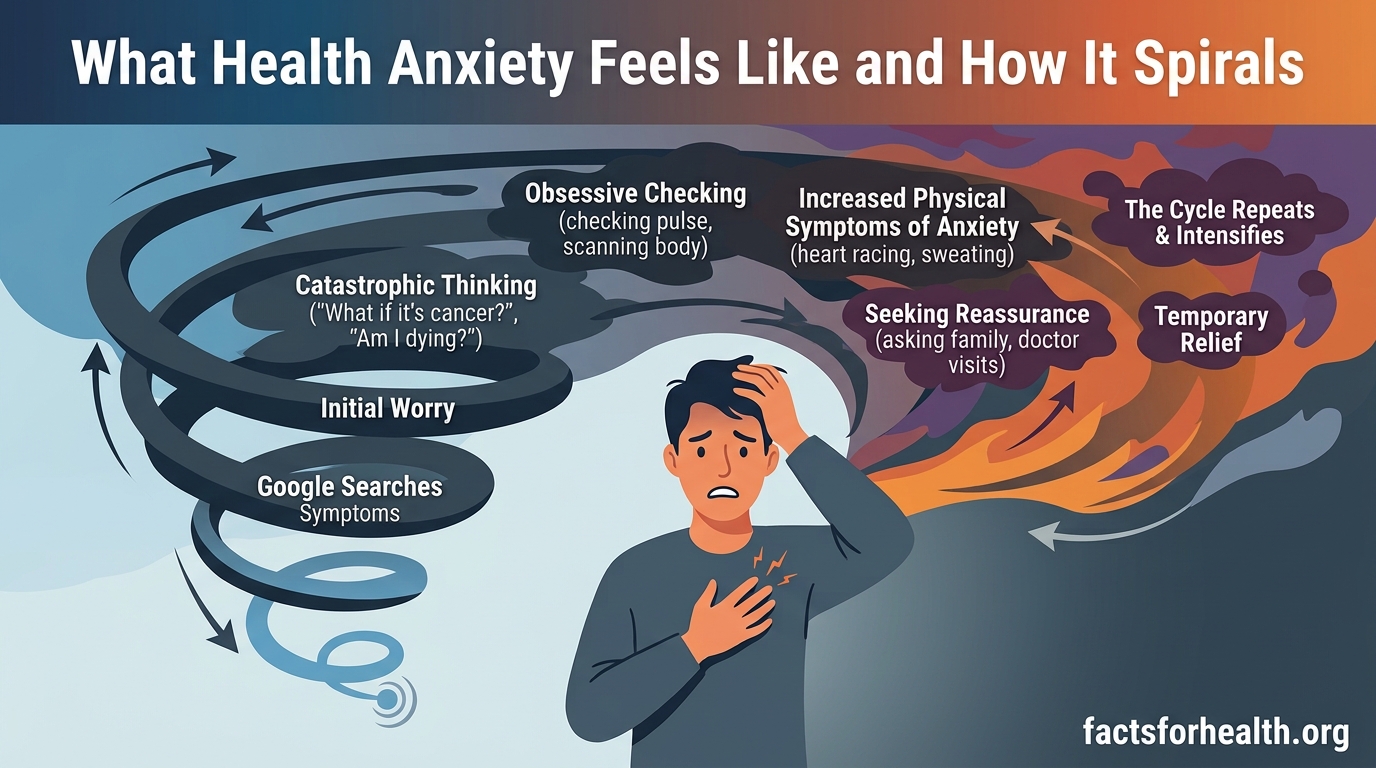
The health anxiety spiral follows a predictable pattern. Understanding each stage helps you recognize when you are being pulled in and gives you specific points where you can interrupt the cycle.
Step 1: The Trigger. Something happens. You feel a physical sensation, notice a mark on your skin, hear about someone’s illness, or even just have a random intrusive thought about your health. The trigger itself is usually mundane and harmless.
Step 2: Catastrophic Interpretation. Your brain immediately jumps to the worst possible explanation. That headache is not tension or dehydration, it is a brain tumor. That chest tightness is not stress, it is a heart attack. This catastrophic thinking feels involuntary and automatic.
Step 3: The Fight-or-Flight Response. Your amygdala, the brain’s alarm system, detects what it thinks is a mortal threat. It floods your body with adrenaline and cortisol. Your heart rate increases, your breathing becomes shallow, your muscles tense up, and your digestion slows. These are real, measurable physical changes.
Step 4: Symptom Amplification. Now your body is producing genuine physical symptoms from the anxiety itself. Your racing heart, chest tightness, dizziness, and nausea are caused by stress hormones, not by a disease. But your anxious brain interprets these new symptoms as further evidence that something is seriously wrong.
Step 5: Reassurance Seeking. You Google your symptoms, ask a family member if you look okay, check your pulse, or schedule a doctor’s appointment. Any relief you get is temporary, usually lasting hours to days before the cycle restarts.
Step 6: Escalation and Reinforcement. Each time the cycle repeats, it becomes stronger and faster. The brain learns that health threats are everywhere, and the hypervigilance increases. Avoidance behaviors grow, and daily life shrinks. This is the self-reinforcing vicious cycle of health anxiety.
Physical Symptoms of the Health Anxiety Spiral
One of the most common questions people ask is whether health anxiety can cause real physical symptoms. The answer is an unequivocal yes. The physical symptoms of health anxiety are not imaginary. They are the direct result of your body’s stress response system being activated repeatedly and intensely.
When adrenaline and cortisol flood your system, your body responds with real, measurable changes. Here are the physical symptoms most commonly reported by people experiencing health anxiety spirals:
- Racing or pounding heart, often with a heart rate above 100 beats per minute
- Chest tightness, pressure, or sharp pains caused by muscle tension
- Shortness of breath or a feeling of being unable to take a full breath
- Dizziness, lightheadedness, or feeling faint
- Nausea, stomach pain, diarrhea, or loss of appetite
- Muscle tension, especially in the neck, shoulders, and jaw
- Headaches caused by tension and prolonged stress
- Trembling, shaking hands, or a feeling of internal vibration
- Sweating, hot flashes, or chills
- Numbness or tingling in the hands, feet, or face
- Fatigue and brain fog from chronic stress and poor sleep
- Insomnia or waking up in the middle of the night with racing thoughts
These symptoms are genuine. They are not “all in your head” in the dismissive sense. They are in your nervous system, which is intimately connected to every part of your body. The key distinction is that the source is anxiety, not a disease, and the treatment is anxiety management, not medical intervention.
Cognitive Symptoms: How Your Mind Gets Hijacked
Health anxiety changes the way you think. Specific cognitive distortions drive the spiral and keep it going even when the rational part of your brain knows better.
Catastrophic thinking is the most prominent. Your mind automatically generates worst-case scenarios and treats them as highly probable. A bruise becomes leukemia. A headache becomes a brain tumor. The jump from minor symptom to fatal diagnosis happens in seconds.
Rumination keeps the spiral spinning. You replay the same worried thoughts over and over, analyzing every detail, looking for certainty that does not exist. Rumination feels productive because you are “thinking it through,” but it actually deepens the anxiety with each cycle.
All-or-nothing thinking eliminates gray areas. Either you are perfectly healthy or you are dying. Either the test was comprehensive or it missed something. There is no room for the far more likely middle ground.
Mental filtering means you focus exclusively on information that confirms your health fears while ignoring evidence that you are fine. A clean blood test is forgotten by evening, but a slightly elevated reading from two years ago is remembered in vivid detail.
Intolerance of uncertainty is the engine driving all of it. Health anxiety is fundamentally about needing to know with 100 percent certainty that you are healthy, which is impossible. No test can rule out every condition, and this gap of uncertainty is where the anxiety lives and grows.
Emotional Symptoms: The Hidden Toll
The emotional experience of health anxiety is often overlooked because the physical and cognitive symptoms are so loud. But the emotional toll is significant and deserves attention.
Fear is the dominant emotion, but it is a specific kind of fear. It is the dread of the unknown, the terror of loss of control, and the anticipation of suffering. This fear does not come in waves and pass. It sits in the background constantly, coloring every experience.
Shame is pervasive. Many people with health anxiety feel embarrassed about their fears, especially after multiple doctor visits with normal results. They worry that doctors, friends, and family see them as dramatic or attention-seeking. This shame often prevents people from seeking the mental health treatment they need.
Irritability and mood swings are common when your nervous system is chronically activated. You may snap at loved ones, lose patience quickly, or feel overwhelmed by minor inconveniences. This is your depleted nervous system, not your personality.
Isolation grows gradually. You avoid activities because you fear something might happen. You avoid social situations because you do not want to explain why you are checking your pulse or seem distracted. You withdraw from people who dismiss your concerns with comments like “it is just anxiety.”
Grief is also present. There is a mourning of the person you were before health anxiety took over, the activities you used to enjoy, and the peace of mind you used to take for granted.
The Neuroscience Behind the Spiral
Understanding the brain science behind health anxiety can be validating and de-stigmatizing. What you are experiencing is not a character flaw or a weakness. It is a neurological pattern that can be understood and changed.
The amygdala is a small, almond-shaped structure deep in the brain that serves as your threat detection system. In health anxiety, the amygdala is hyperactive, meaning it fires more easily and more intensely than it should. It is like a smoke alarm that goes off every time you make toast. The alarm is real, but the response is disproportionate to the actual danger.
The prefrontal cortex is the brain’s reasoning center, responsible for logical analysis, perspective-taking, and impulse control. In a healthy response, the prefrontal cortex evaluates the amygdala’s alarm and either confirms or overrides it. In health anxiety, the connection between the prefrontal cortex and the amygdala is weakened, so the rational brain has trouble putting the brakes on the fear response.
When the amygdala fires, it triggers a cascade of stress hormones. Adrenaline hits first, within seconds, causing your heart to race, your breathing to quicken, and your muscles to tense. Cortisol follows, sustaining the stress response over hours. This hormonal flood produces the physical symptoms that health anxiety then misinterprets as illness.
The parasympathetic nervous system is supposed to counterbalance this response, calming the body back down after a threat has passed. In chronic health anxiety, this calming system becomes less efficient. The body gets stuck in a low-grade fight-or-flight state, making new spirals easier to trigger and harder to escape.
The encouraging news is that the brain is neuroplastic, meaning it can rewire itself. Every time you respond to a trigger with a new, healthier behavior instead of the old spiral, you strengthen the connection between the prefrontal cortex and the amygdala. Over time, this makes spirals less frequent, less intense, and shorter in duration.
Cyberchondria: When Dr. Google Makes It Worse
If there is one behavior that health anxiety professionals and people with lived experience agree is the most damaging, it is searching for health information online. The phenomenon even has a name: cyberchondria.
The logic behind symptom Googling makes sense in the moment. You want information, reassurance, and certainty. But the structure of the internet makes this approach almost guaranteed to worsen your anxiety. Search engines are designed to show you the most engaging results, and the most engaging health content is almost always the scariest. A search for “chest pain” returns heart attack articles before it returns anxiety or acid reflux results.
Symptom checkers are even worse. They use broad algorithms that list dozens of possible conditions for any symptom, ranging from common and benign to rare and fatal. The rare and fatal options are what your anxious brain latches onto.
The reassurance loop works like this. You feel anxious about a symptom, so you search online. You find alarming content, your anxiety spikes, and you search more trying to find reassuring content. Eventually you find something calming, your anxiety drops temporarily, and the cycle resets a few hours or days later. Each search reinforces the neural pathway that says “Googling helps,” even though the overall trajectory is worsening anxiety.
In forum after forum, the advice from people who have recovered is the same: stop Googling your symptoms. Set a rule, use website blockers if needed, and redirect that energy toward anxiety management techniques. It feels impossible at first, but people who have broken this habit consistently report it as one of the single most impactful changes they made.
A Day in the Life: How the Spiral Unfolds Hour by Hour
To make this concrete, here is what a typical day looks like for someone caught in a health anxiety spiral. This narrative is drawn from common experiences shared across support forums and clinical case studies.
7:00 AM. You wake up and immediately do a mental body scan. Your heart rate seems fast. You check your pulse on your phone and see 88 beats per minute. That is within the normal range, but yesterday morning it was 72. Why is it higher today? The first seed of worry is planted.
9:30 AM. At work, you feel a slight pressure in your chest. You try to focus on your tasks but keep returning to the sensation. You discreetly search “chest pressure causes” on your phone. The first result mentions coronary artery disease. Your heart rate jumps to 110.
12:00 PM. You skip lunch because your appetite is gone. Your stomach feels off, which you interpret as another symptom rather than a consequence of the adrenaline circulating in your system. You feel tired and foggy, which also worries you.
3:00 PM. You have checked your pulse 15 times today. Each time, you feel a wave of fear followed by brief relief that the number is “normal,” followed by a new worry about why it fluctuates so much. You text a friend asking if heart rate normally changes throughout the day. The reassurance lasts about 20 minutes.
7:00 PM. At home, you are exhausted from the day of worry. You cannot relax. You feel a twitch in your leg and wonder about neurological conditions. You spend an hour researching before your partner asks you to stop. You feel ashamed and defensive.
11:30 PM. You cannot sleep. Your mind races through every symptom you noticed today. You worry that if you fall asleep, something might happen and no one would know. You finally drift off around 1 AM, already dreading tomorrow’s body scan.
This is what health anxiety feels like day after day. It is exhausting, consuming, and deeply isolating. But it is also a pattern that can be interrupted and changed.
How to Break the Health Anxiety Spiral
There is no single technique that instantly stops health anxiety. Recovery comes from a combination of strategies practiced consistently over time. Here are the eight most effective, evidence-based approaches.
1. Cognitive Behavioral Therapy (CBT). CBT is the most researched and recommended treatment for health anxiety. It teaches you to identify catastrophic thoughts, examine the evidence for and against them, and replace them with more balanced interpretations. Working with a CBT therapist who specializes in health anxiety produces significant improvement in the majority of cases.
2. Exposure and Response Prevention (ERP). ERP involves gradually exposing yourself to health-related triggers while resisting the urge to seek reassurance. This might mean reading about an illness without Googling your symptoms, or feeling a sensation without checking your pulse. Over time, your brain learns that the trigger is not dangerous and the compulsion is not necessary.
3. The 5-4-3-2-1 Grounding Technique. When you feel a spiral starting, redirect your attention to your five senses. Name five things you can see, four things you can hear, three things you can feel, two things you can smell, and one thing you can taste. This pulls your brain out of the internal monitoring loop and into the present moment.
4. 4-7-8 Diaphragmatic Breathing. Breathe in through your nose for four counts, hold for seven counts, and exhale through your mouth for eight counts. Repeat four times. This pattern activates the parasympathetic nervous system, directly counteracting the fight-or-flight response and slowing your heart rate within minutes.
5. Radical Acceptance. Instead of fighting the uncertainty, practice accepting it. This does not mean giving up or resigning yourself to being sick. It means acknowledging that absolute certainty about your health is impossible for anyone, and that learning to live with that uncertainty is the path to freedom from the spiral.
6. Scheduled Worry Time. Designate a specific 15-minute window each day, ideally not before bed, for health worries. When anxious thoughts arise outside that window, note them and redirect your attention, knowing you will address them during your scheduled time. This contains the anxiety rather than letting it spread across your entire day.
7. Mindfulness and Progressive Muscle Relaxation. Regular mindfulness meditation retrains your brain to observe sensations without catastrophizing them. Progressive muscle relaxation (PMR) systematically tense and release muscle groups, reducing the physical tension that generates many of the symptoms health anxiety latches onto.
8. Stop Reassurance Seeking. This is the hardest but one of the most important steps. Stop Googling symptoms, stop checking your pulse, stop asking family members for reassurance, and stop scheduling unnecessary doctor visits. Each act of reassurance reinforces the anxiety cycle. The discomfort of stopping is temporary, but the long-term relief is substantial.
Supporting Someone With Health Anxiety
If someone you love struggles with health anxiety, your response matters enormously. The wrong approach, even with the best intentions, can deepen the spiral.
Do not dismiss their fears with phrases like “it is all in your head” or “you are fine.” Their physical symptoms are real, and their fear is genuine. Instead, validate the experience: “I can see this is really scary for you.” Then gently redirect toward anxiety management rather than providing medical reassurance.
Avoid participating in body checking or extensive symptom discussions. If they ask you to check a mole or take their pulse, you can say, “I want to support you, but I think checking is making things worse. Can we try a grounding exercise together instead?”
Encourage them to seek professional help, specifically from a therapist trained in CBT or ERP for health anxiety. Offer to help them find a provider or make the first appointment. Many people with health anxiety feel ashamed about seeking mental health treatment, so your support in taking that step can be life-changing.
When to Seek Professional Help
Health anxiety is highly treatable, but many people wait years before seeking help. If you recognize yourself in this article, consider these five signs that it is time to talk to a professional:
- Your health worries consume more than an hour per day and interfere with work, relationships, or sleep
- You have visited multiple doctors for the same concern with no medical explanation, but the worry persists
- You avoid medical appointments entirely because you are afraid of bad news
- Your daily life has shrunk due to avoidance of activities you fear might trigger symptoms
- Self-help strategies have not been enough to reduce the frequency or intensity of the spirals
A licensed therapist who specializes in anxiety disorders can provide the structured, evidence-based treatment that makes recovery possible. CBT for health anxiety typically lasts 12 to 20 sessions, and many people see significant improvement within the first few months.
FAQs
Can health anxiety cause real symptoms?
Yes. Health anxiety triggers the body’s fight-or-flight response, which releases adrenaline and cortisol. These stress hormones produce genuine physical symptoms including racing heart, chest tightness, dizziness, nausea, muscle tension, headaches, and insomnia. The symptoms are real and measurable, but their source is anxiety rather than a medical condition.
What is the vicious cycle of health anxiety?
The vicious cycle of health anxiety follows a predictable pattern: a trigger (a physical sensation or thought) leads to catastrophic interpretation, which activates the fight-or-flight response, which produces real physical symptoms, which are misinterpreted as evidence of illness, which generates more anxiety and restarts the cycle. Each repetition makes the spiral faster and more intense.
What does an anxiety spiral feel like?
An anxiety spiral feels like a rapid escalation of fear and physical symptoms. It typically starts with a single worried thought or bodily sensation, then your heart begins racing, your chest tightens, your thoughts speed up and become catastrophic, and you feel an urgent need to check, research, or seek reassurance. The experience can feel overwhelming and out of control, but it always peaks and passes.
Can health anxiety be overcome?
Yes. Health anxiety is one of the most treatable anxiety disorders. Cognitive behavioral therapy (CBT) has the strongest evidence base, with studies showing significant improvement in the majority of patients. Exposure and response prevention (ERP), mindfulness practices, and lifestyle changes like stopping symptom Googling are also highly effective. Many people report recovering 90 percent or more of their quality of life with consistent treatment.
Conclusion
Understanding what health anxiety feels like and how it spirals is the foundation of recovery. The spiral is real, the symptoms are real, and the suffering is genuine. But the pattern is also predictable, understandable, and most importantly, breakable.
The key takeaways are simple but not easy. Recognize the spiral stages so you can catch them early. Understand that anxiety produces real physical symptoms so you stop misinterpreting them as illness. Stop the reassurance-seeking behaviors, especially symptom Googling, that feed the cycle. And seek evidence-based treatment, particularly CBT or ERP, from a professional who understands health anxiety specifically.
You are not broken, you are not dramatic, and you are not alone. Health anxiety affects millions of people, and countless others have walked this path before you and found their way to the other side. The spiral will try to convince you that this time is different, that your symptoms really are something serious. That is what the spiral does. The path forward is learning to respond differently each time it tries.