
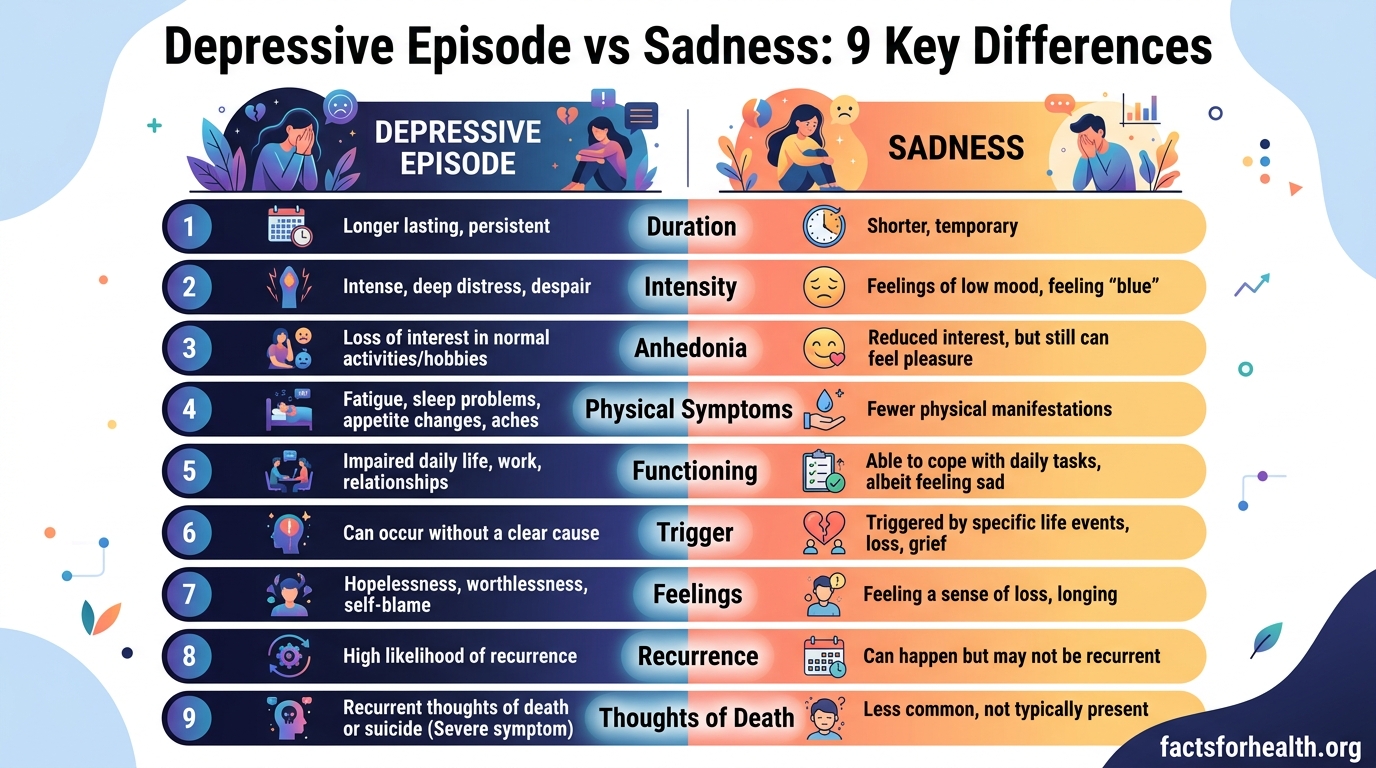
Understanding what a depressive episode feels like compared to feeling sad can help you or someone you love recognize when ordinary emotions have crossed into territory that needs professional support. The two experiences are often confused because they share surface-level similarities, but they are fundamentally different in duration, intensity, cause, and impact on daily life.
Sadness is a normal, temporary human emotion that arises in response to a specific event and gradually fades on its own. A depressive episode is a sustained period of at least two weeks marked by persistent emptiness, numbness, or hopelessness that interferes with your ability to function at work, in relationships, and in self-care. Knowing the difference matters because sadness resolves naturally while a depressive episode typically requires treatment to improve.
In this article, our team breaks down exactly what each experience feels like from the inside, offers a side-by-side comparison across seven key dimensions, and provides clear guidance on when and how to seek help. Whether you are trying to understand your own experience or support someone you care about, you will find practical, compassionate information here.
If you are in crisis right now, please call or text 988 to reach the Suicide and Crisis Lifeline, available 24/7. You can also text HOME to 741741 to connect with the Crisis Text Line.
Table of Contents
Quick Summary: The Bottom Line
Here is the shortest way to understand the difference between what a depressive episode feels like compared to feeling sad: sadness is a wave that comes and goes, while a depressive episode is the ocean itself, reshaping everything around you for weeks or months at a time.
The five most important distinctions to remember are:
- Duration: Sadness typically lasts hours to a few days. A depressive episode persists for at least two weeks and often much longer without treatment.
- Trigger: Sadness usually has a clear cause, such as a disappointment, loss, or rejection. A depressive episode may have no identifiable trigger at all.
- Emotional quality: Sadness feels like a recognizable emotion you can name and sit with. A depressive episode often feels like numbness, emptiness, or the total absence of feeling rather than sadness itself.
- Daily functioning: Sadness may dampen your mood but you can still work, socialize, and care for yourself. A depressive episode significantly disrupts your ability to perform basic daily tasks.
- Resolution: Sadness lifts naturally with time, distraction, or connection. A depressive episode typically requires professional treatment to resolve.
If those quick distinctions resonate with what you are experiencing, the sections below go into much more depth on each point.
What Normal Sadness Actually Feels Like
Sadness is one of the core human emotions, and it serves an important purpose. It signals that something has happened that matters to you, and it often draws other people toward you in support. Everyone feels sad sometimes, and that is completely healthy.
When you feel sad, the experience usually has a recognizable trigger. You lost a job, went through a breakup, received disappointing news, or had a difficult conversation. You can point to what caused the feeling, even if the cause is complex.
The emotional quality of sadness is something most people can clearly identify. You feel a heaviness in your chest, your eyes may water, and you might cry. But even in the middle of sadness, you can usually still experience moments of laughter, connection, or pleasure. A funny video still makes you smile. A hug from a friend still feels warm.
Sadness also comes in waves. You might feel overwhelmed for an hour, then find that the intensity drops and you can engage with your day again. The feeling rises and falls rather than staying at a constant, unbroken level.
Most importantly, sadness is self-limiting. Within a few hours or days, the intensity fades. You may still feel a lingering sense of the emotion, but it no longer dominates your experience. Time, sleep, social connection, and engaging in activities you enjoy help sadness resolve naturally without any clinical intervention.
Physical sensations during sadness are real but temporary. You might feel tired, have a low appetite for a meal or two, or struggle to focus for an afternoon. These symptoms do not persist week after week, and they do not prevent you from maintaining your responsibilities.
What a Depressive Episode Feels Like from the Inside
This is the section most resources skip, and it is exactly what many people are searching for when they ask what a depressive episode feels like compared to feeling sad. Let us describe the subjective experience in concrete, sensory terms.
Numbness Instead of Sadness
One of the most disorienting aspects of a depressive episode is that it often does not feel like sadness at all. Many people describe a profound numbness or emotional flatness. Colors seem muted, food loses its taste, and activities that once brought joy feel like going through the motions. As one person in a mental health forum described it, sadness is something you feel, while depression is the absence of feeling, and the emptiness is often harder to bear than any emotion would be.
This numbness is clinically known as anhedonia, the loss of ability to experience pleasure. It is one of the hallmark symptoms of major depressive disorder, and it is a key reason depression feels so different from ordinary sadness.
The Physical Weight
People in a depressive episode frequently describe a physical sensation of heaviness. Limbs feel leaden, moving feels effortful, and even basic tasks like showering, brushing teeth, or answering a text message can feel like climbing a mountain. This is not laziness; it is the genuine physical fatigue and low energy that depression produces in the body.
Brain fog is another common experience. Concentration becomes difficult, decisions feel impossible, and you may find yourself reading the same paragraph five times without absorbing it. Memory can feel unreliable, and your thinking may slow down noticeably.
The Distortion of Time and Self
During a depressive episode, days can blur together. Without the rhythm of normal engagement and pleasure, time loses its texture. Many people describe feeling like a spectator in their own life, watching themselves go through routines without any real connection to what is happening.
Depression also distorts your sense of self. You may feel like your old self is gone, replaced by someone you do not recognize. Thoughts of worthlessness and guilt become pervasive, and the depression itself can convince you that you have always felt this way and always will. This is a symptom of the illness, not a reflection of reality.
The Persistence
Perhaps the most defining feature is that none of this goes away on its own. Unlike sadness, which lifts after a few days, a depressive episode maintains its grip week after week. You wake up feeling the same way you did yesterday, and the knowledge that tomorrow will likely be the same can deepen the hopelessness.
This persistence is what separates a depressive episode from a bad day or even a bad week. The clinical threshold is two weeks of sustained symptoms, but many episodes last months without treatment.
When Depression Looks Like Anger
It is worth noting that depression does not always look like sadness or numbness on the outside. For many people, especially men and teenagers, depression presents primarily as irritability, anger, or a short temper. If you find yourself snapping at loved ones, feeling constantly on edge, or experiencing rage that seems disproportionate to the situation, depression may be the underlying cause.
This presentation is frequently missed because it does not match the stereotype of depression as visible sadness. Recognizing irritability as a potential depressive symptom is important for getting the right help.
Side-by-Side Comparison: Sadness vs Depressive Episode
To make the differences even clearer, here is a direct comparison across seven dimensions. This framework can help you assess your own experience or describe it to a healthcare provider.
- Duration: Sadness lasts hours to a few days. A depressive episode lasts at least two weeks and often continues for months without treatment.
- Trigger: Sadness has a specific, identifiable cause such as a loss or disappointment. A depressive episode may arise without any clear trigger, or the emotional response is vastly disproportionate to the event.
- Emotional quality: Sadness is a recognizable feeling you can name and process. A depressive episode often feels like numbness, emptiness, or emotional flatness rather than sadness.
- Pleasure and interest: During sadness, you can still enjoy activities, laugh, and feel moments of connection. During a depressive episode, anhedonia robs you of the ability to feel pleasure from things you normally love.
- Physical symptoms: Sadness may cause temporary fatigue or appetite changes. A depressive episode produces persistent sleep disruption, significant appetite or weight changes, chronic fatigue, body aches, and cognitive difficulty.
- Daily functioning: Sadness may lower your mood but you can still work, socialize, and care for yourself. A depressive episode significantly impairs your ability to function in one or more major areas of life.
- Self-perception: Sadness does not usually attack your sense of self-worth. A depressive episode brings pervasive feelings of worthlessness, guilt, and hopelessness that feel absolute and unchangeable.
If you find yourself identifying with the depressive episode side of this comparison across multiple dimensions, that is a strong signal to reach out to a healthcare professional for an evaluation.
The Gray Zone: When Sadness Crosses Into Depression
One of the most common questions people ask is how to tell when normal sadness has crossed the line into a depressive episode. The transition is not always sudden or obvious, which is why so many people wonder whether they are just going through a hard time or experiencing something clinical.
Several warning signs suggest that sadness may be evolving into depression:
- Your low mood has persisted for more than two weeks without significant improvement.
- You have lost interest in activities that previously brought you joy, and this loss of interest is sustained rather than momentary.
- Your sleep has changed significantly, either through insomnia or sleeping far more than usual.
- Your appetite or weight has shifted noticeably without any intentional effort to change them.
- You are having difficulty concentrating, making decisions, or remembering things at work or school.
- You feel worthless or guilty in ways that seem disproportionate to your actual circumstances.
- You have had any thoughts of self-harm or that you would be better off dead, even if you have no intention of acting on them.
The two-week threshold comes directly from the diagnostic criteria in the DSM-5. If you have experienced five or more of these symptoms for most of the day, nearly every day, for at least two weeks, you may be experiencing a major depressive episode.
It is important to note that you do not need to wait a full two weeks to reach out for support. If you are concerned about your mental health at any point, contacting a therapist or your primary care provider is entirely appropriate.
One subtle early indicator that people frequently miss is a growing sense of detachment from the people around you. You might still attend social events but feel disconnected, or you might start declining invitations without fully understanding why. This social withdrawal often precedes the more recognizable symptoms of depression.
Sadness vs Depression vs Grief: The Three-Way Comparison
Many people who are trying to understand their emotional state also struggle to distinguish depression from grief. The confusion is understandable because grief and depression can share symptoms like sadness, sleep disruption, fatigue, and difficulty concentrating. But they are different experiences with different trajectories.
Grief is the natural response to loss, most commonly the death of someone you love but also the loss of a relationship, a job, or a major life change. Like sadness, grief has an identifiable cause. But grief is more complex than ordinary sadness because it involves a whole process of adjusting to life without what was lost.
One key difference is that grief comes in waves. You may feel intense pain and then experience moments of genuine laughter when remembering something fond about the person or situation you lost. There is movement and variation within grief. Depression, by contrast, tends to be more constant and flat, with fewer natural peaks of positive emotion.
During grief, your self-esteem typically remains intact. You feel pain about the loss, not necessarily about yourself. Depression often attacks your core sense of self-worth, producing feelings of worthlessness and self-loathing that go beyond the specific loss.
However, grief can evolve into depression. If your grief becomes more intense over time rather than gradually lessening, if it is accompanied by pervasive feelings of worthlessness, or if you experience thoughts of self-harm, what started as normal bereavement may have developed into a depressive episode. This is not a failure of grieving; it is a recognized complication that responds well to professional treatment.
If you are unsure whether you are experiencing grief, depression, or both simultaneously, a mental health professional can help you sort through the distinction and recommend appropriate support.
Hidden Signs of Depression That Do Not Look Like Sadness
One of the most dangerous misconceptions about depression is that it always looks visibly sad. In reality, depression wears many disguises, and some of them do not resemble sadness at all. Recognizing these hidden presentations can be the difference between getting help and suffering in silence.
Irritability and Anger
As mentioned earlier, depression frequently manifests as irritability rather than sadness, particularly in men, teenagers, and older adults. You might feel constantly frustrated, snap at people over small things, or experience a simmering anger you cannot explain. Because irritability does not match the popular image of depression, this presentation often goes unrecognized by both the individual and those around them.
High-Functioning Depression
Many people with depression continue to perform well at work, maintain their social obligations, and appear perfectly fine to the outside world. This is sometimes called high-functioning depression or, in clinical terms, persistent depressive disorder. The internal experience is one of exhaustion and disconnection, but externally the person seems to be managing. The effort required to maintain this facade is immense, and the gap between how they look and how they feel can deepen the sense of isolation.
Physical Complaints Without Clear Cause
Depression often produces physical symptoms that send people to doctors for the body rather than the mind. Chronic headaches, unexplained body aches, chest tightness, digestive problems, and persistent fatigue can all be manifestations of depression. If medical evaluations keep coming back normal but the symptoms persist, depression may be the underlying cause.
The Depression Hangover
A rarely discussed experience is the crash that can follow a rare good day during a depressive episode. If you have a few hours or a day where you feel closer to normal, the return of depressive symptoms afterward can feel even more crushing. Some people describe this as a depression hangover, and it can make you reluctant to embrace good moments because you fear the aftermath.
If any of these hidden signs resonate with your experience, consider them a valid reason to seek professional support. You do not need to fit the stereotypical image of depression to deserve help.
Why Telling Someone to Cheer Up Makes Depression Worse
If you have experienced a depressive episode, you have probably heard some version of the suggestion to just cheer up, think positive, or focus on the good things in your life. These comments come from people who care, but they reflect a fundamental misunderstanding of what depression is, and they can actually make the experience worse.
The reason cheer up does not work is that depression is not a mood you can talk yourself out of. It is a clinical condition involving changes in brain chemistry, thought patterns, physical energy, and emotional processing. Telling someone with depression to cheer up is like telling someone with a broken leg to just walk it off. The intention may be kind, but the advice ignores the nature of the problem.
These comments also carry an implicit message that the depressed person is choosing to feel this way or is not trying hard enough. Since depression already generates intense feelings of guilt and worthlessness, this implicit blame reinforces the very thought patterns the illness produces.
What helps instead is validation and presence. Simply saying something like, I am here for you and I will not judge you, means more than any attempt at fixing the problem. Offering practical help, like bringing a meal, sitting together in silence, or helping with a task that has become overwhelming, communicates care without implying that the person should be further along in their recovery.
If you are supporting someone through a depressive episode, your role is not to solve their depression. Your role is to reduce their isolation and remind them that they are not alone. That alone can be lifesaving.
When to Seek Help: Recognizing the Threshold
Knowing when to seek professional help can feel difficult, especially when depression itself tells you that nothing will help or that you do not deserve support. Both of those thoughts are symptoms of the illness, not facts. Here is clear guidance on when to reach out.
You should schedule an appointment with a healthcare provider or mental health professional if you have experienced any of the following for two weeks or longer:
- Persistent sad, empty, or numb mood for most of the day, nearly every day
- Loss of interest or pleasure in activities you used to enjoy
- Significant changes in sleep, such as insomnia or oversleeping
- Significant changes in appetite or weight
- Fatigue or loss of energy that makes daily tasks difficult
- Feelings of worthlessness or excessive guilt
- Difficulty concentrating, thinking, or making decisions
- Social withdrawal or loss of motivation to engage with others
You should seek immediate help if you experience any thoughts of self-harm, suicide, or feeling that you would be better off dead. These thoughts are a medical emergency, not a character weakness, and they require urgent professional support. Call or text 988 to reach the Suicide and Crisis Lifeline at any time, day or night.
Professional support for a depressive episode typically involves one or more of the following approaches. Psychotherapy, particularly cognitive behavioral therapy or interpersonal therapy, helps you identify and change thought patterns and behavioral cycles that maintain depression. Medications such as SSRIs and other antidepressants can help regulate brain chemistry. For many people, the combination of therapy and medication is more effective than either approach alone.
Your primary care provider is a good starting point if you do not already have a therapist or psychiatrist. They can conduct an initial assessment, prescribe medication if appropriate, and refer you to a specialist. Many people also find support groups valuable as a complement to individual treatment.
How to Navigate a Depressive Episode: Actionable Steps
If you are currently in a depressive episode, the idea of taking action can feel overwhelming. That is completely normal. The goal is not to fix everything at once but to take small, manageable steps that move you toward support.
Here are five steps that mental health professionals consistently recommend:
Step 1: Reach out to one person you trust. Isolation feeds depression, and connection is one of the most powerful counterforces. Tell a friend, family member, or colleague that you are struggling. You do not need to explain everything; simply letting someone know you need support can reduce the weight.
Step 2: Contact a crisis resource if you need immediate support. Call or text 988 to reach the Suicide and Crisis Lifeline, or text HOME to 741741 for the Crisis Text Line. These services are free, confidential, and available around the clock.
Step 3: Try one small, manageable task each day. Depression makes everything feel harder, so lower the bar. Brushing your teeth, drinking a glass of water, or stepping outside for two minutes all count. Maintaining any thread of routine helps prevent the spiral of inactivity that deepens depression.
Step 4: Avoid making major life decisions while depressed. Depression distorts your perception, making everything seem hopeless and making you feel worthless. Decisions made in this state often do not reflect your actual values and priorities. If possible, defer major choices until your symptoms improve.
Step 5: Schedule an appointment with a mental health professional. This is the single most important step. Depression is treatable, and most people experience significant improvement with appropriate care. The earlier you seek treatment, the better the outcomes tend to be.
FAQs
Is a depressive episode a real clinical thing?
Yes. A depressive episode is a recognized clinical experience defined as a period of at least two weeks during which a person experiences persistent sadness, emptiness, or hopelessness along with other symptoms such as loss of interest in activities, changes in sleep and appetite, fatigue, and difficulty concentrating. It is a core feature of major depressive disorder and other mood disorders.
What does a depressive episode feel like?
A depressive episode often feels less like sadness and more like numbness, emptiness, or emotional flatness. Many people describe a physical heaviness, brain fog, exhaustion, and the sense of going through life as an observer. Activities that once brought joy feel meaningless, and the symptoms persist day after day without relief.
How is depression different from sadness?
The main difference is that sadness is a temporary emotion tied to a specific event that fades naturally, while depression is a persistent condition lasting at least two weeks that affects sleep, appetite, energy, concentration, and self-worth. Sadness comes in waves and allows for moments of joy, while depression is constant and strips away the ability to feel pleasure.
Can you be depressed without feeling sad?
Yes. Many people experience depression as numbness, irritability, anger, or physical symptoms rather than sadness. This is especially common in men and teenagers. You can have a depressive episode without ever feeling what you would traditionally call sad, which is why depression is frequently missed.
How long does a depressive episode last?
By clinical definition, a depressive episode lasts at least two weeks. In practice, untreated episodes often last several months. With appropriate treatment including therapy, medication, or both, many people begin to notice improvement within two to four weeks, though full recovery may take longer.
What to do during a severe depressive episode?
Reach out to someone you trust, contact a crisis resource like 988 or the Crisis Text Line, try one small manageable task each day, avoid major life decisions, and schedule an appointment with a mental health professional as soon as possible. Severe depressive episodes are medical events that respond to professional treatment.
How long does it take to recover from depression?
Recovery varies by individual and treatment approach. With appropriate treatment, many people notice improvements within two to four weeks, though full recovery may take several months. Some people experience recurrent episodes and benefit from ongoing maintenance treatment. Early intervention generally leads to better outcomes.
Conclusion
Understanding what a depressive episode feels like compared to feeling sad is the first step toward recognizing when you or someone you care about needs real support. Sadness is a natural, temporary emotion that resolves on its own. A depressive episode is a persistent clinical condition that affects your body, mind, and sense of self, and it typically requires professional treatment to improve.
If anything in this article resonated with your experience, please take it seriously. Reach out to someone you trust, contact a mental health professional, or call 988. Depression is treatable, recovery is possible, and you do not have to navigate it alone.