
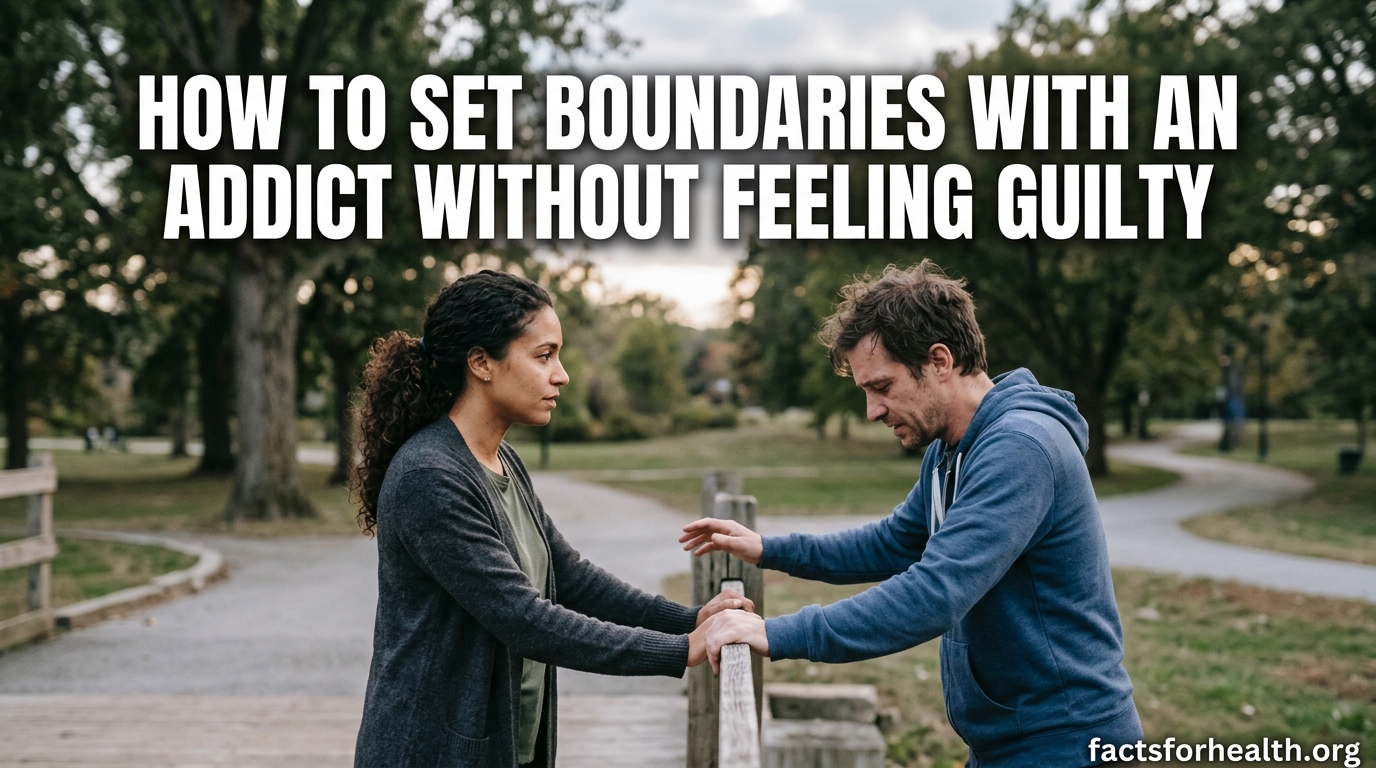
Loving someone who struggles with addiction is one of the hardest things you will ever go through. You want to help, you want to fix it, and you probably feel responsible for their well-being in ways that exhaust you. But if you are reading this, you already suspect that something needs to change. Learning how to set boundaries with an addict without feeling guilty is not about punishment or abandonment. It is about protecting yourself so you can remain a source of stability in a situation that often feels completely out of control.
If you have ever felt sick to your stomach after saying no, second-guessed a boundary within minutes of setting it, or wondered whether you are being selfish for protecting your own peace, you are in the right place. Those feelings are incredibly common, and they do not mean you are doing something wrong. In fact, they usually mean you are doing something right but have not yet learned how to process the discomfort that comes with change.
This guide walks through everything from defining what boundaries actually are to dealing with the guilt that follows. You will find practical steps you can take today, word-for-word scripts for difficult conversations, and a dedicated section on managing the guilt that almost every single person feels after drawing a line. Whether the person you love is a spouse, a parent, an adult child, or a close friend, the principles here apply. Boundaries are an act of love, not of cruelty, and by the end of this guide you will understand exactly why.
Table of Contents
What Are Boundaries (and What They Are Not)
A boundary is a clear limit you set to protect your own mental, emotional, physical, or financial well-being. In the context of addiction, boundaries are the lines that separate what you are willing to accept from what you are not. They are rules for your own behavior, not rules for controlling someone else. This distinction matters more than almost anything else in this guide.
Many people confuse boundaries with ultimatums or threats. An ultimatum sounds like “You have to stop drinking or I am leaving.” A boundary sounds like “I will not stay in the house when you are drinking, so if you start, I will go to a friend’s place for the night.” See the difference? The ultimatum tries to control the other person. The boundary controls your own actions and keeps you safe.
Boundaries are also not walls. Walls shut people out completely. Boundaries have doors. They let the healthy stuff in and keep the harmful stuff out. You can love someone deeply and still refuse to lend them money, still decline to cover for them at work, and still protect your own sleep and peace.
Healthy vs. Unhealthy Boundaries
Healthy boundaries are specific, consistent, and enforceable. You can actually follow through on them. They focus on your behavior, not the other person’s. They are communicated calmly and without anger, and they are designed to protect rather than punish.
Unhealthy boundaries, on the other hand, tend to be vague, inconsistent, or designed to control the other person. “Stop ruining everything” is not a boundary. “If you use drugs in my home, I will ask you to leave” is a boundary. Vague rules fall apart under pressure, while specific ones hold firm.
Healthy boundaries are also flexible enough to adapt as circumstances change. If your loved one enters treatment and is actively working on recovery, you might adjust certain boundaries. The key is that adjustments come from your own choice, not from fear or manipulation.
The 4 C’s of Boundaries
You may have heard of the 4 C’s in the context of Al-Anon: you did not Cause it, you cannot Cure it, you cannot Control it, and you cannot Contract it (meaning you cannot catch or acquire the addiction yourself). These four truths form the foundation of healthy boundary-setting with an addicted loved one.
When you truly internalize the 4 C’s, guilt begins to lose its grip. You did not cause their addiction through anything you did or did not do. You cannot cure it by loving harder or sacrificing more. You cannot control whether they choose recovery. Understanding these facts intellectually is one thing, but believing them emotionally takes time, repetition, and often support from others who have walked the same path.
Understanding Enabling vs. Helping
Before you can set effective boundaries, you need to understand the difference between helping and enabling. This is a distinction that trips up nearly every family member and partner of someone with a substance use disorder. The line can feel blurry because both helping and enabling often come from the same place: love, concern, and a desperate desire to make things better.
Enabling is any action that shields the addicted person from experiencing the natural consequences of their addiction. Helping is any action that supports their recovery without removing those consequences. The difference is not always about what you do, but about the effect it has.
For example, paying for your loved one to attend a treatment program is helping. Paying their rent so they can spend their own money on drugs or alcohol is enabling. Listening to them talk about their desire to get sober is helping. Calling in sick to their workplace because they are hungover is enabling.
Signs You May Be Enabling
Enabling rarely feels like enabling in the moment. It feels like helping, protecting, or just keeping the peace. But if you recognize yourself in any of the following patterns, you may be accidentally prolonging the addiction rather than supporting recovery.
- You consistently cover for their mistakes, absences, or broken commitments to others
- You provide money that ultimately funds their substance use, even indirectly
- You minimize or excuse their behavior to friends, family, or coworkers
- You avoid bringing up the addiction to prevent conflict or emotional outbursts
- You put your own needs, health, and goals on hold indefinitely
- You feel resentful and exhausted but cannot seem to stop stepping in
- You have lied or covered up for them more than once
- You take responsibility for their emotions, reactions, or choices
None of this makes you a bad person. Enabling is a natural response to an unnatural situation. The disease of addiction pulls everyone around it into patterns that feel necessary but are actually harmful. Recognizing these patterns is the first step toward changing them.
Enabling vs. Helping vs. Setting Boundaries
To make this distinction even clearer, here is a side-by-side look at how the same situation plays out in each mode.
- Financial situation – loved one asks for rent money: Enabling = paying the rent so they can spend their income on substances. Helping = offering to help them create a budget or find financial counseling. Boundary = “I will not give you money, but I will help you find resources.”
- They miss a family event due to substance use: Enabling = making excuses to other family members. Helping = expressing concern and encouraging them to seek treatment. Boundary = “I will attend family events on my own and will not lie about why you are not there.”
- They become verbally aggressive while using: Enabling = absorbing the abuse and pretending it did not happen. Helping = discussing the behavior when they are sober and suggesting therapy. Boundary = “I will leave the room or the house when you become aggressive, and I will not return until the next day.”
- They ask you to call in sick for them: Enabling = making the call and lying about their condition. Helping = encouraging them to be honest with their employer or seek support. Boundary = “I will not lie for you. How you handle work is your responsibility.”
Notice that in each case, the boundary does not prevent you from offering genuine support. It simply defines what you will and will not do personally. That is the sweet spot.
Types of Boundaries You Can Set
Boundaries fall into three main categories. Understanding these types helps you identify where you need limits and gives you a framework for creating boundaries that actually work in your daily life.
Physical Boundaries
Physical boundaries relate to your body, your personal space, and your physical safety. These are often the most straightforward to identify because violations are tangible. Examples include refusing to be in the same room when substances are being used, not allowing drugs or alcohol in your home, and physically leaving when a situation becomes unsafe.
Physical boundaries also extend to your sleep, your privacy, and your belongings. If your loved one takes your car without permission, enters your room at all hours, or disrupts your sleep regularly, those are physical boundary violations. You have the right to protect your body, your space, and your rest.
Emotional Boundaries
Emotional boundaries protect your feelings, your mental health, and your sense of self. These tend to be harder to define but are just as important as physical ones. Emotional boundaries include refusing to accept blame for the addicted person’s choices, not absorbing their emotional outbursts, and protecting yourself from manipulation, guilt-tripping, or gaslighting.
An emotional boundary might sound like “I love you, but I will not accept being called names or yelled at. If that happens, I will end the conversation.” It separates your emotional state from theirs, which is especially important when addiction destabilizes everyone’s mood and reactions.
Internal Boundaries
Internal boundaries are the limits you set with yourself. They are about your own thoughts, behaviors, and emotional responses. For example, you might set an internal boundary to stop checking their phone, to stop researching their whereabouts obsessively, or to stop mentally rehearsing conversations you wish you could have.
Internal boundaries also include self-care commitments. Deciding to attend your own therapy appointments, maintain your exercise routine, or spend time with friends even when the addicted person is struggling, these are internal boundaries. They protect your identity and prevent you from disappearing into someone else’s disease.
How to Set Boundaries With an Addict: A Step-by-Step Process
Now that you understand what boundaries are and why they matter, here is a practical, step-by-step process for actually setting them. Take your time with each step. Rushing through this process usually leads to boundaries that collapse the first time they are tested.
Step 1: Identify Your Values and Priorities
Before you can set a boundary, you need to know what you are protecting. Take time to reflect on what matters most to you. Is it your mental health? Your children’s well-being? Your financial stability? Your sense of self? Write these down. Having a clear list of your priorities makes boundary decisions much more straightforward.
When you know your values, boundaries become less about the other person and more about honoring yourself. “I am setting this boundary because I value my children’s safety” feels very different from “I am setting this boundary because you keep doing bad things.” The first is rooted in self-respect. The second is rooted in resentment.
Step 2: Define Specific, Enforceable Limits
Vague boundaries do not work. “Be more respectful” is not enforceable because it means different things to different people. “Do not call me names, and if you do, I will hang up the phone” is specific and enforceable. For each boundary you want to set, ask yourself: Can I actually follow through on this? If the answer is no, the boundary is too broad or the consequence is too extreme.
Write each boundary as a clear statement that includes what you will do, not what the other person must do. Focus on your own behavior. “I will not lend you money” is within your control. “You have to stop asking me for money” is not, because you cannot control what they ask.
Step 3: Determine Realistic Consequences
Every boundary needs a consequence, and the consequence must be something you are genuinely willing to do. If you say “I will leave if you use drugs in the house” but you have nowhere to go, that boundary will fall apart. Choose consequences you can actually execute, even when it is hard, even when you feel guilty.
Consequences are not punishments. They are the natural actions you take to protect yourself when a boundary is crossed. They should be proportional and related to the boundary itself. If the boundary is about financial limits, the consequence might involve separating finances. If it is about physical safety, the consequence might involve leaving the environment.
Step 4: Communicate the Boundary Clearly
Tell the person about your boundary during a calm moment, not during a crisis or argument. Use clear, direct language. Avoid justifying, over-explaining, or apologizing for the boundary. State it simply and let it stand on its own.
You do not need the other person’s agreement for a boundary to be valid. You are not negotiating a treaty. You are informing them of what you will do to protect yourself. They may push back, argue, or try to change your mind. That is expected. Stay calm and repeat the boundary as many times as needed.
Step 5: Follow Through Consistently
This is the step where most boundaries fail. Setting a boundary is relatively easy. Following through on it, especially when it hurts, is incredibly difficult. But a boundary without follow-through is just a suggestion. And inconsistent follow-through teaches the other person that your boundaries are flexible, which invites more violations.
Expect that the first few times you enforce a boundary will be the hardest. Your loved one may escalate their behavior, test your resolve, or respond with anger or guilt-tripping. This is sometimes called an extinction burst in behavioral psychology. It means the boundary is working, and the old dynamics are being challenged. Hold firm.
Step 6: Review and Adjust as Needed
Boundaries are not set in stone. As circumstances change, you may need to adjust them. If your loved one enters active recovery, you might loosen certain boundaries. If their addiction worsens, you might need to tighten them. Review your boundaries regularly, ideally with a therapist or support group, and make changes from a place of clarity rather than fear.
Specific Boundary Examples to Consider
Every situation is unique, but here are specific boundary examples that many people in your position have found helpful. Use these as inspiration, not a checklist. Adapt them to fit your relationship, your living situation, and your own values.
- Financial boundary: “I will not give you money, pay your debts, or lend you my credit cards.”
- Housing boundary: “You may not use or store substances in this home. If you do, I will ask you to leave.”
- Communication boundary: “I will not have conversations with you when you are under the influence. I will walk away and we can talk when you are sober.”
- Legal boundary: “I will not bail you out of jail or pay for legal fees related to your substance use.”
- Childcare boundary: “You may not be alone with the children when you have been drinking or using.”
- Emotional boundary: “I will not accept being called names, threatened, or yelled at. If that happens, I will end the conversation immediately.”
- Social boundary: “I will not lie to family or friends to cover for your behavior or absence.”
- Personal care boundary: “I will attend my weekly therapy appointment regardless of what is happening at home.”
- Vehicle boundary: “You may not drive my car, especially after drinking or using.”
- Work boundary: “I will not call your employer to make excuses for your absences.”
- Privacy boundary: “I will not monitor your phone, social media, or personal belongings.”
- Sleep boundary: “I will sleep in a separate room if you come home late and disruptive.”
These examples illustrate a key principle: boundaries focus on what you will do, not on forcing the other person to change. You cannot make them stop using, but you can decide what you will and will not be part of.
What to Say: Word-for-Word Boundary Scripts
One of the hardest parts of setting boundaries is knowing what to actually say in the moment. Having scripts ready reduces anxiety and keeps you grounded when emotions run high. Practice these out loud, write them on index cards, or save them in your phone so you can refer to them during difficult conversations.
Script for Saying No to a Request for Money
“I love you, and I am not going to give you money. I know this is hard to hear. My decision is final, and I will not argue about it. If you want to talk about treatment options or other resources, I am here for that conversation.”
Script for Setting a Communication Boundary
“I want to have a good conversation with you, but I can tell you have been drinking. I am going to step away now. We can talk when you are sober. This is not a punishment. I just need to take care of myself right now.”
Script for Responding to Guilt-Tripping
“I understand you are upset, and I know this feels unfair to you. I am not changing my mind. My boundary is about protecting myself, not about punishing you. If you continue to pressure me, I am going to end this conversation.”
Script for When a Boundary Is Violated
“We talked about this before. When you do this, I need to do what I said I would do. I am going to leave now. I hope next time we can have a different outcome, but right now I have to follow through.”
Script for Addressing a Discovery
“I found the substances, and I am not going to pretend I did not. I am not going to argue about whose they are or how they got here. Based on what we agreed, I am going to leave for the night. We can talk tomorrow when things have cooled down.”
Script for Expressing Love While Holding Firm
“I am doing this because I love you, not because I do not care. Watching you struggle is the hardest thing I have ever been through. But I cannot keep doing things the way we have been. Something has to change, and this boundary is part of that change.”
How to Maintain Boundaries When They Get Tested
Setting a boundary is the beginning, not the end. The real work is in maintaining it, especially when the addicted person pushes back. And they will push back. Addiction is a disease that resists anything that threatens its supply, including your boundaries.
Expect testing. Your loved one may try to negotiate, minimize, argue, or wear you down over time. They may also enlist other family members to pressure you. This is not necessarily because they are a bad person. It is because addiction rewires the brain to prioritize substance use above all else, including relationships and trust.
What to Do When Boundaries Are Violated
When a boundary is crossed, follow through on the consequence immediately. Do not wait, do not threaten again, and do not give one more chance. Act calmly and without drama. The more matter-of-fact you are, the more effective the boundary becomes.
If the violation involves physical danger, prioritize your safety first. Leave the situation, call for help if needed, and address the boundary later from a safe distance. Safety always comes before boundary education.
What to Do When Boundaries Are Repeatedly Violated
Repeated violations signal that your current approach may not be sufficient. This does not mean your boundaries are wrong. It means the addiction is severe enough that your current boundaries are being overwhelmed. At this stage, you may need to consider stronger measures such as formal intervention, temporary separation, or involving professionals.
Repeated violations also take a cumulative toll on your mental health. If you find yourself becoming numb, hopeless, or severely depressed, that is a sign you need increased support for yourself. Do not wait until you are completely burned out to reach out for help.
How to Deal With the Guilt of Setting Boundaries
This is the section that most guides skip, minimize, or bury at the bottom. But based on what real people in your situation actually say, this is the part that matters most. Setting boundaries with an addicted loved one almost always triggers guilt, and that guilt can be so intense it becomes physical.
People describe feeling nauseous, unable to sleep, and obsessively replaying conversations. One person in a recovery forum wrote that they felt “sick to my stomach” immediately after enforcing a boundary with their mother. Another said they felt like “the worst person in the world” for saying no. These are not signs of weakness. They are signs that you are a caring person doing something that feels deeply unnatural because addiction has trained you to put yourself last.
Here is the truth: guilt is a normal, expected response to setting boundaries. It does not mean you made the wrong choice. It means you are breaking a pattern, and breaking patterns is uncomfortable. The guilt you feel right now is not a signal to back down. It is a signal that you are doing something new, and your brain has not yet caught up with your actions.
Why Guilt Happens: The Psychology Behind It
Guilt is your brain’s alarm system for social connection. From an evolutionary standpoint, humans survived by staying in the good graces of their group. When you do something that feels like it might threaten a relationship, your brain fires off guilt to pull you back into line.
Addiction amplifies this response dramatically. When you have been living with someone’s addiction for months or years, your nervous system has adapted to a state of high alert. You have learned to monitor their moods, anticipate their needs, and suppress your own to avoid conflict. Setting a boundary breaks that pattern, and your nervous system reacts as if you are doing something dangerous.
Additionally, many addicted individuals become skilled at using guilt as a tool. Whether consciously or unconsciously, they learn that guilt-tripping works. Statements like “If you really loved me, you would help me” or “You are abandoning me when I need you most” are designed to make you feel responsible for their situation. Understanding that this is manipulation, not truth, is essential for managing guilt.
Natural Guilt vs. Manipulated Guilt
Not all guilt is created equal. Natural guilt arises from your own values and conscience. It says, “I wish things were different, and this hurts.” It is a signal that you are a compassionate person. Natural guilt is uncomfortable but manageable, and it lessens over time as you adjust to your new boundaries.
Manipulated guilt is externally imposed. It comes from the addicted person’s words, actions, or emotional reactions. It says, “You are a terrible person for doing this, and you should feel ashamed.” Manipulated guilt tends to spike dramatically when you set or enforce a boundary, because the boundary threatens the addicted person’s access to what they need.
Learning to tell the difference takes practice. Ask yourself: Would I feel this guilt if no one else were reacting? Is the guilt proportional to what I actually did? Is it based on my own values or on someone else’s expectations? If the guilt feels overwhelming, sudden, and tied to someone else’s reaction, it is likely manipulated rather than natural.
The Timeline of Guilt: What to Expect
One of the most reassuring things you can know is that guilt follows a predictable timeline. Forum users who have been through this process repeatedly describe the same pattern, and knowing what to expect can help you ride out the hardest parts.
The first few hours: Guilt is usually at its peak. Physical symptoms like nausea, racing heart, and inability to focus are common. This is the acute phase, and it is brutal but temporary.
Days 1 to 3: The intensity begins to decrease, but you may still feel shaky, sad, and second-guess everything. Sleep disruption is common. This is when most people are tempted to take the boundary back.
Week 1 to 2: The guilt starts to feel less constant. You will still have waves, especially when you see your loved one struggling, but you begin to feel moments of relief and clarity between the waves.
Week 3 to 4: Most people report a significant shift. The guilt is still present but no longer overwhelming. You start to feel the benefits of the boundary, better sleep, more energy, a sense of self returning.
Beyond 1 month: The guilt becomes background noise rather than a constant alarm. You may still feel occasional pangs, especially during holidays, anniversaries, or when you hear about your loved one’s struggles, but the intensity and frequency drop dramatically.
This timeline is not exact for everyone. Some people process guilt faster, others slower. But the overall trajectory is the same: the hardest part is the beginning, and it does get better if you hold firm.
Cognitive Reframes That Actually Help
The way you think about boundaries directly affects how guilty you feel about them. Here are reframes that people in recovery communities have found genuinely helpful, not just positive thinking, but actual shifts in perspective.
Reframe 1: Boundaries are not abandonment. Abandonment means walking away with no explanation and no plan. Boundaries mean staying engaged on terms that are healthy for you. You are not leaving the relationship. You are reshaping it.
Reframe 2: You cannot save them by sacrificing yourself. Many people believe that if they just give enough, the addicted person will get better. But addiction does not work that way. Sacrificing your own health does not cure someone else’s disease. It just creates two people who are struggling.
Reframe 3: Guilt is not the same as being wrong. Feeling guilty does not mean you made a mistake. It means you did something hard. If guilt automatically indicated wrongness, no one would ever make positive changes, because all growth involves discomfort.
Reframe 4: You are modeling healthy behavior. If there are children in the picture, your boundaries are teaching them that it is okay to protect yourself, that you do not have to accept harmful behavior, and that love does not require self-destruction. That is a powerful lesson.
Reframe 5: Boundaries can actually help your loved one. When you stop enabling, the addicted person is forced to confront the reality of their situation. Many people credit a boundary, a spouse who finally said no, a parent who stopped paying rent, as the turning point that pushed them toward treatment. Your boundary might be the thing that ultimately helps them.
Coping Strategies for the Acute Phase
When guilt hits hardest, in those first hours and days, you need practical tools. Here are strategies that real people have used to get through the worst of it.
Reach out immediately. Call someone who understands, a therapist, an Al-Anon sponsor, a trusted friend. Do not isolate. The guilt is loudest when you are alone with your thoughts. Hearing another person say “You are doing the right thing” can break the spiral.
Write it down. Journal about why you set the boundary. List the reasons. List the consequences of not having the boundary. When guilt floods in, read what you wrote when you were calm and clear. Your past self can be a voice of reason for your present self.
Use grounding techniques. Guilt can trigger anxiety symptoms like racing heart and shallow breathing. Try the 3-3-3 grounding technique: name three things you see, three sounds you hear, and three things you can touch. This brings your nervous system back to the present moment.
Move your body. Physical activity processes stress hormones. A walk, a workout, or even stretching can reduce the physical intensity of guilt. It does not solve the emotional issue, but it takes the edge off so you can think clearly.
Delay any decision to change the boundary. If you are tempted to take the boundary back, commit to waiting 48 hours. Guilt is most intense immediately after setting or enforcing a boundary. Give yourself time to return to baseline before making any changes.
Practice self-compassion. Talk to yourself the way you would talk to a friend going through the same thing. You would not tell a friend they are a monster for protecting themselves. Extend that same kindness to yourself.
When Guilt Becomes Something More
Sometimes guilt is not just guilt. It can cross into shame, anxiety disorders, or depression. If you find that guilt is constant and unrelenting after several weeks, if it is interfering with your ability to function, or if it is accompanied by thoughts of self-harm, it is time to seek professional help. This is not a sign of weakness. It is a sign that the burden you are carrying is too heavy to carry alone.
Shame, in particular, deserves attention. Guilt says “I did something bad.” Shame says “I am bad.” If you notice the narrative shifting from actions to identity, from “I feel bad about this choice” to “I am a terrible person,” that is shame, and it requires a different kind of intervention. Therapy, especially cognitive behavioral therapy or trauma-informed therapy, can help you separate your worth from the situation.
Building a Support System That Holds You Up
You cannot do this alone. That is not a weakness, it is a fact. Setting and maintaining boundaries with an addicted loved one requires support from people who understand what you are going through. Isolation makes guilt louder, boundaries weaker, and burnout inevitable.
Support Groups: Al-Anon and Nar-Anon
Al-Anon (for families and friends of alcoholics) and Nar-Anon (for families and friends of those struggling with drug addiction) are the most widely recommended support resources in this space. They are free, widely available both in person and online, and they are specifically designed for people in your exact situation.
In forum after forum, people describe Al-Anon and Nar-Anon as life-changing. Not because the groups offer magical solutions, but because they offer something no one else can: the experience of being in a room full of people who understand exactly what you are going through. Hearing someone say “I felt that exact guilt, and it got better” is profoundly validating in a way that professional advice alone cannot match.
Professional Therapy
A therapist who specializes in addiction and family systems can provide individualized guidance that support groups cannot. Cognitive behavioral therapy (CBT) helps you identify and change thought patterns that fuel guilt and codependency. Trauma-informed therapy addresses the deeper wounds that addiction inflicts on family members.
Many therapists now offer telehealth appointments, making it easier to fit sessions into a schedule that may already be stretched thin. If cost is a concern, look for sliding-scale clinics, community mental health centers, or online therapy platforms that offer reduced rates.
Trusted Friends and Family
Not everyone in your life will understand your boundaries. Some family members may actively disagree with them, especially if they have their own enabling patterns. Be selective about who you confide in. You need people who support your well-being, not people who question your decisions.
Identify one or two people you can call when guilt hits. Let them know ahead of time what you need, whether that is someone to listen, someone to validate, or someone to distract you. Having a designated support person removes the friction of reaching out when you are already overwhelmed.
Self-Care as a Boundary
Self-care is not a luxury when you are dealing with a loved one’s addiction. It is a survival strategy. Sleep, nutrition, exercise, and time for yourself are not selfish. They are the activities that keep you functional enough to maintain your boundaries.
Treat your own well-being as a non-negotiable boundary. Schedule therapy appointments the way you would schedule any other important commitment. Protect your sleep by setting physical boundaries around your rest. Make time for activities that have nothing to do with addiction, recovery, or your loved one. Remind yourself regularly that you are a full person, not just a caregiver.
When to Seek Professional Help
Sometimes self-help, support groups, and personal boundaries are not enough. There are situations where professional intervention is necessary for your safety, your loved one’s safety, or the well-being of your family.
Seek professional help immediately if you are experiencing any of the following: thoughts of self-harm, severe depression or anxiety that does not improve, physical violence or threats of violence, child endangerment, or complete emotional exhaustion where you can no longer function in daily life.
For your loved one, professional intervention may be appropriate if their addiction is worsening despite your boundaries, if they express thoughts of self-harm, or if they are ready to seek treatment and need help finding the right program. A professional interventionist can guide this process and increase the chances of a positive outcome.
Key Resources
- SAMHSA National Helpline: 1-800-662-4357 (HELP). Free, confidential, 24/7 treatment referral and information service. Available in English and Spanish.
- Al-Anon Family Groups: Support for families and friends of alcoholics. Meetings available worldwide, both in person and online at al-anon.org.
- Nar-Anon Family Groups: Support for families and friends of drug addicts. Find meetings at nar-anon.org.
- National Domestic Violence Hotline: 1-800-799-7233. If addiction has led to abuse, this resource is available 24/7.
- 988 Suicide and Crisis Lifeline: Call or text 988. Free, confidential support for anyone in distress, including family members overwhelmed by a loved one’s addiction.
Reaching out for help is itself a form of boundary-setting. It says “I will not pretend I can handle this alone.” That is one of the healthiest boundaries you can establish.
FAQs
How to hold boundaries with an addict?
Hold boundaries with an addict by setting specific, enforceable limits, communicating them during calm moments, and following through on consequences consistently every single time. Expect pushback, especially in the early stages, and resist the urge to negotiate or give second chances. Support from Al-Anon, therapy, or trusted friends helps you stay firm when guilt or pressure tempts you to cave.
Should you stay in a relationship with an addict?
Whether to stay depends on your safety, your loved one’s willingness to seek help, and the impact on your mental health. You can love someone and still need distance. Many people stay in relationships with addicts who are actively working on recovery, but establish clear boundaries first. If there is abuse, violence, or ongoing danger to you or your children, leaving may be the safest and healthiest choice.
What is the 3 3 3 rule for addiction?
The 3-3-3 rule is a grounding technique for anxiety, not specific to addiction itself. It involves naming 3 things you see, 3 sounds you hear, and 3 things you can physically touch. This brings your nervous system back to the present moment. Many people use it to manage the anxiety and guilt that arise when setting or enforcing boundaries with an addicted loved one.
What are the 4 C’s of boundaries?
The 4 C’s state that you did not Cause the addiction, you cannot Cure it, you cannot Control it, and you cannot Contract it. These principles, central to Al-Anon, remind family members that they are not responsible for their loved one’s addiction. Internalizing the 4 C’s helps reduce guilt and reinforces that boundaries are about protecting yourself, not fixing someone else.
How do I stop feeling guilty after setting a boundary with an addict?
Guilt after setting a boundary is normal and usually peaks in the first few days. Manage it by reaching out to a support person, journaling your reasons for the boundary, using grounding techniques for physical symptoms, and committing to wait 48 hours before making any changes. Over time, as the boundary becomes familiar, the guilt fades. Therapy and Al-Anon can accelerate this process significantly.
What is the difference between enabling and helping an addict?
Enabling shields the addicted person from the natural consequences of their substance use, such as paying their rent so they can spend their money on drugs. Helping supports recovery without removing those consequences, such as driving them to a treatment center or listening without judgment. If your actions make it easier for the addiction to continue, you are enabling. If your actions support treatment and accountability, you are helping.
What boundaries should I set with an addicted loved one?
Common boundaries include refusing to give money, not allowing substances in your home, declining to lie or cover for them, leaving conversations when they are under the influence, and protecting your sleep and self-care routines. The best boundaries are specific to your situation and values. Start with one boundary you can realistically enforce, then build from there.
How long does guilt last after setting boundaries with an addict?
Most people experience the most intense guilt in the first 1 to 3 days, with a significant decrease by week 2 and dramatic improvement by week 4. The guilt typically becomes background noise rather than a constant alarm after about a month. However, waves can return during holidays, stressful periods, or when you hear about your loved one struggling. Having a support system in place helps you manage these waves.
You Can Set Boundaries Without Losing Yourself
Setting boundaries with an addicted loved one without feeling guilty is not something you figure out once and then never struggle with again. It is an ongoing practice. There will be good days where your boundaries feel solid and natural, and there will be hard days where guilt floods back in and you question everything. Both are part of the process.
What matters is that you keep going. Every time you hold a boundary, you are teaching yourself that your well-being matters. You are breaking the cycle of enabling and codependency that addiction thrives on. And you are creating the conditions under which real change, both for you and potentially for your loved one, becomes possible.
Remember the 4 C’s. You did not cause this. You cannot cure it. You cannot control it. You cannot contract it. What you can do is protect yourself, seek support, and make decisions from a place of clarity rather than fear. Boundaries are not the enemy of love. They are an expression of it, a way of saying “I care enough about both of us to stop pretending that the current situation is sustainable.”
Start with one boundary. Pick something small, specific, and enforceable. Tell someone you trust about it. Write down your reasons. And when the guilt comes, as it almost certainly will, remind yourself that feeling guilty does not mean you are wrong. It means you are growing. You deserve to live a life that is not defined entirely by someone else’s addiction, and every boundary you set is a step toward that life.
If you are reading this in the middle of the night, feeling alone and overwhelmed, know that help is available right now. Call SAMHSA at 1-800-662-4357, find an Al-Anon meeting online, or reach out to a crisis line at 988. You do not have to carry this by yourself.