
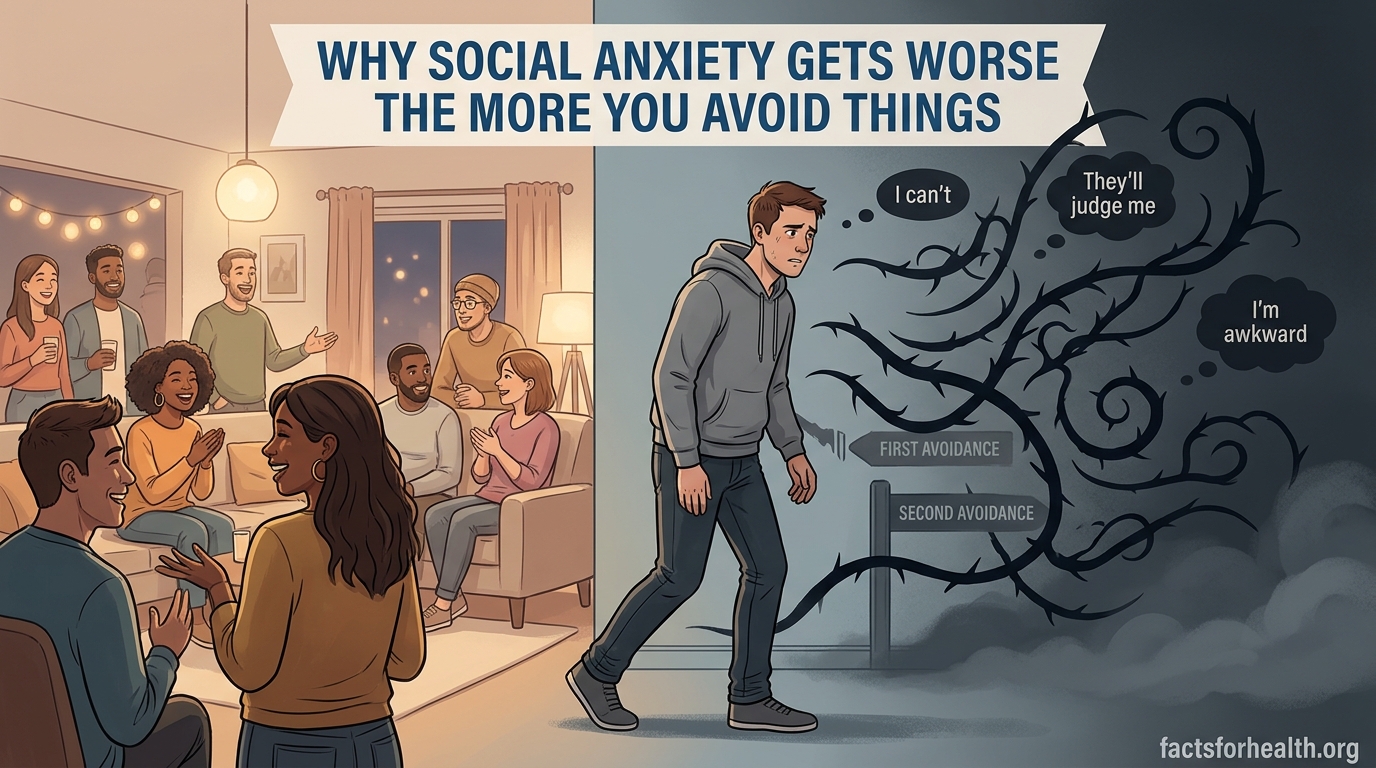
Social anxiety gets worse the more you avoid things because every act of avoidance teaches your brain that the feared situation is genuinely dangerous. Each time you skip a party, stay quiet in a meeting, or cancel plans, your brain logs that decision as proof the threat was real, which makes the next encounter trigger even stronger anxiety. This self-reinforcing pattern is called the anxiety-avoidance cycle, and it is the single biggest reason social anxiety spirals rather than fading on its own.
Our team has spent years researching anxiety mechanisms, and the pattern we see in forum after forum, clinic after clinic, is strikingly consistent. People know avoidance makes things worse, yet they keep doing it. That is not a personal failure. It is how your brain is wired to respond to perceived threats.
In this article, we will walk you through exactly why social anxiety gets worse the more you avoid things, what happens in your brain during each avoidance episode, and practical steps to break the cycle with graduated exposure strategies you can start using today.
Table of Contents
Why Social Anxiety Gets Worse the More You Avoid Things
Here is the core mechanism in one sentence: avoidance removes the opportunity for your brain to learn that social situations are not dangerous. Without that learning, the fear stays locked in place and often grows.
Think about what happens when you avoid a social situation. In the short term, your anxiety drops. You feel relief. That relief is powerful, immediate, and deeply rewarding to your brain. But that same relief acts as a confirmation signal. Your brain interprets the drop in anxiety as evidence that avoidance just saved you from a real threat. The message is simple and destructive: that situation was dangerous, and avoiding it kept me safe.
This is why avoidance makes anxiety worse over time. The short-term reward of relief strengthens the avoidance behavior while simultaneously reinforcing the belief that social situations are threatening. The next time a similar situation arises, your brain predicts danger with even more certainty, and your anxiety spikes higher than before.
Research on exposure therapy shows that the opposite of avoidance, controlled and repeated exposure, is one of the most effective treatments for social anxiety. When you enter a feared situation and nothing terrible happens, your brain updates its threat assessment through a process called habituation. But avoidance blocks this process entirely.
The Paradox of Short-Term Relief
Many people tell us they know avoidance is bad for them, but in the moment, dodging the situation feels like the only option. This creates a painful paradox. The thing that feels protective in the moment is the exact thing causing long-term harm.
Imagine touching a hot stove. Your hand pulls away instantly. That withdrawal is protective and correct. But social situations are not hot stoves. The threat is perceived, not actual. When you withdraw from social situations, you are treating a false alarm as if it were real, which trains your brain to take that alarm more seriously next time.
How the Anxiety-Avoidance Loop Works
The anxiety-avoidance loop is a self-reinforcing cycle with four predictable stages. Understanding each stage helps you see exactly where and how the pattern can be interrupted.
Stage 1: Anticipatory anxiety. Before a social event, your brain begins predicting danger. You might feel physical symptoms like a racing heart, sweating, or nausea. You start imagining worst-case scenarios: judgment, embarrassment, humiliation.
Stage 2: Avoidance or escape. You either avoid the situation entirely (cancel plans, decline the invitation) or attend but use escape strategies (leave early, stay quiet in the corner, stick to one safe person). Both responses reduce anxiety in the moment.
Stage 3: Relief and reinforcement. Your anxiety drops. Your brain registers this relief as a reward and associates it with the avoidance behavior. The neural pathway linking this situation equals danger gets stronger, not weaker.
Stage 4: Expanded avoidance. Next time, your anxiety is worse. You might start avoiding not just the original situation but anything remotely similar. If you avoided one party, you might start avoiding all parties. Then group dinners. Then one-on-one coffee meetings. The avoidance generalizes, and your world shrinks.
This loop is why people often say their social anxiety feels like it came out of nowhere or got worse over time. It did not come from nowhere. It grew, one avoidance decision at a time.
What Happens in Your Brain When You Avoid
To really understand why social anxiety gets worse the more you avoid things, it helps to look at the neuroscience. This is an area where most articles stop at surface-level explanations, but the brain mechanics matter because they explain why willpower alone is rarely enough.
The Amygdala and Fear Conditioning
Your amygdala is a small, almond-shaped structure deep in your brain that acts as a threat detection system. When it perceives danger, it triggers your fight-or-flight response before your conscious mind even has time to think. This is why social anxiety symptoms like a pounding heart or shallow breathing can hit you before you consciously realize you are nervous.
The amygdala learns through experience. When you encounter a social situation and it triggers fear, your amygdala tags that situation as threatening. When you avoid it, the avoidance acts as a confirmation signal. The amygdala interprets your avoidance as evidence that the threat was real, which strengthens the fear-based association. This process is called fear conditioning.
Each repetition of this cycle makes the amygdala’s threat response more automatic and more intense. You do not need to consciously decide to feel anxious. Your amygdala has already learned the pattern and fires the alarm on its own.
Why Avoidance Prevents New Learning
The good news is that the amygdala can also unlearn fear through a process called new learning or fear extinction. When you enter a feared situation and nothing bad happens, your brain creates a new memory that competes with the old fear memory. Over repeated exposures, the new memory grows stronger and the fear response weakens. This is called habituation.
Avoidance completely blocks this process. If you never enter the feared situation, your brain never gets the data it needs to update its threat assessment. The original fear memory stays unchallenged and continues to dominate. This is why exposure therapy works and why avoidance fails. Exposure creates new learning. Avoidance prevents it.
Neuroplasticity: Your Brain Can Change
One more piece of encouraging science. Your brain has a property called neuroplasticity, which means it can rewire itself throughout your entire life. The neural pathways that maintain social anxiety are not permanent. They can be weakened through repeated experiences that contradict the fear. This is why people recover from social anxiety at every age, not just in childhood. But recovery requires entering feared situations, not avoiding them.
Safety Behaviors: The Hidden Trap
Not all avoidance looks like skipping events or canceling plans. Many people with social anxiety use what psychologists call safety behaviors, subtle strategies designed to reduce anxiety during social situations without fully avoiding them.
Common safety behaviors include rehearsing what you will say before speaking, gripping a cup tightly to hide shaking hands, avoiding eye contact, standing near exits, checking your phone repeatedly, or only attending events when you know a specific person will be there.
Safety behaviors feel helpful because they do reduce anxiety in the moment. But they have the same problem as full avoidance. They prevent your brain from learning that you can handle the situation without them. If you always need your phone as a crutch, your brain never learns that standing at a party without it is actually safe.
Part of breaking the anxiety-avoidance cycle involves gradually reducing safety behaviors alongside entering feared situations. This is harder than it sounds, but it is essential for lasting change.
Why Avoidance Feels So Logical (Even When You Know Better)
One of the most common frustrations we see in forums like r/socialanxiety is this: I know avoidance makes my anxiety worse, so why do I keep doing it?
The answer comes down to how your brain prioritizes information. Your threat detection system, the amygdala, operates faster than your rational brain, the prefrontal cortex. When you feel anxious, your amygdala sends an urgent signal: danger, get out. This signal arrives before your logical brain has time to evaluate whether the threat is real.
By the time your prefrontal cortex kicks in and says this is just a dinner party, nobody is going to judge you, your body is already in fight-or-flight mode. The emotional urgency of the fear overshadows the logical reassurance. Avoidance feels like the obviously correct response because your brain is treating it as a survival decision, not a social one.
This is why simply knowing that avoidance is counterproductive rarely changes behavior on its own. The fear response is not a reasoning problem. It is a conditioning problem. And conditioning problems require conditioning-based solutions, meaning repeated, controlled exposure.
People on Reddit have described this experience perfectly. They say it feels like white-knuckling through anxiety is exhausting and unsustainable, while avoidance feels like relief. Both things are true in the moment. But only one of them leads to long-term improvement.
Signs Your Avoidance Is Making Anxiety Worse
Sometimes the anxiety-avoidance cycle develops so gradually that you do not realize how much ground you have lost. Here are clear warning signs that avoidance is actively worsening your social anxiety:
1. Your list of avoided situations is growing. You started by avoiding large parties, but now you also avoid small group dinners, phone calls, or one-on-one conversations.
2. Your anxiety feels more intense than it used to. Situations that once caused mild nervousness now trigger panic-level symptoms like a racing heart, sweating, or feeling like you might faint.
3. You need more safety behaviors to function socially. You used to just feel nervous at parties. Now you need two drinks, a friend by your side, and an exit plan just to walk through the door.
4. You spend significant time ruminating after social events. Post-event rumination, replaying conversations and cringing at things you said, is a sign that avoidance and anxiety are feeding each other.
5. Your world feels smaller than it used to. You are turning down opportunities, declining invitations, and structuring your life around avoiding anxiety rather than pursuing what you want.
6. You feel relief when plans get canceled, followed by guilt or sadness. That combination of relief and guilt is a hallmark sign of the avoidance cycle at work.
If you recognize yourself in three or more of these signs, the pattern is likely well-established. The sooner you start intervening, the easier it is to reverse.
The Loneliness Factor: How Avoidance Feeds Isolation
Forum users frequently mention a feeling that most articles on social anxiety skip entirely: loneliness. When you avoid social situations repeatedly, you do not just reinforce fear. You also cut yourself off from the human connection that buffers against anxiety and depression.
Isolation creates a vicious cycle of its own. The less you socialize, the more out of practice you become. The more out of practice you are, the more anxious you feel when you do try to socialize. The more anxious you feel, the more you avoid. Meanwhile, the loneliness itself becomes another source of stress and low mood, which makes the anxiety even harder to manage.
Multiple users on r/socialanxiety describe years of isolation where they wanted to connect with people but felt trapped by avoidance. They describe trying to branch out, having a setback, then retreating further than before. This experience is incredibly common, and it is not a sign of weakness. It is the natural result of a cycle that is designed, neurologically, to escalate.
If you are experiencing this, the most important thing to know is that you are far from alone. Social anxiety disorder affects roughly 7 percent of the U.S. population at any given time, and avoidance is the central feature of the condition for nearly everyone who has it.
How to Break the Social Anxiety Avoidance Cycle
Breaking the anxiety-avoidance cycle is not about suddenly facing your biggest fears. That approach, what forum users call white-knuckling, is exhausting and often backfires because the intensity overwhelms you. Instead, the most effective approach is gradual, systematic exposure.
Exposure therapy is the gold-standard behavioral treatment for social anxiety. It works by creating controlled opportunities for your brain to learn that feared situations are not actually dangerous. You can start this process on your own using a technique called an exposure hierarchy, also known as an exposure ladder.
Step 1: Build Your Exposure Ladder
Write down a list of social situations that trigger your anxiety, ranked from least anxiety-provoking to most anxiety-provoking. Assign each one a rating from 0 to 100, where 0 is completely calm and 100 is panic. Here is an example of what an exposure ladder might look like:
Rating 20: Making brief eye contact with a cashier and saying thank you.
Rating 30: Asking a store employee where an item is located.
Rating 40: Saying hello to a neighbor you pass on the street.
Rating 50: Attending a small gathering of three to four people for 30 minutes.
Rating 60: Sharing a brief opinion in a work meeting.
Rating 70: Calling a restaurant to make a reservation instead of ordering online.
Rating 80: Attending a party where you know only one person for one hour.
Rating 90: Starting a conversation with a stranger at a coffee shop.
Rating 100: Giving a short presentation to a group of five or more people.
Your ladder will look different from this example because your fears are specific to you. The key is to start at a level that triggers mild anxiety, around 30 to 40 on your scale, not overwhelming panic.
Step 2: Practice One Rung at a Time
Pick the lowest item on your ladder and do it on purpose. Enter that situation, stay long enough for your anxiety to peak and then begin to subside, and resist the urge to escape. Your anxiety does not need to drop to zero. It just needs to decrease from its peak, which teaches your brain that the situation is survivable and that anxiety naturally passes on its own.
Repeat that same item several times over a week or two until your anxiety rating for it drops significantly. Then move up to the next rung. This gradual approach is what distinguishes effective exposure from reckless confrontation. You are building evidence, one experience at a time, that your fears are exaggerated.
Step 3: Drop Safety Behaviors Gradually
As you practice exposure, start reducing your safety behaviors. If you normally rehearse every sentence before speaking, try speaking with less preparation. If you always hold a drink as a prop, try setting it down for a few minutes. Each safety behavior you drop gives your brain another piece of evidence that you can handle social situations without protective armor.
This step is uncomfortable, and that discomfort is the point. You are teaching your brain that the discomfort is tolerable and temporary. That lesson, repeated enough times, is what breaks the cycle.
Step 4: Expect Setbacks and Keep Going
Recovery from social anxiety is not linear. You will have good weeks and bad weeks. A situation that felt manageable on Tuesday might feel overwhelming on Thursday because you are tired, stressed, or simply having an off day. This is normal and does not mean the process is failing.
Forum users who have successfully broken the cycle consistently report the same thing: progress came from continuing to show up even after setbacks, not from never experiencing setbacks. The goal is not perfection. The goal is consistent, gradual willingness to enter feared situations even when it feels hard.
When to Seek Professional Help
Self-guided exposure can be effective for mild to moderate social anxiety, but many people benefit from professional support. If your anxiety is severe, if it is significantly affecting your work or relationships, or if self-guided exposure feels too overwhelming to attempt on your own, it is time to reach out to a mental health professional.
Cognitive Behavioral Therapy, or CBT, is the most researched and effective form of therapy for social anxiety disorder. A specific type called exposure and Response Prevention therapy, or ERP, focuses directly on breaking the anxiety-avoidance cycle through structured, therapist-guided exposure exercises.
Studies cited by leading anxiety treatment centers show that intensive CBT and ERP programs can achieve significant symptom reduction. Some programs report recovery rates approaching 70 to 80 percent for patients who complete treatment.
We recognize, as many forum users point out, that therapy is expensive and not always accessible. If cost is a barrier, look into community mental health centers, university training clinics that offer sliding-scale fees, online therapy platforms, or nonprofit organizations that provide free or low-cost anxiety resources. Some employers also offer Employee Assistance Programs with free short-term counseling.
You do not have to fix this alone, and you do not have to wait until things get unbearable. The earlier you intervene in the avoidance cycle, the less entrenched it becomes.
FAQs
Does avoidance make social anxiety worse?
Yes. Every time you avoid a social situation, your brain interprets the avoidance as confirmation that the situation was genuinely dangerous. This strengthens the fear response and makes your anxiety worse the next time you face a similar situation.
What causes social anxiety to get worse?
The primary driver of worsening social anxiety is the avoidance cycle. Other factors include increased use of safety behaviors, post-event rumination, growing isolation, substance use to cope, high stress levels, and perfectionism. Each of these reinforces the brain’s belief that social situations are threatening.
Do people grow out of social anxiety?
Most people do not simply grow out of social anxiety without intervention. Without treatment, social anxiety tends to persist or worsen over time because the avoidance cycle reinforces itself. However, social anxiety is highly treatable with CBT and exposure therapy at any age.
Are people with social anxiety disorder happier alone?
No. While avoidance provides short-term relief, the resulting isolation typically increases feelings of loneliness, depression, and anxiety over time. Most people with social anxiety genuinely want connection but feel trapped by fear. Breaking the avoidance cycle through gradual exposure is the path to more fulfilling relationships.
Conclusion
Understanding why social anxiety gets worse the more you avoid things is the first step toward breaking free from the cycle. The mechanism is straightforward even though living through it is hard: avoidance provides short-term relief but teaches your brain that social situations are dangerous, which makes anxiety stronger over time.
The path forward is equally clear in principle, though it requires courage and consistency. Gradual, systematic exposure teaches your brain that feared situations are safe. Each time you enter a situation and survive it, you chip away at the fear. Over weeks and months, your world expands instead of shrinking.
If you are ready to start, build your exposure ladder today. Pick the smallest, most manageable item on it, and do it this week. That single step is how the cycle begins to reverse.