
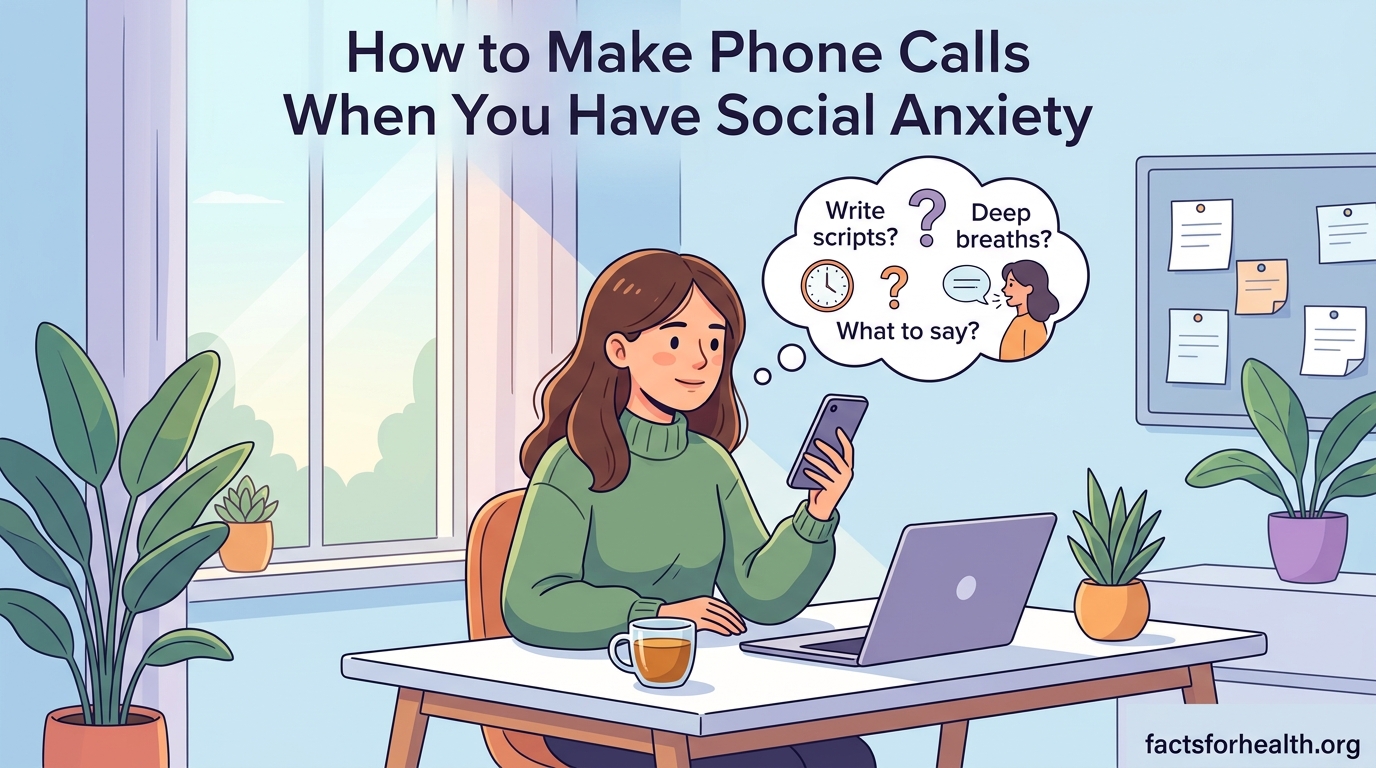
Your phone rings. Your heart starts pounding before you even check who is calling. You let it go to voicemail, again, and then spend the next hour feeling guilty about it. If this sounds familiar, you are far from alone.
Learning how to make phone calls when you have social anxiety can feel like trying to solve a puzzle where every piece is on fire. The good news is that phone anxiety is real, it is common, and there are proven, practical strategies that can help you manage it. You do not have to become someone who loves talking on the phone. You just need enough tools to get through the calls that matter.
In this guide, we will walk through what phone anxiety is, why it happens, and step-by-step techniques you can start using today. We will cover everything from quick grounding exercises to ready-to-use phone scripts so you never feel lost for words.
Table of Contents
What Is Phone Anxiety?
Phone anxiety is a fear or stress response triggered by making or receiving telephone calls. It is sometimes called telephobia, and it frequently overlaps with social anxiety disorder. When the phone rings or when you need to dial someone, your brain perceives a social threat and activates a stress response.
Phone anxiety exists on a spectrum. Some people feel mild nervousness before certain calls, like phoning a doctor or returning a boss’s call. Others experience intense dread that makes them avoid calls entirely, which can interfere with work, relationships, and healthcare.
This is not a personal weakness or a character flaw. It is a recognized anxiety pattern that millions of people navigate. Research on social anxiety disorder consistently shows that phone interactions are among the most commonly avoided social situations. If you feel this way, your experience is valid, and it is something you can work on.
Common Symptoms of Phone Anxiety
Phone anxiety shows up in the body, the mind, and in behavior. Understanding your own symptom pattern helps you pick the right coping strategies. Here are the most common signs.
Physical symptoms: racing or pounding heart, sweating, trembling hands, nausea, shortness of breath, dry mouth, tight chest, and a flushed face. Some people also experience dizziness or a stomachache before or during a call.
Emotional symptoms: intense fear, dread, irritability, embarrassment, and a strong desire to escape the situation. You might replay the call in your head afterward, obsessing over things you said wrong.
Behavioral symptoms: avoiding calls entirely, procrastinating on important phone tasks, rehearsing what you will say for long periods, relying exclusively on text or email, or asking someone else to make the call for you.
These five signs of social anxiety around phone calls, racing heart, avoidance, dread, excessive rehearsal, and post-call rumination, are clear indicators that phone anxiety is present. If you experience several of these regularly, the techniques in this guide are designed for you.
Why Phone Calls Trigger Social Anxiety
Understanding why phone calls feel so threatening can help you feel less broken and more in control. Several factors combine to make phone interactions uniquely difficult for people with social anxiety.
First, phone calls remove visual cues. You cannot see the other person’s facial expressions, body language, or reactions. People on forums describe this as a “dark room” feeling. You are talking into a void, and silence on the other end can feel like judgment.
Second, phone calls happen in real time. There is no backspace key, no opportunity to carefully draft a response, and no buffer between thought and speech. For someone who fears saying something embarrassing, this lack of control is terrifying.
Third, unexpected calls feel like an ambush. When someone calls without warning, your brain has zero preparation time. The spike in anxiety can be immediate and overwhelming, which is why many people silence their phones or let unknown numbers go to voicemail.
Finally, there is the fear of negative evaluation. You might worry about sounding stupid, being judged for your voice, or not knowing the answer to a question. These fears are amplified by the social nature of the call itself.
The 333 Rule for Social Anxiety
The 333 rule is a simple grounding technique that pulls your attention away from anxious thoughts and back into the present moment. It works because anxiety lives in the future, in imagined worst-case scenarios, while your senses exist right now.
Here is how to use it. When you feel anxiety rising before or during a phone call, pause and name three things you can see around you. Then identify three sounds you can hear. Finally, move three parts of your body, such as wiggling your toes, rolling your shoulders, and tapping your fingers.
This exercise takes about 20 seconds. It engages your visual, auditory, and kinesthetic senses simultaneously, giving your brain something concrete to process instead of spiraling into panic. Many people find it especially helpful in the 30 seconds before dialing, when anticipation anxiety is at its peak.
You can also adapt the rule. Some people use a 5-4-3-2-1 variation that adds smell and taste. The core principle is the same: interrupt the anxiety loop by anchoring yourself in sensory reality.
Practical Strategies: How to Make Phone Calls When You Have Social Anxiety
Now let us get into the actionable techniques. These strategies are drawn from cognitive-behavioral principles, gradual exposure therapy, and real-world tips from people who have successfully managed their phone anxiety. Try one or two at a time rather than attempting all of them at once.
1. Write out a script before every call. This is the single most recommended tip from anxiety support communities. Write down your opening line, the key points you need to cover, and any information the other person might ask for, such as your account number or date of birth. Having notes in front of you removes the fear of forgetting what to say. Keep your script visible during the entire call.
2. Start with low-stakes calls and build gradually. Do not begin by calling your boss or making a complaint. Start with calls where the outcome barely matters. Call an automated line to check a balance. Leave a voicemail for a friend. Order a pizza. Each successful call builds evidence that you can handle it, which weakens the anxiety over time. This is called gradual exposure, and it is one of the most effective treatments for phone phobia.
3. Practice with someone you trust. Ask a close friend or family member to do practice calls with you. Role-play the scenario you are nervous about, whether that is scheduling an appointment or calling customer service. The more times you say the words out loud before the real call, the less frightening the real thing becomes. A therapist can also guide you through this process professionally.
4. Move your body during the call. Pacing, standing, or even squeezing a stress ball helps release nervous energy physically. People on anxiety forums consistently report that walking around the room while talking makes calls feel much more manageable. Your brain is too busy coordinating movement to spiral into panic.
5. Schedule calls during your lowest-anxiety window. If mornings feel calmer than afternoons, block out time then. If you feel better after exercise or a meal, plan calls for those windows. Do not make the call harder than it needs to be by choosing a time when you are already stressed or tired.
6. Use the 333 rule right before dialing. We covered this technique above. Spend 20 seconds grounding yourself before you press call. Combined with a few slow breaths, this can significantly reduce the initial spike of panic.
7. Reward yourself after every call, no matter how it went. Positive reinforcement matters. Whether the call went perfectly or you stumbled through it, acknowledge that you did something difficult. Watch an episode of your favorite show, eat something you enjoy, or simply tell yourself you are proud. This trains your brain to associate phone calls with a positive outcome rather than pure relief that it is over.
Cognitive Restructuring: Rewiring Anxious Thoughts
Cognitive restructuring is a core technique from cognitive-behavioral therapy. It involves identifying the negative automatic thoughts that fuel your anxiety and replacing them with more balanced, realistic ones. The goal is not blind positivity. It is accuracy.
Start by noticing what your brain tells you before a call. Common anxious thoughts include: “I will say something stupid,” “They will think I am incompetent,” “I will freeze and not know what to say,” or “The silence will be unbearable.” Write these down. Seeing them on paper often reveals how extreme they are.
Next, challenge each thought. Ask yourself: What is the evidence for this? Has it actually happened before? What is the worst realistic outcome? If you did stumble over your words, would the person on the other end actually care, or would they barely notice?
Then reframe the thought. Replace “I will say something stupid” with “I might stumble over a word, and that is completely normal. People do it all the time.” Replace “They will judge me” with “This person makes calls all day and is probably just focused on getting the task done.”
This process feels awkward at first, but with practice it becomes automatic. The more you challenge anxious thoughts, the weaker their grip becomes. Over weeks and months, cognitive restructuring can genuinely change how your brain responds to phone calls.
Phone Call Scripts You Can Use Today
One of the biggest content gaps we found is that most articles explain phone anxiety without giving you the actual words to say. Forum users consistently say scripts are the most helpful tool. Here are templates for the most common stressful scenarios.
Script for scheduling a medical appointment: “Hi, I would like to schedule an appointment with Dr. [name]. I am available on [day of week] mornings or [day of week] afternoons. Does anything work this week or next?” Keep your availability specific. This reduces back-and-forth, which can feel agonizing when you are anxious.
Script for a customer service call: “Hi, I am calling about my account. My account number is [number]. I need help with [state your issue in one sentence]. Can you walk me through what I need to do?” Write your account number and issue on your script before dialing.
Script for a work call: “Hi [name], this is [your name] from [department]. I am calling about [project or topic]. I have two quick questions. First, [question one]. Second, [question two].” Stating that you have a specific number of questions signals that the call will be short, which reduces pressure.
Script for answering unexpected calls: “Hi, this is [your name].” If you need a moment to collect yourself, add: “Can you hold for just one second while I grab a pen?” This buys you 10 to 15 seconds to breathe and settle before the conversation starts. Nobody thinks twice about this request.
If you freeze mid-call: It is perfectly fine to say, “Sorry, let me check my notes for one second.” This is a normal, professional phrase that gives you a moment to regroup. Keep it in your back pocket.
When to Seek Professional Help
Self-help strategies are powerful, but they are not always enough. If phone anxiety is interfering with your job, your healthcare, your relationships, or your daily functioning, it is time to reach out to a professional. There is no threshold you need to meet to deserve support.
Cognitive-behavioral therapy is the gold standard for social anxiety and phone phobia. A therapist can guide you through structured exposure exercises, help you identify and reframe anxious thought patterns, and provide a safe space to practice calls. Many people see significant improvement within 12 to 16 sessions.
Exposure therapy, a specific type of CBT, involves working with your therapist to create a fear hierarchy. You start with the easiest phone-related task, like listening to a voicemail, and gradually work your way up to harder calls. Each step is celebrated, and you never move to the next level until you feel ready.
If your anxiety is severe, a psychiatrist or primary care doctor can also discuss whether medication might help. Medication is not a replacement for therapy, but for some people it reduces anxiety enough that they can engage fully with treatment.
FAQs
What is the 333 rule for social anxiety?
The 333 rule is a grounding technique where you identify three things you can see, three sounds you can hear, and move three parts of your body. This pulls your attention into the present moment and interrupts anxious thought spirals. It takes about 20 seconds and is especially helpful right before or during a stressful phone call.
Does social anxiety affect phone calls?
Yes, phone calls are one of the most commonly avoided situations for people with social anxiety disorder. The lack of visual cues, real-time pressure, and fear of judgment combine to make phone interactions particularly triggering. Studies on social anxiety consistently show phone avoidance as a frequent symptom.
What are 5 signs of social anxiety?
Five common signs include: 1) intense fear of judgment or embarrassment, 2) avoidance of social situations including phone calls, 3) physical symptoms like racing heart and sweating, 4) excessive rehearsal or rumination before and after interactions, and 5) difficulty speaking or freezing up during conversations. If you experience several of these regularly, consider speaking with a mental health professional.
What not to do if you have social anxiety?
Avoid forcing yourself into overwhelming situations without preparation, relying solely on avoidance without addressing the underlying fear, using alcohol or substances to cope, beating yourself up for feeling anxious, and isolating yourself from support. Instead, use gradual exposure, preparation strategies like scripts, and seek professional help when needed.
Is phone anxiety a recognized condition?
Phone anxiety, also called telephobia, is not a standalone diagnosis in the DSM-5 but it is a recognized symptom that frequently appears alongside social anxiety disorder and generalized anxiety disorder. Mental health professionals treat it using established methods like cognitive-behavioral therapy and gradual exposure therapy.
How long does it take to overcome phone anxiety?
With consistent practice using techniques like gradual exposure and cognitive restructuring, many people see meaningful improvement within 8 to 16 weeks. Working with a CBT therapist often accelerates progress. Complete elimination of phone anxiety is not the goal. The goal is managing it well enough that calls no longer control your life.
You Can Learn to Manage Phone Anxiety
Phone anxiety is real, it is common, and it responds well to the right strategies. Learning how to make phone calls when you have social anxiety does not mean you will ever love the phone. It means building a toolkit so that calls stop running your life.
Start small. Pick one strategy from this guide, whether it is writing a script, trying the 333 rule, or making one low-stakes call this week. Each call you complete, even an imperfect one, is proof that you can handle it. That evidence accumulates over time, gradually rewriting the story your anxiety tells you.
If self-help is not enough, reach out to a therapist. There is no shame in getting professional support for something that is genuinely difficult. You deserve to schedule a doctor’s appointment, return a work call, or catch up with a friend without panic. With patience and practice, that is entirely within reach.